Chilat Doina
November 28, 2025
Let's be honest, omnichannel fulfillment sounds like just another piece of industry jargon. But in reality, it’s a simple, powerful idea: giving your customers a seamless experience no matter where or how they buy from you. It’s the magic that lets someone add a product to their cart on your app and pick it up from a store an hour later without a single hiccup.
It’s all about creating a unified system that connects every part of your business—your website, physical stores, mobile app, and social media channels.
Think of it this way. A multichannel approach is like having a bunch of talented solo artists. Your e-commerce team is doing great things, your retail staff is hitting their targets, but they aren't playing from the same sheet music. They operate in their own little worlds.
Omnichannel fulfillment, on the other hand, is the full orchestra playing in perfect harmony. Every single part of your business has the same playbook, sees the same customer, and works together to deliver one consistent, coordinated experience.
This isn't just a nice-to-have anymore; it's what customers expect. Research shows that around 73% of retail shoppers use multiple channels during their buying journey. These customers are gold—they deliver a 30% higher lifetime value than people who only shop through a single channel.
At its core, omnichannel fulfillment is about tearing down the walls between your sales channels. Instead of having one pile of inventory for your website and another for your brick-and-mortar stores, you get a single, real-time view of every single product you own.
This unified inventory unlocks smarter, faster, and cheaper ways to get orders to your customers.
For example, when an order comes in through your website, an omnichannel system can instantly decide the best place to ship it from. That could be:
This intelligent routing slashes shipping costs and delivery times, which is exactly what keeps customers happy and coming back. To really get it, you have to understand the principal differences between multi-channel and omni-channel.
An omnichannel strategy doesn't just let you sell everywhere; it lets you fulfill from anywhere. It transforms your entire network of stores and warehouses into an agile, interconnected fulfillment ecosystem.

To see why omnichannel is such a big deal, it helps to look at how we got here. Each approach—from single-channel to omnichannel—reflects a different level of operational maturity and focus.
The table below breaks down the key differences.
AttributeSingle-ChannelMultichannelOmnichannelCustomer ExperienceConsistent but limited to one touchpoint (e.g., store-only).Disjointed; channels operate in silos with different policies.Seamless and integrated; a single experience across all touchpoints.Inventory ManagementSimple, single pool of inventory for one channel.Siloed; separate inventory for each channel, risking stockouts.Unified; one view of all inventory across the entire network.Operational FocusChannel optimization (e.g., maximizing in-store sales).Channel expansion; adding more places to sell.Customer-centricity; creating a cohesive journey for the buyer.
As you can see, the shift to omnichannel is fundamentally about moving from a channel-focused mindset to a customer-focused one. It’s about building your operations around the customer, not the other way around.
A solid omnichannel strategy isn't about finding a single, perfect solution. It's about building a network of interconnected fulfillment models. Think of it less like a fortress and more like a series of strategically placed outposts, each one serving a specific purpose. When you orchestrate these components correctly, you can fulfill every order from the most efficient location, every single time.
This network approach is what creates a truly responsive supply chain—one that can roll with the punches of fluctuating customer demands and locations. Instead of banking everything on one giant warehouse, a modern omnichannel retail strategy uses a blend of assets to get products to customers faster and more affordably.
The big idea here is to turn every spot you hold inventory—whether it's a massive distribution center or a small retail store—into a potential fulfillment hub. This creates a flexible, resilient system that turns your physical footprint into a serious competitive advantage.
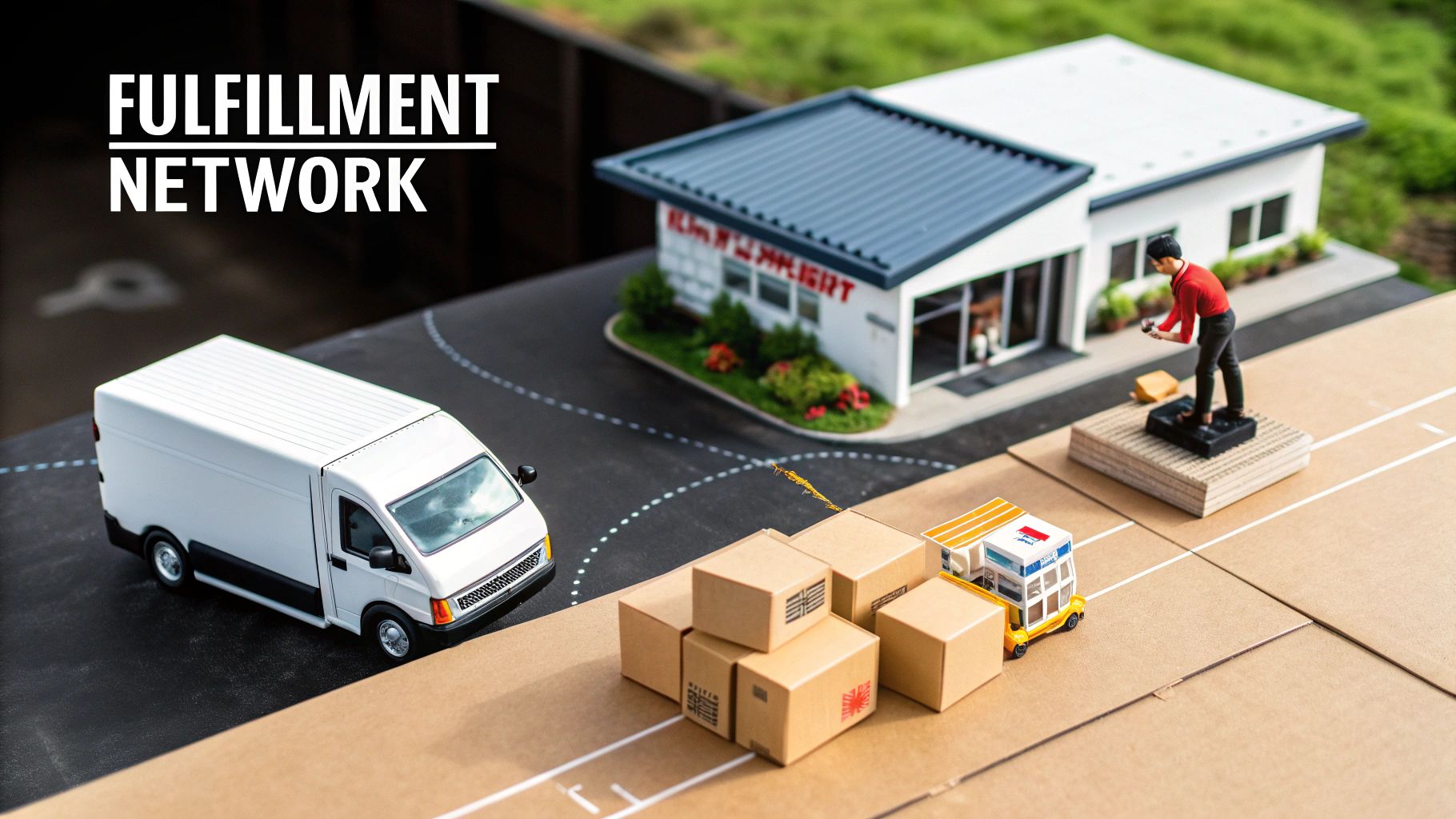
For a lot of brands, the journey starts with a centralized model. This usually means having one or more large fulfillment centers (FCs) that act as the main hubs for picking, packing, and shipping online orders. It’s a classic for a reason: it offers economies of scale and keeps inventory management relatively simple.
But relying only on a centralized FC can be a drag. It often leads to longer shipping times and higher costs for customers who live far from your facility. This is where bringing on a third-party logistics (3PL) partner becomes a game-changer.
A 3PL basically handles your warehousing and fulfillment for you, often from a whole network of facilities spread across the country or even the globe. Partnering with a 3PL lets you:
By plugging a 3PL into your network, you can instantly upgrade your fulfillment muscle. It’s a cornerstone move for many high-growth e-commerce brands.
The next level of omnichannel fulfillment is all about turning your existing retail stores into mini-distribution centers. This is where the true power of a unified system kicks in, opening the door to models that beautifully blend the digital and physical shopping experience.
The goal is to make your inventory work harder for you. A product sitting on a store shelf isn't just for walk-in customers anymore; it's available to any online shopper in that local area.
This unlocks some seriously powerful fulfillment options that cater directly to what modern consumers demand: speed and convenience.
Key Local Fulfillment Models:
Each of these building blocks has a distinct role to play. A centralized FC might handle the bulk of your orders, while a 3PL helps you conquer new regions. At the same time, ship-from-store and BOPIS use your retail footprint to deliver unmatched speed and convenience. The real magic of a true omnichannel fulfillment strategy is in making all these pieces work together seamlessly to create an incredible customer experience.
Trying to run an omnichannel fulfillment strategy without the right tech is like trying to direct an orchestra without a conductor. You can have all the right pieces in place—warehouses, stores, partners—but you’ll just get noise instead of harmony. The real operational backbone of any modern fulfillment network is its technology stack, a suite of interconnected software that acts as the central brain.
This integrated system is what allows your sales channels and physical inventory locations to talk to each other in real-time. It creates that single source of truth you need to make smart decisions, whether it's routing an order to the closest store or updating stock levels across every single marketplace at once. Without it, you’re flying blind, leading to costly mistakes like overselling a hot product or shipping from a location that kills your margins and delays delivery.
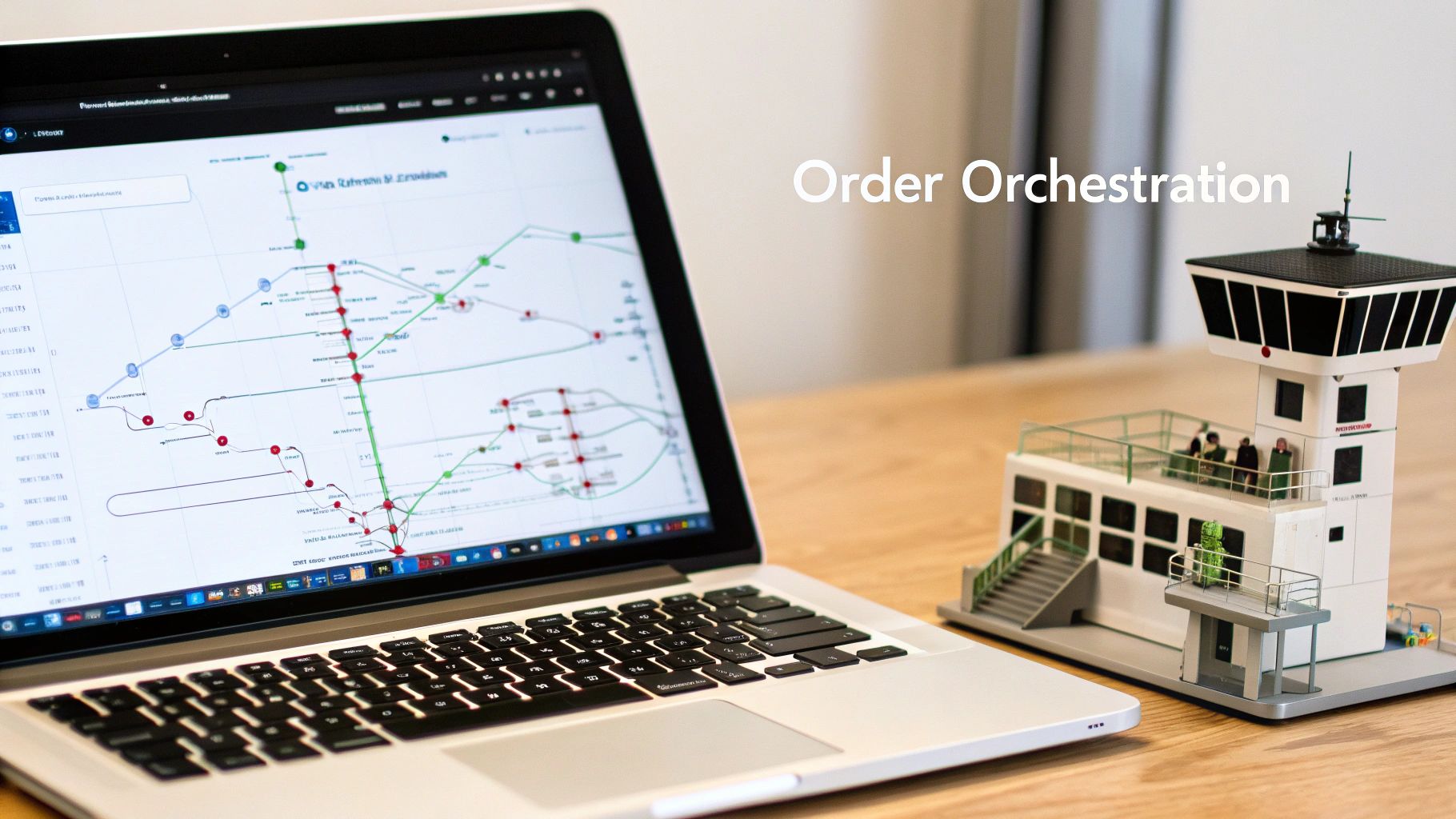
At the center of it all are a few key platforms, each playing a distinct but connected role. Getting a handle on how they work together is the key to understanding what makes seamless omnichannel fulfillment actually possible.
These systems can’t just exist in their own silos. Their real power is unlocked through real-time data sync, which is absolutely essential for effective multi-channel inventory management.
The secret sauce holding this entire stack together is the Application Programming Interface (API). APIs are the digital messengers that let different software systems talk to each other, creating that seamless flow of information you need for a true omnichannel experience.
When a customer buys something on your site, an API instantly pings your OMS. The OMS then uses another API to check inventory levels in your WMS and ERP. Finally, a different API connects to shipping carriers to generate a label and send tracking info back to the customer. This all happens in a matter of seconds, creating the kind of fast, transparent experience modern buyers demand.
An integrated technology stack turns guesswork into data-driven precision. It provides the unified inventory visibility and operational control necessary to execute a sophisticated fulfillment strategy at scale.
Brands are catching on fast. The market for omnichannel order management systems was valued at $2.3 billion and is expected to hit $8.8 billion by 2032, growing at a 12.1% compound annual growth rate. This trend makes it crystal clear: robust software is no longer a "nice-to-have" for managing complex fulfillment. You can find more details about these market trends on coherentmarketinsights.com.
At the end of the day, investing in the right technology is non-negotiable for any brand that’s serious about omnichannel. It’s the foundational investment that turns a bunch of disconnected channels into a single, intelligent, customer-focused commerce engine.
Making the switch to an omnichannel model is a huge operational leap. But once you’ve done it, how can you tell if it's paying off? Success isn't just about plastering more delivery options on your checkout page. It's about building a smarter, more profitable, and customer-friendly operation from the ground up.
To figure this out, you need to look past the surface-level stuff and get into the Key Performance Indicators (KPIs) that tell you the real story of your fulfillment network's health.
These numbers don't lie. A sudden drop in one KPI could be a warning sign that your inventory sync is broken. On the other hand, a jump in another might be the proof you need that your new ship-from-store program is a hit. Tracking the right data lets you spot trouble early, make smarter calls, and constantly tweak your network to save money and keep customers happy.
To get a clear picture, you don't need a hundred different metrics. Just focus on a handful of critical ones that directly reflect how well you're running the show and how your customers feel about it. This gives you a balanced view, so you're not just chasing speed while letting service or accuracy slide.
Every fulfillment model you use comes with its own set of financial trade-offs. What looks like a great way to save a few bucks in one area can sometimes blow up the customer experience in another. A winning strategy means going in with your eyes wide open about these compromises.
An optimized omnichannel strategy isn't about finding the single cheapest way to ship an order. It’s about finding the most effective way, balancing speed, cost, and customer experience to maximize lifetime value.
The real trick is understanding what each model brings to the table for your broader goals. A 3PL might have higher monthly storage fees, but they could slash your shipping costs and delivery times for customers on the opposite coast. Likewise, ship-from-store might add to your retail team's workload, but it's a killer way to move slow-moving store inventory and offer same-day pickup.
Thinking through these trade-offs is crucial. To make it a bit clearer, here’s a breakdown of what you're signing up for with each model.
Fulfillment ModelPrimary CostsKey BenefitsIn-House FulfillmentWarehouse lease, labor, equipment, software licenses.Complete control over branding, processes, and customer experience.3PL PartnerStorage fees, fulfillment fees (per order/item), onboarding costs.Scalability, access to expert logistics, and reduced capital investment.Ship-from-StoreIn-store labor for picking/packing, shipping supplies, potential store disruption.Faster local delivery, improved inventory turnover, and increased store foot traffic (for BOPIS).
At the end of the day, building a data-driven strategy is about consistently measuring these core KPIs and truly understanding the cost-benefit analysis for each channel you use. This approach lets you build a fulfillment network that’s not just optimized for today’s sales, but for strong, profitable growth for years to come.
Making the leap to a true omnichannel setup is a huge win, but the path is littered with traps that can trip up even the sharpest brands. The good news? Most of these pitfalls are well-known, and seeing them coming is half the battle.
The goal isn't just to connect your channels; it's to create one seamless experience that feels effortless for the customer. Anything less leads to frustrated buyers and stressed-out internal teams. Let's walk through the most common hurdles I've seen brands face and, more importantly, how to clear them.
This is the big one—the mistake I see more often than any other, and it's easily the most damaging. It happens when your e-commerce platform, your in-store POS system, and your warehouse software all live on separate islands. They don’t talk to each other, leaving you with a hopelessly fractured picture of your own business.
What it looks like: A customer snags the "last one" online, only to get a dreaded cancellation email because that same item was sold in a store an hour earlier. Or marketing pushes a big sale, but they're working with stale inventory numbers, leading to a flood of backorders and angry emails.
How to fix it: You have to establish a single source of truth. This is non-negotiable. An Order Management System (OMS) is the hub that connects all your spokes, pulling data from every sales channel and inventory location into one unified view. It’s the only way to get the real-time visibility you need to make promises you can actually keep.
When your systems are siloed, your inventory count is a fantasy. It's almost guaranteed to be wrong. You've got products sitting in a shopping cart at a physical store, more units in transit between warehouses, and others reserved for online orders that haven't shipped. Trying to track all that with manual counts or delayed syncs is a recipe for disaster.
When your inventory data is unreliable, every fulfillment decision is a gamble. You're not just risking lost sales from an item showing "out of stock" when you actually have it—you're risking your entire brand reputation when you sell something you can't deliver.
How to fix it: You need to get serious about inventory discipline, backed by the right tech. This means a few key practices:
A frustrating returns process will sour a great buying experience faster than anything else. So many brands nail the cross-channel selling part but completely drop the ball when a customer wants to bring something back. Forcing someone who bought online to go through the hassle of packaging and mailing an item when there's a store five minutes away is just bad business.
What it looks like: A customer walks into your store to return an online order, but the associate can't do anything because their system has no idea what that order number is. The customer gets angry, the employee feels helpless, and you've likely lost a customer for life.
How to fix it: Your returns process needs the same omnichannel love as your sales process. Buy Online, Return In-Store (BORIS) should be a smooth, everyday operation. The tech behind this is key: your store's POS must be able to look up an e-commerce order, process the refund, and instantly update your central inventory to show that the returned item is now on hand and ready to be sold in that very store.
Switching to a true omnichannel fulfillment engine isn't something you do overnight. It’s a journey. But if you break the process down into manageable phases, what seems like a massive project becomes a clear, achievable plan. This roadmap lays out the essential steps for building a customer-first operation that will fuel your growth for years to come.
The very first step is always a brutally honest self-assessment. Before you can build anything new, you need a blueprint of where you stand right now. This means digging into every corner of your current fulfillment process, your tech stack, and how you manage inventory.
This initial audit is all about identifying your strengths, weaknesses, and the specific gaps you absolutely have to fill. It gives you a clear, unambiguous starting point.
Once you have a solid picture of your current reality, you can start defining what success actually looks like. Are you trying to slash shipping times by 25%? Do you want to roll out a BOPIS program in your top 10 stores within six months?
Setting specific, measurable, achievable, relevant, and time-bound (SMART) goals is non-negotiable. These goals become the North Star for every decision you make, from which tech to invest in to how you train your teams.
This is where the magic happens—and often, where things get tricky. This phase is all about selecting and integrating the core software that will run your entire strategy, with your Order Management System (OMS) at the center. Your OMS has to talk seamlessly with your e-commerce platform, WMS, ERP, and any POS systems you have.
A successful technology integration isn’t just about making different software systems talk to each other. It’s about creating a single, real-time source of truth for every order and every piece of inventory across your entire business.
This unified data flow is the absolute bedrock of omnichannel fulfillment. Without it, you can't route orders intelligently or make accurate delivery promises to your customers. It's that simple.
Whatever you do, don't try to flip the switch on your entire network at once. That's a recipe for disaster. Start small with a controlled pilot program. For instance, launch your ship-from-store model in just two or three of your best-performing locations.
This approach lets you:
This simple framework shows how to turn potential roadblocks into successful outcomes.

It’s a continuous cycle: spot a problem, apply a targeted fix, and measure the result. This is how you improve and perfect your system during implementation.
Once your pilot programs are humming along and proving their worth, it's time to scale. Gradually roll out the new capabilities to more locations, applying all the lessons you learned from your initial tests. As you expand, your focus needs to shift to continuous optimization, driven by the KPIs we covered earlier.
This is also a point where bringing in the best ecommerce fulfillment companies can give you the outside expertise and infrastructure you need to scale without breaking a sweat.
The payoff for getting this right is huge. Companies that nail their omnichannel strategy see an average annual revenue growth of 9.5%, which nearly triples the 3.4% growth seen by firms with weaker setups. They also manage to cut their cost per customer contact by 7.5% year-over-year.
This data-driven approach ensures your omnichannel strategy doesn't just meet customer expectations—it delivers a powerful return on your investment.
Even with the best roadmap, a few questions always pop up when you start getting into the nitty-gritty of omnichannel fulfillment. Let's tackle the most common ones head-on.
Think of it this way: marketing is the promise, and fulfillment is the delivery.
Omnichannel marketing is all about creating one seamless brand story across every channel you use—your social media, email campaigns, in-store signs, you name it. It’s the art of consistent communication.
Omnichannel fulfillment, on the other hand, is the operational muscle that actually makes good on that promise. While marketing creates a consistent story, fulfillment delivers a consistent experience, letting your customers buy, get, and return products however they want, wherever they want.
Absolutely. You don't need a sprawling network of warehouses to get started. A brand with just one physical store can jump in with a "ship-from-store" or "BOPIS" (Buy Online, Pick-up In-Store) model. These are incredibly powerful first moves.
The key is to start with a solid Order Management System (OMS) that syncs inventory between your website and your physical shop. Another great option for smaller brands is partnering with a 3PL that already has omnichannel capabilities built-in. It’s an accessible and highly scalable way to grow.
Hands down, the single biggest hurdle is achieving unified inventory visibility. If you don't have a real-time, accurate count of every single item across all your locations—warehouses, stores, even units in transit—it's game over. You can't intelligently route orders or make promises to customers you can actually keep.
This inventory blindness is the root cause of almost every omnichannel failure. It leads directly to overselling, surprise stockouts, and a customer experience that's damaged, sometimes beyond repair. Getting it right means investing in integrated tech and making sure all your systems talk to each other flawlessly.
Ready to connect with a community of top-tier e-commerce founders who have mastered these challenges? Join Million Dollar Sellers to gain access to the strategies and peer network you need to scale your brand smarter and faster. Learn more about MDS and apply for membership.
Join the Ecom Entrepreneur Community for Vetted 7-9 Figure Ecommerce Founders
Learn MoreYou may also like:
Learn more about our special events!
Check Events