Chilat Doina
July 4, 2026
A performance management system is the operating rhythm that keeps an e-commerce team aligned, accountable, and improving every week, not just at review time. In practice, brands that formalize it report 25% higher employee engagement and 15-20% average improvement in key operational metrics like inventory turnover and ad profitability within the first year.
Most founders don't start by searching for a performance management system. They start by feeling friction.
You hire your first PPC manager, then a supply chain lead, then customer service support, then a brand manager. Revenue grows, complexity grows faster, and suddenly your day is packed with Slack follow-ups, half-finished dashboards, repeated questions, and a nagging sense that the business depends too much on you noticing problems first. That's usually the moment behind the question, what is performance management system, and do I need one?
For an Amazon or DTC brand, a performance management system isn't some HR layer you bolt on after the company gets “big enough.” It's the structure that turns founder supervision into team execution. It gives every role a target, a feedback loop, and a clear connection to profit.
The first version of team management usually works fine. You talk to everyone directly. You know who owns what. If ACOS drifts, stock runs low, or customer response quality slips, you spot it fast because you're still close to every function.
Then the business gets bigger and that informal system breaks.
One person is “handling Amazon ads,” but nobody can say whether they're optimizing for contribution margin or just trying to make campaign dashboards look cleaner. Operations says inventory is under control, yet a top SKU goes out of stock because reorder timing slipped. Customer service is replying quickly, but the actual quality of resolution is inconsistent. Everyone is busy, but the business starts losing clarity.
That's the point where spreadsheets, random check-ins, and instinct stop being enough.
I've seen this in scaling brands over and over. The founder becomes the only person stitching the picture together. Team members send updates, but they're inconsistent. Managers hold meetings, but each one uses different expectations. Priorities change, but goals don't get rewritten clearly enough for the team to follow.
The result is predictable:
A growing brand doesn't usually fail from lack of effort. It fails from lack of alignment.
A lean performance management system fixes that. Not by adding bureaucracy, but by creating a repeatable way to answer a few questions every week: what matters now, who owns it, how progress is measured, and what happens when something goes off track.
For e-commerce teams, that's the difference between a company that scales and a company that just gets noisier.
Most founders hear “performance management system” and picture annual reviews, awkward scorecards, and HR language that doesn't belong in an e-commerce business. That's the wrong model.
A better way to think about it is this. Your business already has dashboards for traffic, conversion rate, TACOS, inventory health, and refund trends. A performance management system does the same thing for the people responsible for moving those numbers. It's a team dashboard with a cadence attached to it.
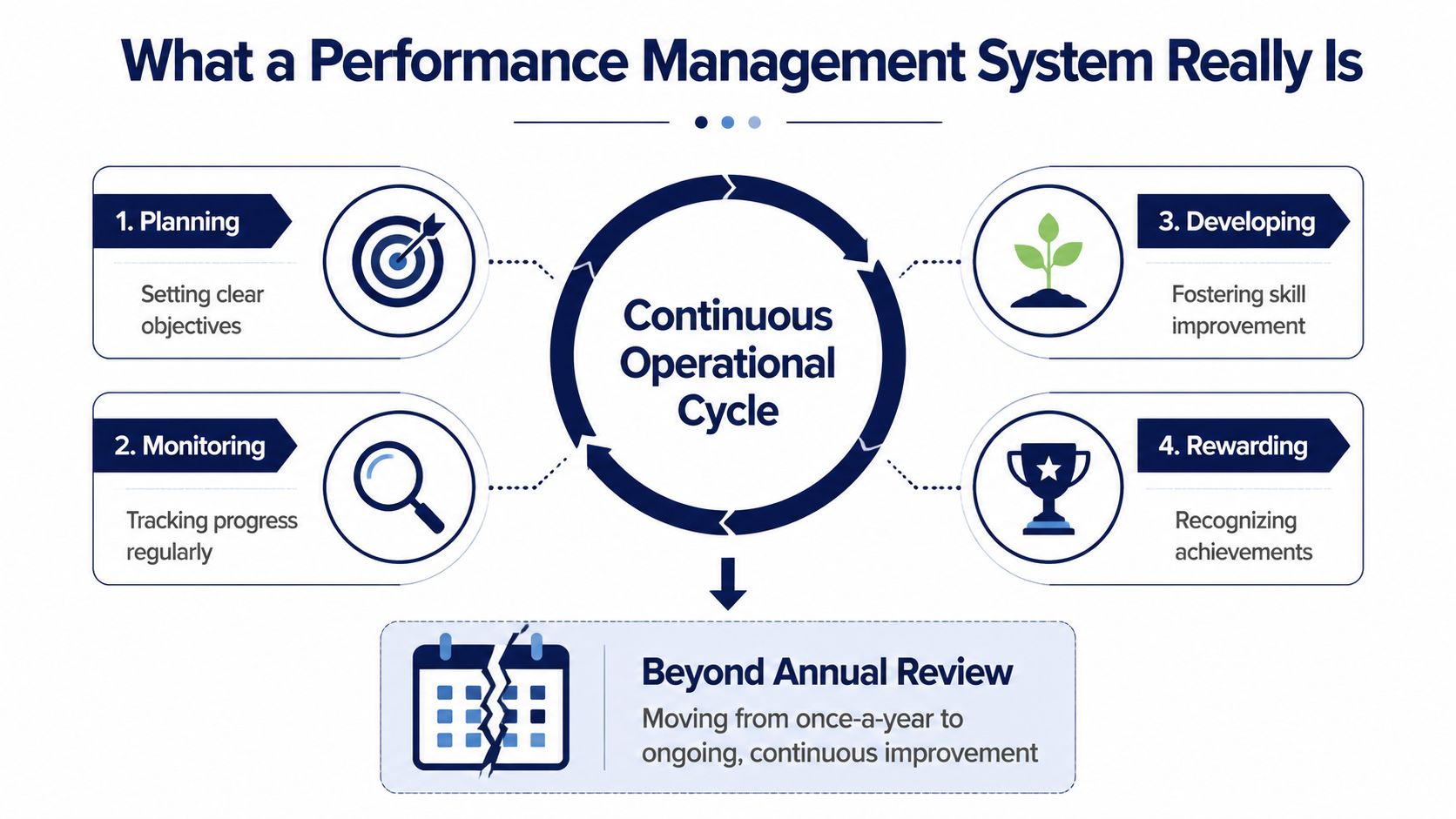
A real PMS runs continuously. It usually includes four parts that feed each other.
Start with clear goals that connect role output to company priorities. If the business needs better cash flow, the supply chain lead shouldn't just have “manage inventory” as a vague responsibility. They should own specific inventory health outcomes, reorder discipline, and exception management.
For a PPC manager, “grow sales” is too broad. Better targets might tie spend decisions to profitable growth, brand terms, new product support, and search placement quality.
This is the weekly or bi-weekly rhythm. Not a lecture. Not a performance tribunal. Just a structured conversation around priorities, wins, misses, and blockers.
A lot of founders skip this because it feels obvious in the early stage. Then they wonder why standards drift across a remote team. Consistent monitoring is how expectations stay alive after the kickoff meeting.
Practical rule: If a goal isn't reviewed regularly, it isn't really being managed.
People don't improve from being measured alone. They improve when managers help them sharpen judgment, solve recurring issues, and build stronger operating habits.
That might mean teaching an Amazon advertising manager how to think beyond ACOS. It might mean helping a customer support lead improve escalation handling. It might mean training an operations hire to flag inventory risk sooner instead of reporting it after the damage is done.
Recognition closes the loop. That can include compensation, expanded responsibility, public acknowledgment, or a stronger path to promotion. If strong execution and weak execution get treated the same, teams stop taking the system seriously.
A strong PMS feels light in process and heavy in clarity. It doesn't force your team into corporate theater. It gives managers a simple framework to lead consistently.
If you want a useful companion resource on establishing performance best practices, that guide is worth reviewing because it reinforces the same core idea: performance systems work when they become part of normal operating rhythm, not a separate HR event.
The key shift is simple. Annual reviews look backward once. A real performance management system helps the team adjust while there's still time to improve the quarter.
In a small brand, weak management hides easily. The founder catches mistakes, fixes priorities, and pushes work over the line. In a larger brand, that same pattern turns into expensive drag.
Your PPC manager can hit an ACOS target while hurting broader profitability. Your ops lead can keep purchase orders moving while ignoring inventory aging. Your customer support team can answer fast while creating repeat contacts because issues aren't solved. Without a system, people optimize for the nearest visible metric instead of the business outcome that matters.

This is the main reason a PMS matters in e-commerce. It forces the business to define what winning actually means by function.
A few examples make it obvious:
This isn't a soft benefit. Brands with a formal system report 25% higher employee engagement and 15-20% average improvement in key operational metrics like inventory turnover and ad profitability within the first year, according to this e-commerce performance impact study.
That tracks with what happens in the field. Once people know the scoreboard and managers review it consistently, execution gets cleaner. Fewer dropped handoffs. Faster correction when priorities shift. Better judgment because teams understand the “why” behind the metric.
A lot of founders think they need more talent when they really need more management structure.
When the system is weak, every problem comes back to the founder for interpretation. What should this role focus on? How do we judge good work? What matters more this month? Why did this issue repeat? A proper PMS pushes those answers into the business so managers can lead without constant founder translation.
That's especially important in Amazon and DTC brands where the environment moves fast. Ad conditions change, stock positions change, margins tighten, creative fatigues, and channel priorities shift. If your team only gets direction when you jump into Slack, you don't have a scaling company. You have a founder-powered control tower.
Teams move faster when they don't need the founder to explain success every week.
A lean system creates that clarity. Not perfectly. Not forever. But enough to keep the business from drifting every time complexity increases.
Most founders make one of two mistakes here. They either avoid the system entirely, or they overbuild it on day one and create a process nobody wants to use.
The better path is lean. Start with the smallest version that improves execution, then tighten it over time.
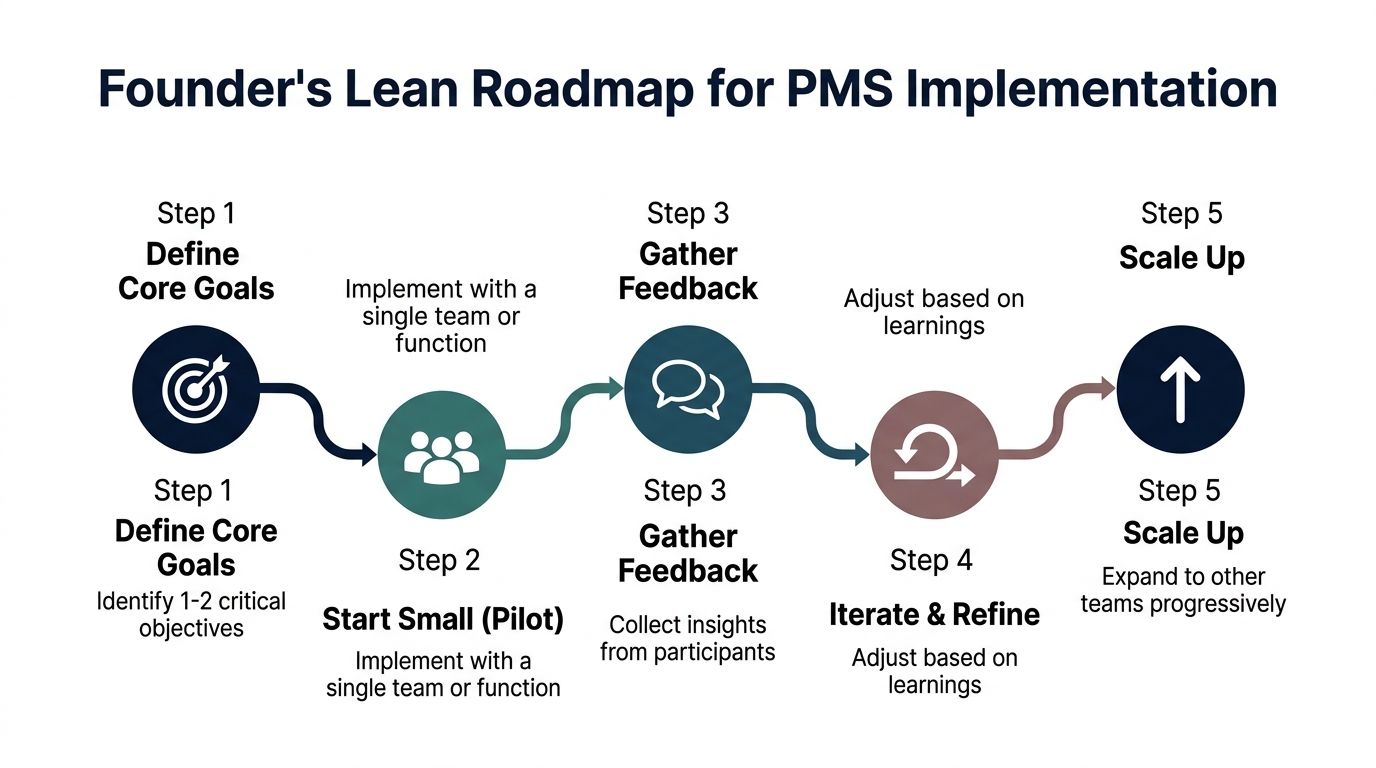
Don't begin with employee forms. Begin with the business.
Pick the few outcomes that matter most this quarter. Maybe it's improving contribution margin, stabilizing in-stock rates on hero SKUs, lifting listing conversion on a product line, tightening customer experience after a rough patch, or improving launch execution on a new channel.
Keep it narrow. If everything is a priority, managers won't know what to reinforce.
A good quarterly objective should pass a simple test. If every team member performed well against it, would the business materially improve?
Most systems often get sloppy. Founders set company goals, but role expectations stay vague.
A strong translation looks like this:
The point isn't to turn every role into a spreadsheet. The point is to define what good judgment and good output look like in language the person can act on.
Many teams don't need more meetings. They need better ones.
I like a basic rhythm:
This video gives a useful visual on building the cadence into how managers operate:
Don't let these meetings become generic status updates. They should answer three things: what moved, what didn't, and what decision or support is needed.
The best check-ins aren't long. They're honest.
A PMS breaks fast when goals live in one tool, updates live in Slack, notes live in someone's head, and review history lives nowhere.
Use one place to track goals and check-ins. That might be ClickUp, Asana, Monday.com, Notion, Airtable, or a dedicated performance platform. The tool matters less than consistency.
If you need examples of the underlying management habits that support this, the MDS article on building high-performing teams is useful because it pairs accountability with execution instead of treating culture as a separate topic.
Don't launch company-wide if you haven't tested the system inside one function first.
Start with a team where output is visible and the manager is coachable. PPC, operations, or customer experience usually works well. Run the system, collect feedback, see where goals are unclear, and trim whatever feels too heavy.
A simple pilot checklist helps:
Most brands don't need a perfect system. They need one that managers will use when the business gets busy.
The fastest way to make a performance system useful is to tie it to role-specific KPIs people already influence. If the metrics feel detached from daily work, the system becomes theater.
For Amazon and DTC brands, the goal isn't to track everything. It's to choose a small set of indicators that show whether each function is helping the business move in the right direction.
| Role | Primary KPI | Secondary KPI |
|---|---|---|
| PPC Specialist | TACOS | New-to-brand customer trend |
| Amazon Account Manager | Organic rank movement on priority keywords | Listing conversion rate |
| Supply Chain Manager | IPI score | Stock-out rate |
| Operations Manager | Inventory turnover | Receiving issue resolution speed |
| Customer Support Lead | First-contact resolution quality | Escalation rate |
| Creative Strategist | Creative testing velocity | Winning angle adoption |
| DTC Retention Manager | Repeat purchase performance | Campaign execution accuracy |
| Brand Manager | Contribution margin by product line | Cross-functional project completion |
Notice what's missing. These aren't vanity metrics.
A PPC specialist can show rising sales while hiding inefficient spend. An account manager can celebrate sessions while conversion softens. A support lead can report fast responses while customer frustration keeps resurfacing. Good KPIs force the conversation toward business impact.
Here's a practical way to judge whether a KPI belongs:
If you want additional perspective on measurement frameworks, discover Fluidwave's team measurement methods. It's a useful complement when you're tightening how individual and team performance roll up into broader outcomes.
For brands building cleaner visibility across functions, a practical reference is this guide to a performance metrics dashboard. It helps when you want team KPIs and business KPIs to live in the same operating view.
Most check-ins fail because they ask for too much. Keep the template simple enough that your team can complete it quickly and managers can respond without turning it into paperwork.
Use this:
Weekly check-in
Wins from this week
What moved forward? What result, decision, or improvement mattered most?Top priorities for next week
What are the key outcomes to focus on next?Current blockers
Where are you stuck, and what support or decision do you need?Metric check
Which KPI is on track, off track, or unclear right now?
That format works because it creates signal fast. You can spot momentum, drift, and bottlenecks without forcing the team into essay writing.
A good template should help managers coach. It shouldn't become administrative drag.
If someone can't answer the four prompts clearly, one of two things is usually wrong. Either the role goals aren't defined well enough, or the manager hasn't created enough clarity around what the person owns.
Most performance systems don't fail because the concept is bad. They fail because leaders stop executing the basics when the business gets busy.
That's not a minor issue. The #1 reason performance management systems fail is a lack of consistent execution from leadership, with over 60% of employees reporting their managers cancel or rush check-in meetings, according to this research on PMS failure reasons.
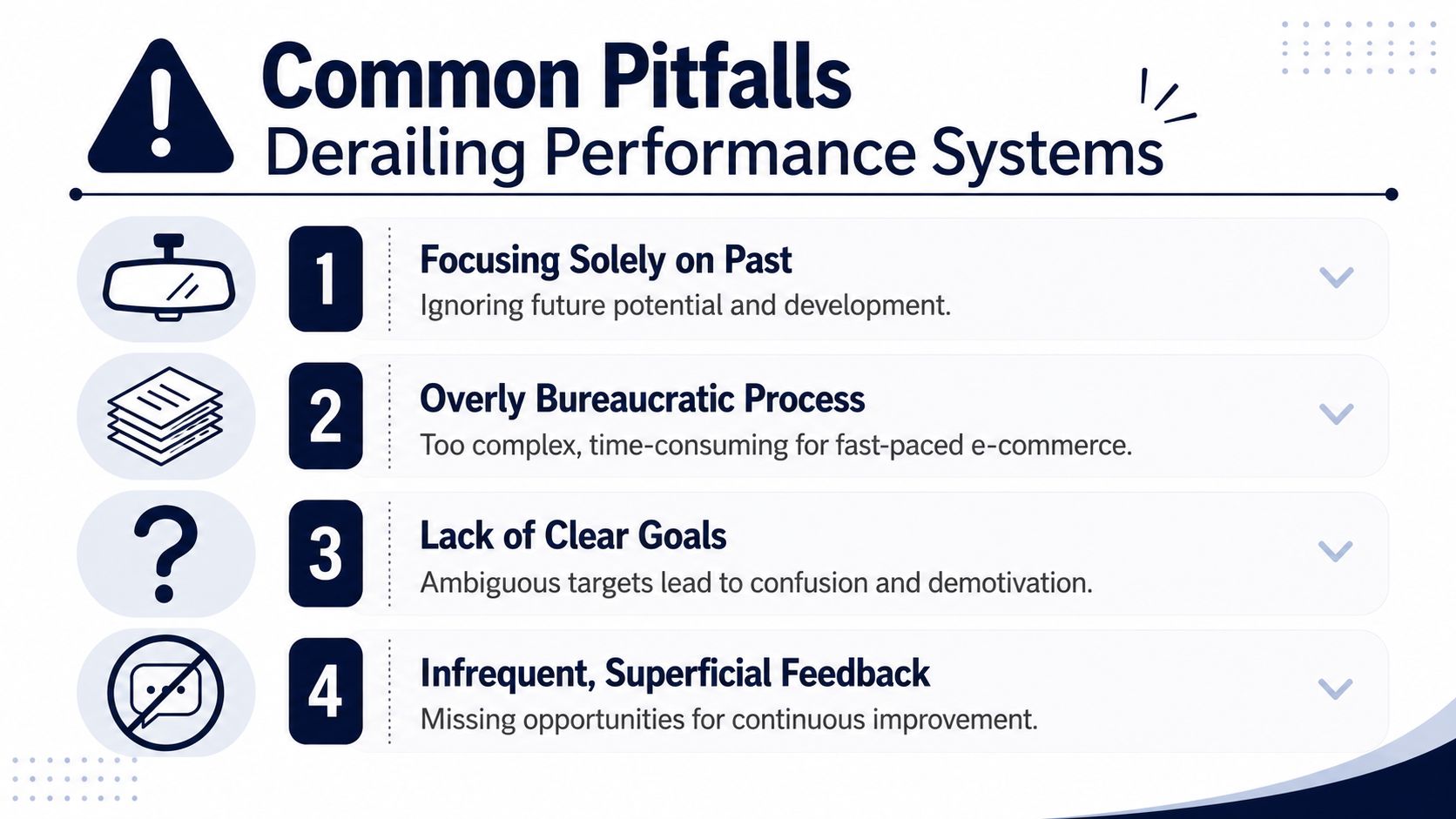
A few patterns come up constantly in fast-moving brands.
The fix is usually less complicated than people think.
| Pitfall | Better move |
|---|---|
| Measuring activity | Measure business-relevant output |
| Annual-only goals | Reset goals quarterly |
| Manager monologues | Use two-way check-ins |
| Heavy admin | Keep templates short and repeatable |
| No reward signal | Tie strong performance to recognition and opportunity |
If managers keep cancelling the cadence, the system isn't alive. It's just documentation.
The hardest part isn't designing a PMS. It's maintaining the discipline to run it when promotions are launching, stock is tight, customer issues are piling up, and everyone wants to skip the meeting. That's exactly when the meeting matters most.
Tool selection is where founders often waste time. They compare feature lists instead of asking a simpler question: what tool will our managers actually use every week?
For lean teams, there are usually two viable paths.
Dedicated performance platforms like Lattice, 15Five, and Leapsome are built for check-ins, goal tracking, review workflows, and documentation. They're cleaner if you want a formal process with manager consistency built in.
Project management tools like Asana, ClickUp, Monday.com, Notion, or Airtable can also work well. They're usually a better fit when the team already lives there and you want performance tracking connected directly to execution.
The trade-off is straightforward:
If you're comparing options, this roundup of top performance management tools is a helpful starting point for getting an overview of the category.
Choose based on stage, not aspiration.
If your current tech stack already feels fragmented, fix that first. A performance system layered onto scattered workflows usually creates more admin, not better management. This is the same logic behind smarter operational design in how to automate business processes. Add tools when they reduce friction, not when they just sound more impressive.
The right tool is the one that supports the cadence, keeps expectations visible, and doesn't make your managers dread using it.
Million Dollar Sellers is where serious e-commerce founders compare notes on the systems that hold up under scale. If you're building an Amazon or DTC brand and want access to peers who've already solved problems around team performance, operational clarity, and founder dependency, explore Million Dollar Sellers.
Join the Ecom Entrepreneur Community for Vetted 7-9 Figure Ecommerce Founders
Learn MoreYou may also like:
Learn more about our special events!
Check Events