Chilat Doina
January 19, 2026
An Amazon wholesale business is pretty straightforward: you buy branded products in bulk from the makers or their official distributors, then sell them on Amazon for a profit. You’re not trying to invent the next big thing like in private label. Instead, you're tapping into the built-in demand and reputation of brands people already know and love. It’s a much faster way to get consistent revenue flowing.
For experienced ecommerce founders, jumping into wholesale isn't a step back—it's a smart, strategic move toward stable, predictable cash flow. We all know the high-margin allure of private label, but that comes with the massive headache of building a brand, developing products, and pouring cash into marketing. An Amazon wholesale business lets you sidestep all of that.
You're not trying to create demand out of thin air. You're simply plugging into a massive, existing river of traffic for products customers are already searching for. This model isn't about marketing genius; it's a game of operational excellence. Your focus shifts to sourcing, negotiating, and logistics—skills most seasoned entrepreneurs have already sharpened.
For sellers who have already built a brand and understand the nuts and bolts of ecommerce, wholesale offers a less glamorous but often more reliable path to growth. It's about leveraging existing market dynamics instead of trying to create new ones.
In short, wholesale is a numbers game built on operational efficiency, while private label is a creative and marketing-heavy endeavor. For a founder with established logistics, wholesale is a natural fit.
The real beauty of wholesale is its data-driven nature. You're not just crossing your fingers and hoping a product sells. You’re digging into historical sales data on platforms like Keepa to confirm it already sells, and sells well. This alone removes a huge layer of risk that comes with every private label launch.
It's also a fantastic diversification play for a few key reasons:
Think about it this way: a successful DTC brand owner adds a wholesale arm to their business. They use their existing logistics network to source and sell high-volume kitchen gadgets on Amazon. The consistent, predictable profit from this wholesale venture then funds bigger inventory buys and new product development for their core brand. It creates a powerful, self-sustaining growth loop.
The market is already set up for this. Over 60% of Amazon's mind-boggling sales come from third-party sellers like us, and a big piece of that pie—26% in 2023—belongs to wholesale sellers. You can dive deeper into these Amazon marketplace seller statistics and see just how much velocity this model can generate.
Alright, let's move past the theory and get our hands dirty. Finding and vetting wholesale products isn't about a quick glance at the Best Sellers Rank (BSR) and crossing your fingers. If you want to build a real, sustainable wholesale business on Amazon, you need a repeatable, data-driven framework to pinpoint products with long-term profit potential.
The right tools are simply non-negotiable. Software like Helium 10 is great for that initial discovery phase, but Keepa is where the real work—the validation—happens. It gives you the deep historical data you need to sidestep costly inventory mistakes and spot the genuine opportunities everyone else overlooks.
This whole process is about finding existing, in-demand products and sourcing them through wholesale channels to create predictable cash flow. That's the entire game.
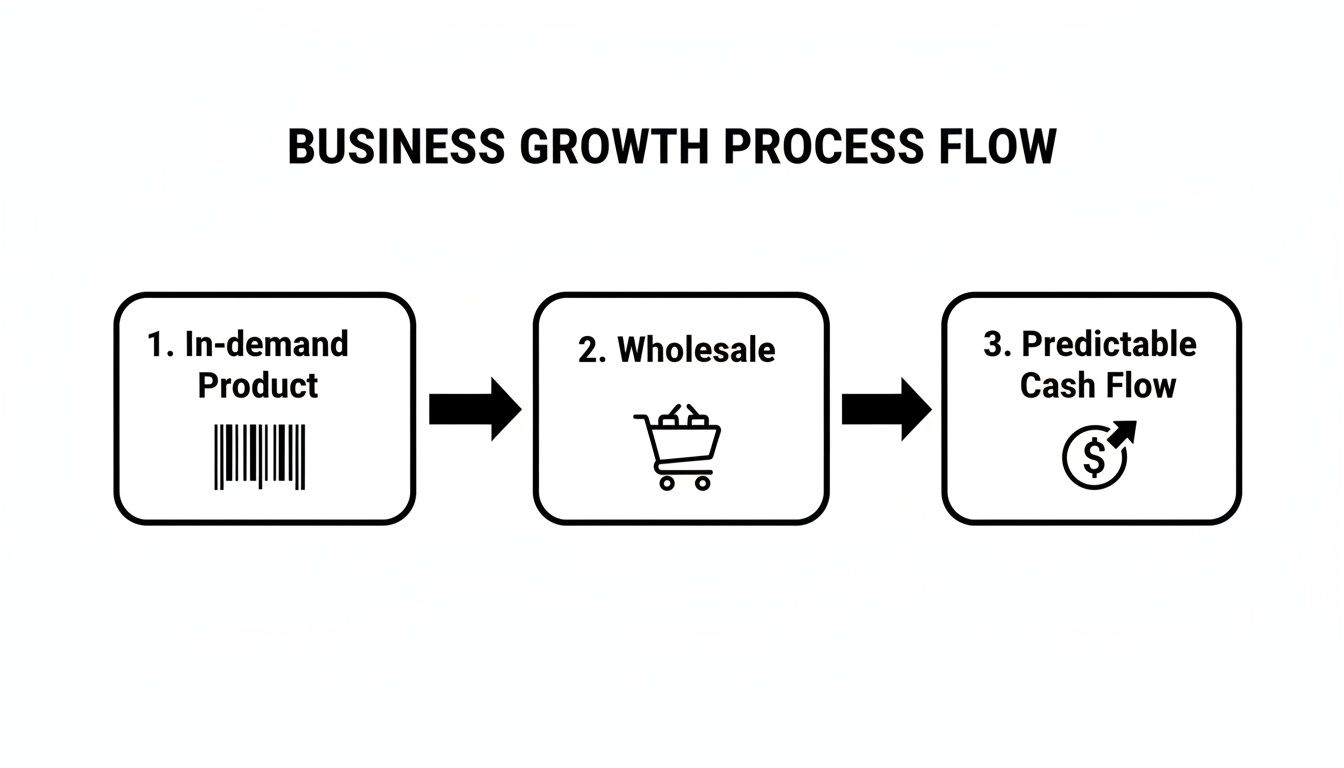
It’s a simple flow, but it underscores the entire strategy: leverage existing demand to build a stable revenue stream without the headaches and risks of creating a new product from scratch.
The secret to profitable sourcing is learning how to read the story a Keepa chart tells you. It’s a visual history of a product's life on Amazon, and every single spike, dip, and plateau has a meaning. When you're analyzing a listing, you're not just looking for a low BSR today; you're hunting for stability and consistency over time.
Let’s say you’re looking at a popular set of food storage containers. Your first move is to plug that ASIN into Keepa and start digging deeper than the surface-level numbers.
A classic rookie mistake is getting hyped about a recent price spike. A pro looks at the 90-day or even one-year average price. If a product's price chart looks like a seismograph during an earthquake, your margins are going to be just as unpredictable. That’s a high-risk bet you don’t want to take.
You have to dissect several key data points on this chart to know if a product is a green light or a dead end.
When you’re vetting a potential wholesale product, zero in on these specific metrics. They'll give you a complete picture of whether it’s a winner or a dud.
For a deeper dive into building out your supply chain, our guide on finding wholesale suppliers for Amazon lays out actionable strategies for building that critical network.
By weaving these data points together, you create a complete profile for every product you consider. For our food storage container example, a "green light" would be a stable price around $25, a consistent BSR under 30,000, a seller count between 5-10 FBA sellers, and no direct, consistent competition from Amazon retail. This methodical approach is what separates a thriving wholesale business from one that’s constantly buried in unprofitable inventory.
Getting the product data is one thing. Actually convincing a brand or its authorized distributors to sell you that product is another beast entirely.
This is the exact spot where most aspiring wholesale sellers trip up. They send out a blast of generic emails begging for a price list and get nothing but radio silence in return. Then they wonder why their Amazon wholesale business is dead on arrival.
Here’s the secret: It’s not about finding a magic email script. It’s a complete mindset shift. You are not a customer asking for a favor. You’re a strategic partner who brings a valuable service to the table.
Think about it. Tons of great brands have a chaotic, messy presence on Amazon. You’re the expert who can step in to clean it up, professionalize their listings, and drive new sales. That value needs to come across from the very first email.
The "Can I have your catalog?" email needs to die. It screams amateur and instantly lumps you in with hundreds of other sellers who bring nothing to the relationship.
Your first move should be to show them what you can do for them—before you ever ask for anything.
Start with some basic recon. Dive into their current Amazon listings. Are the photos grainy? Is the sales copy weak and uninspired? Are a dozen unauthorized sellers driving the price into the ground? These aren't just problems; they're your invitations to start a conversation.
Craft an opening email that’s a soft pitch, highlighting a specific, real improvement you can make. It might look something like this:
Subject: A quick question about [Brand Name]'s presence on Amazon
This kind of email does a few powerful things at once. It positions you as an expert, proves you’ve actually done some research, and offers them something of value for free. You’re not asking for a price list; you’re offering to solve a problem. That’s how you get a reply.
Once you get their attention, you have to be ready for a real business conversation. This means getting all your ducks in a row before you even think about hitting "send" on that first email. Brands want to partner with legitimate businesses, not some fly-by-night operation run from a basement.
Have this paperwork scanned and ready to go:
The wholesale opportunity on Amazon is massive, which is precisely why top brands are so selective. In 2023, a staggering 26% of all Amazon sellers used the wholesale model, proving just how viable it is as a business strategy.
When you get them on the phone, your job is to build rapport and drive home your value. Explain how you help brands take back control of their Amazon channel by consolidating rogue listings, optimizing all their content for conversion, and helping enforce MAP (Minimum Advertised Price) policies. You're not just another reseller; you're their brand manager on the world's biggest marketplace.
This call is also your chance to vet them. To protect your own Amazon account health, you need to ask some tough questions. We’ve put together a comprehensive supplier vetting checklist that walks you through the critical questions you must ask to make sure you’re only partnering with reliable, fully authorized sources.
Only after you’ve built this foundation of trust and value do you pivot to opening an account. By that point, it’s not a cold ask; it's just the natural next step in a new partnership. This value-first, relationship-driven strategy is how you land the profitable, long-term accounts that will become the bedrock of your entire wholesale business.
In the world of Amazon wholesale, winning the Buy Box is the name of the game. It’s the digital version of prime shelf space, and a staggering 82% of all sales happen there. If you think setting your repricer to be the cheapest and walking away is a strategy, you're making a rookie mistake that will absolutely torch your margins.
True pricing mastery isn't about being the lowest price; it's about being the smartest price. This means you have to move beyond simple "undercut the lowest price" rules and start building a sophisticated, multi-layered strategy that reacts to the market in real time. This is how you stop the race to the bottom and turn pricing into your most powerful weapon.

Your repricing software is only as smart as the rules you feed it. Most sellers just set it to look at the lowest FBA competitor and price one cent below them. Sure, it works, but it’s a blunt instrument that almost always triggers price wars, crushing profits for everyone on the listing.
The real money is made with advanced, conditional rules that weigh a whole range of variables. You can program your repricer to make much more intelligent decisions, protecting your bottom line while still aggressively grabbing the Buy Box when the time is right.
Here are a few of the advanced rules you should be building:
The most sophisticated sellers have pricing strategies that adapt not just to competitors, but to their own business metrics and even the time of day. This is about making your pricing work for you 24/7.
Think about it. Let's say you're selling a popular seasonal grilling tool. In the spring and early summer, demand is through the roof. You could set a velocity-based rule: if you sell more than 20 units in a day, your repricer automatically raises your minimum price by $0.50 to capitalize on the surge.
You can also use time-based rules to your advantage. Many sellers only adjust their prices manually during business hours. A savvy move is to set a rule that prices more aggressively between 1 AM and 5 AM to scoop up sales while your competition is asleep, then raises the price back to your standard floor during peak hours.
The core idea is to stop thinking of pricing as a static floor and ceiling. Instead, view it as a flexible range that should expand and contract based on real-time market conditions, competitor behavior, and your own business goals. Your pricing should be a living, breathing part of your operation.
Let's walk through a practical example with a seasonal product, like a popular brand of pumpkin spice coffee K-cups.
This multi-phase approach ensures you’re maximizing profit when demand is hot and protecting yourself from getting stuck with dead stock. For more on the fundamentals, you can learn about developing a comprehensive Amazon pricing strategy in our guide. By building these kinds of intelligent, conditional rules, you move from just reacting to the market to actively shaping it in your favor.
So you've found a few profitable wholesale SKUs and the business is starting to hum. Now what? The real challenge is turning that initial success into a genuine, multi-million dollar operation. Making that leap comes down to two things: building systems that can scale and bulletproofing your account against the inevitable threats.
Get one of these wrong, and you'll either hit a growth ceiling or, even worse, wake up to that dreaded account suspension email.
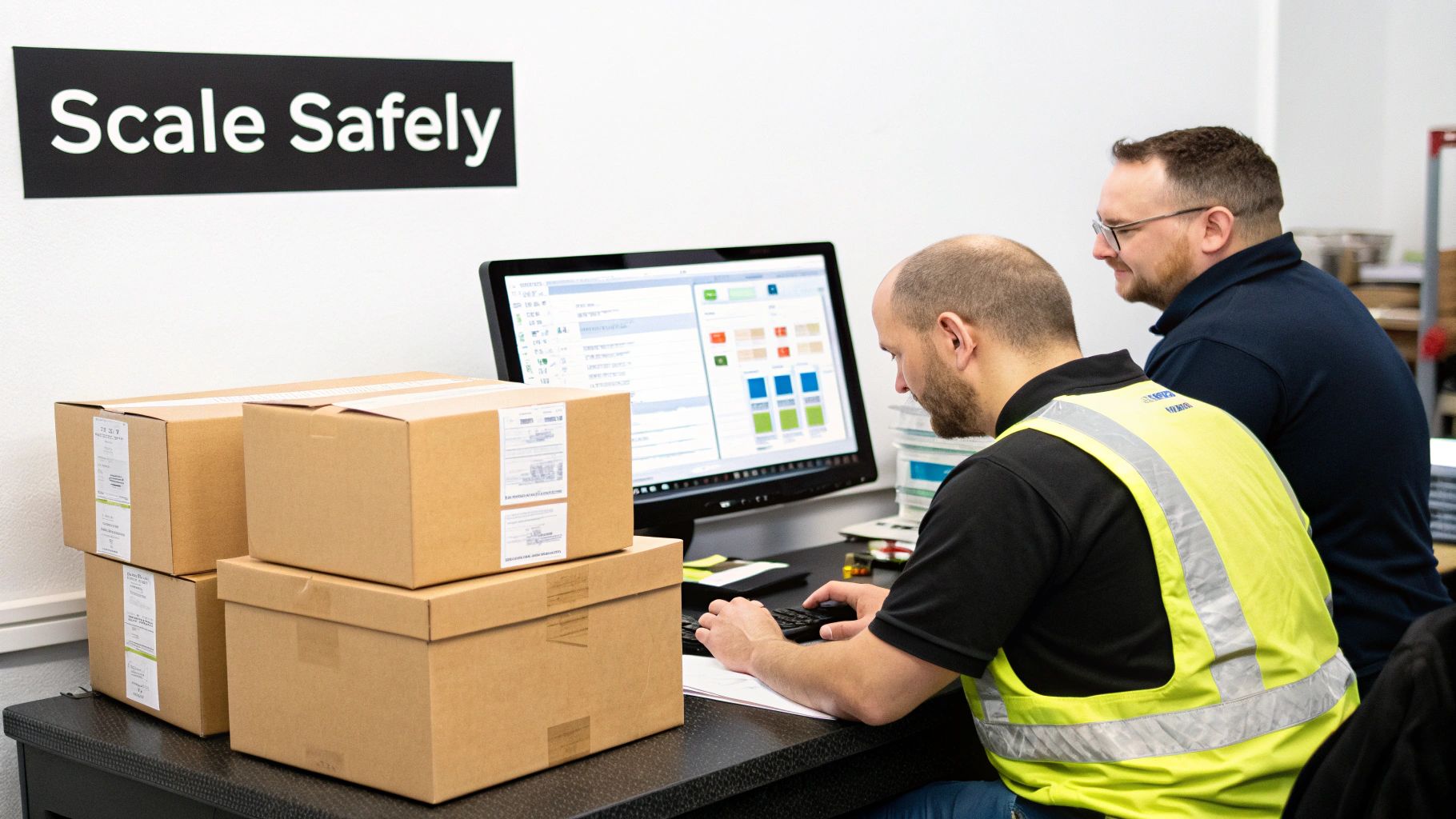
True scaling isn't just about placing bigger purchase orders. It’s about building an operational machine that handles more volume without you becoming the primary bottleneck. This is the critical shift from being a "seller" who does everything to a "business owner" who builds processes that run on their own.
The first move toward scaling is to get the repetitive, time-sucking tasks off your plate. Sourcing new products and managing day-to-day supplier communications are perfect candidates for delegation. This is where Virtual Assistants (VAs) become your secret weapon.
You can train a VA to understand your specific product validation rules—what a good Keepa chart looks like, the BSR ranges you target, and how to spot an overly saturated listing. Their job becomes sifting through endless supplier catalogs to bring you a pre-vetted shortlist. This frees you up to focus on the high-level strategy and where to deploy your capital next.
As your order volume climbs, your relationship with suppliers should change, too. You're not just another small account anymore; you're a partner driving serious revenue for them. That gives you leverage. It's time to renegotiate.
The endgame here is to create a system. Your team handles the tactical grind of sourcing and logistics, while you manage the strategic relationships and pull the financial levers. That's the only way to sustainably push past the 7-figure mark.
As your business grows, your Seller Central account becomes an incredibly valuable asset—and a much bigger target. For any Amazon wholesale business, the two biggest boogeymen are inauthentic claims and Intellectual Property (IP) complaints. Trying to react to these after they happen is a losing game. A proactive defense is your only real strategy.
This defense starts way back with your supplier vetting. Before you even think about placing a PO with a new distributor, you have to verify they are an authorized distributor for the brands they carry. Don't just take their word for it. Pick up the phone or send an email directly to the brand owner to confirm.
Your invoices are your suit of armor in this fight. Every single invoice you receive needs to be perfect. It must contain this specific information, and it has to match your Amazon account details to the letter:
Get a rock-solid digital filing system in place. I recommend sorting them by brand and then by ASIN. When a complaint lands, you want to be able to pull up the correct invoice in minutes, not spend hours digging through folders.
When an inauthentic or IP complaint inevitably appears on your Account Health dashboard, don't panic. This is where all that prep work pays off. Immediately submit the corresponding invoice to Amazon. In my experience, for over 90% of inauthentic claims, a clean invoice from an authorized distributor is all you need to get the violation removed.
IP complaints are a bit trickier. When a brand files one, it's often a signal that they want more control over their Amazon presence. The first step is always to submit your invoice and a Letter of Authorization (LOA) if you have one. If the brand still won't retract it, the smartest move is often to cut your losses—pull the listing, recall your inventory, and reach out to the brand professionally to see if you can find a resolution offline.
Beyond complaint management, you have to be obsessive about Amazon's policies. This covers everything from FBA prep guidelines to shipping rules. The true cost of shipping compliance violations can be staggering, leading to fines and account issues you simply don't need.
By building durable systems for growth and an ironclad process for compliance, you're not just building a profitable business. You're building a real asset—one that can weather storms and scale predictably for years to come.
Even for seasoned founders, jumping into a new model like Amazon wholesale comes with a unique set of questions. Let's tackle the most common ones I hear, based on years of actually doing this stuff.
Forget the guides that say you can start with a few thousand. For any kind of serious growth, you should be looking at a realistic budget between $10,000 to $25,000.
This capital isn't just for a bit of inventory. It's for hitting the supplier minimum order quantities (MOQs) that are the absolute backbone of the wholesale model. You need to buy in bulk to get the pricing that makes this all worthwhile.
Unlike retail arbitrage, wholesale demands a much larger upfront investment to secure real profit margins. Your initial capital also has to cover essentials like a Keepa subscription and maybe a tool like Helium 10, plus other operational costs. Most 7-figure sellers I know use dedicated capital or business credit lines to scale their purchasing power and jump on lucrative deals the second they pop up.
It’s also smart to get your business structure sorted from day one. Understanding your options, like incorporating your business in Canada, is a crucial step for setting up a formal entity that can grow with you.
It's saturated with sellers taking the easy route—all chasing the same obvious, big-name brands and getting into brutal price wars that kill margins. That's not where the real money is.
The opportunity lies in finding and building exclusive relationships with niche brands. The ones that have a messy, unoptimized Amazon presence that you can step in and clean up, adding real value.
The barrier to entry isn't just money; it's the persistence and skill required to build a unique supplier portfolio. The market is wide open for sellers who are willing to put in the real work to find untapped opportunities instead of competing with thousands on the same handful of listings.
Prevention is your only real defense here. It all comes down to sourcing discipline.
Only buy products from authorized distributors, period. Then, keep meticulous digital records of every single invoice. Those invoices are your proof of authenticity, your get-out-of-jail-free card.
If you get hit with an inauthentic complaint, immediately provide Amazon with these invoices through your Account Health dashboard. For an Intellectual Property (IP) complaint, a Letter of Authorization (LOA) from the brand is your golden ticket. If you don't have one, your best bet is to:
Whatever you do, don't ignore these claims. They are a direct and serious threat to your selling privileges.
Absolutely. In fact, you should. It's a powerful hybrid model that many 8-figure sellers use to build a more resilient ecommerce portfolio.
Think of it this way: your wholesale business generates consistent, predictable cash flow from proven products. This revenue stream can then fund the riskier, higher-margin growth of your private label brand, financing things like bigger production runs or ambitious marketing campaigns.
The skills are incredibly complementary. Wholesale teaches you operational excellence on the Amazon platform, while private label hones your branding and marketing abilities. The key is simply having dedicated systems for each so neither one is neglected.
Join the Ecom Entrepreneur Community for Vetted 7-9 Figure Ecommerce Founders
Learn MoreYou may also like:
Learn more about our special events!
Check Events