Chilat Doina
April 11, 2026
The most popular advice on founder groups is wrong for ecommerce operators.
You’ll hear that EO is the natural next step once you cross seven figures, and that YPO is the prestige destination once you get bigger. That advice sounds smart if you sell software, run a services firm, own a regional business, or lead a traditional company with stable margins and slower operating cycles.
It breaks down fast in ecommerce.
A founder running an online brand doesn’t need more polished networking. They need relevant operators who understand inventory exposure, paid media volatility, marketplace risk, returns, attribution noise, and channel concentration. If the room can’t help when Meta gets expensive, Amazon changes the rules, or a platform starts throttling your growth, the room isn’t valuable. It’s just expensive.
That’s why ecommerce founders can't get true value from ypo or eo in the way people claim. The issue isn’t that those groups are bad. The issue is fit. They were built around a different business reality, a different pace, and a different kind of leadership problem.
For a seven-figure founder trying to become an eight-figure founder, this matters. Your calendar is already overloaded. Every dinner, forum, retreat, and call has to pay for itself in clarity, speed, or avoided mistakes. Prestige doesn’t count as ROI.
Most executive networks are status assets before they are operating assets.
That’s not always a problem. If you run a larger traditional company, a broad peer network can help with leadership perspective, governance, hiring senior executives, or long-term strategy. But ecommerce founders often join expecting tactical relevance and leave with polite relationships and very little they can use next week.

You can feel the mismatch quickly.
A room starts talking about board composition, private equity dynamics, real estate financing, enterprise sales cycles, or legacy succession planning. Meanwhile, your actual problems look different. You’re trying to decide whether to push inventory deeper, reduce spend on a soft-performing SKU, rethink subscription economics, renegotiate with a 3PL, or stop over-relying on one paid channel.
Those are not small details. That is the business.
The right founder group should shorten your learning curve on problems you already have, not impress you with problems you may never have.
Many ecommerce operators waste time. They assume smart founders are interchangeable. They aren’t. Intelligence travels. Context doesn’t.
A founder who built a strong B2B company may be excellent at leadership and still have nothing useful to say about:
Generalist groups give you broad empathy. Ecommerce-specific groups give you pattern recognition. If you need true value, pattern recognition wins.
The mistake is assuming a revenue threshold means business similarity. In ecommerce, that assumption breaks fast.
A founder can clear the bar for EO or even YPO and still be running a business with thin contribution margin, cash tied up in inventory, and growth that depends on paid media holding together for one more quarter. That founder may look comparable to a traditional $10 million or $15 million company on paper. Operationally, they are dealing with a different set of constraints.
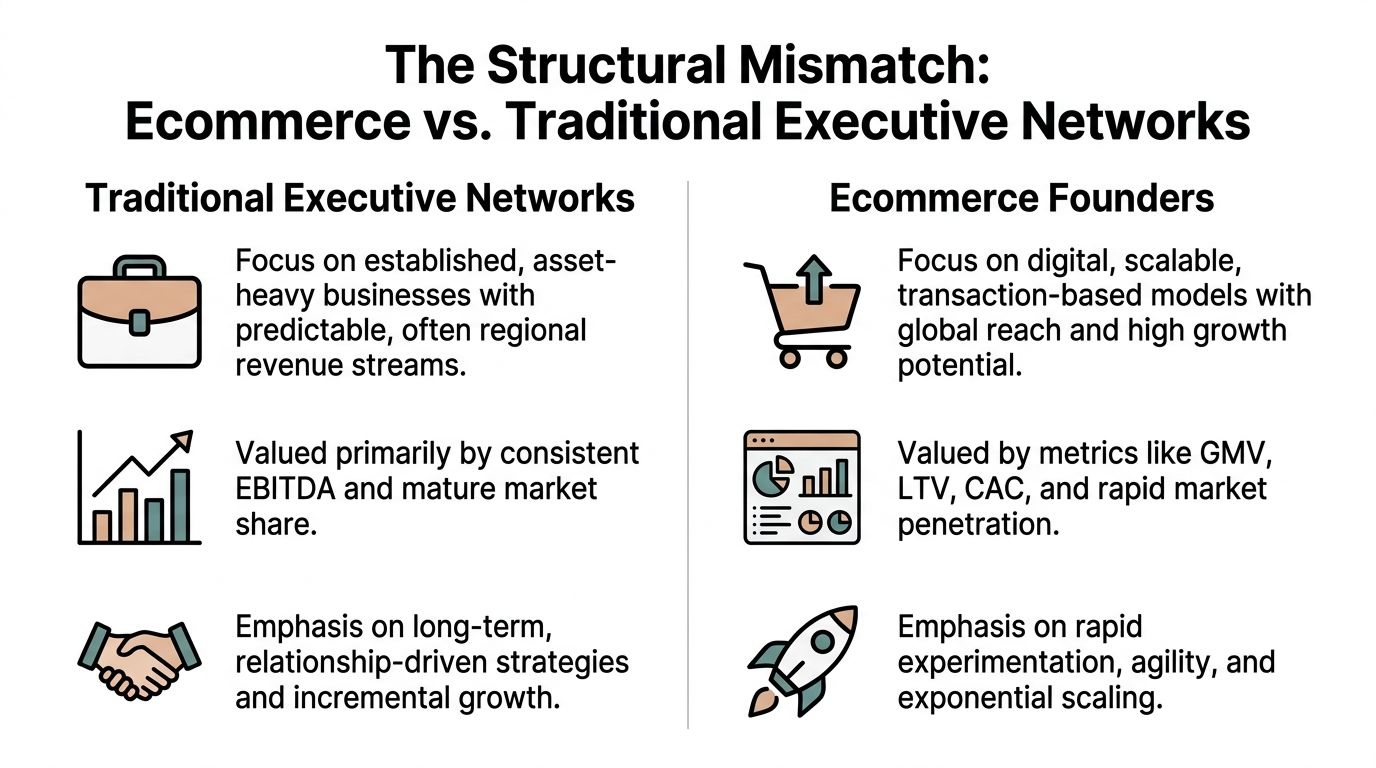
EO and YPO both use revenue as a gate. That works better in businesses where revenue is a decent proxy for durability.
Ecommerce breaks that logic.
A $12 million brand can still be fragile if a large share of demand comes from one ad platform, one marketplace, or one hero SKU. A bad forecasting decision can create six months of cash pressure. A spike in CAC can erase the economics behind what looked like healthy growth. Revenue counts the sale. It does not tell you how much margin survived after discounts, returns, fulfillment, platform fees, and ad spend.
That is why the room can feel off even if everyone technically qualifies.
This is the part many founders learn the hard way.
Two companies can post the same topline and have nothing in common where it matters. One may have recurring contracts, slower customer churn, cleaner forecasting, and more stable working capital. The other may be pre-buying inventory, watching blended MER every week, dealing with return rates that move by channel, and carrying platform risk that can hit revenue overnight.
For ecommerce founders, the pressure usually sits in a handful of operating realities:
That mismatch matters because peer advice is only useful when the economics underneath the advice match your economics.
A founder with stable contract revenue may tell you to accept a short-term margin hit to keep growing. That can be reasonable in their model. In a product business with inventory exposure and paid acquisition pressure, that same move can create a cash crunch three months later.
EO is easier to access. That does not make it more relevant.
A lot of seven-figure and low eight-figure ecommerce founders join broad networks hoping smart people will close the gap. Usually they do not. The discussion stays at the level of leadership, hiring, mindset, and generic strategy because the room lacks shared exposure to the mechanics that drive ecommerce outcomes.
If your week is shaped by reorder points, contribution margin by channel, Amazon listing suppression, refund rate creep, or whether your retention offer can offset rising CAC, you need peers who can pressure-test those decisions quickly. A broad founder room usually cannot do that. A more useful filter appears in this guide to EO vs YPO for ecommerce founders comparing actual fit.
This is the hidden tax.
In a generalist group, ecommerce founders often spend the first half of the conversation explaining why revenue is not the right lens, why cash flow looks tighter than topline suggests, or why a stockout is more than a missed sales week because it can also hurt ranking, retention, and future forecasting. By the time the group understands the setup, the useful part of the conversation is almost over.
That is a poor trade for a founder doing seven or eight figures.
You do not need a room that nods along. You need a room that already knows why a rising CAC, late container, bad inventory buy, or channel concentration problem can wreck an otherwise good quarter. That is where true peer value starts.
Prestige does not fix a bad-fit room.
An ecommerce founder can sit beside exceptional operators in EO or YPO and still leave with nothing they can use by Friday. The problem is not intelligence. It is operating context. Ecommerce runs on compressed feedback loops, channel volatility, and a vocabulary tied to margin, inventory, and platform behavior.

A lot of executive networks are built for reflection. Monthly forums, planned retreats, structured updates, personal growth. That setup fits businesses where problems develop slowly and decisions can wait for the next scheduled conversation.
Ecommerce does not wait.
Meta can push CAC up in 72 hours. Amazon can suppress a listing without warning. A 3PL issue can create a stockout that hurts rank, forecast accuracy, and cash conversion at the same time. TikTok Shop policy shifts can force a founder to decide, fast, whether to pause spend, reroute inventory, or protect liquidity.
A peer group that responds on a monthly cadence is already late.
The best founder conversations start in the middle, not at the glossary.
If you tell an experienced ecommerce operator that contribution margin is tightening, they do not ask whether revenue is still growing. They ask what changed in blended MER, new customer mix, refund rate, shipping cost, promo pressure, and repeat purchase behavior. If you say a hero SKU went out of stock, they understand the damage immediately. Rank loss, weaker conversion signals, broken forecasting, extra cash tied up in the recovery plan.
Generalist rooms usually miss that chain reaction. Smart people still give advice. It is just slower, broader, and less precise than the situation requires.
That gap is why specialized groups outperform broad ones for operators with category-specific problems. If you want a baseline on the benefits founders gain from peer groups, start there. Then apply a harder filter. Can the group help with the exact problems that decide your quarter?
Generalist groups tend to reward topics that sound strategic. Leadership style. Communication. org design. Long-range planning. Those matter, but they rarely sit at the top of an ecommerce founder’s decision stack.
A useful ecommerce room can get specific fast:
Those are operating decisions with strategic consequences. In ecommerce, the line between tactical and strategic is thin.
Many seven-figure and low eight-figure founders get stuck at this point. They get some value from a broad network, make a few introductions, enjoy the events, and assume that means the room is working.
It might be working socially. It might even be working emotionally.
It is not working economically if it does not improve decisions. A founder group should help you protect margin, avoid expensive inventory mistakes, react to channel risk faster, and sharpen judgment under pressure. If it cannot do that, you are paying for access and calling it insight.
The better question is simple. Does this room help you make ecommerce decisions faster and with less error? If not, use a more specific filter, like this guide on how to find the right mastermind group for your stage and business model.
That is why groups like Million Dollar Sellers make more sense for many ecommerce founders. The value is not prestige. The value is speed, relevance, and peers who already understand what is at stake.
Most founders evaluate peer groups backward. They start with brand name, prestige, or who else is in the room. Start with utility.
A founder group is worth joining if it helps you make better decisions faster, avoid expensive mistakes, and solve problems with less trial and error. If you want a broader primer on the benefits founders gain from peer groups, that’s a useful baseline. After that, you need an ecommerce filter.
| Evaluation Criteria | What to Look For | Why It Matters for Ecom |
|---|---|---|
| Industry specificity | Members sell through Amazon, Shopify, retail, marketplaces, or omnichannel models you recognize | Advice improves when members understand paid media, inventory, returns, and platform exposure without explanation |
| Stage alignment | Founders are near your revenue stage, but also near your complexity stage | A founder managing a lean growth brand needs different input than a CEO running a large multi-layered organization |
| Tactical relevance | Conversations regularly cover issues you’re dealing with now | Ecommerce moves fast. A group that stays abstract won’t help on operating decisions |
| Communication speed | There’s an active channel for urgent questions between meetings | Some problems can’t wait for the next retreat or monthly session |
| Trust and vetting | The group screens members and discourages selling | Founders share numbers and mistakes only when they trust the room |
| Operator density | The room has founders and active operators, not spectators | Execution advice is stronger when it comes from people still carrying accountability |
| Channel diversity with relevance | Members know your core channel, but the group also includes adjacent models | You want fresh pattern recognition, not one-dimensional thinking |
| Service provider quality | Recommendations come from actual usage, not sponsorship-heavy promotion | Ecommerce founders waste a lot of money on agencies, software, and consultants that don’t fit |
| Event quality | In-person time is designed for problem solving, not just social networking | Good events create tighter relationships and more candid sharing |
| Signal over noise | The group produces repeatable insight, not endless chatter | More messages don’t equal more value |
Use these in founder calls, application interviews, or while talking to existing members.
Good peer groups don’t just provide access. They reduce bad decision-making.
A lot of founders also join the wrong group because they don’t know how to search for one. This guide on how to find a mastermind group is a practical starting point if you’re trying to identify what fit looks like.
Don’t overcomplicate it. Score each criterion as strong, unclear, or weak.
If a group looks strong on prestige but weak on specificity, speed, and trust, pass. If it looks less flashy but strong on relevance and candor, keep going.
Founders lose money in obvious ways all the time. They also lose money through bad rooms, slow feedback, and diluted attention. This checklist helps you avoid that second category.
If a generalist network isn’t the answer, the next question is practical. Where should an ecommerce founder spend time?
The answer depends on the kind of business you run, the channel mix, and how much complexity you’re managing. The right alternative isn’t always one thing. It’s usually one of a few models.

These are often the fastest way to get relevant answers.
A focused Amazon mastermind, for example, tends to produce sharper discussion around listing quality, catalog issues, account health, review strategy, contribution margin, replenishment planning, and marketplace-specific growth levers. A DTC-heavy group will usually be stronger on creative testing, landing pages, retention, merchandising, and offer design.
This format works well when your biggest bottleneck is tied to one dominant channel.
The downside is that narrow groups can become myopic. If every member wins the same way, the group may reinforce local best practices without helping you think across channels or around larger brand-building questions.
Some groups are less about one platform and more about a founder stage.
These can be useful if you’re graduating from scrappy founder mode into a more structured company. The conversations often center on hiring leaders, cleaning up reporting, building process, improving planning cadence, and learning where the founder still creates drag.
That’s valuable when your core issue is organizational maturity rather than one urgent channel problem.
A good cohort at this level should still include operators who understand ecommerce mechanics. Otherwise, you end up with the same translation issue discussed earlier, just packaged more cleanly.
This is usually where the highest-value sharing happens.
When a community is curated, members are screened, and the group is built around ecommerce operators with meaningful scale, the conversation changes. People share more directly. They’ll talk about margin compression, fulfillment problems, marketplace instability, team structure, channel expansion, and which service providers performed.
One example is Founders Club for ecommerce operators, which describes a curated community model built around founder-level access and vetted peer interaction. The format matters because trust changes the quality of information.
And when founders are trying to improve customer retention, merchandising, and the end-to-end buying journey, practical resources on mastering customer experience for ecommerce can complement what they learn from peers by giving the team a clearer operational lens.
Don’t compare communities by branding. Compare them by output.
Look for:
This video gives more context on how ecommerce-focused founder communities differ from broad networking models:
Million Dollar Sellers is one example of an ecommerce-specific community built for founders and sellers across Amazon, DTC, and omnichannel brands. According to the publisher background, members collectively generate over $8 billion in annual revenue. That matters less as a prestige point and more as a proxy for shared operating context.
If you’re a seven-figure founder, the key question isn’t whether a community sounds exclusive. It’s whether the people inside can help you make better ecommerce decisions with less wasted motion.
The best ecommerce communities don’t just give you motivation. They give you pattern-matched judgment from people who have already paid the tuition.
What works:
What doesn’t:
The right alternative should feel like a shortcut to better judgment. If it feels like another place to explain your business, keep looking.
Join when the cost of operating alone is higher than the cost of membership.
That usually happens when you’re making decisions with meaningful downside. Hiring senior talent, changing channel mix, expanding SKU count, testing wholesale, reworking retention, or dealing with platform instability are all points where peer input can save time and reduce expensive mistakes.
If you’re still so early that every dollar is survival capital, a paid group may be premature. If you’re already running a brand with complexity, the right room can pay for itself through one avoided bad decision.
Think in outcomes, not vanity.
A realistic return can look like better vendor selection, fewer channel mistakes, faster problem diagnosis, stronger hiring judgment, or avoiding unforced errors in inventory and customer acquisition. Sometimes the ROI is direct. Sometimes it comes from speed. Sometimes it comes from not repeating a mistake another founder already made.
Don’t evaluate a mastermind the way you’d evaluate an ad campaign. You’re buying compressed learning and better pattern recognition.
Yes, if you’re clear about why each group exists.
A generalist group can still help with perspective, relationships, or personal development. An ecommerce-specific group handles operating relevance. The mistake is expecting the generalist group to do both.
If your time is limited, prioritize the room that improves your execution. If you have room for both, define the role of each one so they don’t become overlapping calendar clutter.
Use one community for perspective if you want. Use another for decisions you have to make under pressure.
Frame it as decision infrastructure.
You already spend money on software, agencies, consultants, events, recruiting, and paid media. A high-quality peer group supports the judgment behind those spending decisions. That’s the value. It helps the company avoid bad bets and move faster when the stakes are true.
A simple way to justify it is to identify the decisions you expect the group to improve. Vendor selection. Channel expansion. Team structure. Forecast confidence. Retention strategy. Inventory planning. If the group can sharpen those decisions, it’s not a perk. It’s an operating asset.
A few stand out quickly:
Ask questions that uncover behavior, not marketing language.
Try these:
Those questions will tell you more than a polished application page ever will.
Most ecommerce founders don’t need a bigger network. They need a tighter circle with better fit.
That’s the core takeaway. YPO and EO aren’t broken. They’re just misaligned for many ecommerce operators. The structural mismatch makes revenue comparisons misleading. The cultural mismatch makes conversations slower and less useful. And the result is a common but expensive mistake. Founders spend time in rooms that sound impressive and produce moderate value when they need sharp, immediate, ecommerce-native insight.
If you’re a seven-figure founder trying to scale with less waste, your next move is simple.
Audit every group you’re currently in. Ask whether it gives you operating clarity, faster feedback, and trusted pattern recognition. If it doesn’t, stop defending it because of the logo, the history, or the people you might meet there.
Then use a stricter standard for what comes next.
Look for founders who understand your channels without translation. Look for communities where people share what broke, what worked, which tool failed, which agency underdelivered, which hire changed the business, and which metric turned out to be misleading. Look for a room that helps you make decisions with more confidence and less lag.
That’s what connection looks like in ecommerce.
It isn’t collecting business cards. It isn’t joining the most recognized organization in the room. It’s building access to people who are close enough to your operating reality that one conversation can change the quarter.
The founders who scale well don’t just work hard. They get around the right pattern library.
If you want a peer environment built specifically for serious ecommerce operators, Million Dollar Sellers is one path worth evaluating. The core question isn’t whether the name is impressive. It’s whether the members are close enough to your business model to help you make better decisions, faster.
Join the Ecom Entrepreneur Community for Vetted 7-9 Figure Ecommerce Founders
Learn MoreYou may also like:
Learn more about our special events!
Check Events