
Chilat Doina
October 8, 2026
Yes, Amazon delivers on Sundays in many U.S. ZIP codes, but it isn't a blanket guarantee. The program grew from more than 2.7 million Sunday parcels delivered between January 1 and April 6, 2014, and today's result still depends on the item, destination, carrier, fulfillment route, and checkout promise.
The popular advice says, “Amazon delivers on Sunday,” then leaves customers and sellers to discover the difficult part themselves. That answer is technically correct and operationally incomplete. Amazon can deliver on Sunday without promising Sunday delivery for your specific order.
For sellers, the important distinction is eligibility versus guarantee. A product may qualify for a Sunday-capable route in one ZIP code and receive a Monday promise in another. Inventory placement, handling time, local delivery capacity, carrier handoff, and the ASIN's assigned fulfillment path can all change the date Amazon shows.
Treat the checkout promise as the authority. A Prime badge, a general statement about Sunday delivery, or a carrier's normal schedule can't override the item-level date Amazon displays.
Amazon doesn't “always” deliver on Sunday. It delivers selected orders on Sunday when its network can support the promised date.
That distinction matters because Amazon's Sunday network isn't a single nationwide service. Amazon Logistics and USPS share the workload in different markets, and the route depends on the destination ZIP code, local staffing, inventory position, fulfillment method, and product-level eligibility. The same ASIN can show Sunday delivery for one customer and a later date for another.
Sunday delivery has also moved beyond a rare exception. USPS-related analysis reports that Sunday package volume grew 44% from 2020 to 2021, reaching approximately 6.5 million Sunday packages in fiscal year 2021, or about 2.5% of total USPS deliveries (USPS Sunday package volume analysis). That makes Sunday a meaningful part of the parcel network, but it doesn't turn Sunday into a universal service commitment.
Eligibility means Amazon's systems see a possible Sunday route for the order. A guarantee, in the seller's practical sense, would mean the seller controls every condition required to deliver on Sunday. Merchant-fulfilled sellers usually don't have that level of control, and even FBA sellers don't choose the final carrier or route for each order.
Amazon may show “Arrives Sunday” because it has calculated a feasible path. A late inbound transfer, a missed cutoff, an overloaded delivery unit, or a change in inventory allocation can still affect execution. Customers see one date. Sellers manage the variables behind it.
Practical rule: Never advertise Sunday delivery as a general catalog promise. Refer customers to the delivery date shown for their address and order.
For customers, this means the checkout date is more useful than a generic shipping explainer. For brands, it means Sunday should be measured as promise coverage and promise accuracy, not as a permanent feature attached to Prime.
Amazon's modern Sunday program began with a negotiated service agreement with USPS in October 2013. It launched in Los Angeles and the New York metropolitan area, using USPS last-mile infrastructure to deliver parcels on a day when ordinary mail service was generally unavailable (USPS Office of Inspector General audit).
Expansion followed quickly. By the end of April 2014, the arrangement covered 459 USPS facilities across 22 districts in the Pacific, Eastern, Southern, Great Lakes, and Northeast regions. As noted above, the early network handled more than 2.7 million Sunday parcels in just over three months. That volume helped justify expansion beyond the pilot markets and showed that Sunday routes could support recurring parcel demand.
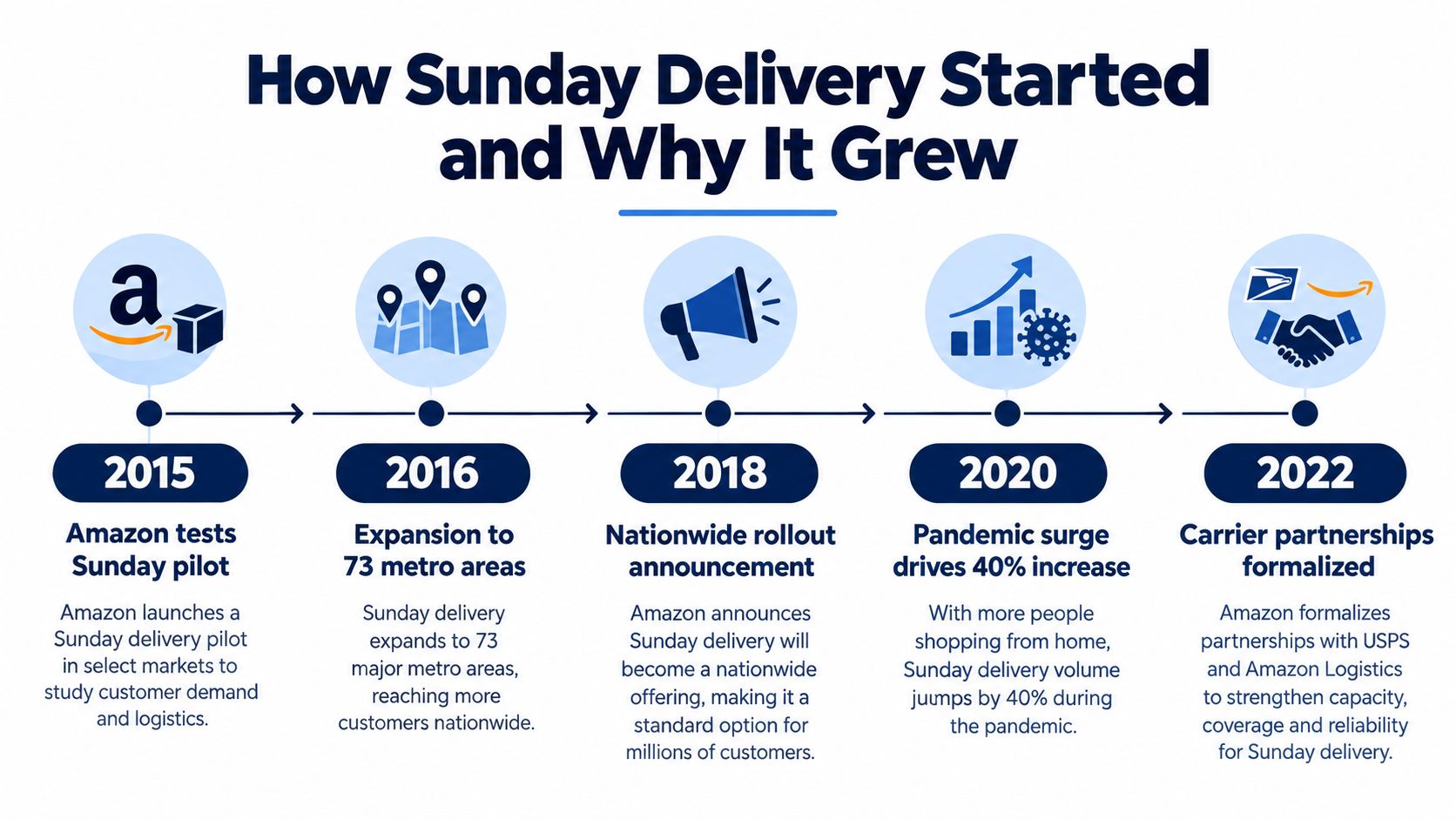
For sellers, the early rollout matters because it established Sunday delivery as a network strategy, not a short-term promotion. Amazon was testing whether concentrated weekend demand could support repeatable routes, carrier coordination, and broader delivery coverage. The operational answer was strong enough to keep expanding.
Sunday routes work when drivers can complete many stops within a compact service area. Metropolitan demand improves route productivity, while sparse coverage requires more travel for each parcel. Cities, large suburbs, and high-demand corridors therefore became practical starting points before rural areas.
The program later reached urban markets including Austin, Dallas, Houston, Philadelphia, and San Antonio. Coverage depended on the destination, local delivery-unit capacity, inventory location, and whether the item had a Sunday-capable path (coverage history and market expansion).
Amazon's logistics operation now works alongside USPS within the wider delivery network. That gives Amazon greater control over route selection, while making Sunday availability a result of network design rather than a simple USPS service label.
The seller takeaway is direct: Sunday availability reflects operational density. Inventory placed far from demand, slow handling, or a destination outside a productive route can push the promise to Monday or later. Treat eligibility as a routing outcome, not a delivery guarantee.
Sunday eligibility starts with the destination and the specific item, not the seller's marketing copy. A dense metro ZIP code may receive regular Sunday deliveries, while a nearby lower-density area may show Sunday only when Amazon has enough volume, staffing, and route capacity.
Do not reuse a historic city list as your coverage plan. Test your own ASINs against representative ZIP codes, including a dense metro, a suburb, and a rural destination. Check the promise at checkout for each test. The relevant variables are ZIP code, delivery-unit staffing, inventory position, and ASIN-level fulfillment assignment. Sunday delivery market coverage can provide context, but it cannot confirm eligibility for your catalog today.
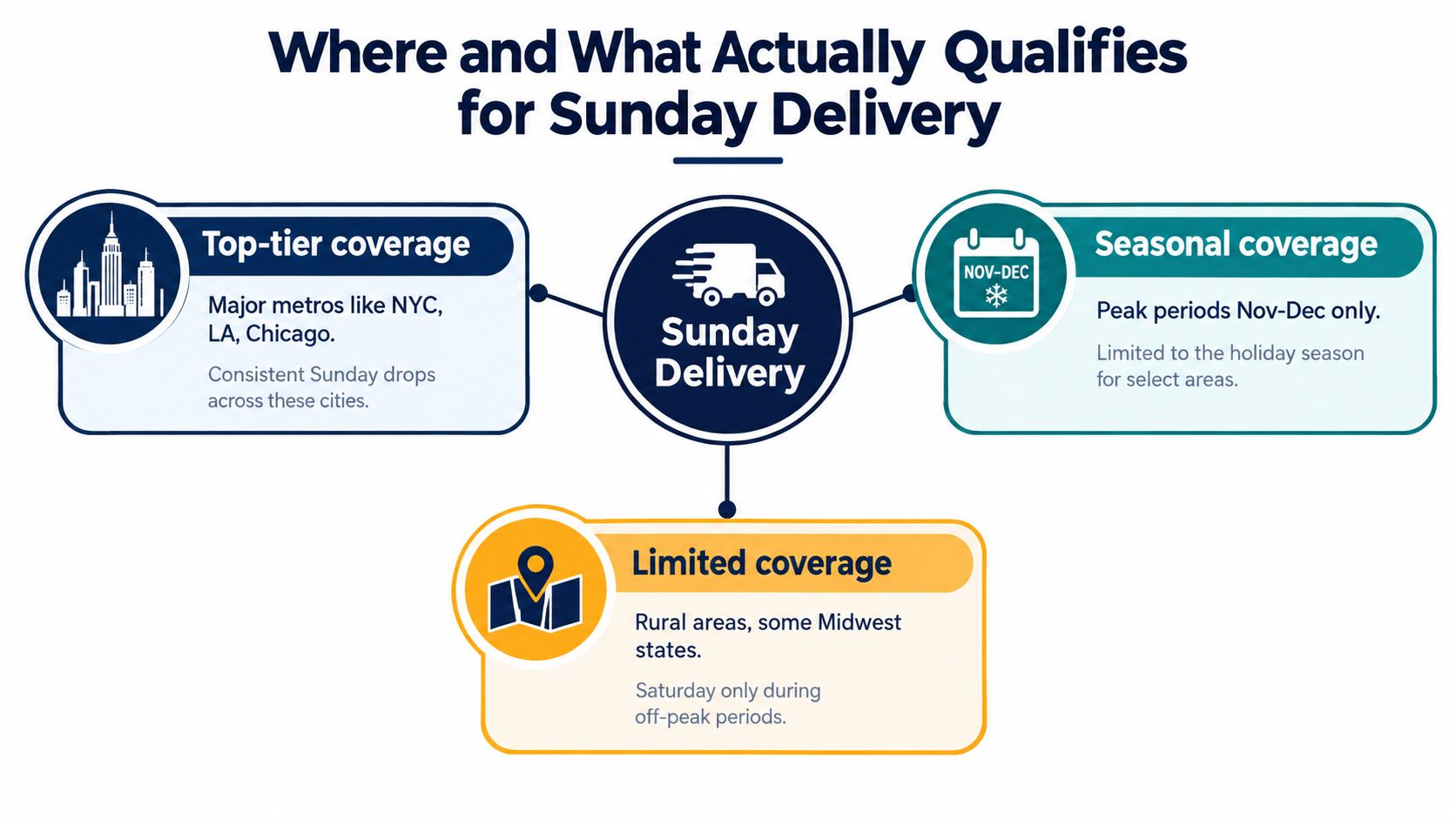
Dense metro coverage: Concentrated demand makes Sunday routes more practical. ASINs with nearby inventory are more likely to show a consistent Sunday promise.
Variable suburban coverage: Two nearby ZIP codes can produce different results. Facility capacity, local staffing, and inventory distance can change the displayed date.
Limited rural coverage: Lower parcel density requires more route miles, so Sunday assignment becomes less reliable. A Monday promise may reflect destination economics rather than a product issue.
Product eligibility can narrow further. Oversized items, hazmat products, special-handling goods, and ASINs without the appropriate fulfillment path may receive a later date. One successful Sunday order does not qualify the full catalog.
Check item-level delivery dates with representative ZIP codes, then repeat the test after inventory moves, handling-time changes, and demand shifts. Record the results by ASIN and fulfillment path. The useful question is which ASINs receive Sunday promises, where, and through which fulfillment path.
Review the wider network through last-mile delivery solutions when assessing routing beyond Amazon's internal operation. Dense demand and nearby inventory create options. A missing handoff, unsuitable product, or weak route can remove Sunday from checkout. Treat eligibility as a variable operational outcome, never as a standing guarantee.
Customers often ask whether USPS or Amazon delivers the package. The answer can vary by order, market, and capacity. Amazon Logistics may handle the route directly, while USPS may deliver Amazon parcels through its Sunday operating arrangements. The tracking experience can differ because each network produces its own scans and exception events.
USPS states that Sunday delivery is limited to Amazon parcels and Priority Mail Express, rather than ordinary mail. Amazon's seller guidance also notes that USPS has limited Sunday pickups and may require line-haul drop-offs at larger processing facilities by appointment (Amazon seller guidance on USPS Sunday operations).
Amazon Logistics often gives customers an Amazon-facing tracking experience and may update delivery status through Amazon's own route system. USPS tracking can follow a different cadence, particularly when a parcel is moving through a handoff before reaching the local delivery unit. Regional delivery partners can introduce another pattern entirely.
Don't promise a specific delivery hour unless Amazon provides one for that order. “Arriving Sunday” and “out for delivery” are different signals. A package can remain within its promised day while the customer waits longer than expected.
| Carrier | Sunday tracking cadence | Typical delivery window | Exception handling |
|---|---|---|---|
| Amazon Logistics | Amazon route scans and delivery updates | Varies by route and customer promise | Amazon manages the route status and customer-facing exception |
| USPS | USPS facility and delivery scans | Varies by local operation and parcel type | USPS scans can appear later in the handoff; Amazon remains relevant for the order experience |
| Regional carrier | Carrier-specific scans, sometimes passed through Amazon | Depends on local route design | Seller and Amazon may need to interpret separate tracking events |
Priority Mail Express deserves separate attention. It has a different service commitment from standard Amazon Sunday parcel delivery, so sellers shouldn't use one as evidence that the other is guaranteed.
If a customer contacts you about a Sunday order, first identify the carrier and the exact promise shown in the order details. A carrier page that hasn't updated yet doesn't automatically mean the order is lost. For broader weekend-carrier context, see how UPS handles Saturday delivery, but don't substitute another carrier's schedule for Amazon's item-level promise.
Fulfillment model determines how much of the Sunday outcome you can influence.
FBA gives Amazon the most control. Amazon stores the inventory, selects the fulfillment path, assigns the carrier, and calculates the customer promise. Your job is to keep inventory available, maintain accurate handling information, and avoid operational choices that push the ASIN outside a fast path. You can improve the conditions, but you don't manually select Sunday delivery for each buyer.
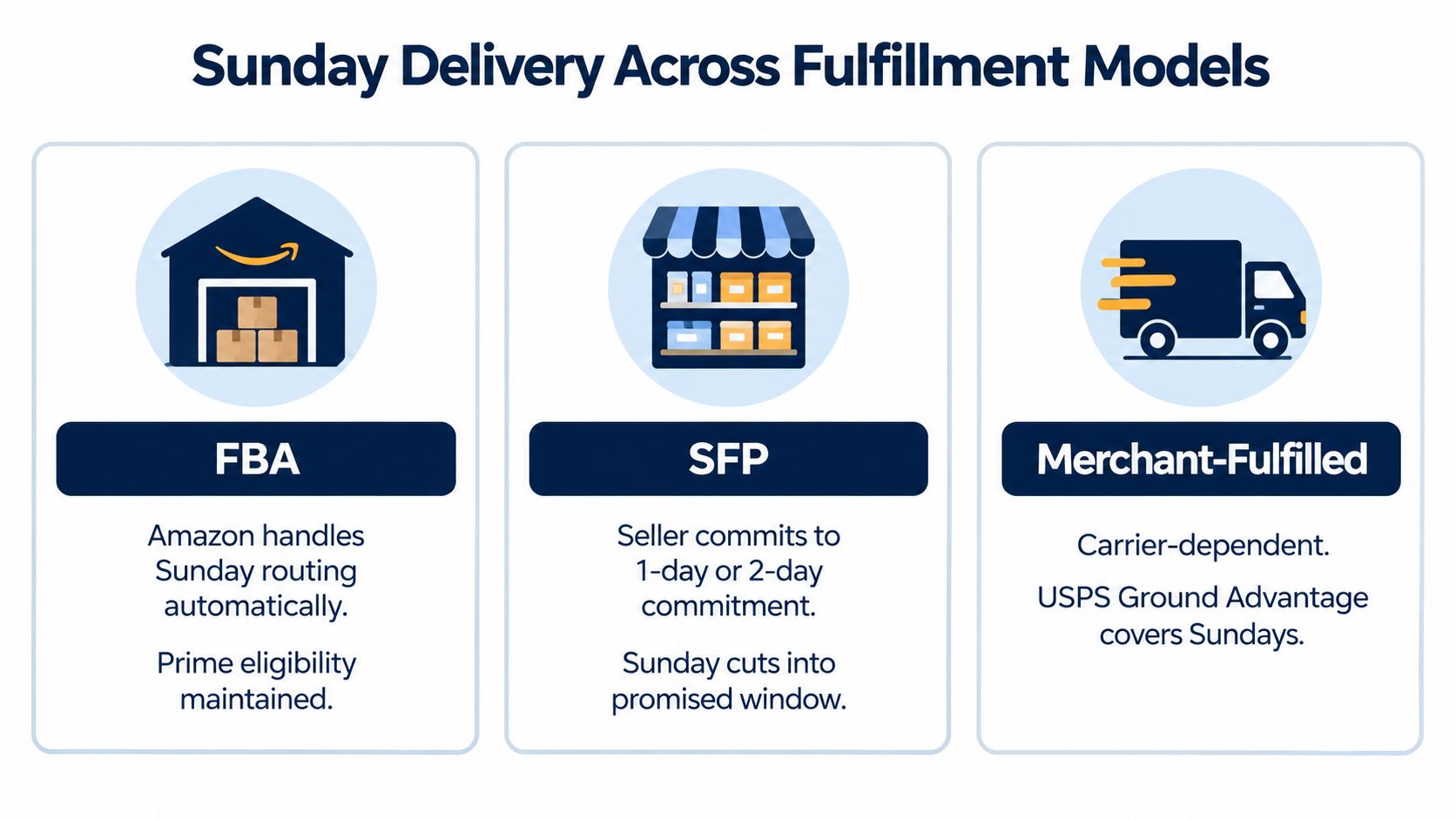
For FBA sellers, focus on inventory placement and promise coverage. A stocked unit near demand has more routing options than a unit arriving from a distant fulfillment center. Amazon's system can still change the promise, but strong availability gives it more ways to meet the date.
Monitor the ASIN, not only the parent listing. Variations can have different inventory positions, dimensions, handling requirements, and fulfillment assignments. A Sunday promise on one child SKU doesn't validate the others.
Seller Fulfilled Prime puts the seller closer to the promise. You must meet Amazon's shipping and handling requirements while coordinating carrier pickups, weekend staffing, label creation, and handoff timing. Sunday can consume part of the delivery window before the package even leaves your facility.
That makes cutoff compliance critical. A warehouse that closes early on Saturday may technically offer fast shipping while missing the operational handoff required to support a Sunday arrival. Test the full workflow, including order receipt, pick and pack, carrier acceptance, tracking transmission, and exception handling.
For standard merchant-fulfilled orders, Sunday availability depends heavily on your carrier, service level, destination, and pickup schedule. You can offer weekend handling, but you can't force Amazon to display Sunday unless the shipping configuration and network support it.
A hybrid approach often makes more sense than chasing Sunday across every SKU. Keep fast-moving, time-sensitive products in FBA while reserving merchant fulfillment for items with special handling, slower demand, or inventory requirements Amazon can't accommodate. Sellers evaluating faster Amazon programs can also review same-day delivery on Amazon, but the same warning applies: speed only helps when the operation can execute it repeatedly.
Operator's view: FBA sellers optimize the inputs. SFP sellers own the handoff. Merchant-fulfilled sellers should treat Sunday as conditional unless their carrier network proves otherwise.
The conversion benefit of a Sunday promise and the late-delivery risk come together. A faster date can make an offer more attractive, but an unsupported promise creates customer contacts and potential concessions. Measure both sides by ASIN, ZIP code, fulfillment model, and carrier rather than celebrating the badge alone.
Chase Sunday when the business conditions support it. Don't chase it because a competitor's listing displays a weekend date.
A Sunday promise is worth optimizing when your ASIN sells quickly, demand clusters in dense markets, inventory is positioned close to buyers, and speed matters in the category. It becomes less attractive when the catalog is low velocity, destinations are geographically dispersed, or the product needs extra handling.

Pursue it when most orders come from dense ZIP codes, the ASIN is consistently in stock, FBA or a proven SFP workflow handles the order, and your promise data shows reliable Sunday coverage.
Treat it as a bonus when coverage varies sharply by region, the product sells unevenly, or Sunday depends on a fragile Saturday handoff.
Avoid building around it when the product is oversized, regulated, special-handling, or frequently replenished from distant inventory. A later but accurate promise beats a faster date that your operation can't support.
Inventory placement matters more than clever listing language. Review fulfillment-center availability and ZIP-code promise coverage in the seller analytics available to your business. Brand Analytics can help connect customer demand and sales patterns to operational decisions, while Vendor Central reporting may provide a different view for vendor-managed inventory. Use the tools you have to identify where Sunday appears, then ask whether those markets justify the inventory cost.
Run this check before changing the operation:
The right target isn't maximum Sunday coverage. It's profitable, accurate coverage where customers value speed and your network can deliver it.
A Sunday promise can slip because of capacity, weather, operational disruption, a missed handoff, or a tracking delay. Customers should start with the order page, not a generic carrier schedule. Check whether the status says “arriving Sunday,” “out for delivery,” delayed, or delivered, then compare the carrier tracking record.
For sellers, triage the contact in this order:
Customer-service rule: Don't turn an Amazon routing decision into a seller promise. Explain the status accurately, then own the resolution.
If the package is marked delivered but missing, ask the customer to check the delivery location and household or building contacts before escalating. If the parcel remains undelivered after the promised date, document the tracking history and act according to the applicable Amazon process. A Sunday order doesn't need a special script. It needs disciplined distinction between a late scan, a late delivery, and a lost package.
Million Dollar Sellers gives serious Amazon operators access to trusted peers, practical strategy exchange, and hard-earned insight from founders scaling large e-commerce businesses. If Sunday promises, fulfillment design, or carrier risk are creating expensive decisions, visit Million Dollar Sellers to explore the community and learn how experienced sellers approach them.
Join the Ecom Entrepreneur Community for Vetted 7-9 Figure Ecommerce Founders
Learn MoreYou may also like:
Learn more about our special events!
Check Events