Chilat Doina
April 1, 2026
For buyers who know exactly what they want, "immediate" isn't a bonus—it's the bare minimum. Same-day delivery on Amazon is what makes this happen, getting products into customers' hands in hours, not days. What started as a novelty has quickly become a massive conversion driver for serious sellers.
In the Amazon arena, speed is no longer just a feature; it's your best competitive weapon. If you're a 7- or 8-figure seller treating same-day delivery as an optional add-on, you're making a critical mistake. It's now fundamental for defending your market share, snagging those last-minute buyers, and holding your ground on premium pricing.
Your competitors are already flashing the Same-Day Delivery badge to swipe the Buy Box and win over customers, especially in dense, high-value urban areas. When a shopper needs a product now, the seller who delivers instantly gets the sale. A small price difference rarely matters in that moment.
Here's a quick overview of how the program shapes up for sellers.
AttributeDetails for SellersEligibilityProducts must be in a fulfillment center designated for same-day service, meet size/weight limits, and be enabled in your FBA settings.Customer ExperienceEligible customers in specific ZIP codes see a "Get it Today" or "Arrives Today" badge and delivery cutoff timer on the product page.Cost to SellerStandard FBA fees apply. No extra per-unit fee for the program itself, but strategic inventory placement can have associated costs.Cost to BuyerFree for Prime members on qualifying orders over $25. A $2.99 fee applies for orders under $25.Key BenefitSignificant conversion lift, increased Buy Box ownership, and the ability to command higher prices.
This isn't just about a faster shipping option; it's a strategic tool that directly impacts your visibility and profitability on the platform.
The push for instant delivery isn't just a feeling; it’s a massive, data-backed shift in how people shop. Amazon has completely rebuilt its logistics around this reality, and the impact on sellers who get on board is huge.
Just look at the numbers:
This strategic shift is powered by some incredible logistics. Amazon's same-day and next-day delivery network has completely changed e-commerce. In 2024, it hit a massive milestone when nearly 60% of Prime orders in the top 60 U.S. cities arrived through these ultra-fast channels. For top sellers, the takeaway is crystal clear: you have to position inventory near these urban hubs. It’s not a choice anymore if you want to keep growing. You can read more about Amazon's delivery speed achievements on redstagfulfillment.com.
For a 7- or 8-figure brand, this isn't about chasing trends. It's about leading the market and meeting customer expectations before your competitors even know what's happening.
Picture this: a customer in Chicago has their laptop charger die hours before a huge presentation. Are they browsing for the best deal? No. They're searching for the fastest possible fix. Seeing the "Arrives Today" badge on your listing ends their search. You just won a sale at a premium because you solved their urgent problem.
This same logic applies to countless other situations:
In every one of these cases, the seller offering same-day delivery on Amazon owns the moment. This isn’t just about winning one sale. It’s about building a reputation for being the most reliable option, which fuels repeat business and real brand loyalty. If you're not offering this speed, you're simply handing these valuable, high-margin customers over to someone who is.
So, you want that slick Same-Day Delivery badge on your listings? Let's be real, it's not as simple as flipping a switch in Seller Central. Getting it is a strategic move that involves a lot more than just good intentions—it’s about nailing Amazon's very specific, multi-layered requirements.
For serious sellers, this isn't just about checking a box. It's a game of chess involving smart inventory placement and picking the right products. Amazon doesn't hand this badge out to just anyone; it's a reward for sellers who can actually deliver on the promise of getting products to customers in hours, not days.
The first hurdle is your fulfillment method. Right now, there are really two main paths you can take to qualify for same day delivery on Amazon:
For most brands, FBA is the only practical way to get the badge. That means the question isn't if you can qualify, but how you can get your inventory in the right warehouses to make it happen.
This decision tree gives you a good look at the strategic side of things. For bigger, 7-figure sellers, same-day delivery can be a way to command higher prices. For everyone else, it's a killer way to boost conversion.
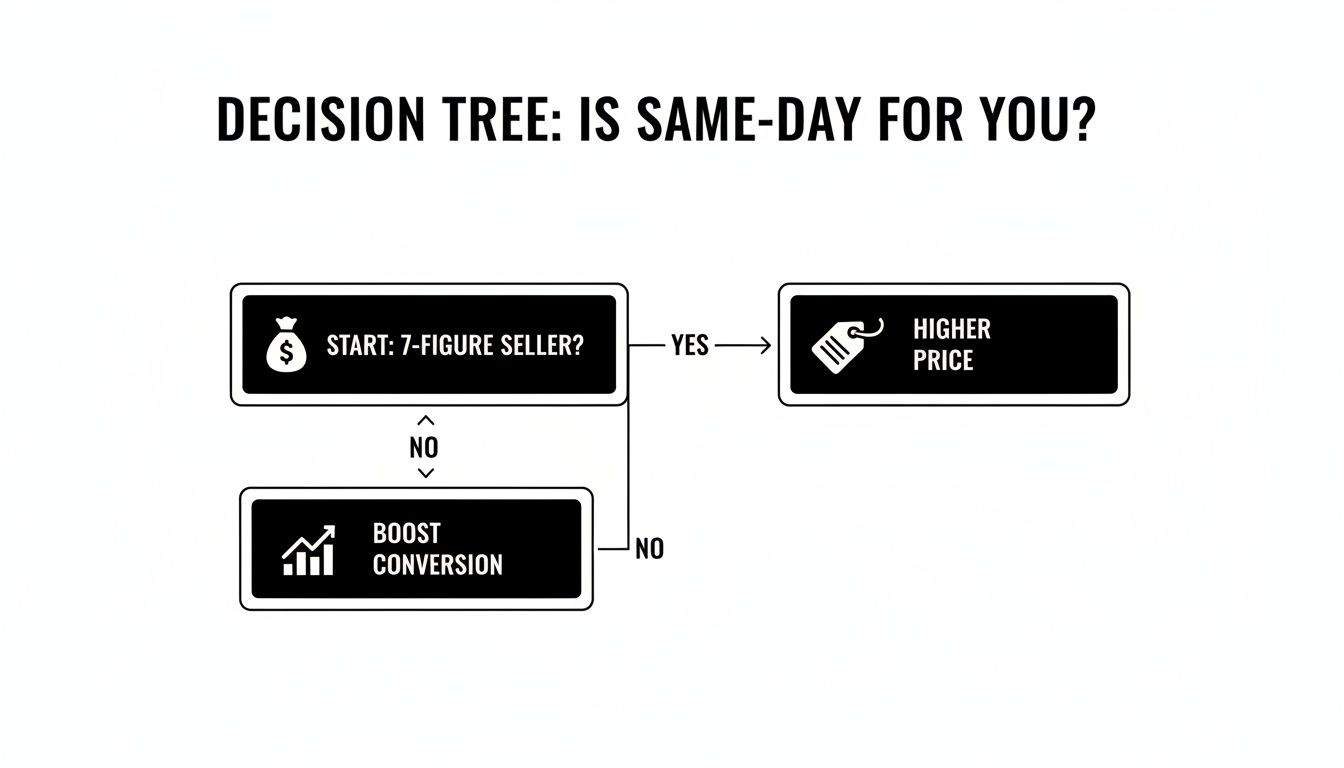
The takeaway here is that same-day delivery plays different roles depending on where your brand is in the market and what you're trying to achieve.
Hold on, though—not every product in your catalog is eligible for lightning-fast shipping. Amazon has a bunch of rules for individual ASINs that will either greenlight or disqualify your products.
Your first move should be to run an audit of your catalog against these rules:
Let me put it this way: Amazon's same-day facilities are all about efficiency. A small, light phone case can zip through the system in no time. A big, clunky piece of furniture? Not a chance. Your product has to fit their system, not the other way around.
This is where the pros really shine. The single most important factor for getting that badge is having your inventory in the right place at the right time.
The Same-Day badge only shows up for shoppers in ZIP codes that are served by a nearby Same-Day-enabled fulfillment center—and only if that center has your product in stock.
You have to be proactive here. Dig into Brand Analytics to find out where demand for your products is highest. Look at your own sales data to see which cities your customers are in. Once you know that, make sure your FBA inventory is consistently sent to and stocked in the fulfillment centers that serve those areas.
Let’s say you see a huge chunk of your sales coming from the Los Angeles area. You absolutely must keep your best-selling ASINs stocked in Southern California fulfillment centers. If you don't, you're invisible to every LA customer looking for same-day options. You're basically just handing a sale to a competitor who did their homework.
For any serious Amazon seller, every decision has to make financial sense. Rolling out same-day delivery is no different. Sure, the "Arrives Today" badge looks great, but if you're not running the numbers, you're just operating on a hunch. To really understand the payoff, you have to look past the obvious fees and model the real impact on your margins.
First things first, you need to get real about the costs. This isn't just about what Amazon charges you directly; the expenses trickle down into your entire operation. You have to tally up every cost associated with turning on and maintaining this premium service. I call it the "cost of speed," and it's usually higher than most sellers think.
This means digging into your P&L and operational data—and not just skimming the surface.
To get a clear ROI picture, you've got to itemize every single expense. These costs typically fall into a few key buckets:
These are the direct hits to your profitability. Once you've got a solid grip on these numbers, you can flip the script and look at the upside.
Here's where it gets exciting. The real magic of same-day delivery is its power to fuel serious revenue growth. We're not just talking about more sales; we're talking about more profitable sales and building a stronger brand over the long haul.
The most immediate win is the conversion rate lift. When a customer needs something right now, that "Arrives Today" badge is often the only thing that matters. We've seen brands get a 15-25% spike in conversions on their eligible ASINs just by flipping the switch in a few key metro areas.
Another huge benefit is a higher Average Order Value (AOV). Customers in a hurry are usually less sensitive to price and are more likely to toss extra items into their cart, especially to hit a free shipping threshold. In fact, shoppers who add fresh groceries to their Same-Day orders tend to shop about twice as often as those who don’t, which is a powerful way to build loyalty.
The choice to offer same-day service isn't just an operational one—it's a financial move that goes right to the heart of your brand's unit economics. For a deeper dive, our guide on understanding unit economics gives you a solid framework for this kind of analysis.
Don't forget the long-term gains, either. Fast, reliable delivery builds trust and creates a halo effect for your entire brand, boosting customer lifetime value (LTV). Happy customers leave good reviews, which in turn improves visibility and sales velocity for your whole catalog.
To tie this all together, you need a simple way to figure out if it's worth it for a specific product. This table is a framework I use to weigh the costs against the potential benefits.
MetricCost Impact (Example)Benefit Impact (Example)How To Calculate For Your BrandConversion RateN/AIncrease from 4% to 5% (+25%)A/B test by enabling the badge and measuring the change in Unit Session Percentage.Fulfillment Fee+$0.50 per unitN/ACompare your FBA fee reports for units shipped from same-day vs. standard centers.Holding Cost+$0.10 per unit/monthN/ACalculate the cost of carrying extra safety stock at regional fulfillment centers.Customer LTVN/AIncrease from $150 to $180Track repeat purchase rates from customers in same-day eligible ZIP codes over 6-12 months.
By plugging in your own numbers, you can turn this from a complex operational headache into a clear, data-driven business case. This is how you pinpoint which products will give you the best ROI for same-day delivery and invest your money with confidence.
Getting same-day delivery on Amazon right comes down to one thing: a smart, proactive inventory strategy. It’s no longer enough to just enroll your products and hope for the best. You have to start treating your inventory placement like a strategic weapon.
The real challenge is balancing your stock across the country, making sure it’s exactly where your customers are, the moment they click "buy." This requires moving beyond the old "send-it-all-to-FBA" playbook. You need a more sophisticated system that feeds Same-Day-enabled warehouses without causing stockouts elsewhere or tying up all your cash in products that aren't moving.
This is where a service like Amazon Warehousing & Distribution (AWD) becomes a game-changer for sellers trying to master this balancing act. Think of AWD as your bigger, upstream inventory reservoir. Instead of juggling dozens of small shipments to FBA centers that are often tight on capacity, you send larger, consolidated shipments to AWD.
From there, Amazon’s own system takes over, automatically pushing inventory to your prime FBA locations based on what’s actually selling. It creates a much more responsive and fluid supply chain.
Here’s how this really helps your Same-Day strategy:
This upstream-downstream model—AWD feeding FBA—is really the secret to scaling your Same-Day footprint without getting buried in logistics. It lets you keep a deep pool of inventory on standby, ready to be sent to the front lines where it matters most.
Let's be clear: not every product is a good fit for Same-Day, and not every city offers the same opportunity. Trying to make your entire catalog available everywhere is a fast track to sky-high storage fees and a terrible return on investment. The goal is to be surgical.
Your first stop should be your own data in Amazon Brand Analytics. Dive into the "Demographics" and "Top Search Terms" reports. Are you seeing huge clusters of demand in New York, Los Angeles, and Chicago? Those are your primary targets for Same-Day inventory.
Once you have that, layer in data from third-party tools that can break down your sales by ZIP code. This gives you an incredibly granular view, showing you exactly which neighborhoods have the highest concentration of your customers.
Use this data to build a "heat map" of your brand's demand. Prioritize stocking your hero SKUs in the fulfillment centers serving your top five to ten metropolitan areas first. This targeted approach ensures you get the biggest conversion lift for your investment.
The customer behavior behind Same-Day delivery has completely changed. It’s not just for last-minute emergencies anymore; it's about pure convenience. This trend has been supercharged by Amazon integrating groceries and everyday essentials into the Same-Day ecosystem, and it's a massive opportunity.
The numbers don't lie. In 2026, Amazon delivered a record-breaking 4 billion grocery and essential items in the U.S. through same- or next-day services. This shift means Prime members are now tossing milk, electronics, and toys into a single, ultra-fast order. You can read more about Amazon's record delivery speeds on Business Insider.
So, what does this mean for your brand?
If you sell items in adjacent categories—think kitchen gadgets, cleaning supplies, phone chargers, or beauty products—you are perfectly positioned to benefit. Your product can become an easy impulse addition to a customer's urgent grocery run. The only catch is that your item must be available in the same fast delivery window.
Position your products to ride this wave. If you sell a popular coffee maker, make sure it’s stocked for Same-Day delivery right alongside the coffee pods and filters customers are already buying with lightning speed. This "shopping cart adjacency" is a powerful growth lever that too many sellers overlook. And if the logistics start to feel overwhelming, you might want to learn more about how a 3PL partner can help manage your Amazon logistics so you can focus on the big picture.

Getting the Same-Day badge to show up on your listings is really just the beginning. The real work starts after you go live. This is where you have to shift from just activating the feature to actively optimizing it.
Think of same day delivery on Amazon as a performance channel, one that needs constant attention to make sure you’re getting the most out of it and protecting your sales.
Just seeing an overall sales lift isn't enough. The best sellers dig way deeper, looking at specific key performance indicators (KPIs) to see exactly how this new delivery speed is changing their business. This is the only way to know if your investment is actually paying off and to catch problems before they get out of hand.
To get the full picture, you need to look beyond your main sales dashboard. The most valuable data is hidden in the details, showing you how customer behavior changes when they can get your product almost instantly.
Start by keeping a close eye on these metrics:
The goal is to build a complete performance picture. A higher Buy Box win rate is great, but if it's not paired with an increase in Glance Views and positive delivery feedback, you may have an underlying issue with discoverability or customer perception that needs addressing.
Once you have the basics down, you can start running some simple tests to measure the true impact of Same-Day delivery. A great way to start is by testing the "halo effect" on one of your hero ASINs.
Here’s a straightforward way to set it up:
This kind of focused experiment helps you put a real number on the indirect benefits, giving you a much stronger business case for expanding Same-Day to the rest of your products. For a deeper dive into setting up this kind of tracking, check out our guide on building a great performance metrics dashboard.
Sooner or later, you'll run into a snag. The most common—and frustrating—problem is when an ASIN suddenly loses its Same-Day badge. This is almost always an inventory issue and it can absolutely crush your sales if you don't fix it fast.
When a badge vanishes, this should be your immediate plan of attack:
By moving quickly to figure out what's wrong, you can minimize the downtime and keep your Same-Day investment paying off.
When you’re operating at a high level, the standard advice just doesn't cut it. You have bigger questions, the kind that digs into how a new program like this really impacts your complex operation. This is where we’ll tackle the specific, nuanced questions top sellers are asking about same-day delivery on Amazon.
We’re moving past the basics. Let's get into the real-world operational challenges you're actually facing.
Yes, you can—but don't go looking for a simple on/off switch in Seller Central. It doesn't exist.
Your control comes from something far more strategic: inventory placement. Amazon’s system is built to automatically offer same-day delivery to customers in eligible ZIP codes, but only if your product is sitting in a nearby, designated fulfillment center.
This means your real control is your replenishment strategy. If you want to light up same-day delivery in Los Angeles, you have to make sure your products are consistently stocked in the specific Southern California warehouses that handle these rapid-fire shipments.
Want to pause the service in a region? You simply stop sending inventory to those specific FCs. This "control by logistics" is your primary lever. It requires a pretty sophisticated handle on your supply chain and demand forecasting, but it's incredibly powerful once you master it.
Pro Tip: Don't think of it as turning a region "off." Think of it as prioritizing your inventory. If serving a certain region is too costly or has weak demand, you can strategically send that stock to a hot market like New York or Chicago instead. This is how you maximize the return on every single unit.
This is a big one. Your brand's reputation is on the line with every single order. When an order blows past its promised same-day window, Amazon's famously customer-centric policies kick in, and it's usually the customer who benefits.
From your perspective as a seller using FBA, the process is mostly automated and hands-off:
Keep a close eye on your Voice of the Customer dashboard. You need to spot any delivery-related complaints before they snowball and hurt your standing.
Your Inventory Performance Index (IPI) score is a vital sign for your account's health, and jumping into same-day delivery can be a double-edged sword.
The biggest risk? A potential dip in your FBA sell-through rate. To offer same-day speed across multiple regions, you have to spread your inventory thin across more fulfillment centers. This naturally means more total units in the network, which can drag down your sell-through if your sales don't increase enough to match.
But there’s a huge upside. That "Arrives Today" badge can be a massive conversion driver, seriously boosting your sales velocity. When done right, a good same-day strategy often leads to a much higher sell-through rate, giving your IPI score a powerful shot in the arm.
The key is to find the right balance. Don't go all-in at once. Start by enabling the program on a handful of your fastest-moving, hero ASINs. Watch their sell-through like a hawk and monitor the impact on your IPI before you even think about rolling it out to your entire catalog. This measured approach lets you capture the rewards while keeping the inventory risks in check.
At Million Dollar Sellers, we know that navigating these complex strategic decisions is what separates good sellers from great ones. Our community is built on sharing the kind of high-level insights and operational secrets that drive real growth. If you’re ready to scale smarter and connect with the best in the business, learn more about joining us at https://milliondollarsellers.com.
Join the Ecom Entrepreneur Community for Vetted 7-9 Figure Ecommerce Founders
Learn MoreYou may also like:
Learn more about our special events!
Check Events