Chilat Doina
May 30, 2026
A lot of e-commerce brands hit the same wall at the same stage. Sales are up, your best-seller is moving, paid acquisition is working, and the problem no longer sits at the top of the funnel. It shows up after checkout, when every order needs to get to a real doorstep, on time, intact, and without creating a support ticket.
That's when founders realize delivery isn't a back-office detail. It's a margin line, a retention lever, and a brand experience wrapped into one. The global last mile delivery market was valued at USD 175.3 billion in 2023 and is projected to reach USD 305.4 billion by 2032, with e-commerce accounting for 42% of market share. That's not a side function anymore. It's core retail infrastructure.
For a 7, 8, or 9 figure brand, the question isn't whether to invest in last mile delivery solutions. The question is which model fits your economics, your customer promise, and your next phase of growth without undermining contribution margin.
One pattern shows up again and again in scaling brands. The catalog gets tighter, one or two products start carrying the business, demand clusters in a handful of metros, and the team thinks fulfillment should get simpler because volume is up. In practice, it often gets harder.
A fast-moving SKU creates pressure everywhere at once. Inventory has to sit in the right places. Delivery promises tighten because customers expect speed. Support volume rises when tracking goes dark or a carrier misses a handoff. What looked like a straightforward shipping problem becomes an operating model problem.
The founder usually sees it first in three places:
That's why last mile delivery solutions deserve executive attention. They shape customer trust at the exact moment your brand stops being a website and becomes a real-world experience.
Last mile operations don't fail all at once. They fail one exception, one late parcel, and one avoidable support ticket at a time.
For growth-stage brands, delivery used to be something you bought from carriers. Now it's something you design. The design choices matter. Where inventory sits. Which orders go through parcel networks versus local delivery. Whether you optimize for raw speed or reliable first-attempt completion. Whether your promise in dense urban zones should look the same as your promise in low-density rural ones.
The brands that scale cleanly don't treat shipping as a fixed cost. They treat it as a controllable system.
Most last mile delivery solutions fit into five operating models. Think of them the way you'd think about infrastructure choices for your commerce stack. Some give you full control. Some trade control for flexibility. Some are cheap to start and painful to scale. Others look expensive until you compare them to the cost of failed execution.
This is the highest-control model. You own the local delivery experience, either directly or through tightly managed local operations. That means you control driver standards, delivery windows, packaging handoff, branded vehicles if you want them, and customer communication.
This model works best when delivery itself is part of the brand promise. Large items, white-glove expectations, fragile goods, scheduled drops, and dense regional demand all make this more viable.
The trade-off is obvious. You take on labor management, dispatch, route planning, insurance exposure, and peak volatility. If your order density isn't strong enough, fixed costs can punish you quickly.
A 3PL gives you outsourced operational capability. In practice, that can include warehousing, carrier management, regional shipping logic, and final-mile coordination depending on the provider's network and service model. If you need a quick primer on how these setups work, this overview of 3PL fulfillment is a useful starting point.
For many scaling brands, this is the default path because it reduces operational complexity while giving access to established carrier relationships and existing infrastructure.
What it doesn't give you is perfect alignment by default. A weak 3PL can hide exceptions, create stock accuracy problems, and make your brand look disorganized to the customer.
Crowdsourced networks rely on flexible driver pools. They can be useful when speed matters in specific markets and order demand is variable. This approach can help brands launch local delivery without building a fleet.
It's often attractive for urgent deliveries, launch events, or city-specific programs where speed is more important than uniformity.
The risk is consistency. Training, presentation, proof of delivery quality, and exception handling can vary. If your brand sells premium products, the gap between what the customer bought and how it arrives can become a problem.
This model shifts the final handoff away from the doorstep. Customers collect from a locker, store, partner location, or designated pickup point. It can be effective when home delivery fails too often or when customer availability is unpredictable.
Pickup models tend to work well when:
The downside is behavioral. Not every customer wants one more task after purchase. Pickup can improve completion while lowering convenience if you force it where it doesn't fit.
This is what many mature brands end up building. You combine national carriers, regional carriers, local same-day partners, lockers, and sometimes store pickup into one rules-based delivery system. You don't use one provider for everything. You route by geography, order profile, service level, and margin sensitivity.
| Model | Cost Structure | Brand Control | Scalability | Best For |
|---|---|---|---|---|
| In-house fleet | Higher fixed costs | Highest | Harder without dense volume | Premium service and dense local markets |
| 3PL | Variable with contract complexity | Moderate | Strong if partner is capable | Brands needing outsourced scale |
| Crowdsourced delivery | Flexible, demand-driven | Lower | Fast to expand in select markets | Urgent urban delivery use cases |
| Pickup points and lockers | Lower failed doorstep exposure | Moderate | Strong in suitable markets | Compact goods and convenience-led delivery |
| Hybrid carrier model | Mixed, but often more optimized | Moderate to high | Strongest when well managed | Multi-region brands with diverse order profiles |
Practical rule: If you serve different geographies with the same delivery model, you're probably overpaying somewhere.
Most founders start with the rate card. That's understandable, but it's incomplete. Last mile delivery accounts for 53% of total shipping costs, and the average failed delivery costs about $17.78 according to ClickPost's last mile delivery statistics. The direct fee matters, but the cost of failure matters more.
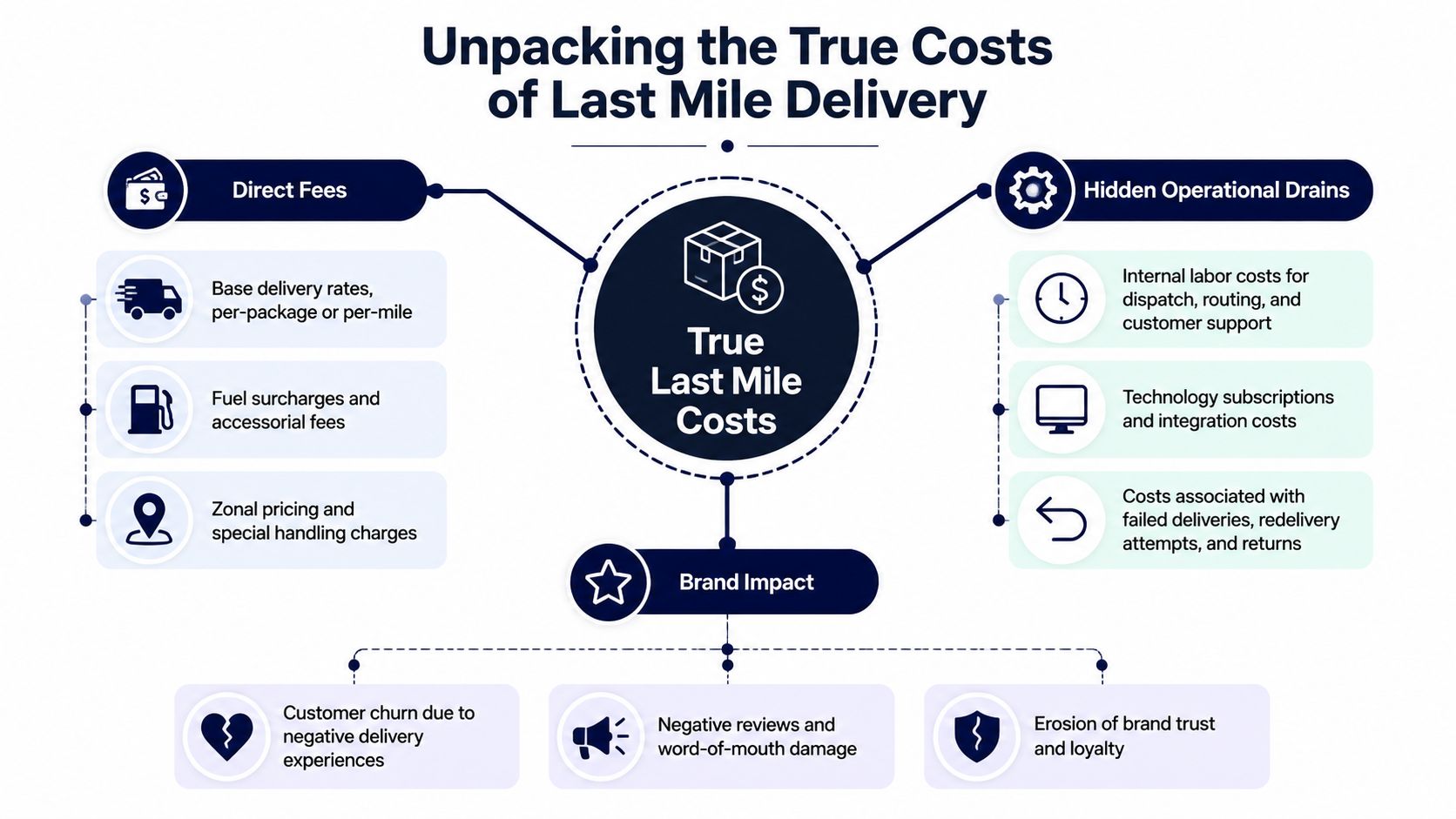
The visible costs are straightforward. Base delivery rates, surcharges, zone pricing, and special handling charges hit the P&L quickly. Founders usually catch those.
The hidden costs are where the damage starts. A failed first attempt creates redelivery work, support tickets, order investigation time, carrier dispute work, and often a replacement or refund decision. The rate card doesn't include your CX team spending half the day answering “where is my order?” messages.
As volume grows, delivery inefficiency stops being isolated. It spreads into multiple teams:
That's why route planning technology matters, but only when it's tied to real operating decisions. If you're evaluating what better planning looks like in practice, this breakdown of truck routing software is useful because it focuses on how routing affects execution, not just maps on a dashboard.
A lot of teams also undercount the impact of shipping on unit economics. If you're trying to build a more disciplined cost view across fulfillment and delivery, this guide on how to calculate landed cost helps frame the broader picture.
Poor delivery creates costs that won't appear in a carrier contract. Lost trust. Negative reviews. Lower repeat purchase confidence. More refund pressure. More demand for proactive status updates.
The best operators separate three buckets on their internal scorecard:
| Cost bucket | What sits inside it |
|---|---|
| Direct fees | Carrier charges, accessorials, fuel, special handling |
| Hidden operational drains | Support labor, redelivery work, reshipments, systems integration |
| Brand impact | Churn risk, review damage, reduced loyalty |
If you only negotiate rates, you're solving the smallest part of the problem.
A lot of teams still rely on one headline metric: on-time delivery. That metric matters, but it's not enough. An order can arrive “on time” and still be expensive, hard to support, or damaging to the customer relationship.
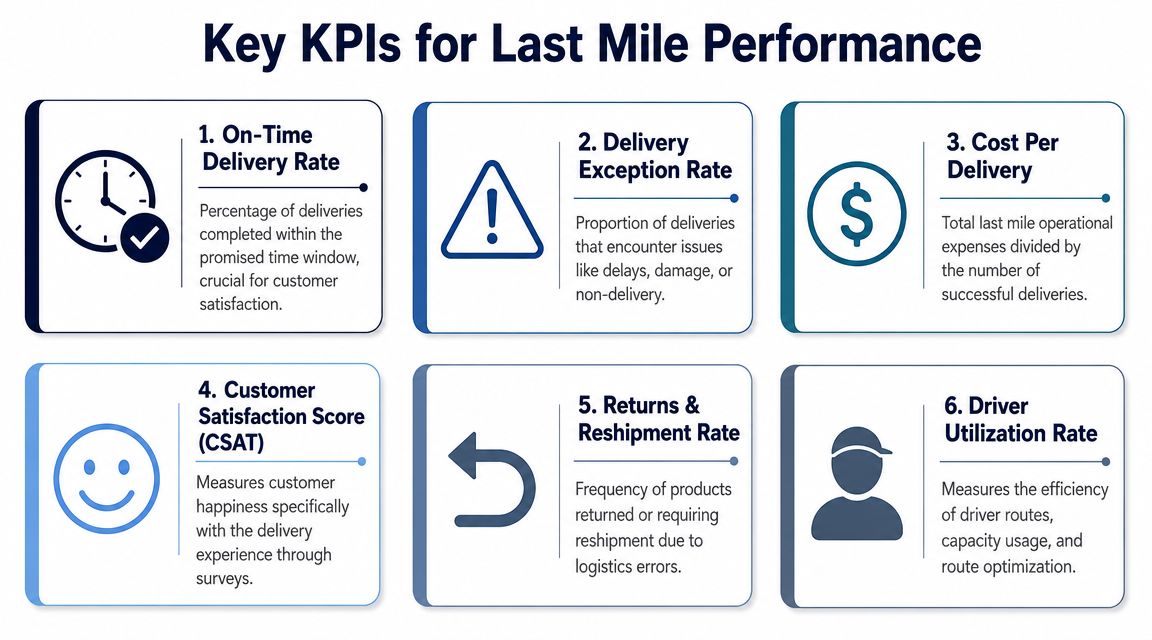
For a scaling e-commerce brand, the dashboard should connect delivery performance to both margin and customer experience.
This is your total last mile operating cost divided by successful deliveries. It forces honesty. Not quoted rates. Actual delivered economics.
If cost per delivery rises while top-line growth looks healthy, your expansion may be getting less efficient.
This is one of the cleanest indicators of execution quality. A fast promise means very little if customers aren't home, addresses fail, or the handoff breaks.
The best route isn't always the fastest one. It's the one most likely to end in a completed delivery.
Track how often deliveries hit delay, damage, access, address, or non-delivery issues. This metric often tells you more about operational quality than broad on-time figures do.
Measure satisfaction with the delivery experience, not just the product. A customer can love what they bought and still blame your brand for a poor handoff.
Good KPI design doesn't end with definitions. The numbers have to be visible to operations, CX, and leadership in a form they can use. Teams running more field-heavy workflows often benefit from tools designed around driver communication and execution. For example, Nimbio's in-car solution is relevant when you're thinking about how drivers access route and delivery information safely in motion.
A broader e-commerce scorecard should also connect delivery metrics to the rest of the business. This roundup of key performance indicators for ecommerce is useful if you want to align logistics KPIs with profitability, customer satisfaction, and repeat purchase goals.
A practical delivery dashboard usually needs:
Too many teams measure activity. Strong teams measure outcomes.
There isn't one best answer. The right last mile delivery solution depends on what you sell, where you sell it, what customers expect, and how much complexity your team can absorb without breaking other parts of the business.
A useful way to make the decision is to judge every option against four filters: order density, product profile, customer promise, and geography.
Right at the start, map the decision visually.
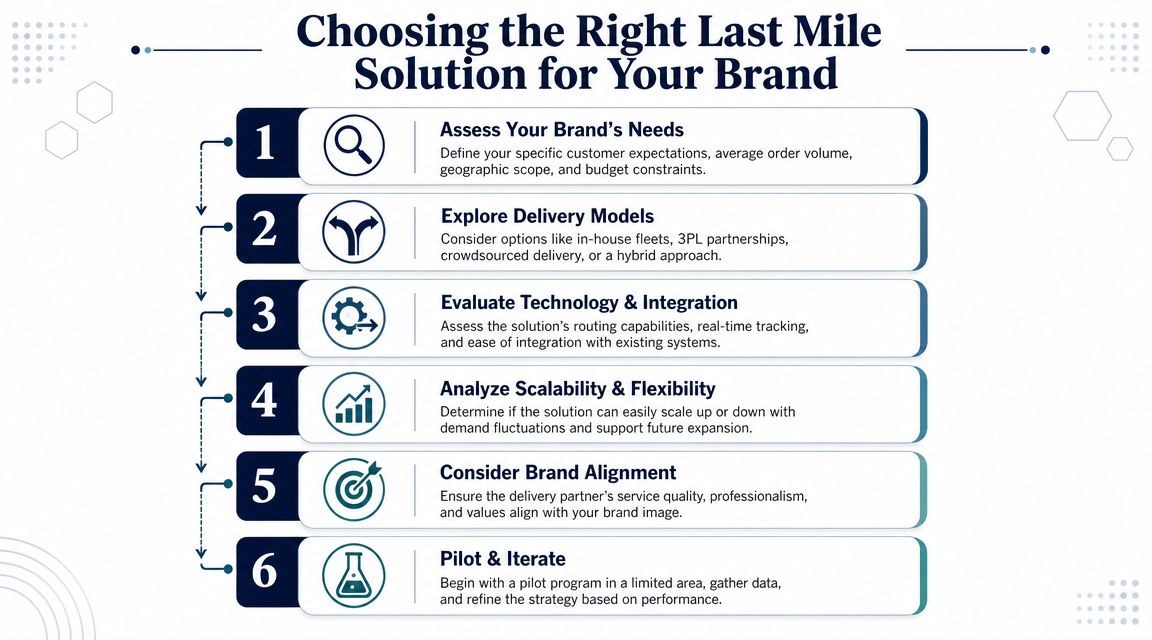
Founders often choose based on the service level they want to offer. That's backwards. Start with density. If orders are concentrated in a few urban zones, you have more room to justify local fleets, same-day programs, and tighter delivery windows. If demand is scattered, the economics push you toward partnerships, pickup models, or hybrid routing logic.
This matters even more in rural delivery. The common advice to “use better routing software” is too shallow. As the rural delivery paper from Detrack makes clear, low-density routes often require hybrid models built around regional hubs, local carrier partnerships, and pickup points because inconsistent addressing and sparse stop density make standard approaches unreliable.
Small durable items can move through standard parcel networks with relatively low touch. High-value items, fragile products, perishables, and oversized goods need more control.
Ask blunt questions:
Those answers narrow your model fast.
Many brands over-optimize for headline speed because they think it signals competitiveness. But the better commercial question is whether faster delivery improves margin once failed handoffs, access issues, labor timing, and support overhead are included.
The urban delivery discussion from ECA Delivery Industry points toward a more useful view. Real-time traffic data, dynamic routing, lockers, crowd delivery, micro-hubs, and off-peak delivery windows all matter, but reliability and completion often matter more than pure speed.
A same-day promise that fails regularly is weaker than a next-day promise customers can trust.
Many software decisions go wrong because teams buy tools before they've settled the operating design. If you're reviewing systems, this guide to shipping software choices is a practical reference as it pushes the conversation toward integration fit, workflow, and business requirements.
Later in the process, it helps to pressure-test your assumptions with a walkthrough like this:
| Business condition | Usually the better fit |
|---|---|
| Dense metro demand and premium delivery expectations | In-house or tightly managed local partners |
| Broad regional or national coverage | 3PL or hybrid carrier network |
| Low-density rural coverage | Regional hubs, local partnerships, pickup options |
| Urgent urban delivery needs | Crowdsourced or specialized local delivery |
| High failed home delivery risk | Lockers, PUDO, or scheduled delivery windows |
The right answer usually isn't a single model. It's a controlled mix.
Once you know the model, vendor choice becomes the primary risk point. Founders often underestimate how much a weak partner can distort customer experience while still looking acceptable in a sales process. A polished demo won't save you from poor exception handling, weak reporting, or inconsistent service on peak days.
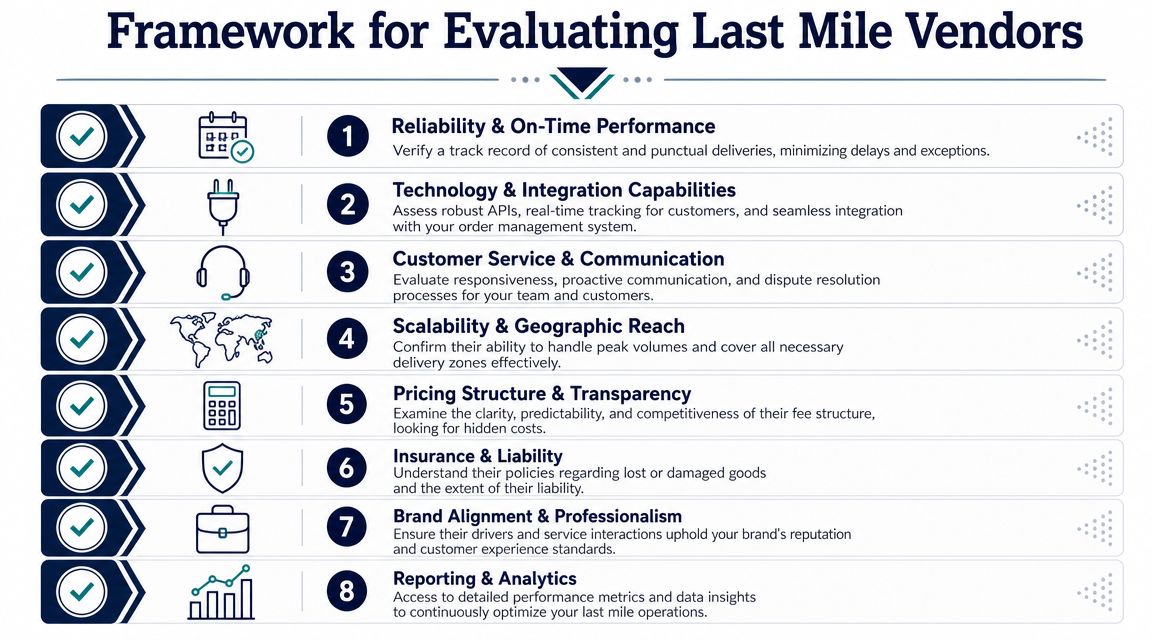
A serious vendor review should cover these categories.
Ask how they handle delivery exceptions, address problems, customer-not-home events, and peak compression. Don't accept broad promises. Ask for real process detail.
Good vendors make order flow, tracking, proof of delivery, and exception visibility easy for your team. If integration sounds custom-heavy, slow, or fragile, expect operational pain later.
You need reporting that separates carrier performance, geography, exception types, and service levels. If the dashboard can't tell you why deliveries fail, it can't help you improve them.
Use your due diligence calls to test maturity, not chemistry.
One overlooked issue is whether the vendor helps you protect your brand, or just move parcels. Those are different jobs.
| Category | What to verify |
|---|---|
| Reliability | Consistent execution, clean exception handling, realistic service commitments |
| Integration | API quality, dashboard usability, tracking visibility, ease of implementation |
| Support | Fast communication, named contacts, clear escalation paths |
| Scalability | Peak readiness, geographic flexibility, ability to support growth |
| Pricing | Transparent structure, understandable surcharges, predictable billing |
| Liability | Claims process, damaged or lost parcel responsibility, coverage clarity |
| Brand fit | Driver professionalism, customer communication quality, service standards |
| Analytics | Useful reporting, root-cause visibility, operational insights |
Don't ask whether a vendor can scale. Ask how they failed the last time a client scaled too quickly, and what changed afterward.
That answer usually tells you more than the deck.
A delivery transition goes wrong when brands treat it like a switch instead of a rollout. The operational details matter. So does sequencing.
The practical goal is simple. Reduce surprises. A good rollout doesn't depend on everything going perfectly. It depends on your team knowing what to do when things don't.
If you're running a serious e-commerce brand and want candid operator-level conversations about logistics, scaling, and what works in the field, Million Dollar Sellers is where high-performing founders compare notes without the usual noise.
Join the Ecom Entrepreneur Community for Vetted 7-9 Figure Ecommerce Founders
Learn MoreYou may also like:
Learn more about our special events!
Check Events