Chilat Doina
June 28, 2026
Friday afternoon is where weekend shipping promises go to die.
A customer places a high-intent order at the end of the week, then sends the message every operations lead has seen: can this arrive by Saturday? If your team answers too loosely, support inherits the fallout on Monday. If your team answers too conservatively, you lose conversion to a competitor that presents a cleaner promise.
The problem with UPS on Saturdays isn't whether UPS delivers on Saturdays. It does. The problem is that most brands collapse three different things into one answer: delivery availability, pickup availability, and business day definitions. Those are not the same thing, and the gap between them is where margin leaks, SLAs break, and customer trust takes damage.
For larger e-commerce brands, Saturday shipping isn't a customer service footnote. It's part of your offer architecture. If your checkout, warehouse process, shipping rules, and support scripts don't agree on what Saturday means in practice inside UPS, you're making promises your ops team can't keep consistently.
The common answer is, "Yes, UPS delivers on Saturday."
That's technically true and operationally incomplete.
A better answer is this: UPS on Saturdays works well for residential delivery in many situations, but it doesn't automatically mean your package qualifies for a Saturday guarantee, and it definitely doesn't mean your warehouse can ship outbound on Saturday like it's a normal business day. That distinction matters most when a shopper orders late on Friday and expects a weekend arrival.
Most failures start with one of these assumptions:
If you're running a high-volume catalog, one bad shipping rule multiplies fast. The customer who ordered a birthday gift, replenishment SKU, or event-driven item doesn't care whether the miss happened because your team misunderstood carrier definitions. They care that the promise failed.
Practical rule: Never let the phrase "Saturday delivery available" appear on your site unless your shipping logic also defines who qualifies, which services qualify, and what happens when a Friday linehaul misses.
The cleanest way to manage UPS on Saturdays is to treat it as a selective conversion lever, not a blanket network assumption.
Use it where it improves customer experience and protects contribution margin. Don't spread it across your catalog just because the carrier can physically deliver on a weekend. Brands win with Saturday promises when they narrow the offer to the right zones, products, and order windows, then train support to speak in exact terms.
That approach feels less flashy than "weekend delivery everywhere." It also produces fewer refunds, fewer escalations, and fewer Monday surprises.
Saturday with UPS is a one-way street for most sellers. Packages move to residential customers. They usually don't move from your warehouse through a normal Saturday pickup cycle unless you operate at negotiated enterprise scale.
UPS changed the game in the U.S. when it made Saturday a standard delivery day for residential ground coverage, reaching 40 million additional U.S. consumers and shifting Saturday from a premium, air-only concept into a standard home-delivery operating day, as reported by Transport Topics on UPS Saturday expansion.
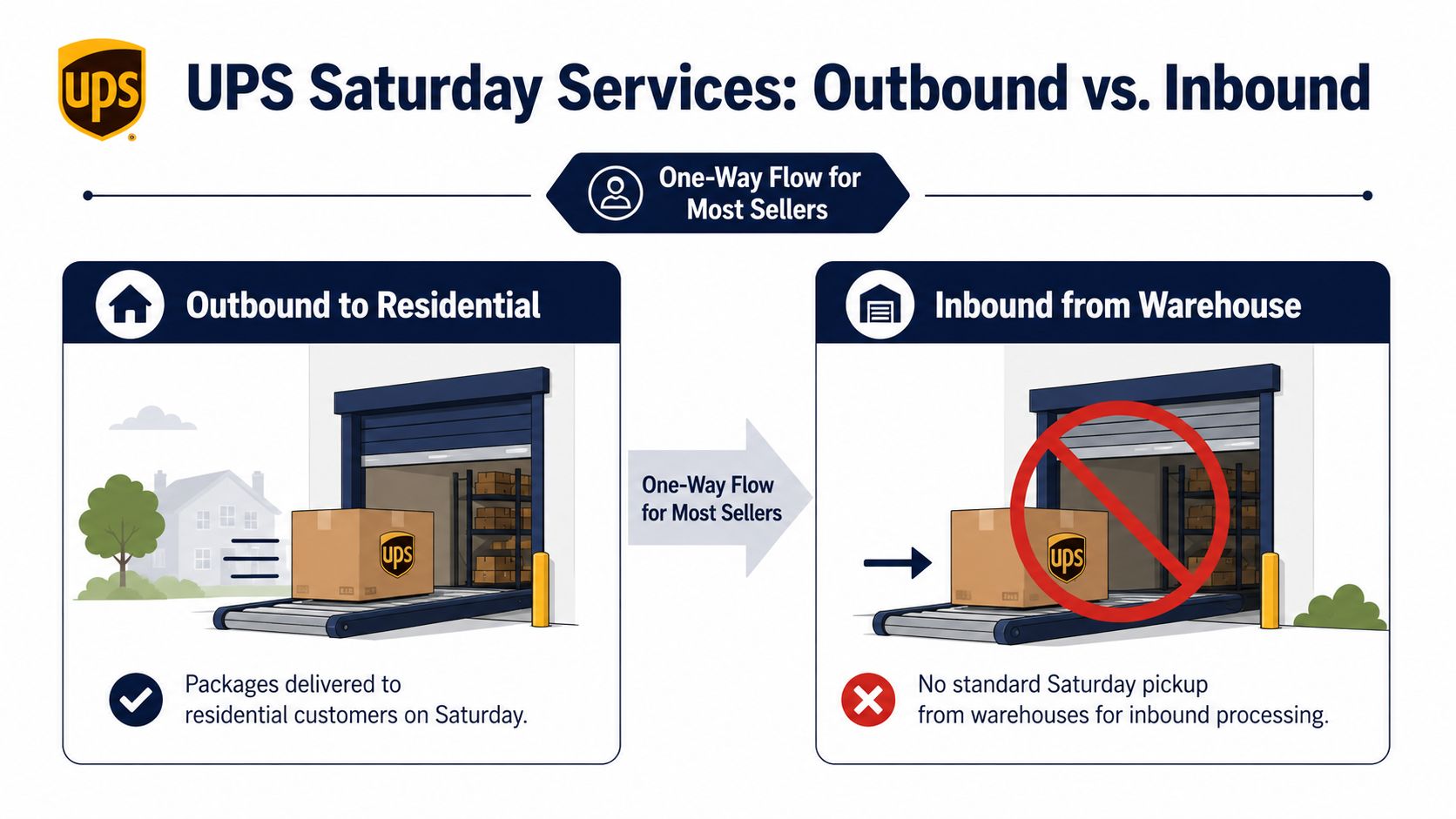
For most e-commerce brands, the useful side of UPS on Saturdays is customer-facing delivery.
Residential delivery is the key word. If your buyer is shipping to a home, Saturday becomes part of the service conversation in a way that can improve conversion and reduce the dead zone between Friday and Monday. This is especially valuable for time-sensitive orders where the buyer doesn't want to lose the weekend waiting on a truck.
That makes UPS a practical option for brands tuning their last-mile delivery strategy. Saturday delivery can narrow the perceived transit gap without forcing every order into premium air.
Now the hard part. Your warehouse and the customer's front porch do not operate under the same Saturday logic.
Standard commercial Saturday pickups are effectively reserved for very large shippers with negotiated weekend trailer arrangements, based on this operator breakdown of UPS weekend pickup reality. For most small-to-mid-sized brands, Saturday is not a normal outbound day. That means you can promise weekend delivery only if the package is already inducted into the network by the right Friday cutoff.
Think of it this way:
| Saturday function | Typical reality for most sellers |
|---|---|
| Residential delivery | Available |
| Commercial warehouse pickup | Usually unavailable without special contract |
| Customer expectation | "It can arrive Saturday" |
| Ops requirement | "It had to move Friday" |
The practical split is simple:
If your team doesn't separate these lanes in your OMS, shipping matrix, and support macros, Saturday becomes chaos disguised as convenience.
A customer places a premium order late Thursday, sees Saturday delivery at checkout, and expects the box this weekend. Your ops team sees the same order very differently. The package may be eligible for Saturday delivery, but that does not mean Saturday counts inside UPS's business-day clock.
That distinction drives refund exposure, service promises, and carrier spend.
According to this analysis of UPS Saturday business day definitions, UPS can deliver to residential customers on Saturday while still defining business days as Monday through Friday for service commitments. The same source explains why a Friday delay on 2nd Day Air can roll the guaranteed date to Monday unless the shipment was set up with the specific paid Saturday Delivery option.
For operators, weekend demand turns into avoidable claims. Merchandising teams write "2 business days." Customers read "by Saturday." UPS may still treat Saturday as available for delivery but outside the standard guarantee framework.
Those are not the same promise.
If your checkout, PDPs, and CX macros do not separate "Saturday available" from "Saturday guaranteed," support inherits the gap. Margin follows. Brands that want lower parcel costs without creating false urgency should tie that language review to a broader analysis of the cheapest way to ship packages, not treat weekend messaging as a copy issue.
The next mistake is assuming Saturday economics are uniform. They are not.
Destination type changes the math. Residential Saturday delivery can be built into standard network availability in many lanes. Commercial Saturday handling follows different rules and can trigger extra charges depending on service setup and account configuration. That matters for any brand shipping to offices, retail stores, event venues, wholesale accounts, or creators using business addresses.
Carrier comparison tools can still help. Some teams use a USPS postage calculator for creators to benchmark lightweight parcels against USPS options before they commit to a weekend promise. Do that after you confirm address classification and service rules, not before. A cheap rate on paper is irrelevant if the Saturday expectation was never contractually covered.
The Friday cutoff is what decides whether UPS on Saturdays helps you or embarrasses you.
Most brands obsess over the service name and ignore the handoff deadline. That's backwards. A valid service level doesn't matter if the carton misses induction. Since standard commercial Saturday pickups are largely unavailable for ordinary sellers, your real operating window closes on Friday, not Saturday.
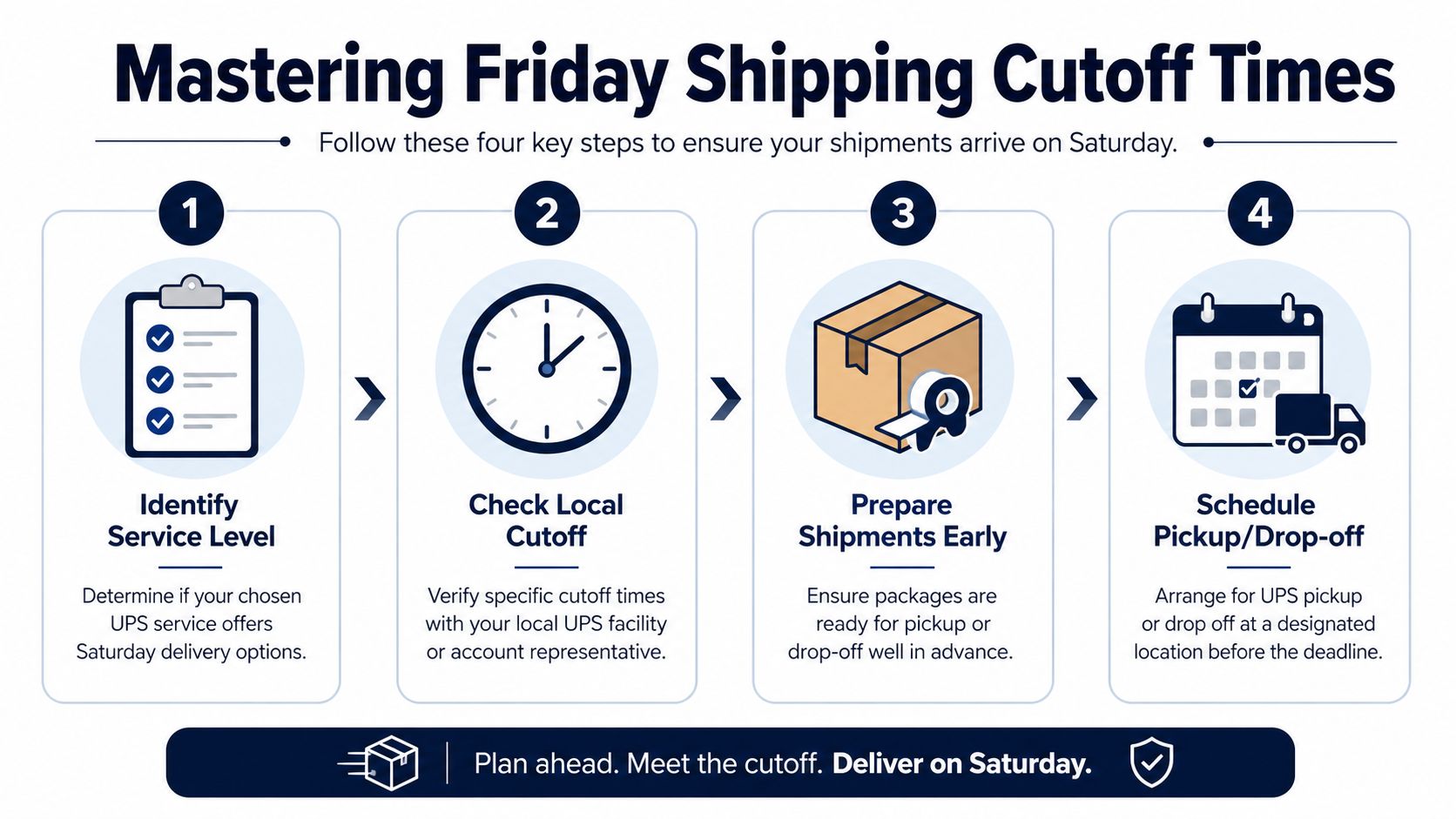
Use a simple chain of custody mindset:
For brands trying to reduce parcel spend while preserving service, this kind of rule-setting belongs inside your broader cheapest way to ship packages analysis. Cheap shipping that misses the weekend promise often costs more after refunds, WISMO contacts, and replacement orders.
The uncomfortable answer is the useful one. Most sellers cannot count on a Saturday pickup from their warehouse.
That means common workarounds have limits:
Operator note: If you don't have a negotiated weekend pickup program, treat Saturday as a customer delivery day and a warehouse planning day.
Instead of asking, "Can UPS deliver this Saturday?" ask:
Those questions prevent more failures than any generic "weekend shipping available" banner ever will.
For brands shipping into Europe, Saturday is no longer just a U.S. operating nuance. It's a market-positioning advantage.
UPS announced that it became the only carrier to offer Saturday Standard delivery to residential addresses without a surcharge across eight major European markets, namely Belgium, France, Germany, Italy, Netherlands, Poland, Spain, and the United Kingdom. That expansion allows businesses to reach over 130 million households on Saturdays, according to the UPS Europe Saturday Standard announcement.

In Europe, this changes the customer promise from premium perk to standard expectation in key B2C lanes.
If you're selling cross-border and still presenting weekday-only assumptions in your delivery messaging, you're underusing a service advantage that can influence conversion. Faster perceived access over the weekend matters most in categories where buyers are purchasing for immediate use, gifting, travel, or event timing.
Keep the message market-specific.
For international brands, this is less about parcel trivia and more about offer design. A seller that can credibly promise standard Saturday residential delivery in major European markets has a cleaner proposition than one still talking in vague weekday windows.
Friday at 4:30 p.m., the pressure hits. Merchandising wants to keep the weekend promo live, CX wants fewer WISMO tickets, and ops has one question that decides margin. Are you offering Saturday delivery, or are you offering a Saturday outcome that still sits outside UPS's official business-day logic for parts of your SLA?
That distinction should shape the program.
A smart Saturday strategy starts with controlled availability. Offer it where it improves conversion or saves a sale, and avoid turning it into a sitewide promise that creates service refunds, manual exceptions, and bad customer expectations. Customers care about arrival. Your finance and operations teams also need to care about whether that Saturday movement changes guarantee exposure, labor planning, and claim handling.

The strongest rollout is narrow at first. Tie Saturday availability to a small set of SKUs, a defined destination list, and a hard Friday operating window your warehouse can hit. Then measure the operational drag. Missed cutoffs, relabels, support contacts, and post-delivery concessions matter more than headline conversion lift if the program erodes contribution margin.
Here is the operating model I recommend:
| Decision area | Best practice |
|---|---|
| Checkout messaging | Promise eligibility and cutoff-based delivery windows |
| Carrier setup | Use UPS services that match your actual Saturday coverage and margin target |
| Internal SLA policy | Document where Saturday counts as customer-visible delivery versus where business-day rules still govern claims or guarantees |
| CX scripts | Explain cutoff time, address eligibility, and service exceptions in plain language |
| Promo strategy | Attach weekend delivery to specific campaigns, launches, and seasonal demand spikes |
| Margin control | Keep premium weekend handling on products and channels that can pay for it |
Best use case: Launch Saturday delivery where it protects high-intent revenue, reduces cart abandonment, or wins time-sensitive orders. Expand only after exception rates and support costs stay under control for several weeks.
Talk to your rep once Saturday volume affects forecast, staffing, or refund exposure.
Bring lane-level detail. Show Friday order intake by hour, destination mix, residential versus commercial split, average order value, and the share of orders where Saturday availability changes conversion. Ask direct questions about service availability, pickup timing, and how UPS defines the shipment inside its business-day framework. That last point is where many brands get sloppy, and it is where avoidable cost usually starts.
When Saturday shipping breaks, the same questions come back every week. Your support team shouldn't have to improvise.
Because Next Day Air and Saturday are not automatically the same promise. If the specific Saturday option wasn't selected where required, the customer may have bought speed without buying Saturday.
Support should avoid saying "it was overnight, so it should've arrived Saturday." That's exactly the kind of shorthand that creates avoidable concessions.
Check the destination first.
If the package went to a commercial address, Saturday pricing logic can be different from residential logic. This is why address classification needs to happen before rate display, not after the invoice lands.
Sometimes you can complete the handoff. You shouldn't assume immediate transit progression.
For most brands, a Saturday drop-off is a convenience move, not a substitute for a real Friday induction plan. If your team treats it like a rescue button, you'll create false confidence.
Because someone on your team likely used delivery language where business-day language should've been used, or your site copy was broader than your carrier setup.
Use this checklist when a Saturday complaint appears:
Use precise language:
That kind of wording lowers friction because it's accurate, repeatable, and defensible.
Million Dollar Sellers is where serious e-commerce founders compare notes on operational details like this before they become expensive mistakes. If you're running an established brand and want access to candid strategy from other high-level operators, apply to join Million Dollar Sellers.
Join the Ecom Entrepreneur Community for Vetted 7-9 Figure Ecommerce Founders
Learn MoreYou may also like:
Learn more about our special events!
Check Events