Chilat Doina
November 15, 2026
The most popular advice about an Amazon growth mindset is to experiment more, embrace failure, and keep investing. That advice gets expensive when nobody defines how much failure the business can afford. A seller can learn something from a campaign and still make a bad decision by continuing to fund it.
Growth is a funding decision, not a personality trait. The useful question isn't whether you're willing to take risks. It's whether you can explain what a bet should improve, what evidence would justify more investment, and what would make you stop.
A fixed-mindset seller treats a setback as a verdict; a growth-mindset seller treats it as a diagnosis to make before committing more cash.
Fixed-mindset and growth-mindset responses to common seller situations
| Situation | Fixed-Mindset Response | Growth-Mindset Response |
|---|---|---|
| Sales dip | Cuts price immediately | Checks traffic and conversion first, then tests one change |
| New competitor | Matches their price | Compares contribution margin before reacting |
| Failed ad campaign | Switches ads off | Reviews search terms and break-even ACoS, then adjusts |
| Stockout | Reorders the same quantity | Reviews sell-through and lead time, then changes the reorder point |
| Flat month | Blames Amazon changes | Runs one controlled test and sets a review date |
The difference isn't optimism. Both sellers want the business to recover, but only one separates the symptom from its possible causes. Lower sales could reflect fewer sessions, weaker conversion, lost availability, or a change in the products customers buy.
Open Seller Central's Business Reports before changing the offer. Compare sessions, ordered units, and unit session percentage for the affected products. Then check availability and recent changes to price, advertising, and listing content.
Before acting, ask: What would need to be true for this response to work? A discount makes sense only if the additional demand can compensate for the margin you surrender. A larger reorder makes sense only if expected sell-through and replenishment timing justify tying up more cash.
Inventory decisions deserve particular care because you can't reverse a purchase order as easily as an ad bid. ELECTE's guide to inventory optimization through data insights is a useful resource for connecting demand analysis with stock decisions rather than reordering by instinct.
Practical rule: Don't choose the action until you've named the problem it is supposed to solve.
Choose the success metric before making the change. For a traffic problem, qualified visits may be the diagnostic measure; for an offer problem, conversion and contribution profit matter more. Don't let a convenient dashboard metric replace the economic outcome you need.
Being willing to be wrong also means keeping the first commitment reversible. Test a listing change before commissioning a full creative overhaul. Validate demand before extending the same inventory bet across the catalog.
The first habit to build is simple: write a testable hypothesis before every change, including the small changes that otherwise disappear into daily account management.
Amazon's product-management model connects customer problems, explicit metrics, experimentation, and expansion of ideas that demonstrate value. For sellers, the practical lesson is to make changes answerable to evidence rather than to whoever argues most confidently.
Use this process to turn an account adjustment into a decision you can evaluate.
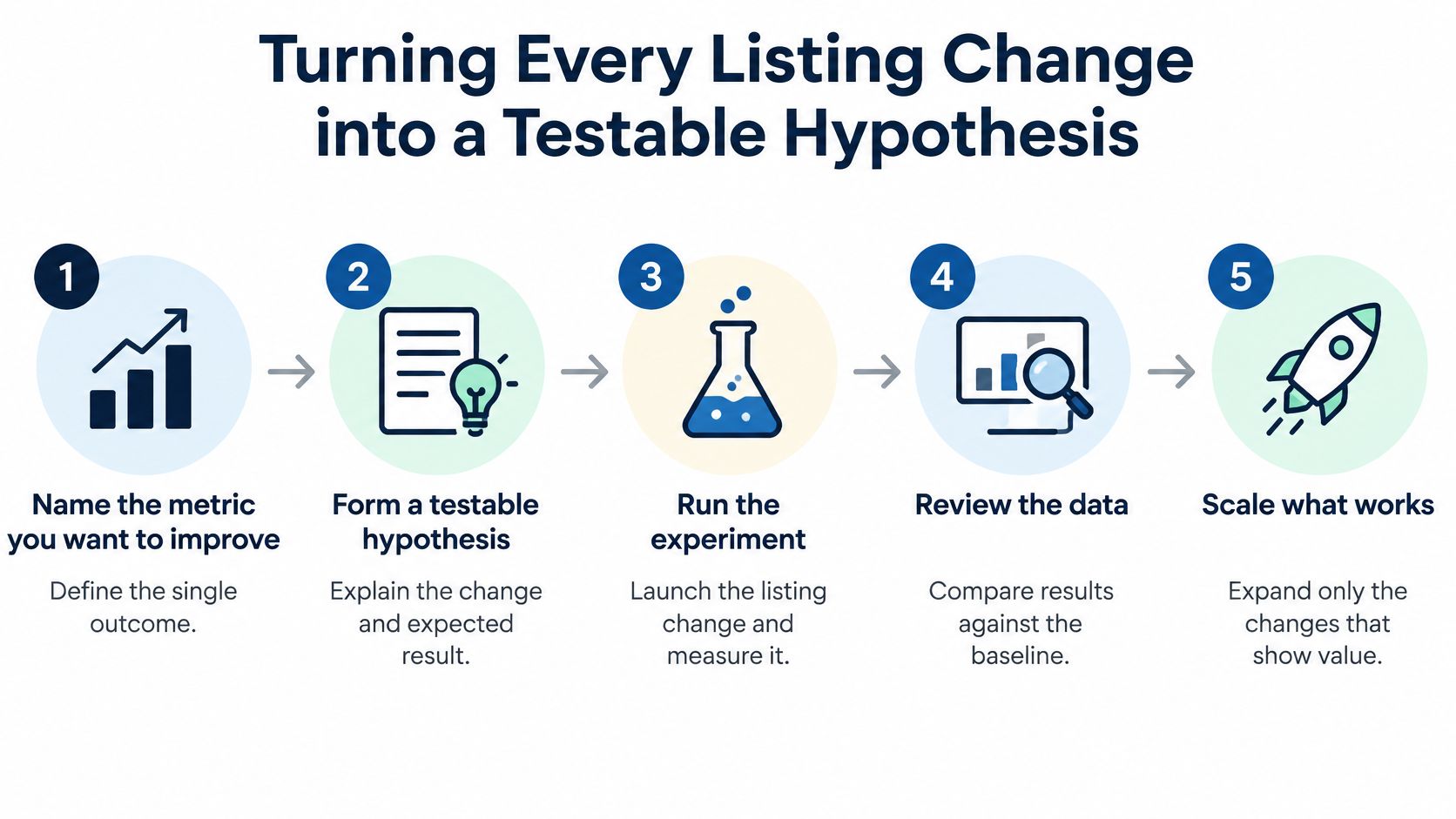
Name the decision. Specify the main image, ad bid, price, or reorder quantity you want to change. “Improve the listing” is too broad to evaluate because it could include several unrelated interventions.
Write a directional hypothesis with a meaningful hurdle. State what you expect to improve and the minimum improvement that would justify keeping the change. Set that hurdle from your economics and available traffic, not from a generic benchmark.
Choose the primary outcome. Use contribution profit per session when the decision affects both demand and economics. Conversion rate, repeat-purchase rate, or in-stock rate can be appropriate when they directly answer the question being tested.
Isolate the variable where possible. Don't change the price, main image, and bids together and then credit the image. Use Manage Your Experiments for eligible listing tests; for the underlying distinction between a comparison and a controlled experiment, consult MDS's explanation of A/B testing.
Set the observation window before launch. Allow for weekday and weekend behavior, sufficient orders, and reporting delays. A scheduled review isn't permission to declare a winner when the result remains inconclusive.
Record the result and the next action. Log the baseline, treatment, relevant disruptions, and whether you'll retain, reject, or investigate the change. Negative findings belong in the same record as winners.
Say a seller suspects shoppers misunderstand what's included in a product bundle. The hypothesis is that a clearer, policy-compliant main image will improve conversion enough to justify the creative cost, without increasing returns from mismatched expectations.
The seller tests the image while holding price and advertising strategy steady. Before launch, the team uses Stimulead A/B testing best practices as a design checklist and records the decision rules.
If conversion improves but returns also increase, the seller hasn't established a clean win. They need to investigate whether the image attracts more buyers by creating an expectation the product doesn't meet.
Better measurement supports better diagnosis. Faster diagnosis helps the team choose a better next iteration, while repeated validated improvements give the seller a stronger basis for scaling. An inconclusive result should lead to a better question, not an invented success story.
Fund experiments according to the question they can resolve and the downside the business can absorb, not their potential revenue alone.
Experiment types, the question each answers and when to stop
| Experiment | Question to Answer | Metric to Watch | Kill Signal |
|---|---|---|---|
| New sponsored product campaign | Does paid traffic convert above break-even? | ACoS against break-even ACoS | Still above break-even after the minimum window |
| Price test | Does a lower price lift contribution profit? | Contribution profit per unit and per session | Profit falls for consecutive scheduled review cycles |
| Inventory expansion | Will extra stock sell through before it ages? | Sell-through rate and days of cover | Days of cover exceed storage and aging limits |
| New fulfillment method | Does faster delivery lift repeat purchase? | Repeat-purchase rate and cost per order | Cost per order rises without a repeat-rate gain |
| Off-Amazon channel | Does the channel add incremental sales? | Incrementality and blended contribution margin | Blended margin falls with no measurable incremental lift |
A learning investment has a capped loss and a question that management can answer when the test ends. A structurally unprofitable channel keeps consuming cash after the learning window, with no credible mechanism for improving its economics.
Amazon's annual-report materials emphasize questioning what changed, experimenting across different paths, investing disproportionately in what matters, and pulling back when an initiative fails; the associated materials report sponsored-product advertising prices 48% higher in Q1 2025 than in Q1 2019. The seller's response should be disciplined allocation, not automatic budget expansion.
Write the maximum acceptable loss as a dollar amount in the test record. Include creative costs, discounts, incremental fulfillment expense, and expected inventory exposure where relevant. Stop when that cap is reached, even if the observation window hasn't finished.
Break-even ACoS = contribution margin per unit before ads ÷ selling price.
In a hypothetical example, a $30 product leaves $9 after product cost, Amazon fees, shipping, and other variable costs before advertising. Its break-even ACoS is 30%, calculated as $9 divided by $30; spending more than $9 in advertising per sale produces a negative contribution on that sale.
That is a ceiling, not necessarily your target. A business that needs contribution to cover overhead and fund replenishment must operate below break-even ACoS. Compare campaign performance with the product-specific threshold and refresh the calculation quarterly, or sooner when costs or pricing change.
Prioritize tests by decision value, cash exposure, and reversibility. Capital allocation strategies for ecommerce operators provide a useful framework for weighing those competing uses of money.
A revenue opportunity isn't automatically a good use of the next dollar.
Decline growth when it worsens payback, threatens availability of a more profitable product, or makes the business dependent on spending it can't sustain. Even a profitable order can be poorly timed if funding it prevents the next replenishment.
A seller can use the language of learning to avoid making an uncomfortable decision. The warning sign is repeated spending without a clearer explanation of how the business will earn that money back.
These mistakes aren't evidence that experimentation is wrong. They show where operating discipline is missing.
“We'll make it up in volume.” Set a contribution-margin floor before scaling. More orders won't repair a negative contribution per order unless the expansion changes the underlying costs or customer economics. Name that mechanism explicitly instead of assuming it will appear.
“The ads just need more budget.” Prove the offer can convert economically before raising spend. Check search-term relevance, product-page clarity, availability, and the offer itself. Increasing bids doesn't fix a listing that attracts the wrong shopper.
“We need more stock to defend rank.” Compare days of cover with the sell-through forecast. Include goods already ordered, not just units currently available. Otherwise, separate purchase orders can create a combined inventory commitment nobody intended.
“The result is obvious already.” Respect the observation window. Check whether a promotion, availability issue, or unusual traffic mix explains the movement. A dashboard change is an observation, not proof that the experiment caused it.
“Every test teaches us something.” Record what the result ruled out. Learning must change a future decision to have practical value. A vague takeaway that justifies repeating the same loss isn't enough.
“It started badly, so we stopped.” Separate safety stops from performance reviews. Stop immediately for a breached loss cap or a serious operational problem. Don't abandon an otherwise valid test merely because the early result is uncomfortable.
Growth is only good when it pays back.
Consider a hypothetical seller whose sales rise after expanding sponsored-product campaigns. The account looks healthier from the revenue dashboard, but the seller has less cash available for replenishment.
A campaign-level contribution review identifies a pair of campaigns bringing expensive orders with no convincing evidence of incremental demand. The seller cuts both, keeps profitable acquisition running, and redirects attention to the product offer.
Sales may fall while contribution improves. That isn't retreat for its own sake; it's refusing to finance demand the business can't afford.
A useful Amazon seller mistakes checklist should help the team catch these patterns before purchase orders and recurring budgets make them harder to reverse. Assign responsibility for correcting each issue, rather than treating the checklist as another report to file.
Jeff Bezos's 1997 shareholder letter, reproduced in Amazon's shareholder materials, emphasized customer focus, long-term value, and bold bets despite uncertainty. Amazon's sales increased from $15.7 million in 1996 to $147.8 million in 1997, connecting that ambition with measurable commercial expansion.
The useful lesson isn't that sellers should copy Amazon's spending capacity. It's that ambitious investment needs an operating routine capable of checking whether customers value the result.
A seed needs consistent care before harvest, not a burst of watering whenever the grower becomes impatient. Seller habits require similar consistency, with the added discipline of stopping investments that don't deserve another season.
Amazon added Learn and Be Curious in 2015, according to its Leadership Principles account, which also reports consumer business revenue rising from $245 billion in 2019 to $434 billion in 2022. That history supports treating learning as an ongoing operating requirement, not an occasional strategy exercise.
Use a shared decision log to make that requirement concrete.

Review cadence for a growth routine
| Review | Frequency | Key Question | Metric |
|---|---|---|---|
| Ad and bid review | Weekly | Is ACoS within break-even for each campaign? | ACoS, spend and orders |
| Inventory check | Weekly | Will current stock last until the next shipment? | Days of cover and sell-through |
| Pricing review | Every two weeks | Is contribution margin still above target? | Contribution profit per unit |
| Experiment review | Monthly | Which tests continue, stop or scale? | Test result against the kill signal |
| Strategy reset | Quarterly | Which channel or product line gets the next dollar? | Blended contribution margin and repeat-purchase rate |
This is a recommended cadence, not a requirement to change something at every meeting. Sometimes the correct decision is to leave a valid test running and record why.
Apply the same checklist at each review:
Pull reporting before the meeting. Use Seller Central, the advertising console, and a shared spreadsheet to flag products or campaigns that need a decision; don't spend review time reading dashboards aloud.
A small team should combine ad and inventory checks into the same working session and reserve deeper discussion for unresolved exceptions. Keep the monthly experiment review focused on funding decisions, not a presentation of every account activity.
Pair sales totals with repeat-purchase rate and customer-review themes. If acquisition rises while buyers report recurring product problems, more traffic may only increase the cost of fixing the underlying offer.
Protect the distinction between observation and action. A bad week deserves inspection, but it doesn't automatically justify a new strategy. The routine works when the team can explain why it acted and why it sometimes chose not to.
Choose a decision from the past month that you made without a written test. A price adjustment, campaign launch, or reorder is enough. Don't begin with the largest strategic question in the business; begin with a decision you can define clearly.
Rebuild it as an experiment before committing more money. Write what you believed would happen, identify the evidence you have, and separate that evidence from assumptions you still need to test.
Put these commitments in a shared document:
If the team can't agree on those commitments, the experiment isn't ready for funding. Resolve the disagreement before launch, when changing the plan is still inexpensive.
Peer review can help expose an assumption the team has stopped questioning. An advisor, an internal finance review, or a group of operators at a comparable scale can challenge whether the proposed test will produce useful evidence.
Million Dollar Sellers is an invite-only ecommerce community whose members are brand founders and leaders, not gurus or info marketers. For Amazon-led brands, eligibility requires at least $1 million in trailing-twelve-month Amazon revenue and founder or substantial-equity-holder status; membership also requires founder or CEO responsibility and P&L ownership.
Peer input should sharpen your judgment, not replace it. Bring the economics, inventory constraints, and proposed stopping rule, then ask what would make another operator reject the investment.
Use the coming week to turn an instinctive adjustment into an accountable bet. Finish with a written hypothesis, a primary metric, a dollar kill signal, and a booked review date. That's a practical Amazon growth mindset: stay open to being wrong while staying responsible for the cash.
Million Dollar Sellers offers an ecommerce peer network, private forums, and mastermind conversations where founders can pressure-test growth decisions with other operators. Visit Million Dollar Sellers to explore the community and whether its peer discussions fit the funding, margin, and scaling decisions you're making.
Join the Ecommerce Community for Founders Scaling from 7 to 9 Figures
Learn MoreYou may also like:
Learn more about our events!
Check Events