Chilat Doina
July 25, 2026
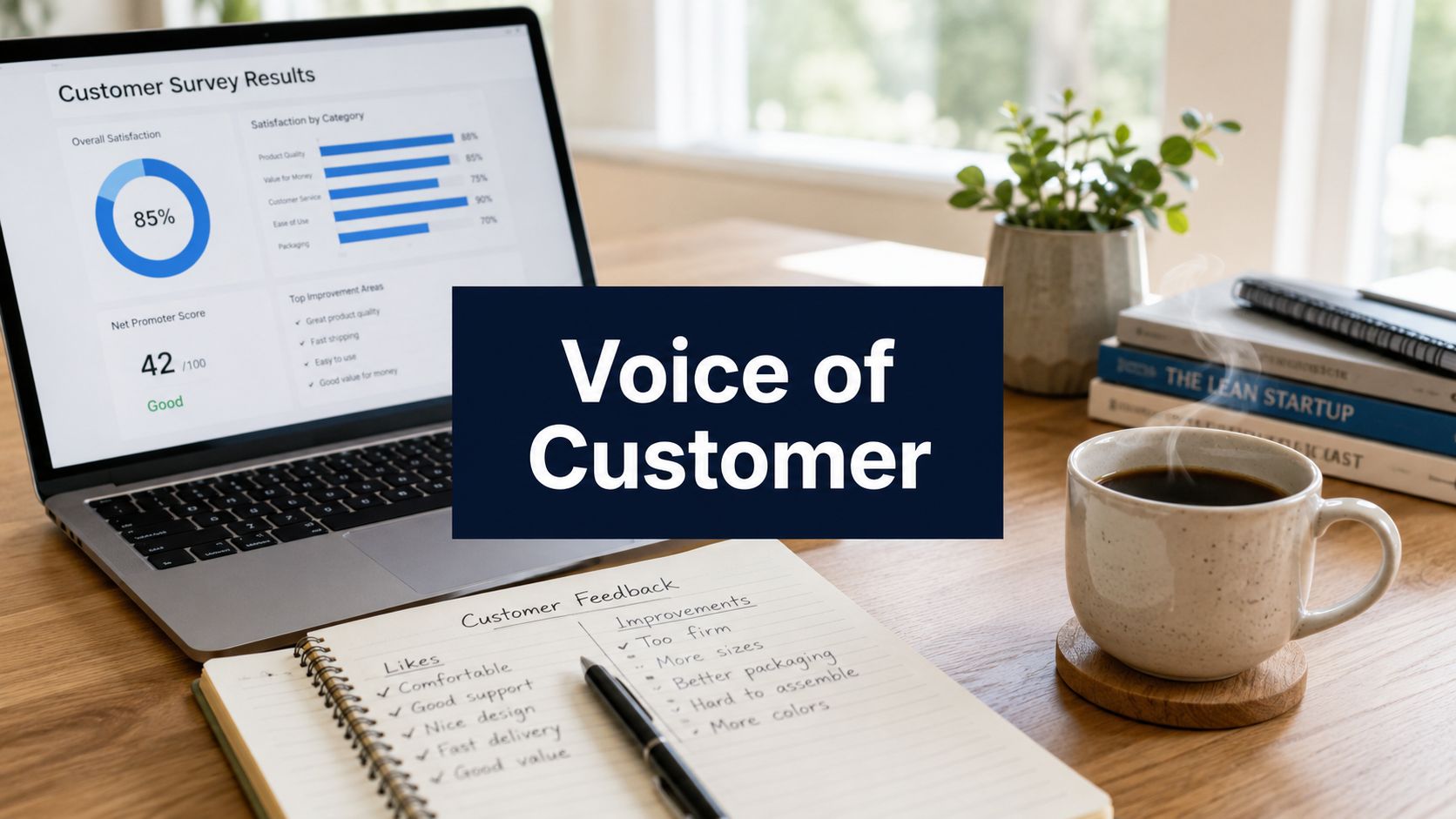
Voice of Customer is the system a brand uses to capture, analyze, and act on what customers say across every channel, not a one-off survey. If you're only sending a post-purchase form and calling that a VoC program, you're still guessing most of the time.
You know the moment. A product launches, reviews come in softer than expected, support starts hearing the same complaint again and again, and the team realizes the launch plan was built around assumptions, not customer language. That's where VoC stops being a buzzword and starts being a discipline.
A founder usually doesn't wake up asking for a VoC program. The need shows up after the product is already in market, when the team has a live listing, a paid media budget, and a growing pile of feedback that doesn't match the plan. One review complains about packaging, another about a confusing bundle, and a support ticket points to the same shipping issue customers never raised during pre-launch planning.
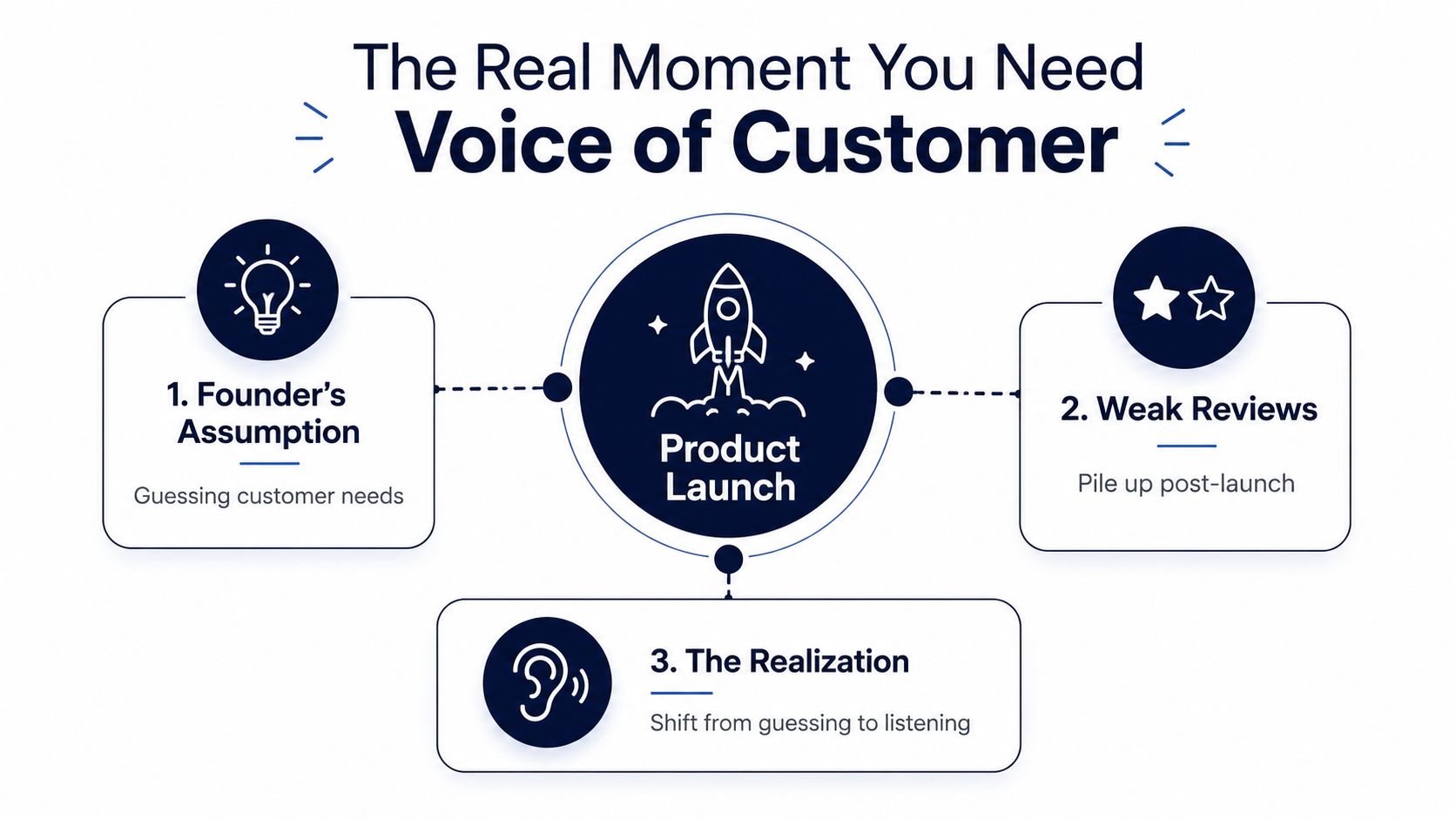
That's the point where Voice of Customer stops being a loose feedback pile and starts functioning as a business discipline. Salesforce describes VoC programs as structured systems that gather and act on customer input across surveys, support interactions, social channels, and digital touchpoints, with measurement often centered on NPS, CSAT, and CES as shared ways to track sentiment and experience (Salesforce).
A better comparison is a feedback loop in a factory. One comment by itself tells you almost nothing. Once the same customer language keeps flowing in, gets tagged, and reaches the right team, it starts pointing to where the business is losing revenue or creating friction. A single survey response is a note on the wall. A real VoC system routes survey responses, reviews, transcripts, and social signals into decisions people can use.
Practical rule: if customer language cannot reach product, CX, and marketing in a structured way, you do not have a VoC system yet, you have scattered comments.
MIT Sloan frames VoC as a process for capturing customer requirements and converting them into a detailed set of wants and needs (MIT Sloan). That framing helps because it shifts the question from “How do people feel?” to “What exactly are they asking for, rejecting, or struggling with?”
In practice, that means translating raw language into decisions. “Shipping is slow” becomes a logistics problem. “The bundle is confusing” becomes an offer architecture problem. “I wish this came in a different size” becomes assortment or variant strategy.
For an Amazon seller, that can mean seeing that star ratings are not the whole story if reviews keep pointing to damaged packaging or unclear instructions. For a DTC brand, it can mean hearing that customers like the product but drop off because the subscription offer feels hard to understand. The point is not to collect more comments. The point is to turn customer words into ranked priorities, then into changes the business can make.
VoC is not the survey. VoC is the operating system behind the survey.
A lot of teams still treat customer feedback as a support function. That made sense when the main job was closing tickets and calming irritated buyers. It breaks down in ecommerce, where one friction point can affect repeat orders, product returns, and whether a customer ever comes back.

The shift matters because structured VoC turns scattered comments into a working input for product, CX, and marketing. Salesforce describes VoC programs as a way to connect customer input to operational change, which helps teams move beyond reactive complaint handling and into deliberate experience improvement.
VoC becomes a growth driver when teams use it to spot recurring blockers, choose the fixes that matter most, and check whether those fixes improve the experience over time. The sequence is simple. Listen, sort, act, then verify whether the issue moved. That is how customer language starts shaping growth decisions instead of sitting in a dashboard.
For ecommerce, that shows up across the funnel. Product teams use VoC to refine bundles, sizing, packaging, or instructions. CX teams use it to reduce repeat questions and remove handoff friction. Marketing teams use it to tighten positioning so the promise matches the experience. A founder selling on Amazon may see reviews cluster around damaged packaging or confusing setup instructions, then use a practical guide to getting reviews on Amazon to understand how review volume and review quality affect what buyers say and what patterns surface.
Gartner defines VoC as an integrated system for feedback collection, analysis, and action. That structure matters because it keeps customer language tied to a business response instead of letting it disappear into a spreadsheet.
Founders do not need more sentiment for its own sake. They need to know why customers hesitate, what keeps them from reordering, and which complaints point to churn or refund risk. A missed sizing question in DTC can suppress repeat purchase. A confusing bundle offer can lower conversion before a support ticket ever exists. A recurring packaging complaint can drag down margin through replacements and returns. The same logic applies when teams use customer feedback analysis tools to group themes, rank patterns, and decide which problems deserve attention first.
That is why VoC sits closer to revenue than many teams assume. It reveals where customers are getting stuck before the problem becomes obvious in the numbers, and it gives founders a clearer way to decide what to fix, what to test, and what to leave alone.
For teams looking for a broader guide to customer satisfaction, the connection is direct. Satisfaction improves fastest when the same issues are being tracked, tagged, and acted on repeatedly.
A founder usually feels the need for VoC in a very ordinary moment. A review mentions a missing feature, support keeps seeing the same complaint, and the team is not sure whether that feedback is noise or a real revenue leak. The answer depends on the signal type, because not every customer input carries the same weight or comes from the same place.

A clean way to organize VoC is to separate what customers say, what they do, and what your analysis concludes from both. Direct signals are the words customers give you. Indirect signals are the behaviors they reveal. Inferred signals are the patterns your tools surface from text or activity.
This is the layer most teams know first. Post-purchase surveys, NPS prompts, CSAT prompts, interviews, review requests, and support transcripts all belong here because customers are speaking in plain language. These signals matter when you want the customer's own phrasing, since the way they describe the issue often shows how they understand it.
A post-purchase survey can show why a buyer felt unsure right after checkout. A short interview can reveal the gap between what a founder thought was obvious and what a customer experienced. Support transcripts can show whether one issue keeps returning under different wording.
Indirect signals are the things customers do without being asked. Reviews, social chatter, browsing patterns, product returns, and repeat purchase behavior all help show where the experience is breaking down. For teams using customer feedback analysis tools, this is the layer that helps connect scattered comments to the patterns behind them.
Inferred signals come from analysis. If text analytics groups hundreds of comments around the same theme, that cluster becomes a clue. If behavior keeps pointing to checkout drop-off after a certain product step, that is a signal even if no one wrote a complaint about it.
Plain-English rule: direct signals tell you what happened, indirect signals show where it happened, and inferred signals help explain the pattern underneath.
The right mix matters. A review-only program can overweigh loud opinions. A survey-only program can miss silent friction. A stronger VoC stack combines survey data, transcripts, reviews, and behavior, then routes the findings to the owner who can act on them.
For marketplace brands, this same collection logic pairs well with how to get reviews on Amazon, because review flow shapes both the volume and the kind of feedback you see.
The hard part of VoC is not collecting comments. It is deciding what they mean and which one deserves attention first. Mature programs separate the score from the story. NPS, CSAT, and CES show how customers feel. Theme frequency, sentiment, and verbatim comments show why they feel that way.
A survey is a tool. VoC is the operating system that turns survey output into ranked priorities.
NPS works well when you need a directional loyalty signal. CSAT is better when you want a narrower read on satisfaction after a specific touchpoint. CES helps when the question is how much effort the customer had to spend, which is useful in checkout, support, or onboarding. Sentiment analysis and theme tagging are better for spotting patterns across large volumes of text.
A simple trap is celebrating a strong score while ignoring the complaint hiding in the comments. A VoC program should not stop at the dashboard. The score tells you whether things are getting better or worse. The themes tell you what to change.
| Metric | What it measures | Best for | Limitation |
|---|---|---|---|
| NPS | Loyalty and willingness to recommend | Broad relationship health | Does not explain the reason behind the score |
| CSAT | Satisfaction with a specific interaction | Post-purchase, support, or delivery experiences | Can stay high even when deeper friction remains |
| CES | How hard a task felt | Checkout, onboarding, support resolution | Does not capture broader brand perception |
| Sentiment analysis | Positive, negative, or mixed language patterns | Large volumes of reviews, tickets, and transcripts | Can miss context and nuance |
MIT Sloan's framing of VoC as requirements engineering is useful here, because customer statements need translation before they become decisions (MIT Sloan). “The bundle is confusing” is not a metric. It is a design requirement waiting to be ranked by severity, frequency, and business impact.
That ranking process is where teams separate signal from noise. Theme frequency and verbatim analysis help group similar complaints, compare them against one another, and avoid chasing isolated opinions. They also connect customer language to product or CX work in a way that can be traced later, which is what keeps VoC from becoming a sentiment dashboard nobody acts on.
For teams that want to read customer intent and behavior together, the logic pairs well with consumer behavior analysis, because good decisions usually come from combining what people say with what they do.
Decision rule: use scores to rank the problem, then use themes and verbatims to define the fix.
For founders, the discipline is choosing fewer metrics and using them well. Track the ones tied to a clear operating decision, then pair them with the language customers use. A customer service team might see repeated comments about slow replies, while a DTC team might hear concern about bundle confusion or subscription terms. That is the point where VoC turns into product, pricing, and CX work instead of another reporting ritual.
If the team needs a practical way to decide which frustrations deserve attention first, the guide to customer satisfaction is a useful companion for turning feedback into actions customers can feel.
A founder comparing reviews across channels will usually notice the same frustration showing up in different forms. On Amazon, it appears in star ratings and listing comments. In DTC, it shows up in onsite behavior, post-purchase replies, and cancellation reasons. In omnichannel, it moves across marketplaces, retail partners, and owned sites, which makes the signal harder to read unless the team has one way to sort it.
Amazon feedback is public, which makes it useful and unforgiving. Review patterns, star trends, and repeated complaints about packaging, size, or instructions can show whether the listing promise is drifting away from the actual product experience. A review that says “size runs small” or “instructions missing” is not just a complaint, it points to a specific mismatch that can affect conversion and returns.
For Amazon operators, the main question is less “What are people saying?” and more “Which phrases keep appearing under this SKU, and what do they tell us to change?” That is why brand-registered workflows matter. The insight has to move from reviews into listing updates, packaging changes, and support macros while it is still current enough to affect the next wave of buyers. If you work in that channel, the operational playbook often sits alongside how to increase ecommerce conversion rate, because removing friction in the listing and purchase path usually starts with customer language.
DTC brands get better signal when they look beyond the homepage. On-site surveys, post-purchase email responses, subscription cancellation reasons, and customer service tickets all explain why buyers hesitate, pause, or leave. The strongest insight here is often quiet. A few customers may not complain loudly, but the same wording can repeat across stages of the journey.
Routing decides whether that signal becomes action. Product feedback belongs with the product team. Offer confusion belongs with lifecycle marketing. Delivery complaints belong with CX and operations. If the team only reads the inbox, it sees isolated messages instead of the pattern behind them.
Omnichannel operators have the hardest version because feedback is split across channels. Retail partners, marketplaces, and owned sites all surface different types of friction, and each one can pull priorities in a different direction if it is viewed alone. The fix is a shared tagging model that makes customer language comparable across sources.
The same issue can mean different things in different places, so the team has to normalize it before acting. A late-delivery complaint on a marketplace may belong to operations, while the same wording on a DTC support ticket may point to a carrier expectation problem. That is where VoC becomes decision infrastructure, not just a place to collect comments.
For marketplace-specific analysis, Amazon Brand Analytics helps because it shows how channel-native data and customer language should sit together, not in separate silos.
More feedback can feel like better feedback, but that is often an illusion. The risk in VoC programs is not too little data, it is distorted data. The people who feel strongly usually speak first and loudest, while repeat buyers, quiet loyalists, and high-value customers often stay out of the sample.
A small cluster of vocal respondents can pull a team toward the wrong problem. CustomerExperienceDive warns that brands should aim for a representative sample rather than leaning only on surveys and social listening, and that feedback should be weighted by customer value instead of treated as equal in every case. That matters because a few highly vocal respondents can make a problem look larger, or more urgent, than it really is for the business.
The quiet majority is the part founders miss. Repeat buyers often do not fill out forms. High-LTV customers may not leave reviews. Low-response segments can disappear entirely if the program only listens to whoever shouts the loudest.
The fix is better outreach design, not more surveys. Use purchase history to identify who has not been heard. Compare feedback by cohort instead of only by volume. Weight account-level feedback when a smaller group matters more to the business than the rest of the sample.
When loud reviewers dominate the dashboard, the roadmap starts bending toward emotion rather than lifetime value.
Founders should also ask who is missing from the picture. Are you hearing from first-time buyers but not repeat customers. Are high-value segments underrepresented. Are cancellations overrepresented because the survey only triggers after a bad moment.
The goal is representativeness, not noise. If the sample is skewed, the program can still feel active while pointing the team in the wrong direction. A mature VoC system corrects for that before decisions are made.
A useful VoC program doesn't need a research department on day one. It needs a simple workflow, a few recurring rituals, and one person who owns the loop. Start small enough to ship, then widen the system once the team sees the pattern.
Set up one post-purchase survey, one review dashboard, and one recurring customer interview. Keep the survey short and focused on the purchase experience. A simple set of starter questions works:
You're not trying to solve everything yet. You're just building a consistent way to hear the same kinds of answers from different customer types.
Build a basic theme-tagging model so the team can group feedback into repeatable buckets. Route the insights to product, CX, and marketing owners, not just one inbox. Add NPS or CSAT to lifecycle emails if you don't already have a touchpoint score.
A good interview prompt at this stage is simple. Ask, “What were you trying to do when you chose us, and where did we make that harder than it needed to be?” That question often surfaces hidden friction without forcing customers into survey jargon.
Close the loop with customers who gave useful feedback, run a recurring VoC review, and tie themes to refund or retention patterns in your own reporting. The point is not to create a report no one reads. The point is to create a habit where customer language changes the next decision.
Operational habit: if a theme shows up repeatedly and nobody owns the fix, VoC stops at observation.
That's the minimum viable system. One listening point, one tagging model, one routing rule, and one review cadence. Once those are in place, VoC becomes part of how the company operates, not a side project.
If you want a sharper peer benchmark for how top ecommerce operators turn customer language into action, join Million Dollar Sellers and compare notes with founders who treat VoC as a core growth system, not a reporting exercise.
Join the Ecom Entrepreneur Community for Vetted 7-9 Figure Ecommerce Founders
Learn MoreYou may also like:
Learn more about our special events!
Check Events