Chilat Doina
July 17, 2026
You're probably in the same spot a lot of growing Amazon operators hit. Revenue is real, ad spend is real, traffic is coming in, but listing performance has flattened. Your team keeps rewriting titles, swapping bullets, debating image order, and nothing feels tied to an actual operating system.
That's when Amazon listing optimization services stop being a copywriting purchase and start becoming a management decision. The question isn't whether someone can “improve the listing.” The question is whether a partner can improve conversion velocity, fit into your reporting cadence, and justify their cost against other uses of capital.
The category itself reflects that shift. The global Marketplace Listing Optimizer market reached USD 1.36 billion in 2024 and is projected to reach USD 4.01 billion by 2033 at a 13.2% CAGR, according to DataIntelo's marketplace listing optimizer market report. This isn't a niche freelancer market anymore. It's becoming part of core e-commerce infrastructure.
The clearest signal is operational, not creative.
If the founder, brand lead, or ads manager is still the person rewriting bullets at midnight, the business has a systems problem. The listing might improve, but the company loses speed elsewhere. New launches slip. Inventory planning gets less attention. Wholesale or DTC initiatives sit untouched because everyone's stuck in detail work on the Amazon shelf.
I've seen the pattern enough times that the tipping point is easy to recognize. A brand reaches respectable scale, then treats listing optimization like a side task instead of a managed function. The result isn't catastrophic. It's slower and more expensive growth.
Most sellers justify DIY with “we know the product best.” That's often true. It's also incomplete.
You may know the product best and still be the wrong person to own iterative optimization. Good Amazon listing optimization services create optimization velocity. They move from audit to test to learnings faster than an internal team that's splitting time across catalog issues, ad performance, customer feedback, and weekly fire drills.
Consider it this way:
| Situation | What it usually means |
|---|---|
| Traffic is stable but conversion stalls | The listing needs structured testing, not another brainstorm |
| PPC is carrying too much weight | Organic conversion quality likely isn't strong enough |
| Listing updates happen irregularly | No one actually owns optimization |
| Creative changes aren't measured | You're editing, not optimizing |
That's why I treat the hire as a capital allocation decision. If a service provider frees senior operators to focus on expansion, pricing, inventory, and channel strategy, the spend belongs in growth planning, not overhead.
Practical rule: Hire when the cost of keeping optimization in-house is lower-quality execution plus leadership distraction.
The best partner doesn't just send revised copy in a Google Doc. They install rhythm.
That means a clear owner, testing logic, and a process for prioritizing what changes first. Main image issues should beat wordsmithing. Objection handling should beat keyword stuffing. Reporting should tie listing work back to conversion and organic contribution, not just “we updated your content.”
A lot of seven-figure operators learn this same lesson when they start delegating more broadly. The pattern is similar to what's covered in ecommerce outsourcing and what 7-figure operators delegate first. You don't outsource because a task is annoying. You outsource because specialized execution compounds faster than founder attention.
If you're still treating listing optimization like a creative errand, you're probably late.
Most proposals sound better than they are.
Every agency says “keyword research,” “SEO copy,” and “conversion optimization.” That language is too vague to buy from. Strong Amazon listing optimization services should map to four separate operating functions, each with a distinct output and owner mindset.
In 2026, the listing has to serve more than one system. Effective optimization now has to account for the A10 keyword algorithm, COSMO, and Amazon's AI shopping assistant Rufus, which handles over 274 million daily queries. Brands using Premium A+ Content with video and interactive modules report up to 20% higher conversion rates than brands using basic A+, according to Incrementum Digital's 2026 Amazon listing optimization guide.
That changes what “keyword optimization” means. A good provider won't just build a keyword list. They'll structure the listing so Amazon understands relevance and the customer understands use case.
What to look for:
For brands also building outside Amazon, there's a useful parallel in broader SEO strategies for Australian businesses. The principle is the same. Search performance improves when structure, intent, and content clarity work together.
Here, weak agencies often falter. They talk about “enhanced brand content” but can't explain why one visual beats another.
Top services usually treat the listing as a conversion stack:
The difference is operational discipline. Serious teams brief images from review language, competitor gaps, and customer objections. Weak teams redesign for aesthetics.
The listing doesn't win because it looks nicer. It wins because it removes uncertainty faster.
A surprising amount of “optimization” work fails because basic technical hygiene is sloppy.
That includes suppressed content, indexing problems, mobile readability, backend field misuse, and variation issues. If the provider can't audit those elements before touching creative, they're not operating at the right level.
Under these conditions, the best providers separate themselves.
They should be able to answer questions like:
If they can't connect listing changes to category context, you're buying deliverables, not strategy.
Discovery calls tell you almost everything, if you ask better questions.
Most sellers waste that call asking for case studies and pricing ranges. Those matter, but they don't expose how the team thinks. You need to find out whether they operate like a strategic partner or a sales layer feeding work to junior copywriters.
Start with this checklist.
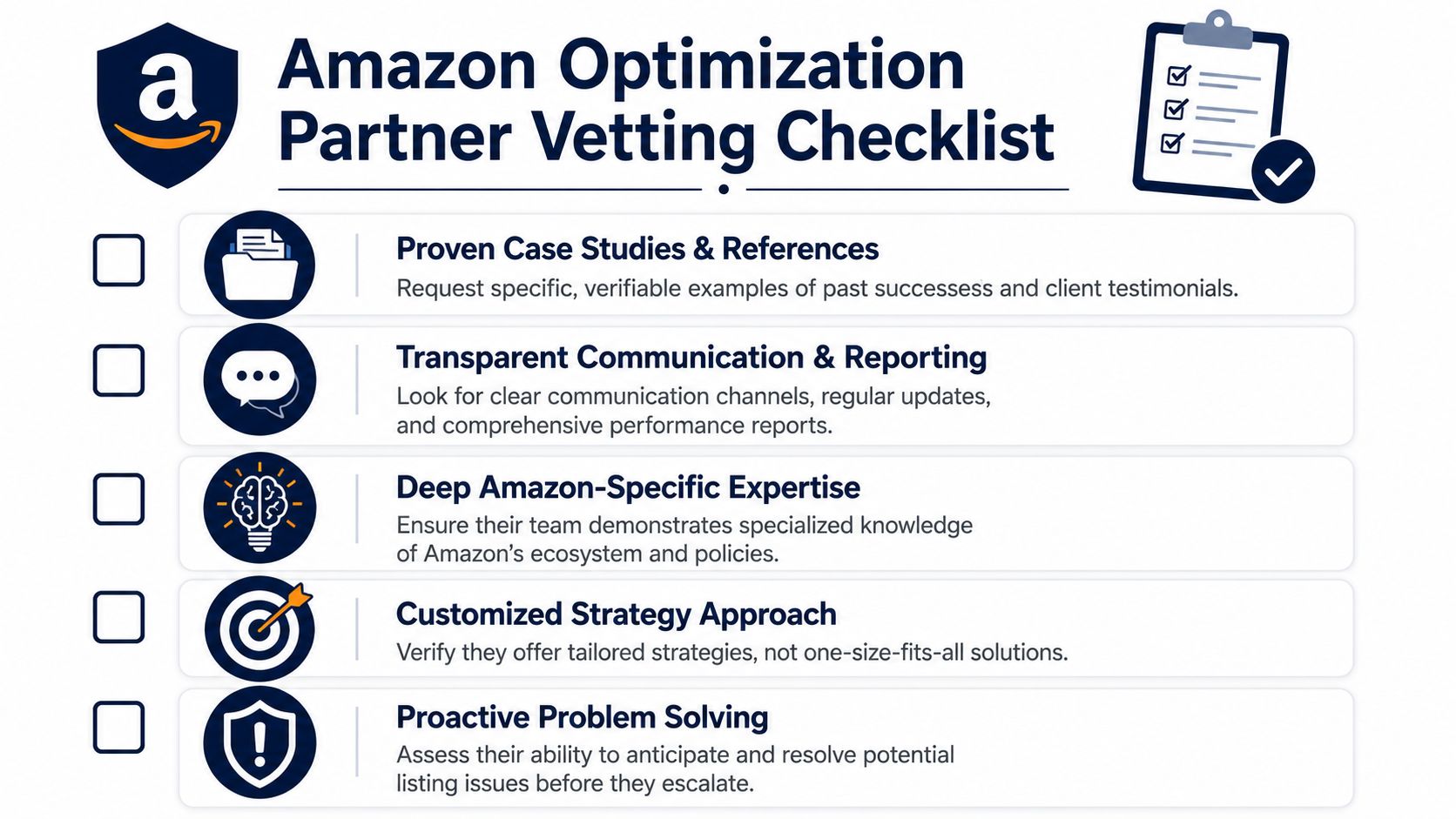
One of the best screening questions is simple. Ask how they move beyond rankings into objection removal.
Top-performing listings in 2026 behave like a conversion coverage system. They use A+ Content and visuals to answer shopper doubts, often by mining competitor negative reviews for recurring friction points, as explained in JoinBrands' discussion of objection removal in Amazon listing optimization.
If the answer drifts back to title length, search volume, or “our copywriters are great,” keep looking.
A lot of this process looks less like hiring an agency and more like hiring an outsourced specialist team. That's why some of the same thinking in evaluating software outsourcing firms applies here. You're checking process maturity, communication quality, escalation paths, and accountability.
Questions worth asking on the call:
Here's the embedded breakdown I'd send a brand manager before final interviews:
The weak provider sells confidence. The strong provider sells process.
Use this quick comparison:
| If they say this | Read it this way |
|---|---|
| “We guarantee better rankings” | They're selling outcomes they don't control |
| “We have a proven framework for all categories” | They may be forcing a template onto your catalog |
| “We optimize everything at once” | They probably won't know what caused the result |
| “We focus on SEO” | Too narrow if they can't discuss conversion behavior |
A more credible partner will talk about sequence, testing discipline, customer objections, and listing economics. If you want a benchmark for what a more integrated provider model looks like, review how full-service Amazon agency capabilities are typically structured. You're looking for strategic depth, not just copy production.
Check this carefully: the discovery call is an interview. If you leave with less clarity than you had before, they failed it.
Pricing only becomes clear after scope becomes clear.
That's why a lot of sellers get burned. They compare a cheap project fee against a more expensive retainer without understanding what each model buys. One includes strategic iteration. The other might only include a first draft and one revision cycle.
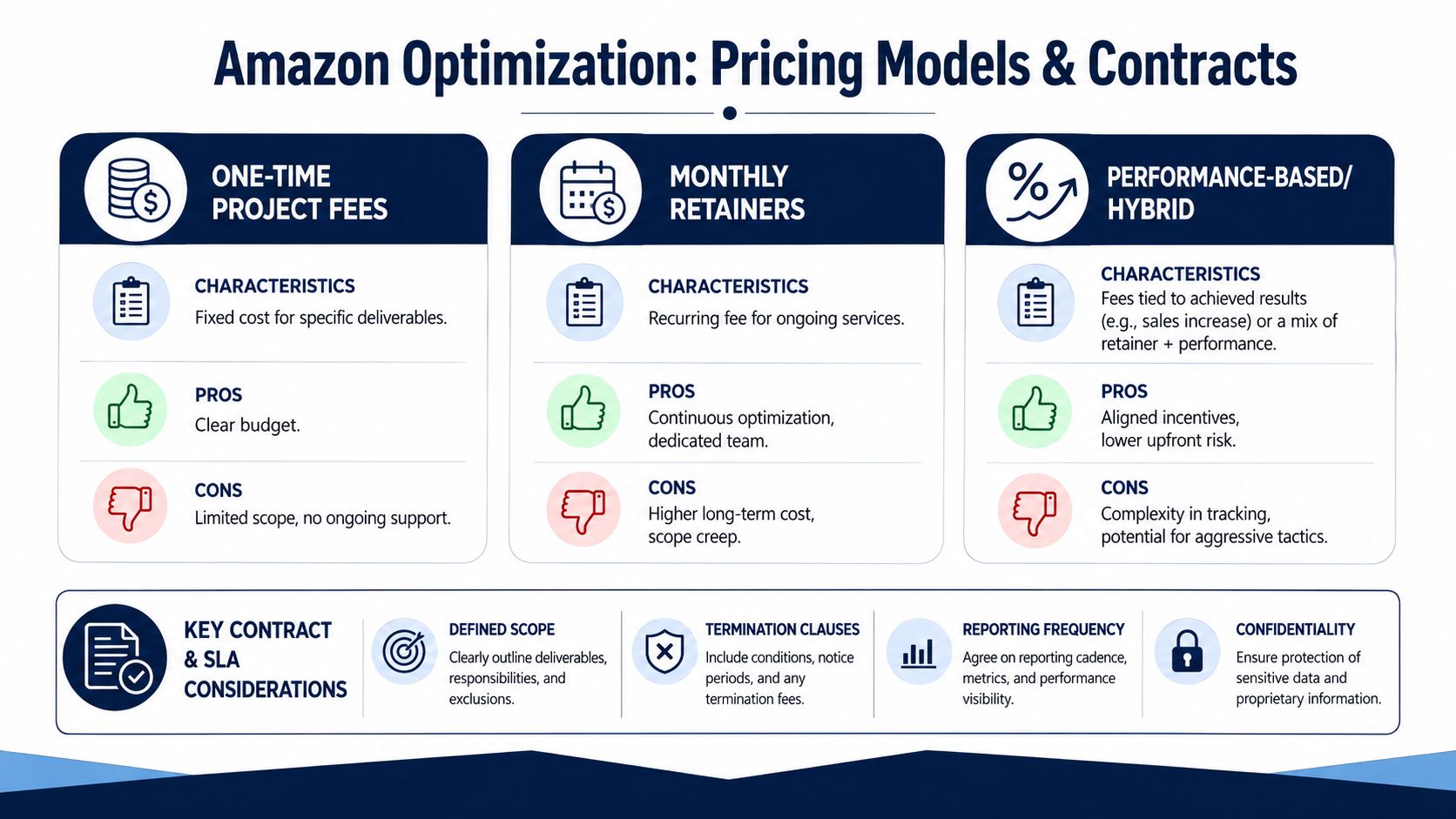
This model works best when the need is narrow. Maybe you have a launch coming, a batch of stale listings, or an internal team that just needs outside firepower for a content refresh.
The upside is straightforward budgeting. The downside is that optimization rarely ends with the first deliverable. If the provider hands over copy and creative recommendations but no testing support, you own the next problem.
Best use cases:
This is usually the right structure for larger brands because it matches how Amazon functions. Rankings shift, review language evolves, competitors update creative, and conversion issues surface over time.
Retainers can go wrong when scope is fuzzy. Agencies love broad language like “ongoing optimization support.” That phrase means nothing unless the contract defines cadence, deliverables, and decision rights.
Look for specifics:
These sound attractive because incentives appear aligned. In practice, they're the hardest to govern.
The problem isn't the idea. It's attribution. Listing performance doesn't live in a vacuum. Pricing changes, stockouts, ad pressure, review shifts, seasonality, and competitor moves all affect results. If the contract doesn't define attribution logic clearly, arguments start fast.
A performance model only works when both sides agree in writing on what counts as influence, what counts as contribution, and what data source settles disputes.
A clean service agreement should protect speed and reduce ambiguity.
| Contract area | What needs to be explicit |
|---|---|
| Scope | Which listings, which assets, which revisions, which channels |
| SLA | Response times, meeting cadence, review timelines |
| Ownership | Final copy, images, source files, research docs |
| Termination | Notice period, handoff obligations, outstanding work |
| Confidentiality | Access limits, data handling, account protections |
Non-negotiable: If the SLA doesn't define reporting frequency, communication cadence, and who approves changes, expect delays and finger-pointing.
The stronger the operator, the less drama you'll see in their paperwork. Mature firms don't resist clarity. They prefer it.
A new provider shouldn't start with rewriting everything. They should start with a baseline.
That baseline is what lets you separate real performance improvement from random movement. Without it, every monthly call turns into opinion trading. Someone likes the new bullets. Someone else likes the old images. Nobody can prove what changed the business.

A rigorous methodology starts with a 30 to 90 day conversion sprint before scaling PPC. The process centers on improving Unit Session Percentage, isolating variables, and running A/B tests for 4 to 6 weeks or until 95% statistical confidence is achieved, according to Keywords.am's Amazon listing optimization methodology.
That sequence matters. If you pour more ad traffic into a weak listing, you're amplifying inefficiency.
The opening sprint should focus on:
Teams often track too much and understand too little.
For listing work, I want a short KPI set tied to commercial impact:
For a broader scorecard structure, this guide on key performance indicators for eCommerce is useful because it forces the team to separate vanity reporting from financial reporting.
The best cadence is usually simple:
A good report should answer three questions:
If a provider's monthly report is mostly screenshots, ranking snapshots, and a list of tasks completed, you're looking at activity reporting, not ROI reporting.
True ROI isn't just “did sales go up.” It's whether the service improved the economics of the listing enough to justify continued investment.
A bad hire in this seat does not just produce weaker copy. It burns calendar, muddies attribution, and creates one more vendor you have to manage around.
By the finalist stage, I care less about who sounds polished and more about who can operate inside a real business. The right partner understands approval chains, launch timing, catalog dependencies, and the fact that listing changes affect paid traffic efficiency, inventory planning, and forecast confidence.

Start with platform competence. Amazon's own Search Terms field guidance makes the backend search term limits clear. A provider who still treats backend terms like an unlimited keyword dump is missing basic execution detail. If they miss details that small, they usually miss larger operational ones too.
The bigger red flags show up in how they run the account:
One more red flag matters at larger scale. If the provider talks about listings as a creative project instead of a revenue surface, expect bad prioritization. They will spend time polishing low-traffic ASINs while your highest-contribution products wait.
Good partners show judgment early.
They ask for catalog context before they suggest edits. They want to know which ASINs drive contribution profit, which products are hero SKUs, where paid traffic is concentrated, and what operational constraints exist. That is how competent teams protect upside.
Strong providers also explain trade-offs clearly. Amazon recommends writing bullets that highlight product benefits and help shoppers understand the offer fast in its product detail page best practices. A mature partner can connect that guidance to business reality. They can tell you whether the first move should be objection handling in bullets, image sequencing, title cleanup, or suppressing low-value keyword stuffing that hurts readability.
Here's the side-by-side I use:
| Red flag | Green flag |
|---|---|
| Talks about “SEO” in generic terms | Talks about buyer objections, conversion friction, and traffic quality |
| Sends polished proposals with loose scope | Sends a workflow with deliverables, approvals, owners, and timing |
| Measures success by rankings alone | Measures success with conversion, organic sales mix, and business impact |
| Pushes one package on every brand | Adjusts scope based on catalog size, margin, ad spend, and category pressure |
| Asks for access first | Asks for goals, constraints, and reporting needs first |
Run one simple test before signing. Put them in a mock weekly operating meeting.
A strong partner can explain what changed, why it changed, what risk came with the change, and what they expect to learn next. They can defend priorities in front of a founder, an ads lead, and an operations manager without hiding behind jargon.
That is the standard.
If a team cannot function like a specialized extension of your growth operation, they are still a freelancer with a nicer deck. The right partner reduces noise, protects focus, and gives you cleaner decision-making around a revenue-critical asset.
If you want to compare notes with founders who've already hired, fired, and rebuilt these relationships at scale, Million Dollar Sellers is where serious operators share the behind-the-scenes details. It's an invite-only community of top e-commerce entrepreneurs swapping vetted service recommendations, operator-level playbooks, and the kind of unfiltered feedback you usually only get after an expensive mistake.
Join the Ecom Entrepreneur Community for Vetted 7-9 Figure Ecommerce Founders
Learn MoreYou may also like:
Learn more about our special events!
Check Events