Chilat Doina
August 20, 2026
You've got a supplier issue that's blocking replenishment, an unexplained PPC cost spike, or inventory sitting in the wrong place, and the usual course videos aren't helping. By the time you find a relevant thread, the advice may describe an older fee structure, a different marketplace, or an account with completely different operating conditions.
That's the true value of an Amazon seller community. It isn't the number of members, the activity feed, or the promise of networking. It's whether the right operator can help you make a better decision before a costly mistake reaches your account, inventory, or margin.
A serious seller rarely struggles because information is unavailable. The problem is that useful information is usually too broad, too old, or disconnected from the decision in front of you.
A seller managing a large catalog might need to decide whether to liquidate stranded inventory, challenge an inbound discrepancy, pause a listing, or keep funding an advertising campaign that suddenly looks inefficient. A generic guide may explain the basic process. It won't tell you what another operator with a similar product, fulfillment model, and account history did last week.
Amazon has become a mature, competitive operating environment. One 2026 estimate places active third-party sellers at about 1.65 million worldwide, compared with roughly 2.4 million in 2021, while registered seller accounts reached about 9.7 million, according to Amazon marketplace seller statistics. The gap between active and registered accounts points to a substantial dormant base, but the active sellers still compete inside a crowded marketplace.
Amazon itself says independent sellers account for more than 60% of store sales, and its 2025 selling statistics report that U.S. independent sellers averaged more than $375,000 in annual sales, with more than 75,000 surpassing $1 million that year, as reported in the same Amazon marketplace seller statistics. Those figures describe a seller ecosystem with serious operators, not just casual side businesses.
The best peer answer has three characteristics:
That access can prevent refunds, lost ranking, avoidable stockouts, or an account-health problem. It can also help you identify when advice is wrong for your situation.
Community selection belongs in your operating plan, alongside supplier management, forecasting, and advertising controls. If you're also building a support team, a resource such as Hire LATAM talent can help you find operational capacity, but people and peer access solve different problems. Your team executes the work. A well-selected community improves the decisions behind that work.
Use networking for entrepreneurs as a useful reminder that relationships create advantages only when they lead to relevant exchanges, trusted introductions, or faster decisions. A large audience isn't automatically valuable. The right answer from the right seller at the right time is.
The format determines what you can reasonably expect. Public forums, masterminds, and paid cohorts all use the word community, but they operate very differently.
| Format | Access | Accountability | Confidentiality | Relevance | Typical Cost |
|---|---|---|---|---|---|
| Public forum | Open or lightly moderated | Low | Limited | Broad to niche | Free or low |
| Mastermind | Vetted, often application-based | High | Usually stronger | Peer-specific | Mid to high |
| Paid cohort | Enrolled group with a defined program | Moderate | Depends on rules | Curriculum-led | Paid, often time-bound |
Amazon Seller Forums, Reddit communities, Facebook groups, and tool-vendor spaces offer breadth. You can search a problem, compare different experiences, and ask questions without making a major commitment. Amazon's own forum guidance positions its forums as a place for seller discussion, policy updates, and community-manager participation, while official support remains the route for urgent account matters.
The trade-off is obvious. You get access, but nobody is responsible for checking your work. Anonymous replies can be useful, yet you shouldn't share supplier contracts, account credentials, customer data, or unredacted financial screenshots. Use public forums for discovery, pattern recognition, and a second opinion.
A mastermind is more useful when the decision is complex and the cost of a wrong move is high. Members are typically selected for experience or fit, calls follow an agenda, and participants are expected to bring current problems rather than consume content passively.
Before joining, review mastermind groups for entrepreneurs with a critical eye. The important question isn't whether calls happen. It's whether members at your level challenge assumptions, share operating detail, and follow up on commitments.
Paid cohorts combine instruction with peer interaction. They work well when you need a structured sequence, such as learning a new advertising workflow or building a repeatable launch process. They're less valuable if most sessions recycle beginner material you've already mastered.
Practical rule: Use a forum for fast breadth, a mastermind for difficult operating decisions, and a paid cohort when structure is the bottleneck.
Match the format to the problem. Don't pay mastermind pricing for information you can verify in a public forum, and don't expect a free forum to provide confidential, sustained accountability.
Discovery should produce a shortlist, not a pile of invitations. Start with the business model you run, then search for the community around that model.
Use targeted queries that combine Amazon seller community with terms such as wholesale, private label, aggregator, PPC, account health, FBA logistics, or your product category. Broad searches surface large groups. Specific modifiers reveal smaller rooms where members face similar decisions.
Search by operating model. Look for discussions that match your inventory ownership, sourcing method, fulfillment setup, and marketplace. A wholesale seller needs different peer insight from a private-label founder dealing with launches, brand protection, and creative testing.
Ask people already inside the workflow. Aggregators, software vendors, agencies, CPAs, and 3PLs see which sellers communicate well and solve problems responsibly. Ask Helium 10, Jungle Scout, or Perpetua contacts which groups their experienced customers respect. Treat referrals as leads, not proof.
Attend Amazon-specific events. Events such as Accelerate, Prospero, and regional meetups let you observe member quality before you pay. Notice whether conversations stay tactical, whether experienced sellers answer newer operators, and whether organizers protect the room from aggressive pitching.
Use your existing network. Your agency partner may know a focused advertising group. Your CPA may know operators who discuss cash flow and tax planning. Your 3PL may know sellers dealing with the same inbound and storage constraints. These introductions often reveal communities that don't rank prominently in search.
Build a simple candidate sheet with columns for access, member profile, confidentiality, facilitation, relevance, price, trial terms, and evidence of outcomes. The point isn't administrative perfection. It's to stop an impressive sales page from becoming your selection process.
For a more structured search, how to find a mastermind group provides a useful framework for identifying candidates and testing fit. Apply that discipline to Amazon groups, too. A community should earn its place in your operating stack.
A community is worth joining only when you can verify who participates, what they discuss, and how the group handles sensitive information. Activity alone proves very little. A busy feed can still produce shallow answers, coaching pitches, or advice from sellers with no comparable experience.
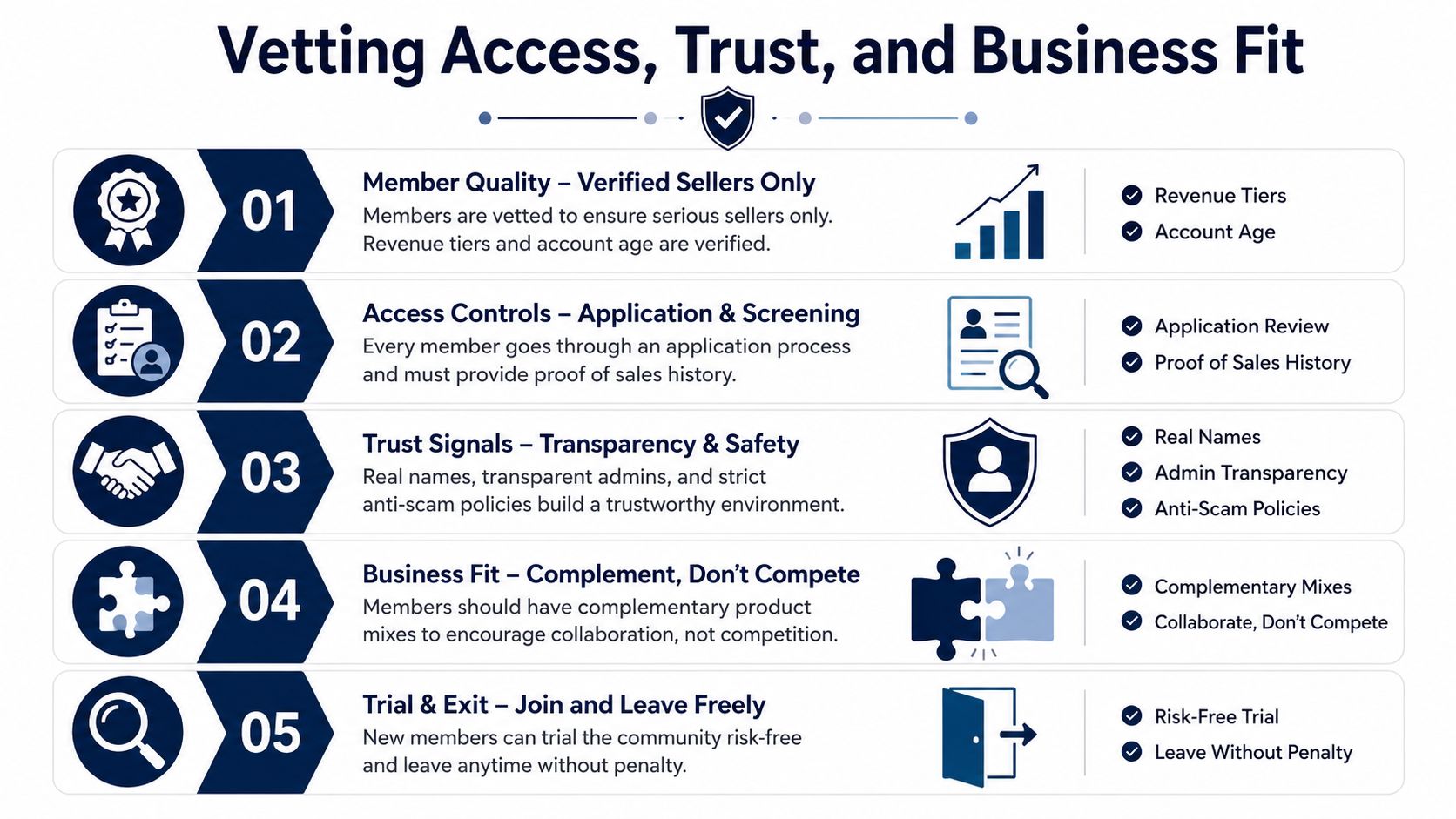
Start with member quality. Ask whether sellers are verified, whether revenue tiers or account age are disclosed, and whether product mixes create useful complementarity rather than direct competition. You don't need every member to sell your product. You do need enough members to understand your kind of problem.
Then observe participation before committing. Are live calls attended? Do replies include context and trade-offs? Do moderators remove misleading promotions? A named facilitator should have a visible operating track record, a structured agenda, and a clear method for handling conflict.
The EMEA research summarized by Pattern found that Amazon sellers commonly struggle with price erosion, expensive logistics, warehouse intake, supply-chain disruption, and forecasting limitations. The survey reported 96.4% experiencing price erosion, 85.2% citing complex or expensive logistics, and 83.3% lacking actionable data or forecasting tools, as detailed in Amazon EMEA seller pain points. A useful community should help members work through these operating issues, not just exchange motivational posts.
Before paying or sharing sensitive information, ask:
The separate seller survey cited by Sellerite found that 69% of respondents said success had become harder, 74% viewed Amazon's algorithms as unfair, and 74% disagreed that Amazon's fees were reasonable, according to Amazon seller performance benchmarks. Those findings don't prove that a particular group will solve these problems. They do show why margin, differentiation, and platform exposure deserve serious discussion.
Refusal, vague answers, or pressure to join immediately are red flags. Trust isn't a branding statement. It's a set of observable controls.
Most members waste community fees by acting like spectators. They read posts, collect opinions, and wait for someone to notice them. That creates the feeling of participation without producing a decision, a process improvement, or a useful relationship.
Arrive with a concise operator profile. Include your business model, revenue range, product category, top SKUs, primary marketplace, current bottleneck, and the decision you want to make. Finish with one measurable objective, such as reducing avoidable inventory risk, improving contribution margin visibility, or resolving a recurring account-health problem.
A weak post says, “How do I improve PPC?” A strong post explains the product context, what changed, what you already tested, which metric moved, and the decision you're weighing. Ask whether to reduce spend, change targeting, adjust bids, revise the listing, or investigate a tracking issue.
Questions about advertising need the same precision as questions about catalog structure. If you're auditing search-term waste, resources on negative keywords for Amazon sellers can help frame the technical issue, but peers still need your actual campaign context to give useful feedback.
Share information responsibly. Redact supplier names, customer details, account identifiers, and proprietary economics unless the community has explicit protections that permit disclosure. A screenshot can clarify a problem, but it can also expose your business if you upload it carelessly.
Attend live calls, use office hours, and volunteer for small accountability groups when the format supports them. Answer questions inside your real skill zone. A wholesale operator can explain replenishment discipline without pretending to be a brand-protection specialist.
Follow up after receiving advice. State what you changed, what happened, and what remains unresolved. That habit does two things: it improves the quality of future responses and shows other members that helping you leads to execution rather than an endless request for free consulting.
Track outcomes for your first two months:
If you can't connect participation to action, change your behavior before blaming the group.
Treat selection like a controlled operating test. Don't join five communities at once, consume everything, and then decide based on which interface feels busiest.
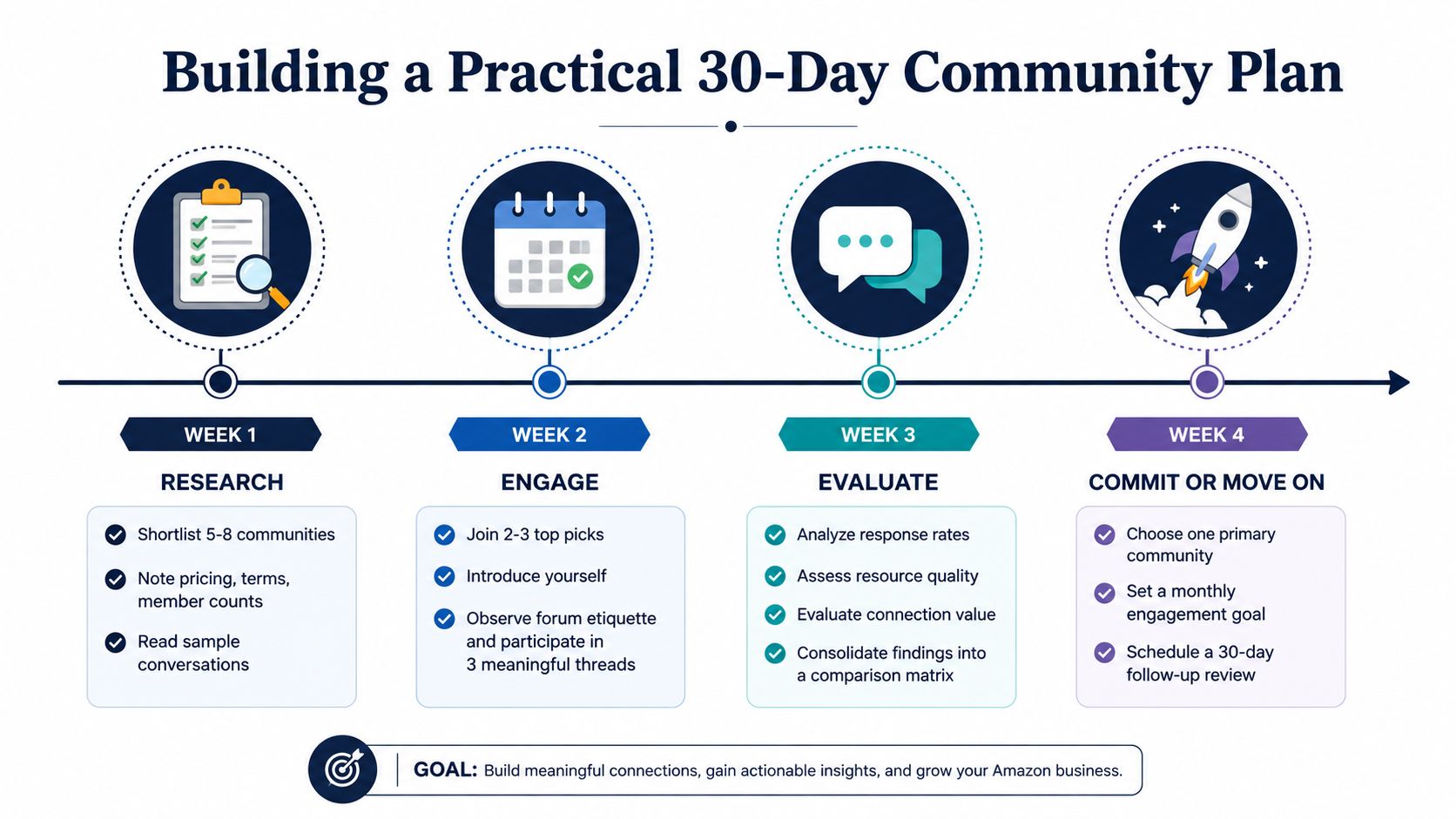
Create a spreadsheet of candidate communities. Record the format, access rules, stated member profile, pricing, renewal terms, sample discussions, facilitator names, and the problems members appear to solve. Read enough conversations to detect whether operators explain decisions or promote services.
Apply the checklist from the previous section. Request references from sellers with comparable complexity. Attend trial calls where available, and score each candidate for access, accountability, confidentiality, relevance, and business fit.
A simple scorecard is more useful than a long review. Give every criterion a written note, not just a rating, so you remember why a group passed or failed.
Choose one trial or paid community. Introduce yourself with a focused profile, attend live sessions, and post one well-formed question. Record response quality, response speed, practical detail, and whether anyone follows up after the initial answer.
Don't judge the group by friendliness alone. Judge it by the quality of decisions it helps you make.
Compare the recorded value with the membership cost and the time required. Continue if the community provides relevant access and measurable advantage. Expand only when a second group serves a clearly different purpose. Exit when the room produces noise, repeated sales pitches, or advice you can't responsibly apply.
Keep four working documents:
Community management doesn't end when you pay the membership fee. Treat each group as an operating resource that must justify its cost, attention, and information risk.
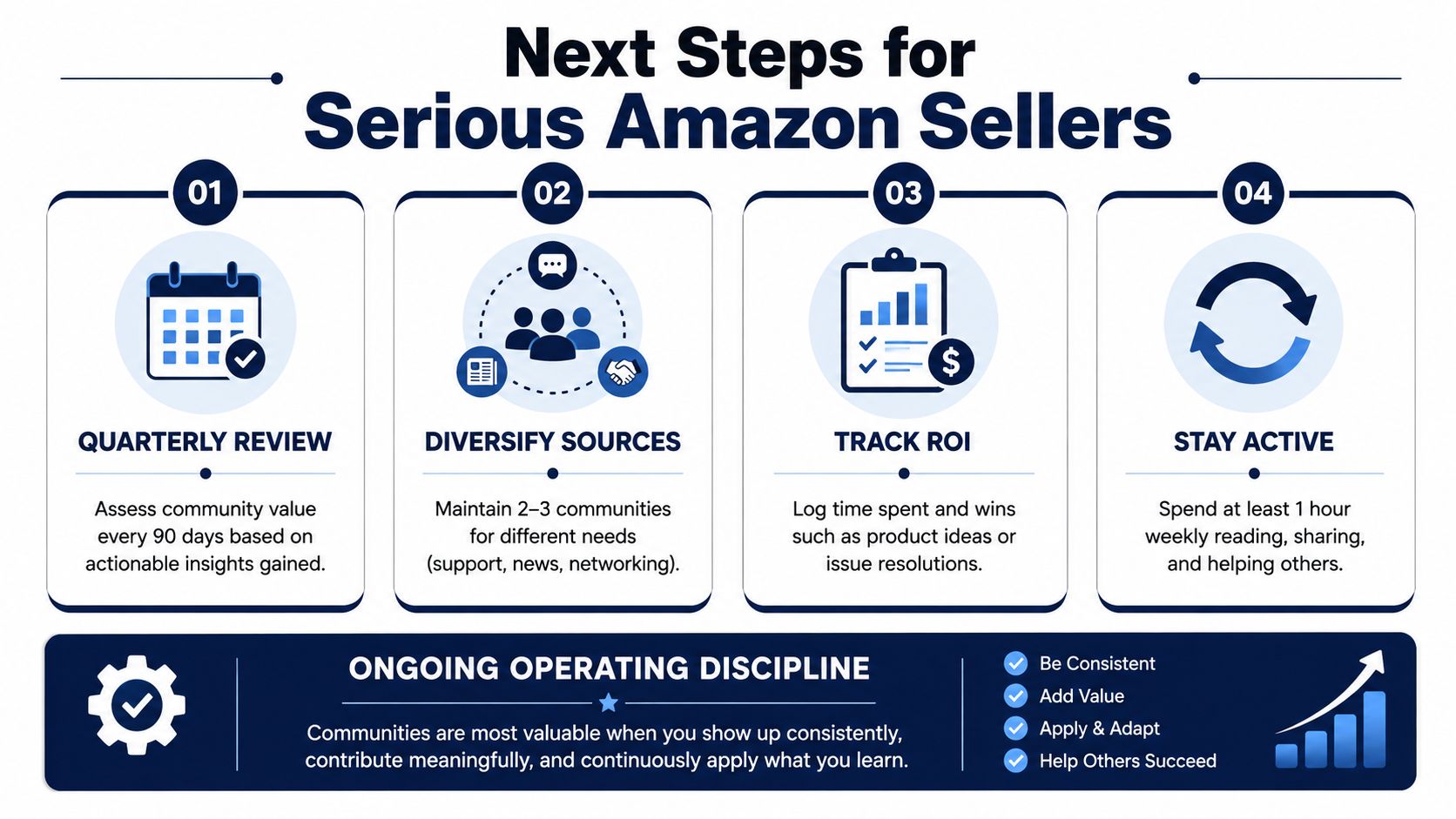
Schedule a quarterly review. Check which conversations produced useful decisions, which introductions became operational relationships, and whether the member mix still matches your growth target. If a group no longer helps with your current constraints, leave instead of preserving it out of habit.
Maintain a small, deliberate mix of communities. An open forum can provide broad issue discovery. A private peer group can support confidential operating discussions. A specialty group can focus on advertising, compliance, wholesale, private label, or another narrow need. These roles are different, so don't expect one room to perform all of them.
Protect sensitive information before you share it. Use the community's stated privacy rules, ask whether an NDA or equivalent confidentiality process exists, and redact anything that could expose your suppliers, customers, account access, or proprietary economics. Escalate difficult problems with a prepared brief that includes context, evidence, attempted fixes, and the decision required.
Every valuable answer should become something your team can use again. Turn it into an SOP, escalation template, replenishment check, advertising rule, or decision log. This prevents the same issue from returning to the community without progress.
Track time as well as wins. Record the product ideas, issue resolutions, introductions, and process changes that came from participation. If a membership produces no meaningful advantage across repeated review cycles, churn it and redirect your attention to peers whose operating outcomes match yours.
For sellers expanding beyond marketplace tactics, video marketing insights for global growth can add another perspective on how content supports international selling. The same selection standard applies: keep the resource only if it helps your team make and execute better decisions.
Million Dollar Sellers offers an invite-only peer community for vetted ecommerce entrepreneurs, including Amazon sellers, with private forums, mastermind calls, events, and strategy sharing among experienced operators. If you're evaluating community access as an operating decision, visit Million Dollar Sellers to review whether its member profile and approach fit your growth targets.
Join the Ecom Entrepreneur Community for Vetted 7-9 Figure Ecommerce Founders
Learn MoreYou may also like:
Learn more about our special events!
Check Events