Chilat Doina
September 18, 2026
You've reached the point where revenue is no longer the only problem. Orders keep coming in, but so do stock decisions, advertising questions, hiring gaps, compliance tasks, cash-flow pressure, and the constant fear that one wrong move will erase a month of progress. The tactics that helped you launch the brand haven't disappeared, but they're no longer enough to run the business at its new level.
That's where an Amazon Seller Growth Program can help, provided you understand what you're buying. The useful programs don't hand you another list of PPC tips. They give you a system for making better decisions, expose blind spots through experienced peers, and, in some models, connect you with execution talent and capital resources.
The distinction matters. Amazon's own programs emphasize education and strategy, while a full-stack peer mastermind may add accountability, operator insight, introductions, and practical execution support. This guide explains the difference, the operating pillars that create durable growth, the metrics that reveal growth quality, and the questions to ask before committing time or money.
A founder can manage a surprising amount alone while a brand is small. You might review PPC in the morning, approve a purchase order at lunch, answer a product question in the afternoon, and still know which listing needs new images. As sales grow, that familiarity fades. You're no longer managing a store. You're coordinating a system with more moving parts than one person can reliably hold in their head.

A common plateau looks like this. Revenue is healthy, but profitability feels unpredictable. The advertising manager wants a larger budget, the operations lead wants more inventory protection, and the finance person says cash is tied up in stock. You respond by working longer hours and collecting more dashboards, yet the central question remains unanswered: which constraint deserves attention first?
That's why scaling often feels harder after the first major milestone. The business has outgrown founder intuition, but the team hasn't yet built a repeatable decision process. You need clear ownership, reliable reporting, documented operating rhythms, and people who can challenge assumptions before expensive mistakes reach the marketplace. Practical guidance on this transition also appears in these insights from Dealmaker Wealth Society, particularly around replacing founder dependence with scalable business infrastructure.
A listing can have strong conversion and still lose momentum because inventory arrives late. A product can rank well and still create weak cash flow because the purchase order was too large. A capable employee can underperform because nobody has defined the decision they own.
Operator's rule: Don't add another tactic until you know which part of the system is limiting the result.
This is also why scaling operations requires deliberate process design, not just more software or another contractor. A growth program becomes useful when it helps you separate symptoms from causes, choose a priority, and create accountability around the work that follows.
Amazon's independent seller ecosystem shows why these decisions matter beyond an individual storefront. Over more than 25 years, independent sellers generated over $2.5 trillion in Amazon store sales, and they represented more than 60% of store sales by 2025, according to Amazon's seller growth update. The opportunity is substantial, but scale amplifies weak systems just as quickly as it rewards strong ones.
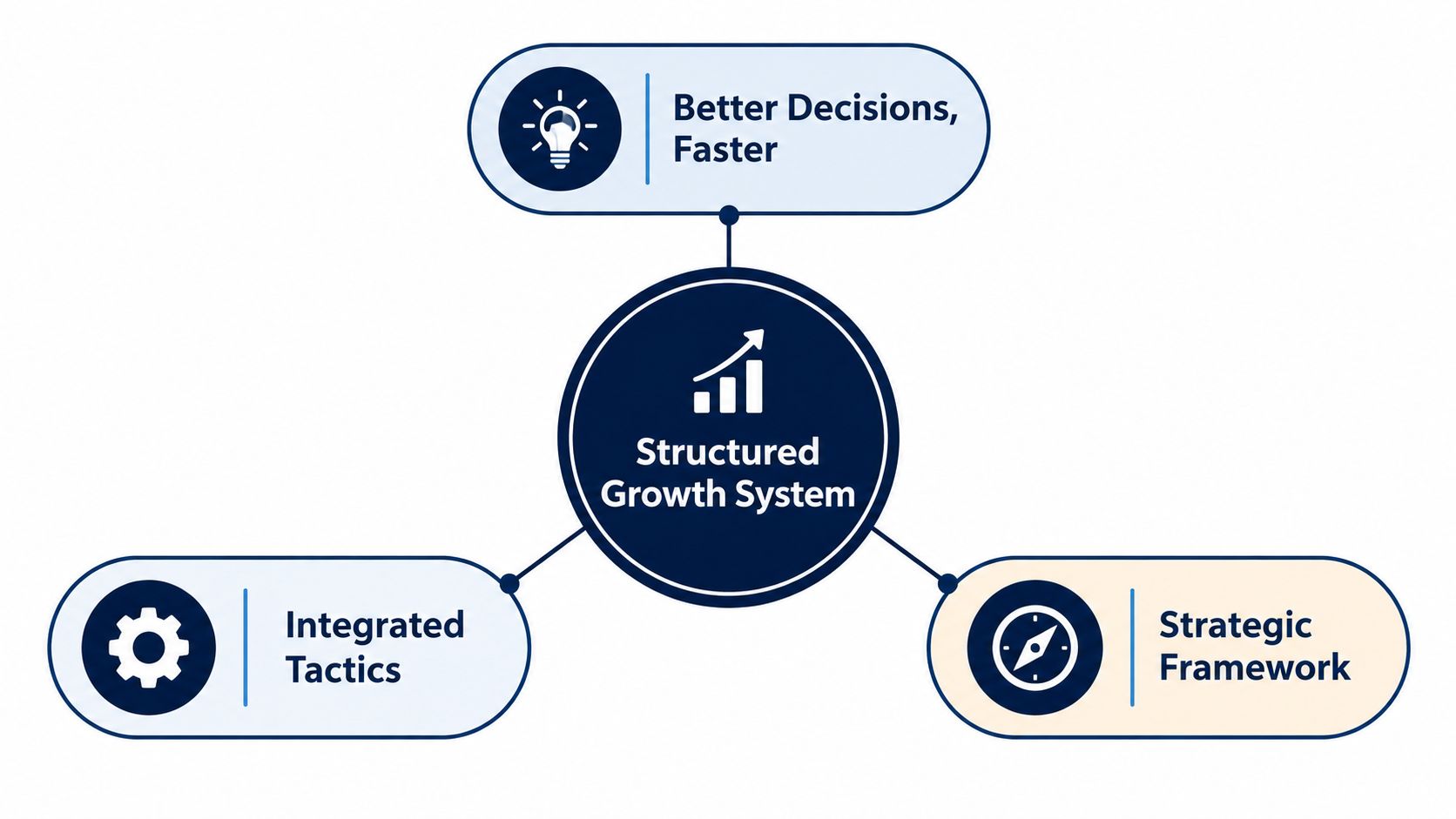
An Amazon Seller Growth Program is best understood as a structured decision system. It helps a seller identify the most important growth constraint, select a response, measure the result, and repeat the process with better information. That's different from buying a course, hiring a freelancer, or outsourcing every task to an agency.
Think of a racing team. The driver makes strategic choices on the track, but the pit crew prepares the car, interprets conditions, and executes precise changes under pressure. An education-led program is closer to a skilled strategist explaining what the instruments mean and which options deserve consideration. A full-service agency may act like the crew handling selected tasks. A peer mastermind adds experienced drivers who can tell you what they've seen on comparable tracks.
Amazon's Growth Education Service is positioned as education and consultation. It includes two one-hour consultations for Professional sellers and costs $1,200, while Amazon's invite-only Seller Growth program in the United States and Canada provides high-level strategy rather than technical support. Those boundaries are important because a strategy conversation won't write listing copy, reconcile inventory, rebuild a reporting stack, or manage a launch for you.
Amazon says consultants commonly discuss tools such as Product Opportunity Explorer, Growth Opportunities, and Brand Analytics. The practical value is prioritization. A consultant can help you decide which opportunity deserves attention, but your team still needs to implement the recommendation.
The same distinction applies when you evaluate external providers. Ask what happens after the meeting:
The right buyer usually has enough activity to create meaningful decisions, but not enough internal structure to make those decisions consistently. You might have a capable team and still need an external lens when paid acquisition, supply planning, new marketplaces, and hiring compete for the same cash.
A useful program won't promise to remove complexity. It should help you manage complexity with a better operating cadence. That means clearer questions, faster escalation, stronger documentation, and less dependence on one founder's memory.
If you're looking for hands-on implementation, confirm that explicitly before enrolling. Many sellers assume “growth” means someone else will execute the work. In practice, the program may only improve the quality of your decisions, which can be valuable, but it isn't the same deliverable.
Sustainable Amazon growth works like a flywheel. Marketing creates demand, operations fulfills it, analytics directs investment, and talent keeps the system running without constant founder intervention. Each pillar affects the others, so improving one while ignoring another often produces a temporary lift followed by friction.
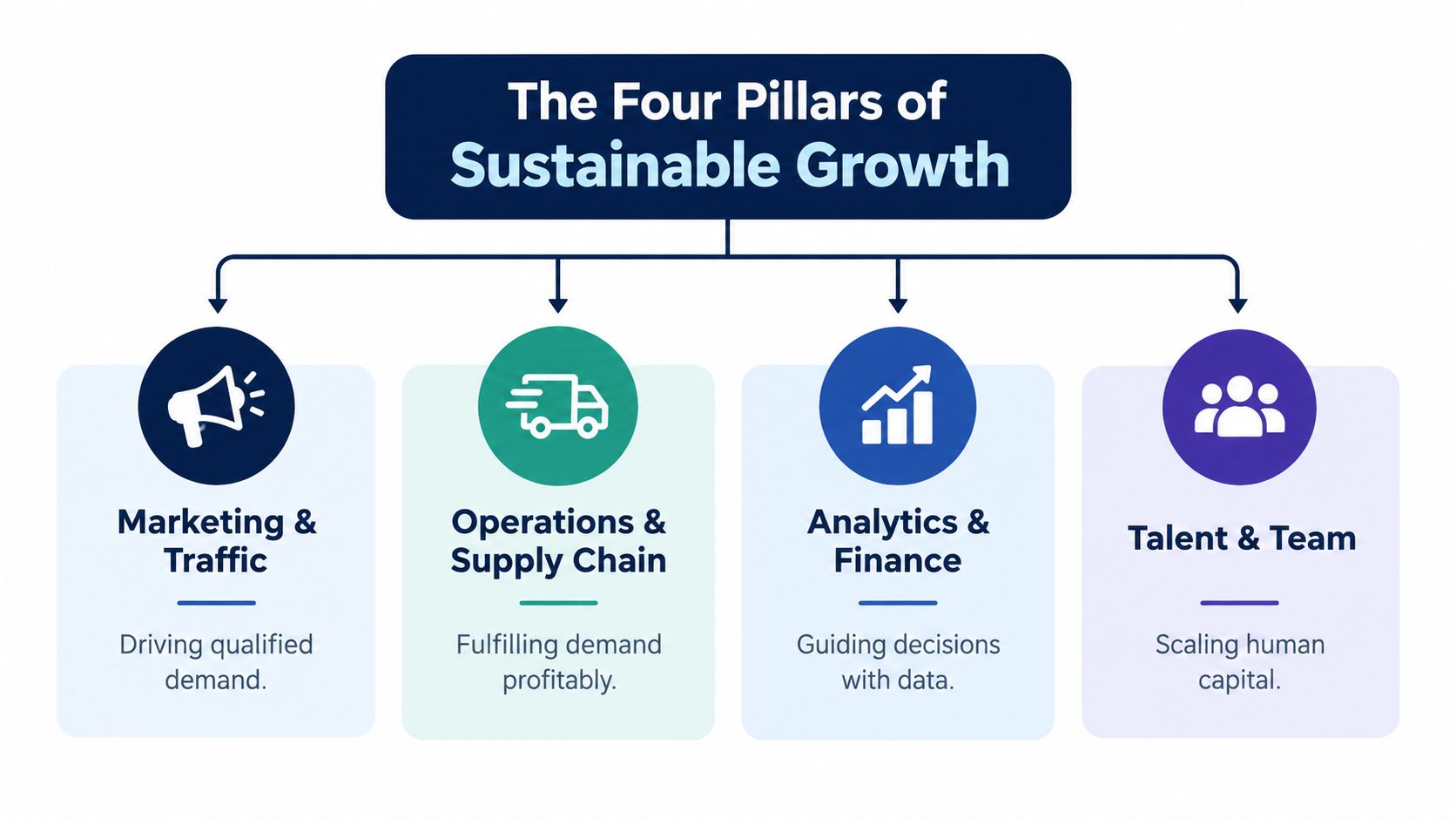
Marketing begins with qualified demand, not more impressions. The team needs a clear view of the customer, the product's differentiation, the listing's promise, and the role of PPC in the wider acquisition system. Strong programs connect advertising decisions to detail-page quality, keyword coverage, creative testing, pricing, reviews, and organic visibility.
A paid campaign can expose a conversion problem, but increasing spend won't solve weak positioning. The better question is whether the listing gives the right shopper enough evidence to buy. That diagnosis prevents the team from treating every performance issue as a bidding issue.
Operations turns demand into delivered orders. It includes purchasing, forecasting, supplier communication, freight planning, FBA preparation, returns, quality control, and marketplace compliance. A growth plan that ignores these areas can create a dangerous outcome, more sales with less reliable fulfillment and weaker cash control.
For example, a team may identify an attractive product opportunity but lack the lead-time visibility to stock it safely. Another brand may expand into Europe without preparing for VAT and EPR obligations. Growth only counts when the business can serve customers profitably and stay compliant.
Analytics should answer decisions, not decorate a dashboard. Owners need to understand contribution margin, advertising efficiency, inventory exposure, SKU-level economics, and the cash consequences of growth choices. A practical analytics approach for ecommerce connects marketplace data with financial reality.
A seller might see rising revenue while profit deteriorates because advertising, storage, returns, or landed costs are moving in the wrong direction. Finance gives the team a common language for deciding whether to scale, hold, renegotiate, or discontinue.
People provide the advantage that lets the other pillars operate. The goal isn't to hire broadly. It's to assign the right decisions to capable owners, document the process, and create a rhythm for reviewing results.
A growth program should help you identify which responsibilities belong inside the business, which can be outsourced, and where a specialist would prevent costly delays. When the founder remains the only person who can approve every meaningful choice, the company has added volume without adding capacity.
The flywheel only turns smoothly when every pillar has an owner, a metric, and a recurring review.
Top-line sales can hide a fragile business. A serious growth program evaluates whether demand converts, whether organic visibility carries more of the workload, and whether customers return through a recurring purchase mechanism. These signals reveal whether growth is becoming more efficient or more expensive.
One benchmark set places healthy gross revenue growth for sellers at 5% to 15% month over month, with a strong organic-to-paid revenue mix around 60% to 70% organic and 30% to 40% PPC. The same research places Unit Session Percentage, Amazon's conversion-rate proxy, at roughly 10% to 15% on average, as reported in independent Amazon KPI benchmark research.
These figures aren't a universal scorecard. They're diagnostic reference points. If traffic rises while conversion stays weak, improve the offer, creative, detail page, or traffic quality before increasing bids. If conversion is healthy but organic share remains low, the team may need to investigate ranking, keyword coverage, retail readiness, or the efficiency of paid acquisition.
Amazon Seller Central benchmarking treats Subscribe & Save as three separate lenses: Subscribe & Save Sales Penetration, Subscribe & Save Sales Growth year over year, and Subscription Growth year over year, according to Amazon seller KPI benchmarking guidance. That separation matters. A seller can have growing subscription sales because total sales are growing, while penetration remains flat. Another seller may improve penetration but fail to build the active subscription base.
The order of operations matters. Improve conversion so paid traffic produces useful customer signals. Strengthen organic performance so the business relies less on purchased visibility. Then develop repeat demand so each acquired customer has more long-term value.
A good growth metric doesn't merely describe the past. It tells the team what to fix next.
Use a focused scorecard rather than a crowded dashboard. Your ecommerce KPI framework should connect commercial metrics to operational and financial decisions, so the team can see when a sales gain is creating inventory strain or margin pressure.
No single program fits every seller. The right choice depends on your current constraint, your team's ability to execute, your market footprint, and the type of support you need. A founder seeking listing optimization shouldn't buy a peer network expecting an implementation team, and a scaled brand with operational bottlenecks shouldn't assume a short educational consultation will solve them.
| Program Type | Best For | Access Model | Support Level |
|---|---|---|---|
| Amazon Growth Education Service | Sellers seeking structured guidance on Amazon tools and opportunities | Professional sellers can purchase the consultation service | Education and high-level strategy |
| Amazon Seller Growth consulting | Invited sellers in the United States and Canada seeking strategic input | Invite-only | High-level strategy, not technical support |
| Done-for-you agency | Teams that need execution in defined areas such as PPC, creative, or catalog work | Generally commercial and provider-dependent | Hands-on execution within the contracted scope |
| Course or group coaching | Founders building baseline knowledge or a repeatable learning routine | Usually open enrollment | Education, frameworks, and varying accountability |
| Peer mastermind | Established operators seeking pattern recognition, accountability, and trusted introductions | Often curated or invite-only | Strategic discussion, peer insight, and network value |
Amazon's availability constraints deserve close attention. The U.S. and Canada Seller Growth consulting offer is invite-only and limited to those markets, while Strategic Account Services is at full capacity and currently not accepting new enrollments, according to Amazon's seller growth consulting information. That makes these services difficult to use as the foundation of a long-term planning model.
If you lack basic marketplace knowledge, education may be enough. If your team knows what to do but can't execute consistently, an agency or specialist may be more appropriate. If the biggest issue is prioritization across advertising, supply chain, hiring, and expansion, a peer environment may provide more useful context than another tactical course.
Market also changes the decision. India has structured “Missions” connected to STEP and rewards, while Europe has added compliance-oriented support through the Service hub for VAT and EPR requirements. A program that works for a U.S.-focused brand may not address the operational burden of a European expansion.
Capital is another separate decision. Before taking on debt or outside funding, review the available funding options for Amazon sellers and connect any financing choice to inventory turns, contribution margin, repayment capacity, and demand confidence. A growth program should improve capital allocation, not encourage spending because more money is available.
The most useful examples aren't dramatic promises. They're ordinary operating situations where a team stops treating every problem as urgent and finds the constraint that matters.
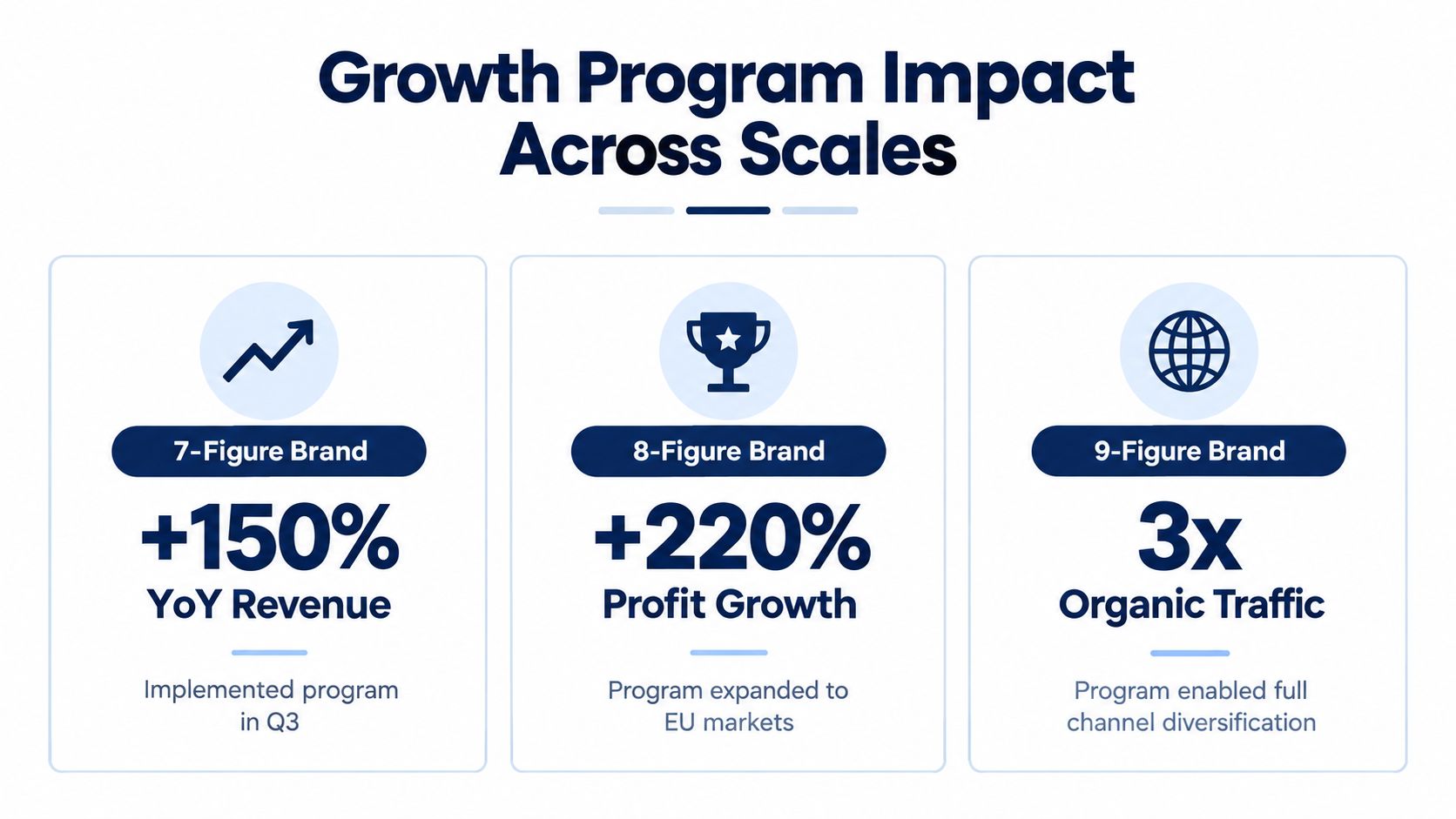
Consider a brand with strong sales but an unhealthy dependence on PPC. Its first move shouldn't be an across-the-board budget cut. The team can segment campaigns, inspect search-term quality, improve the detail page for high-intent traffic, and identify which products deserve organic ranking investment. The program's value is the sequence of decisions, not a magic bid rule.
A larger brand may face a different bottleneck. It has demand, products, and cash, but its supply chain depends on one person's relationships and its leadership team lacks experience managing international operations. A peer network can help the founder pressure-test supplier plans, find specialist introductions, compare operating structures, and avoid repeating mistakes that another operator has already paid to learn.
Amazon's seller milestones provide useful context for the scale of the ecosystem. In 2025, more than 75,000 independent sellers surpassed $1 million in store sales, a 36% increase from 2024, according to Amazon's 2025 small business empowerment report. The same report says U.S.-based independent sellers averaged more than $375,000 in annual sales, up nearly 30% year over year, and that more than 11,000 U.S. sellers increased sales by over 10 times.
Before joining, ask the provider to show how the program handles:
A credible program will answer these questions directly. It won't rely only on revenue screenshots or broad claims about scaling. Look for a clear operating model, specific deliverables, and evidence that the people involved understand the trade-offs between growth, margin, inventory, and team capacity.
Start with a constraint audit. Review one recent period of performance and ask whether the primary issue sits in demand generation, conversion, fulfillment, cash flow, retention, or leadership capacity. Don't choose an Amazon Seller Growth Program until you can describe the problem it must help you solve.
Then match the support model to the gap. Amazon's education and strategy services may help you use tools such as Product Opportunity Explorer, Growth Opportunities, and Brand Analytics more effectively. An agency may be the right choice when execution is the bottleneck. A course can provide structure for a team that needs shared fundamentals. A curated peer environment can add context, accountability, introductions, and operator-level pattern recognition that a static curriculum can't provide.
The four pillars remain the operating test: marketing and traffic, operations and supply chain, analytics and finance, and talent and leadership. Sustainable scale comes from making those areas reinforce one another. More tactics won't compensate for poor prioritization, unclear ownership, or weak financial visibility.
A serious peer community should also make the work more concrete. Members of Million Dollar Sellers operate across Amazon, direct-to-consumer, and omnichannel brands, and the community provides curated events, private discussions, strategy sharing, and vetted service recommendations. Its eligibility requirement is at least $1 million in trailing twelve-month Amazon revenue, according to the publisher's member information, so it's designed for established sellers rather than beginners.
If you're ready to replace isolated trial and error with trusted operator input, visit Million Dollar Sellers to learn how its invite-only peer community supports established ecommerce founders. Use the information there to assess whether its network, strategy discussions, and execution-focused resources fit the constraint your brand is facing now.
Join the Ecom Entrepreneur Community for Vetted 7-9 Figure Ecommerce Founders
Learn MoreYou may also like:
Learn more about our special events!
Check Events