Chilat Doina
January 27, 2026
The whole game boils down to one simple question: do you want to sell to Amazon, or on Amazon?
With Amazon Vendor Central, you're a first-party (1P) supplier. You sell your products in bulk directly to Amazon, and they handle the rest. Think of it as a traditional wholesale model. On the flip side, Seller Central makes you a third-party (3P) marketplace seller, putting you in the driver's seat to sell directly to customers. Your choice here isn't just a small operational tweak; it defines your entire business relationship with the world's largest online retailer.
Deciding between Vendor and Seller Central is one of the biggest strategic forks in the road for any brand. This single choice will ripple through everything—your pricing control, profit margins, and day-to-day operational headaches. There's no single "best" answer, only the right fit for your brand's goals, resources, and long-term vision.
Vendor Central is an invite-only platform where Amazon acts as your customer. They send you purchase orders, you ship them the goods, and they list your products as 'Sold by Amazon.' It’s a pretty hands-off approach that established manufacturers and large brands often prefer.
Seller Central, however, is a completely different beast. It empowers you to be the retailer. You list your products, set your own prices, and manage fulfillment directly with millions of customers. The scale here is immense; third-party sellers racked up $248 billion in sales in 2022, dwarfing the $100+ billion Amazon bought from its vendors.
For international brands eyeing the US market, a critical first step for either platform is getting your finances in order. That usually means figuring out the logistics of opening a U.S. bank account online for non-residents to streamline payments and operations.
Key Takeaway: Vendor Central simplifies things by making Amazon your one and only customer, but you sacrifice control. Seller Central gives you all the control and potentially higher margins, but you’re on the hook for everything. You can get a much deeper look into the specifics in our complete guide to Amazon Vendor Central.
Before we dive deep into the weeds, let's get a bird's-eye view of how these two platforms stack up. This table breaks down the core differences at a glance.
AttributeVendor Central (1P)Seller Central (3P)Business ModelWholesale Supplier to AmazonDirect-to-Consumer Marketplace SellerPricing ControlAmazon sets the final retail priceYou control your own retail pricingInventory ManagementFulfill bulk purchase orders from AmazonYou manage inventory levels (FBA or FBM)Customer DataLimited access to customer dataDirect access to sales and performance dataAccessInvite-onlyOpen to anyone who registers
As you can see, the two models are worlds apart. One offers a simplified, B2B relationship, while the other puts you right in the middle of the retail action. Now, let’s explore what these differences actually mean for your business operations and bottom line.
The path you choose—Vendor Central or Seller Central—leads to two completely different financial realities. It’s a classic trade-off: predictable (but lower) wholesale margins versus a higher profit ceiling that demands you get your hands dirty managing a complex fee structure. Getting this right is the key to forecasting what you’ll actually take home.
If you go the Seller Central route, you're a retailer. You set the price, you control the promotions, and you own the margin. This autonomy is your biggest lever for profitability, but it comes with a handful of fees you have to bake into your pricing.
And make no mistake, the third-party marketplace (Seller Central) is where the action is. It's a much larger ecosystem in terms of raw sales volume.
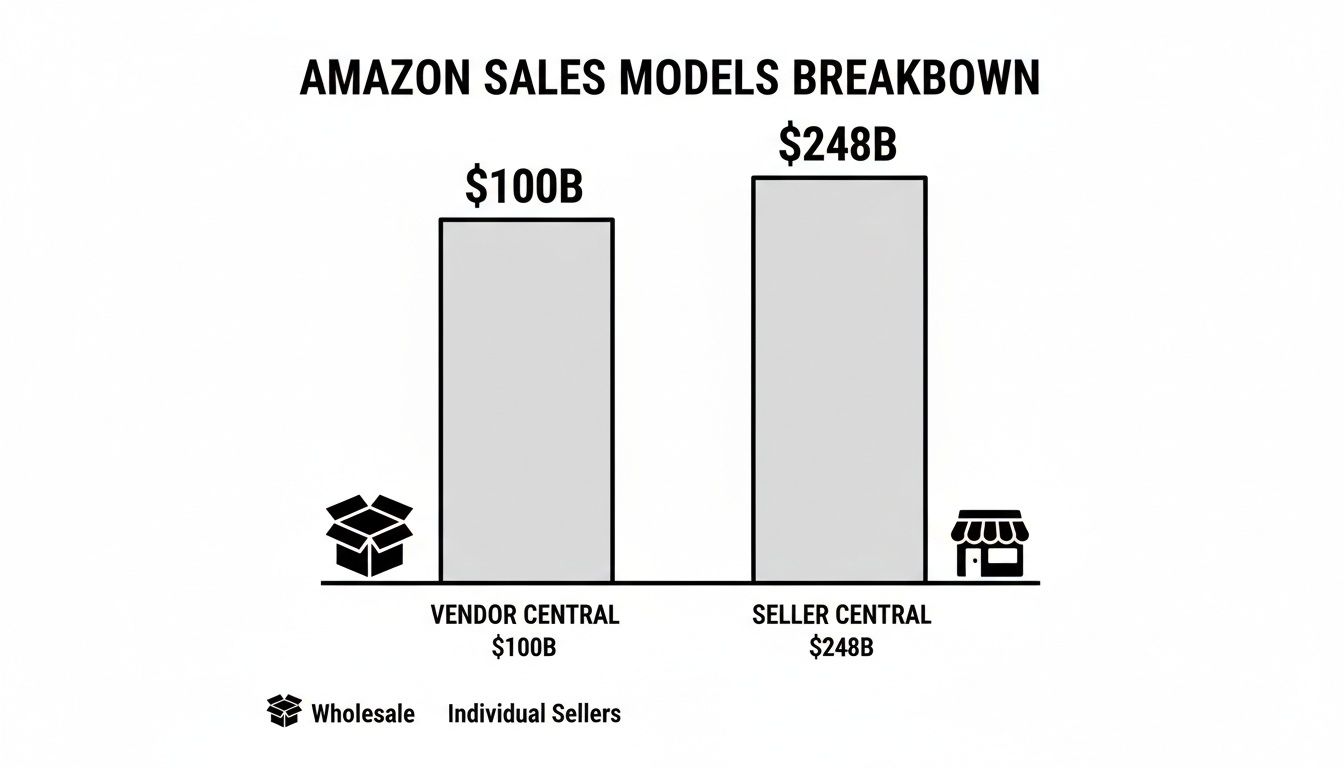
The numbers don't lie. Brands are seeing way more volume by selling directly to consumers on the platform. It just goes to show the massive scale and opportunity waiting in the Seller Central model.
The fees in Seller Central are transparent, but there are a lot of moving parts. Your main costs fall into three buckets, and each one eats into your net profit.
These costs are always changing, so you have to stay on top of them. For a much deeper breakdown of the numbers, check out our full guide on how much it costs to sell on Amazon.
Vendor Central looks simple at first glance. You agree on a wholesale price with Amazon, they send you a purchase order (PO), and you ship the goods. Done. No per-sale referral fees or FBA charges to worry about. But the real story of your profitability is much more complicated.
Key Insight: In Vendor Central, the wholesale price you negotiate is just the beginning. Your actual profit gets chipped away by a laundry list of "allowances" and chargebacks that can tank your net margin.
These deductions aren't surprises; they're baked into the terms of being a first-party supplier for Amazon.
Common Vendor Central Cost Deductions:
This model presents a whole different set of financial headaches. Seller Central fees are variable, but they're predictable. Vendor Central’s "hidden" costs, on the other hand, can be wildly unpredictable and make it incredibly difficult to know your true margin on any given PO.
While a Seller Central account's total fees can add up to 25-50%, smart sellers who actively manage their pricing can still pull in 35-45% gross margins. Vendor Central, however, often puts a ceiling on your take-rate at around 25-35% after you account for all the various fees and allowances. Ultimately, you have to decide what you prefer: higher potential margins that require constant management, or a simpler, hands-off approach with lower but more stable returns.
For brands serious about growth, control isn't a luxury—it's the engine that drives your entire strategy. This is where the choice between Vendor Central and Seller Central gets real. The platform you pick directly dictates how much say you have over your pricing, your brand's story, and—most critically—your customer data.
When you're on Seller Central, you're the retailer. Period. This means you hold almost all the cards, giving you a level of agility that's just not possible in the wholesale model. You set the retail price, you create the promotional calendar, and you have the final word on every single piece of content on your product pages.
This direct command is crucial for keeping your brand consistent and reacting to what's happening in the market. A competitor drops their price? You can respond in minutes. Want to test out a new feature in your bullet points? You can update the listing right away.

Beyond just pricing and content, the biggest win for Seller Central is its absolute treasure trove of customer data. Tools like Brand Analytics (available to all brand-registered sellers) open the door to invaluable market intelligence. We're not talking about surface-level stats; this is a deep well of insights you can actually use.
Seller Central hands you granular data that leads to smarter decisions across your whole business. This access to daily sales reports, buyer demographics, and detailed ad performance is a game-changer. In fact, these free insights can lead to 40% better inventory decisions and a 25% increase in PPC efficiency.
It creates a direct feedback loop. You get to understand who your customers are and what they want, letting you fine-tune your strategy with precision.
Vendor Central is the complete opposite. When you sell to Amazon as a first-party supplier, you're essentially handing over the keys to your brand on the platform. Amazon’s algorithm takes over, setting retail prices based on its own metrics, which almost always leads to price erosion that can screw up your brand's value across every channel you sell on.
Sure, you can submit content for your product pages, but Amazon has the final say and can override it anytime. This creates a "black box" where your brand's message can get watered down or changed without you even knowing.
Key Difference: On Seller Central, your Brand Registry is your shield, giving you powerful tools to protect your listings. On Vendor Central, you're just a supplier—Amazon is the retailer with ultimate control. If you want to dive deeper, our guide on Amazon Brand Registry requirements is a great place to start.
This lack of control bleeds over into data, too. Vendor Central gives you basic sales and inventory dashboards, but it keeps all the rich customer data for itself. You won't know who's buying your stuff, where they live, or how they found you. Want deeper analytics? Get ready to pay for premium packages that can cost thousands a month.
This data scarcity is a massive headache, especially for forecasting. Without direct customer insights, predicting future demand is a total guessing game. It’s no surprise that 60% of vendors say the unpredictable purchase orders lead to stockouts ranging from 10% to 30%, killing sales and hurting their reputation.
The table below breaks down exactly what you can—and can't—control on each platform.
Control PointVendor CentralSeller CentralRetail PricingAmazon controls all retail pricing.You set and control your own retail prices.Inventory ManagementYou fulfill Amazon's purchase orders.You manage your own stock levels (FBA or FBM).PromotionsLimited to Amazon-approved programs (e.g., Vine).Full control over coupons, deals, and promos.Listing ContentAmazon has final say; can override your content.You have full control over all listing elements.Customer DataVery limited; basic sales reports.Rich data via Brand Analytics and sales reports.Direct CommunicationNo direct contact with end customers.Ability to communicate with customers for support.AdvertisingAccess to Vendor ad tools, but data is limited.Full access to Seller PPC with detailed metrics.
Ultimately, the fundamental trade-off is this: Vendor Central offers a simpler, B2B-style relationship, but you sacrifice control and strategic insight. Seller Central, on the other hand, gives you the autonomy and data you need to build your brand with agility, making it the clear choice for founders who want to be in the driver's seat.
How your brand shows up on Amazon is everything. It's shaped by a mix of subtle trust signals and powerful marketing tools, and your choice—Vendor or Seller Central—dictates which levers you get to pull. The decision really comes down to a trade-off: do you want the passive trust Amazon gives its vendors, or the active, hands-on brand-building control that sellers have?
For a lot of shoppers, seeing the phrase "Ships from and sold by Amazon.com" is an instant green light. This little badge, which is only for Vendor Central products, is a mental shortcut for customers. It screams reliability, fast shipping, and no-hassle returns. It can seriously boost conversion rates simply by borrowing from Amazon's massive well of consumer trust, making it a powerful magnet for established brands focused on high-volume sales.
But this borrowed trust comes at a cost. You’re essentially positioned as a supplier to Amazon, not as the brand engaging directly with the customer.
While vendors get that passive credibility, sellers get a whole workshop of tools to build their brand story from the ground up. Seller Central puts you squarely in the driver's seat, letting you create a much richer and more distinct customer experience. This is where the Amazon Vendor Central vs Seller Central comparison gets really sharp.
Sellers can craft a powerful, customized brand presence using a suite of exclusive tools:
These tools let sellers forge a direct connection with customers, turning a simple transaction into a memorable brand moment.
Strategic Insight: A seller can use their Brand Store to create a guided journey, leading customers from discovery to purchase within a branded bubble. A vendor, on the other hand, has their products placed on a digital shelf next to countless others, with Amazon controlling the entire shopping environment.
The ad platforms available on each dashboard also highlight this core difference in control and strategy. Both vendors and sellers can run Sponsored Products and Sponsored Brands campaigns, but the data and strategic options couldn't be more different.
Vendor Central gives you access to Amazon Ads, which includes heavy-hitting tools like display and video ads through the Amazon DSP (Demand-Side Platform). This is fantastic for top-of-funnel brand awareness campaigns designed to reach a massive audience, both on and off Amazon. The catch? The performance data is often aggregated and less granular, making it tough to tie ad spend directly to a specific sale.
Seller Central’s advertising console, while more focused on on-platform ads, provides incredibly detailed, real-time performance metrics. Sellers can see exactly which keywords are driving sales, calculate their precise Advertising Cost of Sale (ACOS), and tweak campaigns with a level of agility that vendors just don't have. This direct feedback loop is built for efficient, performance-driven marketing.
For a brand caught between the two, it's a strategic question. Do you need the broad-reach, awareness-building power of the vendor ad suite? Or do you need the granular, sales-focused optimization tools that sellers get? Your answer depends on whether your main goal is massive market exposure or maximizing the return on every single dollar you spend. Your choice between Amazon Vendor Central vs Seller Central ultimately defines your entire marketing philosophy on the platform.
When you get past the numbers and brand control, the real, day-to-day differences between Vendor and Seller Central show up in your warehouse. How you manage inventory is a completely different beast on each platform. Your choice here determines whether you’re scrambling to fill unpredictable purchase orders or meticulously planning your own stock levels.
For most brands using Seller Central, the go-to solution is Fulfillment by Amazon (FBA). You ship your products in bulk to Amazon’s warehouses, and they take over from there—handling storage, picking, packing, shipping, and even customer service and returns. The biggest perk? Your products instantly get that coveted Prime badge, which is a massive driver for conversions.
But FBA isn't a "set it and forget it" deal. Your success lives and dies by your Inventory Performance Index (IPI) score. This metric, from 0 to 1000, is Amazon’s way of grading how well you manage your inventory in their warehouses. If your score drops too low, you'll face storage limits and higher fees. It’s their way of telling you to get rid of slow-moving stock.
Smart FBA sellers treat Amazon's fulfillment centers like cross-docks, not long-term storage units. You have to stay on top of your sell-through rates, deal with any stranded inventory, and keep just the right amount of stock to maintain a healthy IPI score. It’s a constant, data-driven juggling act.
Of course, you always have the option of Fulfillment by Merchant (FBM), where you handle all the logistics yourself. This gives you total control and can be a lot cheaper for oversized, heavy, or slow-moving products. For Australian brands considering FBM, nailing down an efficient small business parcel delivery partner is key to meeting customer expectations without killing your margins.
Flip over to Vendor Central, and logistics are all about Amazon’s purchase order (PO) system. You don't just send inventory whenever you want; you have to wait for Amazon to place an order with you. This can feel great for brands that can handle large, pallet-sized shipments, as it turns complex demand forecasting into a simple B2B sale.
Those POs can be huge, giving your revenue a big, instant boost. The catch? The system is notoriously unpredictable. Amazon's algorithms decide when and how much to order, which can lead to a feast-or-famine cycle. You might get a massive PO one month and then hear radio silence for weeks, creating huge headaches for cash flow and production planning.
Critical Insight: The biggest operational risk with Vendor Central isn’t just the unpredictable POs—it’s the brutal financial penalties for getting anything wrong. Amazon’s system is a well-oiled machine, and any mistake you make will cost you in the form of chargebacks.
These chargebacks are a vendor’s worst nightmare. They can wipe out the profit on a PO in the blink of an eye. Amazon will ding you for just about anything, creating a high-stakes game where perfection is the only option.
Common Vendor Central Chargebacks Include:
To succeed on Vendor Central, you need an operation that’s disciplined enough to meet rigid B2B compliance standards without a single slip-up. While Seller Central requires you to be an active inventory manager, Vendor Central demands you to be a flawless fulfillment machine. Where your operational strengths lie will tell you a lot about which system is right for your brand.
Choosing between Vendor and Seller Central isn't a one-and-done decision. For many established brands, the real power move isn't picking a side but figuring out how to make both platforms work in tandem. This is what we call the hybrid model—a sophisticated strategy where you run your brand on both platforms at the same time.
A hybrid approach lets you leverage the unique strengths of each program. You can use Seller Central as your launchpad for new products, giving you total control over pricing, marketing, and—most importantly—the customer data you need during that make-or-break launch window. Once a product takes off and demand stabilizes, you can shift that specific ASIN over to Vendor Central to take advantage of the sheer scale and simplicity of Amazon’s bulk purchase orders.
This way, you get the best of both worlds: data-driven agility when you're launching and hands-off volume for your proven winners.
Pulling off a hybrid model requires some careful planning to avoid shooting yourself in the foot. You have to prevent situations where your own FBA offer is competing head-to-head with Amazon's retail offer on the same listing. That's a quick way to start a price war that just eats away at everyone's margins.
A common and highly effective way to structure this is by segmenting your product catalog:
Key Insight: A true hybrid model is more than just using two accounts; it’s about building a strategic lifecycle for your products. ASINs "graduate" from the controlled, high-touch environment of Seller Central to the volume-driven machine of Vendor Central once they've proven their mettle.
Migrating from one platform to another is a major operational lift. Going from Seller to Vendor is usually the easier route, often kicked off by an invite from Amazon once you’ve shown you can move serious volume. The biggest hurdle here is just getting your logistics ready to handle bulk wholesale shipments and meeting Vendor Central’s notoriously strict compliance rules.
The reverse—moving from Vendor back to Seller Central—is a whole different beast. It's often called escaping the "vendor trap" for a reason. When you cut off Amazon’s inventory supply, they don't just disappear; they'll keep selling through whatever stock they have left, essentially turning into your direct competitor on your own listing.
Making this switch successfully requires a perfectly timed game plan:
This transition can take weeks, sometimes even months, and it demands meticulous inventory management to pull off a seamless handover without tanking your sales or Best Seller Rank. It's a strategic reset that gives you back the brand and pricing control you gave up as a vendor, but it has to be executed with surgical precision.
Choosing between Vendor and Seller Central is a huge decision, and it’s natural to have some very specific questions crop up. Let’s tackle some of the most common ones we hear from brands trying to navigate this choice.
Absolutely, and many high-growth brands do. Running a hybrid model lets you keep the control of Seller Central for new product launches, where you need to aggressively test pricing and marketing. The data you get during this phase is pure gold.
Once a product is established and selling at a high volume, you can let Vendor Central handle the heavy lifting on logistics. Just be careful—this requires a tight grip on your channel strategy to avoid Amazon's purchase orders going head-to-head with your own FBA offers on the same product.
There’s no sign-up button here; Vendor Central is strictly invite-only. Amazon’s retail team typically looks for brands that are already crushing it on Seller Central with high sales velocity. They also scout major trade shows or keep an eye on brands with a serious retail footprint outside of Amazon.
Honestly, the surest way in is to build a powerhouse brand on Seller Central first. Consistent, high-volume sales is the best signal you can send to get on Amazon's radar.
Forget the obvious wholesale margins for a second. The real profitability killers are the endless chargebacks and co-op fees. We're talking about mandatory marketing contributions, freight allowances, and painful penalties for not toeing the line on purchase orders (think late shipments or wrong packaging).
These fees are unpredictable and can gut your margins if you're not on top of them. Managing Vendor Central effectively means having someone meticulously watch your operations and financials.
Yes, it's possible, but it's rarely a clean break. If Amazon has been your primary seller (1P), they'll keep selling through their existing stock until it's gone, which means you'll be competing directly against them on your own listings.
Making the move requires careful planning. You have to manage your inventory perfectly to recapture the Buy Box and take back full control of your brand on the marketplace without tanking your sales momentum.
At Million Dollar Sellers, we bring together 7, 8, and 9-figure e-commerce founders in a private, vetted community to share the exact strategies that unlock massive growth. Learn more and see if you qualify.
Join the Ecom Entrepreneur Community for Vetted 7-9 Figure Ecommerce Founders
Learn MoreYou may also like:
Learn more about our special events!
Check Events