Chilat Doina
July 15, 2026
Most advice on Amazon Vine is lazy. It treats Vine like a default launch step, as if every new ASIN should hand out units and collect reviews on autopilot.
That's bad advice.
Vine is not a growth hack. It's a product test under a spotlight. If your offer is strong, Vine can accelerate traction. If your product has quality issues, weak positioning, bad images, or sloppy copy, Vine can hard-code those problems into your listing before you've earned enough sales to recover.
Serious sellers shouldn't ask, “How do I use Vine?” They should ask, “Is this ASIN ready for Vine, and will the payback justify the risk?” That's the only question that matters.
A lot of Amazon advice treats Vine like a default launch setting. List the ASIN, enroll the product, collect reviews, and let conversion improve.
That is how sellers bake early failure into a listing.
Vine speeds up feedback. It does not protect you from it. If the product, positioning, or unit economics are weak, Vine gets those weaknesses published fast, before your listing has enough sales history to absorb the hit.
Vine is a pressure test for launch readiness.
If your product has finish issues, sizing confusion, weak packaging, or a gap between the images and what shows up at the customer's door, reviewers will expose it quickly. That matters because Vine reviewers tend to write specific, high-signal reviews. They are useful when the product is ready. They are brutal when it is not.
Vine is a launch instrument, not a review vending machine.
Too many brands treat reviews like the missing piece. Usually the missing piece is product quality, offer clarity, or margin structure. Reviews do not fix those problems. They make them visible.
Negative reviews at launch hurt more than negative reviews six months later.
At the start, you have no rating cushion, no conversion history, and no established order volume to dilute bad feedback. One cluster of critical reviews can suppress click-through, conversion rate, and retail confidence at the exact moment you need momentum. That is why experienced operators keep unstable SKUs out of Vine until defect risk, packaging issues, and listing clarity are under control.
This is not a theory. It shows up in account performance all the time. Sellers enroll too early, get honest feedback on problems they already suspected, then spend the next 90 days discounting, revising the listing, and explaining away a rating they could have prevented.
Many sellers focus on whether they can use Vine.
Wrong question.
Ask these instead:
Use Vine on products that already deserve proof. Keep it away from products still relying on hope.
If the idea of ten sharp reviewers judging the ASIN this week makes you uneasy, do not enroll it.
Amazon launched Vine in 2007, and it used to be a vendor-heavy tool that could cost up to $2,500 per ASIN. That changed in 2023, when Amazon expanded access and introduced lower pricing tiers for brand-registered FBA sellers, with $0 for 1 to 2 units, $75 for 3 to 10 units, and $200 for 11 to 30 units for eligible ASINs with fewer than 30 existing reviews, as outlined in this overview of the Amazon Vine program for sellers.
That pricing made Vine easier to access. It did not make it automatically cheap.

Vine Voices are not random bargain hunters. Amazon recruits them through a proprietary algorithm that prioritizes reviewers with a strong density of helpful votes on past reviews. That same review ecosystem creates a contractor-style tax implication, where 1099-NEC reporting can be triggered by the aggregate fair market value of products received, as discussed in this video breakdown of Vine Voice recruitment and tax treatment.
That matters for two reasons.
First, these people know how to write useful reviews. They don't just say “good product” and move on. They talk about packaging, expectations, instructions, materials, fit, durability, and whether the listing oversold the product.
Second, they're not participating to flatter your brand. They're participating inside Amazon's system, and the value of their reviews comes from credibility.
Sellers fixate on the enrollment fee because it's easy to see in Seller Central. The bigger cost is everything around it.
You're also giving away units. That means tied-up inventory, landed cost, FBA handling implications, and the opportunity cost of sending product to reviewers instead of paying customers. Vine lets brands generate up to 30 detailed reviews per ASIN while Amazon distributes more than $200 million in free products annually through the program, according to the verified performance data provided above.
For a low-margin SKU, that's not a marketing expense. It's margin leakage.
Vine can move quickly. The program operates with more than 500,000 active Vine Voices globally, with an average 14-day review turnaround, and products with Vine reviews accumulate review volume 67% faster than products relying on organic accumulation, based on the 2025 metrics in the verified dataset.
That speed is exactly why bad products shouldn't go in.
Here's the video overview if you want the tactical Seller Central angle before making the strategic call:
Operator view: Fast feedback is only an asset when your product is ready to be judged.
Most sellers calculate Vine ROI backward. They start with the fee, assume the reviews are valuable, and call it a good investment.
Start with contribution instead. If the ASIN can't turn better social proof into profitable sales quickly, Vine is just an expensive way to learn that the listing wasn't ready.
The performance case for Amazon Vine program reviews is real. Products with Vine reviews show a 34% higher conversion rate versus standard organic reviews and rank 23% higher in Amazon search results, based on 2025 metrics across major categories in the verified data. The same dataset shows Vine is strongest when a product has under 15 reviews at enrollment, while once an ASIN passes 50 reviews, the marginal lift rarely covers the cost.
That tells you where Vine belongs. Early-stage, under-reviewed ASINs with room to improve conversion and rank.
A lot of sellers still assume Vine buys positivity. It doesn't.
Research based on a 132.4 MB dataset found no bias toward favorable ratings, with only 44% of Vine reviews rated 5 stars versus 57% for non-Vine reviews. That's in the verified data, and it's the most important reality check in this whole discussion. Vine gives you trusted feedback. It does not give you guaranteed praise.
If you need a refresher on how to pressure-test the math behind any launch initiative, use a disciplined ROI calculation approach for e-commerce decisions.
Use this framework before you enroll.
| Metric | Calculation | Cost/Benefit |
|---|---|---|
| Enrollment fee | Choose the relevant Vine tier for the ASIN | Direct cost |
| Inventory giveaway | Multiply units allocated to Vine by your landed product cost | Direct cost |
| Conversion lift potential | Estimate whether stronger early social proof can improve paid and organic conversion | Potential benefit |
| Search visibility impact | Assess whether ranking improvement will create additional profitable sessions | Potential benefit |
| Review velocity | Compare Vine's faster review accumulation to your current organic review pace | Potential benefit |
| Risk of critical feedback | Judge product readiness, defect risk, and listing accuracy before launch | Potential downside |
| Payback window | Measure whether improved conversion can repay costs within your target launch window | Decision filter |
This isn't a spreadsheet trick. It's a capital allocation discipline.
The verified data is blunt. 60% of Vine enrollments deliver positive ROI within 90 days, 25% break even, and 15% remain net-negative. A separate projection in the same dataset says Vine is net-negative for roughly 35% of brands using it in 2026.
So yes, Vine often works. No, it is not close to automatic.
That's why smart operators also look for cost leakage elsewhere in the P&L. For example, if you're tightening launch economics across FBA, this practical guide to the FBA refund policy update is worth reviewing because reclaimed reimbursements can improve the margin cushion around launch bets like Vine.
If your ASIN needs perfect reviews to survive, Vine is the wrong tool.
Vine is not a launch strategy. It is an accelerant. If the product and listing are already strong, Vine can shorten the path to traction. If they are weak, Vine speeds up the public failure.
That is the decision.
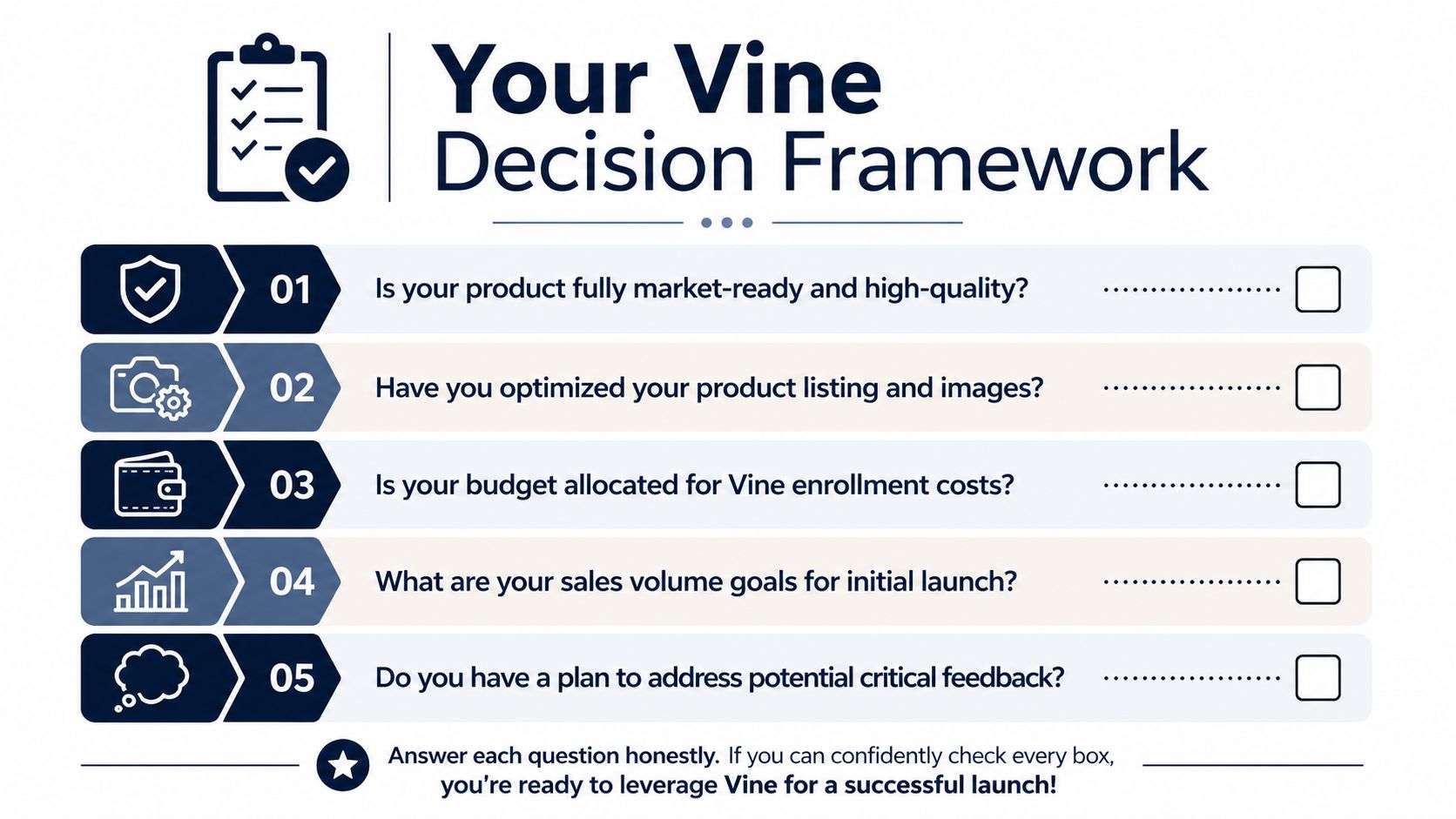
Use Vine only after you have answered a harder question: if this ASIN got traffic tomorrow, would it convert without excuses?
The right Vine candidate has four traits:
That is when Vine earns its keep. You are using reviews to confirm a good launch, not to rescue a bad one.
A lot of sellers misuse Vine because they want answers from the market that they should have gotten from QA, beta users, or internal testing.
Skip Vine if any of these are true:
Strong operators draw a hard line. Do not pay to put an unfinished product in front of highly observant reviewers.
A weak review with specifics does more damage than a generic complaint. It gives future shoppers a reason to hesitate, and it gives them language they can repeat in their own objections.
That is why Vine should never be your product validation layer. It is a distribution tool for early trust.
If your brand already has exposure to public review damage, this executive-level guide on how to protect reputation from Amazon reviews is useful context for teams managing escalation and reputation risk.
Hard rule: If the product team is still arguing about readiness, wait.
Vine isn't the only compliant path to more reviews, and for many ASINs it shouldn't be the only one you use.
This matters even more because Amazon requires products to have fewer than 30 reviews before enrollment, a strict threshold designed to focus Vine on early-stage social proof generation, as explained in this overview of Amazon Vine eligibility limits. If your ASIN is already past that point, you need another playbook.

A mature seller usually combines several compliant systems:
If your team needs a broader playbook beyond Vine, this guide on how to get reviews on Amazon is a useful reference.
Don't frame this as Vine versus everything else. Frame it as sequencing.
For a strong new ASIN, Vine can jump-start early proof while Request a Review builds the ongoing review base. For an ASIN that's already over the threshold, Request a Review and stronger post-purchase operations become the default. For products with visual appeal, creator seeding can support launch assets and external demand even if it doesn't directly solve the Amazon review count.
Here's the practical hierarchy:
| Approach | Best use case | Main strength | Main limitation |
|---|---|---|---|
| Amazon Vine | New, under-reviewed ASINs | Fast, credible early feedback | Risk of visible negative reviews |
| Request a Review | Most ASINs | Compliant and scalable | Slower feedback loop |
| Post-purchase systems | Brands with process discipline | Operational consistency | Requires execution control |
| Creator seeding | Visual or story-driven products | Supports awareness and content | Doesn't guarantee Amazon reviews |
The mistake is trying to make one tool do everything. Vine is specialized. Treat it that way.
By the time you're considering Amazon Vine program reviews, essential work should already be done. Product quality should be proven. Listing assets should be finalized. Margin assumptions should be accurate. If any of that is still soft, delay the enrollment.
That's the disciplined move, not the timid one.
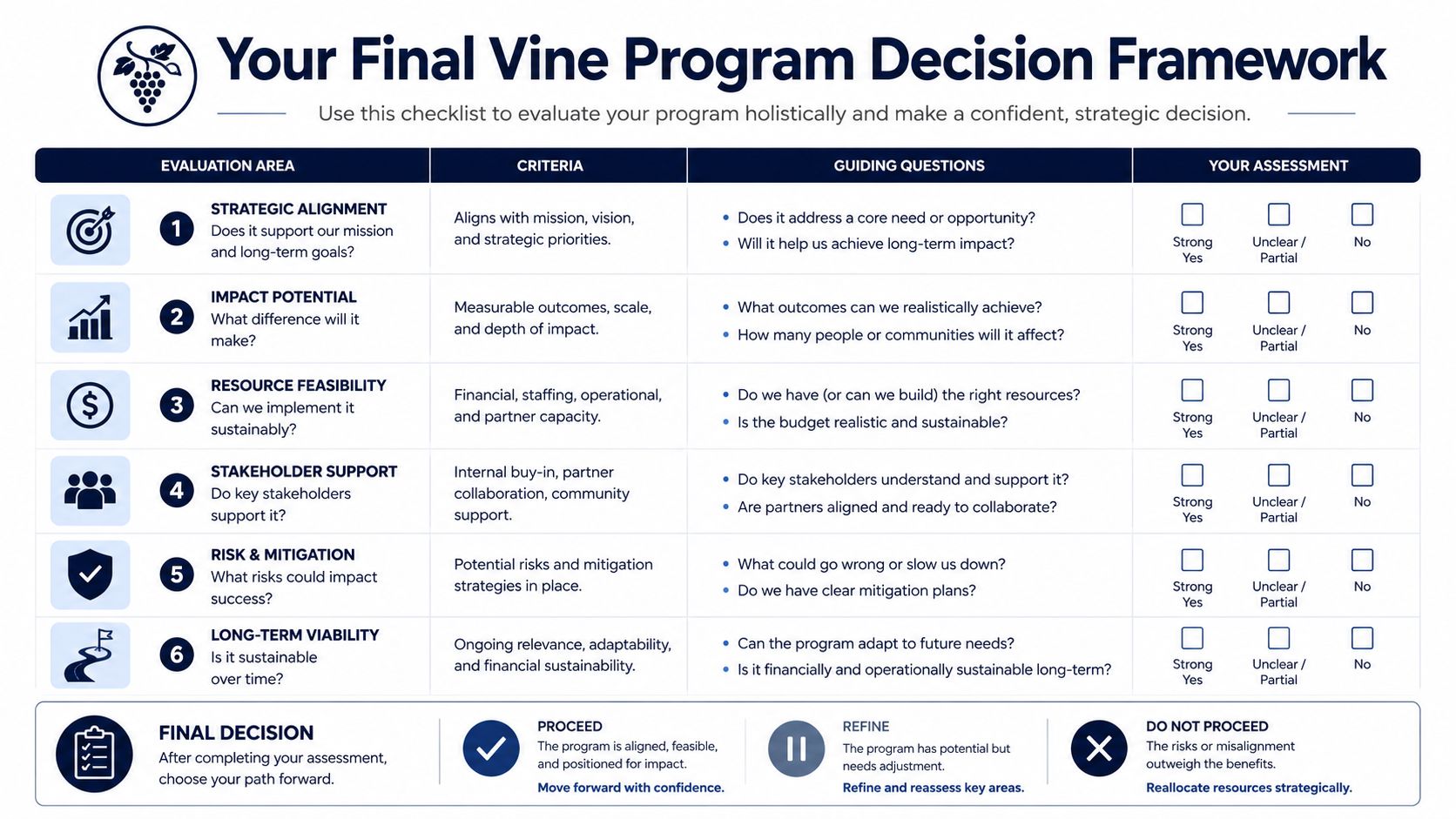
Run every eligible ASIN through this filter:
Would I be comfortable getting blunt public feedback on this product today?
If the answer is no, stop there.
Will stronger social proof materially improve conversion on this listing?
If traffic is weak and the offer is unconvincing, reviews won't rescue it.
Is the ASIN still in the phase where early review velocity matters most?
Vine is strongest at the beginning, not after the listing has already matured.
Can this product financially absorb the fee plus inventory giveaway?
Don't evaluate the fee in isolation. Evaluate launch economics as a whole.
Do I have a response plan if critical feedback lands?
That means product fixes, copy changes, image updates, packaging changes, or pricing adjustments.
The 2025 update that enabled pre-launch review queuing sounds great in theory. In practice, the verified data says there is no definitive evidence that pre-launch reviews improve conversion more than post-launch reviews when organic traffic is low, and the ROI of the $200 per ASIN tier still depends heavily on listing readiness and product confidence, according to this analysis of the pre-launch Vine update.
That's the nuance most promotional content misses.
Pre-launch reviews are only valuable if the listing is ready to capitalize on them. If traffic is thin, positioning is weak, or the product still has unresolved issues, you're just moving feedback earlier. You're not improving the business outcome.
Use Vine when you have a good product, a tight listing, enough margin, and a clear reason to accelerate trust.
Skip Vine when you're uncertain about quality, hoping reviews will fix weak conversion, or trying to force momentum on an ASIN that hasn't earned it.
Good sellers ask how to use Vine. Great sellers ask whether this ASIN deserves Vine.
If you're an established brand operator who wants sharper peer-level judgment on launch strategy, review velocity, and Amazon profitability decisions, Million Dollar Sellers is where serious founders compare notes with other high-performing ecommerce leaders.
Join the Ecom Entrepreneur Community for Vetted 7-9 Figure Ecommerce Founders
Learn MoreYou may also like:
Learn more about our special events!
Check Events