Chilat Doina
March 23, 2026
So, what exactly is the Amazon Vine program for sellers? In short, it’s an invitation-only service from Amazon that connects you with their most trusted reviewers to help you get those critical first reviews for a new product.
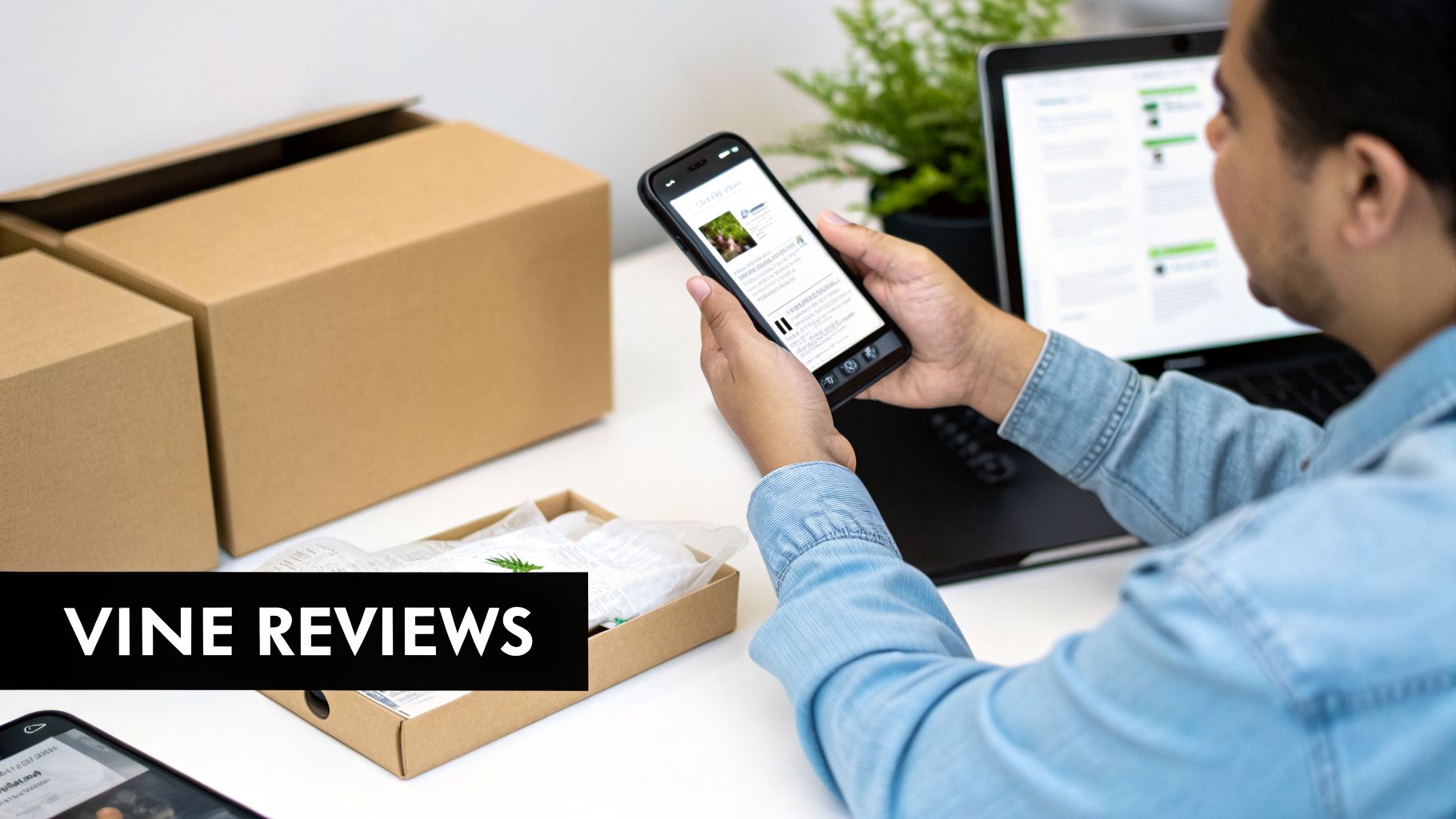
These reviewers, known as Vine Voices, get your product for free in exchange for leaving an honest, unbiased review.
Picture this: you’ve just launched a fantastic new product. You’ve nailed the design, sourced the best materials, and your listing is perfectly optimized. The only problem? It’s sitting on Amazon’s digital shelf with zero reviews, making it practically invisible. This is the classic "no reviews, no sales" catch-22 that every seller dreads.
Amazon Vine was built to smash right through that barrier.
Think of it as your own private, pre-launch focus group, staffed by Amazon's most elite reviewers. By enrolling a product, you’re essentially offering it up to a select pool of people who Amazon has hand-picked for writing consistently helpful and detailed critiques. They get to request your product for free, and in return, you get the initial social proof that can make or break a launch.
To give you a clearer picture, here’s a quick breakdown of how the program’s main components fit together.
| Feature | Description | Impact for Sellers |
|---|---|---|
| Vine Voices | An invitation-only group of Amazon's most trusted and helpful reviewers. | You get feedback from experienced, credible sources, not random shoppers. |
| Review Process | Voices request your product for free, test it, and leave an unbiased review. | A streamlined way to generate your first crucial reviews without chasing down customers. |
| "Vine Voice" Badge | A special badge appears on the review, identifying it as part of the program. | This adds a layer of transparency and credibility, building trust with potential buyers. |
| Enrollment | Brand-registered sellers can enroll an ASIN directly through Seller Central. | The process is straightforward and integrated directly into your existing seller workflow. |
| Unit Limit | You can offer up to 30 units of a product per enrollment. | Gives you control over inventory and program costs while generating a solid base of reviews. |
This structure turns what used to be a guessing game—gathering early reviews—into a predictable and strategic part of your launch plan.
The process itself is surprisingly simple. If you’re a brand-registered seller, you can enroll an eligible ASIN right from your Seller Central dashboard. You just have to decide how many units you want to make available—up to 30 in total.
Once enrolled, your product becomes visible exclusively to the Vine Voices community. Any Voice who’s interested can request it. After they receive and test your product, they'll post their review directly on your detail page.
That review will show up with a special green stripe and the words "Vine Customer Review of Free Product." This little badge does two very important things:
The power of this badge is huge. It lets shoppers know the review comes from a vetted, experienced source, which can do wonders for building trust and boosting your conversion rate.
Not too long ago, Vine was an exclusive club. It was a vendor-only program that could cost a staggering $2,500 per ASIN, putting it well out of reach for most brands. But a massive overhaul in 2023 completely changed the game.
Amazon introduced a new tiered fee structure that democratized the whole system. Now, you can enroll 1-2 units for $0 to test the waters, with fees capping out at just $200 for enrolling up to 30 units. You can read more about how this evolution has made Vine a key tool for sellers.
This single change leveled the playing field, giving smaller, growing brands a fighting chance to compete. It transforms the daunting task of getting those first few reviews into a manageable and strategic investment. By securing that initial feedback, you kickstart the sales velocity needed to catch the eye of Amazon's algorithm, improve your organic rank, and set your product up for long-term success.
Getting into the Amazon Vine program isn't as simple as flipping a switch. Think of it more like having a special set of keys to a very exclusive club. Amazon has put some firm, non-negotiable rules in place to keep the program valuable and trustworthy, and knowing these rules is your first step to getting in the door.
These requirements act as the gatekeepers, deciding which products even get a chance to be seen by Vine Voices. Before you even think about enrolling an ASIN, you need to make sure it ticks every single one of these boxes.
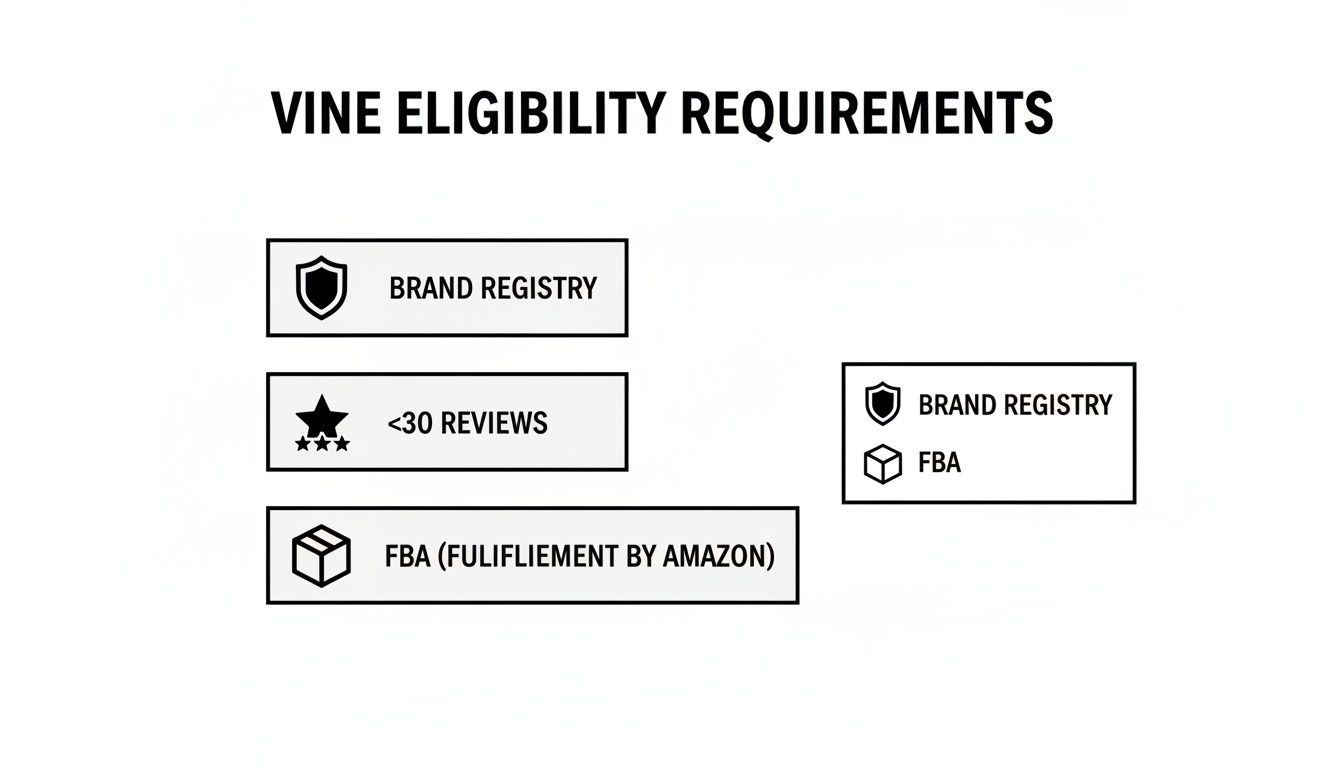
You can think of these as the four pillars of Vine eligibility. If your product is missing even one, it's a no-go. It's a straightforward pass/fail system with no wiggle room.
You Must Be a Brand Registered Seller: This is the big one. The Vine program is only for sellers who have gone through the Amazon Brand Registry process. This is how Amazon confirms you're the legitimate owner of the brand and product.
Your Product Must Have Fewer Than 30 Reviews: Vine is all about giving new or slow-moving products a jumpstart. If your product detail page already has 30 or more reviews, Amazon sees it as having enough social proof, and it won't be eligible.
You Must Use Fulfillment by Amazon (FBA): Your items need to be in an FBA warehouse with available inventory. This is purely a logistics thing—Amazon handles all the shipping from their fulfillment centers directly to the Vine Voices who claim your product.
The Product Must Be in 'New' Condition: Only brand-new items can be enrolled. Any used, refurbished, or open-box products are out, since the whole point is to get feedback on a fresh-out-of-the-box product experience.
Meeting these core criteria is non-negotiable. It’s smart to run through this checklist for any ASIN you plan to enroll. Overlooking just one point will stop you in your tracks, and a quick check can save you a lot of time and headache.
Sometimes, even when you’re sure you’ve met all the requirements, you might hit a snag. The most common problem sellers run into is seeing a grayed-out or inactive enrollment button in Seller Central. This almost always means you’ve missed one of the eligibility checks.
If you find yourself stuck, just work backward and troubleshoot the issue by double-checking each requirement.
Double-Check Brand Registry: Is the ASIN actually linked to your registered brand? Sometimes new products don't connect automatically. Pop into your Brand Registry portal and make sure the ASIN is listed under your brand.
Verify FBA Inventory Levels: Do you have live, sellable inventory in an FBA warehouse right now? The system needs to see available stock to fulfill orders from Vine Voices. If your units are still in transit, reserved, or just plain out of stock, you won't be able to enroll the product.
Confirm the Review Count: Do a quick, fresh check of your product's review count. If a few new organic reviews just came in and pushed your total to 30 or more, that ASIN is now officially ineligible.
By running through these checkpoints, you can figure out and fix almost any enrollment problem. This turns the Amazon Vine program for sellers from a confusing roadblock into a clear, actionable part of your launch plan. Getting your ASINs prepped correctly means a smooth entry, so you can focus on what really matters: getting great feedback and building that early sales momentum.
Thinking about the Amazon Vine program as just an enrollment fee is like seeing only the tip of the iceberg. To really get a handle on its value, you have to think like a CFO, accounting for every dollar in and tracking every dollar out. When you make that shift, Vine stops being an expense and starts looking like a strategic investment in sales velocity.
First things first, let's get real about the total outlay. The enrollment fee is just the cover charge; the true cost includes the products you’re giving away and the logistics to get them to the reviewers. Your total investment is a mix of a few key pieces.
A common mistake I see sellers make is lowballing the full cost of participating. You need a clear-eyed view of your total investment before you can even begin to think about measuring your return.
Once you have these numbers, the formula is pretty simple:
Total Vine Investment = Enrollment Fee + (COGS per Unit x Units Claimed) + (FBA Fee per Unit x Units Claimed)
This gives you the true 'cost of admission' for the program. Knowing this number is the first step to justifying the spend and tracking your ROI.
Now for the fun part: measuring the payoff. The return you get from the Amazon Vine program for sellers isn't just about the immediate sales. It’s about the momentum it creates, which shows up in several key metrics. You’ll want to track these before, during, and after your Vine campaign kicks off.
To see the program's impact, keep a close eye on these key performance indicators:
By tracking these numbers, you can draw a straight line from your initial investment to real, tangible business growth. The conversation shifts from "How much did Vine cost us?" to "What was our return on accelerating this launch?" This data proves Vine isn't just a cost center—it's a powerful growth lever.
For a deeper dive, you can also check out a full breakdown of the costs associated with selling on Amazon.
Think of the Vine program as a turbocharger for your product launch. It can give a great product an incredible speed boost, but it can’t fix a clunker of an engine. Vine is all about accelerating momentum that's already there—it can't create it out of nothing.
True success isn't just about getting a handful of reviews. It's about earning glowing feedback that builds immediate trust and gets your sales velocity humming from day one.
The single biggest mistake I see sellers make is jumping the gun and enrolling a product that simply isn't ready. Vine Voices are seasoned, sharp-eyed reviewers who will pick apart every little flaw. Handing them a half-baked product is a recipe for a flood of 2 and 3-star reviews that can kill your launch before it even gets off the ground.
Here’s the first rule of Vine: be brutally honest with yourself. Before you even click that enrollment button, you need to be absolutely certain your product can earn a 4.5-star rating from a total stranger. It's time to take off your "founder" hat and scrutinize the entire customer experience with a critical eye.
A product that’s just "good enough" won't cut it. These reviewers get tons of free stuff, so their standards are high. They have a built-in radar for quality, packaging, and usability. Your product has to shine.
Before you go any further, run your product through this simple pre-flight check.
Think of this internal vetting process as your first line of defense. Catching a simple issue—like a typo in the manual or flimsy packaging—before enrollment can be the difference between a 5-star rave and a 2-star rant that torpedoes your launch.
I once saw a seller launch a cool DIY shelving unit, but it got hammered with 1-star Vine reviews. The shelves themselves were solid, but the instructions were a mess and the hardware was mislabeled. These were totally fixable problems, but they created a terrible first impression that the listing never recovered from.
To help you vet your own products, use this checklist to gauge if you're truly ready for the spotlight.
Use this checklist to vet your product's readiness for the Vine program and maximize your chances of success.
| Checklist Item | Criteria for Success | Risk if Ignored |
|---|---|---|
| Product Quality | The product is free of any manufacturing defects, feels durable, and functions perfectly as intended. | Negative reviews highlighting poor craftsmanship or defects, leading to a low initial rating. |
| Packaging | The packaging is sturdy enough for shipping, easy to open (frustration-free), and presents the product well. | Reviews mentioning damaged items upon arrival or a frustrating unboxing experience. |
| Instructions & Setup | The manual is clear, concise, and easy for a first-time user to follow. All parts are included and labeled. | 1 and 2-star reviews complaining about confusing setup, missing parts, or poor translations. |
| Listing Accuracy | The product page photos, descriptions, and features perfectly match the physical product. | Reviewers will call out any discrepancies between the listing and the actual product, damaging trust. |
| Competitive Edge | The product has a clear unique selling proposition (USP) that stands out from competitors. | Without a clear "wow" factor, reviewers may give a lukewarm 3-star review, calling it "just okay." |
Going through this list honestly will give you a much clearer picture of your potential for success or failure with Vine.
Okay, so your product is a rockstar. Now what? The next move is deciding how many units to enroll. You can offer up to 30 units, but more isn't automatically better. The goal is to get just enough reviews to build social proof without giving away a ton of inventory.
For most new products, enrolling 15 to 20 units is the sweet spot. This usually generates about 10-15 reviews, which is a fantastic foundation to start with. It's the right balance between getting the social proof you need and managing your costs. And to make those reviews count, make sure you've also read our guide on how to optimize your Amazon listings.
Your job isn't over after you enroll. The first wave of feedback from Vine Voices is pure gold. You need to be watching those reviews like a hawk as they come in. If you see the same problem pop up in multiple reviews, that's a bright red flag telling you to act—fast.
Jumping on feedback can save a listing. If reviewers seem confused about a feature, go update your A+ Content or main images to make it clearer. If a minor defect keeps getting mentioned, pause your enrollment and get on the phone with your supplier. The Vine program is a powerful way to get that initial traction, but for a bigger picture on growth, understanding how to increase Amazon sales is essential. Being proactive turns potential criticism into a powerful tool for making your product even better.
Of course. Here is the rewritten section, crafted to sound completely human-written and natural, following the specific style and tone from your examples.
While the Amazon Vine program can be a fantastic launchpad, it’s not a guaranteed win. Think of it like paying for a focus group, only to have them tell the whole world your new product is a dud. That’s the real fear for a lot of sellers—enrolling an ASIN and getting hit with a wave of bad reviews that kills a launch before it even gets going.
But here’s the thing: that kind of outcome is rarely a surprise. It almost always comes down to a few predictable mistakes you can sidestep. Knowing what these common pitfalls are is the first step to making sure your investment leads to glowing reviews, not launch-day disasters.
The biggest risk is just a classic product-market mismatch. You might think your product is amazing, but the savvy Vine Voices—who get tons of free products—just don't get it. This happens a lot when sellers try to enter a crowded market with a "me-too" product that doesn't have a clear, unique selling point.
Remember, Vine Voices aren't your average shoppers. They’re seasoned reviewers who are a lot harder to impress. A product that a regular customer might call "good" and give 4 stars, a Vine Voice might rate a 3, calling it "unremarkable."
Want to attract negative Vine reviews fast? Ship a product with obvious, fixable problems. Vine Voices are experts at sniffing out issues an average buyer might miss, and believe me, they won't be shy about mentioning them. They’re basically your most critical—and most public—quality control team.
These are the top offenders that can absolutely tank your ratings:
The best way to avoid this is to stress-test your product with fresh eyes. Hand it to someone in your office who has never seen it before. Watch them unbox it and put it together without any help from you. Their feedback is pure gold—it’s your roadmap for what to fix before you enroll in the Amazon Vine program for sellers.
Another huge pitfall is not getting the unique mindset of a Vine Voice. They aren't just getting a freebie; they're part of a program that values honest, detailed feedback. They feel it's their job to help other shoppers make smart buys, which means they are motivated to be thorough.
This can cause a few headaches for sellers who aren't ready for it:
The fix is to be proactive. Before you enroll anything, dial in your main image and title to set clear, accurate expectations. Have a plan to check feedback as it rolls in, and be prepared to quickly tweak your listing or product details to clear up any confusion. Don't think of those first Vine reviews as the final word. Instead, treat them as critical, actionable data to perfect your launch strategy.
While the Amazon Vine program for sellers is a fantastic way to get the ball rolling on reviews, it shouldn't be your entire game plan. Think of it as one powerful play in a much larger strategy. In fact, for some products, it might not even be the best first move.
Let's say you're launching a very expensive item or something for a super-specific niche. Giving away up to 30 units for free might not make financial sense. Plus, the pool of Vine Voices interested in a highly specialized product could be tiny, which means you might not get the results you're hoping for. In those situations, it’s smart to look at other ways to build that crucial social proof.
Even without Vine, Amazon gives you a few compliant ways to ask for feedback. The simplest is the ‘Request a Review’ button you'll find in your Seller Central order details. Clicking it sends a standard, Amazon-approved email to your customer asking for both a product review and seller feedback.
Of course, manually clicking that button for every single order is a nightmare for any brand with real volume. That’s where automated follow-up services come in. These tools automatically trigger the ‘Request a Review’ message for you, making sure you ask every eligible customer without ever breaking Amazon's communication rules. If you're moving a lot of product, automation isn't a luxury—it's a necessity.
Amazon’s approach to reviews is always changing. You can see how things have evolved by looking at past initiatives like the old Early Reviewer Program in our guide on the Amazon Early Reviewer Program.
Some of your best review-generating tools might not even be on Amazon. If you have an audience on your own website, a popular social media page, or a solid email list, you're sitting on a goldmine. You can point that traffic—people who already know and like your brand—to your new Amazon listing.
These initial, organic sales are pure gold because they often lead to genuine, positive reviews. Another great option is influencer marketing. You can learn how to craft effective PR Package Emails and send your product to micro-influencers in your space. This can drum up social proof and user-generated content that drives even more traffic and sales.
By stacking different strategies—using Vine for that first big push, automated requests for a steady stream of follow-ups, and your own audience for organic sales—you create a much stronger foundation. This layered approach is what builds sustainable social proof and drives long-term sales.
Once you start digging into the Amazon Vine program, a few questions almost always seem to surface. The program has its own quirks and timelines that can feel a little confusing at first, so let's clear up some of the most common queries we hear from sellers.
Getting those first crucial reviews is the whole point of using Vine, so naturally, everyone wants to know when they'll start seeing results.
Patience is key here, but you won't be waiting forever. Once your product goes live in the Vine portal, it might take a few days or even a couple of weeks for Vine Voices to start claiming your units. After a Voice snags your product, they usually have about a month to test it out and share their thoughts.
For most products, you can expect the first Vine reviews to appear on your detail page within two to four weeks after being claimed. The majority of reviews from a full enrollment of 30 units typically roll in over the first 30-45 days.
This timeline shows Vine isn’t an overnight fix, but it's a dependable way to build a foundation of reviews during that critical product launch window.
The answer to this is a hard no. Amazon's policy is crystal clear on this: you are never allowed to contact a Vine Voice about their review, your product, or anything else for that matter. Trying to reach out can get you booted from the program and could even jeopardize your entire seller account.
All communication needs to stay public and transparent, right on the product detail page. If you feel compelled to respond to a review—maybe to clarify a feature for other shoppers—you can post a public comment directly on the review itself. But do this sparingly and always stay professional; never argue with the reviewer.
First off, don't panic. A negative review can feel like a punch to the gut, but it's also a free, unfiltered look into how a real customer experiences your product. Think of it as an invaluable learning opportunity.
Here’s a simple framework for handling them:
Your goal should always be to use feedback to make your product and your listing better. Do that, and you'll naturally start getting more positive organic reviews that balance out any early negative ones.
At Million Dollar Sellers, we know that navigating programs like Vine is just one piece of the puzzle. Our exclusive community provides the strategic insights and peer support that 7-, 8-, and 9-figure founders use to scale their brands. If you're ready to accelerate your growth with proven strategies, apply to join our community today. Learn more at https://milliondollarsellers.com.
Join the Ecom Entrepreneur Community for Vetted 7-9 Figure Ecommerce Founders
Learn MoreYou may also like:
Learn more about our special events!
Check Events