
Chilat Doina
June 14, 2026
Most advice on ROI is too clean to be useful.
It tells founders to plug numbers into a formula, get a percentage, and use that number to decide whether something worked. That's how people end up scaling ad campaigns that never produce real profit, overbuying inventory that ties up cash, or approving software that looks smart in a dashboard and weak in the P&L.
In e-commerce, ROI isn't just a formula. It's a filter for capital allocation. You're deciding where cash should go next: into media, stock, people, tools, or a channel bet that may not pay back right away. If your inputs are sloppy, the answer is worse than useless because it gives false confidence.
That's the core issue behind the search for what is ROI calculation. Founders don't need a finance lecture. They need a way to evaluate messy, real operating decisions with enough rigor to avoid fooling themselves.
Most ROI calculations are wrong for one simple reason. They answer the easy question instead of the useful one.
The easy question is, “Did this spend generate more money than it cost?” The useful question is, “After all the costs, over the right time period, did this decision improve the business enough to justify the capital and effort?”
A founder sees a campaign produce sales and calls it a win. An Amazon seller launches a new SKU, sees gross margin on the first batch, and assumes the product is healthy. A DTC operator buys software, sees a lift in one metric, and checks the ROI box. Then cash gets tighter, inventory ages, contribution disappears, and the team wonders why the “profitable” decisions didn't create genuine operational advantage.
ROI only works when you treat it as a discipline around cost capture, timing, and decision context.
That means asking things like:
Practical rule: If the ROI number makes a decision look easier than it felt in real life, the calculation is probably missing something.
This matters even more when you're trying to optimize cash flow for businesses. A lot of “good ROI” decisions still damage the business because they lock up cash too long, hide operating drag, or pull attention away from higher-quality uses of capital.
Founders usually inflate ROI in familiar ways:
If you fix those five errors, your ROI number often drops. That's a good thing. Lower but honest beats high and fake every time.
At its simplest, ROI means return relative to cost.
The technically correct version is:
ROI = ((Investment's total proceeds - Investment's total cost) / Investment's total cost) × 100
Fidelity's explanation is clear on the part many operators skip. Fees and other direct costs are part of total cost, not optional extras in the footnotes. That's why the purchase price alone is not enough in a real ROI calculation, especially in e-commerce where attached costs pile up fast (Fidelity on how to calculate ROI).
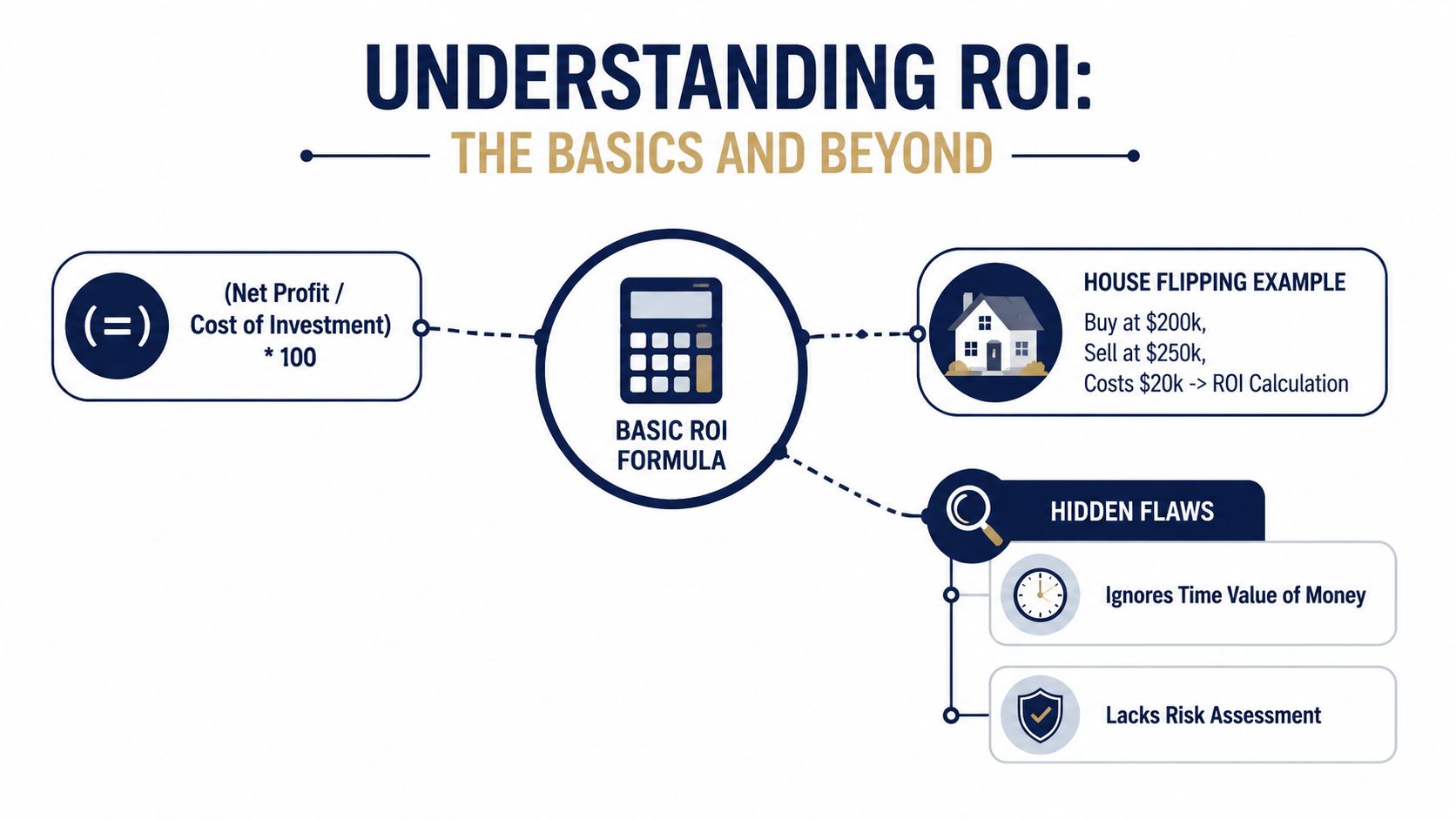
Take a house flip. You buy a property, spend money fixing it, then sell it. The return is what you got out minus what you put in. Nobody serious would calculate ROI on the purchase price alone and ignore closing costs, repairs, agent fees, or financing.
That's exactly what e-commerce teams do when they say a campaign had strong ROI because revenue was higher than ad spend.
The same logic applies to a SKU launch, a creator test, or a warehouse software rollout. If you don't capture the full cost, the percentage is fiction.
The situation where most founders get burned: They know the formula. They misdefine the denominator.
Commonly missed costs include:
If you're working at the product level, it helps to get the costing model right first. A practical walkthrough on how to calculate product costs can tighten the inputs before you ever touch the ROI formula.
A wrong cost base doesn't just make ROI slightly inaccurate. It can make a losing decision look scalable.
Even with cleaner costs, the basic formula has limits:
| Hidden issue | Why it matters in e-commerce |
|---|---|
| It ignores time | A fast payback and a slow payback can show the same raw ROI |
| It ignores uncertainty | Attribution gaps and delayed repurchase can distort the return |
| It compresses complexity | Inventory, media, and software don't create value in the same way |
That doesn't make ROI useless. It just means the basic formula is the starting point, not the final answer.
A single ROI number can't answer every operating question. Founders need different versions depending on what decision they're making.
Some numbers are better for product selection. Others are better for media buying. Others are better when you're comparing a short-term test with a slower platform or brand investment.
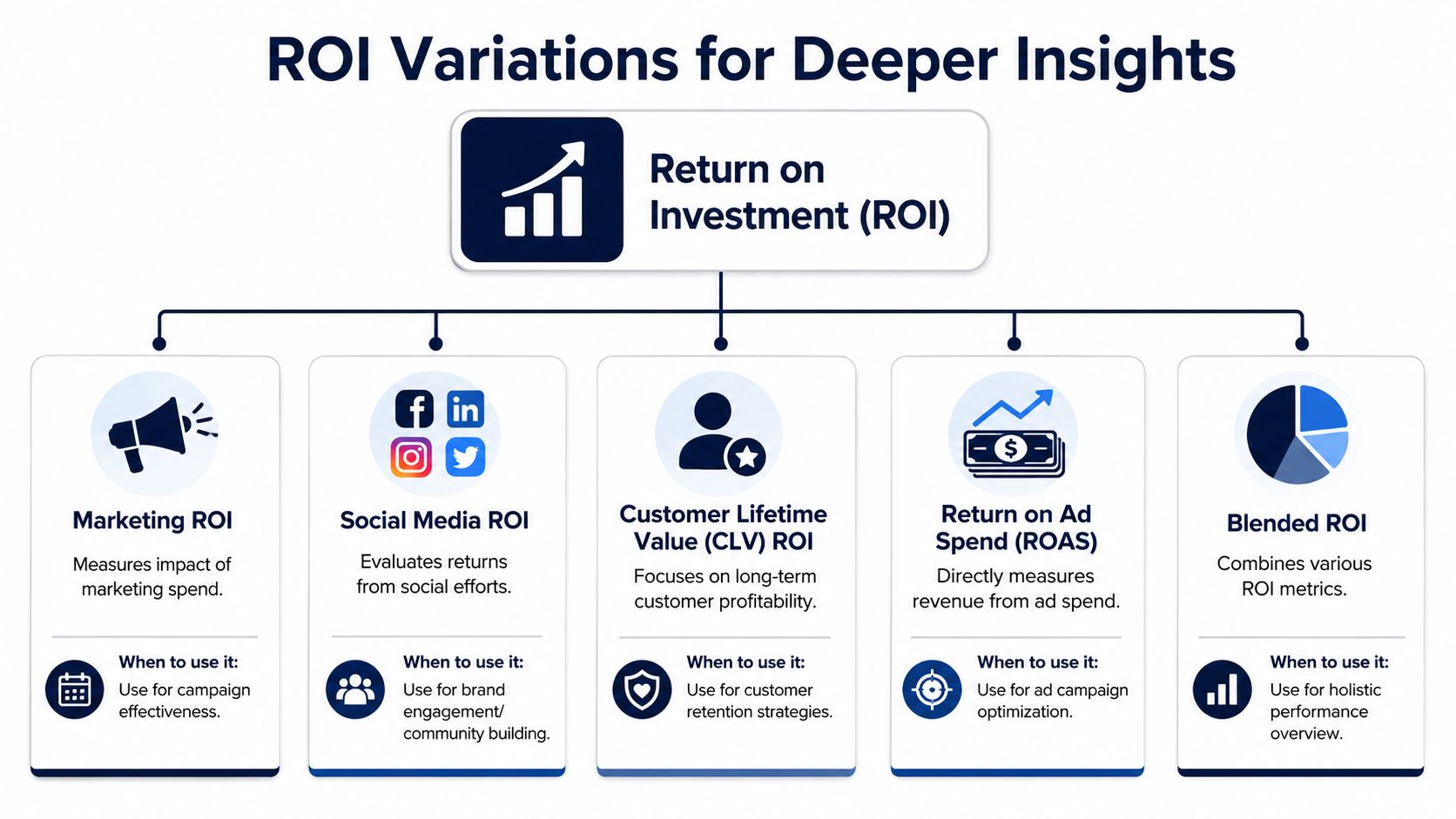
Gross ROI is useful when you want a quick directional read. It looks at return before the full stack of business costs lands on the result.
That can be fine for fast screening. It's often how operators evaluate top-line campaign efficiency, product margin potential, or initial offer performance.
Net ROI is what matters when you're deciding whether to keep funding the thing. It forces in the costs that gross numbers usually ignore. For founders, this is the version that protects cash.
Use gross ROI when you're asking, “Is this worth a closer look?”
Use net ROI when you're asking, “Should I allocate more capital here?”
This version is one of the most useful in e-commerce because it strips out some noise.
If you load every fixed overhead cost into every test, you can make promising opportunities look worse than they are. Contribution margin ROI focuses on the profit left after variable costs directly tied to the sale or initiative. That makes it stronger for campaign decisions, offer testing, and channel comparison.
It also lines up better with how operators think about scaling. You want to know whether each additional unit of spend contributes positive economics before fixed overhead enters the conversation.
If you want a sharper foundation for this, study unit economics in e-commerce. A lot of bad ROI decisions start with weak unit-level assumptions.
Here, most founder spreadsheets fall apart.
Plain ROI ignores time. That means two investments can show the same raw return even if one pays back quickly and the other ties up capital much longer. For comparing different holding periods, annualized ROI is the more defensible metric. Icon Partners points to using a fixed timeline and showing cumulative results at 3, 6, and 12 months when benefits accrue over time, and references the annualized performance-rate form as (((P+G)÷P)^(1÷n))-1 (Icon Partners on ROI calculation in business use).
That matters in e-commerce because these are not the same decisions:
Raw ROI can make them look comparable when they aren't.
If an investment takes much longer to return cash, treat that as part of the evaluation, not a footnote.
For channel-specific work, especially media, it also helps to understand the distinction between tactical and strategic measurement. A practical guide on calculating marketing return on investment can be useful if your team tends to blur campaign efficiency with actual business return.
The fastest way to understand what is ROI calculation is to stop treating it like a textbook formula and apply it to common founder decisions.

A lot of teams calculate campaign ROI using only ad spend against attributed revenue. That's closer to a media efficiency snapshot than true ROI.
A more useful campaign ROI process looks like this:
Define the return you care about
Decide whether the numerator is first-order profit, contribution margin, or longer-window customer value.
Capture the full campaign cost
Include ad spend, creative production, landing page work, management fees, tracking setup, and any tool costs directly tied to the campaign.
Choose the time window before launch
Don't change the window later because the results are flattering or ugly. Lock it in.
Subtract the total campaign cost from the total return
Then divide by total campaign cost.
What works: using contribution margin for direct-response decisions.
What doesn't: calling a campaign profitable because revenue cleared ad spend while ignoring discounts, fulfillment, and the labor required to run it.
Inventory ROI is where strong gross margins can still create weak business outcomes.
Founders often evaluate a buy based on expected margin at sale. That misses the actual capital story. Inventory sits. It takes storage. It creates markdown risk. It may force cash trade-offs elsewhere.
For inventory, include:
The return side should also be realistic. Don't assume every unit sells at the planned price and on the planned timeline unless that assumption is grounded in actual sales behavior.
Operator note: Inventory with decent margin and slow velocity can produce worse real ROI than a lower-margin item that turns quickly and frees cash.
That's why inventory ROI should sit beside sell-through, cash conversion timing, and margin quality. It's not a stand-alone answer.
This is the calculation most standard ROI articles barely touch, and it's one of the most important for brand operators.
Most simple definitions of ROI use net profit divided by cost. The gap is that they don't tell founders how to handle repeat purchases, retention, or delayed value. Mailchimp's glossary calls out that, regarding these aspects, standard explanations fall short. A campaign can look weak on immediate ROI but strong on a 6- or 12-month ROI view if repeat purchase behavior is strong, and the critical decision is whether your numerator should be first-order profit, contribution margin, or lifetime value (Mailchimp on ROI).
Here's the practical approach:
This is the strictest view. It's useful when cash is tight, the category has weak retention, or you don't trust repurchase assumptions.
Good for:
This is often the strongest operating view for growth brands. It captures more than the first order while staying grounded in a defined window.
Good for:
A fixed post-acquisition window keeps the model from turning into wishful thinking.
Here's a short explainer worth watching if your team struggles to connect marketing spend to downstream customer value:
This is the loosest version and the easiest to abuse.
LTV-based ROI can be appropriate, but only if the business has enough historical stability to support the assumptions. Otherwise founders start defending weak acquisition economics with future value that may never arrive.
Use LTV carefully when:
The main lesson is simple. The “right” ROI answer changes based on what return you count and when you count it. That's not a flaw. That's the job.
Founders mix up ROI and ROAS all the time because both get used in marketing conversations. They are not the same thing, and treating them as interchangeable leads to bad scaling decisions.
ROAS is a tactical metric. It tells you how much revenue came back for your ad spend.
ROI is a profitability metric. It tells you what return you generated after accounting for the relevant costs of the investment.
One helps you manage campaigns. The other helps you allocate capital.
| Attribute | ROAS (Return on Ad Spend) | ROI (Return on Investment) |
|---|---|---|
| What it measures | Revenue generated from ad spend | Profit or net return relative to investment cost |
| Primary use | Campaign optimization | Strategic decision-making |
| Best for | Media buying, ad set review, channel efficiency | Marketing, inventory, software, hiring, and broader business bets |
| Cost base | Usually ad spend only | Full relevant investment cost |
| Question it answers | “Is this ad spend producing revenue efficiently?” | “Did this investment create enough real return to justify the spend?” |
A campaign can have strong ROAS and weak ROI.
That happens when ad-driven revenue looks good, but margin is thin after discounts, fulfillment, return rates, agency fees, and team time. The reverse can also happen. A campaign may look average on a narrow revenue basis but support stronger downstream profitability once retention and cross-sell behavior show up.
For Amazon sellers especially, ad metrics can get detached from actual profit fast. If your team is evaluating media in marketplace environments, understanding Amazon advertising costs helps ground ROAS discussions in the underlying economics behind the click.
ROAS is for daily control.
ROI is for business judgment.
A media buyer can improve ROAS while the founder gets poorer. That's what happens when revenue efficiency is optimized without checking profit quality.
If you remember one rule, use this one: ROAS helps you run ads. ROI helps you run the company.
The dangerous ROI mistakes aren't just spreadsheet errors. They're judgment errors.
A founder can calculate ROI correctly and still make the wrong call because the number sits on top of weak attribution, unrealistic assumptions, or bad strategic priorities.
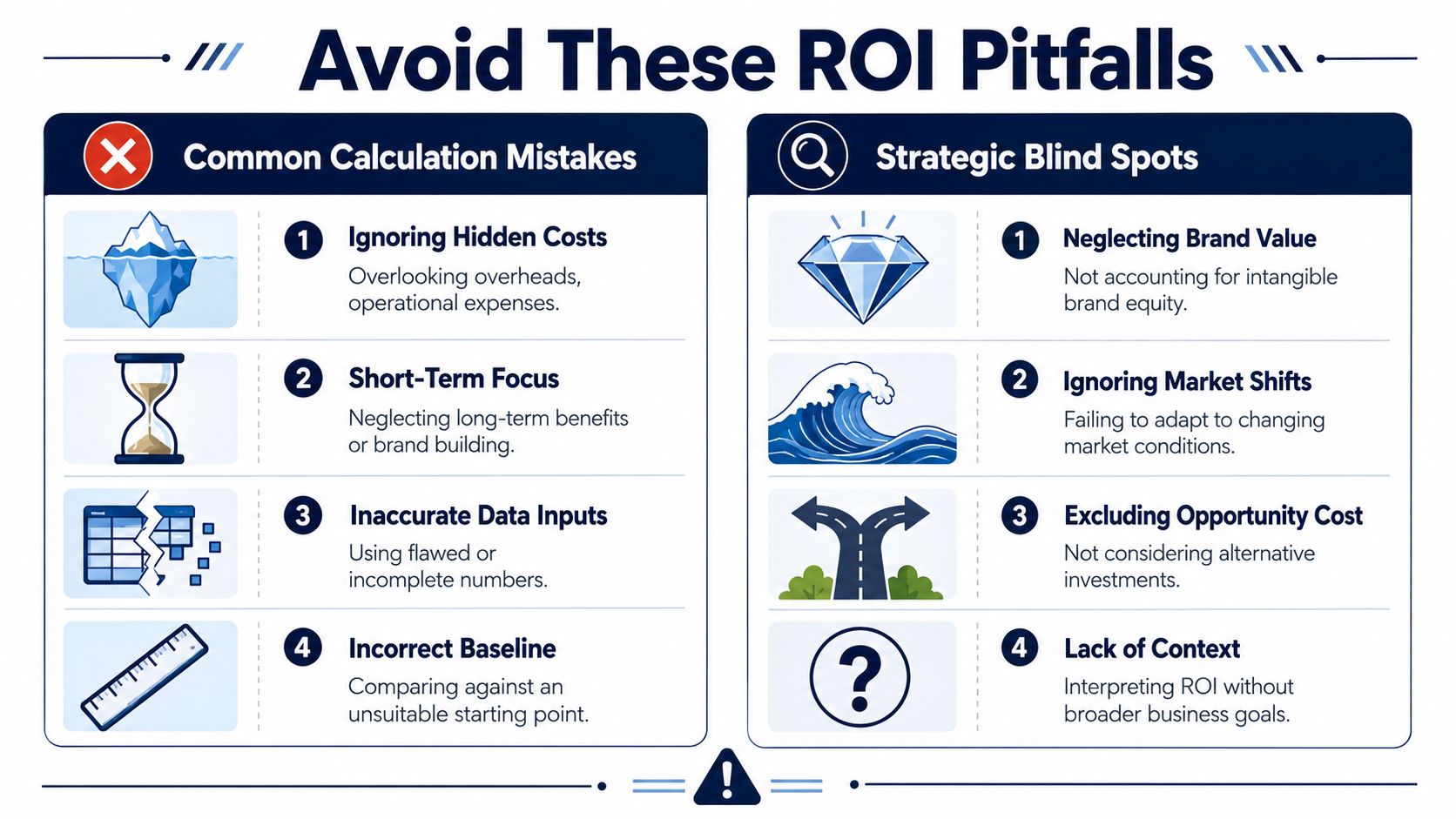
Modern marketers often can't see the full customer journey cleanly. Privacy limits, modeled conversions, and cross-channel overlap make single-channel ROI less trustworthy than many reports suggest. That means one channel can look better or worse than its actual state. Salesforce's overview frames the more useful question well: what level of ROI is decision-grade under uncertainty (Salesforce on ROI).
If your paid social dashboard says the campaign crushed and your blended profitability says otherwise, trust the tension. Don't explain it away too quickly.
Founders routinely exclude internal labor from ROI because it's hard to allocate neatly.
But if your growth lead, creative team, operator, and founder all spent serious time getting an initiative live, that effort belongs in the decision. The cost may not need perfect precision to matter. Even directional labor allocation improves the quality of the answer.
Watch for these hidden drains:
This is the blind spot more experienced operators eventually learn the hard way.
A tiny project can produce excellent ROI and still not matter. A larger initiative can produce moderate ROI and be far more valuable because it improves capacity, resilience, or long-run profitability.
Use ROI alongside questions like:
| Strategic check | Why it matters |
|---|---|
| Does this move the needle? | Small wins with no scale impact can distract the team |
| How certain is the measurement? | A weaker but trustworthy number beats a flashy modeled one |
| What else could this capital have funded? | Opportunity cost changes the quality of the decision |
The best ROI number isn't always the best business decision. Sometimes it just belongs to the smallest, safest, least meaningful option.
When founders mature, they stop asking for one perfect ROI figure. They ask whether the estimate is solid enough to make a decision with eyes open.
The true value of ROI isn't the percentage. It's the discipline of forcing every investment through the same decision filter.
Most founders don't need a fancy finance system for this. A clean Google Sheet is enough if the structure is consistent and the inputs are honest.

Set up one row per investment and include columns like these:
Investment name
Example: Meta prospecting campaign, Q4 inventory buy, Klaviyo flow rebuild, Amazon creative refresh.
Investment type
Marketing, inventory, software, operations, hiring, or channel expansion.
All associated costs
Include direct spend plus attached operational costs.
Return definition
First-order profit, contribution margin, or fixed-window customer value.
Measurement period
Immediate, rolling, or fixed evaluation window.
Confidence notes
Add a short note on data quality, attribution confidence, or assumption risk.
Calculated ROI
The output matters less than consistency across rows.
Without a template, teams recalculate ROI differently every time. One manager includes labor. Another doesn't. One uses revenue. Another uses contribution. One looks at a short period. Another waits until retention fills in the gaps.
That's how companies produce numbers that look precise and aren't comparable.
If your team also evaluates operational vendors or employer-cost decisions, tools built to maximize PEO savings for mid-market can be a useful example of how structured ROI thinking improves non-marketing decisions too.
Build one template. Use it across inventory, media, software, and systems work. Then your ROI process starts doing what it should have done from the start: helping you compare very different uses of capital with the same standard.
If you're an experienced seller who wants sharper operator-to-operator insight on decisions like these, Million Dollar Sellers is where serious e-commerce founders compare what's working across Amazon, DTC, and omnichannel brands.
Join the Ecom Entrepreneur Community for Vetted 7-9 Figure Ecommerce Founders
Learn MoreYou may also like:
Learn more about our special events!
Check Events