
Chilat Doina
October 27, 2026
The world's most valuable brands aren't valued like creative projects. Kantar's 2025 BrandZ Global Top 100 reached a combined $10.7 trillion in brand value, up 29% from the prior year. For an ecommerce founder, the useful takeaway isn't the size of that number. It's that brand building deserves the same operating discipline as inventory, cash flow, and acquisition.
A brand strategy playbook turns positioning into decisions your team can execute and audit. It names who owns the promise, what evidence supports it, where channel teams can experiment, and what must happen before you commit more media or inventory. Most importantly, it separates sales you captured from demand you built.
P&G's brand-manager model began with Neil McElroy's 1931 memorandum, which proposed assigning managers responsibility for individual brands rather than organizing marketing solely by function, according to EBSCO's history of brand management.
Playbook components, outputs and owners
| Component | Question It Answers | Output Document | Owner | Review Cadence |
|---|---|---|---|---|
| Positioning | Who we serve and why we win | Positioning architecture, one page | Founder or brand lead | Quarterly |
| Messaging | What we say to each segment | Message matrix | Brand manager | Quarterly |
| Channel rules | How the brand looks and sounds on Amazon, DTC and retail | Channel rulebook | Channel lead | Monthly |
| Asset governance | Which assets are live and who approved them | Asset library with approval log | Operations or content lead | Monthly audit |
| Metrics | Whether the brand is growing and what drives it | KPI scorecard | Finance or growth lead | Monthly |
| Roadmap | What must be true before each launch or scale stage | Stage gates | Founder | At each stage |
One accountable brand owner still makes sense when you sell through Amazon, Shopify, and wholesale. Without that person, an agency can optimize ads around convenience while the listing emphasizes durability and the wholesale catalog leads with price. Each team can meet its local objective while giving buyers a different reason to choose the product.
Accountability doesn't mean the founder approves every image. It means someone resolves conflicts between channel performance and the brand's commercial direction.
For a lean team, the founder owns positioning and stage gates. The brand manager owns messaging and channel rules, even when freelancers execute the work. The operations lead owns asset governance and runs the monthly audit, with the founder retaining scorecard accountability until a finance or growth lead takes it.
Keep visual identity inside this system, not above it. A practical guide to building brand identity can help translate positioning into recognizable expression, but a palette can't settle which customer problem deserves priority.
Likewise, if comparison-led acquisition fits your category, Landra can help you create product listicle landing pages. Give those pages the same approved claims and evidence as your product pages rather than treating them as a separate performance-marketing universe.
Ownership rule: Every component needs a named owner, a dated document, and a decision it governs.
A slide deck isn't the operating system. The operating system is what your team checks before publishing, spending, or ordering.
The positioning document is the page every other component depends on. Write it before commissioning packaging or asking an agency for campaign concepts.
Say you're developing a stainless-steel meal-prep container brand for Amazon and Shopify. The following is a hypothetical product proposition, not a set of verified product claims.
Positioning architecture template with worked example
| Field | What to Write | Worked Example |
|---|---|---|
| Target segment | Buyer group described by situation | Dual-income households packing weekday lunches |
| Category frame | Shelf or search category buyers use to compare | Reusable lunch containers, not generic food storage |
| Customer problem | Specific failure buyers want to avoid | Lids warp and seals leak after repeated dishwasher cycles |
| Differentiated promise | A sentence grounded in a defensible product difference | Lunch containers with a serviceable lid seal designed for repeated dishwasher use |
| Reasons to believe | Product construction that makes the promise credible | Fully stainless body; replaceable silicone gasket mechanically retained without adhesive |
| Proof points | Measured evidence with date, method and source | Completed dishwasher-cycle and leak-test report for the production version |
Target segment. Describe the buying situation, not just age or income. Households preparing lunches need dependable transport and easy cleanup, which gives the team something concrete to design and communicate.
Category frame. Choose reusable lunch containers because that's the comparison you want buyers to make. Calling the product generic storage invites comparisons with tubs designed mainly for leftovers.
Customer problem. Separate the failure from the inconvenience. A leaking seal is the failure; discovering dressing inside a work bag is the consequence that makes buyers care.
Differentiated promise. Connect the outcome to something competitors can't credibly claim without changing their product. Avoid an absolute leak-proof claim unless your testing supports the conditions under which customers will use it.
Reasons to believe. Describe how the product works. For this concept, the stainless construction and mechanically retained, replaceable gasket explain the design logic, but neither proves real-world durability by itself.
Proof points. Attach the actual report, production version, test conditions, and approval date. Don't substitute a supplier's material specification for a finished-product performance test.
The architecture below provides a visual companion; any performance statements shown in a diagram still need substantiation before publication.
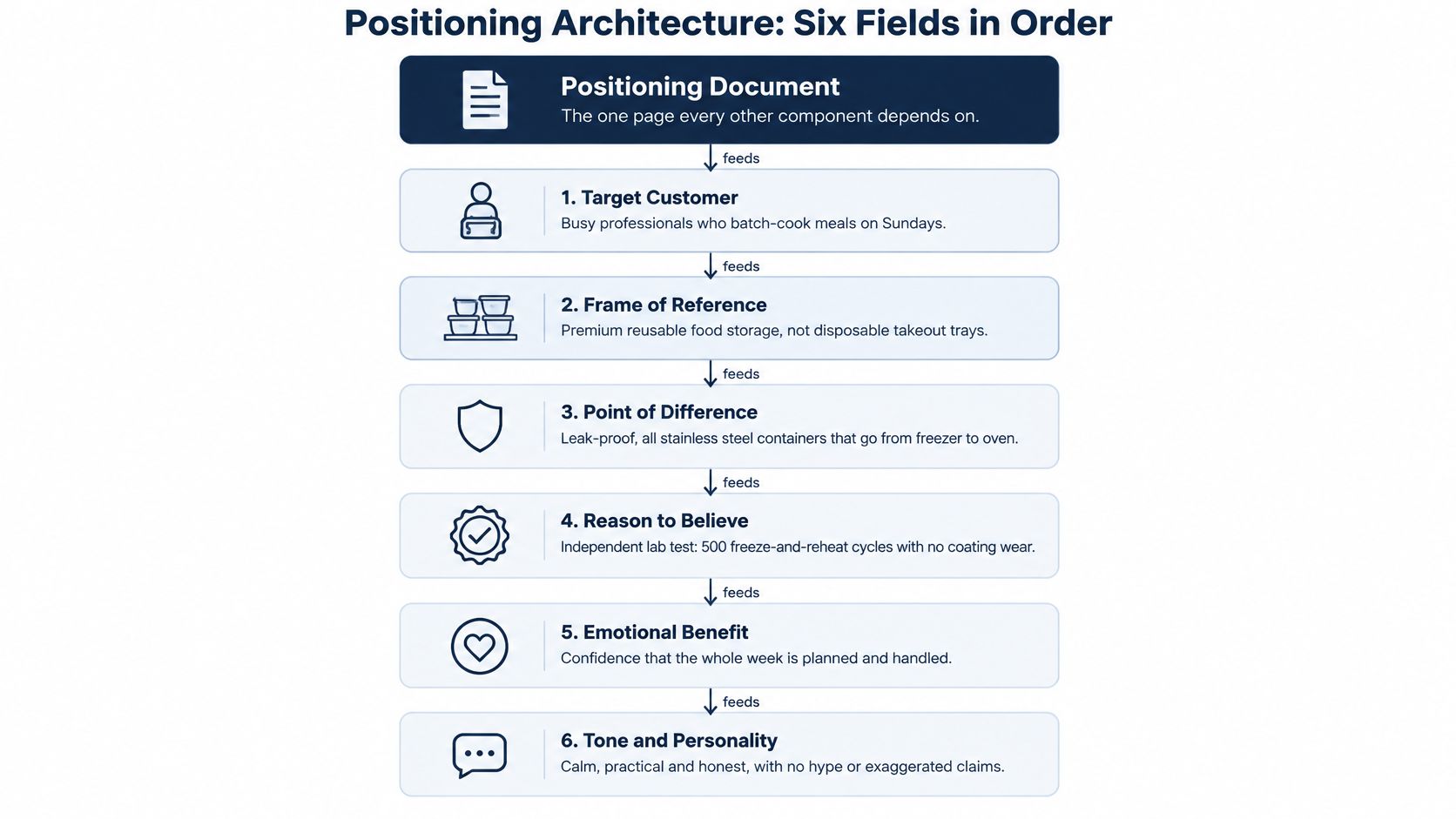
A reason to believe explains construction. A proof point records an observed result. Weak positioning documents blur the distinction and turn features into unsupported promises.
Before signing off, use a structured competitor review. MyMentions' guide to benchmark competitors to prioritize growth provides a useful starting point for comparing claims and substitutes. If a competitor could paste your promise onto its listing without changing a word, rewrite it before building the rest of the playbook.
A positioning workshop produces a hypothesis, not permission to scale. Your validation budget should answer whether the promise attracts the right buyer and survives the delivered experience.
Use the visual as a process reminder, not as a universal budget or performance benchmark.
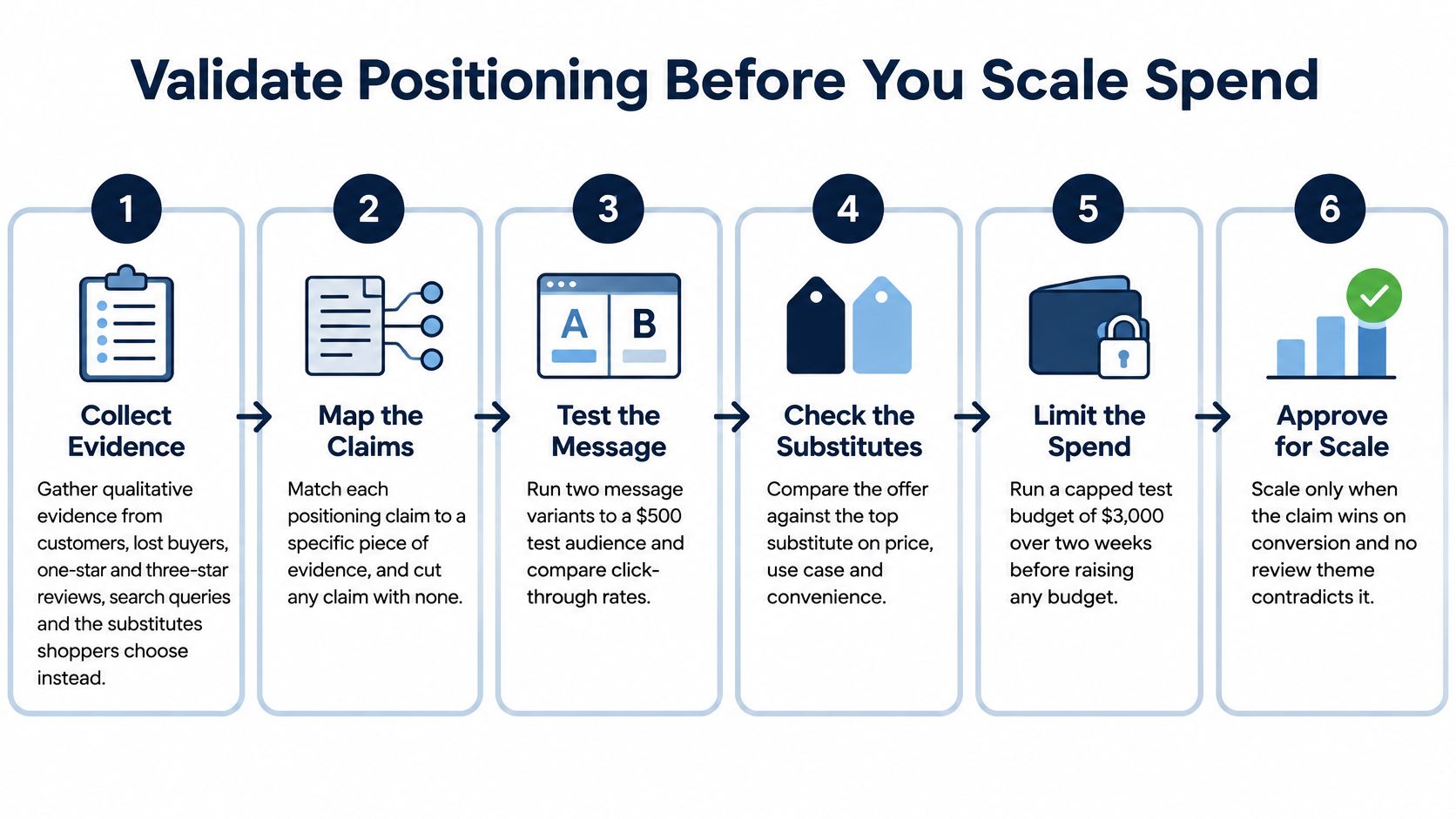
Collect qualitative evidence. Interview customers and lost buyers, then inspect low-rated and mixed reviews, search queries, and the substitutes shoppers choose. For the container concept, include buyers using glass containers or disposable bags, not just competing stainless products.
Code recurring jobs and objections. Tag each observation as a job-to-be-done, objection, desired outcome, or trust signal, and count occurrences within each evidence source. Keep interview comments separate from review counts so a prolific reviewer doesn't masquerade as broad customer demand.
Quantify the strongest hypotheses. Use a representative survey or structured concept test that recruits actual category buyers. Ask a researcher to size the sample around the decision and required precision rather than choosing an arbitrary respondent count, and compare propositions at realistic prices.
Run controlled experiments. Test the headline, hero image, benefit order, guarantee, price framing, and proof without changing everything simultaneously. Keep audience allocation, availability, and offer conditions comparable so you can interpret the result.
Choose on commercial outcomes. Use new-to-brand acquisition, contribution, refunds, repeat purchase, and payback alongside conversion, with a holdout where you need to establish incrementality. In a hypothetical test, a lifetime-guarantee headline that wins clicks but attracts costly refunds loses to a less dramatic promise with healthier contribution.
Build the message matrix. Give each segment a primary promise, supporting benefits, evidence, and approved substantiation language. Include prohibited wording and the source document for each claim so a copywriter doesn't accidentally broaden it.
Don't stop testing at checkout. Inspect the production sample, shipping notification, care instructions, support response, and return flow against the expectation your winning message created.
MarkHub24's discussion of brand consistency emphasizes validating the promised experience against fulfillment, quality, support, and post-purchase communication. That's an important operational distinction: a persuasive claim can expose a product weakness faster rather than solve it.
A message wins only when the business can afford to deliver what the buyer understood.
For international launches, translate the customer situation as well as the words. A lunch-container proposition may need different examples, units, care guidance, and regulatory review while retaining its underlying product advantage.
For an additional perspective on positioning, use the video alongside your written test plan.
The message matrix must pass validation before media or inventory scales. Record unresolved objections as open decisions, not footnotes, and let the roadmap's stage gates determine whether the team proceeds.
Keep the claim identical; adapt the format. Consistency is an operating system, not a requirement to squeeze the same creative into every placement.
A shopper should recognize the same product advantage on an Amazon listing, a Shopify page, and a retail shelf. That doesn't mean those surfaces need the same information density.
Fixed versus flexible rules by channel
| Channel | Must Stay Fixed | Can Flex | Primary Health Metric |
|---|---|---|---|
| Amazon listings | Core promise in title, bullet claims, price anchor, main-image style | A+ modules, lifestyle images, bundles, coupon timing | Conversion rate and available new-to-brand measures |
| DTC website | Homepage promise, offer language, returns policy | Landing-page variants, bundles, seasonal banners | Repeat-purchase rate by cohort |
| Paid social and search | Claim wording and proof points | Hooks, creative formats, audiences | Cost per new customer |
| Packaging and inserts | Promise line, care instructions, brand voice | Seasonal inserts, thank-you cards | Unboxing complaints relative to orders |
| Email and customer service | Tone, promise, returns language | Campaign timing, offers, edge-case scripts | First-contact resolution rate |
| Retail and wholesale | Shelf claims matching the approved Amazon claim word for word | Shelf-talkers, promotional pricing | Units sold per store over a consistent period |
Fixed doesn't mean frozen forever. A price anchor can change through an approved commercial decision; it shouldn't change because separate teams invented incompatible discount stories. Amazon imagery and inserts must also respect marketplace requirements.
Omnibound's summary of Lucidpress/Marq surveys reports that 68% of surveyed organizations attributed at least 10% of revenue growth to consistency. Treat that as directional, self-reported evidence, not a forecast or a causal return on your next brand project.
Maintain a centralized library with approved files, version history, usage restrictions, and an approval log. Name an approver for each claim, image, and offer, and archive superseded material instead of leaving it beside current assets.
The operations lead should check live listings, pages, and ads monthly. Run a deeper quarterly audit across messaging, visuals, offers, and customer experience, including the less visible surfaces such as automated emails and support macros.
A live-asset checklist makes that work tangible.

Protect channel execution before adding complexity. Agentcentral's guide can help teams avoid Brand Registry application rejection, while this guide to omnichannel ecommerce helps frame the broader coordination problem.
DTC also gives you room to build a retention experience beyond the transaction. In Klaviyo's 2024 ecommerce research, reported by MarTech, 86% of consumers used loyalty programs when brands offered them, while 50% of brands offered them. Consider loyalty where purchase frequency supports it, but don't fund points and discounts before checking whether customers need easier reordering.
Brand scorecard metrics and cadence
| Metric | How to Measure | Review Cadence | Healthy Direction |
|---|---|---|---|
| Aided awareness | Consistent survey of category buyers, prompted by brand name | Quarterly | Rising against prior wave |
| Branded-search share | Brand search demand relative to a defined category query set | Monthly | Rising or holding during spend cuts |
| Direct-traffic conversion | Purchases divided by sessions classified as direct | Monthly | Improving against a comparable internal baseline |
| Repeat-purchase rate | First-order cohorts placing another order within fixed observation windows | Monthly | Rising by mature cohort |
| Contribution margin by source | Revenue less product, advertising, fulfillment, fees and returns costs | Monthly | Positive within the approved payback window |
| New-to-brand share | Platform-defined new-to-brand measure or first-party first-customer measure | Monthly | Healthy acquisition without deteriorating contribution |
| Asset compliance rate | Live listings, pages and ads passing the checklist | Monthly audit | All live assets passing |
Define each denominator before collecting results. Amazon Brand Analytics and Search Console cover different search environments, so keep their trends separate rather than adding them into a supposedly complete market-share figure.
Likewise, direct traffic isn't proof that brand activity caused a visit. Tracking gaps can place other traffic in that bucket, and marketplace new-to-brand definitions don't necessarily mean the customer has never purchased anywhere else.
EMARKETER reported that 52.0% of U.S. brand and agency marketers were using incrementality testing in July 2025. Adoption doesn't remove the hard part: designing a test that distinguishes additional sales from sales that would have happened anyway.
The scorecard illustration below is a layout example, not a benchmark or a report of actual brand results.
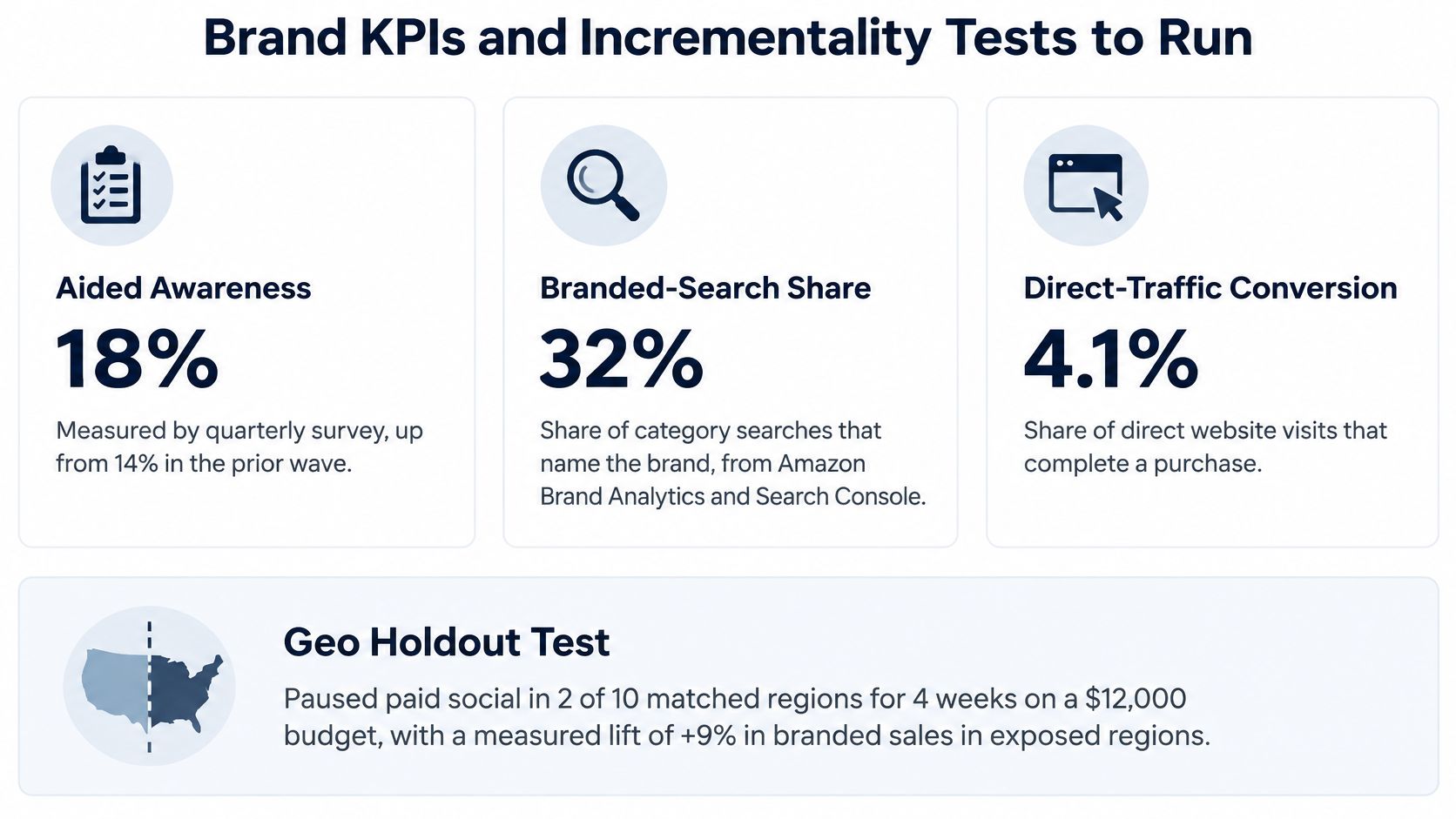
Say paid social looks weak in last-click reporting, but a credible holdout shows incremental contribution across Shopify and Amazon. Keep it funded for another planned test cycle rather than transferring everything to branded search.
Last-click efficiency and brand strength can move in opposite directions. Rewarding only attributed ROAS can favor teams that capture existing demand while cutting the activity that introduces future buyers.
A launch date is a scheduling commitment. A stage gate is permission to take more risk.
Set the calendar around supplier lead times and the category's buying cycle. Set commercial thresholds before testing, using your economics and comparable category evidence rather than adopting someone else's conversion target.
Stage gates from pre-launch to expansion
| Stage | Window | Go Signal | Warning Sign |
|---|---|---|---|
| Pre-launch | Before listing and inventory commitment | Message matrix passed validation; initial inventory matches the promised delivery experience | Promise performs worse than control across relevant segments |
| Launch | Initial selling and learning period | Conversion clears the pre-agreed floor and fulfilled orders support the claims | Refund rate stays above the comparable category norm |
| Scale | After launch economics stabilize | Incremental contribution is positive and customer acquisition clears the approved target | Branded-search share declines across successive reviews |
| Expansion | After the core channel passes scale checks | Additional channel produces credible incremental lift consistent with the business case | Unboxing or support complaints rise faster than order volume |
The founder owns the go decision, but operations and finance must be able to block it. A campaign win doesn't override faulty inventory, and a profitable blended average doesn't justify an expansion channel that loses money.
The timeline below illustrates the staged approach. Treat its numerical thresholds as hypothetical examples, not universal launch requirements.
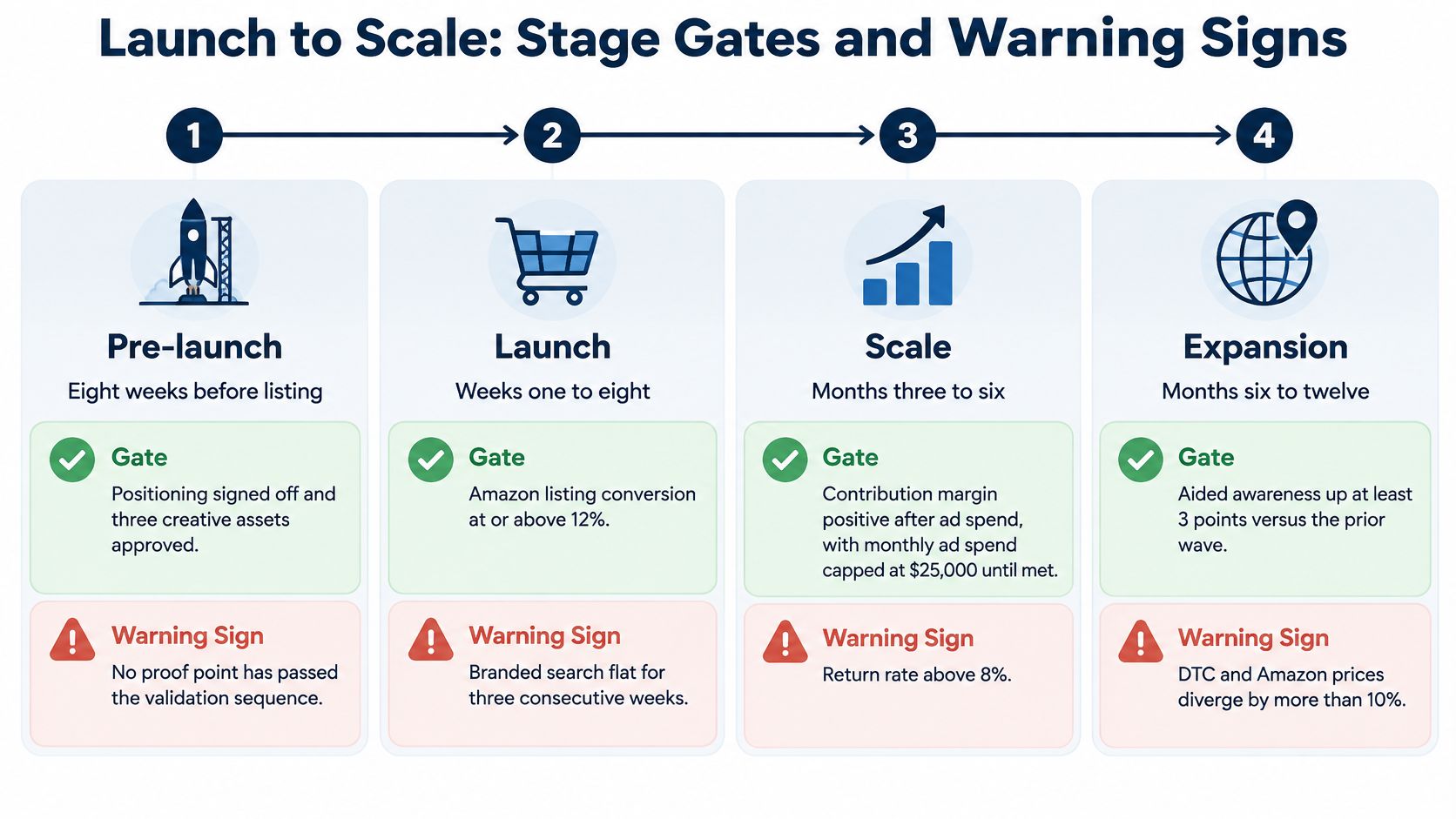
In Adobe's 2025 retail research, 87% of consumers expected retailers to handle personal data responsibly and securely, while only 46% believed brands did so. That gap belongs in the launch decision, not just the privacy policy.
Before deploying AI-generated imagery or personalized recommendations:
More personalization isn't automatically a better customer experience.
For the container brand, generated lifestyle imagery must not imply unsupported uses or show an impossible product configuration. A compelling scene that misrepresents the lid or material creates an expectation the shipped item can't meet.
Pause scale when the business can't explain the personalization plainly, honor the opt-out, or substantiate what the customer sees.
Use the month to produce a decision-ready draft, not a polished brand book. Assign a calendar owner and keep unfinished evidence visible.
Choose reviewers who understand your channel mix and operating constraints. An Amazon-heavy operator and a subscription-first founder may interpret the same repeat-purchase result differently, so ask them to challenge assumptions rather than vote on copy.
At month-end, make the decision explicit: move the positioning into the pre-launch gate or rework it based on validation results. If the buying cycle hasn't produced enough evidence, rework the test plan rather than calling an inconclusive result a win.
Million Dollar Sellers offers an invite-only ecommerce founder community with private forums, mastermind calls, curated events, and practical strategy sharing. Visit Million Dollar Sellers to explore membership and find peers who can pressure-test your positioning, stage gates, and measurement plan before you commit more inventory or media budget.
Join the Ecom Entrepreneur Community for Vetted 7-9 Figure Ecommerce Founders
Learn MoreYou may also like:
Learn more about our special events!
Check Events