Chilat Doina
September 6, 2026
A customer discovers your product on Instagram, checks reviews on Amazon, visits your DTC site to compare bundles, and completes the purchase from a phone. Later, they contact support about delivery, then return the item through a retail partner. Your customer sees one brand. Your finance, marketing, warehouse, marketplace, and retail teams may see several disconnected transactions.
That gap is where omnichannel e commerce becomes an operating problem, not merely a customer experience project. If channels don't share inventory, identity, order status, and fulfillment rules, growth can create more cancellations, duplicated marketing, expensive returns, and internal reconciliation. If they do share those systems, each channel can perform a distinct job while contributing to one economic model.
The core question for a scaling brand isn't, “How many places can we sell?” It's, “Can we route demand, stock, service, and margin through the right place without losing context?”
A single-channel mindset assumes the customer chooses one storefront and stays there. Modern buying journeys don't behave that way. A shopper might discover a product through social content, validate the product on Amazon, purchase from a branded website, and ask a store associate to help with an exchange. Each interaction carries information the next interaction should be able to use.
When those channels operate independently, the shopper pays the price first. The website may show availability that the store can't confirm. Support may not see a marketplace order. A promotion may apply in one channel but not another. The customer then has to repeat details, abandon a purchase, or accept a fulfillment option that doesn't fit the situation.
The business absorbs the second cost. Marketing teams may target a customer who already purchased elsewhere. Operations may reserve inventory in one system while another channel sells the same unit. Finance may report revenue by channel without showing the cost of the handoff, return, service interaction, or split shipment.
Operator's rule: Every channel should have a role, but no channel should have its own version of the truth.
Selling across Amazon, DTC, social commerce, and retail can expand reach quickly. It can also create internal competition. Amazon optimizes for marketplace conversion, DTC optimizes for owned relationships, and retail teams may optimize for store-level sales. Without shared goals and data, each team improves its own dashboard while weakening the total customer journey.
The issue isn't that every channel needs identical creative or pricing. Customers expect some channel-specific behavior. The issue is that product information, availability, order status, service context, and core brand promises can't contradict one another.
Brands exploring a broader channel footprint can use multi-platform selling strategies to think through channel roles before adding operational complexity. The important distinction is that expansion should follow a clear operating design, not just a list of new marketplaces and storefronts.
A disconnected setup may be tolerable while order volume, assortment, and geographic coverage remain manageable. At scale, exceptions multiply. Every oversold unit creates a cancellation or manual intervention. Every inaccurate promise can create a support case. Every return that can't flow through the lowest-cost route reduces contribution margin.
Omnichannel e commerce addresses that reality by treating the customer journey and the fulfillment network as connected systems. The objective isn't to make every interaction look the same. It's to make every handoff reliable, measurable, and economically intentional.
Multichannel means a brand sells in several places. Omnichannel means those places operate as one connected system, with shared customer identity, product information, inventory visibility, order history, and service context.
An orchestra makes the distinction clear. A multichannel business has several capable musicians, but each may be following a different score. An omnichannel business gives every musician a shared composition, tempo, and conductor. Amazon, DTC, retail, email, SMS, push, support, and fulfillment locations can still perform different parts, but they coordinate around the same customer and operational truth.
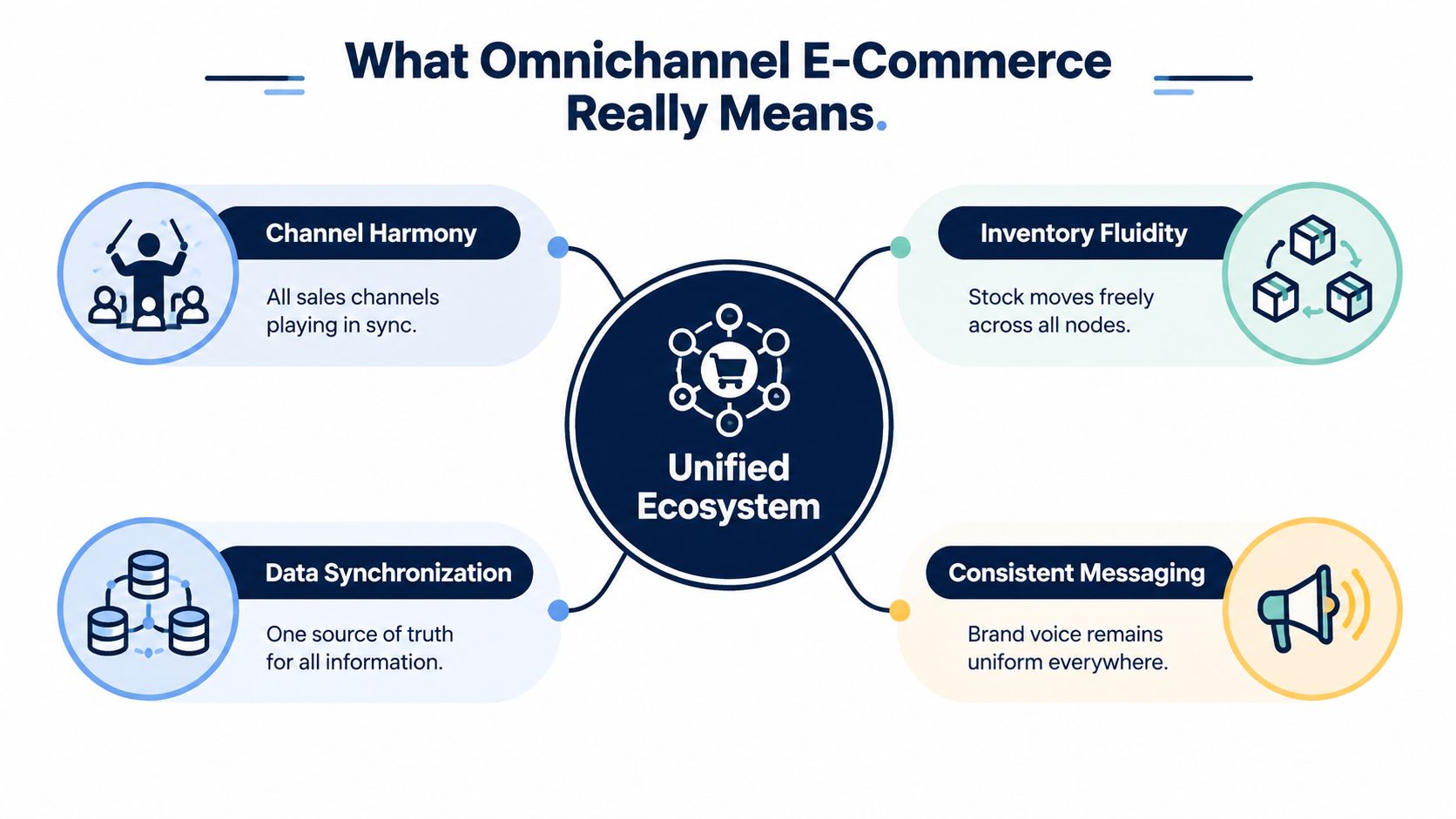
A shopper shouldn't become a different customer because they moved from mobile to desktop, from DTC to store, or from email to SMS. Identity resolution connects those interactions so teams can understand the relationship rather than isolated events.
That doesn't mean sending every message through every channel. It means a completed purchase, support request, or return should update the communication logic everywhere. If a customer buys in-store after receiving an abandoned-cart message, the system should stop treating the cart as unfinished.
Inventory visibility is more than displaying a stock number. The business needs to know where the item is, whether it's available for a specific promise, and which order should reserve it. A unit in a store may be useful for local pickup, but it might be protected for walk-in demand or unavailable for shipping.
Order management translates stock into decisions. It can support delivery, pickup, ship-from-store, store returns, and warehouse fulfillment when the underlying data is accurate and current. Without that foundation, the customer sees a promise that operations can't reliably keep.
For teams building the customer-facing layer, resources such as ways to boost sales with Carti can help connect support conversations to buying journeys. The commercial value comes from preserving context, not from adding another isolated chat window.
A DTC site may explain the full product story. Amazon may prioritize search relevance and review clarity. A retail associate may demonstrate the product in person. Those executions can differ while the core claims, product facts, availability rules, and service standards remain aligned.
A practical test is simple: ask whether a customer can move from one touchpoint to another without correcting the brand's information or retelling their situation. If they can't, the business has multiple channels, not omnichannel orchestration. A useful planning reference is this omnichannel retail strategy guide, particularly when channel expansion starts creating ownership questions between teams.
High-growth brands face a demand allocation problem. Customers don't arrive through one predictable route, and the most visible channel isn't always the most profitable channel. A brand needs to capture discovery where it happens, convert demand where the economics work, and retain the relationship after the transaction.
The behavioral case is established. A study of 46,000 shoppers found that 73% used multiple channels during their purchasing journey, while 7% shopped online only and 20% shopped in-store only, as summarized by omnichannel retail statistics from Whitebox. The finding matters operationally because cross-channel shopping was already the dominant pattern in that research, not a niche behavior reserved for a small segment.
The same body of evidence is commonly summarized as showing that omnichannel shoppers use around 6 touchpoints before purchase and can spend about 16% more per order than single-channel shoppers, according to that same source. Those figures point to a coordination requirement: the brand must preserve product context, price logic, and availability while the shopper moves through the journey.
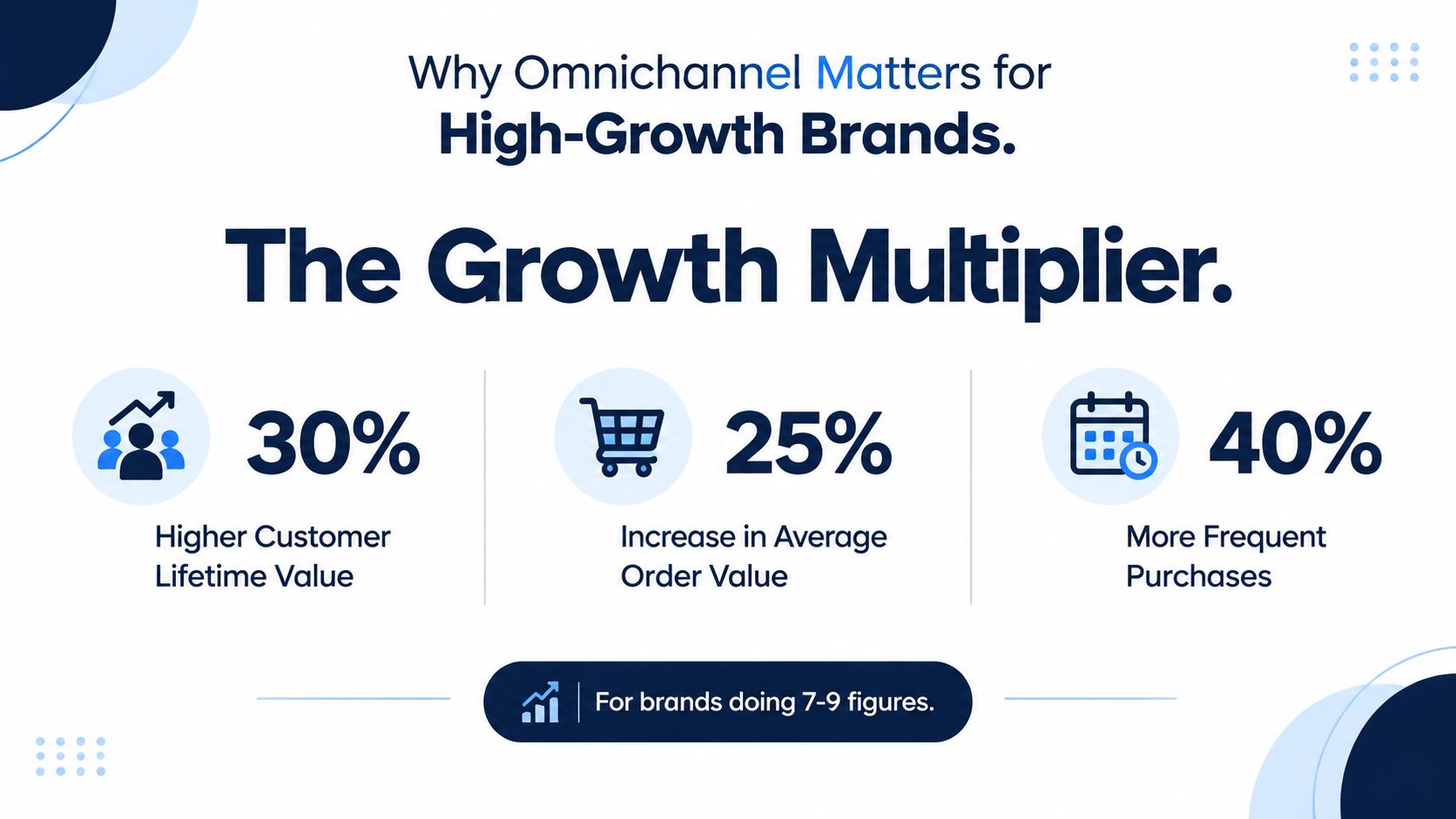
Amazon can provide discovery, search demand, and velocity. DTC can support richer merchandising, owned customer communication, and direct testing. Retail can provide physical access, trust, demonstration, and local convenience. The channels don't need to compete for identical jobs.
The economic opportunity is substantial. One cited estimate projects omnichannel retail sales at $6.3 trillion, or about 40% of all retail sales, while industry summaries associate omnichannel customers with purchasing about 70% more frequently and generating up to 30% higher customer lifetime value than single-channel shoppers, as reported by World Metrics' omnichannel statistics. These are market-level indicators, not a guarantee for every brand. They show why operators treat orchestration as a growth model rather than a cosmetic CX upgrade.
Infrastructure choices reinforce that shift. U.S. click-and-collect sales were estimated at $132.8 billion in 2024, with a 2026 projection of $177.9 billion, according to the same source. Pickup, local inventory, and mobile-to-store journeys therefore belong in the operating plan, especially when a brand can fulfill a customer need more efficiently from an existing location.
Demand doesn't create profit automatically. IMPACT Commerce's 2026 benchmark analyzed 373 brands and retailers across 74 touchpoints in six markets, using more than 27,000 structured data points, and reported an average performance score of 38%. The benchmark indicates that many businesses still struggle to connect web, mobile, store, content, inventory, and service layers into a full-stack model, as detailed in the IMPACT Commerce Omnichannel Index.
For a 7-, 8-, or 9-figure brand, the implication is direct. Adding channels before synchronizing the operating model can increase gross demand while also increasing exceptions, labor, split shipments, and returns. The winning design captures cross-channel demand while routing each order through a fulfillment path that survives contribution-margin scrutiny.
A working omnichannel system has four connected pillars. Treating them as separate projects creates predictable failure. Accurate inventory without flexible fulfillment leaves stock stranded. A unified customer profile without reliable orders creates personalized confusion. New technology without clean data moves errors faster.
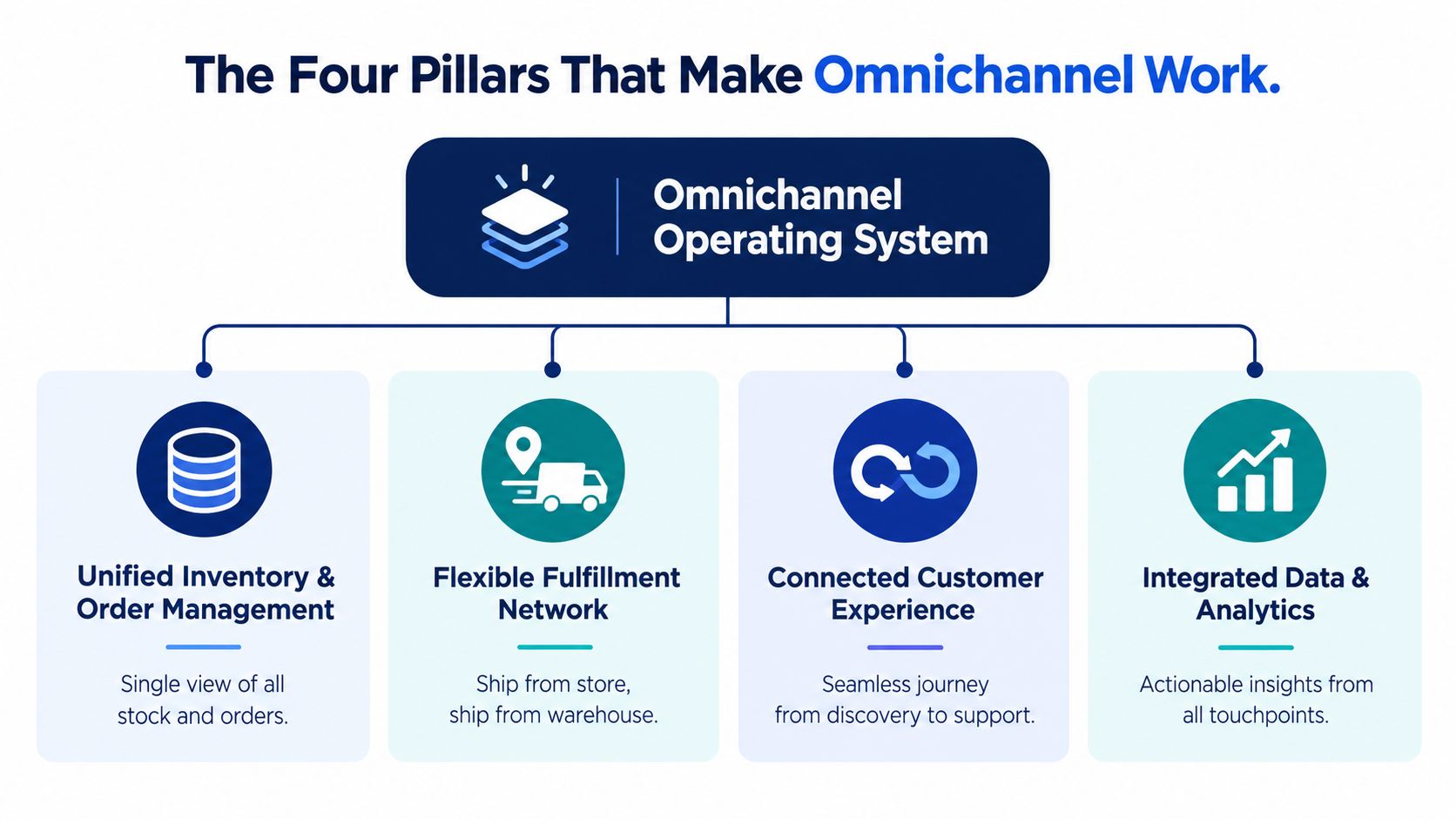
The first pillar is a shared view of products, locations, reservations, orders, cancellations, and returns. An order management system should answer practical questions quickly: Can this item be promised for delivery? Which location should fulfill it? Is store stock available for pickup? What happens if the customer changes the delivery method?
Inventory placement should follow demand and cost, not convenience for one department. A warehouse may be efficient for parcel fulfillment, while a store may be better positioned for local pickup or a ship-from-store order. The system needs rules that balance availability with labor, handling, delivery distance, and stock protection.
A distributed network gives operators more choices, but every choice carries a cost. Ship-from-store can move aging inventory and reduce delivery distance, yet it can also introduce store labor and packing inconsistencies. Click-and-collect can improve convenience and reduce last-mile handling, but failed pickup processes can consume service time and damage trust.
The right approach is to define fulfillment promises by product, geography, location, and customer value. Don't offer every option everywhere just because the technology can support it.
The journey should preserve context from discovery through support and returns. Email, SMS, and push should recognize the same customer, use shared event data, and respect suppression rules. Omnisend's 2025 dataset covered more than 150,000 brands, 27 billion emails, 321 million SMS messages, and 458 million push notifications, illustrating the scale at which owned-channel orchestration now operates, as documented in Omnisend's omnichannel statistics.
The goal isn't maximum message volume. It is channel-level segmentation, event-triggered automation, and identity resolution that prevent multiple teams from sending contradictory or unnecessary messages.
Your commerce platform, POS, ERP, CRM, WMS, marketplace connectors, and marketing tools need a dependable data flow. Select tools based on the events they can share, the ownership of each record, and the speed at which updates reach customer-facing channels.
| Pillar | What Good Looks Like | Common Gap Signal |
|---|---|---|
| Unified Inventory and Order Management | One view of stock, reservations, orders, and returns | Teams reconcile spreadsheets after cancellations |
| Flexible Fulfillment Network | Rules route orders to suitable stores or warehouses | Every order defaults to one location |
| Connected Customer Experience | Customer history and preferences follow channel changes | Support asks customers to repeat order details |
| Integrated Data and Analytics | Reports connect demand, cost, service, and margin | Each channel reports success independently |
Good omnichannel operations feel simple to the customer because the complexity sits behind the handoff. The operator's job is to make that complexity visible internally, measurable financially, and invisible at checkout.
Amazon, DTC, and retail should share the same commercial truth, but they shouldn't use identical playbooks. The mistake is either duplicating the same assortment everywhere or allowing every channel to create its own brand, price logic, and fulfillment promise.
Amazon customers often arrive with strong purchase intent. Product detail pages need clear content, accurate availability, dependable fulfillment, and review-aligned expectations. The brand can tailor the presentation to marketplace behavior while keeping product facts and core positioning consistent with DTC and retail.
Don't assume every DTC bundle belongs on Amazon. Channel-specific assortments can reduce direct price comparison and protect operational simplicity, provided the customer can still understand the product family and value proposition.
DTC gives the brand more control over merchandising, education, customer data, subscriptions, bundles, and post-purchase communication. It can be the best environment for explaining a complex product or testing a new offer, but owned traffic doesn't make an order profitable by default. Acquisition cost, fulfillment, payment fees, support, and returns still determine contribution.
Use DTC to deepen the relationship, not to create a disconnected version of the catalog. Product content, availability, and return expectations should remain aligned with the channels that introduced the customer.
Retail can help customers inspect, compare, try, or collect products. Stores may also become fulfillment nodes, but that decision should be made by margin and service rules rather than by the assumption that every store is a miniature warehouse.
A retail partner may own valuable shopper data, while the brand owns product education and support. Define those boundaries before launch. Customers should know who handles the order, where a return goes, and how support can retrieve the relevant history.
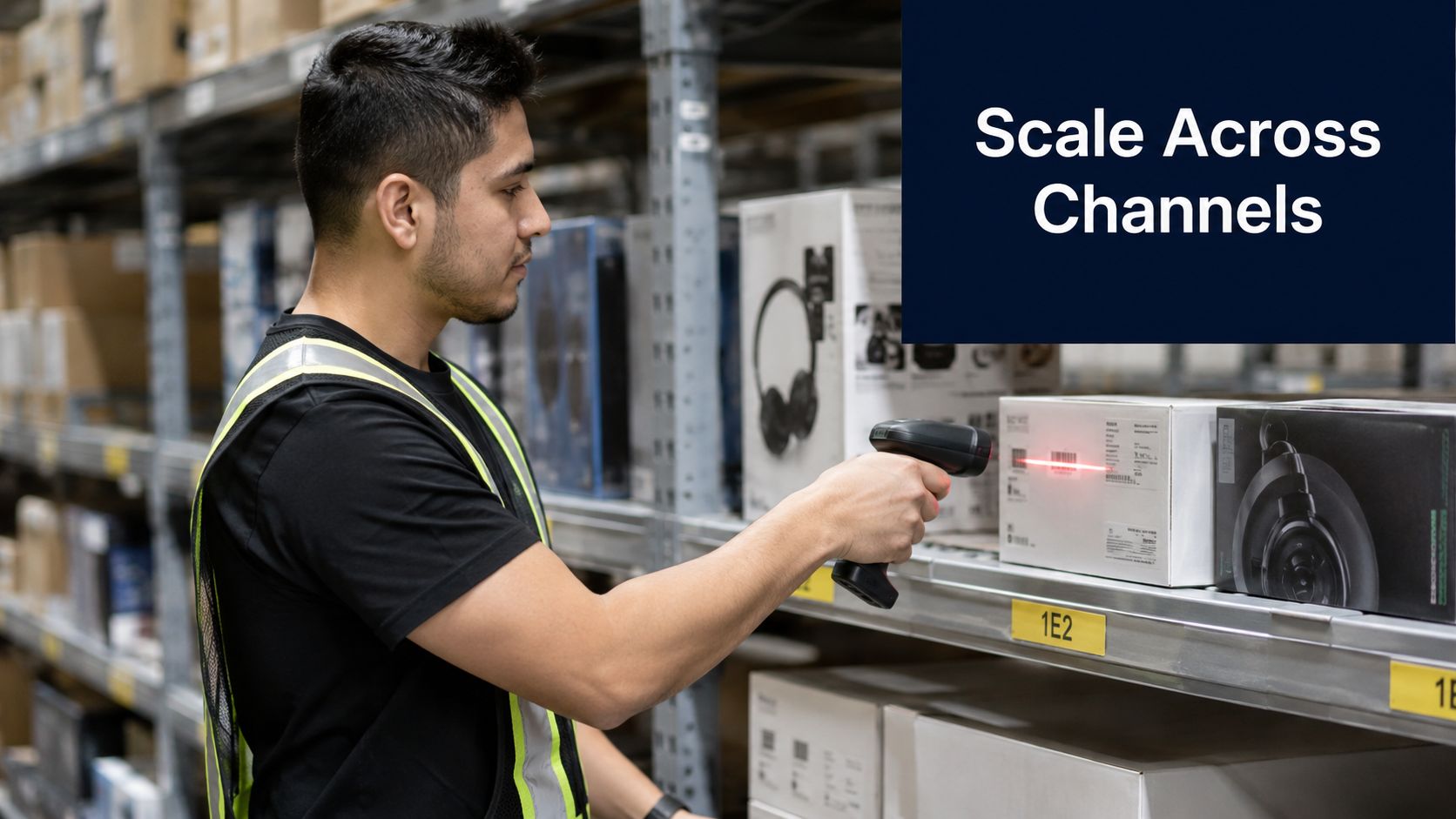
Operationally, barcode discipline, location-level stock accuracy, and order routing determine whether the strategy works. A cross-channel inventory management framework can help teams translate channel ambitions into stock ownership and fulfillment rules.
The following video offers another visual perspective on coordinated commerce operations:
Standardize the product truth, identity rules, inventory status, order lifecycle, support access, and brand promises. Customize channel-specific content, assortment, promotions, merchandising, and fulfillment options where customer behavior or economics justify it.
AI-assisted support can also strengthen continuity when it connects to real order and customer context. For teams evaluating this layer, guidance on how to increase customer loyalty with AI is most useful when it is assessed alongside identity, service ownership, and escalation workflows.
Omnichannel health can't be judged by total traffic, channel revenue, or an attractive conversion rate in isolation. Those metrics may rise while fulfillment cost, return handling, service contacts, and inventory errors consume the gain.
Start with a baseline for each channel and then add a blended view. The blended view should connect acquisition, order economics, fulfillment, returns, and repeat behavior across the full customer relationship.
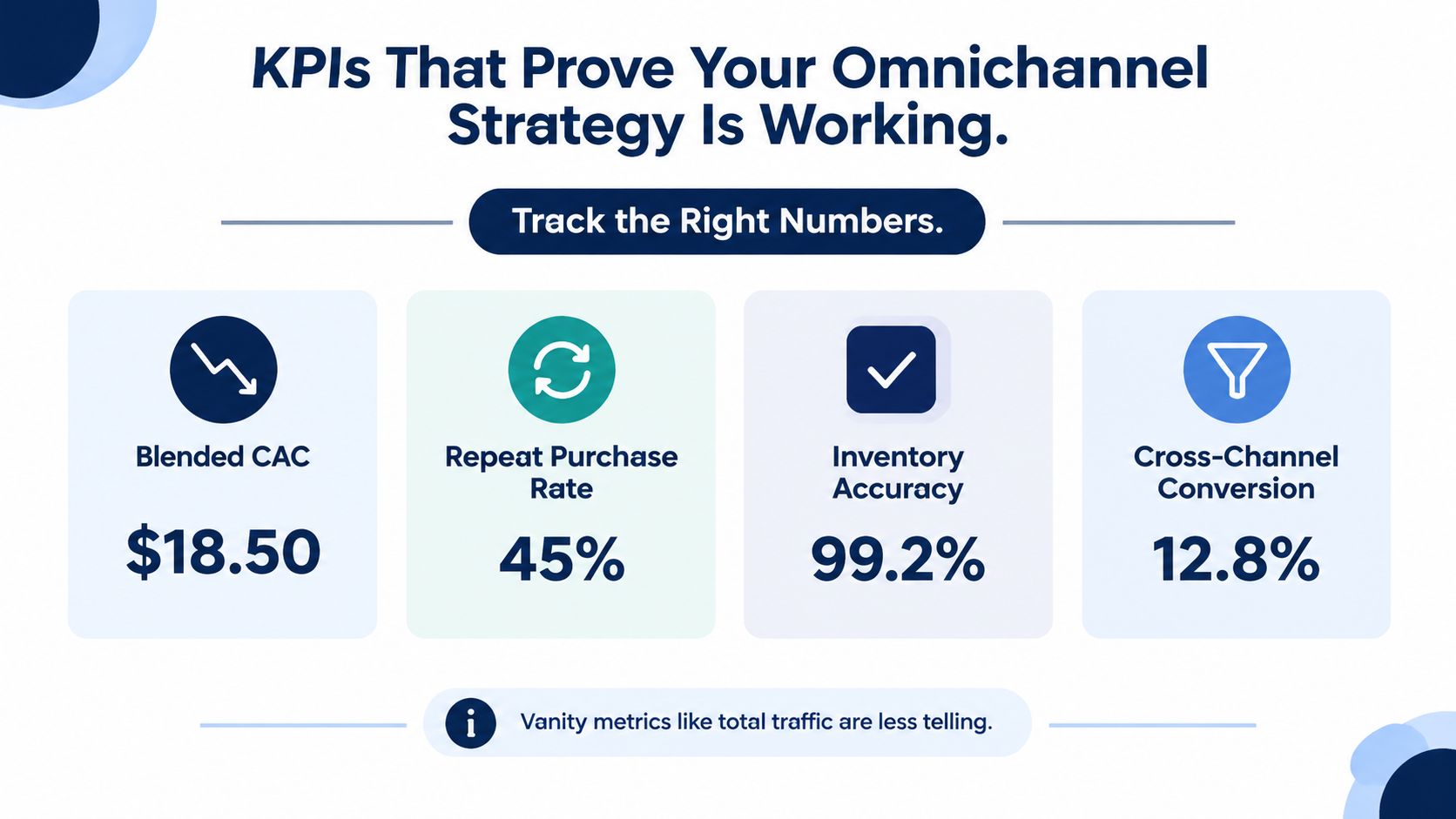
Review operational indicators frequently enough to catch broken promises, including inventory accuracy, order exceptions, pickup completion, delivery time, and return backlog. Review contribution margin, repeat behavior, assortment performance, and inventory placement less frequently, because those decisions need enough completed customer journeys to become meaningful.
A good dashboard ends with an action. If a store fulfills too many low-margin orders, change the routing rule. If a product sells well through DTC but returns heavily from a marketplace, inspect content, expectations, and assortment. If repeat customers move channels, preserve their identity instead of forcing them into a new acquisition journey.
More channels don't automatically create more profit. Omnichannel becomes destructive when the brand treats convenience as a promise without pricing the operational work required to deliver it.
The first failure is fragmented inventory. A brand advertises stock that exists physically but isn't available for the selected fulfillment method. The result can be substitutions, cancellations, split shipments, and customer service labor.
The second is overpromised delivery. Fast delivery looks attractive in the storefront, but the order may require expensive manual handling or a distant shipment. A slower promise that the network can consistently meet may produce better contribution than an aggressive promise that generates exceptions.
The third is unmanaged returns. Buy-online-return-in-store can be convenient, but the business still needs a disposition rule, inventory update, refund workflow, and route for damaged or unsellable goods. If those steps aren't connected, the brand pays for convenience without recovering the inventory value.
The fourth is technology without shared ownership. A CRM, OMS, WMS, POS, and marketing platform can all be advanced while disagreeing about the customer, the order, or the stock position. Integration architecture matters less than clear data ownership, reliable event flows, and disciplined governance.
A neutral benchmark cited by Manhattan Associates found that 38% of specialty retailers were advancing unified commerce initiatives in 2025, suggesting that many operators are still proving return on investment rather than scaling a finished model, as discussed in Manhattan Associates' 2025 omnichannel retail trends.
Use a margin filter for every new promise:
Start with the journeys and locations where the economics are clear. Then expand the network only after the data, inventory, and contribution-margin signals support it.
Million Dollar Sellers gives serious ecommerce operators access to a private peer community for sharing strategy, execution lessons, and vetted resources across Amazon, DTC, retail, and omnichannel businesses. Visit Million Dollar Sellers to learn how the community can help you pressure-test your channel design and scale with stronger operating economics.
Join the Ecom Entrepreneur Community for Vetted 7-9 Figure Ecommerce Founders
Learn MoreYou may also like:
Learn more about our special events!
Check Events