Chilat Doina
September 9, 2026
You've probably seen this movie before. A brand finds a winning product, clears seven figures through Meta ads, hires a growth team, and doubles spend. Revenue rises, but contribution margin collapses. The team responds by debating creative angles while inventory gets harder to forecast, customer support slows down, and the second purchase never arrives.
That isn't mainly an advertising problem. It's a business strategy in e commerce problem. The brand has acquired demand without deciding which customers it should retain, which channels it can operate profitably, or which post-purchase experiences turn one order into a durable relationship.
Global e-commerce is already a strategic retail channel. Retail e-commerce sales are projected to reach $6.88 trillion in 2026, representing 21.1% of worldwide retail sales, according to Quantumrun's e-commerce statistics. At that scale, growth doesn't come from adding another campaign to a crowded account. It comes from making better choices about positioning, distribution, economics, and execution.
The founder usually notices the problem in the ad account. Customer acquisition cost rises, platform-reported return on ad spend becomes less convincing, and every new creative test produces a smaller gain. The deeper issue sits elsewhere. The brand built a channel stack before building a positioning spine.
A stalled direct-to-consumer brand often has a product that looks interchangeable, a financial model that treats gross revenue as business health, and an operating system copied from a category leader without understanding the constraints underneath it. Marketplace brands make the same mistake in a different form. They chase ranking, promotions, and assortment expansion while ignoring whether each SKU creates enough contribution after fees, fulfillment, returns, and inventory risk.
The bottleneck changes as a company grows. Early on, the question is whether anyone will buy. Later, the questions become more uncomfortable:
A useful SEO strategy for e-commerce brands in Dublin illustrates why channel execution still matters, but SEO alone can't rescue unclear positioning or weak retention. Search visibility brings qualified attention. It doesn't decide whether the offer deserves preference, whether the page converts, or whether the customer returns.
Undifferentiated positioning makes every channel expensive because the brand must rent attention instead of earning preference. If a buyer can't explain why this product fits their situation better than the alternative, the business competes on discounts, reviews, and ad efficiency.
Channel monoculture creates false confidence. A brand that depends on one platform may look efficient until the platform changes reach, fees, ranking, or attribution. Diversification doesn't mean opening every channel at once. It means developing a deliberate second source of demand before the first becomes a single point of failure.
Operations that scale slower than ad spend turn growth into a customer experience liability. The store may acquire orders faster than the warehouse can pick them, suppliers can replenish them, or support agents can resolve issues. Sustainable scale begins when the business treats those constraints as strategic decisions, not back-office cleanup.
Practical rule: If doubling media spend would expose a fulfillment, cash-flow, or retention problem, the brand isn't ready to double media spend.
E-commerce strategy isn't a marketing calendar. It's a system of interlocking choices that determines who you serve, where you meet them, what you promise, and how reliably you deliver it.
Think about a restaurant. The menu attracts a particular customer. The dining room sets expectations about the experience. The kitchen determines whether the restaurant can serve that promise consistently. A premium tasting menu, a fast pickup counter, and a family restaurant require different staffing, pricing, layouts, ingredients, and service standards. Combining pieces from each model creates confusion rather than scale.

Positioning answers three questions. Who is the product for? What alternative does that customer consider? Why should they believe your product is the better choice?
A useful positioning statement changes product pages, creative briefs, packaging, retail placement, and customer support scripts. A weak one produces generic copy everywhere. Founders often skip this step because it feels less measurable than launching campaigns. That shortcut creates expensive downstream work, since every channel must compensate for an offer that doesn't communicate a clear reason to choose.
Channel strategy should follow buyer behavior and business economics. A customer who searches by product specification may behave differently from one who discovers through creators, social feeds, or marketplace browsing. The channel affects the information you can collect, the relationship you control, the fees you pay, and the speed of feedback.
Founders frequently reverse the order. They pick Amazon, Shopify, TikTok, or wholesale first, then retrofit the product and message to the channel. That can generate initial sales, but it often locks the company into low-margin customers and fragile acquisition assumptions.
Operations include inventory, fulfillment, delivery communication, returns, support, reviews, and reorder mechanics. These are not separate from the brand. They determine whether the customer receives the experience the marketing promised.
The working definition is simple: strategy is the set of trade-offs you commit to before tactics get measured. It tells the team which customers matter, which channels deserve investment, which costs must stay controlled, and which opportunities should be declined.
Amazon, DTC, and omnichannel aren't interchangeable storefronts. They're different operating environments with different economics and feedback loops.
Amazon offers built-in discovery, customer trust, and fulfillment infrastructure. The trade-off is relationship control. You gain access to demand, but the marketplace owns much of the customer interaction and sets important rules around visibility, fees, and communication.
DTC gives you more control over merchandising, customer data, messaging, and retention. It also makes you responsible for creating demand, earning trust, managing technology, and funding the full customer journey. Omnichannel can compound reach and resilience, but only when inventory, pricing, content, and customer service are coordinated across environments.
| Dimension | Amazon | DTC | Omnichannel |
|---|---|---|---|
| Discovery | Marketplace intent and category browsing | Paid, organic, creator, email, and referral demand | Combined marketplace, owned, social, and retail discovery |
| Customer relationship | Limited control | Direct ownership of the customer experience | Shared across channels, requiring disciplined data practices |
| Margin profile | Marketplace fees and fulfillment costs shape margin | Acquisition and fulfillment costs require close control | More complexity, but potential diversification of demand |
| Feedback loop | Fast product and listing feedback | Richer first-party behavior and retention feedback | Broader signal set, harder attribution |
| Best fit | Search-led categories, operationally ready products, capital-conscious launches | Strong differentiation, repeat purchase, brand-led products | Mature brands with coordinated inventory and channel teams |
| Typical sequencing | Amazon-first, then DTC overlay | DTC-led, then marketplace expansion | Add after the business can manage shared operations |
The right starting posture depends on category margin, repeat purchase potential, brand maturity, and available capital. A replenishable product with clear search intent may justify an Amazon-first launch. A differentiated product that needs education and community may work better DTC-led. A proven brand can use both, provided each channel has a clear job.
Channel selection is a sequencing decision, not a branding decision. Use this guide to multi-platform selling when you're designing the handoff between marketplaces and owned channels, but don't confuse presence with strategy. Every SKU needs a contribution margin guardrail by channel, and the company needs one primary channel rather than a collection of equally neglected experiments.
A practical exit path might start with Amazon for demand validation, add DTC for retention and merchandising control, then expand into omnichannel distribution once forecasting and inventory allocation are dependable. A DTC-led brand may reverse that order. Both can work. Mixing all three without a primary operating model usually doesn't.
Top-line revenue can hide a weak business. The number that matters is what remains after the costs required to produce, acquire, deliver, and support each order.
Start with contribution margin per order:
Net revenue minus COGS, inbound freight, fulfillment, payment processing, returns, discounts, and variable acquisition costs.
Use net revenue rather than the original order value. Refunds and returns change what the company keeps. A product that looks profitable before returns can become a cash drain once customer acquisition and post-purchase costs enter the calculation.
The four metrics that deserve executive attention are:
| Metric | Why It Matters | Healthy Threshold | Vanity Trap |
|---|---|---|---|
| Contribution margin | Shows whether orders create usable profit | 25% to 30% before aggressive acquisition expansion | Gross margin that excludes fulfillment, returns, and ad waste |
| CAC payback | Shows how quickly growth investment returns | Under five months | Platform ROAS without blended costs |
| Repeat purchase rate | Measures product and retention strength | Above 30% in the first 90 days | Email engagement without completed reorders |
| Net revenue retention | Shows whether existing customers sustain revenue | Track by cohort and business model | New-customer revenue masking churn |
| MER | Provides a broad efficiency signal | Use with channel-level contribution data | Treating one ratio as attribution truth |
| Follower count | Indicates audience size | No universal operating threshold | Assuming attention equals demand |
These thresholds are the decision rule specified for a brand ready to push acquisition: contribution margin at 25% to 30%, payback under five months, and repeat purchase above 30% in the first 90 days. They aren't universal laws, but they force the team to prove that growth can survive outside a dashboard's most flattering view.
For product visualization, an AI model for outfit e-commerce may support merchandising and conversion testing, but the tool belongs inside the economic model. If it improves product understanding, measure the effect on contribution per visitor and subsequent orders, not only engagement.
Founders who want a clearer foundation can also use this explanation of what unit economics means. The discipline is less glamorous than a new campaign, but it tells you when scaling is rational.
E-commerce discovery no longer begins in one predictable place. A shopper might see a TikTok video, compare products through Google Shopping, read a Reddit discussion, watch a YouTube review, search Amazon, and finally purchase through a DTC store. Meta paid media, affiliate creators, organic social, and marketplace search overlap throughout that journey.
That fragmentation creates a measurement problem, but it also creates a strategic opportunity. The brand shouldn't ask which single channel deserves all the budget. It should ask which combination creates qualified demand at a cost the post-purchase system can support.
Consumer behavior is moving in this direction. Recent research reports that 64% of shoppers have tried GenAI tools and 58% are comfortable with AI-assisted shopping, according to Constructor's State of E-Commerce takeaways. The implication isn't that classic SEO disappears. It means product information, reviews, comparisons, structured content, creator demonstrations, and customer support must make the brand understandable wherever intent appears.
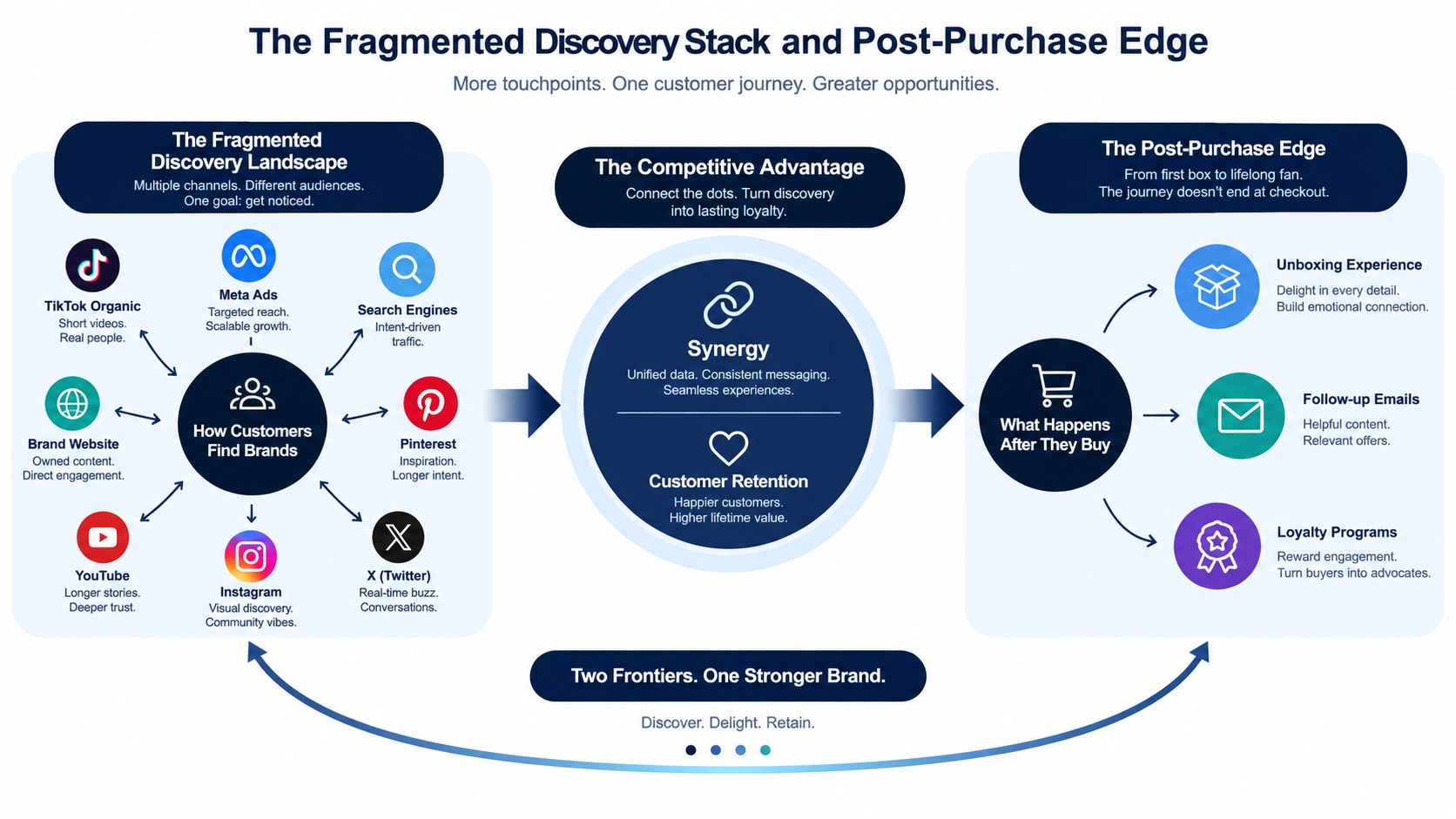
Acquisition gets the order. Operations determine whether that order creates another opportunity.
The post-purchase edge includes warehouse picking accuracy, delivery communication, packaging, inserts, onboarding, customer support response time, review requests, returns, subscriptions, and replenishment reminders. Each touchpoint can either reduce uncertainty or create a reason not to buy again.
The same principle applies to recommendations. Benchmark data summarized by Hello Retail reports that recommendation clicks appeared in about 7% of visits, while those visits generated roughly 24% of orders and 26% of revenue. The useful lesson is not to chase clicks. It's to test recommendation placement and ranking against incremental revenue per visitor.
Consumer expectations reinforce the operational point. Free shipping influences purchase decisions for 76% of consumers, while 68% say retailer site search needs improvement and 67% identify reviews as the top trust signal, according to Ryder's 2025 e-commerce consumer study. Delivery, search, reviews, and returns aren't minor conversion details. They shape margin and loyalty.
A technical migration can expose these dependencies. Presidio's e-commerce migration case study is useful context for thinking about platform changes as operational projects rather than cosmetic redesigns.
Distribution is table stakes. The experience loop is the moat.
The organization should lag the revenue problem, not anticipate a version of the company that doesn't exist yet. A founder-led generalist team can move quickly while the business is still finding product-market fit. As complexity increases, specialists become valuable because nobody can own every channel, vendor, forecast, and customer issue with equal depth.
| Revenue Stage | Org Structure | Supply Chain Model |
|---|---|---|
| Early scale | Founder-led generalists with clear ownership | Domestic 3PL or tightly managed in-house fulfillment |
| Growing complexity | Add a head of growth and an operations lead | Domestic DTC fulfillment, with selective marketplace fulfillment |
| Leadership scale | Establish CEO, COO, CMO, or equivalent functional leadership | Hybrid regional fulfillment, stronger forecasting, and supplier redundancy |
The common mistake is hiring a CMO before the business has a stable position, reliable measurement, or enough channel complexity to justify the role. Another is splitting marketing ownership across too many channel managers, each optimizing a local dashboard while nobody owns blended contribution. Operations often gets outsourced to one 3PL before volume justifies the dependency, leaving the brand exposed when service levels deteriorate.
A domestic 3PL is a practical default for DTC when speed and flexibility matter. A hybrid DTC plus FBA model can make sense when marketplace demand is substantial and the business wants channel-specific fulfillment. Overseas production with bulk freight and regional 3PLs may improve landed economics, but it increases lead-time, forecasting, and working-capital risk.
Use operational defaults as prompts for discipline, not as substitutes for a forecast:
The detailed mechanics in this e-commerce supply chain guide can help frame those decisions. The principle is more important than the tool: add structure when the current system becomes the constraint, not because a larger competitor uses it.
A quarter is long enough to change the operating model and short enough to maintain urgency. Run the work in four two-week blocks, with the remaining time used for implementation, review, and handoff.
Rewrite the value proposition around the highest-value customer. Audit product detail pages for proof, objections, comparison language, and price anchoring. Decide which offer you'll promote, which bundles protect margin, and which discounts you'll stop using.
Map every active channel to a job: discovery, education, conversion, retention, or marketplace availability. Reallocate 15% to 25% of media spend toward the channel showing the cleanest CAC-to-LTV spread, then evaluate the result using blended contribution rather than platform-reported ROAS.
Install or repair subscribe-and-save flows where the product supports replenishment. Set a retention email cadence, create a review request loop, and document a returns playbook that protects margin without creating unnecessary customer friction.
Set KPI targets by channel and SKU. Give every metric one owner, define the review cadence, and document what decision each threshold triggers.
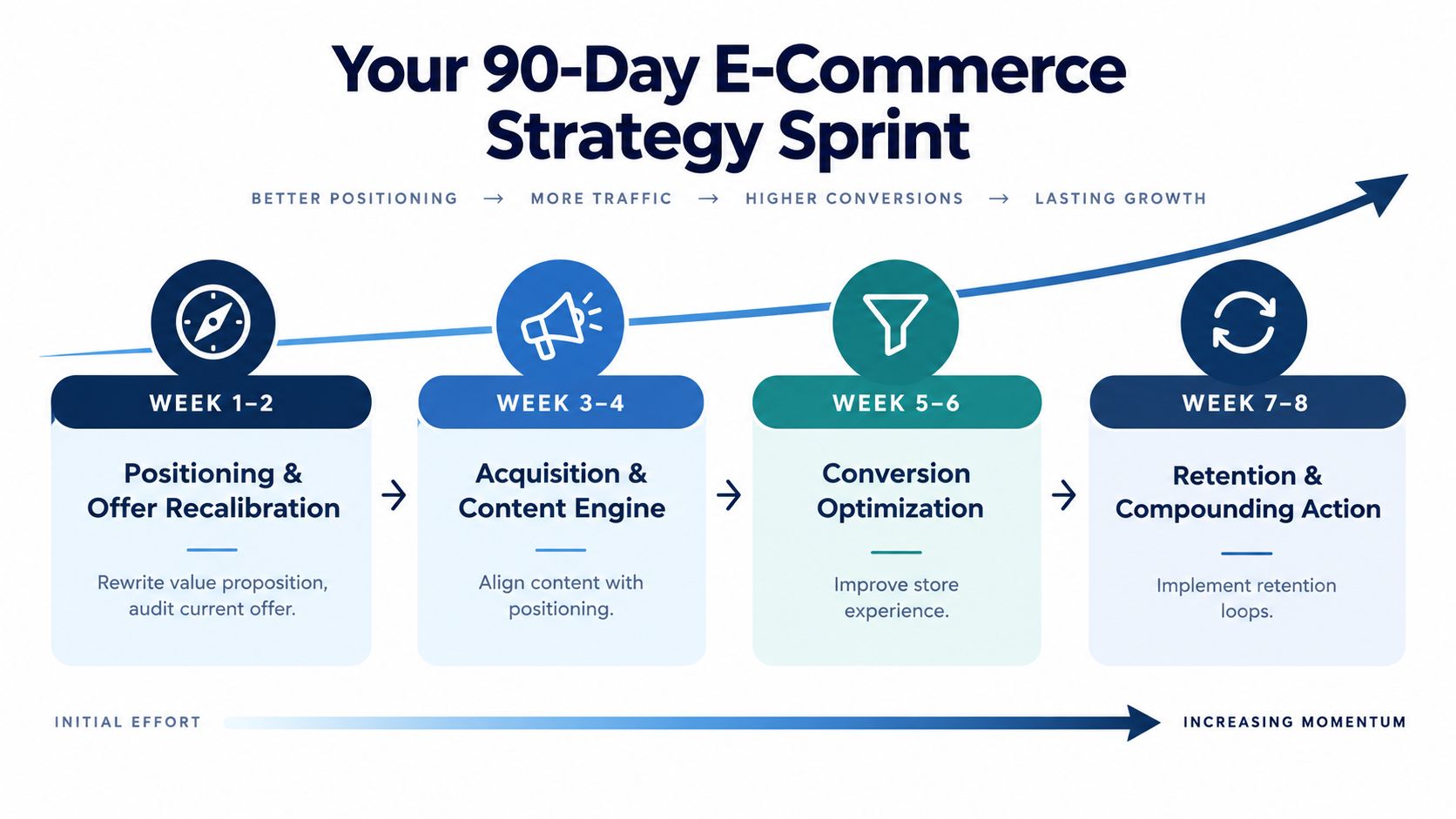
Use the video below as a practical prompt for reviewing how positioning, acquisition, conversion, and retention fit together.
By day 90, ship three artifacts: a one-page strategy memo, a unit economics dashboard, and a 30/60/90 rollout calendar. If the team can't explain those documents without opening five dashboards, the strategy still isn't clear enough.
Stop using traffic as the headline measure of progress. Traffic can rise while contribution falls, inventory turns worsen, and customers fail to return. Brands that scale responsibly manage the relationship between repeat purchase rate, contribution margin by channel, inventory turn, and CAC payback.
Use this checklist before committing more ad spend, adding a marketplace, or expanding the assortment.
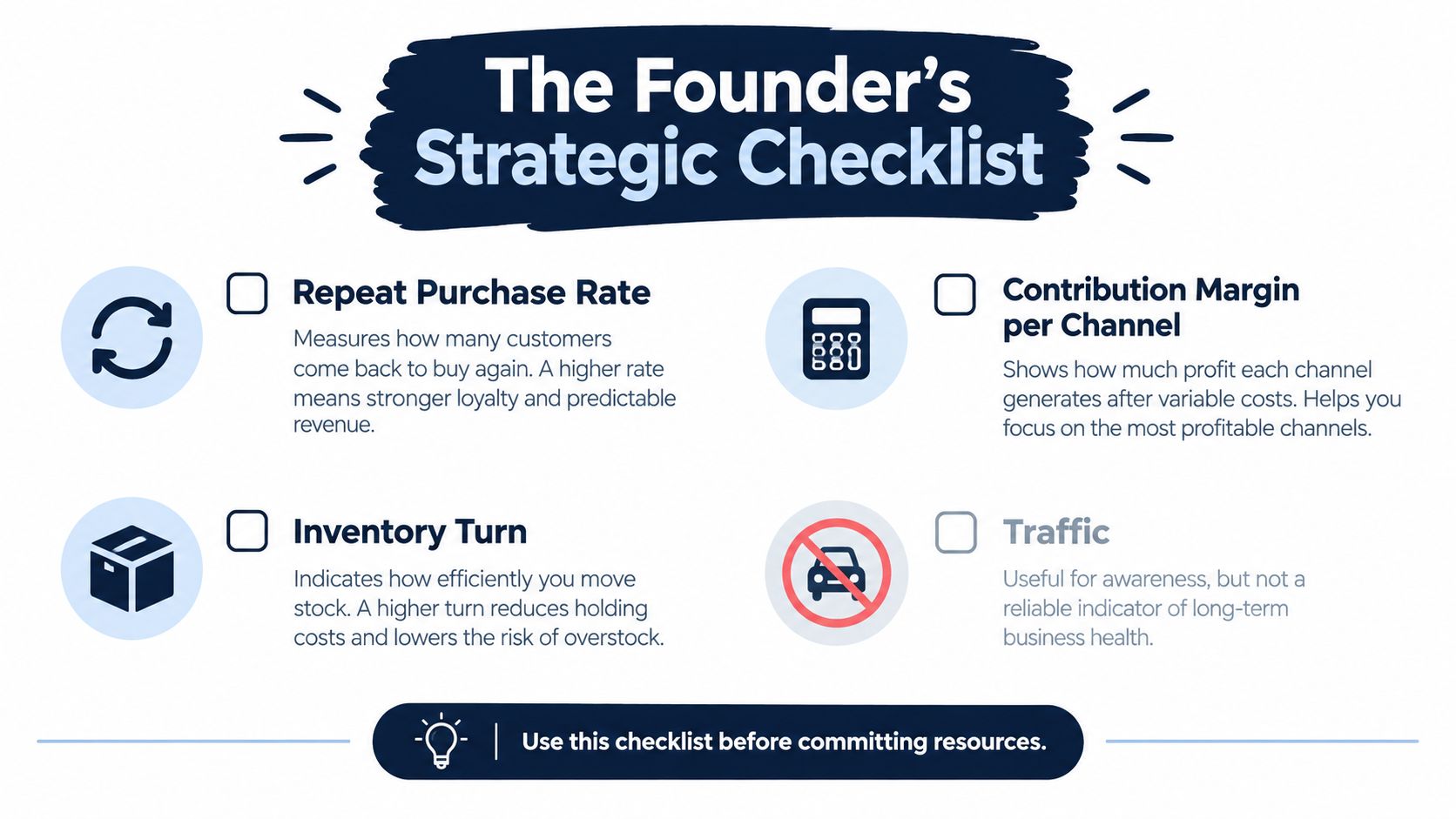
The point isn't to avoid growth until every box looks perfect. It's to know which box will break first and fund that constraint before buying more demand. A brand that understands its customer, economics, discovery mix, and post-purchase system can scale with intent instead of confusing activity for progress.
Million Dollar Sellers offers an invite-only peer community where Amazon, DTC, and omnichannel founders share operating experience, strategy discussions, and behind-the-scenes lessons from scaling brands. Visit Million Dollar Sellers if you want a focused environment for pressure-testing your e-commerce decisions with other experienced operators.
Join the Ecom Entrepreneur Community for Vetted 7-9 Figure Ecommerce Founders
Learn MoreYou may also like:
Learn more about our special events!
Check Events