Chilat Doina
August 28, 2026
You add Walmart because Amazon feels too concentrated. You open a Shopify store because marketplace fees keep rising. Then the orders start arriving from different places, inventory counts disagree, product titles need rewriting, and your fulfillment team spends more time resolving exceptions than shipping profitable orders. The sales dashboard looks healthier, but the operation feels less controllable every week.
That's the reality of multi platform selling after the launch announcement fades. Diversification can reduce dependence on one marketplace and expose your products to different demand pools, but only when the business can maintain accurate listings, reliable fulfillment, consistent pricing, and channel-level profitability. The right question isn't how many platforms you can connect. It's how many you can operate without lowering the standard of your strongest channel.
The popular version of multi platform selling is simple. Add a marketplace, copy your catalog, connect an inventory tool, and wait for incremental revenue. The operational version is harder. Every new channel introduces its own catalog rules, customer expectations, promotional mechanics, shipping requirements, returns process, and reporting logic.
Recent industry coverage found that the average online seller is active on six different marketplaces, while 67% of sellers operate on four or more marketplaces. That shift shows that diversified channel portfolios have become a common operating model, not a niche experiment. It also means sellers are managing discovery, conversion, and resilience across several platforms at once. The reporting on sellers active across multiple marketplaces provides useful context for how quickly this model has become mainstream.
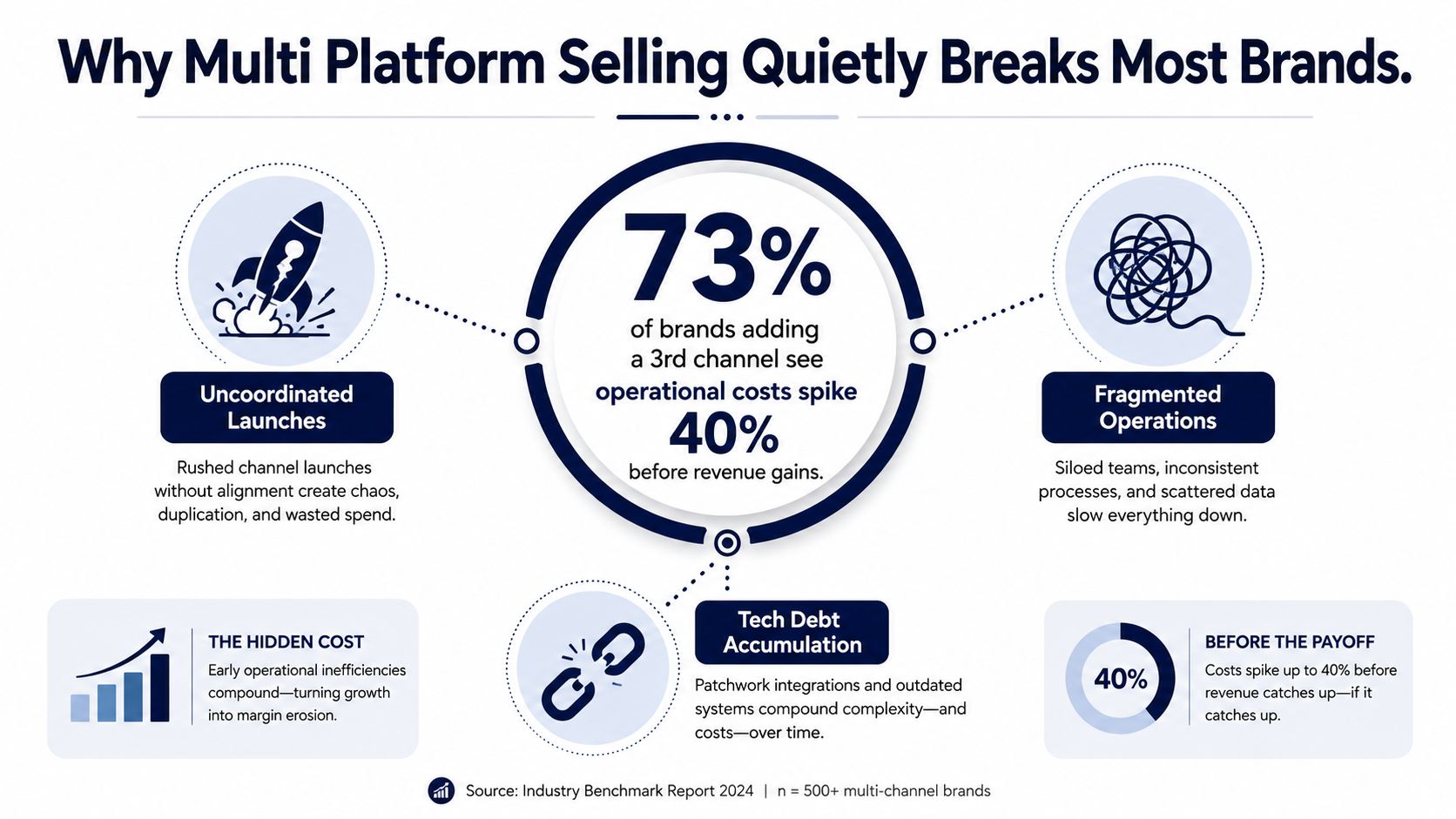
The first failure usually appears in inventory. Amazon, Shopify, and Walmart may each show available stock at different times, especially when one system updates on a schedule and another receives an order immediately. A seller can oversell a fast-moving SKU without realizing that the problem came from sync latency rather than demand.
Catalog complexity creates a second drag. A product may need different titles, attributes, images, category mappings, compliance fields, and variation structures on each marketplace. One seller with 500 SKUs across six channels could be managing more than 3,000 listing configurations, according to coverage of multichannel listing management. The same source notes that many merchants still rely on spreadsheets even as integrators become more common. This practical overview of multichannel listing management captures why listing integrity is often a harder problem than inventory synchronization.
Pricing creates another quiet leak. A promotion on one marketplace can undercut your direct store, trigger a MAP issue, or train customers to wait for marketplace discounts. Meanwhile, advertising costs can rise when channels compete for the same buyers rather than reaching different audiences. Holding extra stock across multiple warehouses can also squeeze cash flow before the added channel proves its contribution margin.
Operator's rule: A channel isn't live when the listing is published. It's live when your team can maintain its catalog, pricing, inventory, service levels, and returns without daily heroics.
Customer service expands in the same way. Each marketplace imposes its own response expectations, cancellation rules, delivery metrics, and dispute process. Review velocity fragments too. Instead of concentrating feedback in one place, you're building credibility across several surfaces, each with different algorithms and buyer behavior.
A thoughtful profitable omnichannel retail strategy should therefore begin with operating capacity, not channel enthusiasm. The objective is selective diversification, not universal presence. More reach only helps when the team can preserve the experience that created demand in the first place.
The best next channel is the one your team can run at the same standard as the current leader. Start with four filters, then force every candidate through the same evaluation instead of allowing a fashionable platform to bypass the process.
Ask how buyers discover products in your category. Amazon often suits products with established search demand, clear specifications, and review-driven consideration. TikTok Shop can fit products that demonstrate well and benefit from creator-led discovery. A Shopify store gives you more control over education, merchandising, bundles, and customer data, but it requires you to create or capture demand.
Category fit also includes returns expectations, competitive density, and content requirements. A product that wins through technical comparison may need a different channel strategy from one that sells through impulse, demonstration, or community identity.
Build a channel contribution model before signing up. Include marketplace commissions, fulfillment, storage, returns, discounts, advertising, payment processing, customer support, and any channel-specific surcharges. Use the same product cost and return assumptions across every candidate so the comparison doesn't become a sales exercise.
A channel that produces revenue but loses money after advertising and fulfillment isn't a growth channel. It's an expensive acquisition program with weak financial controls.
Count the work, not just the orders. Can your team maintain the product content, answer customer messages, process exceptions, reconcile payouts, manage returns, and handle compliance for another platform? If the answer depends on one person remembering a manual step, the channel isn't ready.
Review the competitive set, price ceiling, content rules, and customer expectations. Premium brands may avoid broad marketplace exposure when discount visibility or uncontrolled seller activity would weaken positioning. Value-oriented products may benefit from the marketplace's existing traffic and price comparison behavior.
| Channel | Category Fit | Margin Profile | Operational Load | Brand Fit |
|---|---|---|---|---|
| Amazon | Search-led products with clear specifications and review potential | Fees, ads, fulfillment, and returns require careful modeling | High catalog, compliance, and service discipline | Strong for accessible, comparison-friendly offers |
| Shopify | Products needing education, storytelling, bundles, or retention | More control, but demand generation and support remain your responsibility | High marketing and conversion ownership | Strongest control over positioning and customer experience |
| Walmart | Value-conscious categories with marketplace demand | Requires channel-specific pricing and fulfillment analysis | Moderate to high, depending on catalog and service model | Fits brands comfortable with marketplace comparison |
| TikTok Shop | Demonstrable, impulse-friendly, creator-compatible products | Creator, promotion, fulfillment, and returns costs need close tracking | High content and campaign responsiveness | Fits brands with an adaptable social voice |
| Wholesale or retail | Products with reliable supply, packaging, and replenishment | Lower control over end pricing, but potentially simpler demand planning | Account management and compliance can be substantial | Fits brands built for distribution and consistent availability |
Expansion should follow the existing strength. A DTC-led brand can test Amazon with a focused assortment, then add another marketplace after catalog and fulfillment controls hold. An Amazon-led seller should establish a direct store around its strongest products before adding another marketplace. A wholesale-led brand should confirm that packaging, inventory allocation, and replenishment can support direct marketplace service.
Use stage gates instead of deadlines. Advance only when the current channel has clean contribution reporting, stable inventory accuracy, reliable order handling, and clear ownership for exceptions. If those controls aren't in place, another channel will magnify the weaknesses you already have.
Adding channels before standardizing the back office creates avoidable work. The foundation needs three connected systems: a master record for product data, a rules layer for pricing, and a controlled inventory ledger.
Create a canonical SKU record with titles, attributes, dimensions, images, compliance documents, variation relationships, and channel eligibility. A PIM should store the approved source content, while channel-specific templates reshape that content for Amazon, Walmart, Shopify, or other destinations.
That distinction matters. Standardization doesn't mean publishing identical copy everywhere. It means changing the presentation without letting teams create conflicting facts, images, or claims by hand.
A unified pricing engine should define MAP floors, promotional permissions, channel-specific discounts, currency logic, and repricing boundaries. Manual overrides should be visible, time-limited, and assigned to an owner. Otherwise, one marketplace promotion can undermine the direct store or create a margin problem that only appears after the payout arrives.
Use one authoritative inventory ledger, whether stock is pooled or allocated by channel. Define safety stock by SKU and channel, reserve units for open orders, and trigger replenishment from sell-through and lead-time logic rather than tribal knowledge.
Academic work on omnichannel operations emphasizes joint inventory synchronization across channels, while more recent work frames event-driven architecture as a practical way to maintain consistency. A useful implementation sequence is to unify SKU data, publish inventory changes as events, enforce one source of truth, and audit exceptions automatically. The research on event-driven inventory synchronization explains why delayed updates and data silos create drift, availability problems, and lost sales.
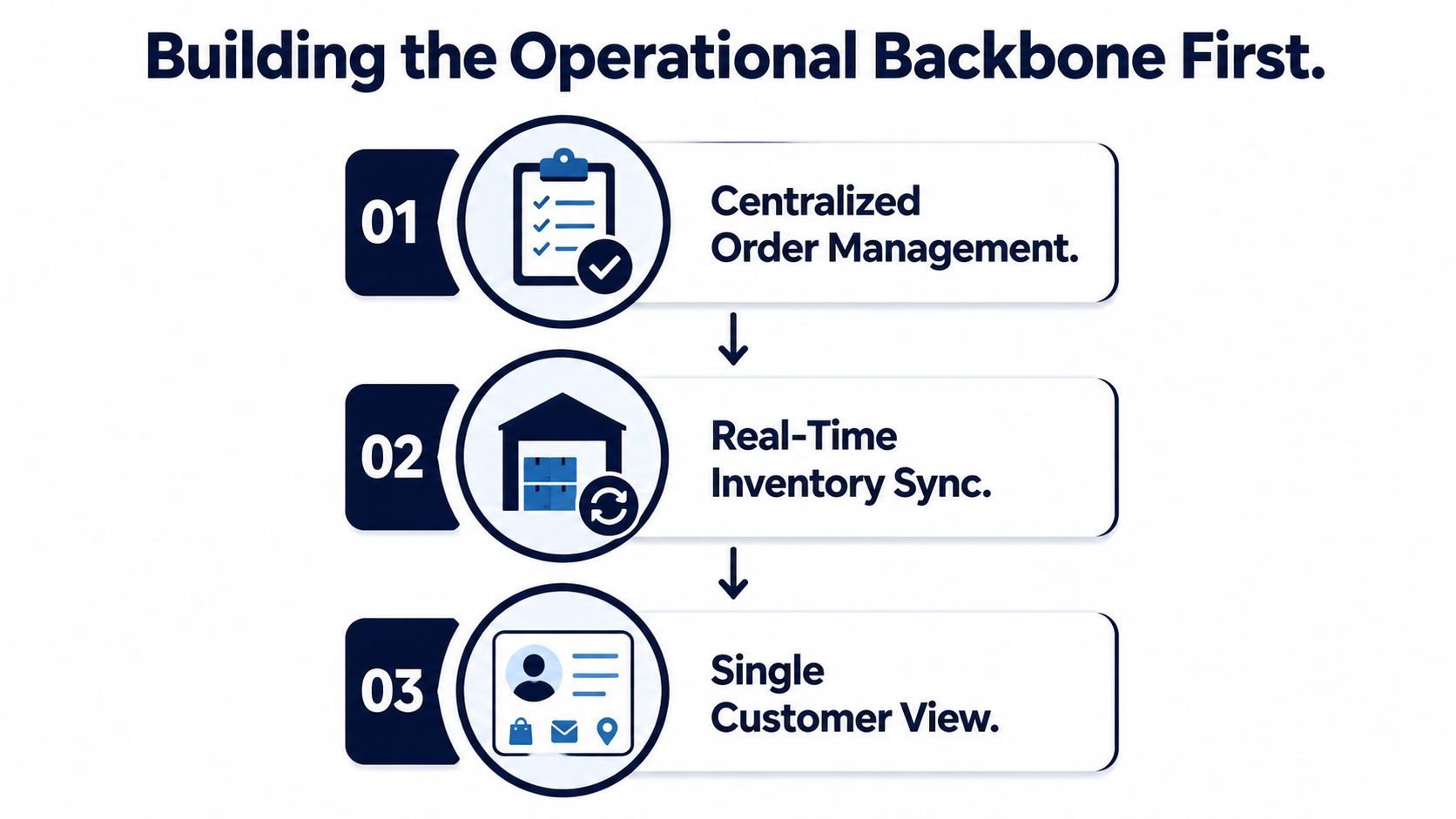
Ownership matters as much as software. Assign a catalog owner, a channel P&L owner, and a person responsible for reorder approval. Document what happens when an order arrives during a sync delay, when a listing is suppressed, or when a channel reports stock that the warehouse can't locate.
The operational backbone should make a new channel mostly a configuration exercise. If every launch requires rebuilding pricing, inventory, order routing, and catalog workflows, the company hasn't built a platform strategy. It has built a collection of exceptions.
Fulfillment should follow the customer promise and contribution margin, not a platform preference. Amazon FBA, a multi-channel 3PL, in-house shipping, and dropship fulfillment each address a different operating constraint.
| Model | True Landed Cost | Control & Branding | Customer Experience | Best For |
|---|---|---|---|---|
| Amazon FBA | Includes inbound freight, prep, storage, fulfillment, returns, and marketplace-related costs | Limited packaging control | Strong Amazon delivery experience | Amazon-heavy catalogs and eligible products needing Prime |
| Multi-channel 3PL | Includes receiving, storage, pick-and-pack, shipping, returns, software, and account fees | More control over packaging and routing | Consistent cross-channel service when configured well | Split inventory across Amazon, Shopify, Walmart, and other channels |
| In-house DTC shipping | Includes labor, warehouse overhead, packaging, software, carrier costs, and returns handling | Highest control | Can support premium unboxing and tailored service | Brands with distinctive packaging or fragile products |
| Dropship fulfillment | Includes supplier handling, shipping, service coordination, and margin paid to the supplier | Limited control | Depends heavily on supplier reliability | Broad assortments where holding inventory is impractical |
FBA fits catalogs where Amazon generates most demand or where slow-moving products need Amazon's delivery promise without your team handling each parcel. The model becomes harder to justify when the same inventory must serve several channels and Amazon's stock position limits flexible allocation.
A multi-channel 3PL such as ShipBob or ShipMonk can suit brands sharing inventory across Shopify and marketplaces. The trade-off is reduced control over a customer-facing operation. Before transferring the full catalog, audit receiving accuracy, pick accuracy, inventory adjustments, return grading, and support responsiveness.
In-house fulfillment makes sense when packaging, inspection, or product fragility affects conversion and retention. It requires warehouse discipline, staffing coverage, carrier management, and a documented returns process. Dropship reduces inventory exposure, but supplier stock accuracy and shipping performance become part of your brand promise.
The right model may differ by SKU or channel. Keep FBA for Amazon-focused products, use a 3PL for shared inventory, and retain in-house handling for products that need inspection or distinctive packaging. That selective approach usually creates less operational strain than forcing every product through one network.
Regional placement changes the economics. Multiple nodes can shorten delivery distances, while bonded warehousing can support certain international flows, but both add reconciliation work and allocation decisions. A SKU sold across Amazon, Shopify, and Walmart needs reserved-stock rules, a replenishment cadence, and a response plan for unexpected demand.
Channel service requirements can make a low-cost route expensive. Amazon's late-shipment requirements and Walmart's on-time shipping metric expose the risk of missing promised delivery windows. For broader planning, Peak Transport ecommerce logistics covers the operational components behind cross-channel delivery.
The operating standard is clear: each channel must know available stock, order ownership, and the process for delivery and returns. For a fuller explanation of how that coordination works, see what omnichannel fulfillment involves.
A scalable stack separates the systems that create information from the systems that distribute it. Shopify Plus can serve as the DTC core, Amazon SP-API can provide marketplace order and catalog data, and a middleware layer can route orders to the right warehouse or fulfillment partner. The inventory ledger should remain authoritative instead of allowing each channel to become its own version of the truth.
Listing tools such as ChannelEngine, Sellbrite, and Linnworks can distribute listings and orders, but they shouldn't replace product governance. A PIM should manage SKU and content standards. An ERP such as NetSuite or Brightpearl can coordinate financial and operational records. Tax tools such as Avalara or TaxJar can handle tax calculation workflows, while shipping software manages labels, tracking, and returns.
Scheduled polling checks systems at intervals. Event-driven synchronization publishes a change as soon as an order, cancellation, shipment, or inventory adjustment occurs. Webhooks are central to that design because they can notify downstream systems without waiting for the next scheduled request.
Real-time doesn't mean latency disappears. APIs can throttle requests, messages can fail, and two orders can arrive for the final available unit before every platform receives the update. Your architecture needs idempotent order handling, reservation logic, retry queues, and a reconciliation process that surfaces conflicts instead of hiding them.
Integration test: Don't ask only whether a connector supports a channel. Ask what happens when the API fails, the same event arrives twice, the request limit is reached, or an order changes while the warehouse is processing it.
Evaluate partners on measurable operating behavior. Review synchronization latency, error visibility, retry controls, field mapping, API rate limits, permissions, audit logs, and support escalation. A feature checklist won't tell you whether a failed inventory event becomes a visible exception or disappears into a log nobody reads.
Tax calculation, label creation, and tracking updates should flow through defined ownership boundaries. The order router should know which warehouse can fulfill the order, the inventory system should reserve stock before release, and the channel should receive a reliable status update after shipment.
Before choosing software, compare multi-channel selling software options against your actual order, catalog, and inventory workflows. The right stack reduces manual decisions. It doesn't eliminate the need for operational judgment.
A product can appear on several platforms without becoming several different brands. The core promise, product facts, visual identity, and quality standard should remain consistent. The expression can change because buyers use each channel differently.
Amazon Sponsored Products and Sponsored Brands work inside a search and comparison environment. Product detail pages need clear keyword alignment, persuasive images, credible proof, and content that answers objections quickly. Amazon Brand Registry can support control over brand assets and enhanced content, but it doesn't remove the need for disciplined catalog governance.
Shopify gives you room for longer-form storytelling, editorial merchandising, bundles, education, email capture, and SEO. Paid social can create demand before a buyer has a specific product query. That freedom also creates responsibility. You own the landing page, the checkout experience, the retention program, and the cost of bringing the visitor back.
Walmart Connect fits a marketplace environment with its own search, merchandising, and promotional rules. Treating Walmart as a carbon copy of Amazon usually produces weak content and poor operational assumptions. The buyer context, competitive set, and service expectations can differ even when the same SKU appears in both catalogs.
Store approved assets and claims in the PIM, then create channel-specific versions. Amazon may need concise comparison graphics and structured attributes. Shopify may benefit from lifestyle photography, buying guides, and use-case storytelling. Social commerce may need demonstrations, creator-ready assets, and short explanations that make the product understandable without a search query.
Premium brands should decide deliberately whether marketplace availability supports or weakens positioning. If a marketplace creates visible price erosion, enforce MAP rules through approved sellers, documented promotions, and regular monitoring. Don't send paid traffic to a marketplace listing out of habit when the direct store offers stronger contribution margin or a better retention path.
The right destination depends on the customer's intent. Send high-intent marketplace shoppers to the listing that removes friction. Send education-seeking or repeat-purchase audiences to DTC when the direct experience, bundles, or retention economics justify it. Measure the decision by contribution margin and customer value, not by which dashboard reports the largest top-line number.
Brand consistency also includes service language, packaging expectations, and returns communication. A customer shouldn't feel that the company becomes less capable after buying through a marketplace. Channel adaptation is useful. Brand fragmentation is expensive.
Total GMV can hide a failing channel. A marketplace may add orders while consuming margin, warehouse capacity, and customer support time. Multi-platform health requires channel-level contribution reporting and an inventory view that shows whether pooled stock is turning productively or becoming stranded.
Track the following measures consistently:
| KPI | Healthy | Warning | Critical |
|---|---|---|---|
| Channel contribution margin | Positive after variable selling costs | Positive before advertising or returns | Negative after normal operating costs |
| New-channel sell-through | Product moves without abnormal discounting | Sales depend on frequent promotions | Inventory remains inactive or becomes stranded |
| Stockout frequency | Exceptions are rare and explained | Repeated issues on priority SKUs | Customers regularly see unavailable products |
| Listing integrity | Content, pricing, and availability stay accurate | Manual corrections recur | Suppression, mismatch, or overselling affects orders |
| DTC repeat buyer rate | Returning customers support retention economics | Repeat behavior is inconsistent | Paid acquisition carries the business indefinitely |
The common traps are predictable. Sellers launch without a pricing engine and undercut themselves across marketplaces. They treat Walmart, TikTok Shop, or international platforms like Shopify clones. They ignore returns until inventory and cash are locked in processing queues. They rely on one 3PL without a contingency plan, then discover that a warehouse outage can affect every channel at once.
Another mistake is scaling ads before the channel produces positive contribution. More traffic can accelerate losses when the listing, price, fulfillment promise, or repeat economics are wrong. Use a quarterly red-flag review to ask:
For broader ecommerce measurement guidance, use key performance indicators for ecommerce. And if your team is publishing across social surfaces, a workflow such as Post To All Social Media At Once can reduce repetitive distribution work, provided the content still receives channel-specific review.
Multi platform selling works when the business treats channels as one coordinated demand network with different customer interfaces. It fails when every marketplace becomes an isolated store with its own inventory, pricing, content, and service habits.
Million Dollar Sellers offers an invite-only peer community for ecommerce founders operating across Amazon, DTC, TikTok Shop, retail, and omnichannel models. If you're deciding which channels to add, how to protect contribution margin, or how to scale without multiplying operational debt, visit Million Dollar Sellers to learn how the community supports practical strategy sharing and execution.
Join the Ecom Entrepreneur Community for Vetted 7-9 Figure Ecommerce Founders
Learn MoreYou may also like:
Learn more about our special events!
Check Events