Chilat Doina
June 2, 2026
You're probably feeling this already.
Meta costs more than it used to. Creative burns out faster. Organic reach is inconsistent. One platform tweak can dent a channel you spent months dialing in. If most of your growth still depends on traffic you rent, your business is more fragile than your revenue line makes it look.
That's why serious operators stop thinking about email as “another marketing channel” and start treating it like an owned asset. A good list gives you direct access to buyers who asked to hear from you. No algorithm decides whether they see your launch. No ad auction decides whether you can afford to reach them this week.
The founders who win long term usually make the same shift. They stop asking, “How do I get more emails?” and start asking, “How do I build a list of people who are likely to buy again, refer, and stay close to the brand?” That's a very different game.
If you want to know how to build email lists that improve margin, retention, and resilience, the answer isn't bigger popups or more aggressive discounts by default. It's tighter strategy, cleaner systems, better offers, and stronger follow-through after the opt-in.
A lot of brands learn this lesson after they've already scaled.
Revenue is up. Orders are flowing. Paid social is carrying the load. Then CAC creeps higher, tracking gets noisier, or a platform change cuts efficiency. Suddenly the business feels exposed. You realize the audience you thought you had is mostly borrowed.
Your email list fixes that problem, but only if you build it correctly.
An owned list is one of the few marketing assets you fully control. You can segment it, nurture it, launch to it, and reactivate it without paying a platform every time you need reach. That matters because healthy growth gets easier when you can repeatedly sell to people who already know your brand.
Salesforce points to permission-based marketing as the foundation of ethical list growth, using opt-in forms, lead magnets, webinars, and in-person sign-ups with clear consent. Mailchimp also notes that brands should attract subscribers through opt-in forms and pop-ups instead of buying contacts, because list quality matters more than raw size in practice, especially once deliverability and engagement enter the picture, as summarized in this permission-based email list guidance.
Industry benchmarks cited by Nutshell show average email open rates around 39.64% and average click-through rates of 3.25% in the same Salesforce summary above. That tells you something important. Even with a healthy program, only a portion of your list will engage with any given campaign.
So if you fill the top of the funnel with low-intent subscribers, the weakness shows up downstream. You don't just get fewer purchases. You also get noisier data, weaker segmentation, and a list that costs money to maintain without producing enough value back.
Practical rule: A smaller list of people who wanted in will usually outperform a larger list of people who signed up for the wrong reason.
For e-commerce brands, this is even more important because list growth usually happens around checkout, educational content, launch pages, and product discovery paths. The signup source shapes the subscriber. The subscriber quality shapes the economics.
Treat every email captured as one of three things:
If the email doesn't improve one of those three, it's probably vanity.
Most list-building advice is obsessed with volume. More popups. More coupon codes. More giveaways. More names in the ESP.
That's how brands end up with expensive lists full of people who were never a fit.
The better question is simpler. What kind of subscriber are you attracting?
For many stores, the first instinct is a sitewide “10% off” popup. It works well enough to become the default. The problem is that default tactics shape customer behavior.
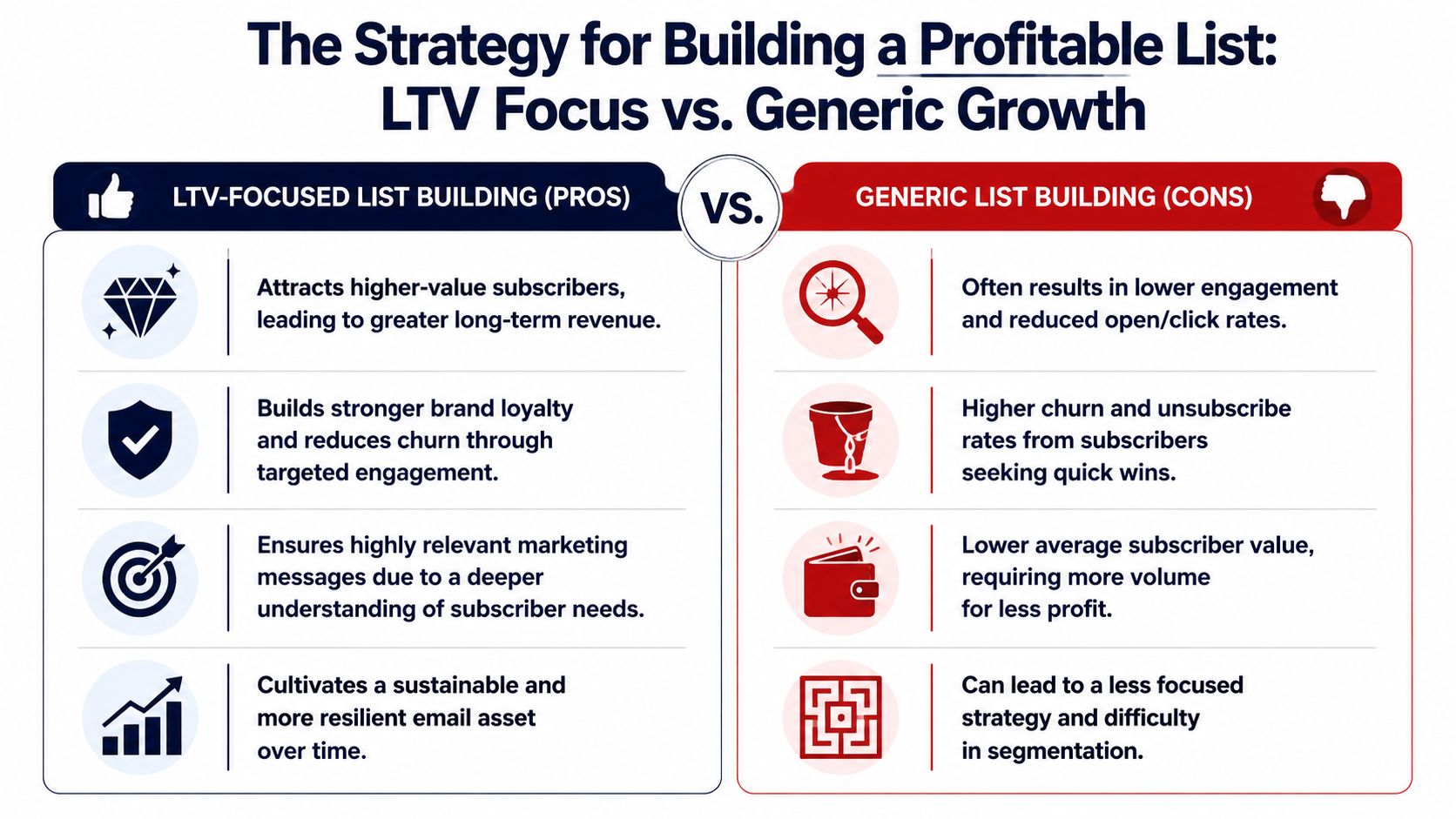
Twilio's guidance on building a list from scratch calls out a shift away from coupon-led capture toward value-based acquisition, especially for premium brands. Their point is straightforward. Most advice still centers on discounts, but those incentives often attract lower-LTV buyers. Product education, quizzes, and community access do a better job attracting higher-intent subscribers while also aligning with the growing importance of first-party consent in a privacy-heavy environment, as covered in this value-based list building resource from Twilio.
That matters if your brand has any margin discipline at all.
A discount-first acquisition strategy can create three problems fast:
How to build email lists depends on what you sell, who buys it, and why they buy it. The same capture tactic won't fit every brand.
Here's a practical perspective:
| Brand position | Best opt-in angle | Weak angle |
|---|---|---|
| Premium brand | Education, exclusivity, early access, product expertise | Constant discounting |
| Value brand | Smart bundles, practical tips, replenishment reminders | Vague “join our newsletter” asks |
| Community-led brand | Membership, identity, insider access, participation | Generic coupons with no brand story |
If you sell high-consideration products, lead with confidence-building assets. If you sell replenishable products, lead with convenience and lifecycle relevance. If your brand wins on identity, build a list people feel proud to be on.
One of the easiest ways to sharpen this strategy is to study strong customer segmentation examples and reverse-engineer which acquisition offer would naturally pull each segment in.
Most founders don't need more top-of-funnel chaos. They need cleaner intent signals.
That means your acquisition system should answer these questions before someone subscribes:
If you want extra inspiration, this roundup of actionable email capture tactics is useful because it gives you multiple ways to capture intent without defaulting to the same old promo box.
The best list-building strategy doesn't maximize signups. It maximizes the number of signups you'll still want on your list six months from now.
That's the filter.
Once the strategy is right, execution becomes a conversion problem. Most brands don't lose list growth because people hate email. They lose it because the signup flow is sloppy, mistimed, or too generic.
A strong flow feels relevant, low-friction, and immediate. It gives the visitor a good reason to opt in now, not “sometime later.”
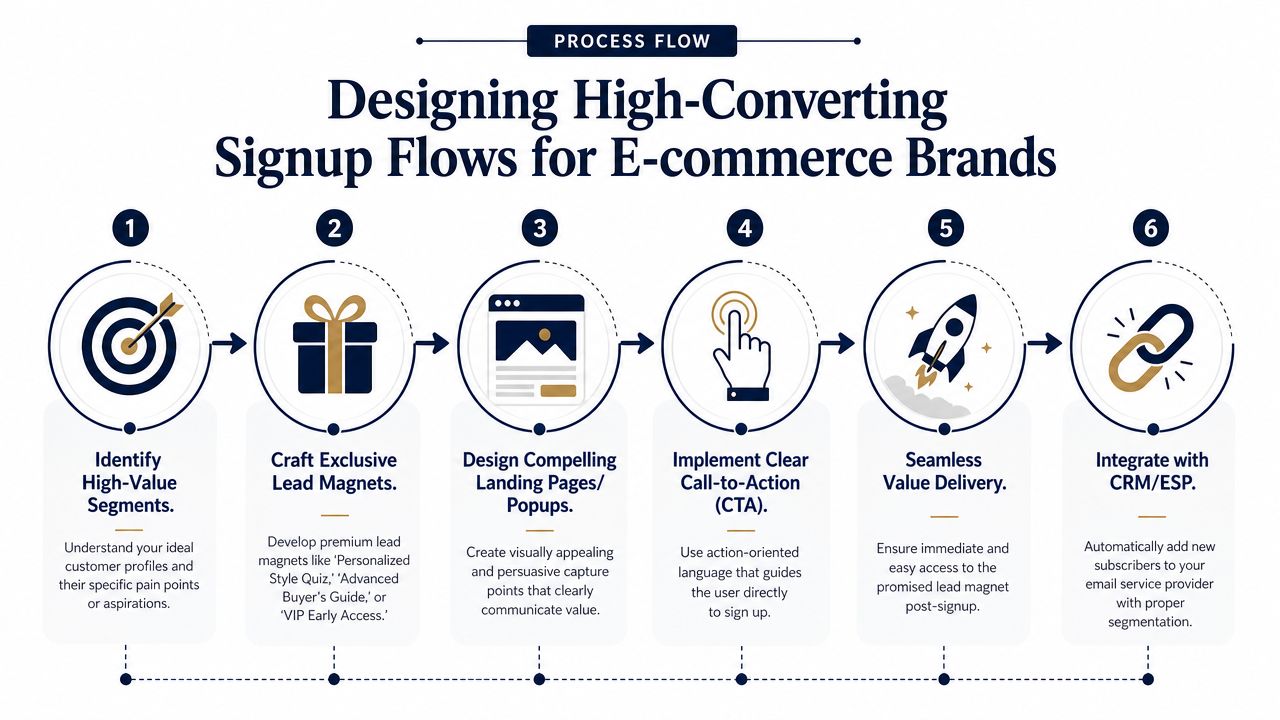
Teachable lays out a practical workflow that holds up well in e-commerce: define the audience and the offer, use a proper ESP with forms and automation, keep form fields minimal, and send the signup to a landing page that matches the promise. That approach reduces friction and improves conversion quality, not just raw opt-ins, as explained in this list-building workflow guide from Teachable.
That last part matters more than people think. If the popup promises one thing and the thank-you page delivers something vague, trust drops immediately.
Use this sequence:
Identify the segment
New visitor, returning browser, cart abandoner, post-purchase customer, or content reader.
Match the incentive to intent
Don't offer the same thing to all five. A first-time blog reader should get a different ask than a repeat PDP visitor.
Minimize fields
Start with email. Add more information later through preference collection, quizzes, or behavior.
Deliver instantly
The promised asset, access, or next step should arrive immediately.
The best e-commerce lead magnets usually do one of four jobs. They reduce uncertainty, increase desire, create exclusivity, or deepen identity.
Here are the ones I like most:
Product recommendation quizzes
Best for brands with multiple SKUs, routines, shades, sizes, or use cases. A quiz doesn't just capture an email. It captures declared intent.
Early access for launches or drops
Strong for premium, limited-edition, or founder-led brands. This keeps value tied to access, not price cuts.
Educational guides tied to the product
Good for technical, high-consideration, or problem-solving products. Think routines, buying guides, comparison frameworks, or care instructions.
VIP or insider access
Useful when the brand has a strong point of view or community element. Access can mean restock alerts, founder notes, or member-only product reveals.
Post-purchase enrollment
One of the most overlooked signup moments. The buyer has already trusted you once. Invite them into product education, replenishment reminders, or a loyalty-oriented list.
If you're also trying to improve the site experience around these offers, these e-commerce conversion rate ideas are worth reviewing because the best signup flow usually sits inside a stronger overall conversion system.
To see one capture framework in action, this walkthrough is useful:
Placement should follow behavior. The same offer can feel helpful in one spot and annoying in another.
| Placement | Best use | Bad use |
|---|---|---|
| Entry popup | Early access, quiz, clear first-visit value | Aggressive generic newsletter ask |
| Exit-intent popup | Recover abandoning visitors with relevance | Showing the same offer they already ignored |
| Embedded blog form | Content upgrades tied to the article topic | Dropping product promos into educational content |
| Dedicated landing page | Paid traffic, influencer traffic, launch campaigns | Sending all traffic to a generic homepage |
| Checkout opt-in | Transactional updates plus optional marketing consent | Hiding consent language or bundling it unclearly |
| Post-purchase page | Education, loyalty, referral, VIP list invite | Asking for the same signup they just completed |
Founders often over-focus on popup mechanics and under-focus on intent. The visitor doesn't care whether your tool has advanced triggers. They care whether the ask helps them make a better decision.
If the offer reduces friction in the buying journey, the signup flow feels useful. If it interrupts without adding value, it feels tax-like.
That's the bar.
A profitable email list doesn't grow from one popup. It grows when every acquisition channel feeds the same owned-audience system.
The mistake is treating email capture as a website-only problem. It isn't. Social, paid, content, checkout, and post-purchase all create moments where a prospect is willing to raise a hand. Your job is to catch that signal and route it into the right flow.
Most brands already have traffic leaks hiding in obvious places.
A product page visitor who wants help choosing shouldn't see the same opt-in as a customer on the thank-you page. Someone reading educational content shouldn't get hit with a blunt discount ask if the content itself could lead naturally into a guide or quiz.
The strongest on-site tactics usually include:
Social is great for discovery. It's weak as a permanent relationship layer unless you convert followers into subscribers.
Use social with that reality in mind:
If someone engages on social, assume interest is temporary. Give them a clear next action while attention is still high.
A lot of brands make paid acquisition harder than it needs to be by forcing every click to convert on first purchase economics.
That's not always the right move.
High-intent lead generation campaigns can work well when they're tied to a meaningful offer. Think product education for a complex category, early access for a drop, or a recommendation quiz for broad catalogs. Meta lead ads and landing-page-based flows can both work if the follow-up inside the ESP is clean.
Use paid list building when:
If you sell through events, retail partners, founder meetups, trade shows, or community activations, those touchpoints can feed your list too.
The key is simple. Make the opt-in explicit, make the value immediate, and make sure the follow-up reflects the context where the person signed up. A retail event subscriber should not receive the same first email as a paid social quiz lead.
A cohesive system beats isolated wins. Every channel should answer the same question: how does this interaction become a permission-based relationship we can deepen over time?
The right stack doesn't need to be fancy. It needs to be connected.
A lot of brands create list-growth problems with fragmented tools. One popup tool captures the lead. Another system stores the data. A third sends the welcome flow. Shopify or BigCommerce holds purchase behavior somewhere else. Then nobody trusts the segments because syncs break or fields map incorrectly.
That's when list building stops being an asset and starts becoming operational drag.
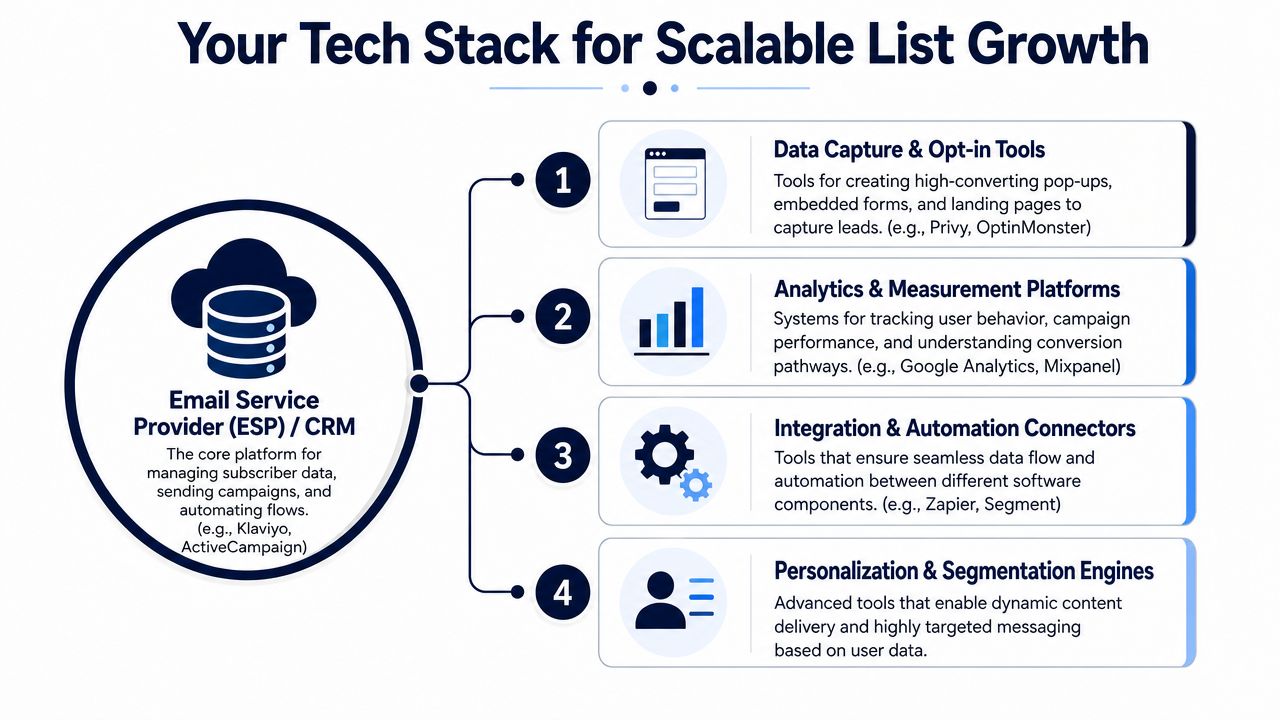
Your email service provider should sit at the middle of the system. For most e-commerce brands, that means using a platform built for commerce behavior, not a generic newsletter sender.
Klaviyo and Omnisend are common choices because they're designed around store events, customer data, segmentation, and automated flows. ActiveCampaign can also make sense for some brands with more complex automation needs. The exact choice matters less than the architecture.
The ESP should know:
If your current setup can't do that cleanly, the stack is limiting growth.
For a broader comparison of platform options, this guide to the best email marketing software for e-commerce is a useful reference point.
Popup and form tools like Privy, OptinMonster, and Justuno can all play a role. Quiz tools such as Octane AI can be valuable when product discovery is part of the buying journey. Landing page tools matter when you need custom acquisition pages for campaigns, launches, or creators.
But every added tool creates one more integration point.
Use a capture tool if it does at least one of these things better than your ESP alone:
If it only adds visual polish without improving data flow or conversion quality, skip it.
A clean stack for most brands looks like this:
| Layer | Role | Example tools |
|---|---|---|
| Store platform | Transaction and customer behavior source | Shopify, BigCommerce |
| ESP / CRM | Core subscriber management and automation | Klaviyo, Omnisend, ActiveCampaign |
| Capture layer | Popups, forms, landing pages, quizzes | Justuno, Privy, OptinMonster, Octane AI |
| Analytics layer | Journey and performance analysis | Google Analytics, Mixpanel |
| Connector layer | Data syncing between systems | Native integrations, Zapier, Segment |
A stack is scalable when your team can answer one question without a spreadsheet fire drill: where did this subscriber come from, what did they want, and what have they done since?
That's what you're buying with better tooling. Not complexity. Clarity.
Most brands celebrate too early after the opt-in.
They capture the email, fire off a generic “thanks for subscribing” message, and then dump the subscriber into the main campaign calendar. That wastes the highest-attention window you're going to get.
A new subscriber just told you, in real time, that they're interested. The next several days are where you either build buying momentum or let that intent cool off.
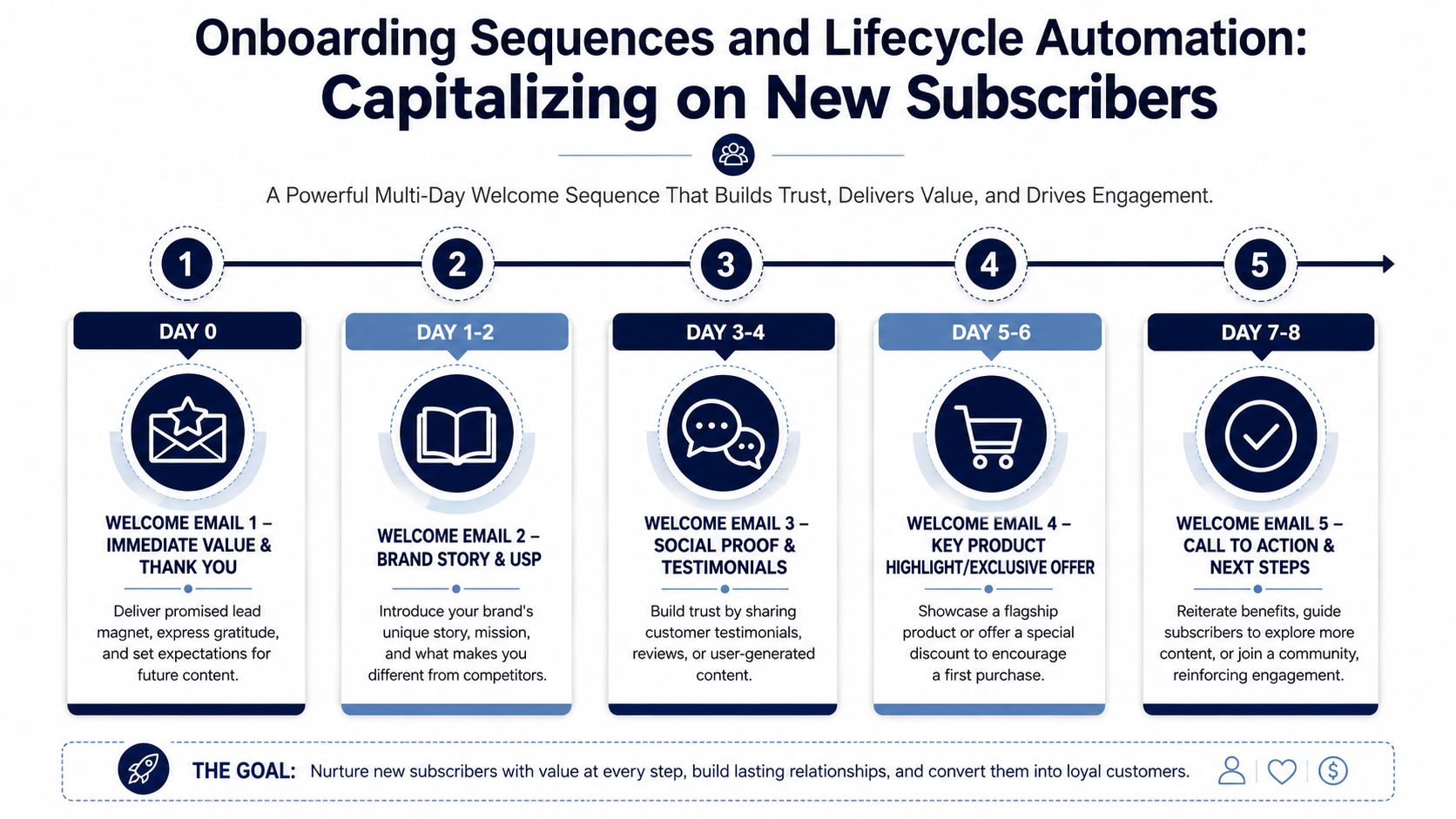
Think about the subscriber journey.
A visitor joins through a quiz, early-access page, educational guide, or product-focused form. They are not looking for a random broadcast. They want the next step to feel consistent with why they signed up.
A strong onboarding flow usually handles five jobs in order:
Deliver the promised value immediately
If they signed up for a quiz result, guide, or access list, give it to them fast.
Explain the brand clearly
What do you sell, who is it for, and why should they care?
Reduce buying anxiety
Help them choose, understand fit, or see how the product solves the problem.
Introduce the product set with context
Don't just push bestsellers. Show relevance.
Create a natural next action
Shop now, complete a profile, browse a curated collection, or join the VIP flow.
Here's the sequence I prefer for most DTC brands.
Email one lands immediately. It thanks them, delivers what was promised, and confirms what kind of emails they'll receive. This keeps trust intact.
Email two introduces the brand through the lens that matters most to the buyer. For a skincare line, that may be problem-solution education. For a premium apparel brand, it may be construction, fit, and philosophy. For a consumable product, it may be routine and outcomes.
Email three helps the subscriber self-select. Show product pathways by use case, product family, concern, or customer type.
Email four addresses hesitation. This can be FAQs, how to choose, common objections, or product education that moves someone closer to first purchase.
Email five asks for a decision. That might be shopping a curated collection, joining a launch list, or taking a next step deeper into your ecosystem.
Don't write welcome emails like a marketer introducing a brand. Write them like a store associate helping a serious customer make the right decision.
Lifecycle automation gets good when the list stops behaving like one list.
You don't need an overly complicated segmentation model to start. You need a useful one. A few simple buckets often do most of the work:
Engaged non-purchasers
People opening and clicking but not buying yet. They need confidence, relevance, and timing.
First-time customers
They should leave prospect messaging fast and enter education, usage, and second-purchase logic.
VIP customers
These are the people who deserve early access, higher-touch communication, and launch priority.
Category-interest segments
Based on quiz responses, viewed collections, purchased product families, or signup source.
The source of acquisition matters here. A person who joined for early access should not be nurtured the same way as someone who subscribed through a care guide or product recommendation quiz.
The best lifecycle systems feel timely because they respond to behavior. Viewed a category twice but didn't buy. Clicked a product education email. Purchased once but never reordered. Joined a launch waitlist and opened every message.
Those behaviors should decide the next communication.
When founders ask how to build email lists that generate real LTV, this is the missing piece. The list becomes profitable after the capture, when onboarding, segmentation, and behavior-based automation turn interest into repeatable revenue.
You can spend six figures a month driving email capture and still lose margin if the wrong subscribers fill the file.
That usually shows up in two places. Spam complaints rise, inbox placement slips, and your ESP bill climbs. At that point, list growth stops being an asset and starts acting like overhead.
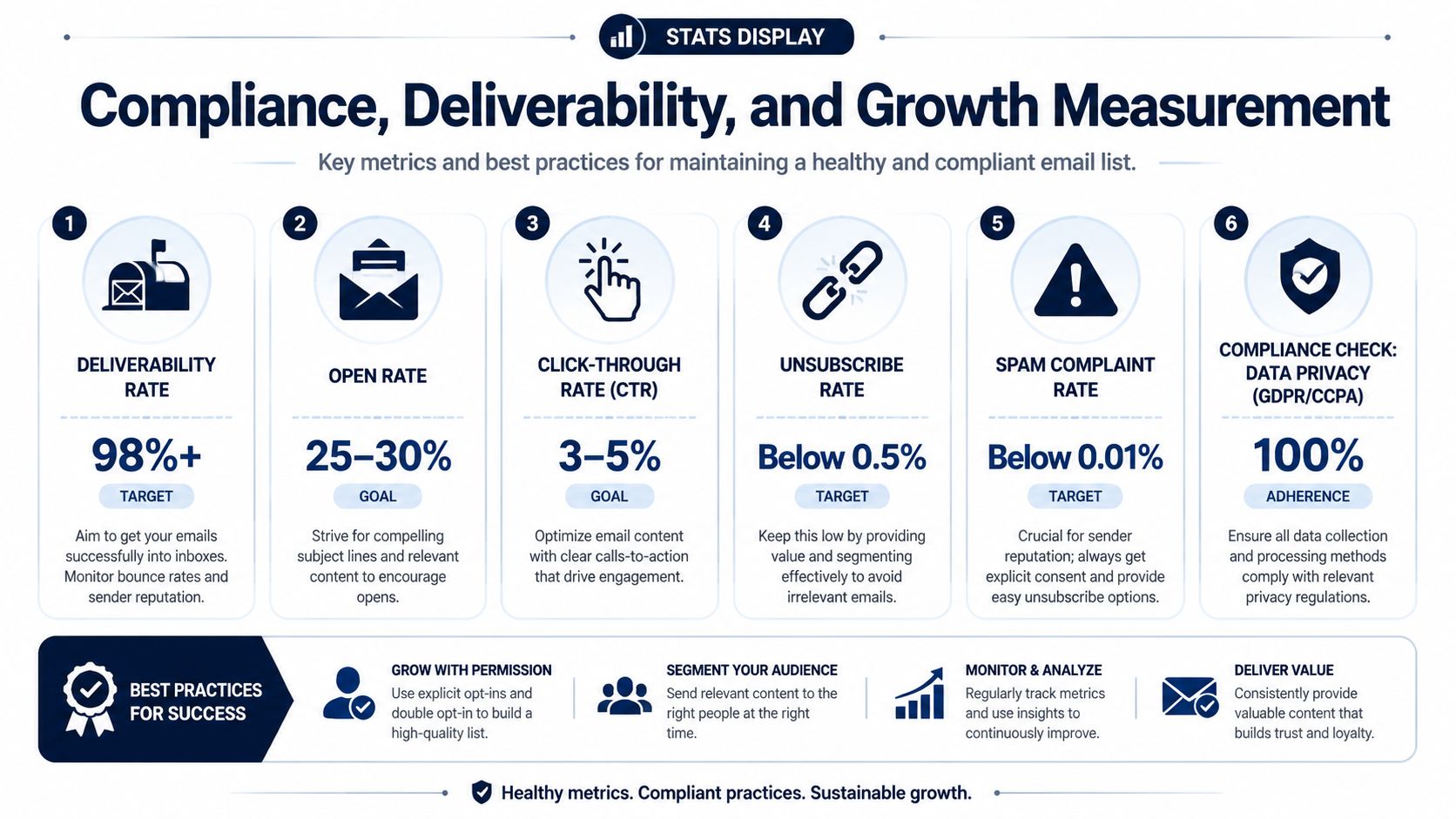
Compliance starts at the moment of capture. People should know what they are signing up for, what they will receive, and how often you plan to email them. Consent should be clear, recorded, and easy to revoke.
In practice, that means:
Clear consent protects more than legal exposure. It protects list quality. People who knowingly opt in are more likely to engage, buy again, and stay subscribed long enough to justify the acquisition cost.
Deliverability problems usually start before founders notice them. A few weak campaigns, too many stale addresses, a spike in complaints, or a signup source that pulls in low-intent subscribers can drag down sender reputation. Then your best customers stop seeing the emails you are paying to send.
Webfor recommends regular list cleaning, double opt-in to reduce bots, and making unsubscribing easy in its email list hygiene guide from Webfor. The practical takeaway is simple. Keeping disengaged or invalid contacts on the file creates direct software cost and hurts inbox placement.
If you want an external diagnostic, review this guide on how to check if emails are going to spam. It helps when campaigns look normal inside the ESP but performance softens anyway.
A bad subscriber costs you twice. First in platform fees. Then in weaker inbox placement for the subscribers who matter.
Subscriber count is not the scorecard. Profit quality is.
Track the metrics that tell you whether acquisition is producing future revenue, not just more names in the database:
| Metric | Why it matters |
|---|---|
| Subscriber source | Shows which channels bring in buyers versus low-intent freebie seekers |
| First-purchase rate by source | Reveals whether the signup path creates real buying intent |
| Revenue per subscriber | Lets you compare acquisition quality across offers and channels |
| Repeat purchase behavior | Shows whether new subscribers turn into durable customers |
| Inactive share of list | Signals when file growth is outpacing list health |
Engagement metrics still matter, but only in context. A source that drives lower open rates and stronger repeat purchase can outperform a source that looks better in the ESP and produces weak customers.
The best operators protect deliverability the same way they protect contribution margin. They cut low-quality acquisition paths, keep the file permission-based, and judge list growth by downstream LTV.
If you're building at scale and want to compare notes with founders who've already solved these problems across Amazon, DTC, and omnichannel, Million Dollar Sellers is where high-level operators share what's working behind the scenes.
Join the Ecom Entrepreneur Community for Vetted 7-9 Figure Ecommerce Founders
Learn MoreYou may also like:
Learn more about our special events!
Check Events



.webp)