Chilat Doina
October 19, 2026
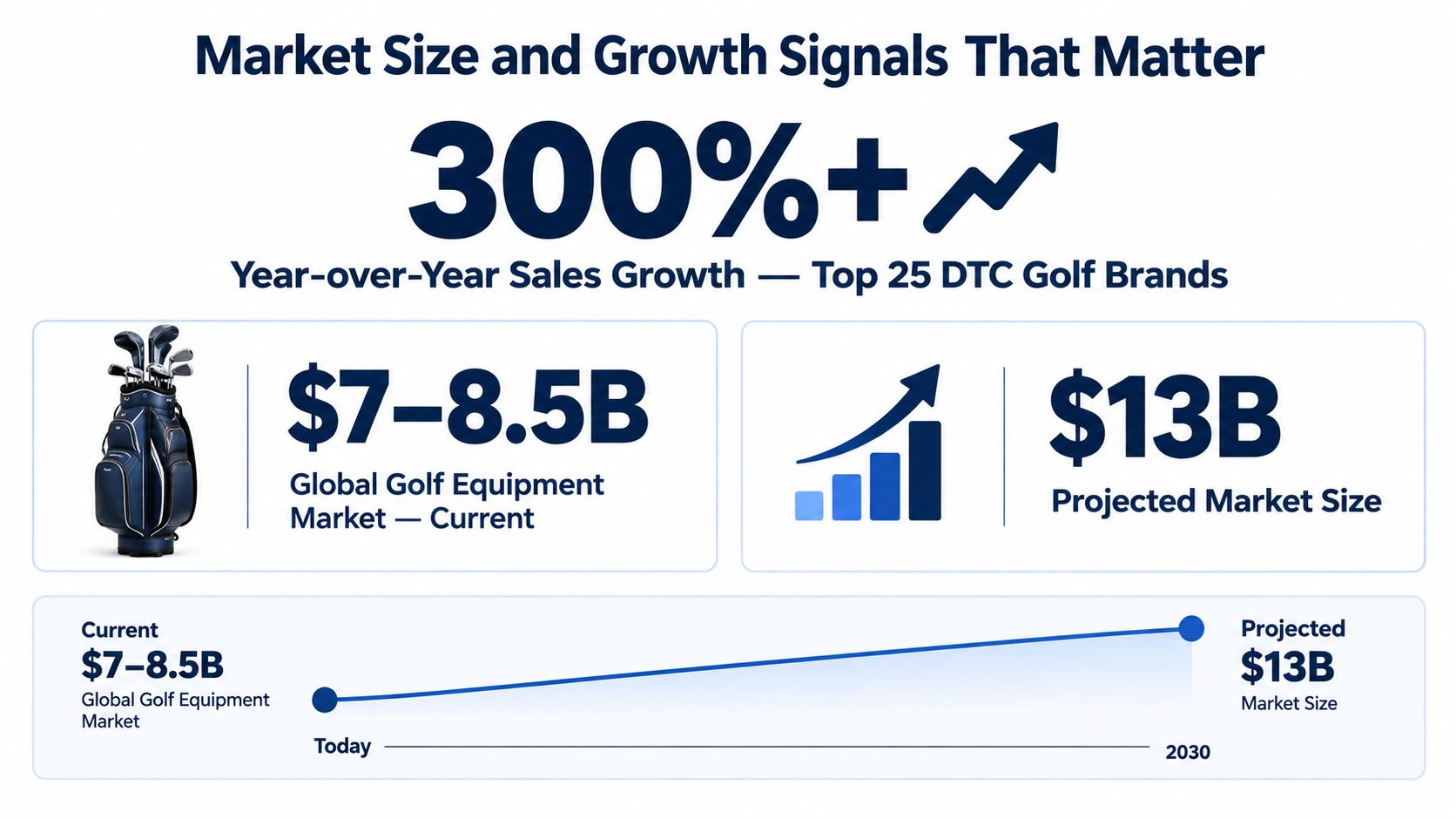
Sales volume for the 25 leading DTC golf brands tracked by Particl rose more than 300% in the twelve months ending March 2024, while the wider golf market grew roughly 5% to 10% per year (Particl's DTC golf report). A gap that large means digital-first sellers are taking share, which raises a sharper question for founders: which products can sell profitably online without the fitting, trial, and specialist advice a pro shop provides?
DTC golf is an operations and channel-design problem. The brands that hold their growth will match each product to the right buying path, expose the cost of wrong-fit returns, substantiate performance claims, and measure retention by what a customer buys first.
The signal in the introduction is a share shift, not a blank check. As the Particl data cited above showed, tracked DTC sellers grew far faster than the wider market. For a founder, the useful inference is narrower: early demand is real, but fast share gain usually makes the next customer more expensive once paid channels, creators, and retail partners all chase the same golfer.
Golf also contains uneven conversion economics inside one category. A ball reorder can be close to a low-friction replenishment decision; irons can carry fitting risk, advice needs, and return exposure that arrive after checkout. A site-wide conversion rate can make those products look comparable when the margin path is not.
The entry question should therefore be product-class specific: which SKU acquires without a fitter, proves quality quickly, and creates a reason for a second order that does not require another expensive recommendation.
The strongest DTC positions replace parts of specialty retail with better product data, sizing guidance, comparison tools, post-purchase education, and first-party retention. The weakest positions imitate the storefront while pushing fit mistakes back into the brand's cost base. Service should be priced into the model before scale, not discovered after returns arrive.
Founders tracking golf beyond ecommerce mechanics can use GolfRep's 2026 growth insights for added context on brand and retail dynamics. Judge entry by where direct selling lowers doubt rather than by where it removes an intermediary.
A DTC golf brand resembles a chef-driven restaurant that ships nationwide. The business controls the product, merchandising, price, and customer relationship, rather than relying on a chain of intermediaries to decide what reaches the buyer. It can tell its own product story and learn directly from customer behavior.
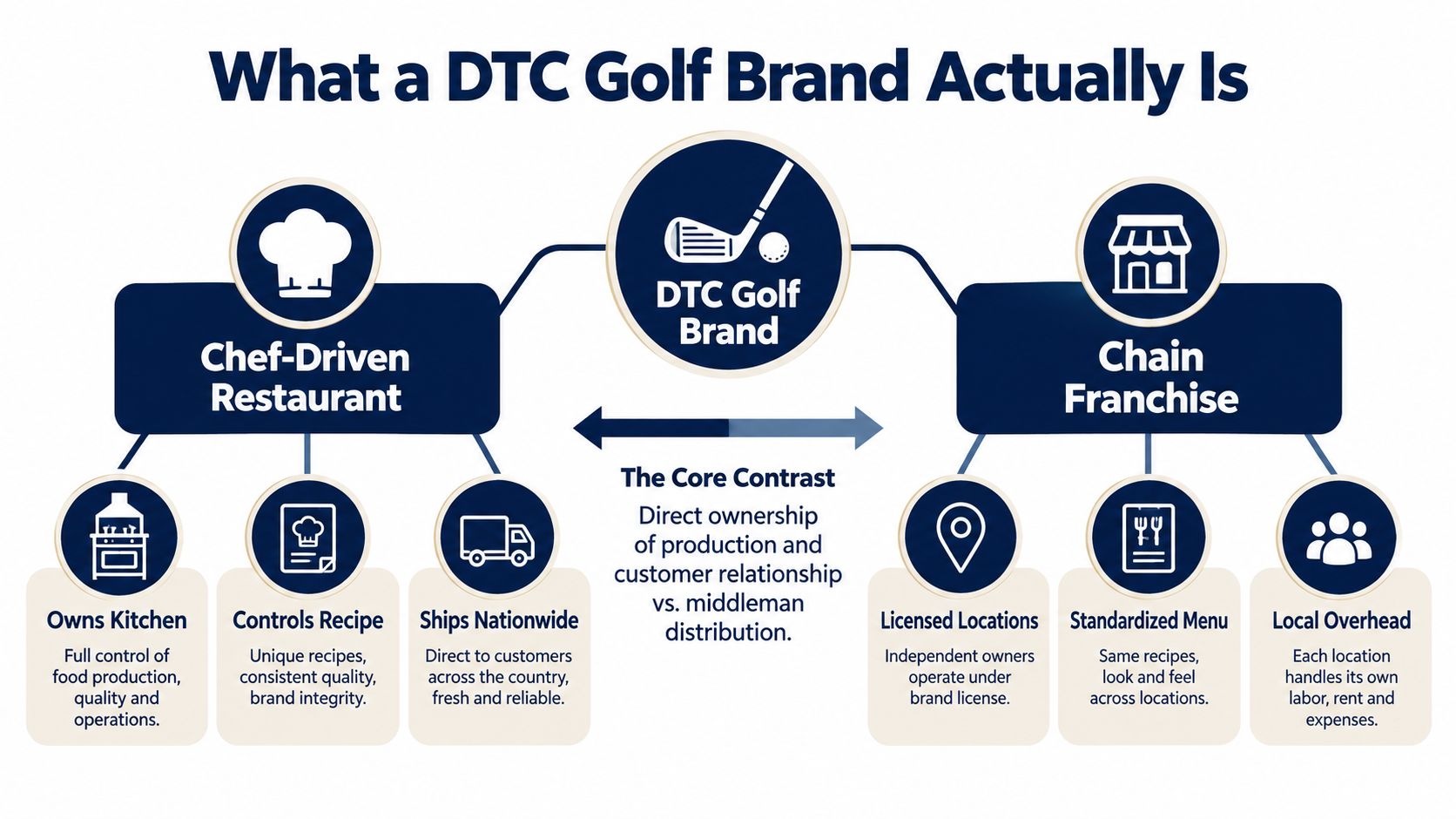
The comparison isn't a claim that DTC brands manufacture every item themselves. It describes control of the route to market. A brand might use outside manufacturers and still sell directly through its own online store, manage its own product presentation, collect first-party customer data, and own the post-purchase experience.
A conventional golf-equipment journey can involve an OEM, a distributor, a pro shop or specialty retailer, and sometimes a sporting-goods store before the product reaches the golfer. Each channel participant can contribute something: retailer reach, in-person trial, fitting knowledge, or a trusted point of sale. But the brand may have less direct access to the customer and less control over how a product is merchandised.
A DTC model removes some of those layers, not all the work those layers perform. The brand takes greater responsibility for discovery, education, delivery, service, and returns. It also gets a chance to test product positioning and learn from customer responses without relying entirely on wholesale cycles.
That's the strategic trade. Direct distribution can give a brand tighter control over pricing, storytelling, customer data, and merchandising. In return, it must build or arrange the capabilities that a specialist retailer may already provide, especially when a purchase depends on fitting or hands-on advice.
For ecommerce operators in other categories, the analogy is familiar. A DTC golf brand owns the customer-facing experience much like a digitally native apparel or beauty business. The difference is that an equipment recommendation can depend on a golfer's swing and setup, so the cost of a poor match may include more than a refund. That reality shapes the channel, service model, and economics that follow.
Global golf equipment is a multi-billion-dollar category, and the estimates point upward even where they disagree. One forecast valued the market at $8.5 billion in 2025 and projected $13.1 billion by 2033, a 5.6% compound annual growth rate from 2026 through 2033 (Grand View Research's golf-equipment market analysis). Other estimates land lower because reports define golf equipment differently, so treat any single figure as a range marker rather than a precise measurement. As noted earlier, tracked DTC brands grew sales volume far faster than the category, a pattern consistent with share capture.
Headline market size answers one question: is there enough demand to support a business. It says nothing about whether a given product can acquire customers profitably, absorb return costs, or earn a second purchase. A large, expanding market sets the ceiling. Unit economics set the floor.
The online-channel data is the more useful signal for a DTC operator. The same Grand View Research forecast identifies online stores as a fast-growing channel, with a projected 31.8% share and approximately $6.1 billion in value in 2025, plus channel growth of 6.8% compound annually. An online channel growing faster than the overall market confirms that digital demand is real. It also means more competitors will chase that demand the same way, and rising channel share tends to push paid-media costs up as incumbents and new entrants bid on the same golfers.
For founders sizing an entry, the discipline is separating market expansion from addressable demand. A structured DTC market research process can test customer need, competitive position, and product-specific buying friction before a team commits to a broad assortment. The sharper questions are narrower: which entry product converts cold traffic, what share of buyers return within a season, and how much gross margin survives returns. Market reports cannot answer those questions. Cohort data can.
The market's scale creates room to compete. Capturing that room depends on whether a brand's product and service economics hold up at the acquisition costs the channel charges.
Channel design in golf is a cost-allocation problem that dresses up as a marketing one. Dataintelo's golf-equipment market coverage puts specialty retailers at roughly 38% of global golf-equipment sales, with online channels holding around 22%. Golf DataTech's research on serious golfers' shopping habits similarly describes specialty retail as a significant purchase channel and online as the fastest-growing one, consistent with the online-share forecast covered earlier.
The estimates come from different studies and resist a tidy single ledger. Read together, they carry a sharper implication: the largest channel is the one an ecommerce brand cannot fully copy, and the channel it controls outright captures a minority of equipment spend. Specialty retail's share is, in effect, the market price of expert advice. Fitting labor, demo inventory, floor space, trained staff.
A pure online brand escapes that cost structure. It also inherits the uncertainty the structure was paying for.
| Channel | Approx. share | Strategic implication for DTC |
|---|---|---|
| Specialty retailers | Roughly 38% | Fitting and trial live here; digitize the advice or partner where hands-on help matters. |
| Online channels | Around 22% | Discovery and replenishment live here; a smaller share of spend raises the value of each retained customer. |
The controllable levers are concrete: how products are grouped, how pricing is presented, how much technical detail a product page carries, what the returns policy covers, and how the brand applies customer data. A store that prices a driver like a replenishment item hides the questions that stall checkout. One that makes the fitting pathway visible tells shoppers what information to provide and what a recommendation can and cannot guarantee.
Balls and gloves run on known preference. Clear specs, easy reordering, and a short path back to purchase serve that buying situation. Drivers, irons, and putters are different purchases; the shopper may need guidance on fit, performance, and compatibility with their swing, and each wrong answer carries a return cost.
A single blended funnel obscures that difference. Tracking discovery, conversion, returns, and repurchase by product category shows which channel does the work for which product. Brands weighing direct sales against retail partners can use an omnichannel distribution strategy to assign each channel an explicit role rather than treating wholesale and ecommerce as competing ends of a binary choice.
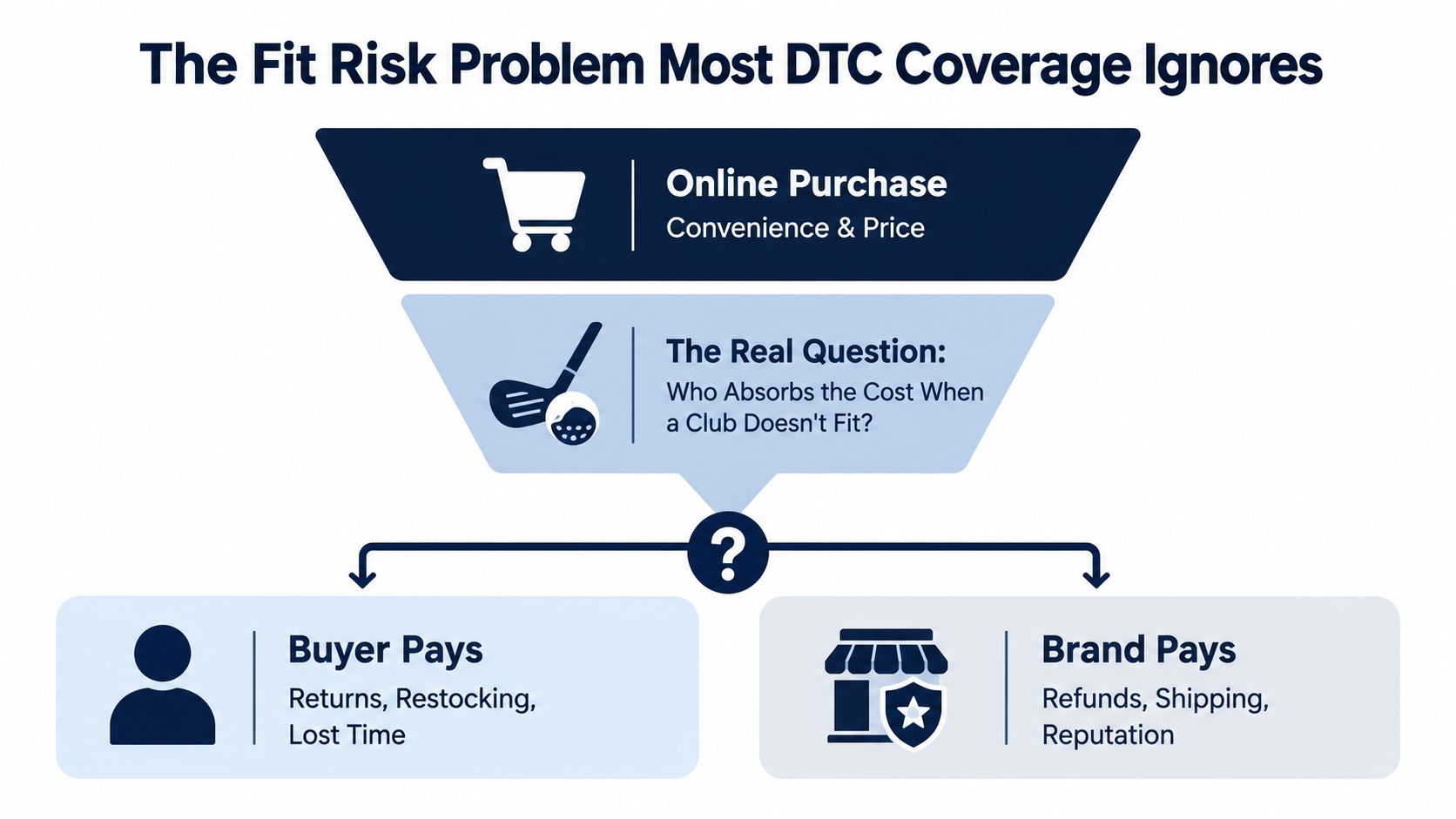
Golfers will buy clubs online. The open question is who pays when the recommendation is wrong. A virtual fitting may need to account for swing data, shaft choice, lie angle, grip size, and differences in launch-monitor assumptions. If the club doesn't work for the customer, the brand may also face return shipping, reconfiguration, refurbishment, service labor, and lost trust.
As the channel data showed, golfers still lean on specialist retail for exactly these purchases. That behavior signals what a fitting conversation delivers: confidence that an expensive, spec-dependent product will perform for a specific swing. Convenience alone does not supply that confidence, so a DTC brand has to rebuild the advisory function inside its own funnel rather than assume it away.
Take one driver returned for poor fit. The visible cost is the refund. Behind it sit return freight on an oversized parcel, the labor to inspect and diagnose the club, a second shaft or grip pulled from stock for reconfiguration, refurbishment before resale, and a discounted relisting price if the club can no longer pass as new.
Each step consumes labor and materials, and none of it appears in the checkout math. A driver sold at a healthy gross margin can close the loop at breakeven or worse once the full cycle is priced. Multiply that pattern across a club catalog and the returns line starts to resemble a second cost of goods sold.
For clubs, a structured intake can collect relevant details such as handicap, swing speed, launch profile, shaft preference, and existing equipment. Brands can also offer certified remote fitting, explain which inputs affect a recommendation, and display a fit-confidence score that signals when the available information is incomplete. Refundable fitting deposits are another option when the service requires substantial human involvement, provided the terms are clear.
Consumables have a different risk profile. Balls and gloves don't usually require a complex club fitting, so subscription or replenishment mechanics may be more relevant than an elaborate configuration flow. Treating both product classes as equivalent in a blended margin model can obscure where the business loses money.
Measure the cost of a poor fit, not just the cost of acquisition. Include returns, shipping, refurbishment, service time, and the effect on future purchasing when evaluating club economics.
For a customer-facing perspective on the decision itself, is golf club fitting worth it provides a useful reference point for explaining why a fitting process matters. Operators should go further by calculating contribution margin after fit-related returns and exchanges, then comparing that result with the economics of lower-fit-risk categories.
The question to answer before scaling club SKUs is straightforward: What's the end-to-end cost of a bad online fitting? If the answer includes only the refund, the model is missing the operational burden.
A product claim is useful only if the customer can understand what was measured and under which conditions. For golf balls and clubs, relevant measures include ball speed, launch angle, spin rate, carry distance, and dispersion. Each helps describe a different part of performance: launch conditions influence carry, spin affects trajectory and stopping behavior, and dispersion helps a golfer assess consistency.
The USGA Research and Test Center evaluates nearly 900 golf-ball models and more than 2,000 other equipment items, while club heads, shafts, and grips must meet defined conformance specifications (USGA Research and Test Center primer). Conformance and performance are distinct. Meeting equipment specifications doesn't, by itself, substantiate a brand's comparative claim about distance or feel.
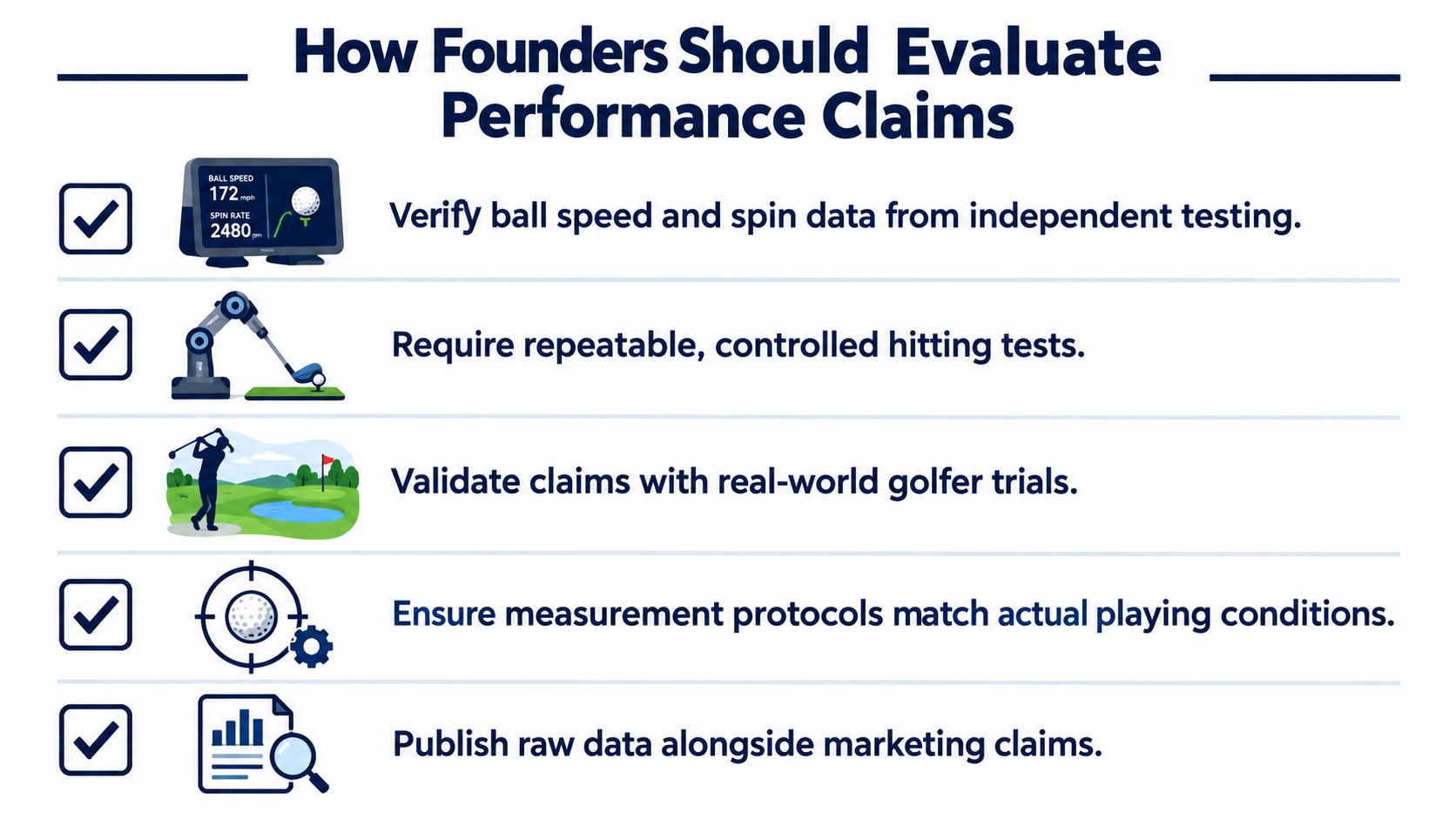
A credible performance page should explain how the test was conducted. At a minimum, the team should specify swing speed, test-ball model, club loft, shaft, simulator or outdoor conditions, sample size, and whether the reported result is an average or a median. If a number changes when the setup changes, buyers need enough context to judge whether the test resembles their own situation.
A headline distance claim without conditions isn't a complete product explanation.
Founders can hand product and ecommerce teams a straightforward checklist:
Brands can also use educational comparisons and buyer guides to help shoppers assess product options. For example, Tattoo Golf's brand recommendations illustrate the kind of category-focused content that can support product discovery. Whatever the format, the claims on a DTC product page should be specific enough to help the right customer decide and cautious enough not to promise a result the test can't establish.
A wider range of golfers and the crossover between golf and lifestyle apparel can create new ways to introduce people to a brand. But demographic messaging isn't a retention strategy. A campaign can bring a new customer to the site without proving that the assortment, sizing, product experience, or follow-up offer will earn a second purchase.
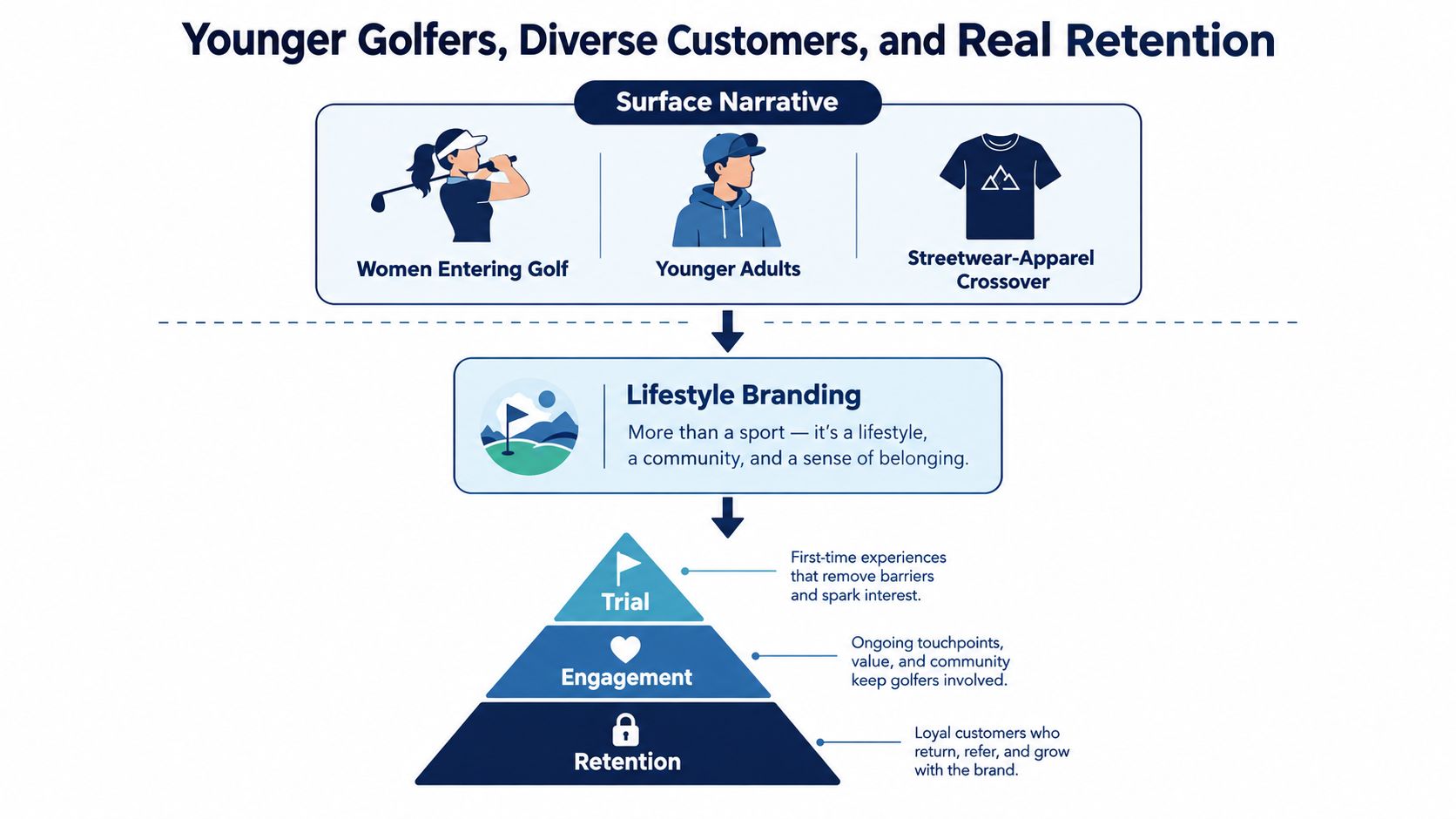
The more useful question is what the customer buys first, and what gives them a reason to return. Industry commentary notes that brand loyalty appears to be weakening in clubs and footwear while strengthening in golf balls, suggesting that repeat purchasing may be more closely tied to consistency and consumability in some categories than to broad lifestyle branding (Clear's discussion of golf brands and ecommerce). That's a signal to analyze retention by product, not to assume that every customer will adopt a full brand wardrobe or equipment set.
Separate cohorts by entry product, playing frequency, and skill level, then examine whether customers move to another category or repeat the initial purchase. That can reveal whether apparel introduces customers who later buy equipment, or whether balls and accessories deliver a more direct path to repeat behavior. The point isn't to assume which journey will win, but to measure it.
For apparel, pay attention to size-related returns and how colors and styles sell through. For consumables, examine repeat purchasing and subscription cancellations. For higher-consideration equipment, look at exchanges, service contacts, and later purchases. Then compare the contribution of each cohort rather than relying on headline revenue.
A customer acquired through a low-risk product can be more valuable than a customer who buys a larger first order but never returns.
This perspective changes assortment planning. A brand doesn't need to lead with an all-encompassing wardrobe or premium club set to appeal to a new golfer. A customer might start with balls, gloves, accessories, or versatile apparel, then consider a higher-commitment purchase after building confidence in the brand.
Teams refining their measurement can use customer retention strategies as a starting point, then adapt the metrics to golf's product-specific journeys. The key is to keep customer identity and entry product visible in the analysis. Without that detail, a retention report may blend customers with very different needs and buying cycles.
A founder doesn't need to launch across every category at once. The priority is to choose an entry product and design the operating model around its buying risks.
A single conversion metric can mask different purchase journeys. Headline-only distance claims can attract the wrong buyer or invite a credibility problem. One demographic-led campaign can create attention without showing whether the assortment earns repeat purchases.
The operator's fix is to separate the data: conversion and returns by product class, fit-related service costs for clubs, and repeat behavior by entry product. Make those decisions before expanding the assortment, not after returns and service work reveal that the economics were different from the forecast.
For founders weighing these tradeoffs with peers, Million Dollar Sellers is an invite-only ecommerce community where members share strategy through discussions, events, and founder sessions across DTC, Amazon, and omnichannel businesses. Compare your proposed category, fitting flow, and retention measures against the operating questions other ecommerce owners are solving, then use that input to sharpen your next test.
If you're building or evaluating a DTC golf business, bring your channel, fitting, and retention questions to Million Dollar Sellers. Its invite-only community gives ecommerce founders access to peer discussions, strategy sharing, and founder-led sessions that can help turn category research into clearer operating decisions.
Join the Ecom Entrepreneur Community for Vetted 7-9 Figure Ecommerce Founders
Learn MoreYou may also like:
Learn more about our special events!
Check Events