Chilat Doina
October 3, 2026
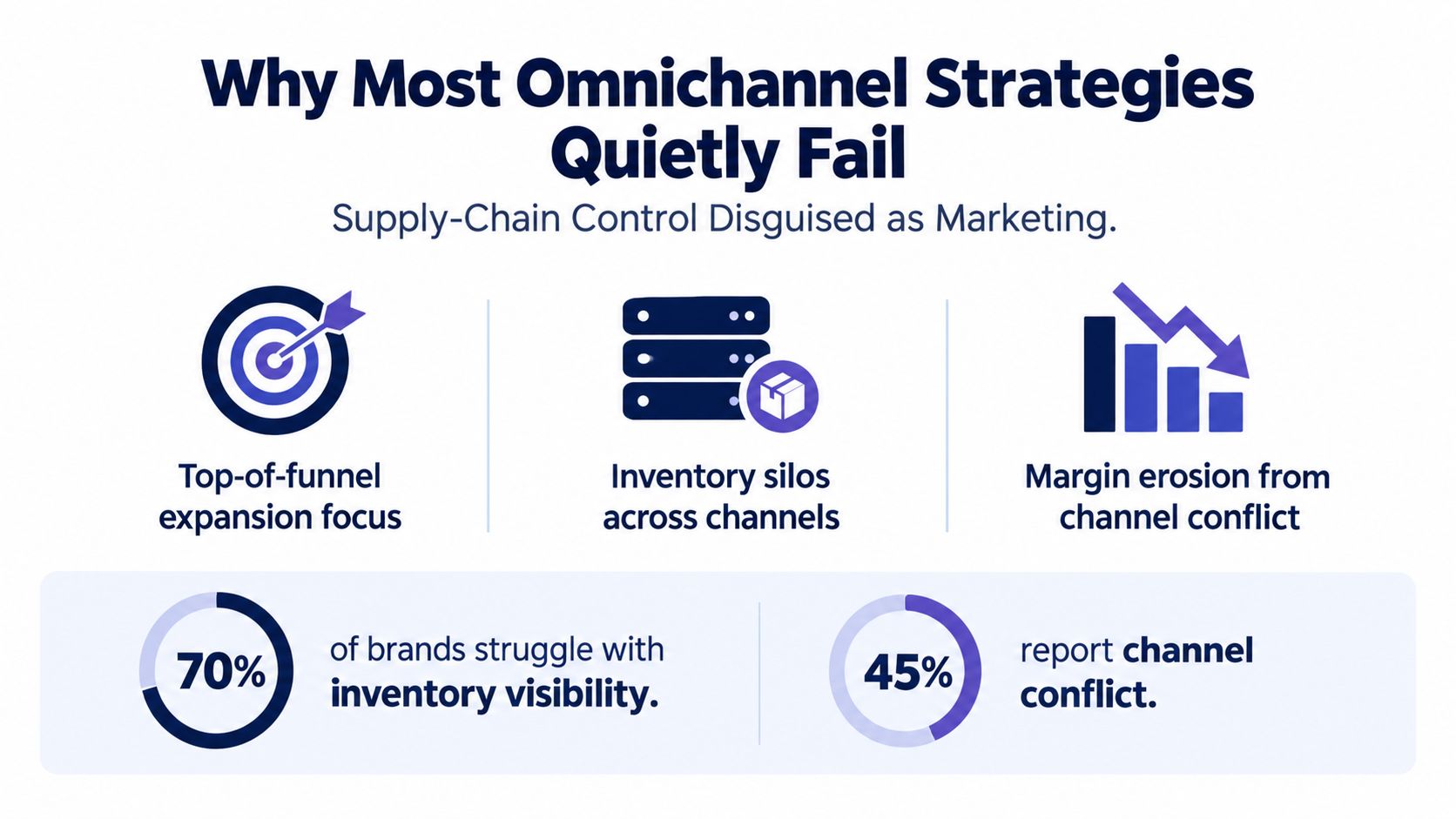
Most advice about omnichannel starts in the wrong place. It tells you to add marketplaces, launch a DTC site, secure retail distribution, and make the customer journey feel unified. That sounds commercially sensible, but it skips the constraint that decides whether the strategy makes money: inventory, order routing, and cost-to-serve.
An omnichannel distribution strategy is a supply-chain control problem disguised as a marketing strategy. McKinsey found that an online order can cost 4 to 5 times more per unit than a brick-and-mortar replenishment order, and 10 times more than a wholesaler distribution-center order. McKinsey's analysis of omnichannel network design makes the uncomfortable point clearly: adding channels can add revenue while undermining contribution margin.
Founders often treat channel expansion as a top-of-funnel exercise. They launch a DTC storefront, list on Amazon, pitch a retailer, and assume each channel will contribute incremental demand. The operating model underneath usually remains unchanged, with separate inventory pools, disconnected forecasts, inconsistent pricing, and fulfillment promises that no warehouse can reliably meet.
That approach creates multichannel presence, not omnichannel execution. Customers may see the same product in several places, but the business still manages each channel as an isolated business. The result is duplicated stock, avoidable transfers, stockouts in one channel while units sit idle in another, and customer service teams trying to reconcile order data that should have been unified at the system level.
The margin problem is especially easy to miss. A DTC order may look attractive because the brand owns the customer relationship and avoids wholesale deductions. Once pick and pack labor, parcel shipping, returns, customer service, payment costs, promotional discounts, and acquisition spend are allocated correctly, that order can be less profitable than a wholesale shipment. Revenue by channel won't expose that difference. A channel-level contribution model will.
Operating rule: Never approve a new channel because its top line looks attractive. Approve it only after you know which node will fulfill the order, which inventory will be reserved, and what the fully loaded contribution margin will be.
The failure modes are predictable:
MIT CTL reported that respondents implementing an omnichannel strategy rose from 50% to 60% year over year, while those declining to implement one fell from 33% to 22%. Retail led adoption at 84%, followed by wholesale at 78% and manufacturing at 74%. The same research identified online and offline integration as a top challenge for 51% of respondents and fulfillment decisions for 50%. MIT CTL's omnichannel strategy research supports the practical conclusion: omnichannel is now a structural operating model, not a campaign layer.
Customers rarely experience a brand through one channel at a time. Retail research places the path to purchase at an average of six touchpoints, with other datasets describing research and buying across five to seven channels. A shopper may discover a product on a marketplace, compare it on mobile, read reviews on a brand site, visit a store, and complete the purchase elsewhere, as summarized in the retail compilation on omnichannel buyer behavior.
That pattern changes how demand should be measured. A customer who researches on Amazon, checks your DTC site for education, and buys through a retail partner remains one customer. Treating those interactions as separate demand pools can produce duplicate acquisition costs, distorted forecasts, and stock in the wrong location.
The first question is therefore operational: where does the customer encounter the product, and where can the business fulfill the order profitably? Marketing creates the touchpoints, but supply chain decisions determine whether the customer finds accurate availability, consistent product information, and a workable delivery option at each one.
The commercial signal is also meaningful. The same retail compilation reports that omnichannel customers spend 30% more than single-channel shoppers, while other datasets cited there report 28% higher average transaction value and 3.4 times higher lifetime value over 36 months. It also reports retention of 89% for omnichannel companies versus 33% for companies that do not implement the model, alongside omnichannel consumers shopping 70% more frequently than single-channel shoppers. These figures come from different datasets, so they should not be combined into a single forecast. They support a narrower conclusion: cross-channel customers can be more valuable when inventory, pricing, service, and customer records remain consistent.
The economics make that discipline harder to ignore. McKinsey's 4 to 5 times cost spread across fulfillment choices means the same order can produce very different contribution margins depending on its location, handling method, delivery promise, and return path. A channel that appears attractive in revenue reports can quietly burn margin if it requires expensive split shipments, expedited delivery, or reserve stock that rarely sells.
Build the demand plan around three separate signals:
Those signals should inform assortment, safety stock, replenishment, and attribution. Amazon, DTC, and retail should not be modeled as completely independent pools when customers move between them. Shared data can capture the full relationship while reducing redundant stock and preventing one channel from claiming demand created by another.
Operating every channel is unnecessary. The channels worth keeping are the ones whose customer reach and conversion value justify their service, inventory, and fulfillment costs.
The right channel mix isn't a checklist. It's a decision matrix built around product economics, customer behavior, control requirements, and operational capacity.
Amazon can create demand quickly and provide marketplace reach, but it compresses brand expression and exposes products to direct price comparison. DTC gives you customer data, merchandising control, and a direct relationship, but you carry the acquisition and fulfillment burden. Wholesale provides efficient volume and retailer access, while retail adds physical presence and credibility at the cost of compliance, replenishment complexity, and reduced control over the final selling experience.
Use the following matrix as a pressure test, not as a promise of universal economics.
| Channel | Margin range | Control level | Capital required | Best for |
|---|---|---|---|---|
| Amazon | Variable, fee and fulfillment sensitive | Medium to low | Moderate, especially for marketplace inventory | Search-driven demand and standardized products |
| DTC | Potentially attractive before acquisition and returns | High | High, including technology, inventory, and marketing | Education-led products and owned customer relationships |
| Wholesale | Lower direct control, often efficient at volume | Low to medium | Moderate, with production and compliance needs | Predictable account volume and category distribution |
| Retail | Variable, with meaningful compliance and replenishment demands | Low at point of sale | High, particularly for packaging, inventory, and service requirements | Physical discovery, credibility, and scaled reach |
Start with the product, not the competitor. Products that need explanation, fitting, education, or a high-trust purchase path often benefit from DTC content and selective retail demonstration. Standardized replenishment products may perform better on Amazon and wholesale, where convenience and availability matter more than brand storytelling.
Then assess four constraints:
A brand entering Target needs a different design from an established operator expanding internationally. The first may need clean case packs, retailer-ready labeling, replenishment discipline, and a narrow assortment. The second may need regional inventory nodes, localized tax and compliance workflows, and a more nuanced currency and pricing policy. Copying a competitor's channel list ignores the capacity required to make those channels work.
For a practical operating overview, the distribution ERP buyer guide is useful when evaluating whether your systems can support purchasing, inventory, order management, and fulfillment across account types. A separate review of multi-platform selling can help frame the commercial decision, but the conclusion should come from your own contribution model.
The best channel mix is the one your team can replenish, price, measure, and service without creating a second company behind the scenes.
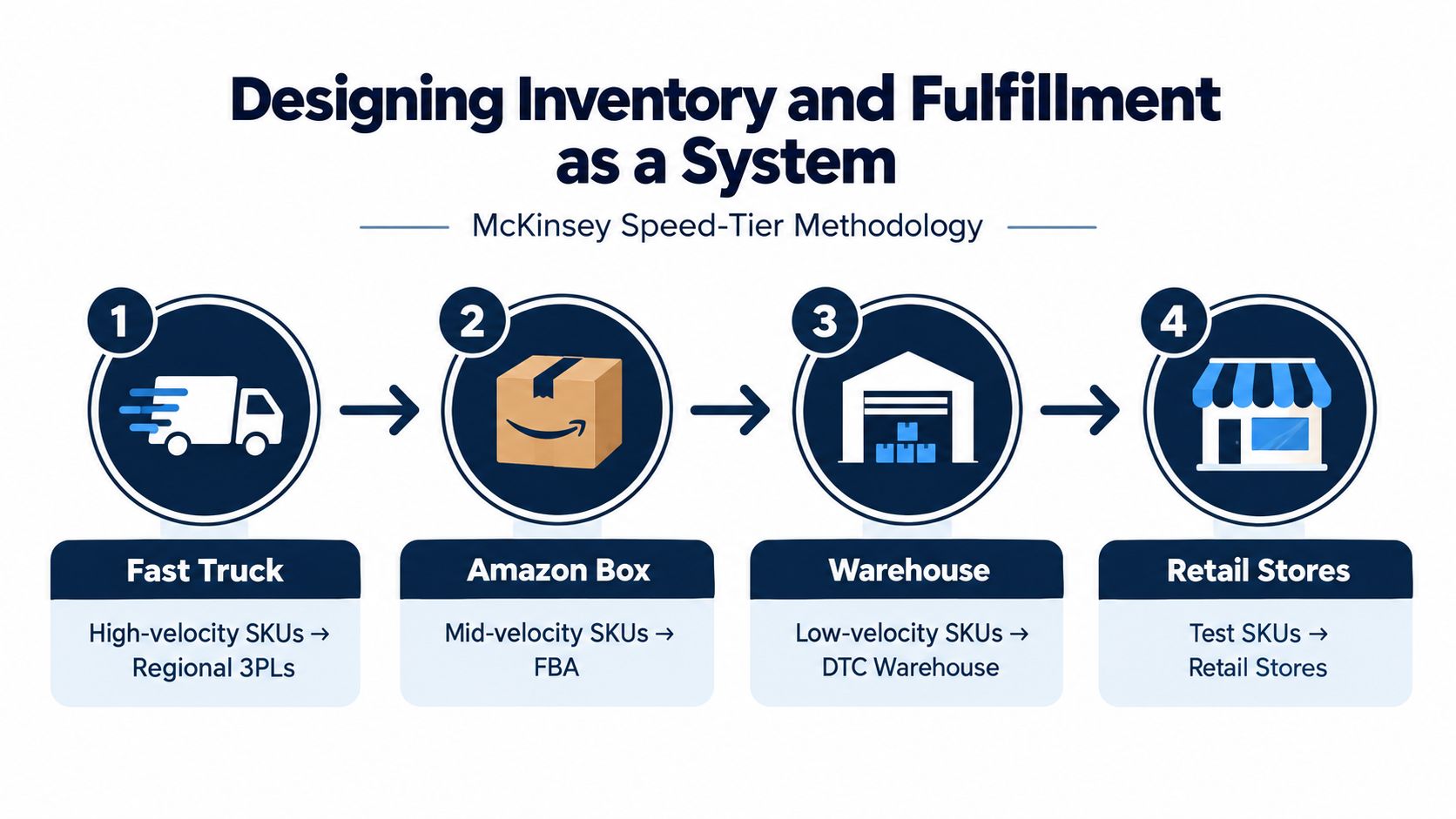
Inventory placement should follow customer promise and SKU behavior, not organizational habit. McKinsey's speed-tier approach starts by separating products according to velocity and service requirement, then assigning each group to nodes that can fulfill the promise economically.
A practical sequence looks like this:
High-velocity products generally belong closer to demand, provided the extra node improves service enough to justify the added working capital and handling complexity. Mid-velocity products may work in marketplace fulfillment or a regional partner. Long-tail products usually need centralized stock, where the business can avoid duplicating inventory across locations.
Don't turn on ship-from-store or buy online, pick up in store just because the feature exists. A store needs accurate inventory, trained labor, a defined picking area, reliable handoff procedures, and an assortment that can support the promised service. If staff can't find the item or the system shows stock that isn't physically available, the feature creates cancellations and customer disappointment instead of convenience.
The same caution applies to FBA. Sending too much stock into marketplace fulfillment can create stranded inventory, reduce flexibility for DTC promotions, and increase the cost of correcting a forecast mistake. A disciplined allocation model should reserve enough inventory for each channel's service obligations while maintaining a clear rule for rebalancing.
Before adding a second fulfillment node, verify three basics: the OMS can route orders using inventory and promise logic, every node uses the same SKU master, and the team reconciles physical and system inventory on a regular weekly rhythm. The supply chain execution guide is a useful reference for connecting transportation decisions to warehouse execution. Operators also benefit from documenting omnichannel inventory management as a formal process rather than leaving allocation logic in spreadsheets.
This video provides a visual introduction to fulfillment system design:
Channel conflict rarely begins with a dramatic pricing decision. It starts with small exceptions that nobody owns. A marketplace seller discounts a bundle, a retailer runs an uncoordinated promotion, DTC extends a campaign, and the customer sees three different versions of the same offer in one buying journey.
Each channel needs a written rule set covering price authority, promotions, assortment, content, and escalation.
| Channel | Pricing authority | MAP enforcement | Promo flexibility | Brand content control |
|---|---|---|---|---|
| Amazon | Marketplace mechanics and seller activity influence the visible price | Brand policy must be actively monitored | Medium, with marketplace constraints | Medium, subject to listing rules and marketplace competition |
| DTC | Brand controls the storefront price | Brand controls its own displayed price | High, but discount discipline is essential | High |
| Wholesale | Retail or account agreement shapes the final price | Brand sets policy where legally and commercially appropriate | Determined through account planning | Medium, with retailer requirements |
| Retail | Retailer controls point-of-sale execution | Brand monitors compliance through agreements and audits | Often account-specific | Low to medium at the shelf |
Amazon requires guardrails, not wishful thinking. Algorithmic pricing and authorized reseller activity can move a listing away from the intended price architecture. Subscribe and Save discounts can stack with other incentives in ways that alter contribution margin. Set minimum advertised price rules where appropriate, monitor offers by seller and SKU, and document which promotions are authorized.
DTC needs a promotion calendar that respects the wider network. A DTC-only discount can be useful when it is tied to a differentiated bundle, loyalty benefit, or customer segment. It becomes destructive when the same product is available at a lower visible price than a retail partner can offer. Use exclusive bundles, service benefits, and product education to create reasons to buy direct without turning every channel into a price match exercise.
Wholesale and retail need commercial discipline before the first purchase order. Off-invoice allowances, co-op spending, markdown support, and retailer promotions must be modeled as part of net revenue. If those allowances leak into unauthorized marketplace offers, the brand funds price erosion without receiving the intended distribution benefit.
A clean rule sheet should answer practical questions:
Content parity doesn't mean identical content everywhere. It means the customer should receive the same essential product facts, dimensions, usage instructions, claims, and visual identity. Amazon may need concise comparison content. DTC may support long-form education. Retail packaging may need fewer words and stronger shelf recognition. Adapt the format without changing the truth.
The technology stack should reinforce those rules. The ERP owns financial and supply data. The OMS manages order states and routing. The WMS executes warehouse work. The PIM governs product content. The e-commerce platform manages the owned storefront. Marketplace connectors translate orders and inventory. Retail EDI handles purchase orders, acknowledgments, shipment notices, and invoices. BI turns the resulting events into channel and contribution reporting. Middleware connects the systems and manages transformations.
The stack usually breaks at the seams:
Build versus buy should be decided by the uniqueness of your routing logic and the maturity of your team. Buy standard OMS and middleware capabilities when your requirements are conventional and reliability matters more than customization. Build only where the process creates a genuine advantage, and isolate custom logic behind stable interfaces so one marketplace change doesn't destabilize the entire operation.
Treat data contracts as product. Define the required fields, ownership, update frequency, error behavior, retry rules, and fallback process for every integration. Test API rate limits before peak periods, make webhook processing idempotent, and decide what happens when a connector goes dark. Manual order intake may be acceptable as a temporary emergency process, but it shouldn't become the undocumented operating model.
Revenue by channel is a useful starting point and a poor stopping point. It tells you where orders happened, not whether those orders created economic value.
Build a cost-to-serve model at the SKU and channel level. Include pick labor, packaging, parcel or freight costs, storage, marketplace and payment fees, returns processing, customer service contacts, discounts, allowances, and acquisition costs. For wholesale and retail, include compliance work, routing requirements, chargeback exposure, and the labor required to maintain account data.
Then rank channels by contribution margin per order and contribution margin per inventory dollar. A channel with lower revenue may deserve more inventory if it turns stock efficiently and creates reliable contribution. A channel with impressive sales may need tighter assortment, higher prices, or a reduced service promise.
| Metric category | Vanity metric to ignore | Profit metric to track | Why it matters |
|---|---|---|---|
| Revenue | Gross sales by channel | Contribution margin by order and SKU | Shows what remains after variable costs |
| Advertising | Blended ROAS | CAC payback by acquisition source | Separates efficient acquisition from subsidized demand |
| Orders | Total order count | Contribution per order after fulfillment and returns | Reveals whether volume is economically useful |
| Inventory | Total units held | Inventory turn and aged stock by channel | Shows where working capital is trapped |
| Customer behavior | Blended repeat-purchase rate | Cross-channel repeat behavior | Identifies customers whose value spans several channels |
| Returns | Overall return rate | Return rate and recovery value by SKU | Exposes products that consume fulfillment capacity |
| Service | Average delivery performance | On-time performance by node and promise type | Connects the customer promise to operational execution |
Don't let last-click attribution decide channel investment. A marketplace may introduce the customer, DTC may educate them, and retail may close the sale. The reporting model should preserve those relationships where the data allows it, while still holding each channel accountable for its own cost-to-serve.
Use a weekly operating view for exceptions and a monthly or quarterly review for allocation decisions. The weekly view should flag stock imbalances, oversells, aged inventory, returns spikes, late shipments, and margin anomalies. The strategic review should decide which SKUs receive more inventory, which promotions stop, and which channel promises need to be narrowed.
A practical KPI framework should be documented in the same language used by finance, operations, and growth teams. The ecommerce KPI guide can support that process, but the important work is assigning an owner and a decision to every metric.
If a metric doesn't change an allocation, pricing, replenishment, or channel decision, it probably belongs on a dashboard, not in the operating meeting.
Channel expansion should be gated by operational stability, not revenue ambition. A retail purchase order can look like a breakthrough while exposing weak item setup, poor replenishment logic, inaccurate inventory, and noncompliant shipping processes.
A sensible sequence begins with the channel you already control most directly. Stabilize DTC fulfillment and unit economics first. Then validate Amazon with controlled inventory exposure and clean listing, pricing, and order-state data. Pilot wholesale with a limited account set before adding broad retail complexity. Extend into retail only when MAP enforcement, replenishment cadence, packaging, and compliance ownership are reliable.
Use gates that require evidence rather than optimism:
Each gate needs a kill criterion. Pause the launch if inventory accuracy deteriorates, aged stock rises, return handling becomes unmanageable, or contribution margin falls below the approved floor. Don't add a new channel to compensate for a broken forecast. Fix the forecast and allocation model first.
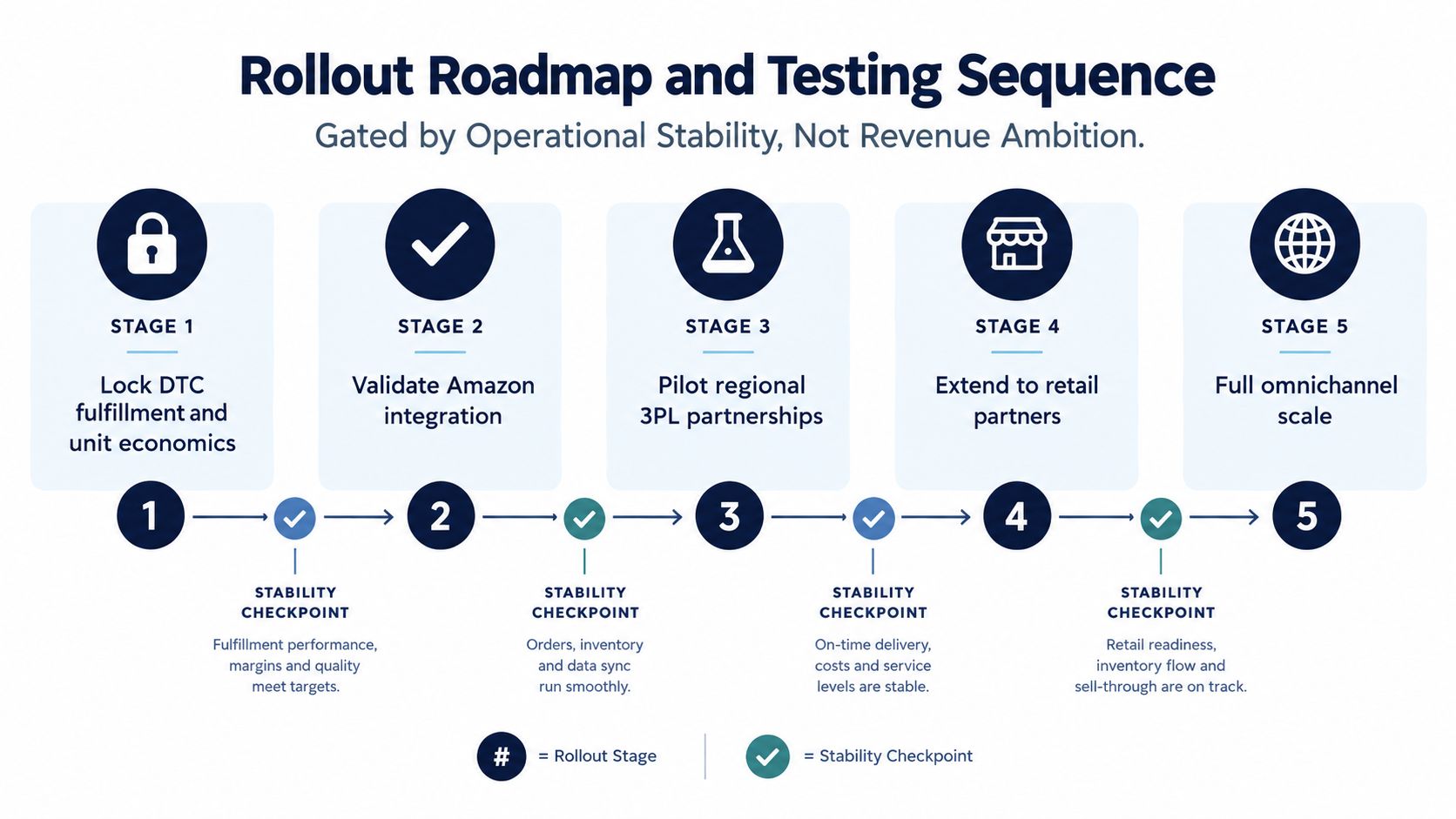
Run each pilot with a narrow assortment, explicit inventory limits, and a written review date. Instrument every handoff, including order acceptance, allocation, pick, ship, delivery, return, refund, and reconciliation. That record tells you whether a problem belongs to demand quality, inventory placement, system integration, warehouse execution, or commercial policy.
The common mistake is chasing a retail PO before Amazon inventory is clean, then spending months resolving stockouts, chargebacks, and customer complaints. Sequence matters because every new channel adds data states, service obligations, and failure modes. Scale the operating system first, then scale the channel footprint.
Million Dollar Sellers gives ecommerce founders and operators a private peer environment for sharing execution experience across Amazon, DTC, wholesale, retail, and omnichannel businesses. Visit Million Dollar Sellers to learn how the community can help you pressure-test channel economics, inventory decisions, and the operating cadence required to scale.
Join the Ecom Entrepreneur Community for Vetted 7-9 Figure Ecommerce Founders
Learn MoreYou may also like:
Learn more about our special events!
Check Events