
Chilat Doina
November 11, 2026
Your sales dashboard looks healthy, but your bank balance tells a different story. You know how to adjust bids, launch products and answer customers, yet you still can't explain which orders make money. Another course might add information. The right ecommerce business training should help you make a better operating decision, implement it and prove that it improved the business.
Say an Amazon founder has built a busy store and can manage advertising confidently. Then a supplier requests payment, inventory needs replenishing and marketplace settlements arrive below expectations. The founder knows revenue, but can't identify which products lose money after fulfillment, advertising and returns.
That's an operating-skills gap, not necessarily a marketing problem.
Ecommerce business training is structured learning in the skills required to run an online business: channel management, conversion, operations, finance, marketing and expansion. It comes through courses, workshops, masterminds and peer networks. The format matters less than whether the founder can apply the lesson to an actual business decision.

A driving theory test teaches road rules. It doesn't prove that someone can merge into traffic safely. Similarly, watching a lesson about inventory forecasting doesn't prove that a founder can place a purchase order without creating a cash shortage.
Good training combines explanation, practice, feedback and another attempt. A useful exercise ends with something the business can use, such as a reorder calculator or a product profitability report.
The broader digital-skills gap is substantial. Eurostat's digitalisation publication reports that 22% of EU businesses provided employee ICT-skills training in 2024, with 73% of large businesses doing so compared with 21% of SMEs. These are business-wide figures, not an ecommerce-course survey, but the capabilities overlap with store management, analytics, cybersecurity and automation.
Practical rule: Judge training by the decisions you can make afterward, not the vocabulary you can repeat.
For a resource-constrained founder, that means choosing instruction tied to an immediate operating need. The useful curriculum connects channel skills to financial milestones, then adds conversion testing, program accountability and profitable expansion.
Core curriculum tracks, skills and milestones
| Track | Core skills taught | Milestone that proves competence | First deliverable |
|---|---|---|---|
| Amazon | Listing optimization, PPC structure, inventory and account health | Stable Buy Box share and falling ad cost of sales | Restructured campaign set with a defined test plan |
| DTC | Storefront conversion, paid traffic, email and retention | Repeat purchase rate tracked by cohort | Cohort retention report and checkout test plan |
| Operations | Supplier terms, reorder points, fulfillment and returns handling | Forecast accuracy and stockout rate reviewed monthly | Reorder calculator and returns cost review |
| Finance | Contribution margin, cash flow, pricing and working capital | Product-level P&L supported by settlement and bank reconciliations | Contribution margin by SKU and rolling cash forecast |
| Marketing | Channel mix, creative testing, attribution and budgets | Each channel has a target cost per acquisition | Monthly test log with winners and losers |
| Scaling | Hiring operators, channel P&Ls, international and omnichannel expansion | Expansion decisions made on channel-level profit | Expansion model with downside scenarios |
The answer to “What should I learn first?” starts with the bottleneck costing money today. Don't choose the track with the most exciting tools or the instructor with the biggest sales screenshot.
A founder with profitable advertising but persistent cash shortages needs finance and operations before expansion. A DTC operator with reliable fulfillment but weak repeat purchasing needs cohort analysis and retention work, not another marketplace launch tutorial.
Amazon training should connect campaign structure to inventory availability and listing performance. Falling advertising costs aren't enough if the seller keeps running out of the products that generate demand.
DTC and marketing training overlap, but they answer different questions. DTC instruction examines the customer journey within your owned store. Marketing instruction helps allocate spending across acquisition channels, audiences and creative approaches.
Finance and operations provide the controls underneath both. Finance explains what an order contributes; operations explains whether the business can fulfill that order reliably at the expected cost.
Use business maturity rather than revenue alone to establish the learning order:
Revenue can help describe the business, but it doesn't certify operational readiness. A larger seller may still need foundational finance training if nobody can reconcile product profitability to the accounts.
Choose the track that changes your next important decision, not the one that promises the biggest future business.
Keep the initial assignment narrow: one track, one competence milestone and one usable deliverable. Broad enrollment makes it easy to consume lessons without finishing the work that prompted the purchase.
A learning roadmap should describe increasing responsibility, not just a longer list of lessons. Start by proving that you understand an order, progress to managing a channel and then demonstrate that you can coordinate people, capital and inventory across the business.
Use the stages below as competence gates, not automatic promotions based on revenue.
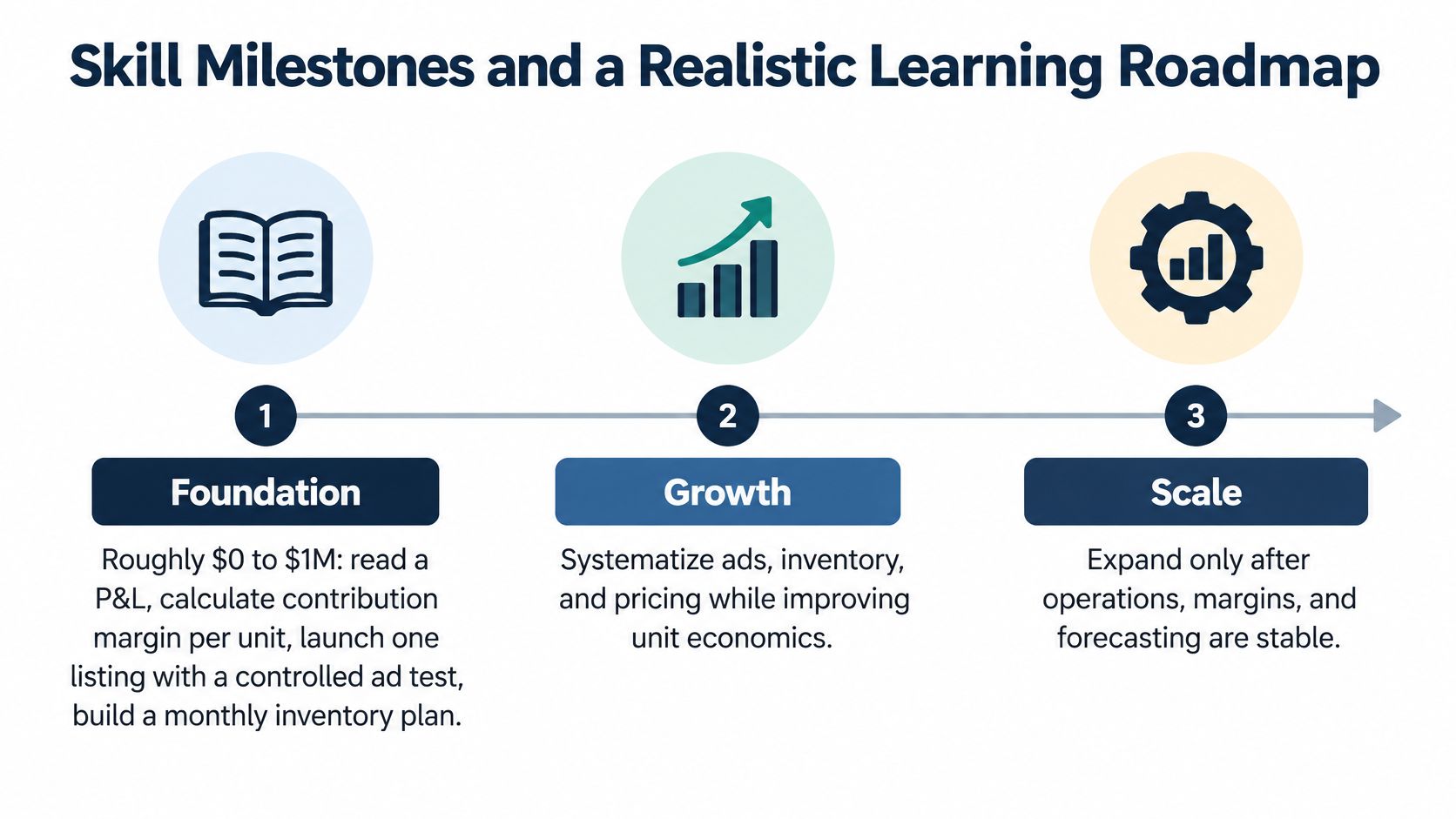
Begin with the finance track alongside your primary sales channel. Learn to read a P&L, calculate contribution margin per unit and distinguish product cost from the additional costs of selling and fulfilling an order.
Then launch or improve a listing using a controlled advertising plan. Build an inventory forecast that connects expected demand, supplier lead time and available cash.
The milestone: You can explain whether a product should be reordered and show the assumptions behind that decision.
The deliverable is a product economics worksheet linked to an inventory plan. It should include actual fees and return costs, not just supplier price and selling price.
At the operator stage, combine operations, finance and conversion skills. Produce a channel-level P&L, negotiate supplier terms using landed cost and maintain a record of experiments and operating changes.
A useful growth-stage assignment is to compare forecast demand with actual sales, explain the difference and revise the purchasing decision. The lesson isn't complete when the spreadsheet calculates correctly. It's complete when someone can use it.
The milestone: Another operator can follow your process and understand when to escalate a problem.
Advanced training should prepare you to manage working capital across inventory and advertising, compare channel economics and hire operating managers with clear targets. Practice explaining what a manager owns, which decisions require approval and how performance will be reviewed.
Allow enough time for assignments to pass through real purchasing, selling and reporting cycles. Don't accept a fixed completion promise as proof that these skills will develop on schedule.
Before moving forward, check your readiness:
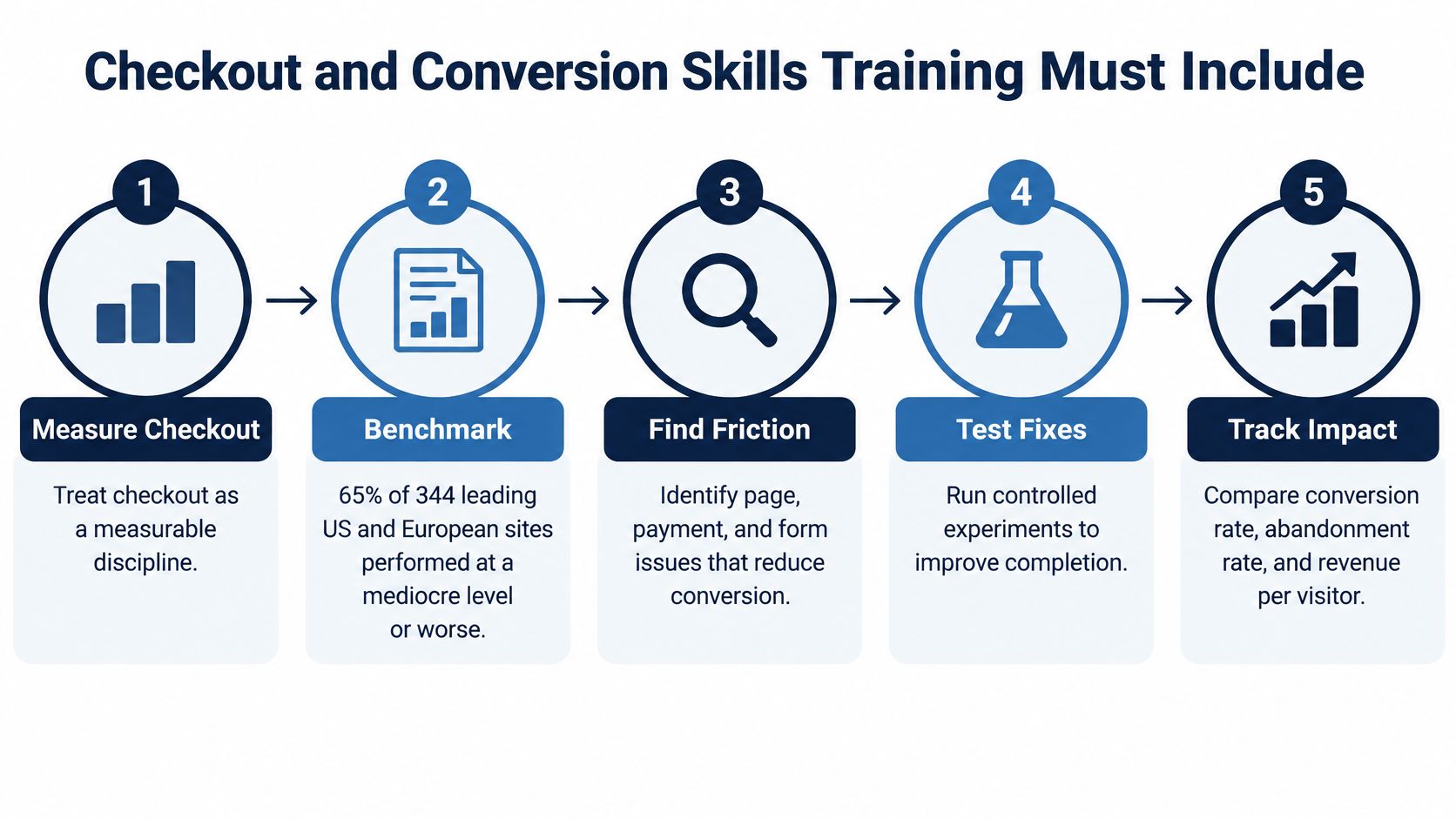
Checkout deserves its own practical curriculum. In Baymard's checkout usability benchmark, 65% of 344 leading US and European ecommerce sites performed at a mediocre level or worse; its testing also indicates that the average large ecommerce site has approximately 32 meaningful checkout improvements available.
Those findings don't establish what your store will gain. They establish why training should teach a disciplined audit rather than a cosmetic redesign.
For broader experimentation ideas, use the practical guidance on how to improve conversion rates. Keywordme's resource on how to turn paid traffic into loyal customers can also help connect acquisition work with the experience visitors encounter after clicking.
Track conversion rate, checkout completion rate, validation errors and revenue per session. These measures answer different questions: site conversion describes the whole visit, while checkout completion isolates people who started buying.
Say a team adds a more expensive payment method. Completion might improve while the additional fees reduce contribution per visitor. That's why the final assessment must include the economics of the change.
Customer comments help identify confusion, but positive feedback alone can't prove that a redesign worked. Your training deliverable should be a test record containing the hypothesis, implementation, comparison and business decision.
Opening another marketplace isn't automatically progress. A founder can increase sales while taking on more inventory, more support work and less profit per order.
MIT's 2026 omnichannel supply-chain findings identify cost-to-serve as a major impact for 42% of respondents and returns for 40%. Advanced training should therefore teach operators to evaluate operational complexity before committing to expansion.
Start with the people and processes required to deliver the promise.

A useful expansion exercise builds a channel-level P&L, not just a sales forecast. Include marketplace fees, fulfillment, duties, currency exposure, customer support and reverse logistics.
Then challenge the model:
The pass condition isn't a persuasive launch presentation. It's a defensible decision to enter, delay or decline the channel. A solid understanding of ecommerce business operations helps connect these financial assumptions to the team's actual capacity.
Use the video below alongside a written exercise: list the operating assumptions your expansion model still needs to verify.
AI adoption also needs an investment case. EcommerceFuel's 2026 survey of 300 stores found revenue growth of 26.7% among AI adopters versus 27.8% among non-adopters, while reported net-income growth was 32.7% versus 55.3%, respectively. This comparison doesn't establish causation, but it challenges the assumption that adoption itself proves an advantage.
Require each automation proposal to name its input data, human reviewer, total cost, payback condition and failure threshold. Customer-support automation, for example, should account for escalations and incorrect answers, not just faster responses.
Rapid Ads' guide to scale creative testing with ecommerce automation offers a workflow to evaluate through that lens. Automate a defined process, then measure whether the business benefits.
Disciplined selection and profitable execution are the advantage, not adoption itself.
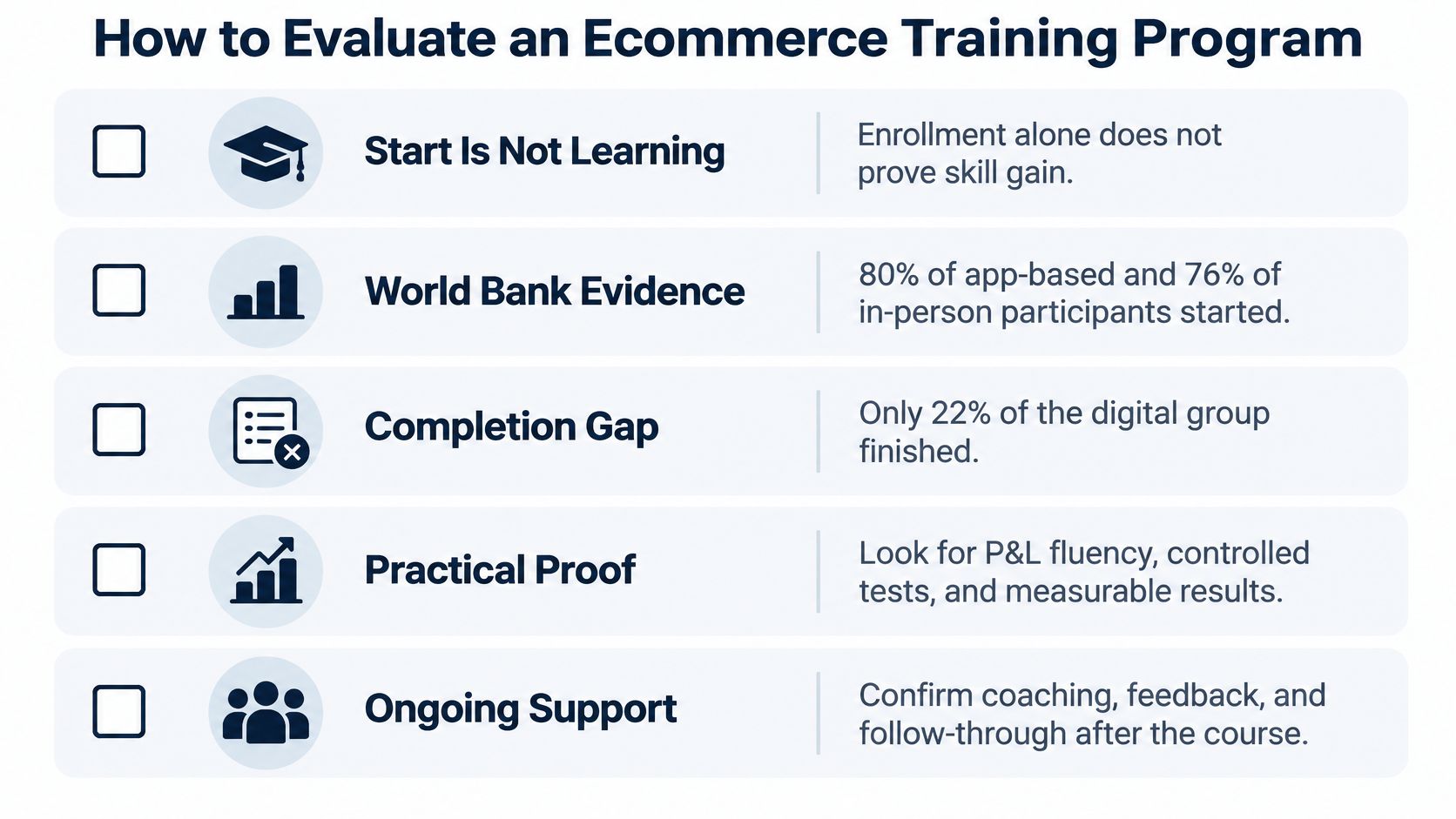
Enrollment isn't learning. A World Bank study comparing app-based and in-person business training reported initial take-up of 80% and 76%, respectively, but only 22% of the digital group completed at least eight modules, compared with 71% of those assigned to in-person training attending at least eight sessions.
Completion outcomes by training format
| Format | Initial take-up | Completed at least 8 modules or sessions |
|---|---|---|
| App-based training | 80% | 22% |
| In-person training | 76% | 71% |
These are business-training findings, not a ranking of ecommerce programs. The practical lesson is to inspect how a provider supports follow-through rather than assuming convenient access will produce completed work.
Ask how feedback works when your business doesn't resemble the example used in class. A founder selling bulky goods needs different fulfillment assumptions from a seller shipping lightweight replenishable products.
Guaranteed earnings, access without milestones and pressure to buy recommended services deserve scrutiny. Lifetime access describes availability, not teaching quality.
Skup's guide to avoid misleading online store training provides an additional screening resource. Use it to prepare questions, not to substitute a red-flag checklist for reviewing the actual curriculum.
Before paying, request the completion definition, the completion rate and a sample deliverable. If the provider can't show what learners finish, you're buying an uncertain implementation process.
Set a baseline before the first assignment changes the business. Choose a representative operating period and a review date that allows the intended change to affect orders, costs or cash.
Training ROI needs a narrow measurement plan. “I understand finance better” may be true, but it doesn't establish whether the business recovered the cost of learning.
Metrics to track for training return
| Metric | How to calculate | Review cadence | Sign training worked |
|---|---|---|---|
| Contribution margin per order | Net revenue minus variable costs, including fees and returns, divided by orders | Monthly | Rising margin without higher acquisition spending |
| Checkout completion rate | Completed checkouts divided by checkout starts | Monthly | Higher completion on mobile and desktop |
| Ad cost of sales | Ad spend divided by ad-attributed sales | Weekly | Lower cost at stable or higher sales volume |
| Cost to serve per order | Fulfillment, shipping and handling costs divided by orders | Monthly | Lower cost after operations changes |
| Return rate by product | Returned units divided by units sold | Monthly | Falling rate on the products reviewed |
| Working capital days | Inventory days plus receivable days minus payable days | Quarterly | Shorter cycle after forecasting changes |
| Time to launch a new channel | Days from decision to first profitable week | Per launch | Shorter launch period without weaker profitability |
Say a founder completes the finance track and discovers that a product line has an attractive gross margin but loses money after advertising, fees and returns. The founder changes its price, stops an unprofitable promotion or removes the line.
The first achievement is better visibility. The financial return arrives only when the decision improves realized contribution, after accounting for consequences such as clearance costs or lost complementary purchases.
Use consistent cost definitions throughout. Don't subtract returns twice, and don't compare a margin calculation that includes advertising with an earlier version that excludes it.
A practical ecommerce analytics framework helps establish reliable definitions and reporting ownership before you judge the outcome.
Payback test: Compare attributable incremental contribution with the full cost of training and implementation.
Include program fees, employee time, software and outside implementation support. A lower advertising ratio isn't automatically a win if total contribution falls.
Where possible, isolate changes or use a comparison group. Record promotions, supplier changes and seasonal effects that could explain the result.
If the expected return doesn't appear, investigate the assignment, execution and assumptions. Don't change the success metric afterward merely to make the program look worthwhile.
Start with a short decision document rather than another course shortlist. Write down the business problem, the evidence that it matters and the operating decision you currently can't make confidently.
Then follow this sequence:
Protect implementation time in the calendar. If you can attend lessons but can't access the accounts, involve the team or make changes, resolve that constraint before enrolling.
Peer learning is useful when members review assumptions and expect a finished assignment, not just an update about what you watched. Bring a forecast, campaign plan or operating procedure that others can examine.
At Million Dollar Sellers, our 1-day hands-on masterminds cover topics from fundraising to operations; Inspire is a public 2-day tactical conference with over 500 ecommerce professionals, workshops, hot seats and mastermind tables; and membership includes 500+ member SOPs and templates. These formats provide different ways to connect learning with operating work.
Our membership requires founders or CEOs of businesses with at least $1M in trailing-twelve-month revenue, with P&L ownership required. Confirm that you meet the relevant channel eligibility requirements before applying.
This week, write down your baseline metric and the deadline for your first deliverable. Send them to the person who will review the work. That commitment is more useful than enrolling in several tracks you won't have time to implement.
Million Dollar Sellers offers ecommerce-focused peer learning, hands-on masterminds and member-contributed operating resources for founders who want to turn instruction into execution. Visit Million Dollar Sellers to explore the community, review eligibility and choose a learning format that supports your next operating milestone.
Join the Ecommerce Community for Founders Scaling from 7 to 9 Figures
Learn MoreYou may also like:
Learn more about our events!
Check Events