Chilat Doina
April 5, 2026
An ecommerce community is a group of online brand owners and founders who actively share strategies, troubleshoot problems, and push each other to grow. Think of it as a strategic growth engine—a network of peers that helps you scale faster and sidestep the costly mistakes that are all too common in this business.
We all know the classic founder story: the lone genius in a garage, battling the odds to build an empire. It’s a great narrative, but the reality of building a 7, 8, or 9-figure brand is rarely a solo mission. The sharpest founders figure out pretty quickly that trying to solve every single problem on your own isn't just hard—it's a one-way ticket to burnout.
Imagine you’re trying to find a hidden treasure on a remote mountain. You could go it alone with just your map and a compass. You might eventually find it, but you'll waste a ton of time on dead-end trails and get caught in unexpected storms. Now, picture making that same trip with a team of guides who have done it a dozen times. They know the shortcuts, the gear you actually need, and how to navigate the trickiest parts of the climb.
An ecommerce community is that team of guides. It’s a hand-picked network of peers who have already walked the path you’re on and can give you a proven roadmap.
Instead of constantly reinventing the wheel for everything from logistics to marketing, you get to tap into a shared pool of real-world experience. This instantly turns your biggest headaches into collective learning moments. As founders look for solid ways to grow their business, they often explore a mix of tactics, including the ones found in these 12 Powerful Ecommerce Growth Strategies.
This shift away from solo grinding toward community-led strategy has very real payoffs:
At the end of the day, refusing to scale alone is all about being more efficient. Understanding how to start unlocking growth through networking for entrepreneurs shows just how much of a competitive edge these connections can create. When you join a high-level ecommerce community, you aren't just making contacts; you're gaining a personal advisory board that’s invested in seeing you win.
Let's be honest—not every group calling itself an "ecommerce community" is the real deal. Most are just noisy Facebook groups or rambling forums full of anonymous advice. A true, high-value community is something else entirely. It’s a carefully vetted network built on trust, proven knowledge, and a genuine desire to see every member succeed.
Think of it this way: a public forum is like a crowded city park. Anyone can show up, the conversations are all over the place, and you have no idea who to trust. A top-tier community, on the other hand, is like a private club. Every single person at the table has earned their seat, so you know you're surrounded by peers who are serious about growth.
The real difference comes down to trust. A free group might give you a few surface-level tips, but an exclusive community is where founders share the standard operating procedures (SOPs) and financial benchmarks they’re actually using to scale their businesses. This is the stuff that never gets posted publicly.
Ecommerce communities come in all shapes and sizes, each offering a different mix of access, information quality, and member commitment. Figuring out where a group falls on this spectrum is the first step to finding the right fit for you. For any founder, the choice between grinding it out alone or joining forces with trusted peers can make or break their growth trajectory.
This is the difference between going it alone and scaling with a community.
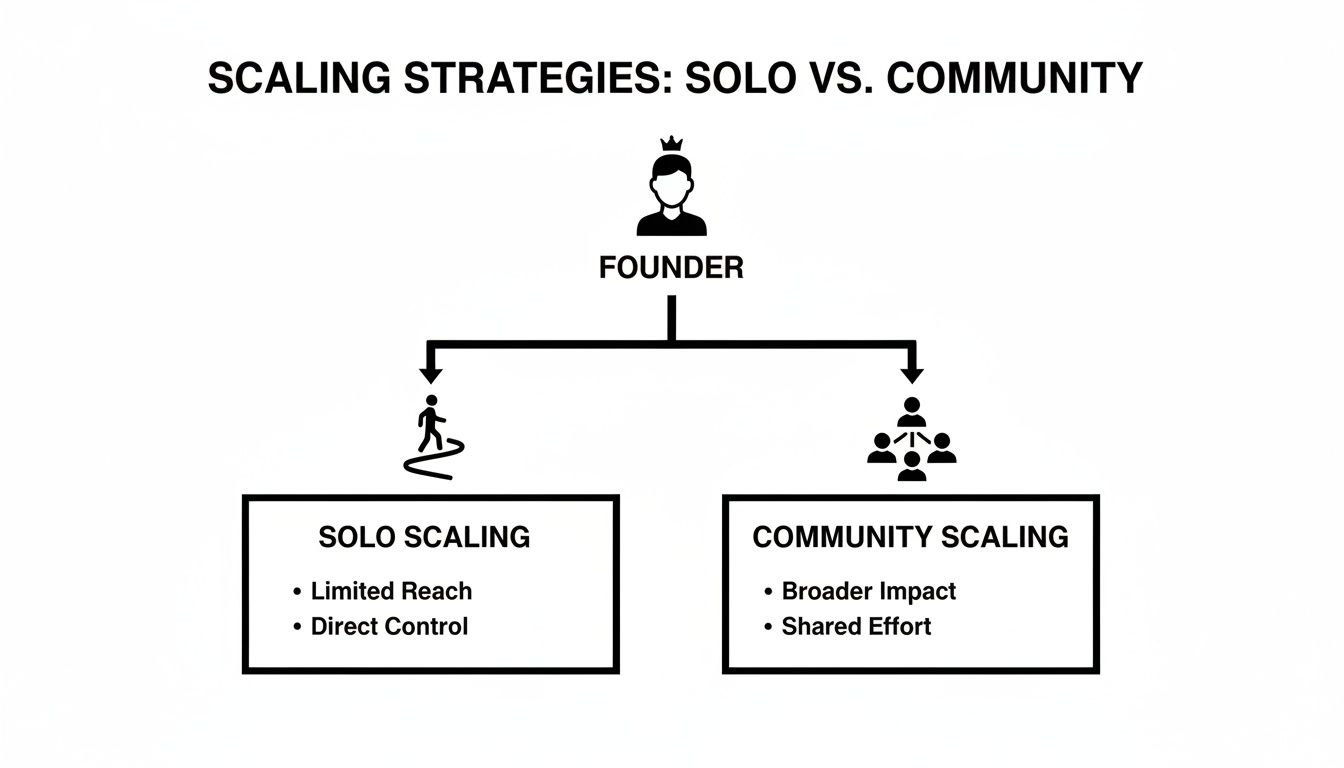
As you can see, a community creates a supported path to growth, which is a stark contrast to the isolated and often slower journey of a solo founder. Choosing the right type of community is critical.
To help you navigate your options, we've broken down the most common types of ecommerce communities. Each model serves a different purpose, so it’s important to know what you're looking for.
| Community Model | Accessibility | Information Quality | Best For |
|---|---|---|---|
| Free Public Forums | Open to everyone | Low to moderate; often noisy and unvetted | Beginners looking for basic answers and broad networking. |
| Paid Niche Groups | Low to mid-cost barrier | Moderate; generally better moderation and focus | Founders developing specific skills or exploring a new niche. |
| Brand-Owned Communities | Often free for customers | Varies; focused on a specific product or ecosystem | Users of a particular software or service looking for support. |
| Elite Masterminds | Invite-only; high barrier | High; vetted, actionable insights from proven operators | 7, 8, and 9-figure founders aiming for accelerated scaling. |
The right community for a founder just starting out is completely different from what a seasoned 8-figure seller needs. The key is to find the one that matches your current stage and future ambitions.
A truly great community is more than just a member list; it’s an active, living network. It’s intentionally built to forge real connections and encourage the exchange of high-stakes information that fuels massive growth.
So, what should you look for? Here are the non-negotiables:
A powerful ecommerce community is defined by the trust between its members. When founders feel safe enough to share their real numbers, biggest challenges, and hard-won lessons, the collective value skyrockets.
Ultimately, you want to find a group where the signal is loud and the noise is nonexistent. It’s about replacing endless Google searches with direct access to proven answers from people you know you can trust. For serious founders, this isn’t just a nice-to-have—it’s a core strategic advantage.

It’s one thing to understand the idea of a great ecommerce community, but it’s something else entirely to see it show up on your P&L. The real power of a vetted network isn’t just about feeling less alone—it’s about generating measurable returns that blow the cost of time and money out of the water. It’s where talk turns into tangible growth.
Think about it. You're staring down a six-figure logistics nightmare that could sink your whole quarter. Instead of burning weeks (and cash) on pricey consultants, you post your problem in a trusted founder community. Within minutes, you get a proven fix from someone who dealt with the exact same headache last month. That's the immediate, powerful ROI of a real community.
This value isn't just about putting out fires, either. It becomes a core strategic advantage woven into every part of your business, turning that collective brainpower into a serious competitive edge.
A top-tier ecommerce community is your launchpad for smart growth. It gives you a direct line to founders who have already navigated the minefield of scaling from seven to eight or even nine figures. Instead of throwing darts at a map to pick a new market, you get a validated roadmap from people who've actually been there.
This shared intel is gold, especially with the market expanding so fast. By 2025, over 2.77 billion people—a full 33% of the world's population—were shopping online. That number is set to hit 2.86 billion by the end of 2026, opening up massive opportunities if you can move fast and make the right calls. An ecommerce community helps you turn those big trends into actual revenue by sharing what's working right now. You can discover more about these digital commerce statistics to see just how big the opportunity is.
Operational drag is the silent killer of profit. Clunky warehouse processes, a bloated tech stack, and overpriced shipping contracts will bleed your business dry from the inside. The right community is a powerful antidote, offering up shared operational tactics that have been battle-tested by your peers.
Members freely share their go-to 3PLs, organize group discounts on must-have SaaS tools, and reveal the inventory tricks that keep their operations lean and mean.
In a trusted community, a single conversation about freight forwarders or packaging suppliers can unlock more savings than months of flying solo. The advice is real, tested, and you can act on it immediately.
Marketing channels are always shifting, and last year’s killer strategy is often today’s dead end. A community of active operators is like having a real-time feed of what's actually working in marketing. You hear about new ad platforms before they get crowded and discover the CRO tweaks that are crushing it for other high-growth brands.
This is where you find out about the new TikTok ad format that’s outperforming Instagram, or the simple email segmentation strategy that bumped another member’s LTV by 20%. It’s raw, unfiltered advice driven by real performance data, not theory.
Finally, the value goes beyond the business and straight to you, the founder. The entrepreneurial journey is a grind, and burnout is a constant threat. A supportive peer group provides an essential sounding board for all the tough stuff—leadership challenges, team-building struggles, and mapping out your long-term vision.
Sharing the weight of it all with people who genuinely get the pressure is invaluable. It builds your resilience, sharpens your decision-making, and ultimately makes you a better leader. This kind of holistic support ensures that as your business grows, you're growing right along with it.
Once you see just how much an ecommerce community can do for your business, the next question is pretty obvious: "Okay, so how do I get in on this?"
You've got two clear paths. You can find and join an existing, high-caliber group, or you can roll up your sleeves and build one from scratch for your own niche.
Neither route is a walk in the park. Joining isn't just about paying a fee; it’s about finding a place where you genuinely fit and can contribute. And building isn't as simple as firing up a Slack channel—it’s about creating a space that people actually want to show up to, week after week.
Picking the right community is a lot like picking a business partner. You have to do your homework to make sure the group’s vibe, members, and focus line up with what you’re trying to achieve. Jumping into the wrong group is a surefire way to waste time and money, so use a solid checklist to size up your options before you commit.
First thing's first: look at the members. Are these the kind of operators you admire and can actually learn from? A community is only as good as the collective experience of the people in it. Look for groups with a tough vetting process. An application or a revenue requirement isn't there to be exclusive; it's a filter to make sure everyone in the room is tackling similar, high-stakes problems.
Next, get a feel for the activity and moderation. A forum that’s a ghost town is useless, no matter who’s in it.
The best way to judge a potential community is to see how they handle real business problems. Look for proof that members are sharing specific, actionable strategies—not just fluffy, surface-level tips. The real gold is in the depth of the knowledge being shared.
Once you’re in, live by the "give-to-get" rule. The quickest way to earn respect is to offer value first. Share a recent win, jump in to help solve someone else's problem, or post the data from a marketing test you just ran. It shows you’re there to contribute, not just to take.
If you can't find the perfect group—or you spot a glaring gap in the market—building your own ecommerce community can be a massive power play. It puts you at the center of your niche and builds an incredible asset for your brand. It’s a big project, for sure, but you can get started with a fairly simple framework.
First, pick your platform. This is where the community will live, and it sets the tone for how everyone interacts. The usual suspects are:
Your content strategy is the heartbeat of the community. You have to give people a reason to keep coming back. Start with a simple content calendar that includes recurring events. A weekly "wins and challenges" thread, monthly expert interviews, or virtual co-working sessions are all great places to start. For more ahas on sparking engagement, check out our guide on building a thriving DTC community.
Finally, get your member onboarding right. A good welcome process makes new members feel like they belong and shows them how to get value from day one. Create a welcome post, tag new members, and nudge them to introduce themselves. It’s a small touch that sets a positive, inclusive tone and helps you build a network that has real staying power.
It’s easy to talk about the camaraderie you get from a good community, but when you’re investing serious time and money, you need to see a real return. Top founders aren’t just looking for friends; they're looking for a measurable edge.
So, how do they track it? It all boils down to tangible outcomes that show up on the P&L.
For most, the clearest and fastest return comes from something we call Time-to-Solution. Think about it: a critical supply chain link just snapped. The old way involved weeks of frantic searching, vetting expensive consultants, and hoping you picked the right one.
Inside a trusted community, a founder can post the exact problem and get a proven solution from a peer in minutes. Being able to solve a six-figure problem almost instantly is a massive, undeniable ROI. In today's market, where everything moves at lightning speed, that kind of agility isn't just nice to have—it's essential for survival and growth.
To really put a number on a community's value, you have to move past anecdotal wins and look at specific key performance indicators (KPIs). These are the metrics that turn a good piece of advice into a clear business case.
Here’s what the sharpest founders are tracking:
The true measure of a community’s worth isn't just in the advice you get, but in the costly disasters you avoid. A single warning about a legal pitfall can save you more than the membership cost for a lifetime.
The ROI of an ecommerce community truly comes to life in high-stakes situations where a peer's input leads to a direct, measurable business win. These aren't hypotheticals; they're real scenarios founders face every day.
Case Study 1: Optimizing Logistics
A founder was getting hammered by rising 3PL costs that were destroying their margins. On a mastermind call, another member shared the exact SOP and negotiation script they used to lock in better rates with a niche 3PL. By putting that advice into action, the founder slashed their fulfillment costs by 18% in just one quarter.
Case Study 2: Scaling International Sales
An 8-figure brand owner was ready to expand into the EU but was completely stuck on the complexities of VAT and compliance. A member who had just scaled into Germany walked them through the entire process, recommended a vetted compliance partner, and even shared their launch strategy. This direct guidance saved an estimated six months of brutal trial-and-error and prevented what would have been very expensive regulatory fines.
These strategic wins are happening in a market that's absolutely exploding. In Q4 2025, U.S. eCommerce sales rocketed to a record $365.2 billion, making up 25% of all retail sales. For founders in elite circles like Million Dollar Sellers, whose members pull in a collective $8 billion in revenue, these numbers aren't just statistics—they're opportunities.
You can find more details on quarterly online sales growth and see just how powerful these trends are. Being in the right room gives you the playbook to grab a bigger piece of that ever-expanding pie.

While plenty of communities cater to the broader ecommerce world, a completely different type of network exists for founders who have already hit major milestones. This is the world of the elite mastermind—a carefully selected ecosystem built not for beginners, but for top-tier operators running 7, 8, and 9-figure brands. Million Dollar Sellers (MDS) is the gold standard for this model.
Think of it less as a community and more as a private advisory board made up entirely of high-level peers. Unlike open forums where anyone can join, getting into MDS requires a tough application process. This isn’t about being exclusive for the sake of it; it's a quality-control measure to guarantee every member is an active, proven founder who can give as much as they get.
This strict vetting process builds an environment of deep, unwavering trust. It’s the kind of trust that empowers members to openly discuss the one thing most founders guard with their lives: their actual financials, marketing data, and operational playbooks.
In a group like MDS, the conversations are on another level entirely. The focus isn't "How do I start?" but rather "How do I solve a multi-million-dollar logistics bottleneck?" or "What’s the smartest way to structure an international expansion?" The advice you get isn't just theory; it's backed by real-world P&L statements and hard-won experience.
This is where the real magic happens. Members get access to insights that you simply can't find anywhere else, turning the collective brainpower of hundreds of elite entrepreneurs into a personal strategic weapon.
In an elite mastermind, you don’t just get advice; you get a playbook from someone who has already solved your exact problem at the same scale. The value of that is immeasurable.
This unique setup puts members in a position to jump on market shifts faster than their competitors. With global eCommerce sales expected to rocket past $7 trillion by 2026, the opportunities for growth are massive. In a community like Million Dollar Sellers—where members pull in a collective $8 billion in annual revenue—founders use shared strategies on private forums and at curated events to grab a bigger piece of that pie. And with 85% of global consumers shopping online, this shared intelligence is an incredibly powerful tool.
At the end of the day, 7-, 8-, and 9-figure founders join an elite ecommerce community like MDS for one simple reason: leverage. They’ve already proven they can build successful businesses. Now, they’re looking for the insights and connections to scale smarter, faster, and with fewer expensive mistakes. If you want to dig deeper into how these powerful networks work, our guide to mastermind groups for entrepreneurs breaks it all down.
It’s all about trading the isolation of being a founder for a powerful peer network and swapping guesswork for proven strategies from the best in the business. For serious sellers, it’s the definitive way to stay ahead of the curve.
Even with all the benefits laid out, it's smart to have a few questions. Deciding on a community strategy is a big move. Let's tackle some of the most common questions we hear from founders so you can figure out your next steps.
The single biggest mistake you can make is just lurking. Seriously. Joining a top-tier community isn't like subscribing to a newsletter—the real gold is in the give-and-take. Founders who just sit back and wait for wisdom to fall into their laps without sharing their own wins, losses, and questions rarely get their money's worth.
The best groups, like Million Dollar Sellers, are built on a "give-to-get" foundation. The second most common pitfall? Joining a community that isn't at your level. The headaches of a 6-figure seller are a world away from an 8-figure founder's problems, so if there's a mismatch, most of the advice just won't apply.
Costs are all over the map. You’ve got free communities on places like Facebook or Reddit, which can be a decent starting point. But you often have to wade through a lot of noise and bad advice from unvetted members. Then there are mid-tier paid groups, maybe $50 to $300 a month, which usually offer better moderation and a more focused crowd.
Elite, invite-only masterminds are a serious investment, often running into thousands of dollars per year. That price tag buys you a highly curated network, a room full of proven operators, and access to insights you simply won't find anywhere else.
At the end of the day, weigh the cost against the potential ROI. What would it be worth to solve just one of your biggest business roadblocks? While you want a high-value community, it also pays to be aware of the common mistakes that can cause paid crypto communities to fail—a lot of the same lessons apply.
Absolutely. A mentor offers incredible one-on-one guidance from their specific journey, but a community provides something completely different: peer-to-peer validation and a ton of different perspectives, all at once.
Think of it this way: a mentor gives you a single, expert viewpoint. A community of 100+ successful founders, on the other hand, acts as a real-time sounding board. You get access to dozens of fresh experiences in logistics, marketing, and operations. You can stress-test a new idea against a dozen different viewpoints in an afternoon. It’s the perfect blend of top-down advice and on-the-ground support from people who are in the trenches with you.
Ready to surround yourself with the top 1% of ecommerce entrepreneurs? Million Dollar Sellers is an exclusive, vetted community for 7, 8, and 9-figure founders. Apply to join and start scaling smarter.
Join the Ecom Entrepreneur Community for Vetted 7-9 Figure Ecommerce Founders
Learn MoreYou may also like:
Learn more about our special events!
Check Events