
Chilat Doina
February 8, 2026
Before you start scrolling through LinkedIn or hitting up networking events, the real work of finding a business partner starts with a serious look in the mirror. It's a process. You first need to nail down exactly what you're missing, then you can strategically hunt in the right places, and finally, do your homework before signing anything.
Getting this foundation right is what makes a partnership click—or what causes it to crumble down the line.

You can't spot the right person if you don't even know who you're looking for. It's a classic mistake: founders jump into the search for a generic "cofounder" without a clear blueprint of what that person actually needs to do and be. This first phase is all about honest self-reflection.
Think about it. You wouldn't hire a Head of Marketing without a detailed job description. A business partner is an infinitely more critical role, so the definition needs to be razor-sharp. The search begins by looking inward at your own skills and identifying the gaps holding your ecommerce brand back.
First things first: you need a brutally honest assessment of your own skillset. Nobody is great at everything. Maybe you're the creative genius who can design a killer product but the thought of a P&L statement makes you break out in a cold sweat. Or perhaps you're a marketing wizard who can't stand the nitty-gritty of supply chain logistics.
Owning your weaknesses isn't a failure; it’s a strategic advantage. It lets you hunt for someone with complementary strengths, creating a leadership duo that’s more than the sum of its parts. I've seen too many partnerships fail because of skill overlap, which just leads to stepping on each other's toes and fighting for control.
A partnership built on complementary skills—where your strengths cover their weaknesses and vice-versa—is built to last. It creates a synergy that's a key ingredient for long-term success.
To get started, I've put together a simple checklist. Be honest with yourself here; no one else needs to see it. This is about giving your search a real direction.
Use this checklist to honestly evaluate your strengths, weaknesses, and the exact needs of your business before seeking a partner.
.tbl-scroll{contain:inline-size;overflow-x:auto;-webkit-overflow-scrolling:touch}.tbl-scroll table{min-width:600px;width:100%;border-collapse:collapse;margin-bottom:20px}.tbl-scroll th{border:1px solid #ddd;padding:8px;text-align:left;background-color:#f2f2f2;white-space:nowrap}.tbl-scroll td{border:1px solid #ddd;padding:8px;text-align:left}Assessment AreaKey Questions to ConsiderMy Honest AnswerSkill GapsWhat are the top 3 business functions I avoid or am weakest at? (e.g., Finance, Marketing, Operations)Core StrengthsWhat are the 3 areas where I provide the most value to the business?Work StyleAm I a "big picture" visionary or an "in the weeds" operator? Do I thrive on structure or chaos?Time CommitmentHow many hours per week can I realistically commit? Am I looking for a full-time or part-time partner?Financial StateCan the business currently support another salary? What level of equity am I willing to offer?Long-Term VisionDo I want to build a lifestyle brand, a legacy company, or sell in 5 years?
Filling this out will give you a much clearer picture of the type of person you need to find. It moves the goalposts from a vague idea to a concrete set of requirements.
Now that you know what you lack, you can build a "Partner Persona." This is way more than a simple checklist. It's a detailed profile of the person who would perfectly complement you and the business. If you need more guidance on this, there are some great resources on how to find a cofounder that dive deeper.
Your persona needs to cover two key areas:
Finally, write down your brand's core mission and your five-year vision. Any potential partner has to be completely aligned with where you're headed. If they’re looking for a quick flip and you're building a legacy brand, you’re setting yourselves up for failure. This clarity is your north star for the entire search.
Knowing who you're looking for is one thing. Knowing where to find them is a whole different ballgame. You can waste months sifting through noisy platforms like LinkedIn, drowning in profiles from people who are just casually browsing, not seriously looking to build something.
If you want to find a partner who can actually help you scale, you have to go where the real operators hang out. The goal here isn't to build a massive list of leads. It's to find a small, curated group of people who already have the right mindset and a proven track record. That means skipping the masses and zeroing in on high-trust, exclusive environments.
Some of the best connections you'll ever make will come from communities built on trust and mutual success. I'm not talking about your average "open-to-everyone" networking group. I mean vetted, often invite-only spaces where successful entrepreneurs are actively sharing what works, solving tough problems, and scouting for new opportunities.
Take a group like Million Dollar Sellers (MDS), for example. It’s packed with seven, eight, and nine-figure e-commerce founders. In a place like that, members are incredibly transparent because their reputation is everything. A single warm introduction from a trusted peer in a group like this is worth more than a hundred cold emails.
When you're on the hunt for a partner, make communities where membership is a filter your top priority. If someone had to prove their success just to get in the door, you're already starting with a pre-vetted pool of talent.
Checking out the best business networking groups can give you a solid roadmap. These are the circles where real partnership talks happen, grounded in mutual respect and verified results.
Huge trade shows can be a total zoo, but smaller, high-ticket industry conferences are goldmines for top-tier talent. The price tag alone filters out the people who aren't serious. Look for events that focus on a specific e-commerce niche, like supply chain logistics, DTC marketing, or brand acquisitions.
But don't just show up to collect business cards. Go in with a plan.
This approach helps you cut through the noise and build genuine rapport with the exact type of industry players you want to work with.
Sometimes, the perfect partner is just one introduction away. Think about your existing professional advisors—your lawyer, accountant, or high-level consultants. They have a direct stake in your success and are connected to a whole network of other high-performing business owners. They see "under the hood" of dozens of companies and know who’s competent, who’s trustworthy, and who might be looking for their next big thing.
Set up a formal meeting with them. Bring your "Partner Opportunity Brief." This isn't a casual coffee chat; it's a strategic ask. Clearly lay out the role, the ideal candidate profile, and what’s in it for them. This gives your advisor the specific ammo they need to spot the right matches in their network.
The real magic here is the built-in trust. An introduction from a respected professional acts as a powerful stamp of approval, immediately elevating the conversation way beyond a cold inquiry. It validates that the candidate is worth your time from the get-go.
This kind of strategic sourcing is more than just a nice-to-have; it's critical for growth. In fact, research shows that high-maturity partnership programs generate 28% of revenue, which blows past the 18% from paid search. It just goes to show that strategic alliances, built on peer insights and vetted referrals, deliver a much higher ROI and a stronger position in the market. Skipping this step is literally leaving money on the table.
Alright, you’ve got a shortlist of promising candidates. Now the real work begins. This isn't about running through a generic interview script; it’s a methodical deep-dive into their professional history, work ethic, and character. We’re moving from what their resume says to who they are.
A structured due diligence process is your best defense against a bad partnership. It's designed to uncover the truths that don't make it onto a LinkedIn profile and reveal how someone actually operates under pressure.
This is where you'll find most of your best candidates—through curated communities, industry conferences, or trusted referrals.
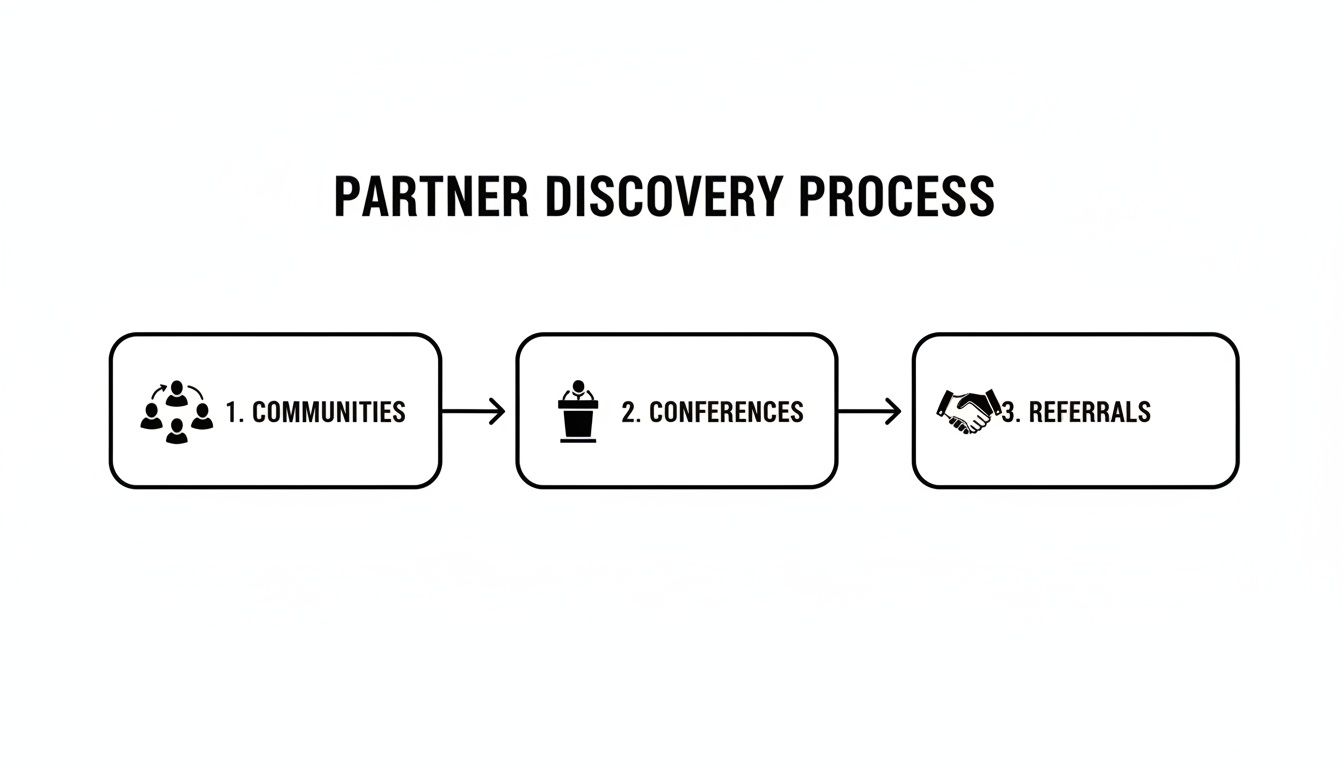
No matter where they come from, this core due diligence process is what truly confirms if they’re the right fit.
Anyone can give you a list of people who will sing their praises. Forget that. To get a true 360-degree view, you need to speak with people they haven't hand-picked. Your goal is to see the complete picture of how they perform in different contexts.
Think of it as piecing together a mosaic of their professional life, not just admiring a polished self-portrait. You need to talk to people who have seen them succeed, fail, and navigate conflict.
When you do get on the phone, don't ask fluff questions like, "Was it good working with them?" Get specific and situational.
Questions That Get Real Answers:
These kinds of questions peel back the layers and give you a glimpse into their resilience, leadership, and self-awareness—all non-negotiable traits in a business partner.
The single best way to know if you can work with someone? Actually work with them. A "working trial" is a small, paid, time-bound project that mirrors a real challenge your business is facing. It’s a low-risk way to test-drive the partnership before signing on the dotted line.
This isn’t busy work. The project has to be meaningful and directly tied to the role they’d fill. For a deeper look at structuring this, our guide on the due diligence checklist for an acquisition has some great frameworks you can adapt.
For instance, if they’re a marketing pro, have them analyze your ad accounts and present a strategy to boost ROAS by 15% in the next 30 days. If they're an operations wizard, get them to audit your supply chain and find three concrete cost-saving opportunities.
The working trial isn’t just a skills test. It’s an audition for your working relationship. Pay close attention to their communication, how they manage deadlines, and how they take feedback.
This trial period gives you a front-row seat to their soft skills. Do they ask smart, clarifying questions? Are they proactive? How do they react when you push back on an assumption? The answers will tell you more than any interview ever could.
Throughout this process, some warning signs should make you stop in your tracks. Ignoring them is a classic mistake that almost always leads to a messy breakup down the road. Stay sharp and trust your gut.
Here are a few deal-breakers to watch for:
This whole process is your insurance policy. It protects your business, your team, and your sanity by making sure the person you bring on is every bit as capable, committed, and trustworthy as they seem on the surface.
You’ve done the hard work of searching and vetting. Now it’s time to make it official. This is where the partnership goes from an idea to a legally binding reality, and it’s arguably the most critical phase of the entire process.
A handshake or a verbal agreement might feel good, but they mean absolutely nothing when a real disagreement pops up—and trust me, it will. A well-structured partnership agreement is the single best thing you can do to protect your business, your investment, and even your friendship in the long run.
This isn’t the time to cut corners. Your first move should be to hire an experienced business attorney. Trying to save a few bucks with a generic online template is a rookie mistake that can cost you everything down the line. A good lawyer will help you navigate the nuances of your specific situation and make sure your agreement is rock-solid.
One of the first big conversations you'll have is about the equity split. It's tempting to just go 50/50, but that’s often a recipe for a deadlock when you can’t agree on a major decision. The equity split should be a direct reflection of what each partner brings to the table—cash, intellectual property, critical skills, or key relationships.
Even more important than the initial split is the vesting schedule. This is a non-negotiable. A vesting schedule protects the business if a partner bails early, ensuring they don't walk away with a huge chunk of a company they didn't stick around to build.
A standard setup is a four-year vesting period with a one-year "cliff." Here’s how it works:
This structure ensures ownership is earned through sustained effort, not just for showing up. For a deeper dive into the mechanics of business financing, understanding the difference between equity financing vs debt financing can give you some valuable context for these conversations.
Think of your operating agreement as the constitution for your business. It's the rulebook that dictates how the company will be run, how big decisions will get made, and how you'll handle conflicts. Getting this right from day one prevents future power struggles and makes sure everyone is on the same page.
After finding your partner, learning How to Structure a Business Partnership is the next vital step, and this agreement is the foundation for it all.
An operating agreement acts as your partnership’s rulebook. It forces you to have the uncomfortable conversations now so they don’t blow up your business later. Think of it as preventative medicine for your company.
Your agreement needs to clearly lay out the operational pillars of the business. Here are the must-haves:
Your partnership agreement is your roadmap for navigating the inevitable challenges of business. Below is a breakdown of the core clauses you absolutely need to include.
This table outlines the non-negotiable legal clauses to include in your operating agreement. Getting these right protects everyone involved and provides a clear path forward when things get complicated.
.tbl-scroll{contain:inline-size;overflow-x:auto;-webkit-overflow-scrolling:touch}.tbl-scroll table{min-width:600px;width:100%;border-collapse:collapse;margin-bottom:20px}.tbl-scroll th{border:1px solid #ddd;padding:8px;text-align:left;background-color:#f2f2f2;white-space:nowrap}.tbl-scroll td{border:1px solid #ddd;padding:8px;text-align:left}ClauseWhat It DoesWhy It's Non-NegotiableRoles & ResponsibilitiesClearly defines each partner's duties and authority within the business.Prevents turf wars and ensures all critical business functions are covered without overlap or confusion.Decision-MakingEstablishes the voting process for key business decisions (e.g., majority vs. unanimous).Avoids stalemates on critical issues like spending, hiring, or strategic pivots.Capital ContributionsDocuments initial and future financial/asset contributions from each partner.Clarifies ownership stakes and sets clear expectations for funding the business as it grows.Profit & Loss DistributionOutlines how profits (and losses) will be allocated among the partners.Ensures transparency and fairness in financial returns, preventing disputes over money.Vesting ScheduleDictates how and when partners earn their full equity stake over time.Protects the company from a partner leaving early with a large chunk of unearned equity.Buy-Sell AgreementSets the terms for a partner's exit due to death, disability, or voluntary departure.Provides an orderly exit process and valuation method, preventing costly legal fights or forced sales.Dispute ResolutionDefines the process for resolving disagreements (e.g., mediation, arbitration).Offers a structured, less expensive alternative to suing each other in court when conflicts arise.
Having these clauses hammered out before you launch isn't just a legal formality—it's a sign of a healthy partnership built on clarity and mutual respect.

Popping the champagne after signing the legal docs feels great, but it’s not the finish line. It’s the starting gun. The real work—and the real measure of your partnership’s success—begins now. What you do next separates the partnerships that truly accelerate a business from the ones that just fizzle out.
Those first 90 days are your make-or-break window. This is where you build momentum, forge a powerful working dynamic, and prove to yourselves (and your team) that this was the right move. Get this right, and you turn a legal agreement into a genuine force for growth.
The biggest killer of a new partnership is ambiguity. To avoid it, you need to be intentional about your communication from day one. Don't just assume you'll "talk when you need to." That's a recipe for misalignment and frustration.
Structure is your best friend here. A simple, non-negotiable rhythm keeps you both on the same page.
This two-part cadence ensures you're connected on the daily grind while still making dedicated time to steer the ship together.
Nothing builds trust faster than hitting a goal together. Within the first week, sit down and map out a few shared Objectives and Key Results (OKRs) for the first quarter. This isn’t just about accountability; it’s about creating a shared scoreboard.
Focus on a few "early wins." These should be meaningful goals you can realistically hit within 90 days that will have a visible impact on the business. For an e-commerce brand, it might look something like this:
These OKRs give you a clear, measurable definition of what success looks like for the quarter. It immediately shifts the dynamic from "my tasks" and "your tasks" to "our goals." That’s a crucial psychological leap.
"A business without a shared vision is just a bunch of people running in circles. Setting joint quarterly goals ensures you're not just busy, but that you're both rowing hard in the same direction from day one."
This process also gives you a simple filter for making decisions. When a new idea comes up, you can both ask, "Does this actually help us hit our key results?"
You need to establish your new partner's role and authority—fast. A formal, thought-out introduction process prevents confusion and makes for a smooth transition with your team, suppliers, and other key players.
Don't just fire off a generic email and call it a day.
This deliberate rollout does more than just get people up to speed. It projects a united front and gives your new partner the credibility they need to start making an impact right away.
Even with the best game plan, a few big questions always pop up when you're looking for a business partner. Let's tackle the most common hurdles ecommerce founders run into so you can navigate these critical decisions with more confidence.
There’s no magic number, and blindly defaulting to a 50/50 split is often a recipe for disaster and deadlock down the road. The smarter approach is a dynamic equity split that’s tied to a vesting schedule. This way, ownership is actually earned over time through real commitment.
A pretty standard setup is a 4-year vesting schedule with a 1-year cliff. Here’s how that works:
The initial split itself should be a direct reflection of what each person brings to the table. Think about tangible contributions: capital investment, intellectual property, critical skills, and the sheer amount of time they’re expected to put in. Get everything documented in a clear agreement drafted by a lawyer to make sure it’s fair and keeps everyone motivated for the long haul.
The single best way to see if you can work with someone is to, well, actually work with them. Before you sign any life-altering legal documents, set up a paid "trial period" or what I like to call a "pre-partnership project."
This should be a short-term sprint, usually 30-90 days, with specific, measurable goals that mimic what their role would actually be. For example, if they’re a marketing guru, give them a small budget to develop and run an ad campaign aimed at improving one specific metric.
A trial project is the most effective way to see how you collaborate under pressure. It shifts the dynamic from theoretical interviews to real-world performance, revealing everything from work ethic and communication style to whether you actually enjoy working together.
Use a simple Memorandum of Understanding (MOU) or a short-term contractor agreement for this. That document should clearly spell out the project's scope, the compensation, and any confidentiality terms. This low-risk test drive is invaluable for seeing how you handle real challenges together before you legally tie your businesses to each other.
During the vetting process, there are a few red flags that should make you slam on the brakes. Ignoring your gut is one of the most common mistakes founders make, and it almost always leads to a painful breakup later.
Keep an eye out for these major warning signs:
At the end of the day, you have to trust your intuition. If something just feels off—even if you can't quite put your finger on why—it’s worth digging deeper before you make any commitments.
Finding the right partner is a game-changer. For founders serious about scaling, surrounding yourself with a network of proven operators is non-negotiable. Million Dollar Sellers is an exclusive, invite-only community where top e-commerce entrepreneurs share strategies, solve problems, and grow faster together. Stop guessing and start scaling with the best in the business. Learn more and see if you qualify.
Join the Ecom Entrepreneur Community for Vetted 7-9 Figure Ecommerce Founders
Learn MoreYou may also like:
Learn more about our special events!
Check Events