Chilat Doina
March 16, 2026
If you feel like you’re stuck in a cycle of just barely inching forward, it’s time to look beyond your own four walls. The next phase of growth isn’t about working harder; it’s about working smarter, together.
This means building strategic partnership development into the very DNA of your business. Let's be clear: this isn't just fluffy 'networking.' It’s about creating a powerful engine for scaling that taps into resources you don’t own.
Forget the old idea that partnerships are a 'nice-to-have.' The most resilient and fastest-growing ecommerce brands today are built on powerful networks. This playbook is your guide to building your own.
For top-tier DTC brands and elite Amazon sellers, these collaborations are an absolute must. They’re forming alliances for everything from locking in better supply chain deals and launching massive co-marketing campaigns to building out critical tech integrations that give them an edge.
The market data tells the same story. The Global Partnerships Market is absolutely exploding, growing at a massive 14.20% CAGR and on track to hit $59.7 billion by 2033. This isn't just random growth; it’s fueled by brands that are choosing co-innovation over going it alone.
You see this trend in high-performance circles like the Million Dollar Sellers community, where top sellers collectively generating over $8 billion constantly trade insights to out-maneuver the competition.
To really make this work, you need to treat it like any other critical business function. That often means having a dedicated Head of Business Development for Strategic Partnerships to formalize the process and chase down results.
A partnership isn't just a marketing campaign; it's a strategic asset. Think of it like adding a new department to your company—one you don't have to manage day-to-day but that delivers measurable value to your bottom line.
Adopting a partnership-first mindset means you start seeing other companies not as threats, but as potential allies.
Look at what Microsoft, NVIDIA, and Anthropic did. They pooled their strengths—Microsoft's cloud, NVIDIA's hardware, and Anthropic's AI models—to create something far more powerful than any one of them could have built alone. It’s a win for all three, and for their customers.
That same thinking applies directly to ecommerce. You can drive incredible results by focusing on deals like:
The goal is always to find those win-win scenarios where 1+1=3. By formalizing your approach, you’re not just chasing one-off wins. You're building a sustainable, repeatable growth channel that strengthens your brand's competitive moat for years to come.
Let’s be honest. Chasing every partnership lead that lands in your inbox is a recipe for burnout, not growth. Real, impactful strategic partnership development isn’t about luck or random chats. It’s about having a structured, repeatable playbook that treats your time like the valuable asset it is.
A solid blueprint is what keeps you focused on opportunities with the highest potential ROI, moving your brand from solo hustle to collaborative scaling. It’s a deliberate journey from doing everything yourself to amplifying your efforts through a network of allies.
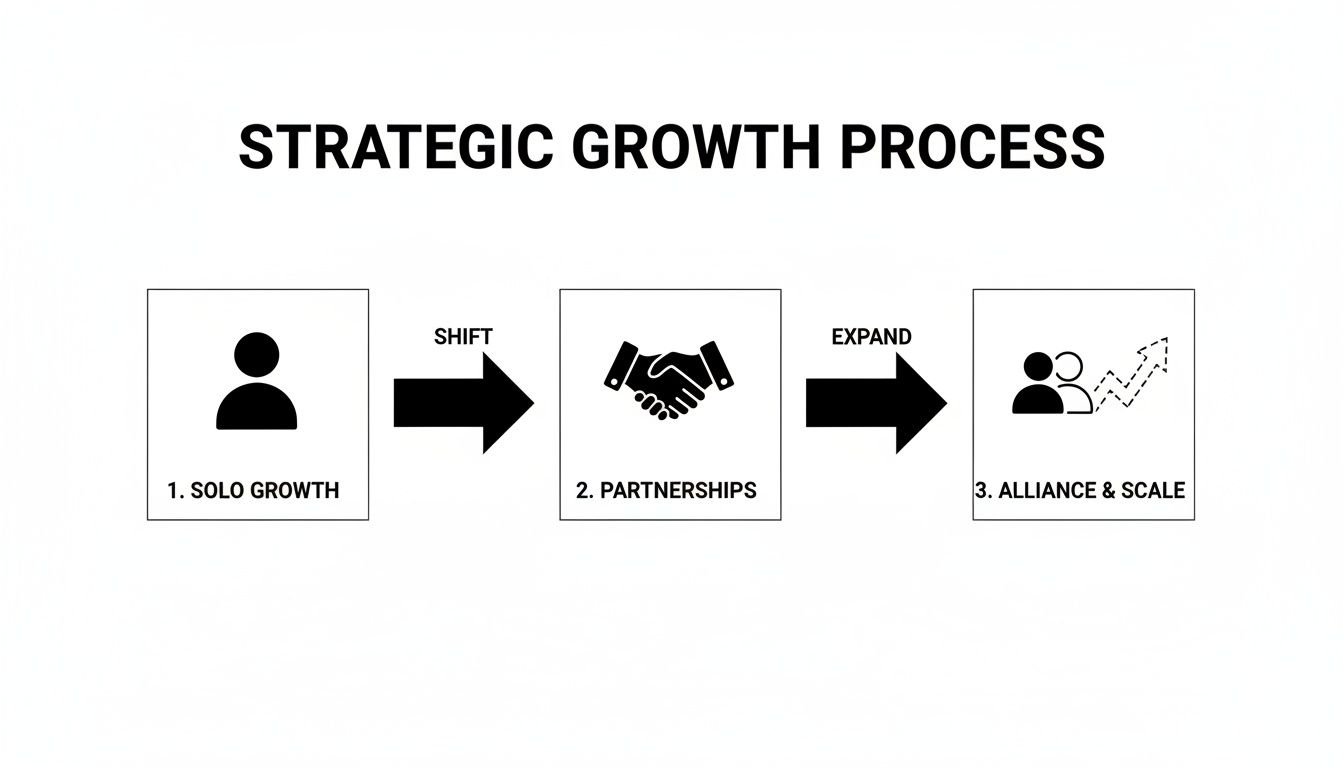
This is the shift that turns your brand into a hub, unlocking audiences and opportunities you could never reach alone.
Before you even think about outreach, you need to know what a "win" looks like. Vague goals like "grow the brand" are just wishful thinking. You have to get specific and tie your partnership goals directly to your core business metrics.
So, what are you actually trying to accomplish?
Your goals are the compass. A goal to lower CAC points you toward co-marketing or affiliate partners. A goal to enter a new market means you should be looking for a distribution alliance.
With your goals locked in, it's time to create your Ideal Partner Profile (IPP). This is exactly like building a customer persona, but for the businesses you want to work with. It's the difference between guessing and having a data-informed search.
Your Ideal Partner Profile is your filter. It prevents you from wasting weeks or even months exploring partnerships that were never going to work, simply because you didn't define what "good" looks like upfront.
Don’t just scratch the surface. A strong IPP goes deep on the details that truly matter.
Finding the right companies to work with is one of the most foundational parts of scaling. For a deeper look at this process, check out our guide on how to find the right business partner that fits your brand’s needs.
Once you have a list of potential partners who fit your IPP, the final step is to score them objectively. This is what keeps you from getting distracted by the biggest name and instead focuses your energy on the best fit.
A simple scoring matrix is the tool that makes this possible. It’s a game-changer for effective strategic partnership development because it forces you to be disciplined.
Here's a framework to evaluate each opportunity systematically.
The key is the weighted system. Assign a higher weight (1-5) to the criteria that matter most for your goals. "Audience Overlap" might be a 5, while "Ease of Execution" might be a 3. Just multiply the score you give each partner (1-10) by the weight to get a total, then add it all up.
This simple exercise instantly clarifies where you should focus first. You’re no longer guessing—you now have a data-driven blueprint for building a predictable, high-impact partnership pipeline.
You’ve done the research and have a scored list of potential partners. Great. Now comes the part where the rubber meets the road—turning those prospects into active, committed partners. This is all about strategic partnership development, and it starts with outreach that actually gets read and negotiations that build something lasting.

The mindset here is key. Don't think, "What can I get out of this?" Instead, lead with, "What can we build together?" That shift toward mutual value is what separates a one-off campaign from a powerhouse partnership.
Your first email is everything. It's your only shot to make an impression, and generic, copy-paste messages are a one-way ticket to the trash folder. To get a reply, you have to prove you’ve done your homework.
Your message needs to immediately answer their silent, all-important question: "What's in it for me?"
Let’s walk through an example. Say you sell high-end, sustainable coffee beans and you've found a popular blogger who reviews non-toxic cookware.
See the difference? The second one is specific. It shows you're a genuine reader and proposes a clear idea that benefits their audience. This is the kind of thoughtful outreach that works. Solid business networking strategies are built on this value-first principle.
Once you’ve opened the door and started a conversation, the game shifts to negotiation. This isn't about winning or squeezing the other person. Think of it as a collaborative session to build a deal structure that works for everyone.
Negotiation is not a battle; it's a creative problem-solving session. The best agreements are co-created, with both parties contributing ideas to shape a deal that excites them and aligns with their business goals.
The deal you land on will really depend on the type of partner and what you’re trying to achieve. Here are a few common models we see all the time.
The trick is to be flexible. Go in with your preferred model, but be ready to listen and adapt the structure based on what your partner needs to make it a win for them, too.
Before you sign on the dotted line, you have to do your homework. This is non-negotiable. Due diligence is the safety net that protects your brand from a partnership that could turn sour and damage your reputation. A bad partner is much, much worse than no partner.
Treat this checklist as mandatory.
This isn't about being paranoid; it's about being a professional. Vetting a potential partner thoroughly ensures you’re teaming up with a company that shares your values and work ethic, paving the way for a truly win-win deal.
Think of your partnership agreement as the rulebook you both agree to play by. It’s not about planning for a fight; it’s about creating total clarity so you can focus on execution. This document gets you and your partner on the same page, aiming for the same targets, before any real work begins. While it's no substitute for a lawyer, walking into that conversation well-prepared is a critical part of smart strategic partnership development.
A solid agreement protects everyone and manages expectations from day one. Your goal is a contract that’s thorough but still easy to understand—a clear guide to the "who, what, when, and how" of your collaboration.
Here's what you absolutely need to nail down:
Your partnership agreement is the single source of truth. It's the document you'll both refer back to when questions pop up, preventing small misunderstandings from becoming deal-breakers.
To get a jumpstart on your paperwork, you can use a Free AI Contract Generator to outline the basic structure. This helps organize your thoughts before you bring in the legal experts.
Once the legal ink is dry, it’s time to get practical. How will this partnership actually work day-to-day? A slick operational setup is what keeps things transparent and friction-free.
First, set up your communication lines. A shared Slack or Teams channel works wonders for quick check-ins and daily chatter, keeping important details out of the black hole of email. Lock in regular calls—I’d suggest weekly during the launch phase, then shifting to bi-weekly or monthly to keep the momentum going.
Next, you have to build the technical framework for tracking. For any deal based on performance, this is non-negotiable.
Financials are where partnerships often get messy, so make it painfully clear from the start. If you're on a revenue-share model, define the exact payment schedule (like Net 30 or Net 45) and map out the entire invoicing and payment process.
Smart commercial partnerships have been a game-changer across industries, unlocking massive value. For Amazon sellers and DTC brands, this can mean partnering with vetted suppliers to slash fulfillment times or teaming up with logistics pros to boost margins by 15-25% by sharing infrastructure.
This kind of operational discipline is everything. When you manage your partners with the same focus you give your own internal teams, you’re building a relationship that's not just profitable but also sustainable. These are the same core ideas you'll find in solid vendor management best practices, and they apply just as much to strategic partners.
Getting the contract signed feels like the finish line. It’s a huge win, but in reality, it’s just the start. The real work—and the real value—begins the moment you activate a partnership. This is where a promising deal transforms into a real growth engine for your brand.

I’ve seen too many partnerships lose steam right after the ink dries. It’s not because the idea was bad; it’s because there was no plan for what to do next. A solid activation plan is your insurance against this, making sure you and your new partner hit the ground running and score those critical early wins.
The first three months are everything. This is when you set the tone, establish a working rhythm, and prove the partnership is worth the effort. A well-designed 90-day plan gets everyone moving from commitment to action with clear, achievable goals.
Think of it as a shared roadmap that builds momentum, not just a single launch day.
A structured plan like this helps you avoid that awkward "…now what?" moment and creates a clear path to generating returns right out of the gate.
Good communication is the lifeblood of any healthy partnership. You can't just wait for problems to pop up; you need a proactive, scheduled cadence for performance reviews and strategic planning.
This isn’t about adding more meetings to the calendar. It’s about creating dedicated time to align on data, celebrate what’s working, and tackle challenges together. A great framework looks something like this:
Your partner dashboard is your objective scorecard. When both teams are looking at the same numbers—be it referral traffic, conversion rates, or coupon usage—conversations shift from subjective feelings to data-backed decisions.
The best partnerships don't stay static; they evolve. If that initial co-marketing campaign was a home run, don’t treat it as a one-off success. Let it be the start of a deeper, more integrated relationship. The real goal is to find ways to create compounding value over time.
Think about how the partnership could expand:
By actively managing, reviewing, and scaling your partnerships, you turn them from simple transactional deals into strategic assets that deliver sustainable, long-term growth.
Even with the best playbook in hand, you’re bound to have some questions. It’s a natural part of wading into partnerships for the first time. Let’s break down some of the most common hurdles ecommerce founders face and give you some straight, actionable answers based on what we’ve seen work (and what hasn't).
This one comes up all the time. When a partnership isn't driving direct sales, you have to shift your focus to the leading indicators—the metrics that signal you're building real brand equity. Think of these as the precursors to future revenue.
Instead of staring at your sales dashboard, start tracking these KPIs:
You can also toss in a unique discount code, like "PARTNERNAME15," to catch any sales that trickle in indirectly. Over time, you can connect the dots between these awareness activities and a general lift in your baseline sales to get a rough financial estimate.
Hands down, the single biggest mistake is launching on a foundation of misaligned expectations. It happens when excitement causes founders to gloss over the nitty-gritty details, and that’s precisely where promising partnerships go to die.
Before you even think about launching, you and your partner need to co-create a document that spells everything out. Don't assume anything is "obvious."
The most common point of failure is ambiguity. If you haven't written it down and had both parties agree to it, it doesn't exist. Clarity upfront prevents 90% of downstream conflicts and disappointments.
Your agreement needs to be crystal clear on who's creating the marketing assets, who's fronting the ad spend, the exact process for content approval, and who fields customer questions about the collab.
Knowing when to fold 'em is a superpower. It saves you from wasting time and energy and, more importantly, protects your brand from getting stuck in a bad deal. A great partnership feels like a true collaboration right from the start; a bad one feels like an uphill battle from the first conversation.
You should seriously think about walking away if you see these red flags:
If your gut tells you a negotiation feels purely transactional or one-sided, listen to it. It’s always better to walk away and keep your resources for an opportunity that actually feels right.
The time you’ll spend really depends on the scale and importance of the partner. But for a key strategic relationship, a solid rule of thumb is to budget 3-5 hours per week for the first 90 days.
This initial "activation period" is where all the heavy lifting happens. You'll be on weekly check-in calls, planning campaigns together, and digging into the first waves of performance data. Once you find a good rhythm, you can usually pull back to 1-2 hours per week for ongoing check-ins and monthly strategy reviews.
The real key isn't the total number of hours, but the consistency. A dedicated, recurring block of time on your calendar is infinitely more effective than trying to manage the relationship in random, reactive spurts.
At Million Dollar Sellers, we know that the right partnerships are a force multiplier for growth. Our community is built on the principle that the smartest founders scale by learning from their peers—sharing what works, what doesn't, and who to trust. If you're ready to move beyond solo growth and tap into a network of elite ecommerce entrepreneurs, see if you qualify to join us. Learn more at milliondollarsellers.com.
Join the Ecom Entrepreneur Community for Vetted 7-9 Figure Ecommerce Founders
Learn MoreYou may also like:
Learn more about our special events!
Check Events