Chilat Doina
July 19, 2026
You're probably in one of two situations right now.
Either your brand is already doing meaningful volume on Amazon, DTC, or marketplaces, and someone on the team keeps saying TikTok Shop is the next channel you need to open. Or you already tried to open it, hit a vague verification wall, and realized TikTok Shop seller requirements are stricter than most seller guides make them sound.
For established operators, the mistake isn't moving too slowly. It's assuming TikTok Shop works like another standard marketplace onboarding flow. It doesn't. The platform now checks legal structure, operational readiness, identity, banking, and category compliance as one connected system. If one piece is loose, the whole application can stall.
The biggest problems usually don't come from beginners. They come from complex brands with layered ownership, foreign founders, holdcos, US LLCs, shared service teams, and bank accounts that don't line up cleanly on paper. That's where applications break.
A lot of established brands waste weeks here.
The team has revenue, inventory, a US LLC, a warehouse partner, and a finance stack that works everywhere else. Then TikTok Shop asks who owns the entity, where the operator is based, which market the account is native to, and whether the payout and fulfillment setup match that exact structure. That is where sellers with complex setups get tripped up, especially non US owners using a US LLC as the operating shell.
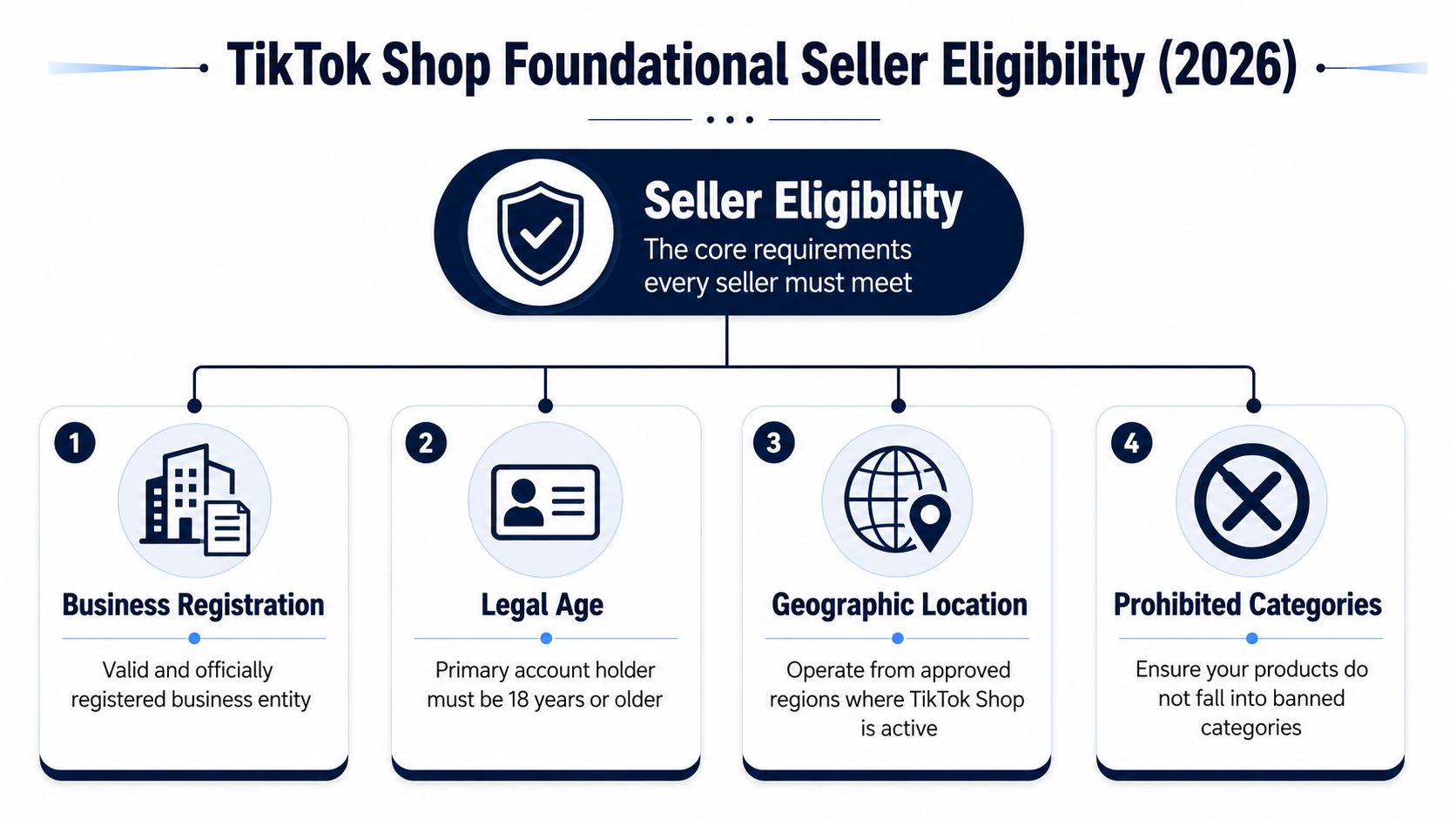
TikTok Shop reviews the seller as an operating business, not as a pitch deck. The entity needs to make sense on paper and in practice for the market you want to enter.
For established operators, the primary question is alignment. Does the registered business name match the tax record, bank account, warehouse relationship, and account owner identity? If one piece points to a different company, holding company, founder, or country, review friction goes up fast.
The common failure pattern looks like this:
A US LLC helps. It does not fix a broken compliance chain.
Some brands try to squeeze through the individual seller route because it looks faster. For a real company, that usually creates more problems than it solves.
If inventory, payouts, taxes, customer support, and ad spend run through a business, register as a business. Keep the application logic consistent with how the company already operates. Trying to run a scaled brand through an individual profile creates avoidable mismatch between the legal seller, the tax party, and the payout destination.
That mismatch gets expensive later, not just during approval.
TikTok wants evidence that the business can fulfill orders in the target market without chaos. A remote setup can work in some structures, but established brands should assume the platform will look for proof that local operations are real, controlled, and fast enough for marketplace standards.
Use a hard internal check before anyone starts the application:
If you are a global brand, run one more test. Ask whether an outside reviewer could understand your structure in five minutes from the documents alone. If the answer is no, fix the structure first.
Teams building that readiness plan can use these TikTok seller considerations for scaling brands as a benchmark.
This is the eligibility issue I see experienced sellers underestimate most often.
A non US founder can absolutely operate through a US entity in many cases. The problem is assuming the LLC itself is enough. TikTok still has to get comfortable with beneficial ownership, tax identity, banking alignment, operational control, and who is responsible for the account. If your setup was built for Stripe, Amazon, or a 3PL contract, that does not mean it is clean enough for TikTok Shop review.
Treat eligibility as a chain. Entity, owner, bank, warehouse, market, and account identity all need to line up. If one link is weak, the application can stall even when the business is legitimate and already doing serious volume elsewhere.
A clean business can still get rejected if the file set looks improvised.
TikTok reviews seller applications like a compliance file. Reviewers are checking whether the person, entity, bank, tax profile, and operating footprint all point to the same business. Established brands run into trouble here because they assume marketplace onboarding works like opening a Stripe account or adding a new Amazon store. TikTok is less forgiving about mismatches, especially when the owner lives outside the US and the selling entity is a US LLC.
Build the dossier before anyone touches the application. If your team uploads documents first and tries to explain inconsistencies later, you create avoidable delays.
Seller documents need to be complete, legible, and consistent with the registration path you chose. TikTok's own US seller guidance for individuals requires full-image identity documents in JPG, PNG, or PDF format under 10 MB, plus legal name, date of birth, residential address, expiration date, SSN or ITIN details, a W-9, and proof of address, according to TikTok Shop Seller University guidance for US individuals.
The operational lesson is simple. File discipline matters more than people expect.
Use these standards across the dossier:
One small mismatch can stall a legitimate application. The common examples are boring and expensive: abbreviated entity names, a home address on one file and a registered agent address on another, a bank account tied to a different operating entity, or an authorized representative whose authority is never documented.
| Document | Individual Seller (Sole Proprietor) | US-Based Business (LLC/Corp) | Non-US Owner of US LLC |
|---|---|---|---|
| Government-issued ID | Required | Required for identity verification of account holder or representative | Required for representative and relevant owner verification |
| SSN or ITIN | Required | May be relevant for identity or tax workflows | Depends on representative setup and tax workflow |
| W-9 | Required | Required for US tax setup | Required where the US entity is being onboarded for tax setup |
| Proof of address | Required | Often needed for verification support | Often needed for representative verification support |
| EIN documentation | Not primary requirement for sole proprietor path | Required | Required |
| Business registration documents | Not required for individual path | Required | Required |
| UBO information | Not primary requirement in individual path | Required for anyone holding 25% or more equity | Required and often the source of friction |
| Local US bank account | Required and must match seller identity | Required and must match business setup | Required and must match approved operating structure |
| Authorization letter | Not typical | May be needed depending on representative setup | Often required |
| IRS CP757A | Not typical | Usually not the issue for domestic ownership | Often requested when the EIN and ownership chain need stronger support |
This is the compliance gap advanced operators miss.
The LLC formation doc proves the entity exists. It does not fully explain who owns it, who controls it, who is authorized to act for it, and why the payout account, tax file, and representative all belong in the same story. That gap gets wider when the founder is non-US, the US entity was built for payments or logistics, and the TikTok account is being opened by a US employee, agency, or contractor.
In practice, the weak spots are usually predictable:
For non-US owners using a US LLC, I tell teams to prepare for a higher standard of proof than the portal suggests. If the reviewer has to infer ownership, authority, or control, you have already made the application harder than it needed to be.
Organize the file set the way a reviewer will validate it.
Identity layer
Entity layer
Authority layer
Financial and tax layer
Teams that win here do one thing well. They submit a file package that answers the reviewer's questions before those questions get asked.
A lot of established brands lose a week here for a preventable reason. They submit a clean-looking application, assume approval is a straight line, then get stuck because the person completing verification, the device environment, and the entity details do not line up the way TikTok expects.
For a domestic founder running a simple structure, that delay is annoying. For a non-US owner using a US LLC, it can turn into a compliance stall fast because the platform is trying to reconcile cross-border control, local entity registration, and account integrity at the same time.
The timeline is only predictable when the operating details are disciplined. TikTok may move quickly on a clean file set, but teams should plan for review, follow-up requests, and post-approval checks before the shop is ready to sell.
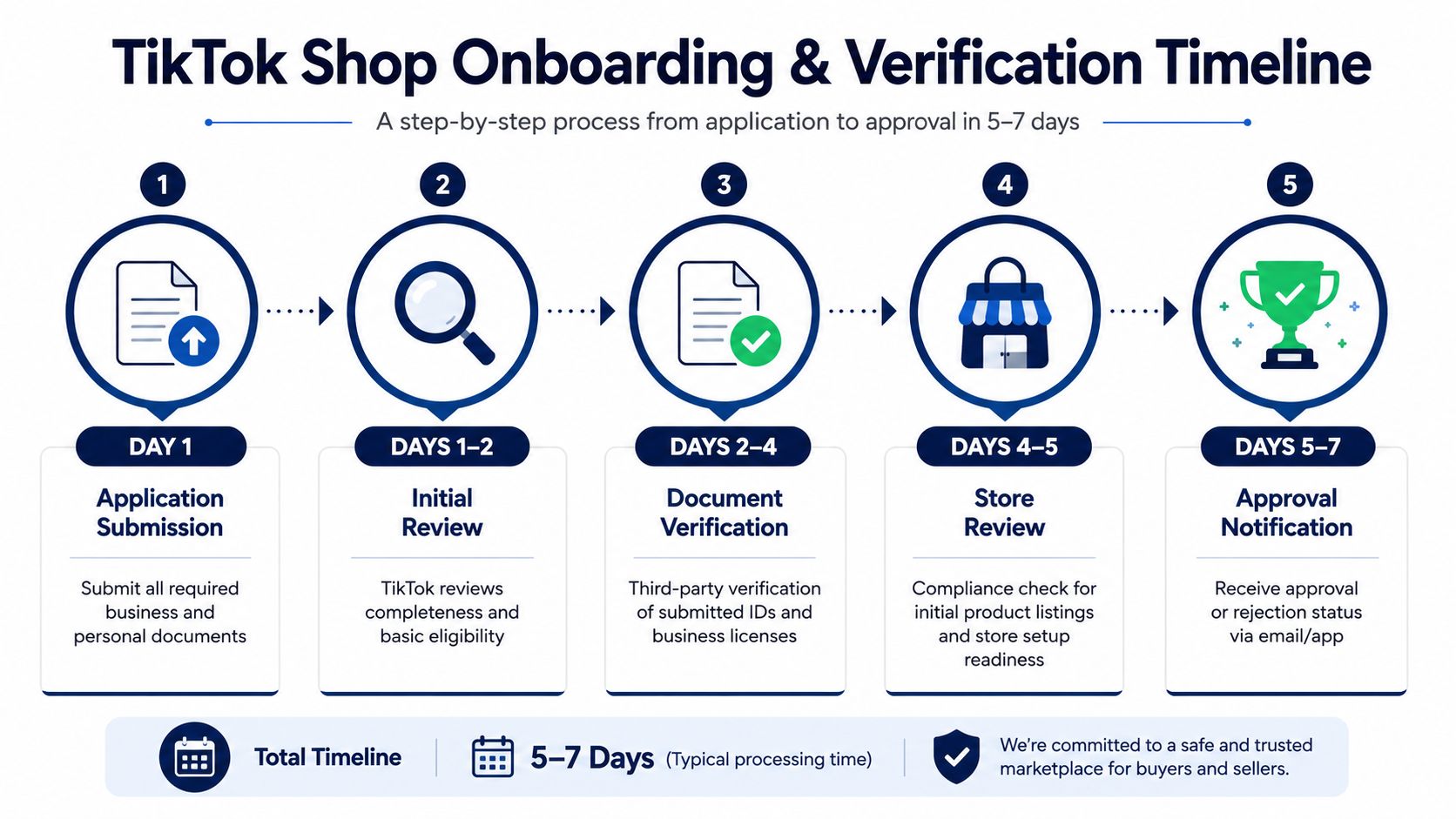
The application form is the easy part. The risk review sits behind it.
TikTok will usually verify the person opening the shop, the entity tied to the shop, and the environment used during setup. That includes identity checks, live verification steps, login security, and basic signals that the account is genuinely operating in the market where it is applying. If your team uses a borrowed device, inconsistent IP history, or a contractor account that was originally created for another region, expect friction.
Larger global operators frequently make expensive mistakes. They delegate setup to a remote team member who is efficient but not legally connected to the entity, or they let an agency start the account before internal legal and finance teams lock the final registration path. That creates a mismatch between who is clicking through onboarding and who controls the business.
For teams building around a US LLC with non-US ownership, the practical rule is simple. The person completing verification should be the person your documents can defend.
Document approval does not mean you are ready to push catalog live.
TikTok still expects the account to clear operational setup steps, and that is where rushed teams burn time. Shipping settings, returns, tax configuration, warehouse logic, and catalog permissions all need to behave like a real business, not a placeholder account assembled just to get through review. The merchants that move fastest usually have their operator training done before approval lands, not after. If your team needs a practical reference point, study how experienced sellers share workflow issues inside the TikTok seller community for operators and brands.
There is also a simple management mistake here. Founders treat the approval email as a green light for the merchandising team to start loading SKUs immediately. That is how you end up with products queued in a shop that still has unresolved settings or a compliance quiz nobody on the team prepared for.
The readiness assessment matters because it tests whether the people running the account understand platform rules well enough to avoid obvious violations. It usually covers topics like:
Operator note: Put the person who will own daily shop operations through these questions before launch week. The founder should not be the only one who knows the answers.
Use this order if you want fewer review loops and fewer internal handoff errors:
Speed comes from clean sequencing. In cross-border structures, especially the non-US owner with US LLC model, precision saves more time than urgency ever will.
A mature brand gets rejected, the team assumes TikTok made a mistake, and two weeks disappear in pointless resubmissions.
That usually is not what happened. TikTok saw one mismatch, treated the account as higher risk, and stopped giving the rest of the file set the benefit of the doubt. The fastest fix is to isolate the exact failure point, correct it at the source, and resubmit a cleaner application instead of arguing with the platform.
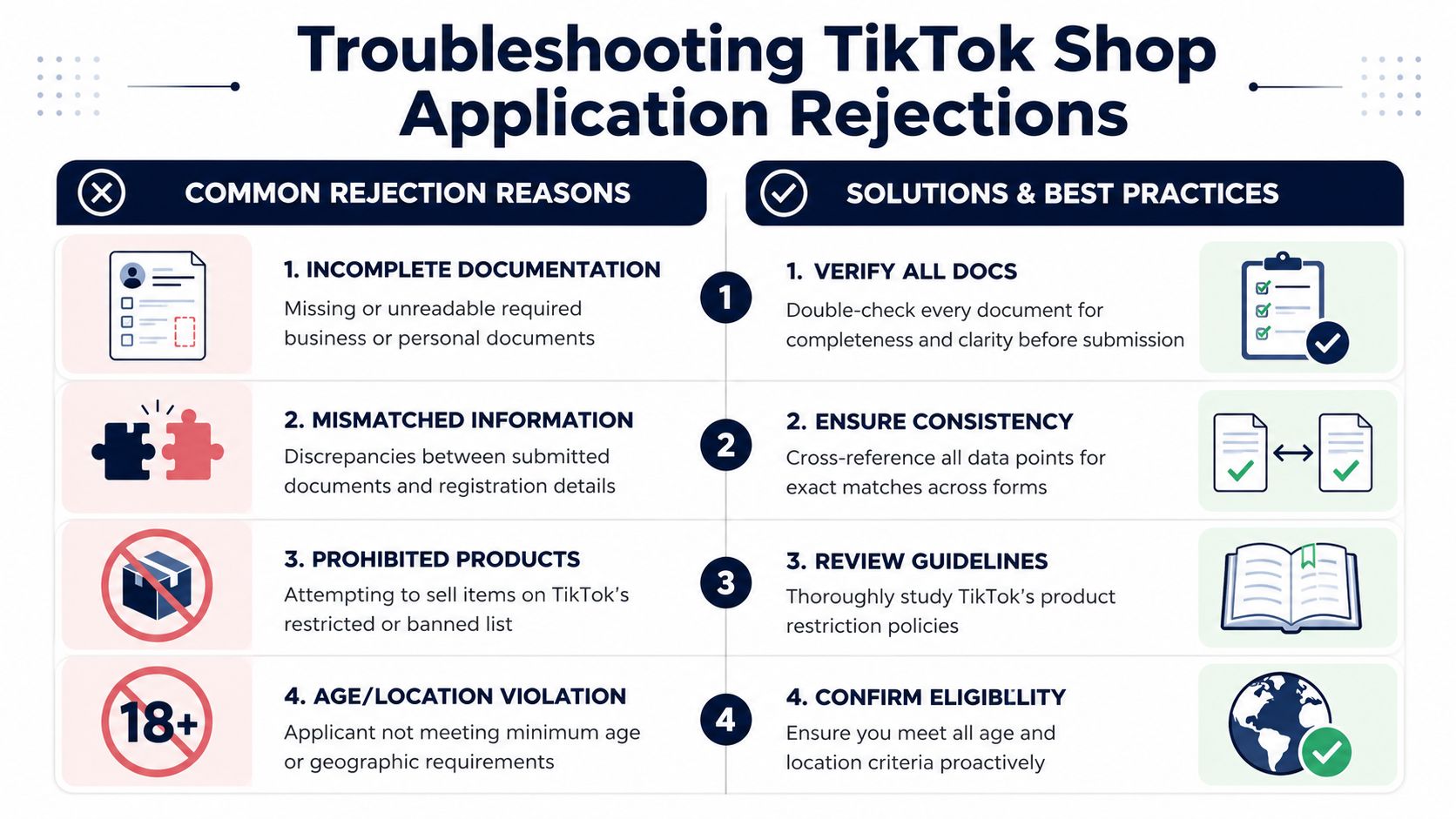
Even advanced operators get tripped up here.
The highest-friction setup is the non-US owner with US LLC model. On paper, the structure is common. In review, it often fails because the application shows a US entity, the supporting documents point to a foreign parent or foreign beneficial owner, and the authorization trail is incomplete or unclear. TikTok reviewers are not going to map your holding structure for you.
Check three things first:
If your ownership stack includes a foreign parent, nominee manager, or layered holdco structure, simplify the reviewer's job. One clean ownership chain beats a technically correct but messy file every time.
This rejection is usually earned.
The platform is strict about document quality and exact-name matching. Cropped corners, glare, shadows, expired IDs, and slight name differences can all trigger a fail. If the ID says Jonathan Michael Smith Jr. and the application says Jon Smith, treat that as a mismatch until proven otherwise.
Use a tighter resubmission standard:
I have seen strong businesses lose review cycles over a single abbreviated first name. That is the level of precision required here.
Payout verification is less forgiving than many finance teams expect.
A clean setup in your ERP or treasury stack does not mean TikTok will accept it. The seller entity name, bank account name, and supporting records need to line up character for character. If the LLC is registered under one format and the bank uses another, the platform can freeze the payout setup or kick the application back for review.
Keep the payout account simple. Use the same legal entity name everywhere, avoid operating aliases during onboarding, and make sure the account is opened in the same country logic the shop is being reviewed under.
Document quality is only part of the review. Login behavior matters too.
Global brands often let agencies, founders, ops staff, and contractors touch the account during setup. That creates avoidable noise. If one person starts the application from London, another uploads documents from Dubai, and a third verifies details from Miami, the account can look compromised even when the business is legitimate.
Control the setup environment:
For operator-level feedback on how teams compare rejection patterns and fixes, review these TikTok seller community discussions.
Do not rush a resubmission the same day unless you know the exact cause.
Audit the rejected field, compare it against the underlying legal and banking records, and rebuild the document set around the mismatch. If the issue sits inside the non-US owner with US LLC structure, get legal, finance, and the person acting as authorized representative aligned before you upload anything again. Speed helps only after the file is internally consistent.
A mature brand can clear seller approval and still stall at the catalog stage.
That happens when the legal entity is acceptable, but the products are not. For established operators, the expensive mistake is assuming TikTok Shop treats category compliance as a later merchandising task. It does not. For a non-US owner using a US LLC, this gap shows up fast. The shop may be approved under the LLC, while the product file still needs testing records, safety documentation, or labeling support tied to the actual goods, importer, or market of sale.

Catalog quality affects review outcomes and sales performance.
As noted in Marszal Studio's TikTok Shop UK 2026 guide, TikTok expects disciplined listing inputs: square or vertical image formats, clean color profiles, compressed files that still render well on mobile, multiple product images, and short product video where the category supports it. Missing category attributes, weak hero images, and inconsistent pricing across channels can reduce visibility or trigger extra scrutiny.
Operators with large catalogs should standardize this before upload. Do not let the creative team improvise image specs SKU by SKU. Build a listing template by category, assign attribute ownership, and QC the first batch manually. Brands that want outside execution support usually benefit from working with a TikTok Shop agency that handles catalog and compliance operations.
Restricted categories are where well-established businesses lose time.
Cosmetics, electrical products, toys, supplements, and other sensitive categories often need supporting documents before listings stay live. In practice, TikTok wants more than a clean product page. It wants proof that the product can legally be sold in that market and that the seller account structure can support that claim if reviewed.
For global businesses, the friction usually sits in one of three places:
Use a simple rule. Before loading any SKU in a restricted category, confirm that the seller entity, product certificates, labeling, and brand authorization all point to the same commercial story.
At the SKU level, the review standard is usually straightforward:
A restricted category can still be profitable. A restricted category without aligned documentation turns into suppressed listings, appeal cycles, and inventory that cannot scale on the channel.
Once the shop clears approval, the last mile is operational.
Here, disciplined brands pull ahead. Not because the steps are complicated, but because they treat launch readiness like a controlled deployment instead of a scramble.
What works is boring consistency. One entity, one bank logic, one warehouse reality, one clean first catalog.
What doesn't work is trying to fix legal, operational, and listing problems after the account is live. TikTok Shop is more forgiving to brands that launch narrow and clean than to brands that launch broad and messy.
For operators that want experienced help benchmarking agencies and execution partners, this review of the best TikTok Shop agency options is a practical next stop.
If you're already operating at scale and want sharper, behind-the-scenes insights from founders solving marketplace, omnichannel, and TikTok Shop challenges in real time, Million Dollar Sellers is where serious e-commerce operators compare notes, pressure-test strategy, and scale with a peer group that's already been there.
Join the Ecom Entrepreneur Community for Vetted 7-9 Figure Ecommerce Founders
Learn MoreYou may also like:
Learn more about our special events!
Check Events