
Chilat Doina
May 21, 2026
You already know the obvious version of fees with FBA. Referral fee. Fulfillment fee. Storage fee. That part isn't what wrecks margin.
What wrecks margin is when a SKU looks healthy in a launch sheet, keeps converting, and still underperforms in the P&L because the fee stack behaves differently than you modeled. A packaging change pushes the unit into a different size tier. Inventory lingers into peak storage months. A product priced just above a threshold earns worse economics than the cheaper version of the same offer. None of that shows up if you treat FBA as one blended line item.
That's why experienced operators keep revisiting contribution margin instead of assuming the model is stable. The fee reset that took effect on January 15, 2026 made that even more obvious. Amazon increased U.S. fulfillment fees, with standard-size items priced $10 to $50 seeing an average increase of $0.08 per unit, items over $50 seeing an average increase of $0.31 per unit, and oversize items seeing increases from $0.12 to $0.85 per unit depending on tier, while low-price items under $10 still kept a discounted fulfillment rate of about $0.86 below the standard rate, as summarized in this 2026 Amazon FBA fee guide.
If you're serious about margin control, don't treat that as background noise. At scale, tiny unit changes become operating policy. That's the same mindset behind Everglow Prosperity's profitability guide. The useful takeaway isn't “cut costs” in some generic sense. It's that profitable businesses find the specific leaks, then build systems to stop them.
A common pattern looks like this. You launch a SKU with a clean sourcing sheet, a reasonable target margin, and plenty of room for ads. Sales come in. Reviews build. The listing doesn't look broken. Then the statement lands, and the margin is thinner than expected.
Usually, the product didn't fail. The model failed.
Most sellers still diagnose profit problems as if there's one culprit. They blame the outbound fee, or they blame storage, or they blame Amazon in general. In practice, the margin leak comes from stacking effects:
The dangerous part is that none of these moves feels dramatic on its own.
Your fee statement rarely screams. It whispers, and it does it across dozens or hundreds of ASINs.
Founders with real volume don't usually miss the existence of fees. They miss the interaction between fees. That's a different problem.
A mature catalog creates false confidence because the business is already working. Units are moving, cash is recycling, and the dashboard looks fine. But fees with FBA aren't linear. The same sell-through pattern that works for one ASIN can subtly punish another because dimensions, seasonality, age, and pricing band all behave differently.
That's why the right question isn't “What are Amazon's fees?” You already know that.
The right question is, where is this SKU leaking money after the sale happens?
When you start looking at fees that way, you stop accepting them as unavoidable overhead. You start treating them like a live operating variable that deserves the same scrutiny you already give to CVR, TACoS, and cash flow.
Teams often overcomplicate fee review because they look at Amazon reports as a pile of line items instead of a simple cost architecture. The fastest way to clean that up is to sort every charge into a few functional buckets.
Imagine a restaurant bill. One charge is the price of the meal. One is the cost of getting it to your table. One is the cost of occupying the table too long. Everything else is either an optional service or a penalty for making operations harder.
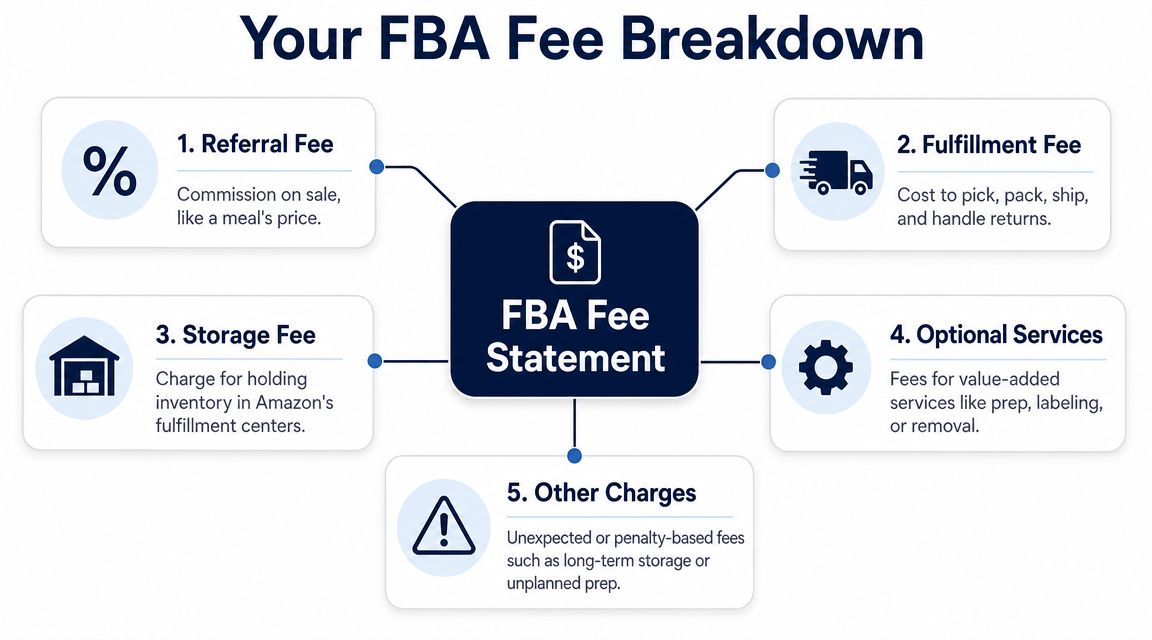
Use this mental model when you review settlements, product economics, or launch assumptions.
| Fee Category | What It Covers | Primary Cost Driver |
|---|---|---|
| Referral Fee | Amazon's commission on the sale | Selling price and category |
| Fulfillment Fee | Pick, pack, ship, customer service, returns handling | Size tier, dimensions, shipping weight |
| Storage Fee | Space used in Amazon's network | Cubic volume and time held |
| Optional Services | Prep, labeling, removals, related value-added services | How cleanly inventory arrives and how you manage exceptions |
| Other Charges | Penalty-like or reactive charges tied to inventory performance or operational misses | Inventory age, stock health, process quality |
Referral fees matter, but they're usually the most straightforward piece of the stack. They behave more like a commercial commission than an operations fee.
That's why strong operators don't spend most of their time debating referral. They spend it on the part they can bend. Physical product design, replenishment timing, and assortment strategy all sit in the other buckets, and that's where their greatest influence lies.
This is the first place many models break. Amazon's own FBA overview notes that fulfillment economics are highly sensitive to size-tier and weight breakpoints, not just sale price. In the U.S. structure described in 2026 market summaries, standard-size fulfillment fees are commonly around $3.06 to $6.62 per unit, while larger or heavier items can rise to $9.61 to $194.95+ depending on dimensions and shipping weight, as outlined on Amazon's FBA page.
That means a product isn't “a 15 percent fee product” or “a 20 percent fee product.” It's a physical object moving through a network with pricing rules.
For teams that need a more detailed breakdown of how these buckets show up in practice, this FBA fee analysis from MDS is a useful companion read.
Practical rule: If your margin depends on a SKU staying inside a narrow size profile, treat packaging review as a finance function, not a branding exercise.
A lot of sellers still think of storage as a background warehouse cost. It isn't. It's an operational tax on poor inventory timing.
The key distinction is simple:
Once you separate fees this way, diagnosing a margin problem gets faster. If a SKU sells well but still disappoints, look first at fulfillment tier. If a SKU looked good on paper but weakens over time, inspect storage age and inventory cadence. If a normally healthy ASIN suddenly turns erratic, go hunting in the exception fees.
That's the frame most sellers skip. And skipping it is why fees with FBA keep feeling random when they're usually very explainable.
Good operators don't stop at “what does Amazon charge.” They ask a harder question. What does this unit cost after the network touches it, after time passes, and after the inventory plan gets stress-tested?
That's what true landed FBA cost means in practice. It's not just the sale-day fee. It's the combined effect of sale, physical footprint, and time.
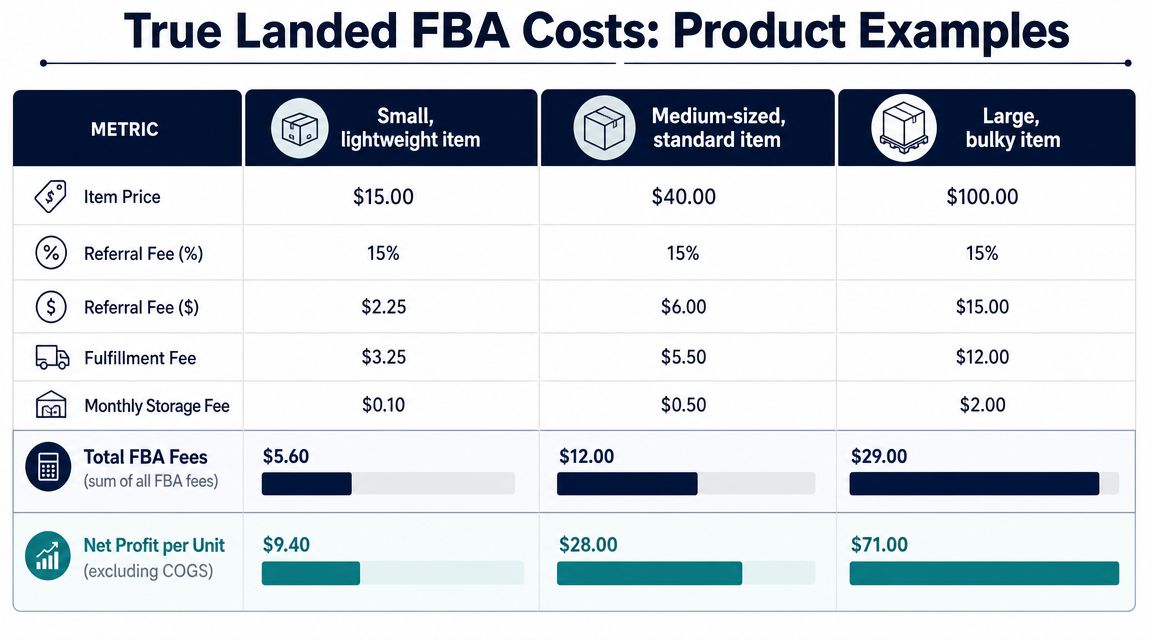
At the SKU level, I'd model landed FBA cost in this order:
That sequence matters. Most sellers reverse it. They start with referral because it's easy, then they use a generic fulfillment assumption, and they barely model storage. That's how a product gets approved when it shouldn't.
If your team needs a broader framework for unit-level economics, this landed cost guide from MDS helps connect sourcing math with channel-level profitability.
Before launch or reorder, answer four questions:
That last question is where margin models get honest.
Storage and aged inventory costs changed enough that they can't sit in the “minor fees” bucket anymore. In 2026, standard storage rates were reported at $0.78 per cubic foot from January through September, then $2.40 per cubic foot during October through December, which is roughly a 3.1x seasonal jump, and inventory stored more than 365 days carried an additional long-term storage fee of $6.90 per cubic foot per month, or $0.15 per unit, whichever is greater, according to this 2026 storage fee summary.
A seller looking only at launch-month profitability can miss the full picture. A unit that works comfortably in the first part of the year can produce much weaker economics later if inventory planning slips and more volume is still sitting in Amazon during peak storage months.
That doesn't mean the SKU is bad. It means the inventory calendar is part of the cost model.
Here's the practical implication:
| Variable | What it looks like in a model | What it means operationally |
|---|---|---|
| Dimensions | Determines likely fulfillment tier | Packaging engineering affects margin |
| Weight | Can alter fee treatment within size logic | Product and bundle choices matter |
| Cubic volume | Drives storage exposure | Air space inside packaging is expensive |
| Days in network | Drives seasonal and aging risk | Forecast accuracy matters as much as sourcing |
They focus on conversion and AOV, then underestimate how fast physical inefficiency eats the gross profit. A light but bulky unit can be worse than a dense, compact product because Amazon prices around logistics reality, not seller optimism.
That's why product development and ops have to sit at the same table. If your packaging team adds perceived value but nudges a SKU into a worse dimensional outcome, finance needs to know before the PO goes out.
If a package redesign can move a unit below a breakpoint, the margin gain often beats a lot of the “growth hacks” sellers spend time chasing.
A clean FBA model should include at least three scenarios:
You don't need fake precision to do this well. You need honesty. If a product only works when inventory moves perfectly, it doesn't really work. It's just fragile.
That's the non-obvious lesson with fees with FBA. Landed cost isn't a static worksheet. It's a moving number shaped by packaging, price position, and inventory velocity. The sellers who model all three before they commit cash usually avoid the ugliest surprises later.
The dangerous fees aren't the ones you can spot in five seconds. They're the ones that only appear after your catalog is already live, your reorder is already in motion, and your team has mentally classified the SKU as “working.”

That's why the idea that FBA fees are predictable is only half true. The visible fees are predictable. The reactive fees depend on how well you operate.
A lot of sellers obsess over overstock and ignore the opposite problem. Amazon has stated that inventory-level fees can apply when a product's inventory relative to short- and long-term historical demand falls below 28 days, with charges reported in the range of $0.89 to $1.11 per unit depending on size tier, shipping weight, and historical days of supply, as noted in this breakdown of Amazon FBA fees.
That creates an annoying reality. You can get hit for carrying too much inventory later, and you can also get penalized for running too lean now.
The fix isn't “hold more stock” or “hold less stock.” The fix is better inventory cadence.
When a hidden fee appears, treat it as operational feedback.
The fee itself matters, but the process failure behind it matters more.
Most hidden fees aren't random. They're Amazon billing you for operational indecision.
A quick visual refresher helps if your team needs to reset how it thinks about fee categories and account hygiene.
Stronger operators don't just ask, “How much did this fee cost?” They ask:
That last question matters. If one ASIN ages out, maybe the offer is weak. If lots of ASINs age out, the catalog strategy is weak. If inbound mistakes keep triggering cleanup costs, that's not an Amazon problem. That's a receiving and prep workflow problem.
The hidden fees are useful because they reveal what the business is bad at. They force clarity. And once you start reading them that way, fees with FBA become less mysterious and more diagnostic.
The sellers who protect margin don't think of FBA fees as fixed. They treat them like a set of constraints that can be designed around.
That shift matters. Once you stop asking “what does Amazon charge me” and start asking “what decision is causing this charge,” a lot more becomes controllable.

This is one of the most impactful strategies in the whole system. Amazon's fee structure rewards compact, efficient packaging and punishes wasted dimensional space.
If your product sits near a size-tier breakpoint, packaging work can outperform listing optimization. That might mean:
A lot of brands treat packaging as a brand function. The stronger move is to treat it as margin engineering.
One of the cleanest pricing cliffs in fees with FBA sits around the low-price threshold. Amazon now automatically applies lower Low Price FBA fulfillment rates to products priced under $10, with the fee discount described as $0.86 less than standard FBA rates, which creates a meaningful difference between a SKU at $9.99 and one at $10.01, according to Amazon Seller Central's fee guidance.
That should change how you think about assortment and repricing.
The decision isn't always “stay under $10.” Sometimes the right move is to move decisively above it because your offer can support a stronger gross margin. But hovering just over the threshold without modeling the fee consequence is lazy pricing.
Packaging and pricing get the attention. Replenishment discipline still does just as much work.
If you're trying to lower total FBA cost, don't isolate Amazon from upstream logistics. Inbound decisions affect how cleanly inventory lands, how much buffer you need, and how often slow-moving stock gets stranded. For operators reviewing that full chain, this freight forwarder for FBA guide from MDS is worth a look.
Not every tactic is worth the operational complexity. These usually are:
A few common reactions sound smart but age badly.
Operator note: The best fee reductions usually come from product design and inventory policy, not from arguing with statements after the fact.
That's the main persuasion point here. Fees with FBA aren't just a cost line. They're a direct output of the choices you make in packaging, pricing, and inventory planning. Sellers who accept them passively donate margin. Sellers who engineer around them keep it.
The strongest founders eventually stop talking about fees as if they're a tax. They start treating them as a map of Amazon's incentives.
Amazon is telling you what it wants. It wants inventory that moves. It wants packaging that uses less space. It wants replenishment that supports customer demand without clogging the network. It wants fewer operational exceptions. Sellers who align with that system tend to keep more margin.
That's why fee mastery becomes a moat. When you understand the breakpoints and the second-order effects, you can source products other brands reject for the wrong reasons. You can also reject products that look attractive in surface-level spreadsheets but collapse once the full FBA reality shows up.
There's also a subtler edge. Fee-aware sellers make better commercial decisions faster. They know when to trim packaging, when to reprice, when to bundle, and when to pull a weak ASIN out of FBA instead of letting it drain cash.
You don't need perfect control. You need a better model than the seller next to you.
That's the genuine opportunity in fees with FBA. If you treat them as static overhead, they stay painful. If you treat them as operational signals, they become one of the clearest competitive advantages available inside the marketplace.
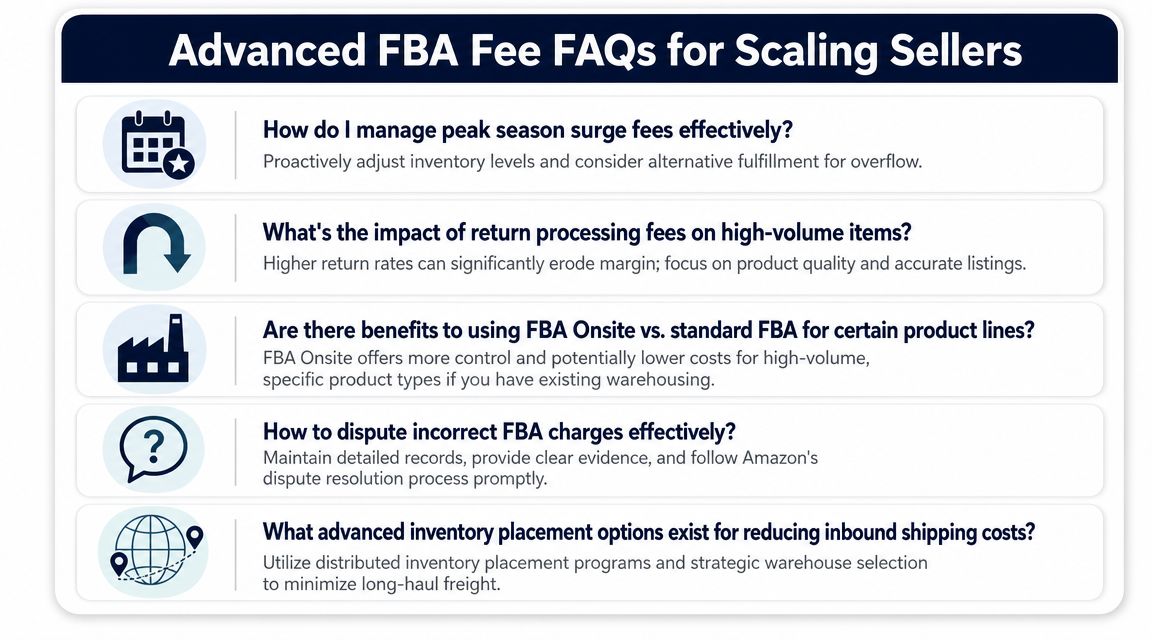
At scale, basic fee advice stops being useful. The key questions are portfolio questions, not definition questions.
When the SKU's strategic value no longer justifies the storage and cleanup risk.
Recent coverage shows long-term storage penalties can rise sharply with age, with cited levels of $1.50 per cubic foot for 181 to 270 days, $3.80 for 271 to 365 days, and $6.90 per cubic foot or per unit for 365 plus days, while removal fees and return-related costs can also climb materially, as summarized in this look at hidden Amazon FBA fees.
The practical framework is simple:
Only if the threshold improves total contribution, not just fee optics.
A lower fee is useful. A weaker business isn't. If moving below a threshold increases conversion, protects margin, and keeps velocity healthy, do it. If it undermines perceived value or leaves no room for ads and returns, don't force it.
The right test is total contribution after all channel costs, not emotional attachment to a price point.
Don't start at the account level. Start with exception clusters.
Review the ASINs showing one or more of these patterns:
That method gets you to the actual leaks faster than reading reports line by line across the entire catalog.
When the SKU is conversion-stable but contribution-weak.
If the offer is already proving demand and traffic isn't the problem, more marketing often amplifies an inefficient unit. A packaging fix can improve every single order without requiring more spend. That's especially true when the current package wastes space, ships awkwardly, or creates inbound friction.
In other words, don't pour ads into a unit that physically wants to be redesigned.
If demand is healthy and margin is not, the next meeting should usually be with ops, not with the ad team.
Use a portfolio lens, not a channel ideology.
Some products belong in FBA because speed, Prime conversion, and network reach outweigh the fees. Some don't. The problem starts when sellers force every SKU into the same fulfillment model because operational simplicity feels cleaner than channel fit.
Use these decision criteria:
| Question | FBA tends to fit better when | FBM can make more sense when |
|---|---|---|
| Velocity | Demand is consistent and predictable | Demand is irregular or lumpy |
| Physical profile | The unit is compact and efficient | The unit is bulky, awkward, or expensive to store |
| Margin tolerance | The SKU can absorb platform logistics costs | Margin is too thin for prolonged storage exposure |
| Catalog role | The product is a core growth driver | The product is niche, seasonal, or defensive |
More often than most do.
Not because Amazon changes rules every week, but because your catalog changes. Packaging drifts. Suppliers make substitutions. price architecture evolves. Inventory habits get sloppy. A SKU that was efficient last year can become mediocre without anyone making one dramatic mistake.
For larger brands, the better discipline is a recurring margin review tied to packaging, replenishment, and aging inventory decisions. The point isn't to obsess over every penny. The point is to stop preventable leakage before it scales across the catalog.
If you're building at a level where these fee decisions affect real cash flow across a large catalog, Million Dollar Sellers is where high-caliber founders compare notes on the operational details that move profit. It's a serious room for serious operators who want better answers than the public playbook gives them.
Join the Ecom Entrepreneur Community for Vetted 7-9 Figure Ecommerce Founders
Learn MoreYou may also like:
Learn more about our special events!
Check Events