Chilat Doina
December 11, 2025
Picture the Amazon marketplace for a second. It's not one giant, open bazaar. It’s more like a sprawling city with two very different kinds of districts.
One area is like a public square, open to everyone. Anyone can show up, set up a stall, and start selling. That’s your ungated category.
The other area is like an exclusive, high-end shopping district. To get in, you need to go through a doorman who checks your credentials. That's a gated category. This simple distinction is at the core of how Amazon operates.
Amazon’s whole system of “gating” isn’t about making life difficult for sellers. Far from it. It's a smart quality control move designed to protect customers, guarantee products are authentic, and keep brands happy.
Think about it. When you're buying something sensitive like baby formula, fine jewelry, or high-end beauty products, you want to know you're getting the real deal. This vetting process is Amazon's way of creating a trusted space where shoppers feel safe.
By putting up a velvet rope around certain categories, Amazon builds a more controlled and trustworthy marketplace for high-stakes products. It's a win-win for serious sellers and for customers who demand authenticity.
This system forces sellers to be strategic. Sure, ungated categories are the easiest way to get your foot in the door, but they're often packed with competition. This usually leads to a race to the bottom on price, squeezing your profit margins thin.
Gated categories, however, are a different ballgame. They act as a natural barrier to entry. Getting through the approval process takes some work, but once you're in, you’re rewarded with a much less crowded field and the chance to earn much higher profits.
So, Amazon is split into these two distinct environments. As of 2024, you need to get explicit approval to sell in dozens of these restricted categories. The process usually involves having a Professional Seller account, keeping your account health metrics in top shape, and providing specific documents like recent invoices from legitimate suppliers.
For the 9.7 million sellers in the US market, this structure shapes everything. The path you choose—gated or ungated—really depends on your business goals, how much capital you have, and your appetite for a little upfront legwork. It all starts in your seller dashboard, so it's a good idea to understand what Amazon Seller Central is and how to navigate it.
To put it all into perspective, here’s a quick rundown of the main differences.
CharacteristicGated CategoriesUngated CategoriesCompetitionLowerHigherProfit PotentialHigherLowerApproval RequiredYesNoBarrier to EntryHighLow
At the end of the day, ungated categories offer speed and simplicity, while gated categories offer higher potential rewards for those willing to put in the effort. Neither is "better"—it's about what's right for your brand's strategy right now.
Picking between a gated and an ungated Amazon category is one of those foundational decisions you make early on that echoes through everything else you do. It’s not just about what you’re allowed to sell; it’s about defining the entire DNA of your business model—from how you price your products to how you spend your day.
Think of it like choosing your race. The ungated path is a flat-out sprint. The gated path is a strategic marathon. You can't train for one and expect to win the other.
The big draw for ungated categories is speed. The barriers to entry are almost nonexistent, which means you can get a product up and running fast to catch a trend right as it’s cresting. This is the perfect playground for sellers who thrive on high-volume, quick-turnaround sales.
But all that accessibility has a flip side: the market is absolutely packed.
This model is tailor-made for operators who are masters of sourcing, logistics, and running on razor-thin margins. Your competitive edge isn't really the product; it's how efficiently you can get it from A to B.
Real-World Example: An arbitrage or wholesale seller flipping common household goods is built for this world. Their entire business is about spotting small price gaps and moving massive quantities of product, making the wide-open competition of ungated categories their ideal arena.
On the other hand, choosing to get into a gated category is a deliberate, long-game move. The approval process itself acts as a filter, clearing out the casual sellers and leaving a much smaller, more professional pool of competitors. And that changes the entire dynamic of the business.
With fewer players on the field, that constant downward pressure on prices just isn't there. This opens up the door to healthier profit margins and a far more stable marketplace. You can actually focus on building a real brand instead of just surviving a price war. Customers shopping in categories like Fine Jewelry or Collectibles already have a higher level of trust, because they know Amazon has vetted every single seller.
This is the perfect environment for true brand builders with a long-term vision.
This path demands more upfront investment in inventory, the patience to get through the approval hoops, and a deep commitment to creating a brand that lasts. For serious sellers aiming for sustainable, high-margin growth, navigating the gated and ungated Amazon rules isn't a hassle—it's a strategic investment that pays off big time. Your choice truly sets your course.
Knowing the difference between gated and ungated categories is one thing, but actually seeing it play out is another entirely. These restrictions aren’t just random hurdles Amazon throws in your way. Each gated category is a direct response to a specific risk—be it safety, authenticity, or legal red tape.
Think of Amazon as the manager of a massive, digital shopping mall. Most stores can set up shop with some standard paperwork (ungated). But certain businesses—a high-end jeweler, a pharmacy, or a car dealership—need to show specialized licenses and prove they're the real deal. That’s exactly how Amazon's gating system works.
At the heart of it all is one thing: customer trust. When someone buys a product that could impact their health, safety, or wallet, they need to feel 100% confident in what they’re getting. Gating is Amazon’s way of guaranteeing that confidence.
Let’s break down the thinking behind some of the most common gated categories:
When you understand the "why," the approval requirements suddenly make a lot more sense. You’re not just jumping through hoops; you’re proving to Amazon that you can be trusted to sell responsibly in a high-stakes arena.
The Automotive & Powersports category is another perfect example of risk management in action. If you’re selling something like brake pads or an engine component, you’re dealing with parts that can directly affect a vehicle's performance and safety. That’s a huge liability.
Amazon gates this category to ensure every part is genuine, actually fits the vehicles it's advertised for, and meets industry standards. This is how they prevent faulty or counterfeit parts from causing accidents or serious vehicle damage.
For sellers, getting ungated here is all about proving you have a rock-solid supply chain. Amazon wants to see invoices from reputable manufacturers and distributors to confirm you’re a legitimate player in the auto industry, not just some random person selling parts out of their garage.
Here’s a common trip-up for new sellers navigating the world of gated and ungated Amazon products: the restrictions aren’t always at the category level. A category can be wide open, but a specific, high-profile brand within it might be locked down tighter than Fort Knox.
Think of it like this:
This brand-level gating protects big names from unauthorized resellers and counterfeiters. So, before you drop a ton of cash on inventory, always check the restrictions for both the category and the specific brand you plan to sell. That one simple step could save you from getting stuck with thousands of dollars of stock you can't even list.
Getting ungated on Amazon can feel like a high-stakes interview. You've got to have your story straight, your paperwork perfect, and prove you're a trustworthy seller. Think of this workflow as your playbook, breaking down that complex process into clear, actionable steps that take you from prep work to submission.
The real work starts long before you ever hit that "Request Approval" button. Amazon's number one concern is trust. They need absolute certainty that you're a legitimate business sourcing authentic products, and the only way to prove it is by having a rock-solid foundation.
Before you even think about invoices, your Amazon account itself needs to be in perfect standing. Amazon won’t even look at an application from an account with red flags, so this is the non-negotiable first step.
With your account in order, it's time to focus on the single most critical piece of your application: proving you have a legitimate supply chain. This is where most sellers get stuck. Amazon is incredibly particular about what it considers valid proof.
The heart of any successful ungating application is the invoice. It's the verifiable proof that you're sourcing new, authentic products from a reputable supplier—not from a retail shelf or some shady online marketplace.
Your mission is to get your hands on an invoice that meets Amazon's strict criteria. Yes, this means you have to buy the inventory before you can even apply.
Let me be clear: retail receipts, pro forma invoices, or packing slips will not work. It has to be a finalized commercial invoice. When the products arrive, it’s also smart to take clear, high-quality photos of the items and their packaging from every angle. Amazon might ask for them. For a deeper look at getting your inventory prepped, our guide on how to ship to Amazon FBA is a fantastic resource.
Here’s a look at some of the most common high-value gated categories that sellers often chase after.
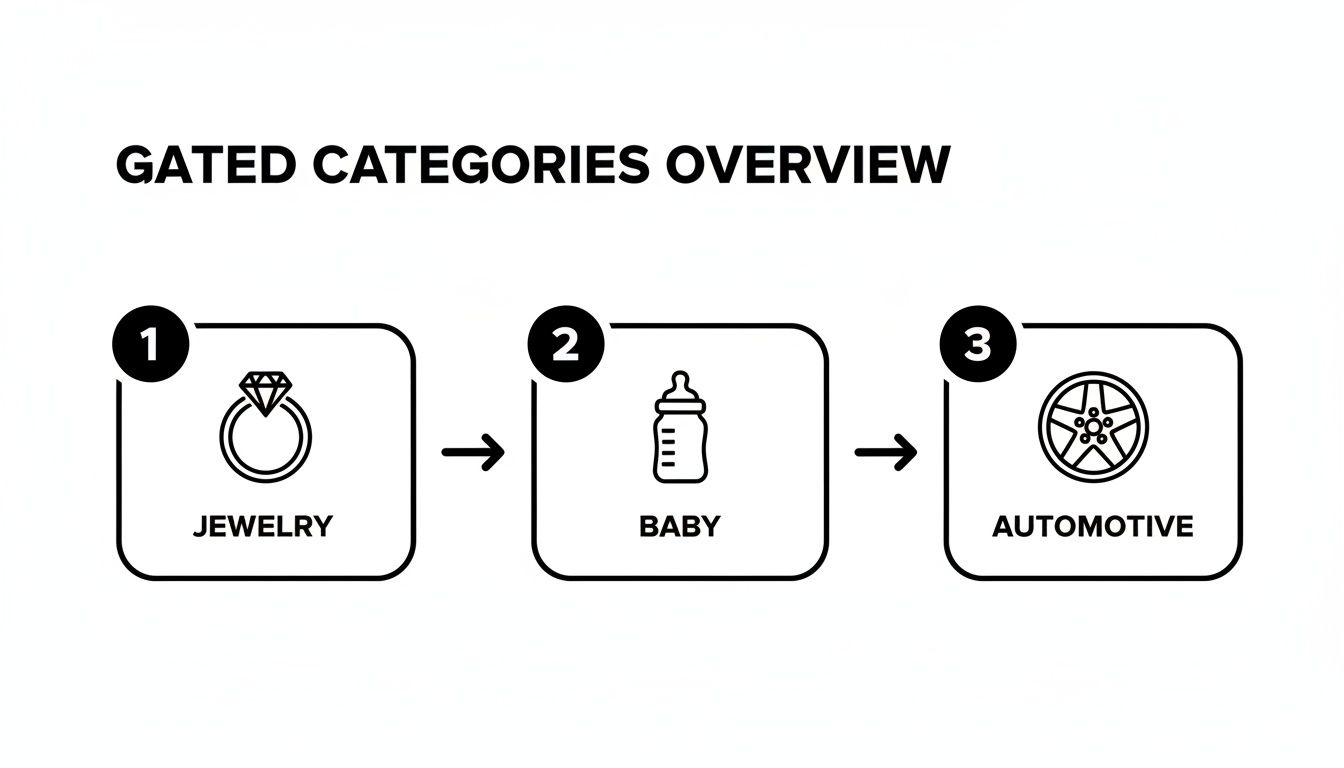
Each one of these represents a massive opportunity precisely because of that barrier to entry. It’s a built-in reward for sellers who put in the work to get approved.
Once you have that perfect invoice and your product photos ready to go, it’s game time. Here’s how you submit the application.
Now, the waiting game begins. The review process can take anywhere from a few hours to several weeks, depending on the category and how swamped Amazon is. Just be patient and resist the urge to open multiple cases for the same request—that will only slow things down.
Getting that rejection email from Amazon can be a real gut punch. You’ve spent time and money on inventory, only to be stopped at the gate.
But a denial is rarely the end of the road. It’s usually just a puzzle you need to solve. By figuring out why applications get rejected in the first place, you can turn a frustrating "no" into a profitable "yes."
Think of a rejection not as a final verdict, but as a request for more specific information. Amazon’s review teams are looking for perfect, verifiable proof that you meet their standards. Anything less than perfect gets flagged, but these flags are almost always fixable once you know what they mean.
First things first: you need to dissect that generic rejection email and identify the real problem. Amazon isn't always direct, but their denials almost always trace back to a few common, easily identifiable issues.
Let's break down the most frequent culprits and create an action plan for each.
1. Unverifiable Supplier Information
2. Mismatched Business Information
An ungating application is a test of attention to detail. Amazon's automated systems and human reviewers are trained to spot inconsistencies. Your job is to make your documentation so flawlessly consistent that there's no reason to say no.
Sometimes, all your information is correct, but the presentation is the problem. A blurry photo or a poorly formatted document is a surefire way to get denied.
When you resubmit, always do it through the original case log in Seller Central. Opening a new case just creates confusion and delays. Politely state that you've reviewed their feedback and are providing updated documentation that resolves the initial issue.
This kind of methodical, professional approach shows Amazon you're a serious seller and dramatically increases your chances of getting that approval.

So you did it. You jumped through the hoops, filed the paperwork, and finally got that ungating approval. It’s a huge win, but don't pop the champagne just yet. Getting ungated isn't crossing the finish line—it's just being allowed onto the starting grid of a much more serious race.
Winning inside these exclusive categories requires a whole new playbook. You're no longer just listing products; you're building a real, defensible business in a less crowded, higher-stakes marketplace.
Your very first move should be to bulletproof your supply chain. This is where you graduate from one-off buys to building solid, lasting relationships with authorized distributors. Having a steady, reliable stream of inventory is your new secret weapon. It means you can actually meet the demand for these premium products without those dreaded stockouts.
The whole game changes operationally, too. Managing a smaller catalog of high-value items is a world away from slinging high volumes of cheap goods. You’ll need tighter inventory control, more capital tied up in stock, and a near-obsessive focus on quality.
In these less saturated categories, building a brand isn't just a "nice-to-have"—it's everything. That approval from Amazon is a stamp of credibility. Now it’s time to use it to carve out a space that new competitors can't just waltz into.
This is your chance to really lean into Amazon's powerful brand-building tools:
By investing your time here, you’re turning a simple product listing into a rich brand experience. It does more than just attract buyers; it builds a protective moat around your business, making it much harder for the next seller to challenge your spot.
This newfound credibility extends far beyond Amazon's walls. Your authorized status in a gated category is a massive selling point when you're talking to other sales channels or partners. Proving you can meet Amazon’s ridiculously high standards opens doors you didn't even know were there.
For any entrepreneur aiming for this kind of serious growth, connecting with other high-level Amazon FBA sellers can be a goldmine for strategies and hard-won advice. The real goal is to turn that one approval into a catalyst for sustainable, long-term growth across your entire business.
When you're first digging into the world of gated and ungated Amazon categories, a handful of questions always seem to pop up. Let's tackle the most common ones head-on to clear up any confusion about the costs, timelines, and long-term reality of getting approved.
Amazon itself doesn't charge an application fee to get ungated. The real costs are the investments you have to make before you can even apply.
First off, you’ll need a Professional Seller account, which runs $39.99 a month. The bigger expense, though, comes from getting the right paperwork. Amazon wants to see a legitimate invoice from an authorized distributor, which means you have to buy real inventory—usually at least 10 units of a product. This could set you back anywhere from a few hundred to several thousand dollars, all depending on the supplier's minimum order. Think of it less as a fee and more as your initial inventory investment.
The timeline here can be a bit of a rollercoaster. In a perfect world, where every document is flawless and you hit "submit," you might see an approval in as little as 48 hours.
But let's be realistic. It’s far more common for the process to take anywhere from a few days to a few weeks. Delays are part of the game. Maybe Amazon needs more info, your invoice scans came out blurry, or an address doesn't quite match up. Sometimes, they're just swamped with applications. It's smart to build a buffer of up to a month into your plans so you don't derail your launch.
A successful ungating application is a test of precision. The faster you can provide perfect, verifiable documentation, the shorter your wait time will be. Patience and attention to detail are your greatest assets.
For the most part, yes. Once Amazon gives you the green light for a gated category, that approval is tied to your seller account for good. You won't have to jump through the same hoops again every year just to keep selling.
However—and this is a big "however"—that approval is conditional. It hinges on you keeping your seller account in good standing. If your account health metrics tank, you start racking up policy violations, or major authenticity complaints surface in that category, Amazon can and will re-gate you. The best way to protect your hard-won approval is to consistently run a tight ship and keep your account health pristine.
Ready to connect with other high-level sellers who have mastered the art of scaling on Amazon? The Million Dollar Sellers community is an exclusive, invite-only network of elite e-commerce entrepreneurs sharing strategies to dominate their markets. Apply to join and learn from the best at https://milliondollarsellers.com.
Join the Ecom Entrepreneur Community for Vetted 7-9 Figure Ecommerce Founders
Learn MoreYou may also like:
Learn more about our special events!
Check Events