Chilat Doina
August 13, 2026
If you're staring at a replenish report, a shipment plan, and a margin sheet all at once, you already know the question isn't “what is FBA?” It's whether handing inventory to Amazon will make the business cleaner or just hide costs in a different place. How does FBA work on Amazon becomes a practical question the moment you've got cash tied up in stock, a launch window to hit, and buyers expecting Prime delivery.
Fulfillment by Amazon moves the messy part of ecommerce into Amazon's warehouse network. You send inventory in, Amazon stores it, picks it, packs it, ships it, handles customer service, and processes returns, while your listing can qualify for Prime delivery through Amazon's system Amazon's FBA overview. That trade sounds simple on paper. In business, it changes packaging decisions, inventory planning, and the way you think about profit.
The first time a seller hands logistics to Amazon, the relief is immediate. No more stacking cartons in a garage, no more chasing carriers, no more building a customer-service process around lost packages. Amazon takes over the post-click work, while the seller still controls the product, the listing, and the traffic that drives sales. That shift matters because FBA is a business model decision, not merely a shipping method.
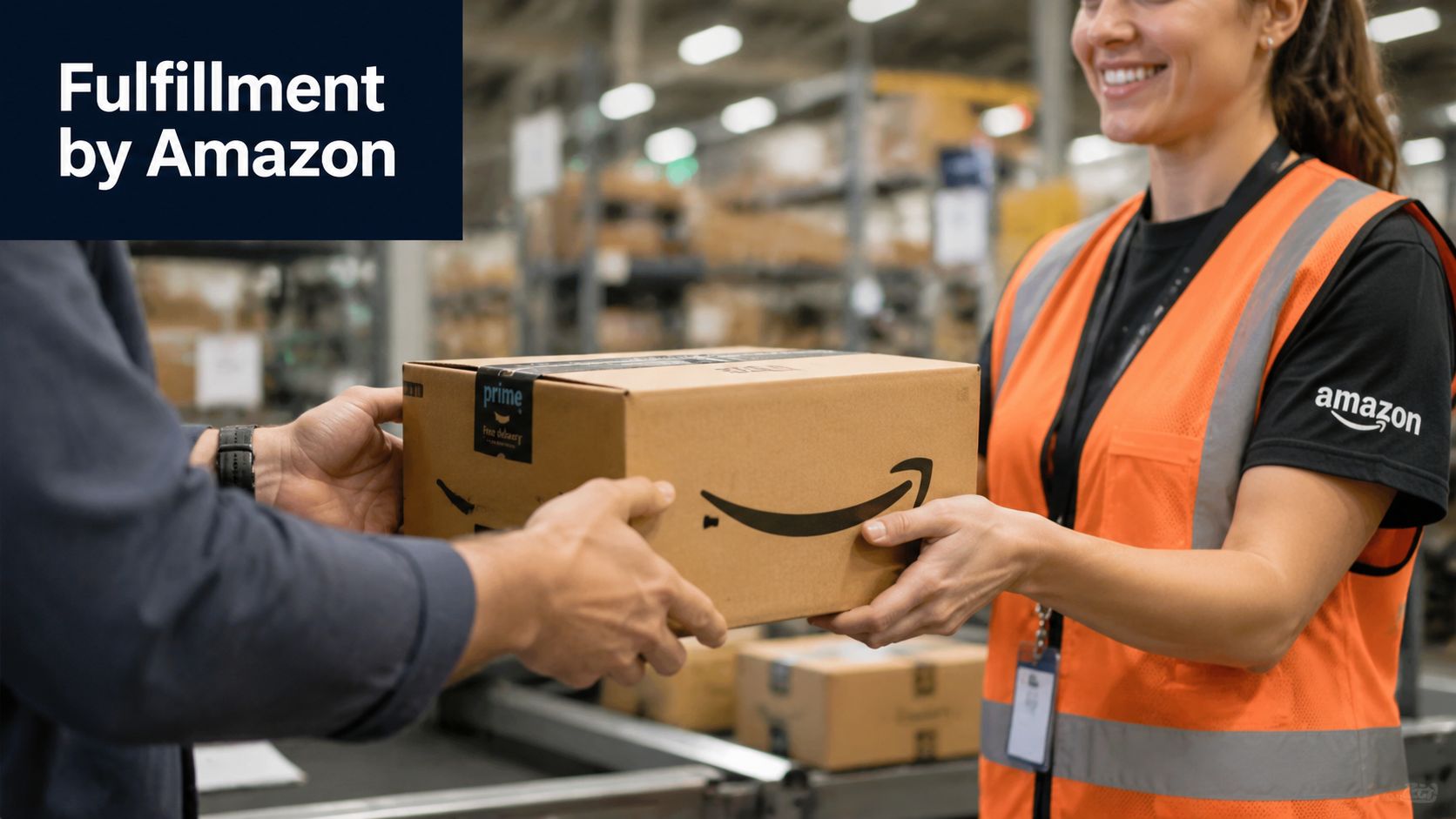
For most sellers, the trade-off is control versus reach. Amazon says FBA lets sellers offer customers free, two-day shipping through Prime Amazon FBA, and that Prime eligibility is one reason the program affects trust and conversion. Independent industry reporting cited in 2026 estimated that about 82% of active Amazon marketplace sellers used FBA in 2025 Red Stag Fulfillment's FBA seller estimate, which shows how standard the model has become. Once a distribution layer becomes the default, the decision is no longer between FBA and “normal” fulfillment. It is about how much of your brand operation you are willing to hand to Amazon's system.
A brand running FBM can touch every carton. A brand running FBA gives up the box-level experience, but gains access to a network built around Amazon's logistics footprint. That changes how you think about packaging, prep, and replenishment. It also changes the cost structure, because the savings in labor and customer-service load can be offset by storage fees, prep mistakes, and inventory that moves slower than planned.
The sellers who handle FBA well treat Amazon like a fulfillment partner, not a storage closet. They use it for speed, Prime trust, and operational efficiency. They do not use it to ignore inventory discipline.
If you want a broader comparison to outsourced logistics outside Amazon, this internal guide on 3PL logistics for Amazon is a useful way to frame the decision.
Practical rule: if your product depends on packaging, inserts, or a highly controlled unboxing experience, FBA changes the customer experience before the customer ever sees the item.
A clean FBA order starts long before a customer clicks buy. The seller creates an FBA listing, prepares inventory, labels units, and sends the shipment into Amazon's inbound workflow in Seller Central. Once the cartons arrive, Amazon receives the units, stores them in its network, and makes them available for customer orders. From there, the order moves through Amazon's systems automatically, which is why the process feels invisible to the shopper and mechanical to the operator Amazon FBA process.
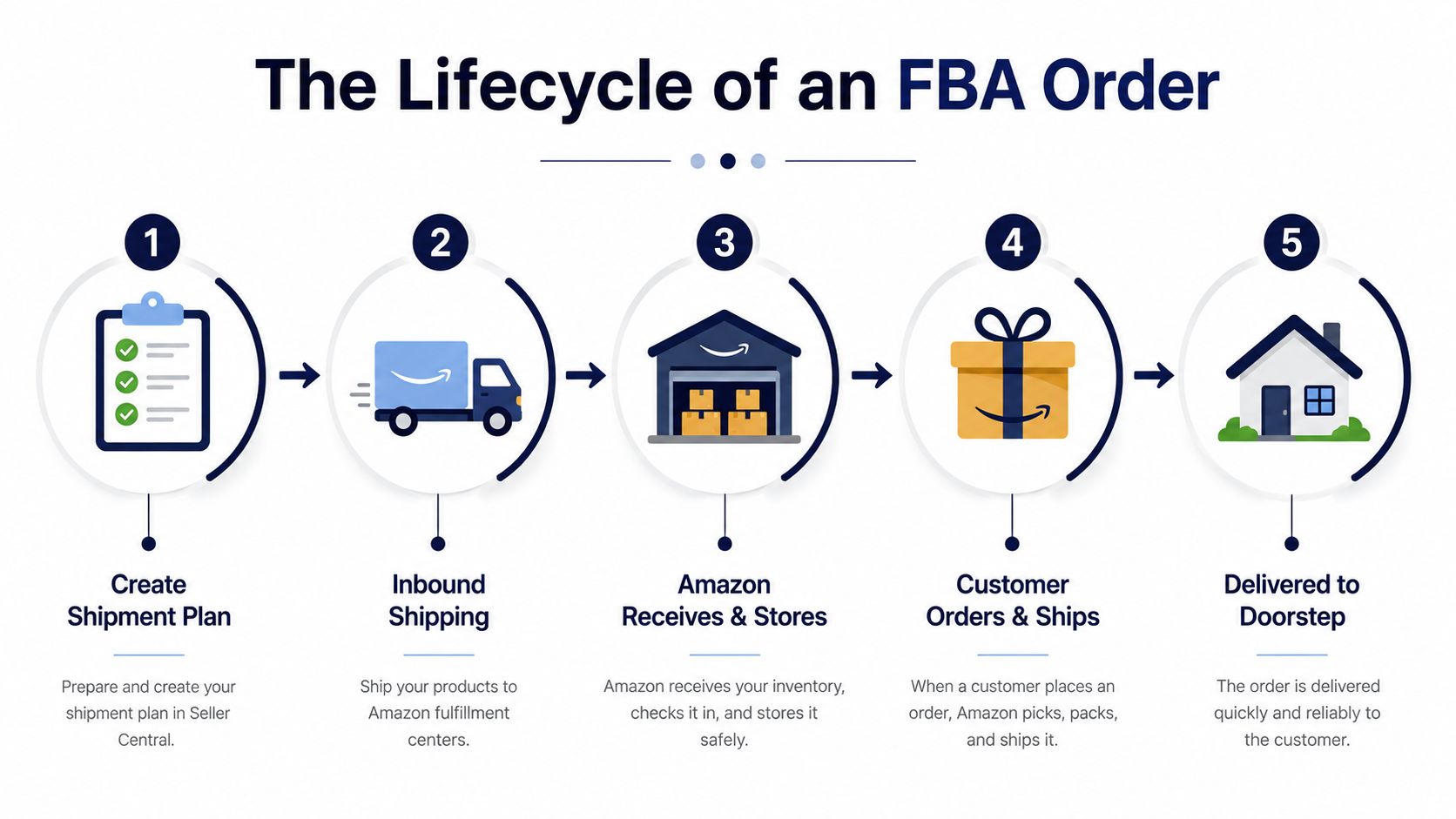
The part that trips up newer sellers is that the work does not end when the inventory leaves the warehouse. It ends when Amazon accepts the inventory into the fulfillment network. If the shipment is mislabeled, the box count is off, or the prep is sloppy, receiving slows down before a single customer order is touched. A practical walkthrough of the handoff is laid out in this order fulfillment process guide.
Once inventory is in the system, Amazon handles storage, picking, packing, shipping, customer service, and returns. That division of labor matters. Sellers do not manage carrier pickups for each order, but they do manage replenishment, forecasting, and the problems that show up when stock sits too long or sells through too fast.
The inbound workflow is where many profit leaks begin. Every extra minute spent fixing shipment issues, correcting labels, or reconciling receiving errors adds friction before the product even starts selling. Amazon can automate the order side only after the seller has done the manual work on the front end.
Amazon's system works best when the seller sends clean inventory, clean labels, and clean carton data.
That is why FBA feels easy only after the boring parts are done well. The customer sees fast delivery. The operator sees a chain of handoffs that only works if each one is precise.
FBA pricing is built around fulfillment complexity, not a single flat charge. Amazon says FBA fees cover storage, picking, packing, shipping, returns, and customer service, and fulfillment fees are charged per unit based on size and weight Amazon FBA fees overview PDF. That matters because a product can look profitable on a spreadsheet until the physical dimensions and time in network start pressuring margin.
The operator's job is to understand where the cost moves. A lightweight item with efficient packaging can be easier to carry through FBA than a bulky SKU with strong revenue but poor storage economics. If the carton shape wastes space, Amazon's receiving data reflects that footprint, and storage and handling economics follow the footprint, not your brand story.
Here's the practical way to think about it. Smaller, tighter packaging usually gives you more room to stay profitable. Slow-moving inventory does the opposite. The longer a unit sits in the network, the more pressure you feel from storage-related charges and capital tied up in stock. That's why the true landed cost of an FBA SKU isn't just the product cost plus inbound freight, it's the total of every fee the unit triggers while it lives inside Amazon's system.
| Fee Type | Trigger | Impact on Margin |
|---|---|---|
| Fulfillment fee | Per unit, based on size and weight | Directly reduces contribution margin on every sale |
| Storage fee | Inventory sitting in Amazon's network | Increases carrying cost as units remain unsold |
| Long-term storage exposure | Inventory that stays in network too long | Adds margin pressure and punishes slow turns |
| Return handling | Customer returns processed through FBA | Can reduce profitability if the SKU has a high return rate |
The biggest mistake is treating FBA as a fixed cost bucket. It isn't fixed. It changes with packaging, turns, and inventory discipline. That's why experienced sellers audit every SKU against the same question, does FBA improve conversion and speed enough to justify the full cost stack? A useful overview of the fee categories lives in this Amazon FBA fee breakdown.
Margin rule: if you can't explain how a SKU makes money after fulfillment, storage, and return exposure, you don't have a product strategy, you have a guess.
Amazon's receiving team doesn't want creative packaging. It wants compliant packaging that can move through an automated network without human intervention. That's why prep requirements matter so much. If you send inventory that isn't retail-ready, you invite delays, prep fees, and inventory rejection. The warehouse can only process what your prep makes processable.
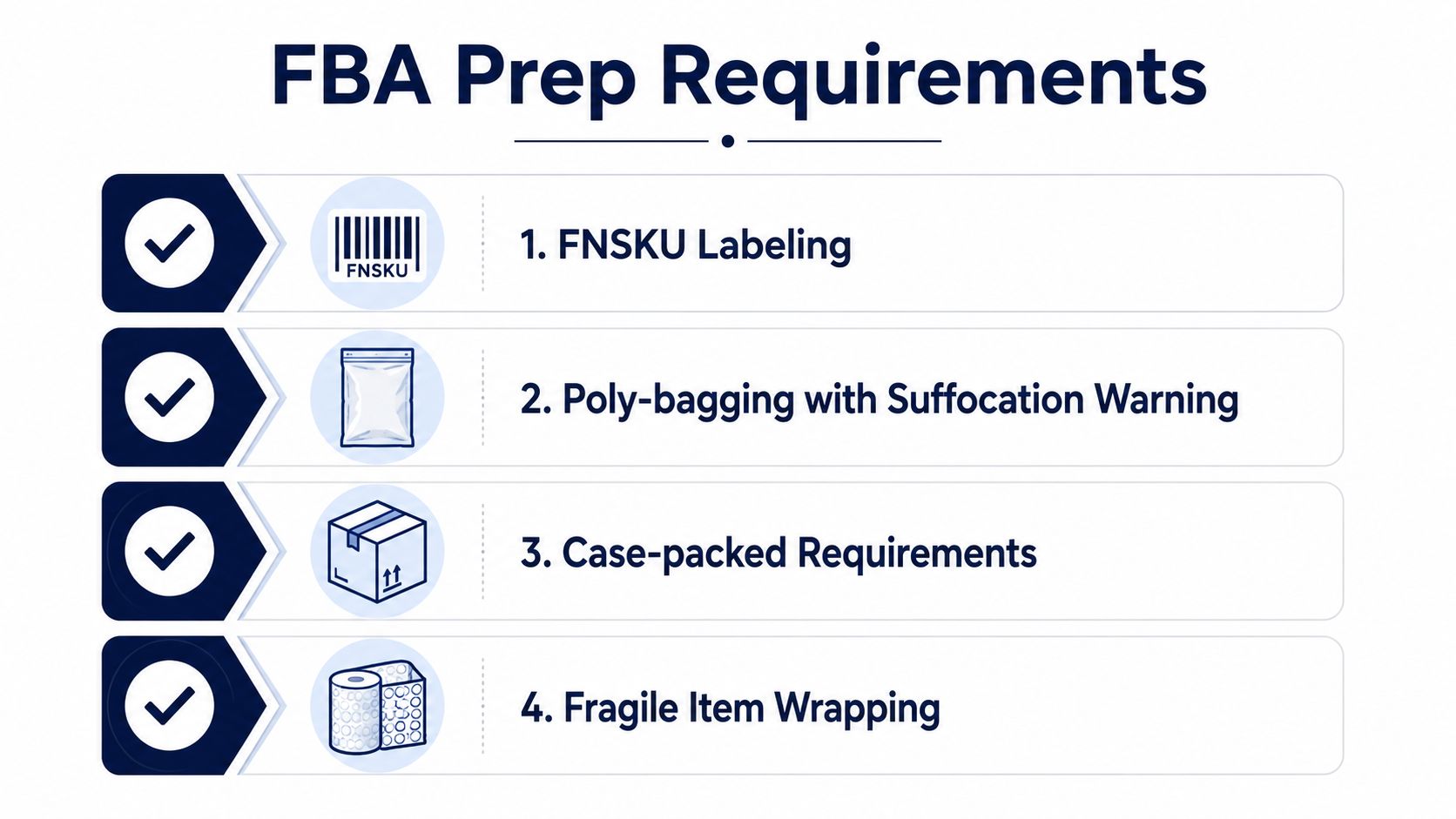
The basics are essential. FNSKU labeling tells Amazon's system what the unit is. Poly-bagging with a suffocation warning protects certain products and keeps them compliant. Case-packed requirements matter when you're shipping consistent cartons. Fragile item wrapping keeps breakage from turning into a reimbursement fight later.
The pain usually shows up at receiving, not in Seller Central. A shipment that looked fine on paper can stall because the labels are wrong, the carton contents don't match the plan, or the prep standard doesn't fit the product type. That's why seasoned sellers build prep checklists at the SKU level, not the category level. One product can need nothing more than a barcode. Another may need bags, inserts, wraps, or exact case packs to pass cleanly.
If your team manages stock across multiple channels, inventory discipline matters just as much before the carton leaves your warehouse. A practical resource on organizing that side of the operation is Standby Self Storage inventory tips, especially if you need a tighter internal process for counting, labeling, and tracking units before they enter Amazon's network.
A clean inbound process is cheaper than a fast rescue process.
What works is boring. Print the right label, prep the unit the right way, pack the carton correctly, and verify counts before shipping. What doesn't work is assuming Amazon will fix sloppy receiving inputs for you. The system is designed to punish ambiguity.
FBA is not the right answer for every SKU. Some products belong in Amazon's network because speed and Prime visibility drive conversion. Others belong in FBM because the economics or operational limits are better outside Amazon. The decision hinges on which model protects margin and brand control for that specific item.
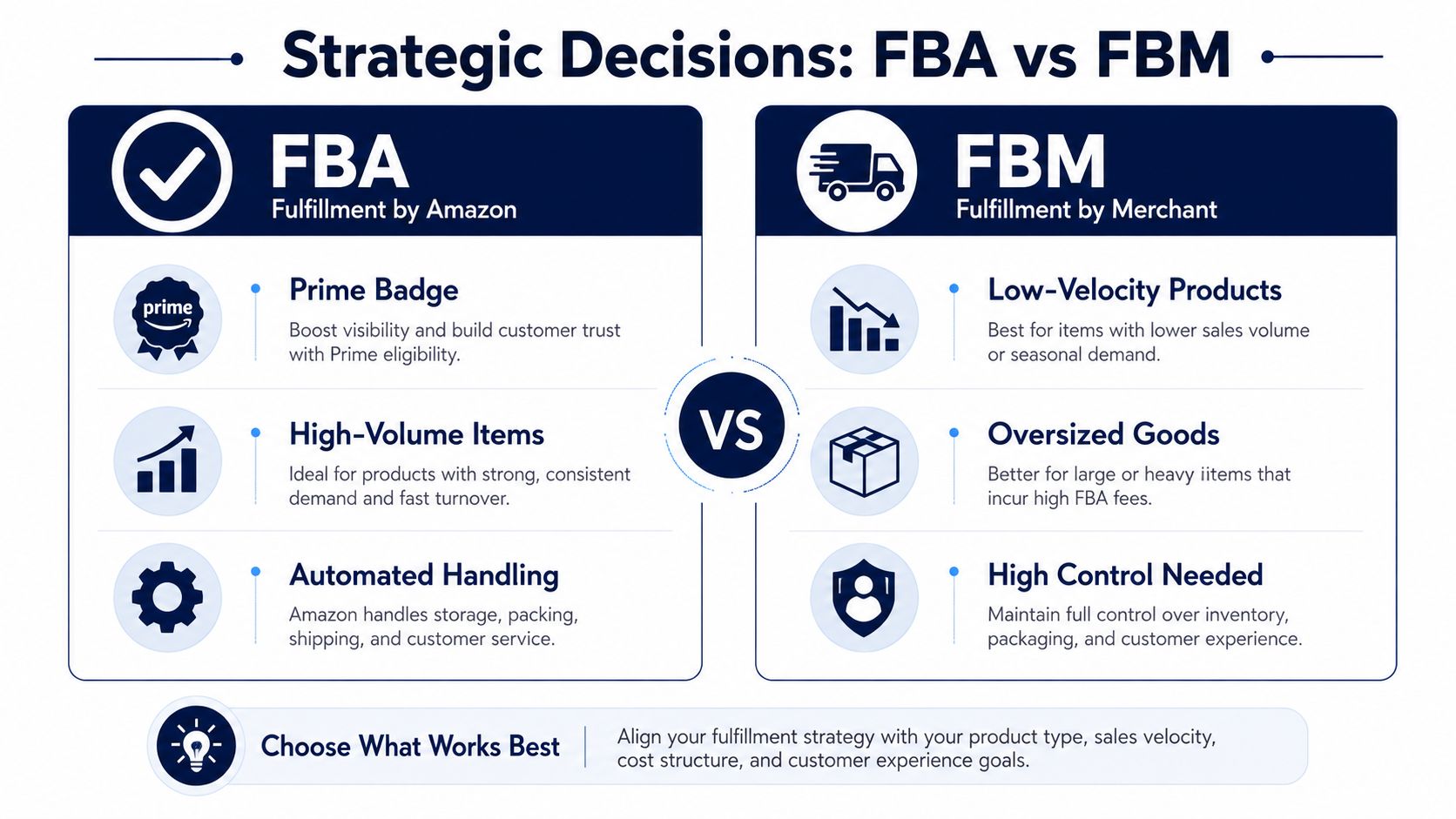
FBA makes the most sense when the listing benefits from Prime eligibility, when velocity is strong, and when Amazon's handling removes enough operational burden to justify the fees. That matters most for products where speed and trust are part of the conversion story. Amazon's system is built to support that outcome through storage, picking, packing, shipping, customer service, and returns, as outlined in its Amazon FBA overview.
FBM usually wins when the SKU is low-velocity, oversized, operationally awkward, or sensitive to extra handling costs. It can also be the cleaner choice for products that need more control over packaging, or for catalogs where you want inventory closer to the customer experience. The point is to keep the wrong product out of the wrong fulfillment lane, because that mismatch eats margin fast.
Experienced operators usually do not choose one model for the entire catalog. They split the catalog. High-turn items go into FBA for Prime visibility and convenience. Slower items stay in FBM until demand justifies the extra storage and handling cost. Some sellers also keep FBM as a backup when FBA stock gets tight, so sales do not stop just because a replenishment shipment is late.
That judgment matters more than platform preference. If the item sells quickly, FBA can be a strong fit. If the item sits, FBA can turn into an expensive place to warehouse it. The question is how much speed, control, and inventory risk the product can support without pushing margin below the line that matters.
The best fulfillment model is the one that fits the product's velocity, margin profile, and control requirements, not the one that sounds simplest in a podcast clip.
Once FBA is working, the question changes from whether Amazon can receive your inventory to whether the system still behaves efficiently as volume rises. Inventory placement, replenishment discipline, and clean data become more important than basic setup. Amazon uses regional forecasting and placement algorithms to shape delivery speed, so the seller's job is to feed that system inventory that can move without backing it up Amazon Growth Lab guide on FBA.
The first lever is inventory placement. Uneven shipments or a loose replenishment rhythm make the network harder to manage and usually create friction somewhere else in the operation. The second lever is storage discipline. Amazon's process rewards velocity, so slow-moving stock turns into a cash drag and a warehouse cost problem. The third lever is post-sale recovery, because lost, damaged, or misprocessed units need to be tracked and reconciled instead of disappearing into margin leakage.
A strong operator treats FBA as an active system, not a passive warehouse. That means checking replenishment signals, watching sell-through, and clearing stranded or unsellable inventory before it becomes a recurring drain. Amazon also supports adjacent programs such as Multi-Channel Fulfillment, which can extend Amazon's fulfillment network beyond Amazon orders in some cases, and that helps when a brand sells across multiple channels Amazon FBA beginner guide.
If you want peer-level conversations about catalog structure, margin discipline, and operating at scale, one place sellers compare those playbooks is Million Dollar Sellers. The right community will not replace execution, but it can shorten the learning curve when you are deciding which SKUs belong in FBA and which do not.
If you are building around FBA at scale, do not stop at the shipment plan. Tighten your prep, track your fee exposure, and make each SKU earn its place in the network.
Join the Ecom Entrepreneur Community for Vetted 7-9 Figure Ecommerce Founders
Learn MoreYou may also like:
Learn more about our special events!
Check Events