Chilat Doina
February 25, 2026
When a customer clicks "buy," they're not just purchasing a product; they're buying a promise. The journey from that click to a package landing on their doorstep is where you either keep that promise or break it. For any brand with serious growth ambitions, nailing order fulfillment isn't a back-office chore—it's your single greatest competitive advantage.
At its core, the fulfillment process is what turns static inventory into a tangible brand experience. It's an engine that needs to be designed for performance, not just function.
Let's break down the big picture. The entire workflow can be boiled down to four crucial steps: receiving inventory, picking items for an order, packing them securely, and shipping the package out the door.
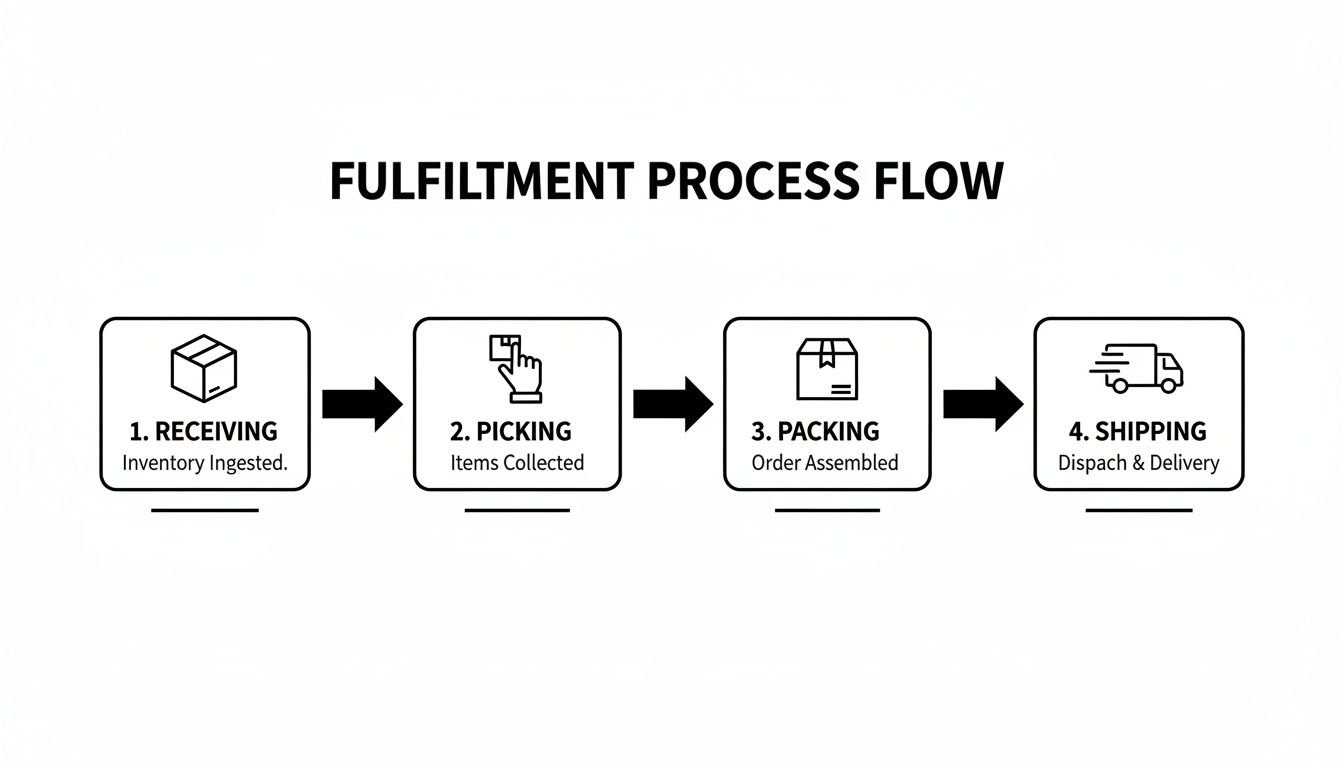
Think of it like a relay race. Each stage hands the baton to the next, and a fumble at any point—say, a bottleneck in receiving—will slow everything down, ultimately delaying shipping and frustrating customers.
A truly high-performance fulfillment engine is more than just a sequence of tasks. It’s a finely tuned system where every component is optimized for speed, accuracy, and cost-efficiency. Each step is meticulously designed to get products into your customer's hands with as little friction as possible.
Here's a look at how each of these critical stages functions and what they're meant to achieve when you're operating at scale.
.tbl-scroll{contain:inline-size;overflow-x:auto;-webkit-overflow-scrolling:touch}.tbl-scroll table{min-width:600px;width:100%;border-collapse:collapse;margin-bottom:20px}.tbl-scroll th{border:1px solid #ddd;padding:8px;text-align:left;background-color:#f2f2f2;white-space:nowrap}.tbl-scroll td{border:1px solid #ddd;padding:8px;text-align:left}StagePrimary FunctionKey Scalability OutcomeReceivingAccepting, verifying, and storing new inventory.Accurate, real-time stock levels and fast availability.PickingLocating and retrieving items for customer orders.High order accuracy rate and reduced fulfillment time.PackingSecurely packaging items for transit.Lower shipping costs (DIM weight) and brand consistency.ShippingLabeling and handing off packages to carriers.On-time delivery and reduced cost-per-shipment.
As you can see, each stage directly impacts the next. Getting these gears to turn smoothly requires a solid understanding of operational flow. For a closer look at the nitty-gritty, this guide on improving warehouse efficiency offers some great, actionable insights for cutting down waste.
At scale, fulfillment becomes a game of seconds and cents. An error in the picking stage that costs 30 seconds can cascade into thousands of dollars in wasted labor and delayed shipments over a month.
Without a documented, repeatable process, you’re basically inviting chaos into your warehouse. This becomes painfully obvious during peak seasons like Black Friday. A well-defined system is what ensures every team member—from the person unloading a truck to the one taping up a box—knows exactly what their role is and executes it flawlessly every time.
This operational backbone is what allows a brand to handle 10,000 orders with the same precision as 10. If you're building from the ground up, a good crowdfunding order fulfillment guide can be an invaluable resource, offering battle-tested frameworks that apply to any e-commerce business, not just crowdfunded projects.
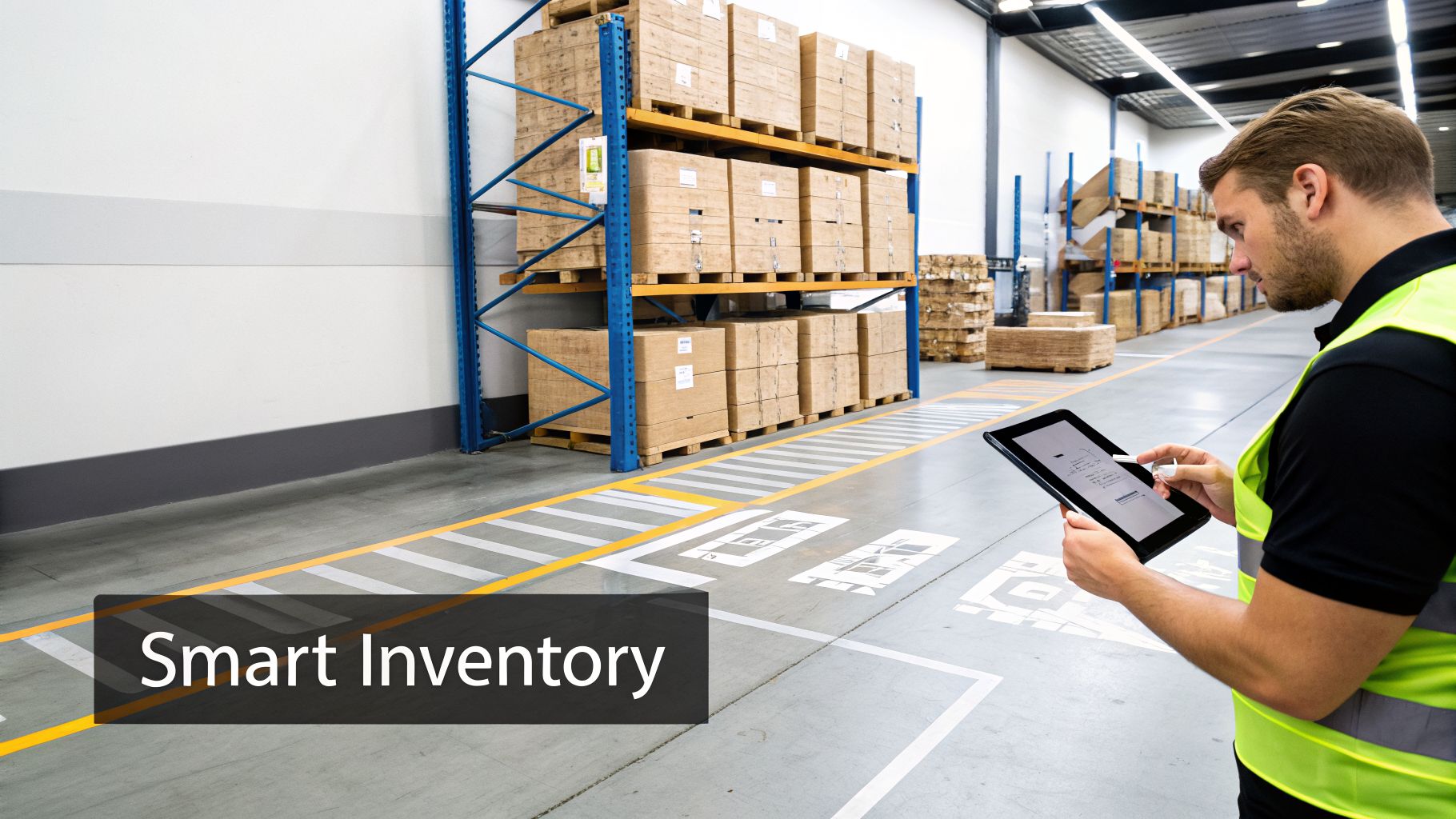
Winning at fulfillment starts long before a customer ever clicks "buy." The real groundwork is laid the moment your inventory hits the receiving dock. This is where you can turn your stock from a simple line item on a balance sheet into a strategic weapon for faster, cheaper shipping.
It all begins with that first shipment from your supplier. Think of this as more than just unloading boxes; it's your first line of defense for quality and accuracy. A sloppy receiving process creates a nasty ripple effect—inaccurate stock counts, shipping damaged goods, you name it.
Before a single item can be stowed away, it has to be received properly. A rock-solid receiving workflow isn't just a nice-to-have; it's non-negotiable for keeping your inventory counts clean and your product quality high.
Your team needs a documented standard operating procedure (SOP) that covers a few key checks every single time:
Once everything is verified and scanned, the final step is putaway—the physical process of moving inventory from the receiving area to its designated home in the warehouse. A chaotic putaway process is a recipe for lost inventory and painfully slow picking times. The goal here is pure speed and precision.
A classic mistake I see growing brands make is treating receiving as a low-skill, entry-level task. In reality, it's the absolute foundation of your inventory accuracy. One slip-up—like miscounting a single case of your best-selling SKU—can cascade into overselling and angry customers down the line.
Okay, so the inventory is received and ready to go. Now for the million-dollar question: where should it live? The answer really boils down to your fulfillment model, which usually falls into one of two camps.
Centralized Fulfillment
This is the simplest model and where most brands start. You operate from a single warehouse, keeping everything under one roof. It’s straightforward, easier to manage, and doesn't require a massive upfront investment.
Distributed Fulfillment
In this model, you get strategic. You split your inventory across multiple warehouses or fulfillment centers in different geographic regions, specifically to store products closer to your customers.
This is exactly how top brands compete with Amazon's lightning-fast delivery speeds. Industry analyses predict that by 2026, operations using distributed fulfillment will slash their average shipping distances by up to 40%. We're talking about reducing transit times from 5-10 business days down to next-day or even same-day delivery in major metro areas. This is where predictive analytics becomes your best friend, using sales data to forecast regional demand and pre-position stock, boosting efficiency by 25-30%. You can learn more about how predictive analytics reshapes fulfillment and find more insights into this trend.
Deciding where to put that inventory shouldn't be a gut feeling. It’s a data decision, plain and simple. Your order history is a goldmine.
Dig into your sales data to find your demand clusters. Do you have a ton of customers in California? A big pocket on the East Coast? A surprising number in the Midwest? Placing your fastest-moving products in a warehouse smack in the middle of those clusters is one of the most powerful moves you can make.
This strategy of "forward-stocking" inventory completely flips the script. You’re no longer reacting to orders; you’re anticipating them. You're positioning your products to meet demand almost instantly, which directly moves the needle on your two most important metrics: shipping cost and delivery speed.
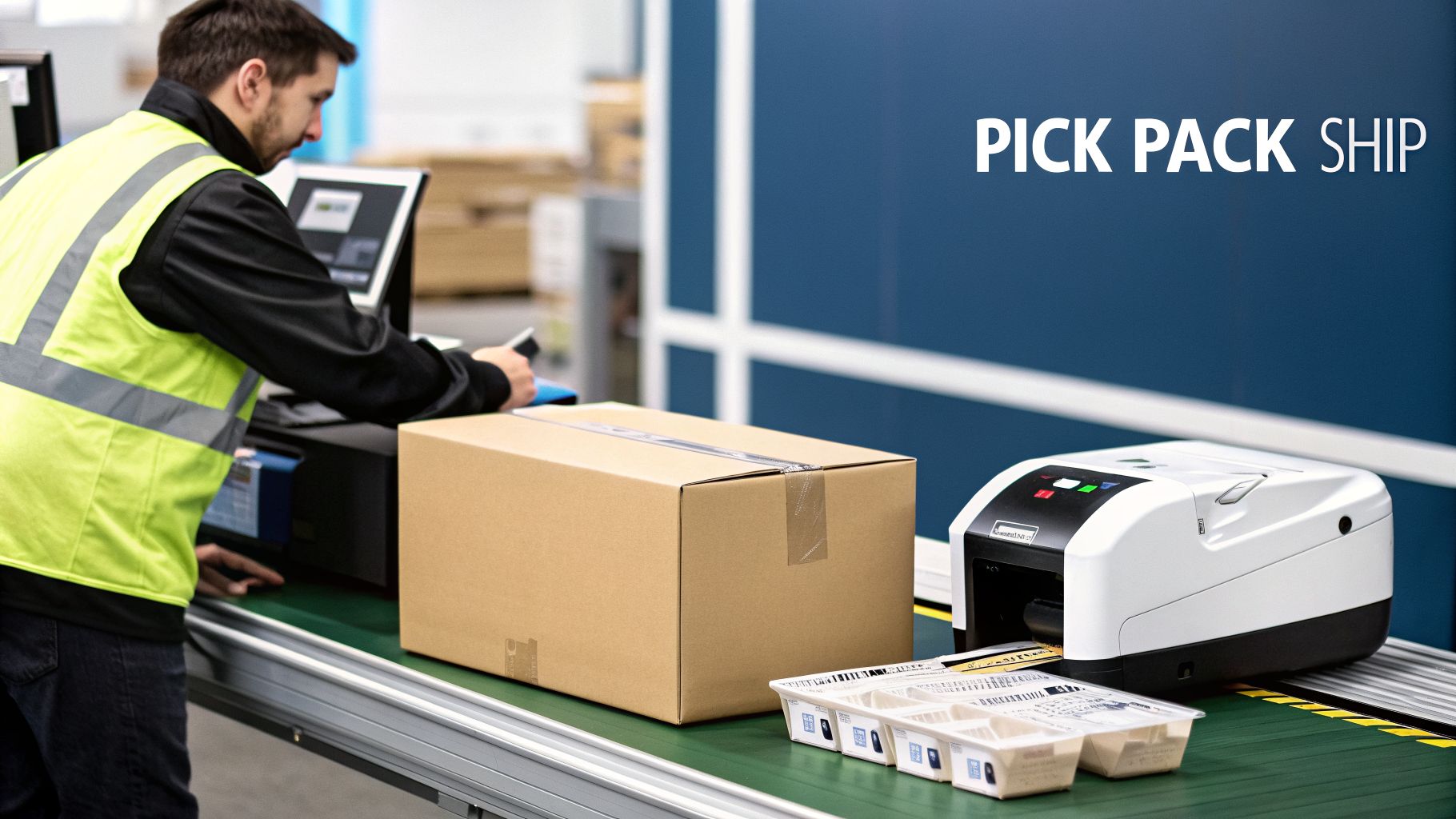
This is where your brand’s reputation is truly on the line. Once that "buy" button is clicked, the race begins. The pick, pack, and ship workflow is the beating heart of your entire operation, and it's a dead sprint where speed and accuracy are everything.
Let's get into how to fine-tune this critical sequence. The real goal isn't just to shove boxes out the door faster. It's about building a system so slick that it feels invisible to your customer—their order just shows up, exactly right and impressively fast, every single time.
Picking is the most labor-intensive part of the fulfillment puzzle. In many warehouses, it accounts for over 50% of all operating costs. The method you choose here has a massive domino effect on everything that follows. Just sending a picker to wander the aisles for one order at a time is a recipe for slow, expensive fulfillment.
Instead, the pros use more strategic approaches.
For instance, a supplement brand could use batch picking to grab 15 different orders for its top-selling protein powder in one go. A cosmetics company with a huge SKU catalog, on the other hand, might use zone picking—one person handles all lipsticks, another handles all foundations.
Packing isn't just about getting things into a box. It's a critical control point for both your costs and your customer's unboxing experience. A sloppy packing station will absolutely bleed money through wasted materials and inflated shipping fees.
Dimensional (DIM) weight is the silent killer of shipping budgets. Carriers like UPS and FedEx charge based on a package's size, not just its actual weight. Using a box that’s way too big for a small item can easily double your shipping cost.
I once worked with a brand that saved over $50,000 a year just by introducing three smaller box sizes and training their team to stop defaulting to the large "one-size-fits-all" option. It’s a simple change with a massive impact.
Your packing station SOP needs to be airtight. It should spell out exactly which box to use for specific product combinations and the right amount of dunnage (like bubble wrap or air pillows) to keep things safe without adding bulk. For more on this, check out our guide on how to reduce shipping costs for small businesses.
The final handoff—shipping—is where automation becomes your MVP. Manually typing addresses and choosing carriers is slow, tedious, and a breeding ground for expensive errors. Modern shipping software is non-negotiable for taking that risk off the table.
Look at where this is all going. It's predicted that by 2026, AI-driven systems will adjust pick-and-pack sequences on the fly based on carrier schedules, pushing on-time shipments past 95%. During peak season, when manual picking error rates can soar to 20-25%, robotic sorters are already getting those errors under 1% while hitting 400 picks per hour. The industry is moving fast.
Even without a fleet of robots, the right software makes all the difference. Your shipping setup should handle these tasks for you automatically:
This tech-forward approach all but eliminates mistakes, drives down shipping costs, and gets every package out the door on time using the most economical route. It transforms your pick, pack, and ship workflow from a manual cost center into a powerful engine for growth.
Your fulfillment operation is only as smart as the technology that powers it. Seriously. Without the right systems in place, even the most dedicated team will eventually get buried under a mountain of manual errors, inaccurate inventory counts, and painfully slow processing times.
This is where your tech stack and key performance indicators (KPIs) come in. They’re what shift you from fighting daily fires to making proactive, data-informed decisions that actually fuel your growth. The right software doesn't just automate a few tasks; it creates a single, reliable source of truth across your entire business. That’s the foundation for scaling.
Navigating the alphabet soup of fulfillment software can feel overwhelming at first. Let’s break down the three core pillars of a modern e-commerce tech stack and what they actually do for you.
While you can get these systems as standalone tools, they deliver their real power when they're seamlessly integrated. A great OMS tells the WMS what to pick, and the WMS then tells the IMS that the inventory has been depleted. This constant, automated communication is what makes a high-volume operation run like a well-oiled machine.
Choosing your fulfillment software isn't about buying the fanciest or most expensive option. It's about matching the technology to your business's current size and, just as importantly, your future goals. A brand shipping 50 orders a day has vastly different needs than one pushing 5,000 out the door.
When you're evaluating your options, keep these factors top of mind:
I see this all the time: a brand over-invests in a complex, enterprise-level WMS before they have the operational scale to justify it. A much better approach is to start with a robust IMS/OMS that handles your core needs, and then add a WMS only when your warehouse workflow truly requires that level of granular control.
Integral to building a high-performance fulfillment engine is bringing in supply chain visibility software. These tools often bridge the gaps between your core systems, giving you a complete, real-time picture of your inventory from the moment it leaves your supplier to the second it lands on your customer's doorstep.
You can't improve what you don't measure. But drowning in data is just as useless as having none. The key is to zero in on a handful of KPIs that directly reflect the health and efficiency of your fulfillment operation. These are the numbers that should live on your dashboard.
.tbl-scroll{contain:inline-size;overflow-x:auto;-webkit-overflow-scrolling:touch}.tbl-scroll table{min-width:600px;width:100%;border-collapse:collapse;margin-bottom:20px}.tbl-scroll th{border:1px solid #ddd;padding:8px;text-align:left;background-color:#f2f2f2;white-space:nowrap}.tbl-scroll td{border:1px solid #ddd;padding:8px;text-align:left}KPIWhat It MeasuresWhy It MattersTargetOrder Accuracy RateThe percentage of total orders shipped without any errors (wrong items, quantities, or damage).Directly impacts customer satisfaction and the painful, high cost of returns.>99.5%On-Time Shipping RateThe percentage of orders shipped on or before the promised date.This is a critical factor in meeting customer delivery expectations and building trust.>98%Dock-to-Stock TimeThe time it takes for new inventory to be received, processed, and made available for sale.Faster times mean you can sell new products sooner and reduce out-of-stocks.< 24 HoursCost Per Order (CPO)The total fulfillment cost (labor, supplies, shipping) divided by the total number of orders shipped.Your core metric for tracking and controlling every dollar spent on fulfillment.Varies by industry
Monitoring these specific metrics gives you a clear, actionable report card. When you see your Cost Per Order creeping up, you can immediately dig in to find out why. Is it rising shipping rates? Inefficient packing? Too much overtime labor? This data-driven approach is what separates a good fulfillment process from a world-class operation.
It's the question every growing e-commerce brand eventually hits: do we build our own fulfillment operation, or do we hand the reins to a third-party logistics (3PL) partner?
There’s no one-size-fits-all answer here, but there is a right answer for your specific brand. This isn't just a simple cost calculation—it's a massive strategic decision that will ripple through your entire business, shaping everything from your customer experience to your ability to scale.
Making this call demands a brutally honest look at your company's cash flow, internal expertise, and long-term vision. Get it right, and you unlock incredible growth. Get it wrong, and you can easily get buried in operational quicksand and spiraling costs.
Keeping fulfillment in-house gives you the ultimate control. You get to dictate every single detail, from the exact branded tissue paper in the box to the final cutoff time for same-day shipping. But that level of control comes with a hefty price tag, and it’s way more than just rent.
The total cost of running your own warehouse is a complex beast. You have to factor in everything:
One of the most overlooked costs of self-fulfillment is opportunity cost. Every hour you or your team spend managing warehouse staff or haggling with carriers is an hour you’re not spending on product development, marketing, and actually growing the business.
A good 3PL partner takes this entire operational headache off your plate. They are logistics specialists, and their whole business model is built on economies of scale—something a single brand can rarely match on its own.
They’re the ones negotiating rock-bottom shipping rates with carriers and investing in the tech and infrastructure to run hyper-efficient operations. Outsourcing means you can sidestep the massive upfront capital investment and the daily grind of managing a warehouse. This frees you up to focus on what you're actually good at, while leaning on a partner’s expertise. It's a powerful move for brands that need to stay flexible and scale up fast.
If you're new to the concept, you can learn more about what 3PL fulfillment entails in our detailed guide.
To make the right call, you need a clear-eyed view of the pros and cons of each path. The best choice almost always comes down to your order volume, how complex your products are, and how fast you're planning to grow.
Let's break down the key differences in a simple table to see how they stack up.
.tbl-scroll{contain:inline-size;overflow-x:auto;-webkit-overflow-scrolling:touch}.tbl-scroll table{min-width:600px;width:100%;border-collapse:collapse;margin-bottom:20px}.tbl-scroll th{border:1px solid #ddd;padding:8px;text-align:left;background-color:#f2f2f2;white-space:nowrap}.tbl-scroll td{border:1px solid #ddd;padding:8px;text-align:left}FactorIn-House Fulfillment3PL OutsourcingControlComplete control over branding, process, and quality.Less direct control; you're reliant on the 3PL's standards.Cost StructureHigh upfront capital investment and fixed operational costs.Predictable, variable costs that scale with order volume.ScalabilityDifficult to scale quickly; requires leasing more space and hiring more staff.Easily scales up or down to handle seasonal peaks and growth.ExpertiseYou must build or hire logistics expertise from scratch.Instant access to a team of logistics professionals and technology.FlexibilityHighly flexible for custom packing or special projects.Can be less flexible; may charge extra for non-standard requests.
Ultimately, this decision boils down to one simple question: is logistics a core competency of your business?
If you sell highly customized products or believe that a unique unboxing experience is absolutely central to your brand identity, then keeping fulfillment in-house might be the right long-term play. You'll own every detail.
However, if you see fulfillment as a critical function that just needs to be as efficient and cost-effective as possible, partnering with a 3PL is often the smarter move. It allows you to tap into world-class infrastructure without the multi-million dollar investment, freeing up your capital and your focus to build a better brand.
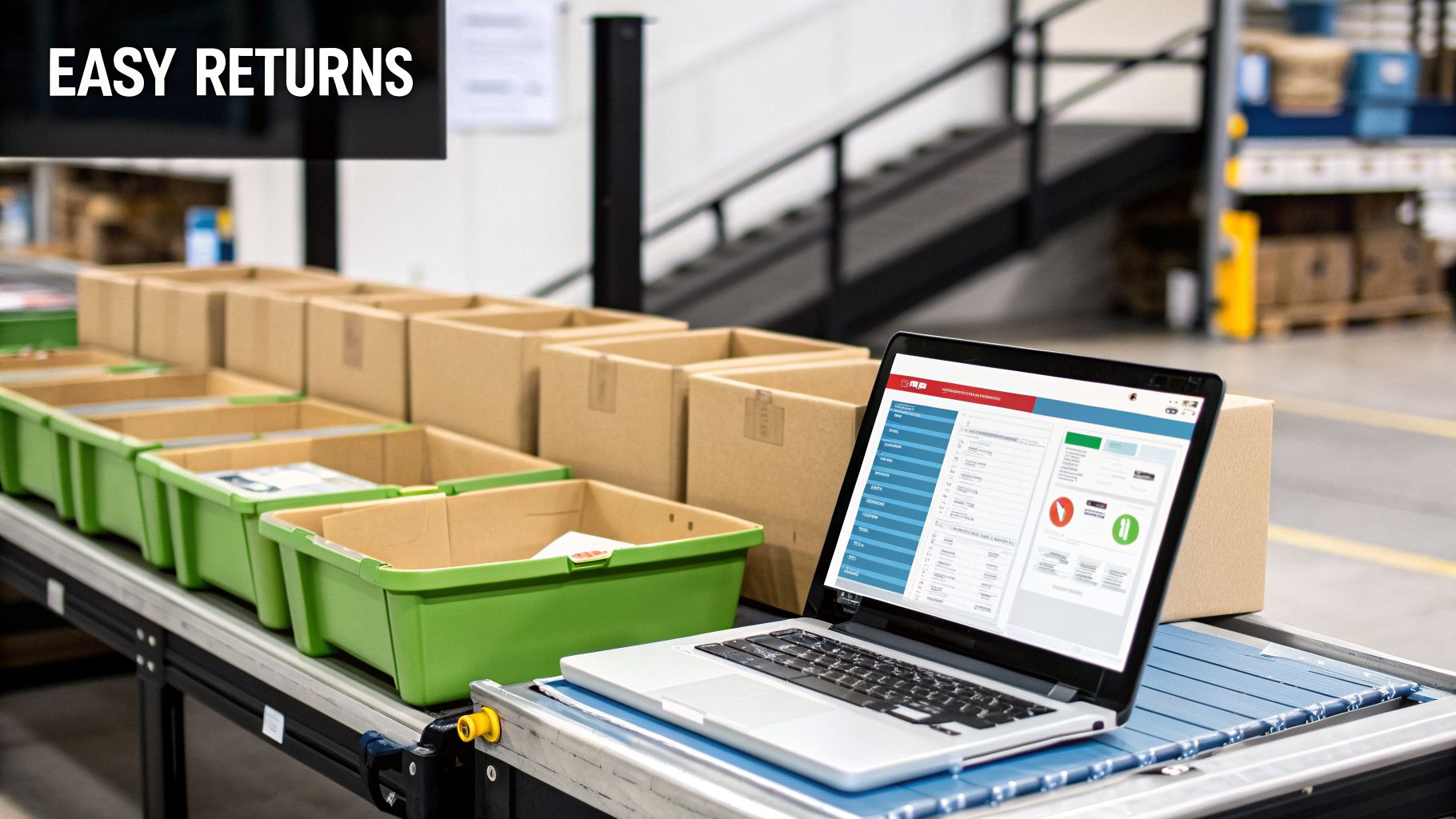
Think your job is done once a package leaves the warehouse? Think again. In many ways, that's when the most critical phase of the customer experience actually begins. The post-shipment follow-up and returns process—what we call reverse logistics—is an often-neglected part of fulfillment, but it's where you truly win or lose brand loyalty.
You absolutely have to be proactive here. Instead of leaving customers to nervously refresh a tracking page, take control of the conversation. Send out automated, branded emails or SMS notifications for key delivery milestones: shipped, out for delivery, and delivered. It's a simple move that turns that dead waiting time into a positive brand interaction and drastically cuts down on those "where is my order?" support tickets.
Alright, let's talk about the elephant in the warehouse: returns. A clunky or expensive return process is one of the fastest ways to lose a customer for good. On the flip side, making it easy can actually boost sales—over 67% of shoppers admit they check a store's return policy before they even think about buying.
Your goal is to build a system that’s a breeze for the customer but still cost-effective for you. This usually means setting up a clear, simple returns portal on your website. Customers should be able to start a return and print a shipping label without ever having to email your support team.
Here's the real secret of world-class reverse logistics: it isn't just about processing returns efficiently. It's about using the data from those returns to reduce them in the first place. Every "item didn't fit" or "not as expected" reason is a piece of feedback that can help you fix your product descriptions, improve your sizing charts, or shoot better photos.
Once an item makes its way back to you, your team needs a rock-solid SOP to follow. The process has to quickly decide the item's fate:
This final stage of fulfillment closes the loop. It’s your chance to turn a potential negative experience into an opportunity to impress a customer and gather some incredibly valuable insights about your products.
As you start to scale, the nitty-gritty details of fulfillment can get complicated, fast. Let's tackle some of the most common questions we see from founders navigating their operational growing pains.
It's easy to use these terms interchangeably, but they represent different scopes of your operation.
Think of logistics as the entire supply chain map. It's the big-picture strategy covering everything from sourcing raw materials and booking freight from your manufacturer to forecasting inventory needs across your entire network.
Order fulfillment is a specific, critical piece of that map. It’s the set of actions that kicks off the moment a customer clicks "buy"—the picking, packing, and shipping process that gets the product from your shelf to their doorstep. It's the direct-to-consumer, last-mile part of the logistics puzzle.
While you should be watching several metrics, Order Accuracy Rate is the one that can make or break your brand's reputation.
This KPI measures the percentage of orders you ship without a single error—no wrong items, no incorrect quantities, and no damage. A low accuracy rate is a silent killer. It doesn't just cost you money; it destroys the customer experience and unleashes a tidal wave of expensive problems like returns, negative reviews, and wasted labor.
Sure, Cost Per Order is crucial for your P&L, but getting the order right the first time is the bedrock of a healthy fulfillment machine. You should be shooting for an accuracy rate of 99.5% or higher. Anything less is a problem you need to fix immediately.
An inaccurate order isn’t just a one-time cost. It erodes trust. You pay for the return shipping, the labor to process it, and you might lose that customer’s lifetime value forever over a simple picking mistake.
The answer isn't a magic number—it's hiding in your order data. The ideal setup depends entirely on where your customers live.
Start by pulling your order history and mapping it out. You're looking for your top three to five shipping destinations, or what we call "demand clusters." Where are the hotspots?
For most brands shipping across the US, a two-warehouse model is a fantastic starting point. Placing one facility on the East Coast and another on the West Coast instantly puts your inventory within a 2-day ground shipping window for over 80% of the U.S. population. This single move can slash both your shipping costs and your delivery times, which is a huge competitive advantage.
At Million Dollar Sellers, top e-commerce founders share the exact fulfillment strategies that helped them scale past eight figures. Learn more about how the right network can accelerate your growth.
Join the Ecom Entrepreneur Community for Vetted 7-9 Figure Ecommerce Founders
Learn MoreYou may also like:
Learn more about our special events!
Check Events