
Chilat Doina
July 24, 2026
You're staring at Slack at 9:47 p.m., the warehouse has a stock issue, your media buyer wants a decision before the ad account burns through spend, and your body feels weirdly flat even though you “only” worked all day. That's the founder version of burnout, not a dramatic collapse, just a slow leak in judgment, patience, and energy that makes every next decision more expensive than it should be.
The bad advice says to meditate more, take a bath, or buy a nicer notebook. The useful advice starts with a harder truth, burnout in a founder-led e-commerce business is usually a system design problem first and a recovery problem second. If the business keeps demanding unbounded attention, personal resilience gets used up faster than it can be restored.
An employee can often point at a manager, a workload, or a policy and name the pressure source. A founder usually can't do that cleanly because the business is the pressure source, the income source, and the identity source all at once. That fusion is why generic burnout advice misses so badly. It assumes a person can step back from the machine, while founders often feel like stepping back means the machine stops.
Gallup's framework is useful here because it names the organizational stressors that drive burnout, unfair treatment at work, unmanageable workload, unclear communication from managers, lack of manager support, and unreasonable time pressure. For founders, those same stressors often show up internally instead of coming from a boss. The founder becomes the manager, the bottleneck, and the emotional shock absorber at the same time. Gallup also points to three prevention levers, making wellbeing part of culture, equipping managers to prevent burnout, and designing the employee experience to reduce burnout, which translates well to founder-led businesses because the company's operating model is often just the founder's habits at scale. See Gallup's guidance on preventing and dealing with employee burnout.
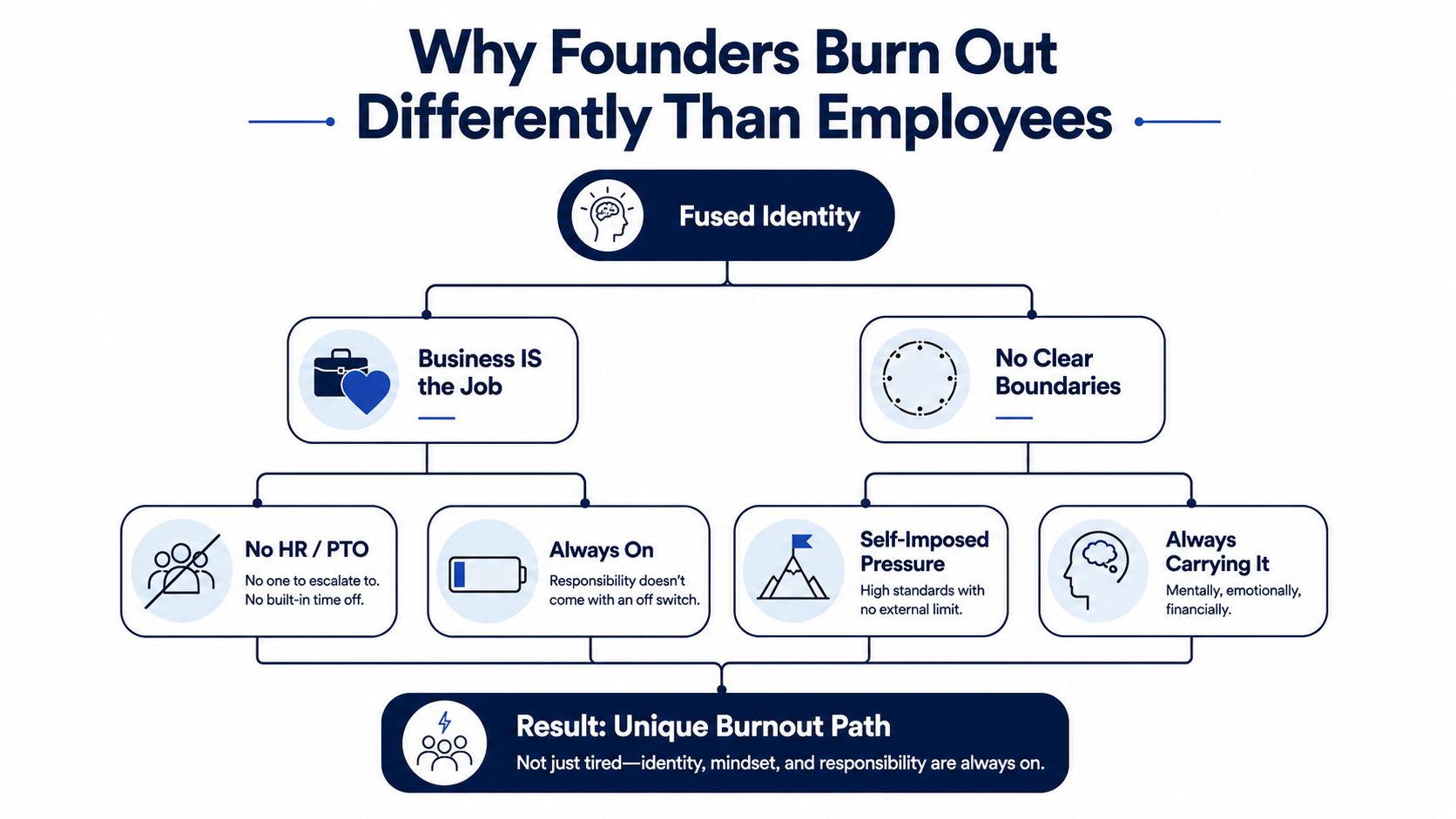
In a 7 to 9 figure e-commerce business, burnout rarely shows up as one dramatic mistake. It shows up as slower decisions, worse hiring, sloppier prioritization, and more rework across inventory, operations, and growth. The founder starts rescuing every problem personally, which feels responsible in the moment and becomes expensive fast.
The framework that holds this guide together is simple. Recognize the signals, recover enough to think straight, redesign the business so the same overload doesn't return, and ritualize the habits that keep the system stable. That sequence matters because people often try to ritualize before they recognize, or they recover without redesigning, and then the cycle comes back.
Practical rule: if the business can't function for a few hours without your constant input, the problem isn't your grit, it's your operating model.
Burnout usually announces itself in small, annoying ways before it becomes disabling. The signals are easy to dismiss because founders normalize fatigue, but the pattern matters more than any single bad day. I've seen the warning signs show up first in the calendar, then in the tone of messages, then in the body.
The clearest founder self-audit is behavioral, cognitive, and physical. If you're making more decisions but feeling less certain, that's not just pressure, it's a capacity warning. If you're reaching for coffee before you've done meaningful work, that can be a compensation strategy, not a preference.
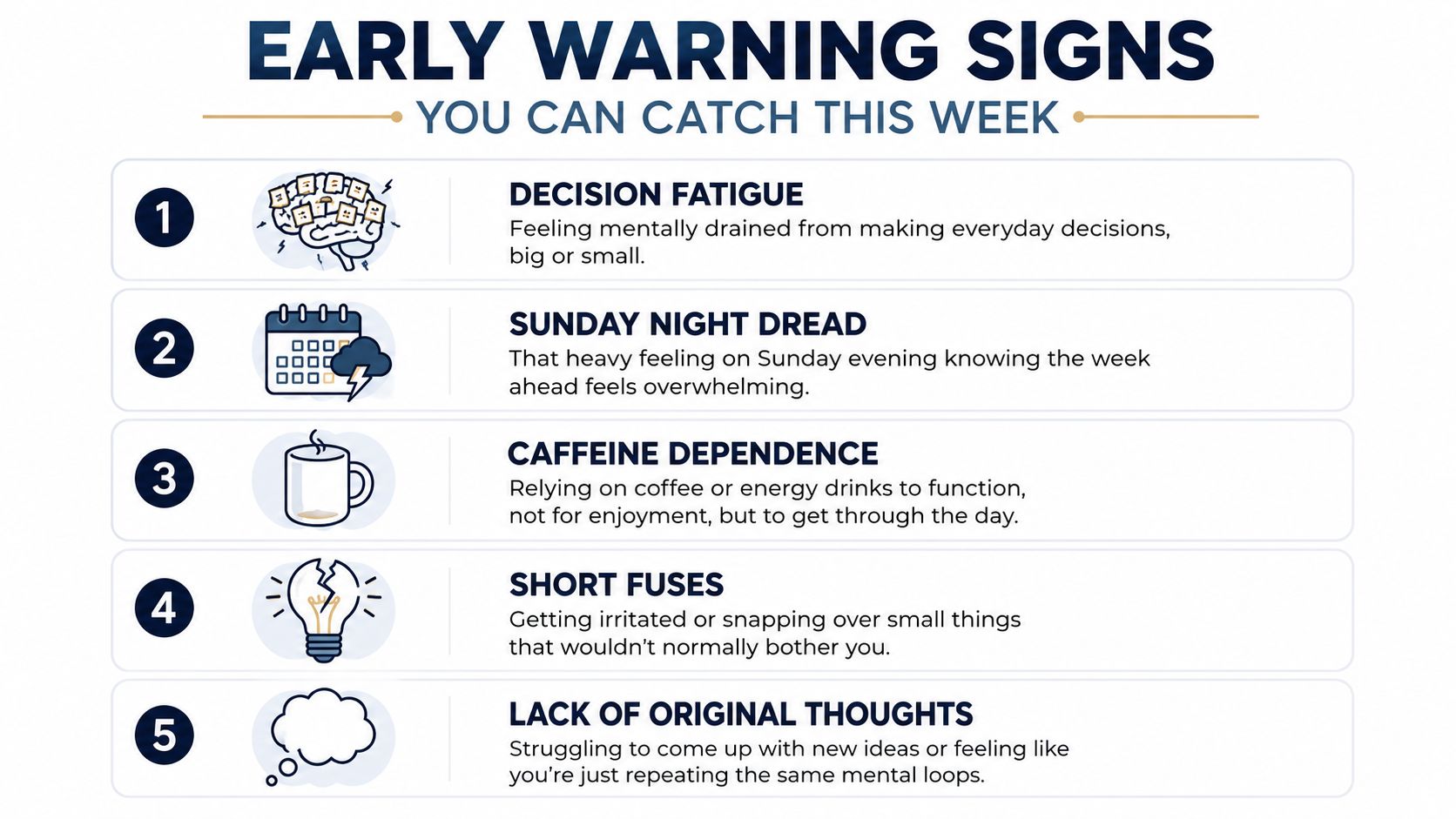
Decision fatigue shows up when everything feels equally important, even the small stuff. If you keep reopening decisions you already made, that's a red flag.
Sunday night dread is another one. It isn't just not liking Monday, it's that physical drop when you see the week in front of you and feel trapped by it.
Caffeine dependence becomes a clue when coffee stops being a boost and starts being the only thing holding your attention together. If your first productive hour depends on multiple cups, the issue may be sleep debt or overload, not discipline.
Short fuses are easy to spot in team chats. If a customer complaint, supplier delay, or agency mistake triggers a response you'd normally edit down later, your patience reserve is already thin.
Lack of original thoughts is the subtle one founders miss. When you're only reacting, never synthesizing, you're not operating at strategy level anymore.
If you want a broader employee-oriented checklist, the stop employee burnout guide from Acheloa Wellness, Inc. is a useful comparison point, especially because it highlights how much of burnout prevention is environmental rather than purely personal.
If you are already fried, stop trying to build a perfect wellness system. Triage first. Founders usually cannot afford to “recover later” and keep running the business as if nothing is wrong. The goal in the first 72 hours is to stop making the burnout worse, get enough sleep back into the system, and reduce the number of decisions your brain has to carry.
A founder who is running on fumes does not need more inspiration. They need fewer inputs, fewer open loops, and a cleaner recovery target. The APA's burnout prevention guidance points to sleep, movement, nutrition, and social connection as recovery inputs, and the Hubstaff burnout statistics article underscores how closely burnout tracks with heavy workload and poor recovery habits.
Turn off work notifications for one full block. No Slack, no email, no dashboards, no calendar scanning. You are not fixing the business today. You are stopping every ping from landing like a threat.
Sleep comes first. Protect a full night, then protect the next one. If that means canceling a meeting, handing off a decision, or letting something wait until tomorrow, do it. The business can absorb a short pause better than it can absorb a founder who keeps pushing while cognitively flat.
Take a 20-minute walk. Eat real food. Hydrate. Then do one thing that is not work, preferably away from screens. The point is not to look productive. The point is to get your body out of the constant stress loop long enough for your thinking to come back online.
Do not use the recovery window to audit every failure. Audit nothing until your sleep and attention are less scrambled.
If your brain keeps trying to spin up new decisions, write them down and leave them alone. That gives your mind somewhere to put the noise without dragging you back into every operational fire. A simple burnout recovery plan for CEOs can help in this situation, because it gives you a short, structured path instead of a vague promise to “rest more.”
Talk to someone who does not work in the business. Say the part you have been editing out. Burnout gets worse when founders stay alone with a polished version of their own stress.
If you still cannot think clearly, extend the reset. Do not force your way back into heavy decisions just because the calendar says it is time. A depleted founder usually creates more churn, more rework, and more noise for the team. The better move is to stabilize first, then re-enter with fewer obligations and cleaner focus.
Delegation is the most effective burnout intervention because it attacks the source of overload, not just the symptoms. If you are the person reviewing every inventory decision, answering every escalated customer issue, and approving every agency ask, your burnout is not mysterious. You are carrying more decision weight than one brain can hold for long.
The trap is that founders often delegate tasks but keep the decisions. That does not reduce cognitive load much. Real relief comes when someone else owns the outcome, not just the checklist.
The fastest way to start is to separate your irreplaceable hours from your dangerous hours. Irreplaceable hours are the ones only you can do, like high-stakes capital allocation, key hires, and major strategic resets. Dangerous hours are the ones where you keep getting pulled into repetitive operational judgment, because that is where founder burnout compounds.
Pick one task you keep grabbing back. Maybe it is supply chain follow-up, Amazon listing changes, or agency creative feedback. Write down the decision criteria in plain language, not a vague standard like “use judgment.” A good handoff document says what success looks like, what the edge cases are, and when the owner should escalate.
Then assign one person to own it. If you do not have that person yet, use the transition to hire or train for the role. The internal guide on how to hire a virtual assistant can help you think about support roles that remove noise from your week without creating another management headache.
Founder rule: if you answer the same kind of question more than twice a week, you either need a better owner or a better SOP.
Run a 30-day handover window. For the first two weeks, let the new owner decide and report. For the next two, stay out of the decision and only review exceptions. That shift is hard because it exposes how much of your control was really repeated involvement.
When the business has already worn you down, delegation should be part of the recovery reset, not a generic promise to rest more. A focused burnout recovery plan for CEOs works better when it is tied to specific ownership changes, fewer founder approvals, and a cleaner line between what you must decide and what the team can own.
For founders, that is the trade-off. You give up some immediate control to get back cognitive space, cleaner execution, and a business that does not fall apart every time you are offline.
Personal recovery won't stick if the operating system keeps producing the same overload. Burnout is a capacity-management problem, not a motivation problem. Once that's clear, the fixes get more concrete, shorter meetings, tighter decision rights, visible exceptions, and fewer moments where low-value questions land on the founder by default.
Start with meetings. Many founder calendars are full of status meetings that should have been async updates long ago. Replace daily ops standups with Loom or written updates, keep meetings shorter, and require an agenda before anyone books time. The cost isn't just the meeting itself, it's the attention residue that lingers after every context switch.
Slack is another hidden drain. If your team expects you to be available after 6 p.m., the business has trained everyone to treat your off-hours as overflow capacity. Put a boundary on response windows and hold it. The first week will feel awkward. The third week will feel normal.
A good KPI dashboard doesn't ask you to inspect everything. It tells you when something is off so you can intervene fast. That matters because founders burn out when they become the dashboard. If every question is routed to you, the system is broken.
Decision rights documents help too. The simple version says who decides what, who gets consulted, and who only gets informed. If you need help thinking about culture and role fit while you redesign the team, browse best practices for culture fit before you hire the next person into a role that will otherwise boomerang back to you.
One overlooked lever is consistency. When accountability is fuzzy, founders end up carrying the memory of the whole business in their heads. The internal guide on accountability systems is relevant here because burnout often starts when follow-through depends on your personal reminders instead of a process.
The goal isn't to make the business frictionless. Some friction is healthy. The goal is to eliminate the chronic, low-grade friction that forces you to re-decide the same things every day. That's where exhaustion compounds.
A useful burnout system has to survive a busy week. That means templates, not just intentions. Founders don't need another philosophy session on self-care. They need something they can drop into Notion, a calendar, or a recurring doc before Monday starts.
Use this every Friday or Sunday:
The point of the review is to catch overload early, not congratulate yourself for surviving it.
Close your laptop at a fixed time. Write down the three most important items for Monday, then write the one thing you're officially not solving tonight. That tiny act prevents the brain from reopening the week repeatedly in the background.
Use this for every recurring meeting:
If a meeting can't fill those five lines, it probably shouldn't exist. Keep the agenda short enough that people will use it.
For team structure and documentation habits, the internal guide on how to create standard operating procedures is worth pulling into your workflow. SOPs don't prevent burnout by themselves, but they reduce the number of decisions you have to reinvent every week.
A founder who avoids burnout does more than feel less depleted. They make cleaner calls, keep stronger operators around them, and avoid the slow drag that builds when the business is run from exhaustion for months. I have lived through the version where everything still looks fine on paper while the operating system is breaking down. The fix is rarely another productivity trick. It is usually a business design change, with recovery as the second layer.
The excuse I hear most is that there is no time to redesign the company. That logic is backward. If there is no time to change how the business runs, the current system is already taking too much out of the people inside it. At that point, burnout prevention is not a wellness project. It is a management decision.
Make three commitments before you close this tab. First, name one warning sign you have been treating as normal. Second, remove one recurring task from your plate this week, even if it feels faster to keep doing it yourself. Third, set one boundary that protects your next recovery window, and tell the team what changes because of it. Those moves are small on purpose. They show the business that your capacity is a finite input, not a bottomless one.
Burnout prevention pays off in ways founders can measure inside the company. Decisions get less reactive, team members stop absorbing your stress, and the business stops paying the hidden cost of constant context switching. If you want to pressure-test the trade-offs behind growth with operators who care about the mechanics, keep close to Million Dollar Sellers. Book a peer call this week to audit your top three recurring decisions, then remove or delegate at least one of them.
Join the Ecom Entrepreneur Community for Vetted 7-9 Figure Ecommerce Founders
Learn MoreYou may also like:
Learn more about our special events!
Check Events