Chilat Doina
March 19, 2026
For high-growth ecommerce brands, the best email marketing software isn't a general, all-purpose tool. It's a specialized, data-obsessed platform like Klaviyo or Omnisend. These options are built to be predictable revenue machines, thanks to deep integrations, smart automation, and attribution that actually makes sense.

Once you're scaling past seven figures, email stops being about just sending newsletters. It becomes the primary growth lever for your business, responsible for a massive chunk of your revenue. Thinking about your platform choice isn't a cost-center decision; it's a serious investment in your core marketing infrastructure.
Generalist platforms like Mailchimp or Brevo are fine to get you off the ground, but they have a very clear ceiling. High-growth brands simply need software built from the ground up for ecommerce.
Specialized platforms are designed with a single goal: helping you sell more stuff. This sharp focus shows up in a few key areas that give you a serious edge.
The core difference is this: a generalist tool sends emails, while an ecommerce-native platform builds customer relationships that generate revenue. It shifts the focus from open rates to profit.
If you want to dig into more specific reviews and recommendations, check out this excellent guide on the best email marketing software for ecommerce.
Two names pop up over and over again in conversations with serious ecommerce operators: Klaviyo and Omnisend. While other tools like Drip have strong features, these two have cemented themselves as the go-to solutions for brands aiming for 8-figure growth and beyond.
They don’t just connect to your store; they connect to your entire tech stack, from your helpdesk to your subscription app. This creates a unified customer profile, which is the holy grail for real personalization. If you're thinking about how this data fits into your bigger picture, our guide to the best CRM for ecommerce might be helpful.
Here’s a quick breakdown of why they lead the pack:
| Capability | Klaviyo | Omnisend | Generalist Tools |
|---|---|---|---|
| Primary Focus | Data-driven ecommerce revenue | Omnichannel ecommerce marketing | Broad, multi-industry use |
| Integration Depth | Extremely deep with Shopify | Strong across multiple platforms | Often surface-level |
| Automation | Highly advanced, event-based | Strong, with unified SMS/Push | Basic to intermediate |
| Attribution | Granular, revenue-focused | Solid, multi-channel view | Often limited to clicks |
Ultimately, picking the right platform means choosing an engine that’s powerful enough to fuel your brand’s ambitions for years to come.
Before diving into a feature-by-feature comparison, we need to get our priorities straight. For a rapidly scaling brand, the criteria are different. Forget the shiny objects and basic drag-and-drop editors. We’re talking about the core capabilities that actually drive profit and make your life easier.
This means zeroing in on software built specifically for commerce. The general marketing automation market is projected to swell from $7.23 billion in 2025 to over $20.12 billion, but that’s mostly noise for us. The real magic is in the specialization. Think about it: automated emails in ecommerce have an average open rate of 40.55% compared to just 26.64% for generic campaigns. Even better, a tiny 2% slice of your email volume can generate a whopping 41% of your revenue when automated properly.
That’s the kind of leverage we’re looking for.
For any high-growth brand, sending generic "email blasts" is the fastest way to kill your revenue potential. You need a platform that lets you slice and dice your customer list based on actual behavior and predictive insights, not just what they bought six months ago. The best email marketing software for ecommerce is built for this.
Specifically, look for these non-negotiable capabilities:
Getting this right is what separates the pros from the amateurs. If you want to go deeper, we have a whole guide on advanced customer segmentation strategies.
Key Insight: Real personalization isn't just dropping a
{{first_name}}tag in the subject line. It’s sending the right message, to the right person, at the exact moment they’re most likely to act—all based on the data clues they leave behind.
A basic abandoned cart email? That's table stakes. A platform built for real growth lets you build complex, multi-path automations that guide customers through their entire journey with your brand. The right software essentially becomes your most reliable marketing hire, working 24/7.
At a minimum, your automation playbook should include:
Each of these flows is a money-making machine just waiting to be turned on.
Finally, your email platform can't be an island. It has to talk to every other tool in your tech stack, from your storefront on Shopify to your helpdesk like Gorgias and your subscription tool like ReCharge. No exceptions.
This deep integration is what allows for dead-accurate revenue attribution. You absolutely have to know which emails and which flows are actually making you money. Look for a platform that gives you a clear, multi-touch attribution model. It’s the only way to double down on what’s working and cut what isn’t, without just guessing.
Alright, let's get to the main event. Choosing the best email marketing software for ecommerce isn’t about ticking off features on a checklist. It’s about digging into how these platforms actually work when you’re a scaling brand trying to turn clicks into customers.
We’re putting the top contenders—Klaviyo, Omnisend, and the strong alternative Drip—under the microscope. This isn't about finding a one-size-fits-all winner. It's about figuring out which tool has the right DNA for your specific business and where you're headed.
There’s a reason so many high-growth DTC brands live and breathe Klaviyo: it’s built from the ground up around data. For anyone obsessed with metrics, lifetime value, and getting super granular with targeting, Klaviyo just clicks.
Its real magic is its event-based system. It doesn’t just track that a customer made a purchase. It knows what they bought, when, what they looked at beforehand, and what its predictive model thinks they’ll buy next. This is the stuff that drives serious revenue.
How This Works for a Flash Sale
Imagine you're launching a 24-hour flash sale for a specific product line. With Klaviyo, you can instantly target a segment of customers who have:
Trying to pull this off with a more basic tool is next to impossible. You can surgically target your absolute best prospects, which means better conversion rates and not annoying the rest of your list with irrelevant offers.
For a brand whose strategy hangs on frequent, highly-targeted promotions and squeezing every drop of value from high-spending customers, Klaviyo’s segmentation engine is in a class of its own.
The platform's explosive growth tells the story. Klaviyo has seen a staggering 174,729% increase over the last decade, now powering over 147,491 active stores. That growth comes from its powerful automation, which pulls in an average of $2.87 per email, blowing past the $0.18 from standard campaigns. For some US merchants, that's an ROI of $76 for every dollar spent.
While Klaviyo goes deep on data, Omnisend goes wide on channels—and makes it look easy. If your strategy is to create one unified experience across email, SMS, and push notifications, Omnisend is a seriously compelling option. Its biggest win is how it bakes all these channels into a single, intuitive workflow.
You aren't building separate flows for email and SMS. You're building one customer journey.
How This Works for Cart Abandonment
Think about a standard abandoned cart sequence. In Omnisend, the flow is beautifully simple:
You can build this in Klaviyo, but it’s often a clunkier process with more complex logic. Omnisend makes it visual and straightforward, and its simplified credit system can be more budget-friendly if you're just dipping your toes into omnichannel marketing.
Drip carves out its own space as an "Ecommerce CRM" (ECRM). It’s all about building a unified profile for each customer and then triggering messages based on a huge range of actions. It offers automation and segmentation that go toe-to-toe with the big guys, making it a great pick for brands who find Klaviyo a bit much or Omnisend a bit too narrow.
One of Drip's standout features is its visual workflow builder. It’s both powerful and easy to grasp, letting you set up complex split-paths to A/B test entire automation sequences, not just a subject line.
Drip hits the sweet spot for a brand that needs more automation firepower than a basic tool but wants a more guided, visual experience than Klaviyo. It makes advanced automation feel accessible.
How This Works for a Multi-Store Business
Let’s say you run separate storefronts for the US and the UK. Drip handles this beautifully. You can tag users by which store they came from and make sure every email they get—from currency symbols to promo details—is tailored to their region. While other platforms can do this, Drip's rule-based system makes managing these segments incredibly clean. This is a crucial detail, much like we discuss in our guide to the best ecommerce platforms for small business, where the right integrations make all the difference.
To make this even clearer, let's break down how these platforms stack up on the features that truly matter for a growing ecommerce business. We're looking past the basics and focusing on what helps you scale.
| Feature/Capability | Klaviyo | Omnisend | Drip (Alternative) |
|---|---|---|---|
| Advanced Segmentation | Best-in-class. Unmatched depth with predictive analytics, custom properties, and event-based logic. The gold standard for data-driven brands. | Strong. Excellent for segmenting based on campaign engagement, purchase history, and channel preferences. Very user-friendly. | Very Strong. Powerful tagging and event-based rules. Great for managing data across multiple stores or complex customer journeys. |
| Automation Workflow | Extremely Powerful. The best for building complex, hyper-personalized flows based on deep data, but it comes with a steeper learning curve. | Streamlined & Intuitive. The clear winner for building unified email, SMS, and push notification flows. Incredibly easy to visualize and manage. | Highly Visual & Flexible. An intuitive drag-and-drop builder that shines with its ability to split-test entire automation paths, not just single emails. |
| Ecommerce Integration | Deepest. Pulls an immense amount of data from Shopify and other platforms, enabling personalization that others can't match. | Broad & Solid. Excellent, easy-to-set-up integrations with all major platforms, with a focus on unifying channel data for a single customer view. | CRM-Focused. Integrates tightly with a focus on building a single, comprehensive customer profile that aggregates data from all touchpoints. |
| Reporting & Attribution | Revenue-Focused. Granular, customizable attribution that ties every email, flow, and campaign directly to sales, LTV, and other key business metrics. | Channel-Focused. Clearly shows the revenue contribution of email vs. SMS vs. push, helping you optimize your omnichannel budget and strategy. | Action-Oriented. Good reporting that connects actions within workflows to revenue goals, helping you see which paths are most profitable. |
There’s no single "best" platform here—just the one that's best for your business right now. Your final decision should be a direct reflection of your marketing strategy, your team's bandwidth, and your biggest growth goals for the next year.
The hunt for the best email marketing software for ecommerce isn't about finding one perfect tool. It's about finding the right one for your business, right now. The platform that a massive DTC brand needs would be total overkill for a new subscription box. It all comes down to context.
We're going to break down a few common ecommerce models and pinpoint the best platform for each. Forget the generic feature lists—this is about practical, real-world advice you can actually use to make a decision.
This graphic gives a quick snapshot of how our top picks stack up for different ecommerce needs.
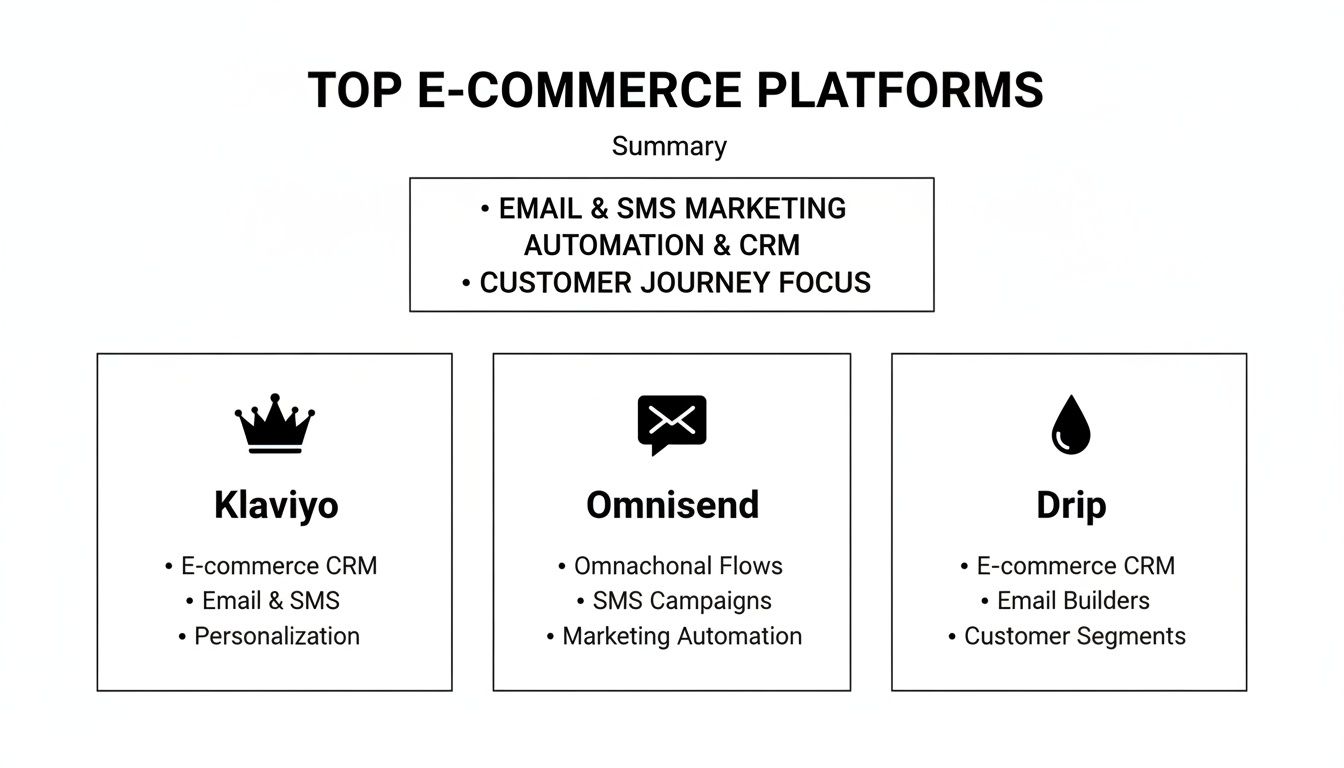
As you can see, each one has a distinct focus. Klaviyo is all about data, Omnisend brings multiple channels together, and Drip leans heavily into its CRM roots for automation.
If you’re running a high-volume brand, especially on Shopify Plus, the conversation almost always starts and ends with Klaviyo. Your entire business hinges on your ability to slice and dice customer segments and drive those crucial repeat purchases. Klaviyo's native Shopify integration is so deep it’s like a firehose of data that most other platforms just can't keep up with.
Just think about your marketing calendar. You're probably juggling a new product launch, a flash sale for your VIPs, and your regular content newsletters. Klaviyo lets you build complex segments so these campaigns don't trip over each other.
For a fast-growing DTC brand, Klaviyo’s predictive analytics are a game-changer. Features like “predicted date of next purchase” and “predicted customer lifetime value” allow you to build automated flows that are proactive, not just reactive, significantly boosting CLV.
What if you're selling across different storefronts? Maybe you have your own site, an Amazon presence, and even a pop-up shop. Your biggest headache is stitching together a single view of your customer. While no email platform has completely cracked Amazon’s walled garden, Omnisend gives you a flexible and surprisingly affordable way to run an omnichannel strategy.
The goal here is simple: reach your customers wherever they shop. That means getting your email, SMS, and push notifications to work together as one seamless journey.
This straightforward approach lets you focus on crafting the right message and timing, not fighting with complicated settings or surprise bills.
For businesses built on recurring revenue—like a monthly coffee club or a quarterly beauty box—retention is everything. While Klaviyo and Omnisend can certainly handle subscriptions, Drip's "ECRM" (Ecommerce CRM) model offers a compelling alternative built for nurturing long-term customer relationships.
Your main job isn't just to get the next one-off sale; it's to prevent churn and grow the lifetime value of every single subscriber. That requires some seriously sophisticated, behavior-driven automation.
So You've Picked Your New ESP. Now What?

Choosing the best email marketing software for your ecommerce brand is a major win, but don’t pop the champagne just yet. The real work is just beginning. A rushed or sloppy migration can absolutely tank your revenue and deliverability, undoing years of hard-won progress.
This isn't a weekend job. For a mature brand, a proper migration is a strategic project that takes a full 4 to 8 weeks. Trying to fast-track it is a recipe for disaster and can get you blacklisted by inbox providers like Gmail. A careful, methodical approach is the only way to protect your sender reputation and keep your automated revenue flowing.
Before you even think about exporting a single contact, it's time for a serious list cleaning. Moving a messy list to a shiny new platform is like dragging all your junk into a brand-new house—it completely defeats the purpose and will kill your performance from day one.
Start by exporting your entire list and getting ruthless. You have to identify and cut the dead weight: unengaged subscribers who haven't opened or clicked an email in the last 90-120 days. I know it can feel painful to delete subscribers, but trust me, they're actively hurting your deliverability.
Why pay to migrate people who ignore you? A smaller, more engaged list will always crush a massive, sleepy one in performance. This single step is the fastest way to boost your open rates and start strong on your new platform.
Once your list is squeaky clean, you can start the import. Take your time mapping all of your data—custom fields, tags, and especially historical purchase data. This information is the fuel for the powerful segmentation and automation you're paying for, so don't cut corners here.
You can't just flip a switch and blast your entire list from a new email service provider. Your new sending IP and domain are complete unknowns to email clients; they have zero reputation. You need to "warm them up" by slowly and strategically increasing your sending volume over several weeks.
This process proves to Gmail, Outlook, and others that you're a legitimate sender, not a spammer. Here’s what a typical warming schedule looks like:
During this warm-up phase, you'll keep your old platform running for your main campaigns. The new ESP is only for these small, targeted warming sends. You need to watch your open rates and bounce rates like a hawk for any red flags.
While your new domain is warming, it’s the perfect time to start rebuilding your core automated flows. Focus on the money-makers first: the welcome series, abandoned cart recovery, and post-purchase sequences. For a little while, you might even run them in parallel with your old system to ensure there are no gaps in the customer experience.
And one last thing—don't be afraid to negotiate. If you're signing an annual contract, especially as a high-volume sender, there’s almost always some wiggle room. Ask for a 10-15% discount, a dedicated account manager, or a free migration support package. The worst they can do is say no, and you might just save yourself a nice chunk of change.
Picking the right email marketing platform is a make-or-break moment for your brand. The right one acts as a growth engine, but the wrong one quickly becomes an expensive headache that stalls your progress. After putting these platforms through the wringer, we’re ready to make our final calls for 2026.
For the majority of high-growth, data-obsessed ecommerce brands pushing past the 7-figure mark, Klaviyo is the clear winner. Its segmentation capabilities are second to none, and when you pair that with its predictive analytics and deep-seated Shopify integration, you get a powerful machine built to maximize customer lifetime value.
If your entire strategy revolves around granular targeting and squeezing every last dollar out of your customer data, Klaviyo is the investment that will scale with you to 8-figures and beyond. It’s simply built for that level of ambition.
But that doesn't mean Klaviyo is the only game in town. For brands that want a unified omnichannel strategy from day one without all the fuss, Omnisend is our top runner-up.
Omnisend's genius is in its simplicity. It seamlessly weaves email, SMS, and push notifications into a single, intuitive workflow, making it incredibly easy to build a cohesive customer experience across every channel.
This makes it the perfect choice for businesses looking to test and scale omnichannel marketing without the complexity—or separate bills—you often find with other setups. If you want to reach customers where they are with minimal friction, Omnisend offers a streamlined and cost-effective path.
Ultimately, your choice has to mirror your core business model. For pure-play DTC brands that live and breathe data, Klaviyo is your growth engine. For emerging retailers focused on an omnichannel presence, Omnisend gives you the most direct route to a unified marketing front. Pick the platform that doesn’t just solve today’s problems but also fuels your vision for the future.
Thinking about switching email platforms? It’s a big move, and it always brings up some tough, practical questions. Founders get hung up on the nitty-gritty of making a switch or figuring out the right time to upgrade. Let's tackle the most common questions we hear from brand owners who are weighing their next move.
Don't fall into the trap of thinking a platform migration is a quick weekend project. For any growing store with real customer data and established flows, you should be planning for 4 to 8 weeks, minimum.
Trying to rush it is one of the biggest mistakes you can make. It can wreck your sender reputation and bring your revenue to a grinding halt.
A proper migration has a few key phases:
A rushed migration is the fastest way to land in the spam folder. Treat it like a strategic project, not just a technical to-do list. That’s how you ensure a smooth transition without tanking your sales.
This is a constant headache for anyone selling on multiple channels. Platforms like Klaviyo and Omnisend are brilliant with DTC data from storefronts like Shopify, but Amazon data is a different beast entirely.
Amazon’s policies are built to keep you from communicating directly with their customers. You can't just sync your Amazon customer list into your main email software. It's a closed ecosystem.
But there are workarounds. Smart brands use third-party tools to bridge the gap. They capture Amazon buyer info using things like warranty registrations, QR codes on product inserts, or special landing pages. You can then pipe that data into your email platform and start building a relationship, but it definitely takes an extra layer of strategy and tech.
The right time to upgrade from a basic tool like Mailchimp isn't about revenue—it's about complexity. A lot of brands hit this point somewhere around the $500K to $1M ARR mark, but the real trigger is when your current software starts holding you back.
Ask yourself this: Are your marketing ideas getting shot down by your tool's limitations?
If you constantly find yourself unable to build the segments or automated flows you know you need, it's time to move. The switch becomes essential when you can no longer effectively use your own customer data to drive repeat business and grow LTV.
At Million Dollar Sellers, our members navigate these platform decisions by sharing real-world data and experiences. Join our exclusive community to get behind-the-scenes insights from top ecommerce founders who have successfully scaled their marketing stacks. Learn more at https://milliondollarsellers.com.
Join the Ecom Entrepreneur Community for Vetted 7-9 Figure Ecommerce Founders
Learn MoreYou may also like:
Learn more about our special events!
Check Events