
Chilat Doina
January 31, 2026
If you want to delegate effectively, you need to start by defining the outcome you're after, not just listing the steps to get there. It’s about giving your team the right resources, context, and authority to get the job done. Then, set up a simple way to check in without breathing down their necks. This simple shift empowers them and frees you up to finally focus on high-impact growth.
For a ton of high-achieving e-commerce founders, the jump from seven to nine figures gets blocked by one person: themselves. It's a classic trap. You built this brand from scratch, wearing every hat from marketer to shipping clerk. But that same hustle that got you here? It’s now the bottleneck holding you back.
Mastering delegation isn't about just offloading the tasks you hate. It's the core strategy for unlocking real, exponential growth. The true cost of doing everything yourself isn't just the hours you lose. It's the stifled innovation, the missed strategic opportunities, and the brutal founder burnout that can grind even the most promising business to a halt.
When you're stuck in the day-to-day—tweaking ad campaigns, chasing down suppliers, or answering support tickets—you're working in the business. Real delegation lets you finally start working on the business. And that transition is make-or-break for any e-commerce brand that wants to scale big.
Think about the sheer amount of mental space that opens up when you're no longer the go-to person for every tiny fire. That new freedom lets you zero in on the big-picture activities that only a founder can really drive:
The bottom line is simple: your time is the company's most valuable asset. Every hour you spend on a task someone else could do is an hour you didn't spend on growing the entire business. Delegation is how you multiply your impact.
Of course, bad delegation can seriously backfire, creating more work instead of less. Imagine running a booming Amazon brand but still finding yourself buried in operational quicksand. A wild survey revealed that managers waste around 14% of their time redoing tasks and fixing delegated work that went sideways.
Proper delegation flips this script. It empowers your team with real autonomy, which skyrockets job satisfaction and loyalty. Want to dive deeper into how this works? Check out the 5 reasons to delegate effectively in our detailed guide.
The first step toward smart delegation is a brutally honest look at where your time actually goes. As a founder, you're hardwired to wear all the hats and do whatever it takes to get the job done. But that same hustle that got you off the ground will eventually become the very thing that holds you back.
You can't decide what to hand off until you have a clear picture of your day-to-day. A lot of founders get stuck right here, convincing themselves that every little task needs their magic touch. The reality? A huge chunk of your day is probably eaten up by stuff that’s repetitive, requires a skill you don’t have, or just doesn't move the needle.
The goal is to draw a line in the sand between the high-impact work only you can do and… well, everything else.
Grab a notepad or open a spreadsheet and track everything you do for one full week. I mean everything—from answering DMs and generating shipping labels to checking inventory levels. No task is too small.
Once you have that raw list, it's time to sort it into a few key buckets. This will help you see what’s ripe for delegation.
This is the classic founder's dilemma: keep doing it all yourself and hit a growth ceiling, or start delegating to break through it. This flowchart lays it out perfectly.
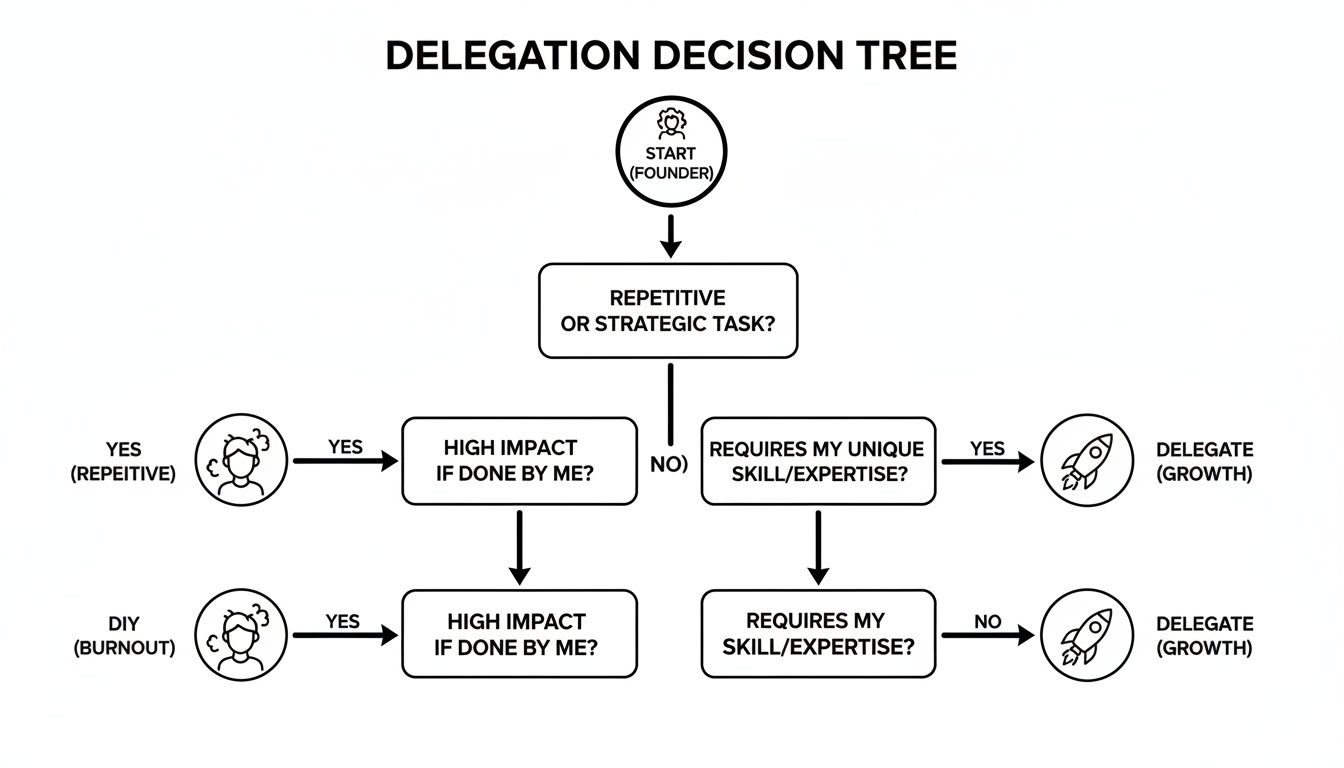
While the DIY approach feels safe and controlled, it's a direct path to stagnation. Scaling your store and getting your life back means strategically letting go of the right things.
To make this even more practical, let’s put it into a simple matrix. This isn’t just about making a list; it’s about creating an action plan. Use this to sort your tasks and see exactly what you should hand off first.
Use this matrix to categorize your daily tasks and identify prime candidates for delegation, freeing you up for high-impact strategic work.
Task CategoryDescription & E-com ExamplesAction PlanDelegate ImmediatelyLow strategic impact, highly repetitive or specialized. Examples: Daily social media posting, basic customer support emails, data entry for sales reports, processing returns.Document the process, find a virtual assistant or junior team member, and hand it off within the next 30 days.Systematize & DelegateModerate strategic impact, requires a clear process to succeed. Examples: Managing paid ad campaigns, reconciling inventory, handling customer service escalations.Create a detailed SOP, set clear KPIs, and train a skilled team member or hire a specialist freelancer.Keep for NowHigh strategic impact, closely tied to your unique vision and skills. Examples: Final product selection, forging key strategic partnerships, defining brand voice and vision.Own these tasks completely. Re-evaluate quarterly to see if any components can be broken off and delegated.
Remember, the point isn’t to get to an empty to-do list. It’s to make sure every single item left on it is a high-value activity that only you, the founder, can do to drive real growth.
Knowing what to delegate is just half the battle. Figuring out who will take on these new roles is next. To get that part right, check out our guide on building a winning e-commerce team structure that’s built for scale. This ensures you aren't just offloading work but actually building a resilient company that can thrive, with or without you handling every detail.
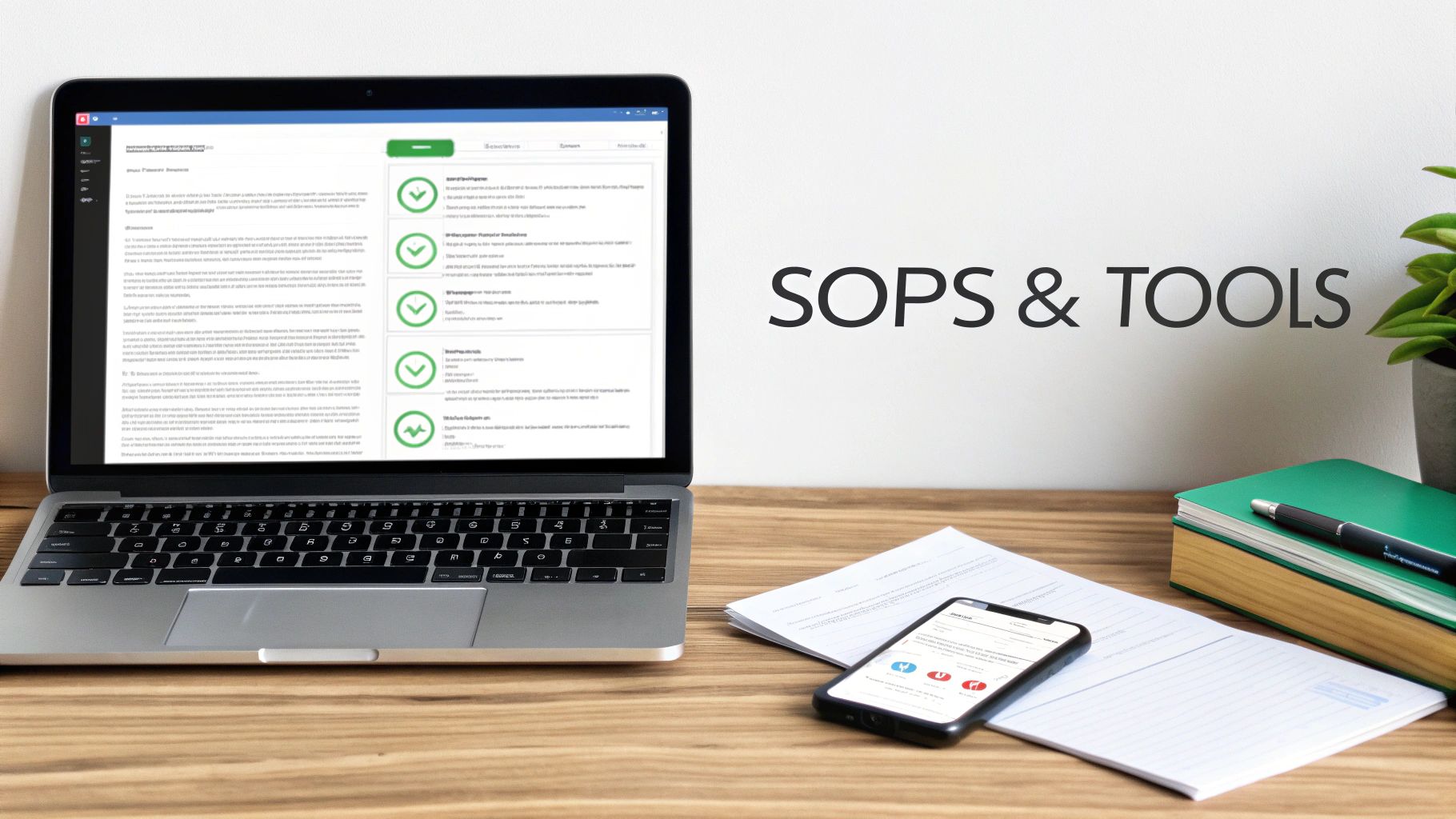
Handing off a task without a clear system isn't delegation—it's just passing on chaos. It causes confusion, guarantees subpar results, and almost always lands the work right back on your desk, messier than before.
The secret to great delegation isn't just about what you hand off; it's about building the operational backbone that makes the process smooth, repeatable, and scalable. This is where you graduate from ad-hoc task assignments to creating a true delegation machine. It means documenting your processes, using the right tech, and setting crystal-clear metrics for success.
Get this part right, and you’ll empower your team to execute flawlessly, often without needing your input at all.
The term "SOP" can sound painfully corporate, but for an e-commerce founder, it’s just a playbook for how things get done. Forget the 50-page manuals. A good SOP is simply a clear, concise, and actionable guide for the person doing the work.
Think about a critical, repetitive task, like processing a customer return. A dead-simple SOP for this could be a quick screen recording using a tool like Loom. Just hit record and walk through the exact steps in your e-commerce platform—from finding the order to issuing the refund and sending the confirmation email.
This visual guide is almost always better than a written document alone. It crushes ambiguity and gives your team member a direct reference they can watch as many times as they need. For something more complex, like launching a new product listing on Amazon, your SOP might be a detailed checklist in your project management tool.
The goal of an SOP isn’t to stifle creativity; it’s to eliminate guesswork on routine tasks. A great SOP provides the "what" and "how," freeing up your team’s mental energy to focus on problem-solving and improvement.
To really nail this, check out our complete guide on how to create standard operating procedures that your team will actually want to use.
Technology is your best friend for managing delegated work without turning into a micromanager. The right tools create a central source of truth, keep communication organized, and let you track progress at a glance. You don't need a massive, complicated tech stack; a few key pieces will make a world of difference.
Here’s a simple, effective stack that works for most e-commerce founders:
The trick is to pick your tools and commit to them. Consistency ensures everyone knows where to find information and how to provide updates, which is the bedrock of effective delegation.
You can't improve what you don't measure. Setting clear Key Performance Indicators (KPIs) for delegated tasks is non-negotiable. This isn’t about being a taskmaster; it’s about defining what "done well" actually looks like. KPIs turn vague instructions into concrete, measurable outcomes.
For example, instead of just saying, "Handle customer support emails," you need to define specific, measurable targets:
These numbers give your team member a clear target to hit and provide an objective way for you to measure performance. They know exactly what success looks like, and you have a simple way to check in on results without getting lost in the weeds.
To tie these efforts into a bigger picture, a solid understanding of process and performance management can help ensure your delegation strategy aligns with your company’s overarching goals.

You can have the best SOPs in the world and the slickest project management software, but if the handoff is clumsy, the whole delegation effort falls apart. A great handoff is more about psychology than process. This is the moment you move from just assigning tasks to genuinely empowering your team.
It all boils down to trust. You have to believe in your team's ability to get the job done, and they need to trust that you’ve given them everything they need to succeed. Without that two-way street, you'll slide right back into micromanaging, which defeats the whole point.
Effective delegation doesn't start in the handoff meeting. It starts with a bit of strategy beforehand. Just dumping a task on whoever seems to have the most free time is a fast track to mediocre results.
Instead, I always think through three key factors:
For e-commerce founders, especially those in elite networks where execution is everything, delegation isn't just a tactic—it's the engine for growth. Handing off tasks builds a sense of ownership, making your team feel valued and seriously boosting their motivation.
This is huge when you realize a shocking 85% of employees worldwide are disengaged, which absolutely cripples productivity. Smart delegation fights this by building the trust your team needs to thrive.
Once you've picked the right person, the handoff meeting is where you set them up for a home run. This isn't a quick Slack message; it's a dedicated conversation to eliminate any and all ambiguity.
Your goal is to cover these key points with total clarity:
The core principle here is to delegate outcomes, not just tasks. When you give someone ownership of the result, you unlock their creativity and problem-solving abilities. You're not just getting something checked off a list; you're building a leader.
Alright, the handoff is done. Now comes the hardest part for most founders: getting out of the way. We're so used to having our hands on everything that letting go feels unnatural. But micromanagement is a trust killer, plain and simple.
Instead of constantly pinging them with "How's it going?" set up a clear and predictable check-in schedule. Maybe it’s a quick 15-minute sync once a week or a daily end-of-day update in a dedicated Slack channel. This structure gives you the visibility you crave without making your team feel like you're hovering over their shoulder.
As your team grows, especially with remote members, adjusting your leadership style is non-negotiable. To make sure your delegated work is getting done right, it's worth exploring some proven strategies for success in managing remote teams. Trust your people, trust the system you built, and watch them rise to the occasion.
Let’s be honest, even the sharpest e-commerce founders have delegation horror stories. One minute you're celebrating a calendar that's finally clear, and the next you're diving in to clean up a mess that's somehow bigger than the original task. It’s a frustrating, but totally normal, part of scaling up.
The good news? These mishaps are rarely a sign you hired the wrong person. More often than not, they’re a signal that something in your delegation system is busted. If you can learn to spot the root cause, you can turn a failure into a powerful learning moment that makes your whole operation stronger.
When a delegated task goes sideways, the gut reaction is to blame the person and just take the work back. This is a massive mistake. Instead of reacting, you need to diagnose the failure like an engineer looking at a broken machine. Was the problem with the input, the process, or the expected output?
Let's walk through a classic e-commerce scenario. You delegate the weekly inventory restock order to a trusted operations associate. A week later, you find out you've over-ordered a slow-moving product by $10,000, tying up cash you desperately need.
Before you jump to any conclusions, stop and ask a few diagnostic questions:
Nine times out of ten, the mistake can be traced back to a breakdown in one of these four areas. It's rarely about a lack of effort. It's almost always about a lack of clarity, resources, or proper alignment from the get-go.
Once you’ve figured out what went wrong, the next move is to build a simple, repeatable way to course-correct. This isn't about pointing fingers; it's about refining your system so the same mistake doesn't burn you twice.
A botched PPC campaign is another perfect, and painful, example. You hand off your Google Ads account to a marketing assistant, and a month later, your Cost Per Acquisition (CPA) has shot through the roof. The campaign is just incinerating cash.
Instead of just yanking their access and taking over, you can use this as a teaching moment to build a more bulletproof system.
A solid feedback loop turns a costly error into a valuable training investment. This process builds ownership and sharpens your team's problem-solving skills, making them far more effective down the road.
This approach shifts you from a frustrated micromanager to a high-impact coach. You’re not just fixing the fire in front of you; you’re fireproofing your entire playbook and upskilling your team at the same time.
In the cutthroat world of e-commerce, bad delegation is a direct path to burnout. And burnout is the number one preventable reason that growth stalls—burnt-out leaders are 50% less engaged and 3.5X more likely to quit. You can dig into how poor delegation feeds this cycle in DDI’s in-depth report on burnout. By mastering this troubleshooting process, you don't just dodge burnout. You build a resilient, self-sufficient team that can handle challenges without you needing to swoop in and save the day.
Even with the best playbook in hand, questions are going to pop up the minute you start handing off tasks. That’s perfectly normal. Making the leap from being the primary "doer" to a strategic leader is one of the biggest—and toughest—mindset shifts any e-commerce founder has to make.
Here are the straight-up answers to the most common questions we hear from entrepreneurs who are deep in the trenches.
Let’s get one thing straight: mistakes aren't just possible, they're inevitable. Especially when someone is learning the ropes.
The goal isn't to prevent every single error. That's an impossible standard that leads straight to micromanagement hell. The real win is treating mistakes as an investment—an investment in your team's training and your company's systems.
When a mistake happens, your first instinct might be to yank the task back. Don't. Instead, schedule a calm debrief to figure out what actually went wrong. Was the SOP missing a key detail? Did they not have the right software access? More often than not, a mistake points to a crack in your process, not a fatal flaw in your person.
Use it as a teaching moment. Refine the SOP together. This builds your team's problem-solving muscles and fosters a culture where it's safe to take on a challenge, which is absolutely critical if you ever want to scale.
This is the big one, isn't it? It's the fear that keeps so many founders chained to their keyboards, personally answering every customer service ticket. You've built your brand on a reputation for excellence, and the thought of that slipping is terrifying.
The solution isn't to cross your fingers and hope for the best. It's to define your standards with painstaking clarity before you hand anything over. Vague instructions like "make the new product listing look good" are a recipe for disappointment.
You have to give your team concrete, measurable criteria for what "good" actually means.
By delegating the outcome and providing objective benchmarks, you shift the focus from "doing it my way" to "achieving the required result." You might even be surprised when your team member finds a faster, smarter way to get there—one you never would have considered.
Motivation doesn't come from just piling more work onto someone's plate. It comes from giving them context, real ownership, and a clear path for growth. Nobody gets fired up about a task that feels like it was just dumped on them.
If you want your team to be genuinely motivated, you have to frame delegation as a sign of trust and an opportunity to level up.
Start by connecting the task to the bigger picture. Explain the why behind the what. Instead of "I need you to manage inventory now," try, "When you take over inventory management, you're directly impacting our cash flow and our ability to invest in awesome new products." See the difference?
Then, give them actual ownership. This means they have the authority to make decisions related to that task without running to you for approval on every little thing. When people feel trusted, their sense of responsibility and engagement goes through the roof. This is how you stop just offloading work and start building future leaders in your company.
At Million Dollar Sellers, we know effective delegation is the only way to break through those frustrating growth plateaus. Our private community connects you with top e-commerce founders who have already mastered the art of building systems and teams that scale. If you’re ready to stop being the bottleneck in your business and start operating like a true CEO, find out if you qualify for MDS. Learn more about joining MDS.
Join the Ecom Entrepreneur Community for Vetted 7-9 Figure Ecommerce Founders
Learn MoreYou may also like:
Learn more about our special events!
Check Events