
Chilat Doina
August 8, 2026
You already know the feeling. The dashboard says inventory is available, the ads are live, the cart is moving, and then a buyer gets an out-of-stock email or a pick team goes hunting for a hero SKU that should have been sitting on Bin A-14. That gap between the system and the shelf doesn't just create a headache. It drags on cash, fulfillment speed, and trust.
How to improve inventory accuracy starts with admitting the problem is usually bigger than a bad count. It's a control problem, a data problem, and a decision problem. If you keep treating it like a once-a-month housekeeping task, the same misses will keep showing up in different clothes.
The first time most founders feel an inventory gap is when it hits revenue, not when it shows up in a report. Amazon oversells because the WMS says stock exists. A hero SKU disappears during a promo push. A 3PL says the units are there, your team says they aren't, and customer service spends the afternoon apologizing for orders that never should've been accepted.
That's the obvious damage. The quieter damage is worse.
Every unit of phantom inventory ties up cash you could have put into replenishment, ad spend, or the next SKU launch. When counts are wrong, planners buy around noise. When the shelf is empty, ops rushes shipments and pays for avoidable expediting. When the system is wrong enough times, buyers stop trusting your availability, especially on Amazon and Shopify where stock promises have to be tight.
Practical rule: if the number in the system and the number on the shelf don't match, every downstream decision gets worse.
The issue isn't just fulfillment. It's also allocation. Stock that looks available can get reserved, promised, or routed into the wrong channel. That creates backorders, stranded ads, write-offs, and a lot of internal finger-pointing that should've been prevented upstream.
You can't scale a broken inventory record. You can only scale the errors faster. If your team keeps launching campaigns, opening channels, or adding SKUs while the base record is untrustworthy, the operation will keep leaking margin in places that don't show up cleanly on one P&L line.
That's why inventory accuracy sits above most “growth” work on the roadmap. If the record is wrong, forecasting is wrong. If forecasting is wrong, purchasing is wrong. If purchasing is wrong, the warehouse gets stuck cleaning up decisions it never made. That chain is why fixing the record beats adding another layer of hustle.
Teams often jump straight to tools. That's backward. You need a baseline at the smallest control level, SKU and bin, or the averages will hide the true breakpoints. The right way is simple: compare system quantity versus physical count, then segment the difference by facility, channel, and movement type so the error points to a process step, not a vague blame bucket. The inventory-days-on-hand concept is useful here as a planning lens, but it only helps if the count underneath it is clean, as outlined in how to calculate inventory days on hand.
Use one formula everywhere and don't let different teams invent their own version. A clean baseline starts with a physical count or cycle count, then the same math gets applied across the business so you're comparing like with like. The point isn't mathematical elegance. The point is making sure finance, ops, and the warehouse are arguing over the same number.
Don't freeze the whole building to get started. Pull a count on a sample of critical SKUs, then expand into the noisy zones where errors are likely to live. If Amazon FBA, a 3PL, and DTC all pull from different stock pools, keep them separate in the analysis. A healthy-looking warehouse total can still hide a channel-specific failure.
The most useful report isn't “How wrong are we?” It's “Where does the wrongness enter the system?” Receiving mistakes belong in one bucket. Put-away errors belong in another. Picks, returns, and adjustments should never be lumped together because they point to different owners and different fixes.
| Movement Type | Common Error Rate | Where to Investigate First | Owner |
|---|---|---|---|
| Receiving | Qualitatively high when labels or counts are rushed | PO reconciliation and scan compliance | Receiving lead |
| Put-away | Qualitatively high when location discipline is weak | Bin labeling and location confirmation | Warehouse supervisor |
| Picking | Qualitatively high when users bypass scans | Pick validation and exception handling | Pick floor manager |
| Returns | Qualitatively high when resaleable and damaged stock get mixed | Return grading and quarantine flow | Returns lead |
| Adjustments | Qualitatively high when recounts are used as a shortcut | Root-cause coding and approval trail | Inventory control owner |
The goal is to isolate exceptions to a process step. If the discrepancies cluster in one zone, one shift, or one channel, that's where the fix belongs. If you only look at facility-wide averages, you'll miss the leak that's costing you.
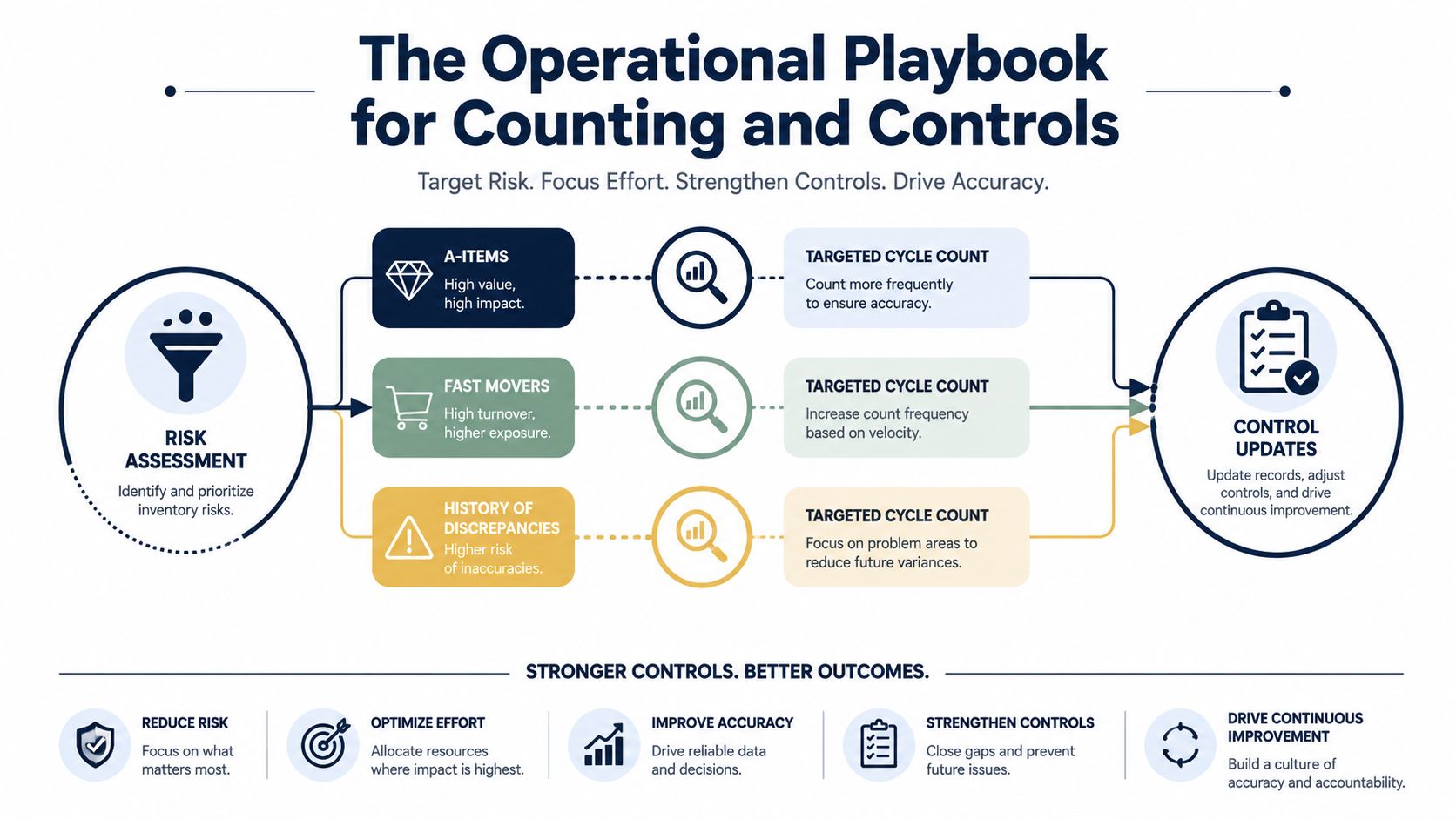
Most inventory drift comes from the same five failure modes. If you can't name them, you can't fix them. If your team keeps saying “the system is off,” that usually means someone skipped a control point, a master record drifted, or a process was never locked down in the first place.
Manual entry without barcode validation is still one of the fastest ways to corrupt a clean record. Ask one question, are people typing quantities or locations by hand when they should be scanning? If yes, the fix is boring and cheap, add scan enforcement before anyone touches automation.
Weak receiving controls show up when purchase orders aren't reconciled before storage. The symptom is stock that technically entered the building but doesn't reconcile cleanly to the PO. The cheapest fix is a receiving gate, no unit gets put away until the count and label are confirmed.
Inconsistent units of measure create chaos when a case, pack, and each all get treated like they're interchangeable. Ask whether the same SKU appears in multiple units without strict conversion logic. If it does, clean up the master data and force one naming convention before you buy more software.
Returns and damaged stock mixed together pollute the active sellable pool. If your team throws resaleable returns into the same lane as RTVs, scrap, or damaged inventory, the count will look fine while availability is wrong. The cheap fix is a quarantine flow with a hard split between available, hold, and unsellable.
Master-data drift is the situation where item names, numbers, descriptions, and location records fall out of sync across systems. Oracle calls out the need for consistent item names, numbers, and descriptions across systems, and that's the right place to be ruthless about it, because if the identity layer is wrong, every downstream count is suspect. For e-commerce and omnichannel brands, this is the point at which the record gets untrustworthy while the warehouse still looks busy and “organized.”
The question isn't whether your team counted enough. The question is where the truth stopped being trustworthy.
That's why recounting without diagnosis is weak leadership. A recount that doesn't produce a root-cause code just creates a cleaner-looking lie. Use the operational guidance on inventory accuracy across the supply chain as a reminder that touchpoint reduction and master-data discipline matter as much as labor discipline.
The fastest fix is usually not a major system change. It's ownership, one person owns receiving truth, one owns location truth, one owns item identity, and one owns variance coding. The moment responsibility is ambiguous, accuracy starts to drift again.
Blanket full counts are a labor tax. They make teams feel busy and give leadership a false sense of control, but they don't target the places where accuracy breaks. The better move is risk-based cycle counting, focused on A-items, fast movers, and zones with a history of discrepancies, because those are the places where a bad record hurts most.
Start with the highest-risk inventory classes. High-velocity SKUs move too often to trust casual observation, and high-value items deserve more scrutiny because a single miss matters more. When a location has a history of discrepancies, stop treating that as background noise and count it more often until the process stabilizes.
The rule is blunt. Pause inventory movements during active counts so the count means something. If product is moving while the team is counting, you're not auditing stock, you're creating a new error stream. Reconcile purchase orders before storage, then count what's supposed to be in the bin.
Barcode or RFID validation at receiving and put-away is essential. If your team can receive product without a validation step, the error starts at the door and gets harder to unwind later. The point of the scan is not speed. It's traceability.
The Shopstar guide on how to manage product inventory is useful because it reinforces the operational basics, keep product records tied to actual movement and don't let updates lag behind reality. That's the discipline that stops inventory systems from drifting into fiction.
Use root-cause codes for every variance. Not a generic “adjustment.” Not “miscellaneous.” A real code tied to the failure that caused the difference. If the same error keeps recurring and nobody can see the pattern, the process hasn't been managed, it's been tolerated.
Daily, your floor team should verify receiving, put-away, and exception handling. Weekly, they should review discrepancy zones, repeat offenders, and stale locations. Monthly, inventory control should review the codes and decide which control point needs to change, not just which number needs to be corrected.
If you need an SOP framework, keep it simple and written. The SOP structure guide is a good reference point, because accuracy improves when the work is standardized, not when everyone “knows what to do.”
| Control Point | What Good Looks Like | Failure Signal |
|---|---|---|
| Receiving | Every receipt is validated before put-away | PO and bin quantity disagree |
| Put-away | Item lands in the bin the system assigned | Location exceptions keep recurring |
| Cycle count | High-risk SKUs get counted on a risk basis | Counts are random and labor-heavy |
| Variance review | Every adjustment has a coded cause | The same errors repeat monthly |
When this playbook works, the warehouse gets calmer. Fewer surprises. Fewer escalations. Fewer teams arguing over whether the system or the floor is wrong.
Do not start with a technology wishlist. Start with the question, where does the record become untrustworthy, and which system owns the truth? If you can answer that, the decision between a process fix, barcode scanning, RFID, a WMS cleanup, or automation gets a lot easier.
If the break happens at one handoff, one shift, or one zone, fix the process first. Add barcode validation. Tighten receiving. Clarify ownership. Clean up naming conventions in the WMS and ERP before you touch anything expensive. If the error volume is concentrated and the SKU count is manageable, process discipline usually beats a software project.
That's especially true for teams running Amazon FBA, 3PL, DTC, and wholesale at the same time. Each channel can look healthy on its own while the shared truth layer is broken. The warehouse management system guidance matters here because a WMS only helps when the data model beneath it is clean enough to trust.
Barcode scanning is the cheapest reliable upgrade when the team is still making manual entry mistakes. RFID makes sense when the workflow is high-volume, high-touch, or too fast for scan-by-scan discipline to hold. Don't buy RFID because it sounds advanced. Buy it when the cost of missed reads is higher than the cost of the rollout.
Decision rule: automate the step that fails repeatedly, not the whole warehouse.
Robotics and deeper automation only make sense when the upstream record is already disciplined. Otherwise, the machine just moves bad data faster. Oracle's recommendation to reduce touchpoints before layering in more mobile and scanning control is the right bias, and it lines up with what operators see in real buildings.
If your accuracy issue is local, fix the process. If the issue is spread across zones but still tied to human handling, add scanning and system rules. If the issue is rooted in multiple handoffs, channel complexity, or persistent location errors, then it's time to look at WMS tuning or broader automation.
For compliance-heavy moves, especially if you're tracking cargo or fleet-linked inventory, the HGV cargo compliance guide is a good reminder that control systems only work when the physical chain is managed cleanly end to end. Same principle, different surface area.
The short test is this, if the cheaper fix can close the gap, don't buy the expensive one. If the cheap fix only masks the symptom, then you're underinvesting in the break.
You do not need a giant dashboard. You need four numbers that tell the truth. Record accuracy, location/bin accuracy, shrink percentage, and put-away accuracy are the ones worth watching because they expose whether the record, the slot, and the movement controls are holding up.
A working benchmark for record accuracy is 95%+ as outlined in warehouse-tech guidance. Location or bin accuracy should live in the high 90s if the warehouse is controlled well. Shrink should stay low for most CPG operations, and put-away accuracy should be high enough that mis-slots are exceptional, not normal.
The point of targets is not to decorate a scorecard. It's to tell you whether process control is improving or slipping. If one KPI improves while another gets worse, you probably moved the problem instead of fixing it.
Take 30 minutes. Pull variance reports by zone. Review root-cause codes. Spot the same SKU families, shifts, and locations that keep popping up. Assign one owner per problem, not one team. If nobody owns the fix, the fix won't happen.
For a strong asset-tracking mindset, the best practices from Evright Industrial are a useful reminder that accuracy comes from discipline, traceability, and repeatable checks, not from optimism. The monthly review should prove whether those controls are working.
Use three cadences. Weekly floor checks for obvious drift. Monthly trend reviews for repeated variance. Quarterly deep dives for master-data cleanup, system sync issues, and control redesign. If a KPI moves in the wrong direction for two cycles, escalate it immediately instead of waiting for a bigger mess.
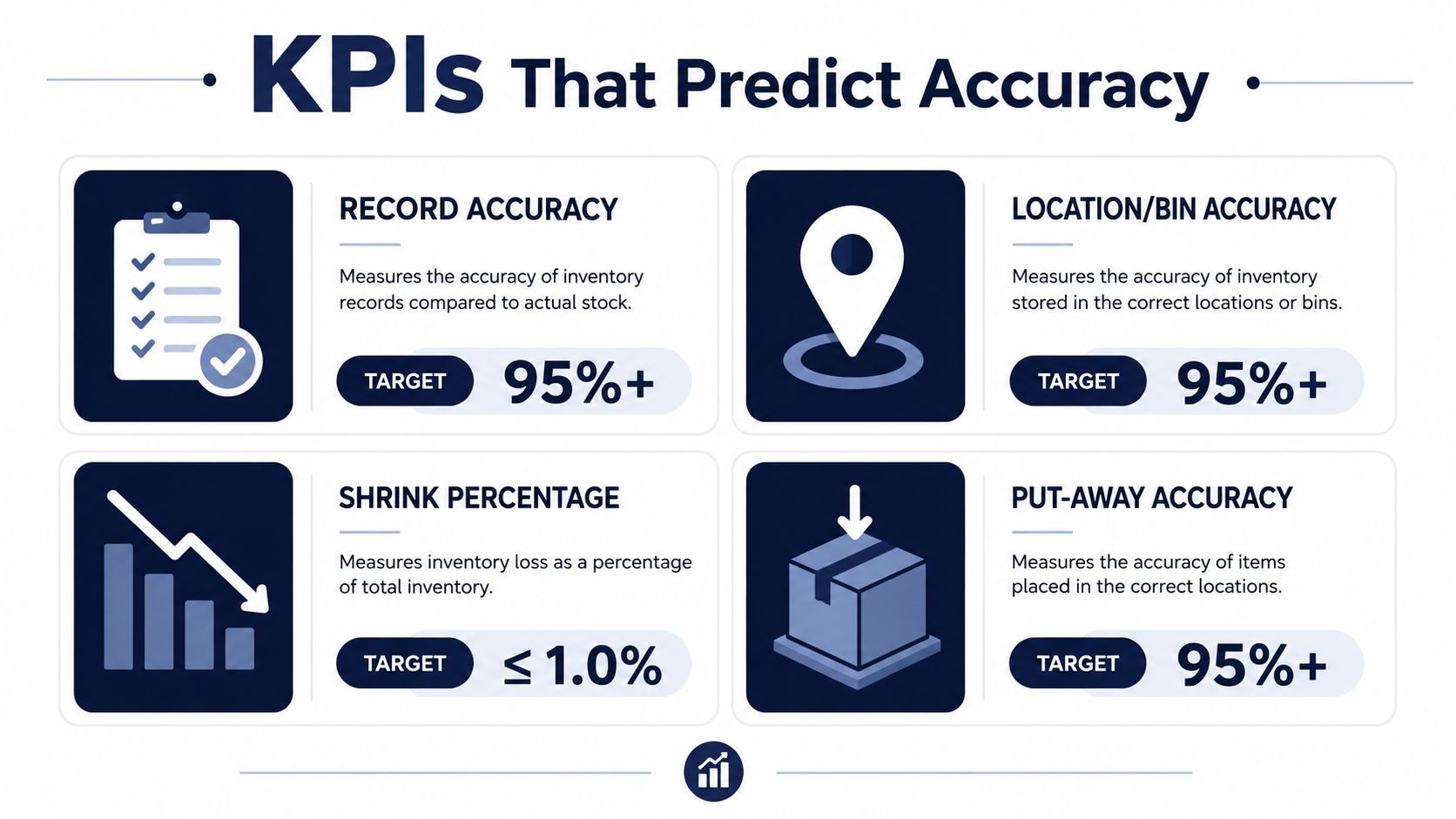
The only scorecard you really need is simple. Put the metric, target, current value, owner, and next action in one sheet. That gives leadership a clean view and keeps the warehouse from hiding behind anecdotes.
The fastest way to improve inventory accuracy is to stop treating it like a forever initiative. Give it a timeline, ownership, and checkpoints. If the operation is serious, the first 90 days should feel like a controlled cleanup, not a brainstorming exercise.
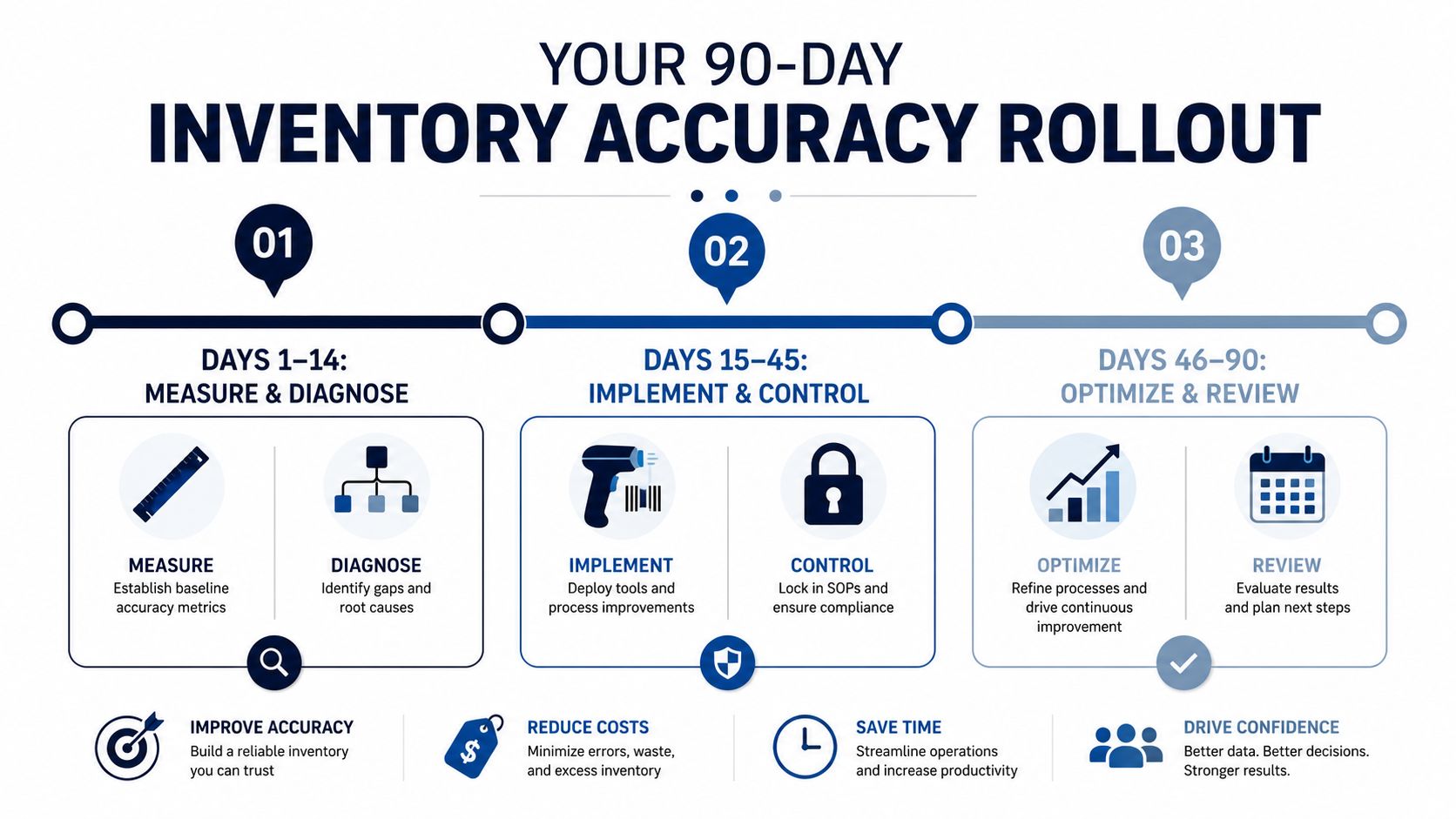
Measure the baseline at SKU and bin level. Map the touchpoints. Identify the top three root causes. If you don't know where the record starts breaking, don't buy tech yet. The one metric to watch first is record accuracy, because it tells you whether the system can be trusted at all.
Lock in the SOPs. Deploy barcode validation at receiving. Start risk-based cycle counting. Train the team on root-cause coding so adjustments stop being a dumping ground for uncertainty. If counts improve but the same variance types keep recurring, the process still isn't under control.
Tune WMS and ERP master data. Build the KPI scorecard. Run the first monthly review and make the difficult calls on tech spend. If the problem is still local, stay with process fixes. If the problem spans channels and handoffs, that's when you look harder at RFID, WMS redesign, or automation.
The mindset shift matters most. Inventory accuracy is not a project with an end date, it's a weekly operating rhythm. If you get the rhythm right, the warehouse gets quieter, the numbers get harder to game, and the business stops paying for preventable confusion.
If you want sharper operator-level playbooks on inventory control, scaling systems, and fixing the messy parts of e-commerce operations, Million Dollar Sellers is where serious founders trade what works. Join the community if you want to pressure-test your inventory process against operators who've already cleaned up the same kind of chaos.
Join the Ecom Entrepreneur Community for Vetted 7-9 Figure Ecommerce Founders
Learn MoreYou may also like:
Learn more about our special events!
Check Events