Chilat Doina
June 18, 2026
Most advice on Instagram Shopping is backward. It treats the feature set like a checklist. Turn on tags, upload a catalog, post a few Reels, and wait for sales.
That's not how serious operators use it.
Instagram shopping features matter because they sit in the middle of consumer attention, but attention isn't the same thing as owned demand. The key question isn't whether your brand should use Instagram Shopping. It's whether you're using it to create profitable customer journeys, or just helping Meta keep shoppers inside Meta.
Founders who win here treat Instagram as a commerce layer, not a standalone storefront. They use product tags, Stories, Reels, creator content, and live formats differently depending on margin, repeat purchase behavior, and how much first-party data they need to capture. That's where the strategic edge lives.
A lot of smart founders have become skeptical of Instagram Shopping, and for good reason. Meta has changed the interface, shifted priorities, and made it harder to pretend Instagram is a simple plug-and-play sales channel. If you've felt that tension, you're not wrong.
But dismissing Instagram Shopping entirely is also a mistake.
Instagram Shopping launched in October 2017 and grew from a product-tagging feature into a major commerce channel. By 2024, Instagram's social commerce revenue was estimated at more than $37 billion, with about 130 million users tapping shoppable posts each month and 46.8 million people in the U.S. making a purchase on Instagram in 2024, according to Statista's overview of e-commerce on Instagram.
That tells you two things. First, people are absolutely willing to shop on the platform. Second, Instagram is no longer just top-of-funnel media. It can influence discovery, consideration, and transaction in the same environment.
The mistake is thinking scale automatically means Instagram should become your primary storefront.
For some brands, especially impulse-friendly products with strong visual appeal, in-app commerce can shorten the path to purchase. For others, the bigger value is product discovery and demand capture that later converts on a DTC site, through email, SMS, retargeting, or retail.
Practical rule: Don't ask whether Instagram Shopping “works.” Ask what role it should play in your sales system.
If you sell replenishable products, bundles, or items that benefit from education, comparison, upsells, or subscriptions, your own site often carries more strategic value than a frictionless in-app purchase. If you sell trend-driven products with low explanation requirements, native shopping tools can be useful conversion accelerators.
Many teams still operate with a false binary. They think they must choose between “brand content” and “sales content.” In practice, Instagram shopping features do both when they're merchandised properly.
The platform remains one of the fastest ways to put product, context, and social proof in front of an interested audience. What's changed is the operating model. Winning brands don't rely on Instagram as a complete ecommerce business. They use it as a high-intent layer inside a broader customer acquisition machine.
That's why Instagram still matters in 2026. Not because Meta says it should. Because your customers are already there, already browsing, and often already ready to buy.
Instagram shopping features work best when you stop treating them as one thing. They're a stack of tools, and each tool has a different job in the path from discovery to purchase.
Recent industry reporting shows 83% of Instagram users search for new brands and products on the platform, and about 44% shop there in an average week, according to Capital One Shopping's Instagram Shopping statistics. That matters because it means these features sit inside existing shopping behavior. You're not forcing commerce into a social app. You're meeting commercial intent that's already there.
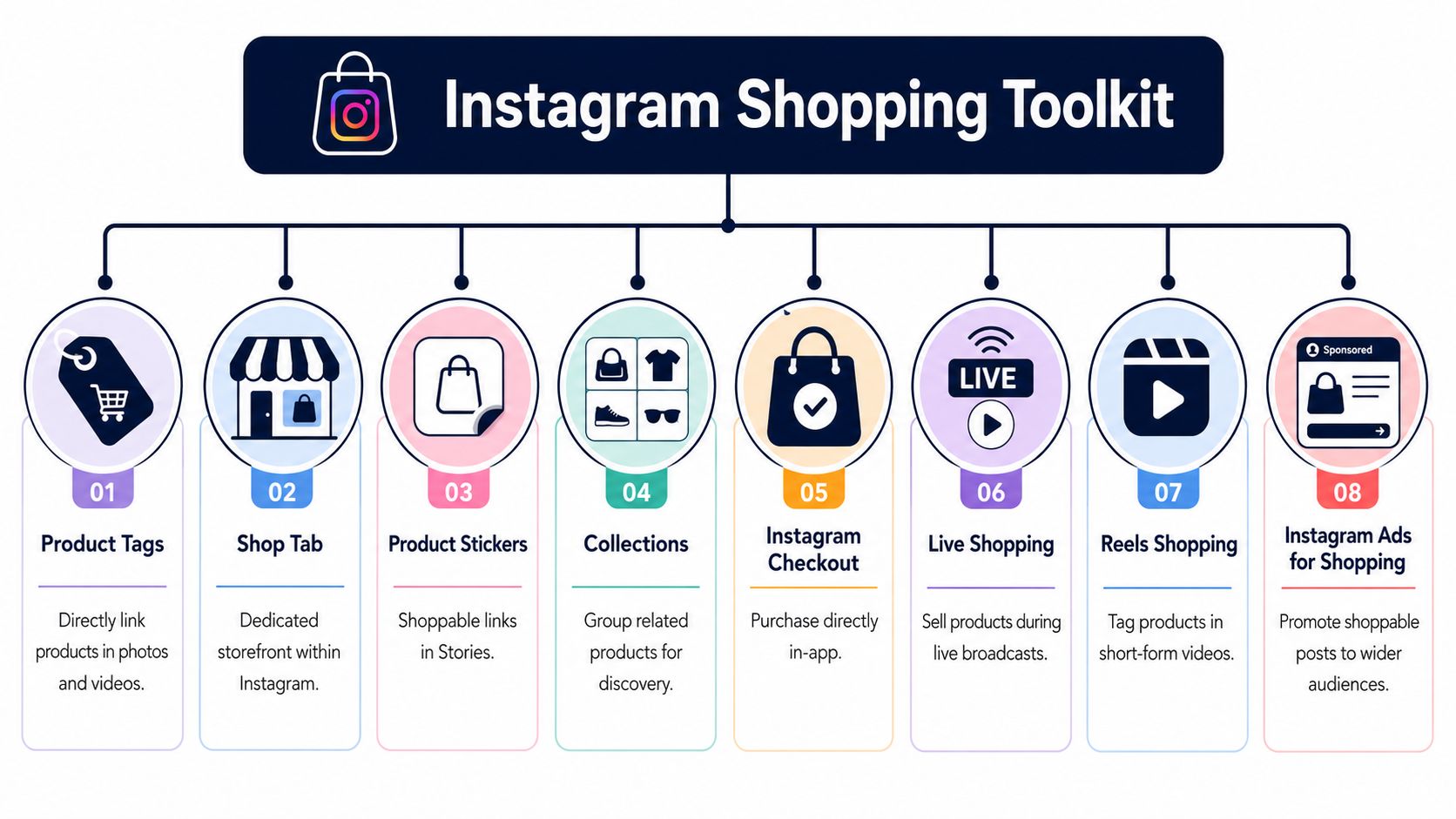
Here's how I'd think about the core toolkit.
Product Tags: These are your lowest-friction merchandising units. They work best when the content already carries desire. A clean product image with weak creative won't be rescued by a tag. Strong creative with a relevant tag gives buyers a fast next step.
Shop surfaces: Your shop area acts more like a lightweight storefront than a replacement for your site. Use it for product organization and buyer continuity, not for deep brand storytelling.
Product Stickers in Stories: These are useful when you want immediacy. Stories are where you can pair urgency, social proof, founder commentary, or creator demos with a direct click path.
Collections: Collections help with curation. They're especially useful for seasonal drops, gift edits, hero-product ecosystems, or “start here” paths for new customers.
Reels Shopping and shopping-enabled video are often more valuable than static tagged posts because they show product use, not just product presence. That distinction matters. People buy more confidently when they understand context, scale, texture, routine, and result.
Live Shopping sits in a different category. It's less about passive browsing and more about guided selling. When done well, it combines demonstration, objection handling, urgency, and trust in one format.
A practical content mix usually looks like this:
| Feature | Best use | Weak use |
|---|---|---|
| Product Tags | Converting existing interest | Trying to create interest from bland assets |
| Stories Stickers | Flash launches, restocks, social proof | Evergreen catalog browsing |
| Reels Shopping | Education and aspiration | Flat product-only edits |
| Collections | Merchandising and guided discovery | Dumping your full assortment without logic |
| Live Shopping | Launches, demos, creator selling | Low-energy broadcasts with no offer or structure |
If your team needs a useful operational primer on how brands sell more on Instagram, that guide is worth skimming. Not because you need more feature definitions, but because it helps newer operators see how these surfaces connect.
The best operators assign one commercial role to each format:
Discovery in Reels. Trust in Stories. Merchandising in collections. Conversion in tags. Demand spikes in Live.
When teams blur all of that together, performance gets muddy. Every post becomes half branding, half selling, and not particularly good at either. Clear role assignment fixes that fast.
Most Instagram Shopping problems aren't creative problems. They're infrastructure problems.
If your catalog is messy, your variants are inconsistent, your pricing lags behind your site, or inventory goes out of sync, the front-end experience breaks. Customers don't care whether the issue came from Meta, Shopify, WooCommerce, or your feed manager. They just see a sloppy brand.
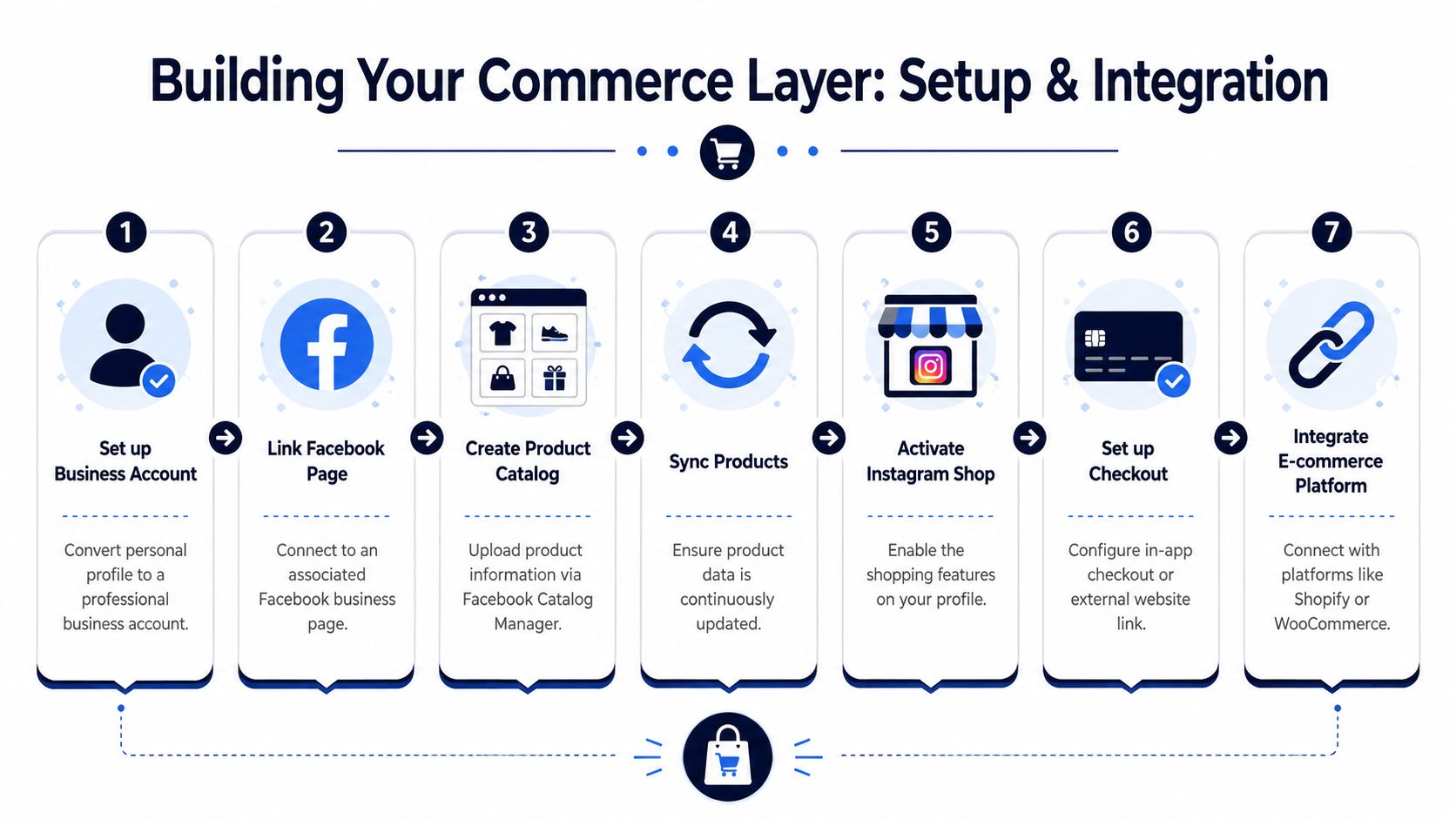
The architecture matters here. Instagram Shopping is built around a product catalog connected to a Facebook Page, and that upstream catalog controls how product data appears across shoppable surfaces. When titles, pricing, inventory, or product details change in your primary commerce platform, those updates can flow through automatically, which makes the system much easier to manage at scale, as explained in Sked Social's breakdown of Instagram Shopping setup.
The account structure is the first filter. You need a professional account, a connected Facebook Page, and a clean product catalog. If your team still isn't clear on the distinction, this comparison of Instagram business vs personal accounts is useful because it frames the choice in operational terms, not creator-style vanity terms.
Then focus on the catalog itself.
Product naming: Keep names clear and buyer-friendly. If your PDP title on your site is confusing, that confusion carries into Instagram.
Variant logic: Apparel, beauty shades, bundles, and size-based products need disciplined variant structure. If your catalog feed is chaotic, merchandising on Instagram becomes chaotic too.
Image consistency: Don't rely on whatever image was convenient to upload. Use images that match the buying context on Instagram, not just your site's default thumbnail.
A lot of brands rush setup and create work for themselves. Better approach: make the catalog your single source of truth.
That usually means:
A synced catalog doesn't guarantee a good shopping experience. It just removes one class of avoidable failure.
Founders don't need to click every button themselves, but they do need to understand the architecture. If you know where product truth lives, how it syncs, and where it breaks, you can spot bad ops before they hit conversion.
This is the decision that separates operators from content marketers.
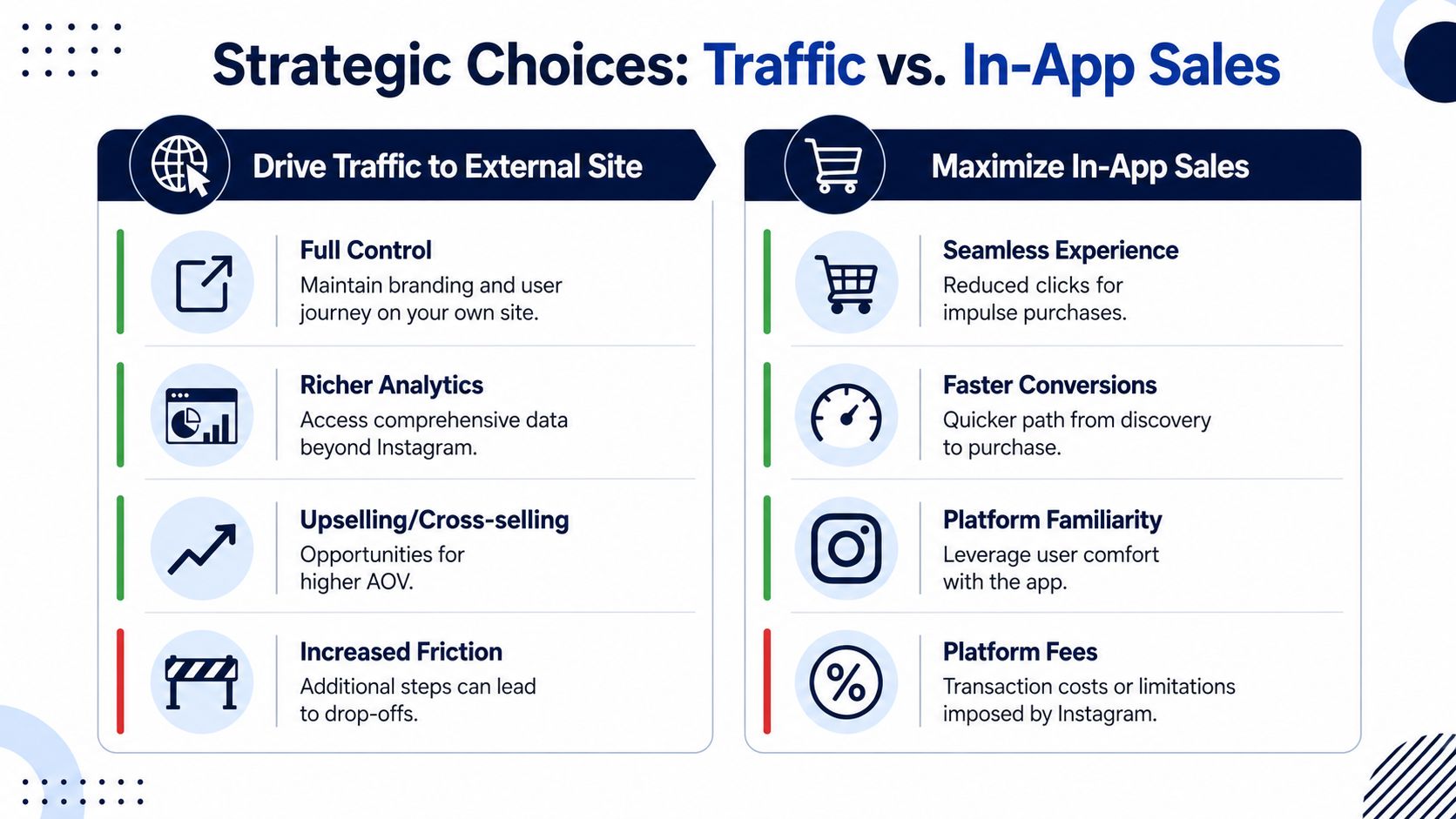
Most Instagram advice assumes more in-app shopping is always better. That's only true if your priority is reducing purchase friction inside Instagram. If your priority is building a durable DTC business with stronger customer data, richer post-purchase flows, and tighter margin control, the answer gets more complicated.
Meta's shifts made that tension impossible to ignore. Industry reporting noted Instagram removed the Shop tab from homepage navigation in 2021 while keeping shopping active across feed, stories, reels, and ads. That same reporting also highlighted changes that limited how catalogs could send traffic to brand sites, which sharpened the core strategic question around conversion versus customer ownership, as covered by Econsultancy's analysis of Instagram removing the Shop tab.
In-app conversion is strongest when the product is simple, desire is immediate, and the buyer doesn't need much extra reassurance.
That often includes:
The upside is obvious. Fewer steps. Less leakage. Faster path from interest to purchase.
The trade-off is also obvious. You own less of the journey.
Your site matters more when your economics depend on what happens after the click.
A brand-owned journey usually wins when you need:
| Priority | Why your site helps |
|---|---|
| Bundling | You can control merchandising and AOV strategy |
| Education | You can answer objections with richer PDPs and landing pages |
| Retention | You can capture more first-party signals for email and SMS |
| Brand experience | You can control design, copy, upsells, and post-purchase flow |
That's why Instagram should be part of an omnichannel marketing strategy, not mistaken for the whole stack. Treating it as a closed commerce environment often leads to short-term conversion decisions that weaken long-term brand influence.
If you can't explain what happens after the Instagram click, you don't have a channel strategy. You have a content habit.
Choose your primary path by answering three questions:
The best brands rarely stay at one extreme. They let Instagram convert what should convert there, while pushing higher-consideration demand into owned experiences that increase AOV, retention, and lifetime value.
Product tagging is table stakes. It's useful, but it rarely creates breakout growth on its own.
The bigger wins usually come from formats that feel closer to selling than posting. That's why strong operators have shifted attention toward creator-led content, live selling, and short-form commerce assets that show the product in motion, in use, and inside a believable purchase context.

Academic research in the Journal of Retailing and Consumer Services found that Instagram Live Shopping influences both buyer engagement and actual purchase behavior, which is why static tags alone aren't enough for brands trying to push serious commerce volume through the channel. That research is summarized in the study on Instagram Live Shopping and purchase behavior.
Most brand lives fail because they're treated like casual social content. Good live commerce is structured.
Use a host with energy. Build an offer. Sequence the product story. Handle objections in real time. Show texture, function, scale, and use. Pull urgency forward without sounding desperate.
A strong live format often includes:
Founders overestimate brand-produced assets and underestimate credible third-party selling. A creator who understands the product and speaks in native platform language will often generate more buying intent than a perfectly lit studio asset.
That doesn't mean handing over the brand. It means controlling the message architecture while letting creators deliver it in a human way. If you need help producing more ad-ready short-form assets from raw angles, demos, and UGC, a tool like the ShortGenius Meta ad creator can speed up creative iteration without forcing your team to build every variation from scratch.
This is also where a disciplined user-generated content campaigns system becomes valuable. The point isn't solely “get UGC.” The point is to create a repeatable feed of believable buying scenarios your team can merchandise across Reels, Stories, paid social, and shopping-enabled posts.
Here's a useful breakdown of the format in action:
The strongest Instagram commerce programs chain formats together.
Start with a Reel that creates desire. Follow with Stories that answer objections. Use product tags where intent is hottest. Bring creators or a founder into a live session when the audience needs proof, demonstration, or a launch moment.
Operator insight: Static tags close demand. Dynamic formats create it.
If your team is still relying on product photos with tags as the main shopping strategy, you're using the weakest part of the system as the centerpiece.
Many teams measure Instagram commerce the wrong way. They either obsess over vanity metrics like likes and follower growth, or they overcorrect and judge the channel only on last-click sales.
Both approaches miss the point.
Instagram often influences purchase before it captures purchase. A shopper sees a Reel, taps a product tag later, visits the site through branded search, joins email, then buys from a retention flow. If your measurement framework can't see that kind of path, you'll underinvest in content that's doing real commercial work.
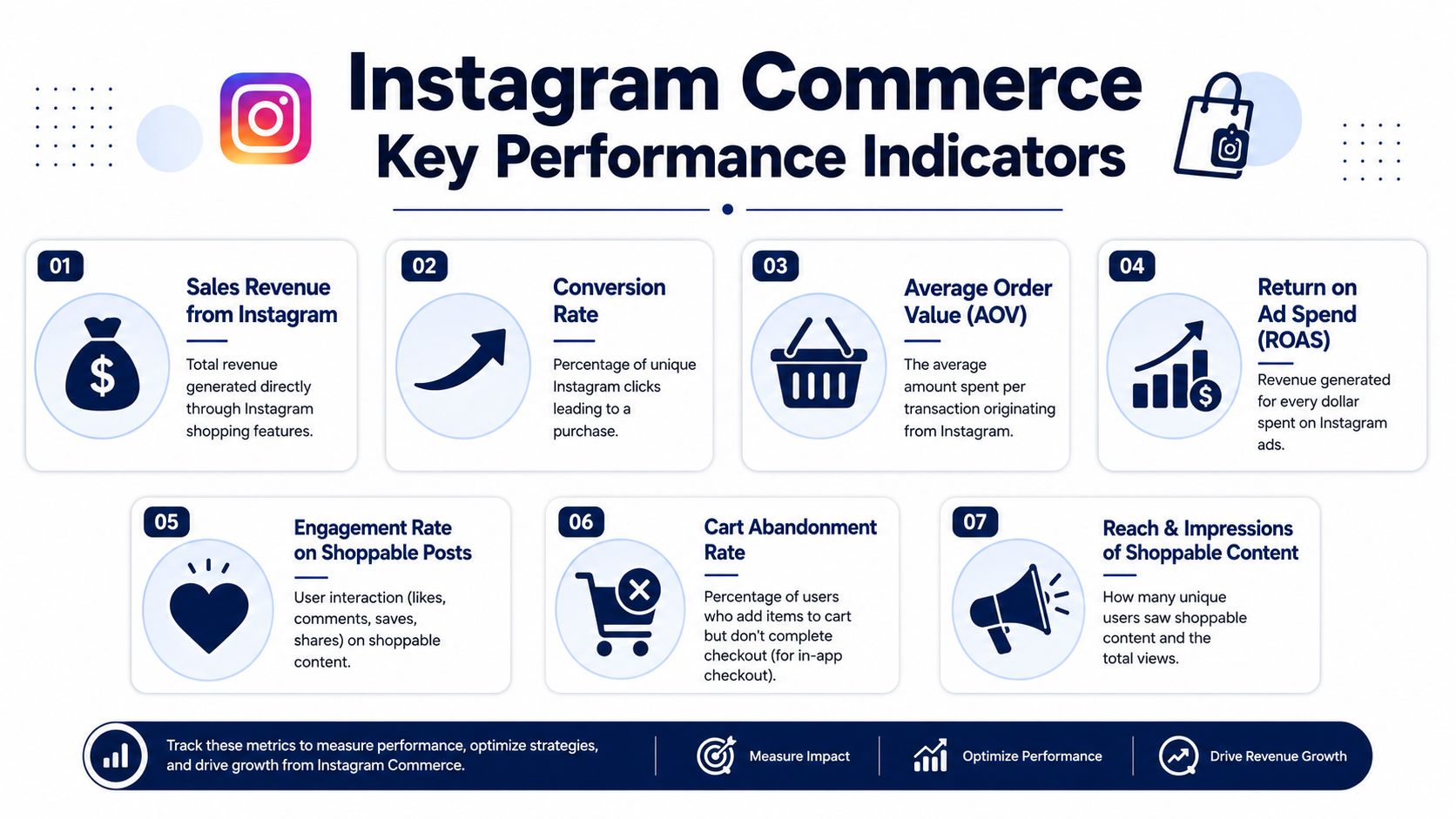
I'd break Instagram commerce KPIs into four layers:
| Layer | What to measure | Why it matters |
|---|---|---|
| Discovery | Reach, impressions, product views | Tells you whether merchandise is getting seen |
| Consideration | Clicks, product-page visits, saves, replies | Shows active buying interest |
| Conversion | Purchases, conversion rate, AOV | Measures direct revenue impact |
| Quality | Repeat orders, assisted conversions, profitability | Tells you if the channel is attracting valuable customers |
A post with strong engagement and weak product interaction is content. A post with moderate engagement and strong product interaction is commerce.
You need to compare Instagram's direct revenue with its assisted value. That means looking at how Instagram-originated traffic behaves after the first touch, how often shoppers return through another channel, and whether those customers buy again.
If your team only looks at native dashboard metrics, you'll miss what matters on the P&L. Bring the data back into your ecommerce analytics, attribution model, and retention reporting. Then ask harder questions: which content themes drive product detail views, which creators bring high-intent traffic, which SKUs convert natively versus on-site, and which sequences lead to repeat purchase.
For teams trying to tighten the post-click side, this guide on how to improve conversion rates is useful because Instagram performance often collapses on the landing experience, not in the social asset itself.
The metric that matters most isn't engagement. It's whether Instagram helps you acquire customers profitably and keep them.
The most expensive Instagram Shopping mistakes aren't dramatic. They're quiet. A broken variant. A weak product thumbnail. A creator post with the wrong tagged SKU. A polished Reel that drives interest into a bad mobile PDP.
Individually, those issues look small. Together, they turn a high-intent channel into a leaky one.
A lot of brands activate every available tool without deciding what they want Instagram to do. The result is scattered execution. Stories try to sell. Reels try to educate. Product tags appear on content that wasn't designed for commerce. Nothing compounds.
The fix is simple. Assign each format a job and measure it against that job. Discovery, education, objection handling, conversion, or launch momentum. One role first. Secondary benefits second.
Founders often delegate the catalog to junior ops and forget about it. Then the storefront reflects internal sloppiness. Bad names, inconsistent images, outdated inventory, mismatched variants.
Audit Instagram the way a customer sees it.
This one kills trust. The Instagram content feels premium, but the click lands on a cluttered, generic, discount-heavy site. Or the content promises ease, while the page creates confusion.
Shoppers don't separate those experiences. They see one brand.
That means your visual language, offer structure, product naming, and proof stack need to feel connected across touchpoints. If Instagram creates desire and the site creates doubt, the channel underperforms even when creative looks strong.
Instagram shopping features need active merchandising. What worked last month won't always work now. Product-market fit shifts. Creative fatigue shows up. New creators outperform old angles. Seasonal buying behavior changes the surfaces that convert best.
The fix is operating cadence. Review tagged-product performance, creator outputs, top assisted paths, and on-site behavior regularly. Then cut weak flows and scale strong ones.
The brands that win on Instagram don't just post more. They merchandise better, decide faster, and protect ownership where it matters most.
Million Dollar Sellers brings together the kind of operators who care about those details. If you're building at a serious level and want sharper conversations about DTC growth, channel strategy, and what's working behind the scenes, Million Dollar Sellers is where high-level ecommerce founders compare notes without the usual noise.
Join the Ecom Entrepreneur Community for Vetted 7-9 Figure Ecommerce Founders
Learn MoreYou may also like:
Learn more about our special events!
Check Events