Chilat Doina
June 11, 2026
User generated content earns 28% higher engagement than branded content, campaigns that integrate it can see a 50% lift in engagement, and 92% of consumers trust peer recommendations over brand messages according to Archive's roundup of UGC performance data. That changes the conversation.
For established e-commerce brands, user generated content campaigns aren't a social media side project anymore. They're a performance asset. They influence conversion, reduce creative fatigue, feed retention channels, and give buyers the proof your studio shoot can't.
Most brands still run UGC like a scavenger hunt. They repost tagged photos, ask for a hashtag, maybe run a giveaway, then wonder why the results stay inconsistent. The problem usually isn't demand. It's systems. If the sourcing workflow is weak, permissions are vague, moderation is reactive, and assets live in random Slack threads, UGC never becomes reliable enough to power serious revenue channels.
The brands that win treat UGC like inventory. They define what content they need, secure rights before activation, tag assets for reuse, test placements by funnel stage, and remove anything that creates legal or brand risk. That's the difference between “we occasionally repost customers” and “we built a repeatable content engine.”
Shoppers can validate your brand claims against customer proof in seconds. That changed the economics of creative.
For a scaling e-commerce brand, user generated content is no longer a social add-on. It is operating infrastructure for trust. It affects paid efficiency, PDP conversion, return pressure, marketplace credibility, and retention performance. The brands that treat it like occasional community content usually hit the same ceiling. Creative fatigue rises, acquisition costs creep up, and the product page still feels like the brand is grading its own homework.
The shift is not only about attention. It is about evidence. Buyers want to see products in normal lighting, normal homes, on real bodies, in real routines. Studio assets still matter, but they rarely answer the final objections around fit, texture, setup, durability, or results. Customer content does, if the asset is collected properly, rights-cleared properly, and deployed in the right place.
That last part is where mature brands separate themselves.
A useful UGC program does not stop at “get more tagged posts.” It needs intake rules, permission records, moderation standards, and asset tagging that make the content usable across teams. Paid wants footage with clear hooks. CRM wants proof tied to post-purchase objections. Amazon wants images that feel authentic without tripping compliance issues. Legal wants documented usage rights and age-related safeguards. If those workflows are missing, the content volume looks healthy while the program stays commercially weak.
That is also why teams investing in types of viral content should judge UGC by portability, not reach alone. A strong asset can move from social to product pages to email to marketplace listings without losing context, trust, or a rights trail.
UGC earns its keep when it handles different jobs across the funnel.
A creator-style testimonial can improve thumb-stop rate in paid social. A customer review with product-specific detail can reduce hesitation on the PDP. A usage photo in a replenishment email can reinforce habit and lower drop-off. A marketplace image from a verified buyer can make the listing feel less manufactured. Same content category, different commercial role.
I have seen brands overvalue top-of-funnel engagement and underinvest in bottom-of-funnel proof. That is usually a measurement problem. The content that looks less exciting in social reporting often does more work on conversion pages and in retention flows, where the buyer is trying to answer one practical question. Will this product hold up in my situation?
Brand recognition still matters. It just performs better when buyers can match the story to evidence. If your team is tightening positioning alongside performance creative, this guide on how to build brand awareness is useful context. UGC works best when it supports a clear brand narrative instead of showing up as random screenshots and testimonials.
The operational risk is what many guides ignore. If nobody owns consent language, moderation queues, claim review, creator payout terms, and file naming standards, the program slows down the moment volume increases. Good content gets buried in DMs. Teams reuse assets with no usage record. Agencies request footage the brand cannot legally run in paid channels. Customer support spots a misleading claim after the ad is live.
Scaling brands cannot afford that kind of sloppiness.
The standard is higher now. UGC has to function as a governed content system, not a collection habit. The question is no longer whether customers will post. The question is whether your team can source, approve, store, deploy, and retire those assets with enough control to support revenue without creating legal or brand risk.
Most UGC programs fail before the first asset is collected. The brief is vague, the ask is generic, and the team confuses content volume with commercial value.
You need a tighter starting point. Build the campaign backward from a business KPI, then narrow it to one operational mission.
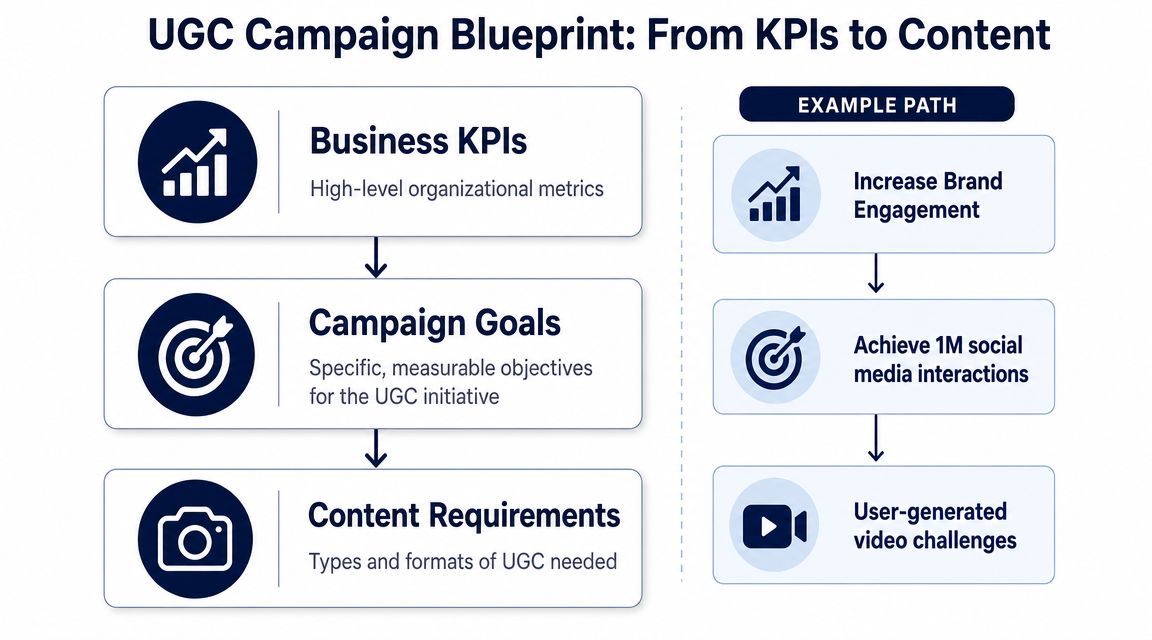
The cleanest UGC brief answers one question first. What problem is this content supposed to solve?
Here are common examples:
That distinction matters because different goals require different content formats, different creators, and different review standards.
Benchmarks are useful when they sharpen the brief instead of turning into wishful thinking. Salesgenie's UGC statistics summary reports that product pages featuring UGC can generate 161% higher conversion rates, and as few as 10 product reviews may increase conversions by about 45%. Those numbers are directional. They tell you where the upside can be if content quality, relevance, and trust are high.
They don't mean any random gallery widget will print money.
Better benchmark thinking looks like this: “We believe detailed customer proof on our PDPs is underdeveloped, so we're going to test visual reviews and richer review density on our top SKUs.”
I like a one-page campaign brief because it forces trade-offs. If a campaign needs five pages to explain, nobody is clear on the job.
A useful UGC brief includes:
| Brief field | What to define |
|---|---|
| Primary KPI | One business metric the campaign supports |
| Funnel stage | Awareness, consideration, conversion, retention |
| Asset type | Review, image, unboxing, testimonial, tutorial, before-and-after |
| Submission criteria | Format, framing, product visibility, talking points, prohibited claims |
| Rights needed | Organic repost only, site use, paid ads, email, retail, packaging |
| Approval owner | Who clears quality, legal use, and channel fit |
| Success readout | What gets tested, where it gets placed, and what wins look like |
A lot of mediocre user generated content campaigns fail because the content request doesn't match where the asset will end up.
If you need paid social hooks, ask for vertical video with a problem statement in the first seconds. If you need PDP proof, ask for clear product detail, context of use, and concise commentary about what changed after purchase. If you need Amazon support, ask for image clarity, visible packaging, and concise use-case proof that complements listing content.
Three placement-first questions usually clean this up fast:
Once you can answer those three, the campaign becomes much easier to execute.
Most brands don't have a UGC problem. They have an acquisition problem. The content exists, but the system for pulling it out of the customer base is weak, inconsistent, or too vague to produce usable assets.
The fix isn't louder asking. It's better sourcing design.

A generic “share your experience” request usually gets generic praise back. That content rarely performs well because it doesn't answer buying objections.
A stronger post-purchase request sounds more like this:
Send us a photo or short video showing how you actually use the product. The best submissions show setup, results, fit, texture, or a quick explanation of what surprised you.
That one change improves quality because customers know what “good” looks like.
For brands collecting submissions on-site, simple online product feedback forms can help standardize intake. The point isn't the form itself. The point is forcing structure into what would otherwise become a pile of screenshots, unlabeled files, and half-usable comments.
The most stable sourcing programs use separate lanes for separate asset types.
This is the reliable base layer. Every qualified buyer gets an email or SMS request after a sensible usage window. Keep the first ask easy. Rating plus short text. Then follow with a second ask for photo or video if the sentiment is positive and the product category benefits from visual proof.
This lane is where volume comes from. It shouldn't carry the burden of producing premium ad creative every time.
This is for when you need something specific. Maybe it's seasonal use-case footage, installation clips, before-and-after content, or problem-solution testimonials.
The outreach here needs a clear brief. Not a vague brand vibe deck.
Use language like:
Campaign recruitment gets better assets because the prompt is narrower. It also makes moderation easier later.
A small bench of repeat contributors beats a giant list of random one-off submissions. The right customers already understand your product, your visual standards, and how to film in ways your media team can use.
Don't turn this into influencer management unless you need reach. For pure asset production, you're looking for reliability, responsiveness, and clean usage rights more than follower count.
The mistake is offering the same incentive for every type of submission.
If you reward everything equally, you invite rushed, low-effort content. If you don't reward anything, your pipeline may stay thin for high-effort formats like edited video.
A practical way to think about incentives:
| Content type | Best incentive logic |
|---|---|
| Basic review | Low-friction ask, minimal reward or brand-led recognition |
| Photo submission | Small reward if image quality and usefulness matter |
| Video testimonial | Higher-value reward because effort is higher |
| Campaign-specific brief | Direct compensation or product credit tied to rights and deliverables |
What matters most is transparency. The customer should know what you're asking for, what they get, and what usage rights you're requesting.
Ask for authenticity, not praise. “Tell us what stood out, what almost stopped you from buying, and who this product is best for” usually produces stronger content than “Tell us why you love us.”
Support tickets.
Not because you should publish private conversations. You shouldn't. But support teams hear the language customers use when they explain what confused them, what helped them, and what convinced them to keep the product. That language should shape your UGC prompts.
If shoppers keep asking about sizing, ask customers to film fit context. If setup causes hesitation, ask for assembly clips. If buyers struggle to imagine results, request side-by-side use-case proof.
For marketplace sellers, the same logic applies to review generation strategy. This guide on how to get reviews on Amazon is worth reading if Amazon is one of your key proof environments, because the submission mechanics and trust context differ from DTC.
The simple test is this. If your sourcing system disappeared tomorrow, would new UGC still show up in a useful, organized, legally usable way? If the answer is no, you don't have a pipeline yet. You have luck.
A lot of brands still act like a hashtag is permission. It isn't a serious rights strategy, and it definitely isn't enough if you plan to reuse customer content across ads, email, product pages, Amazon, retail, or packaging.
Amateur user generated content campaigns break down. Not on creativity. On governance.
The risk isn't theoretical. Berkeley's discussion of UGC calls it a “double-edged sword” for marketers, and the practical issue is exactly what experienced operators run into: collecting content is easy compared with systematizing permissions and moderation to align assets with business objectives when you want to repurpose that content broadly across channels, as noted by Berkeley's analysis of UGC risk and curation.
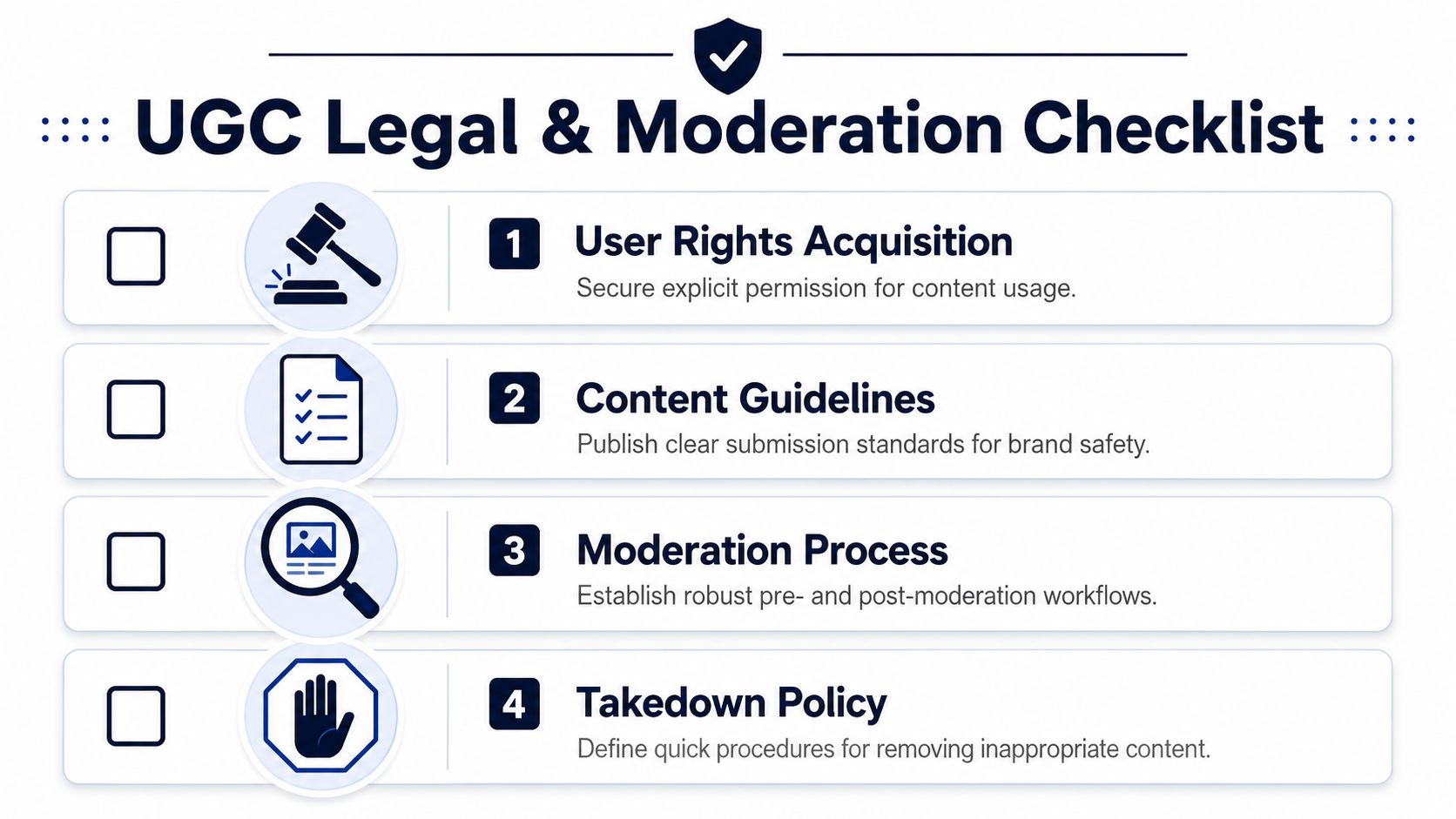
Brands get into trouble when they collapse these into one step.
Discovery means you found content you want to use. Rights mean you obtained permission to use it in specific contexts. Those are not the same thing.
A clean framework distinguishes between:
If your request language doesn't spell out use cases, duration, modification rights, and revocation handling, legal ambiguity stays in the system.
You don't need bloated legal copy in front of the customer, but you do need a real structure behind it.
Your terms and submission flow should address:
If your team needs a starting point for legal language structure, reviewing diverse legal contract examples can help frame what a proper release or permission template should account for before counsel adapts it to your use case.
Rights should be attached to the asset itself, not buried in an email thread that nobody can find six months later.
A lot of teams say they “curate” UGC when what they really do is let one social manager decide based on instinct. That doesn't scale.
You need a moderation rubric. Not because it makes the process bureaucratic, but because it keeps approval quality consistent when more channels start consuming the content.
Before any asset goes live, someone should check:
| Review area | What you're screening for |
|---|---|
| Rights status | Permission documented and channel rights matched |
| Brand safety | Offensive material, unsafe use, regulated claims, competitor visibility |
| Technical quality | File resolution, audio clarity, framing, readability |
| Commercial relevance | Does the asset answer a buying question or support a funnel objective |
| Identity risk | Minors, third-party trademarks, private information, location sensitivity |
This process should happen before the asset enters the approved library. Not after it gets posted.
Moderation doesn't end at approval. Once content is live, you still need takedown rules and a clear owner for response.
Reasons for removal can include creator complaints, newly discovered rights gaps, changed brand standards, platform policy conflicts, or customer backlash that changes the context of the asset.
The teams that stay fast don't avoid structure. They codify it.
Some submissions aren't worth salvaging:
That doesn't mean your standards should sterilize the content. Raw is good. Sloppy rights management is not.
If a founder asked me for one absolute rule, it would be this: never let channel demand outrun your permission framework. The moment paid media starts pulling customer assets faster than legal records can keep up, the system is already degrading.
Strong UGC dies in folders all the time. The problem usually isn't quality. It's placement.
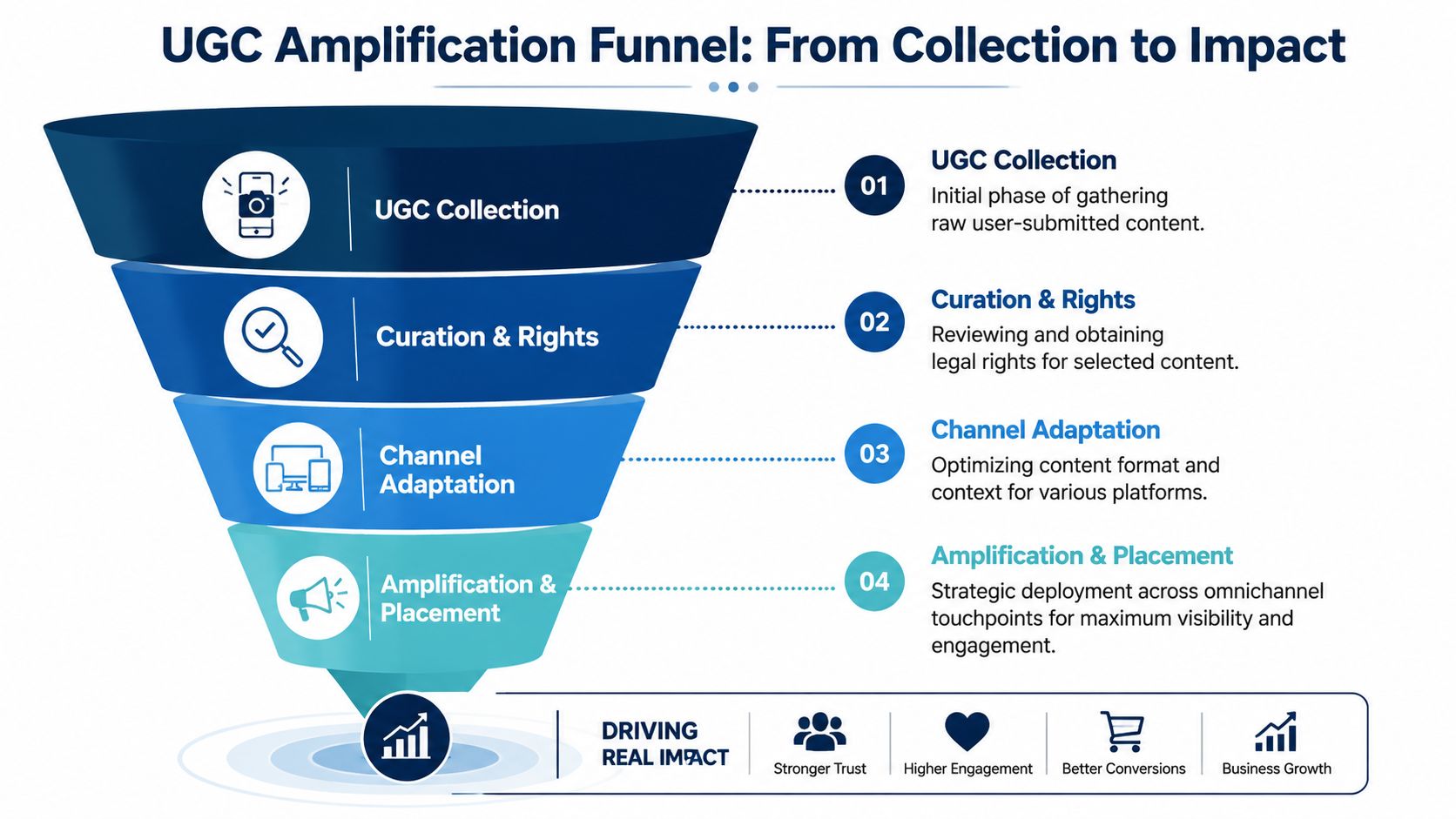
A customer video that performs on TikTok may fail on a PDP if it doesn't answer a buying objection. A glowing review can help conversion on-site but do nothing in prospecting if the hook is weak. User generated content campaigns only compound when the brand adapts the asset to the channel instead of pasting the same creative everywhere.
A useful planning lens is this omnichannel marketing strategy. The key idea applies directly to UGC. The customer shouldn't feel like they're encountering disconnected proof fragments. They should feel a consistent trust narrative across touchpoints.
Early in the deployment process, map each asset to one primary stage first.
Here's the practical channel map I like to use:
| Channel | Best UGC format | Main job |
|---|---|---|
| Paid social | Short testimonial video, problem-solution clip, creator-style demo | Stop scroll and establish credibility fast |
| DTC PDP | Visual reviews, customer photos, specific written reviews, use-case clips | Remove doubt and support conversion |
| Customer quote, before-and-after image, product-in-use photo | Re-engage with proof instead of brand copy | |
| Amazon or marketplaces | Clear customer imagery, concise review proof, real-world usage context | Reduce skepticism and support listing trust |
Many brands underuse UGC by adding a gallery far below the fold, detached from the product decision. That's decorative social proof, not conversion architecture.
Good PDP placement usually does three things:
If the content lives too far from the decision point, it loses force.
The best PDP UGC doesn't just say the product is good. It shows the product in the exact context the buyer is trying to imagine.
A customer video can become a strong ad, but not in raw form every time.
Edit for hook speed. Add captions. Cut dead air. Match aspect ratio to placement. Keep the customer voice intact, but package it for media buying realities. The media team should know which assets have paid rights, what claims are safe, and which audience segments the asset is meant to address.
This video breaks down useful ways brands think about UGC in social channels and paid creative execution:
Email teams often overlook UGC because they default to product launches, promotional blocks, and house copy. But customer proof works well in retention because it feels less like another campaign push.
Three placements I've seen work repeatedly:
One asset can fit multiple channels, but don't force that by default.
A rough user selfie might feel authentic in social and unusable in a premium email. A polished testimonial video might support paid social but feel overly produced on a PDP where buyers want realism. The answer isn't to choose one standard. It's to define channel-specific quality thresholds while preserving the core authenticity of the customer voice.
That's the operational shift. UGC isn't a single content type. It's a source material class that needs adaptation before amplification.
If your team measures user generated content campaigns with likes alone, the program will stay underfunded. Engagement can be useful, but operators need to know which assets move revenue, reduce production dependence, and outperform house creative in real placements.
That requires a tighter system. Adobe's guidance is the right framing here: treat UGC as a conversion asset, set explicit goals, centralize assets in a DAM, and run embedded A/B tests to see which photos or reviews drive the most conversion, as outlined in Adobe's UGC playbook.
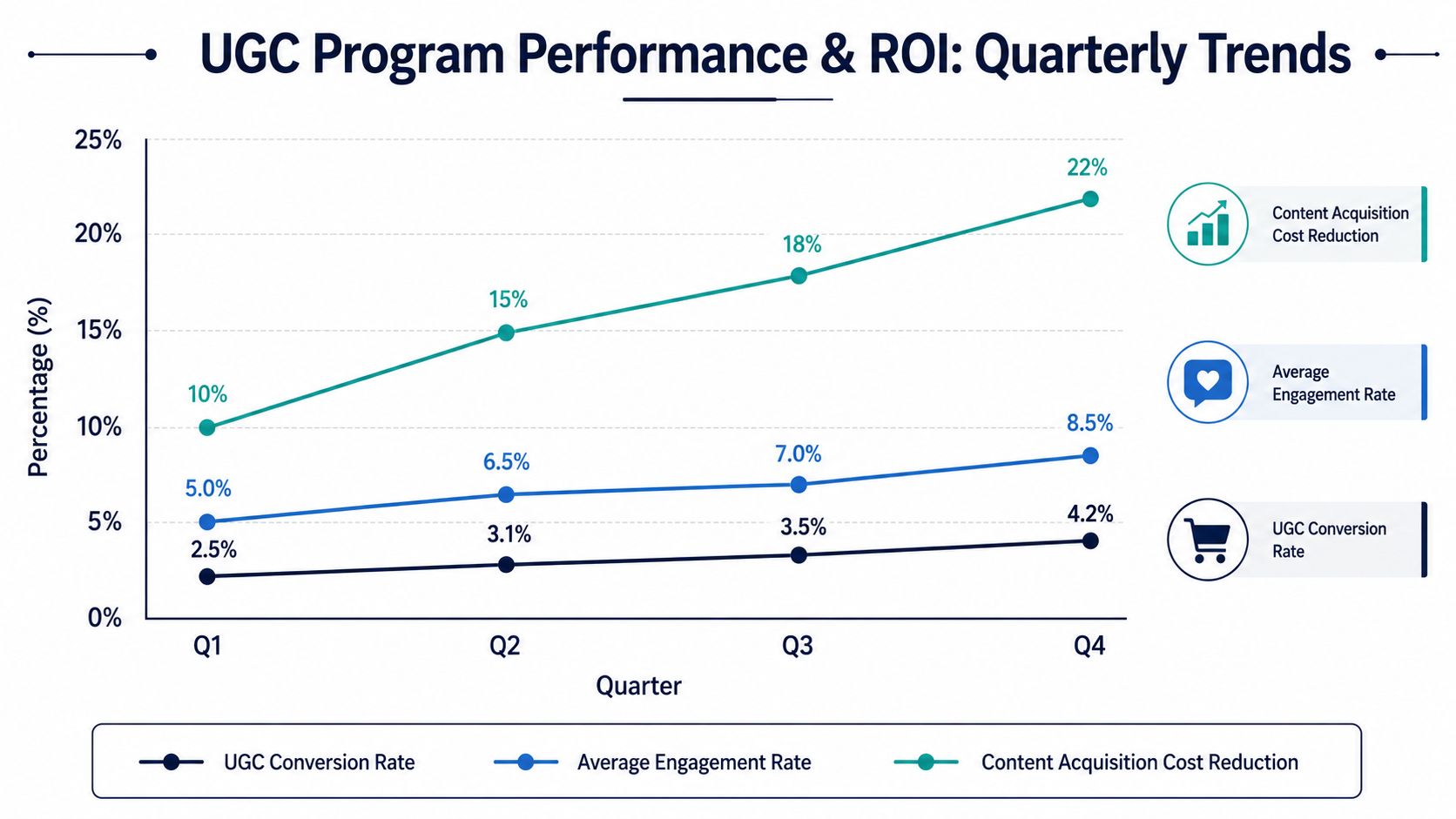
“UGC worked” isn't a useful conclusion. You need to know what kind of UGC worked, where, and against what baseline.
A disciplined testing setup compares variables like:
That lets you isolate what produced the improvement instead of giving credit to UGC broadly.
A DAM can be advanced software or a tightly run folder system. The point is retrieval and accountability.
Every approved asset should be tagged in a way that lets teams answer questions like:
| Tag category | Example use |
|---|---|
| Product | Which SKU or collection the asset supports |
| Format | Image, review, vertical video, testimonial |
| Use case | Travel, setup, fit, routine, before-and-after |
| Rights scope | Organic, owned, paid, extended commercial |
| Performance status | Untested, active, top performer, retired |
Without that structure, teams keep recreating sourcing work because nobody can find what already exists.
Good UGC programs don't just collect more assets. They make the best assets easier to find, easier to approve, and easier to test again.
Scaling usually breaks when acquisition, creative, legal, email, site, and paid media all treat UGC as somebody else's job.
The stronger model is a monthly or biweekly review where each team contributes signal:
That loop turns UGC from content collection into system optimization.
The biggest key usually isn't more volume. It's better reuse. Once an asset proves itself, adapt it across adjacent channels, update the metadata, and keep testing the derivative versions. The winner isn't the brand with the most submissions. It's the brand that can identify a strong customer asset, clear it properly, redeploy it quickly, and learn from the result.
The market already tells you where this is going. The global UGC market was valued at $4.4 billion in 2022 and is projected to reach $32.6 billion by 2030, according to Coursera's summary citing Grand View Research. That projection matters because it reflects a structural shift. UGC has moved from informal customer posting into an organized marketing category with process, tooling, and repeatable deployment.
That's the right mental model for established brands. User generated content campaigns shouldn't live as isolated launches owned by one enthusiastic social manager. They should function as an operating system that turns customer proof into approved, tagged, channel-ready assets.
The brands that get the most out of UGC usually do five things well. They define the business job before sourcing. They request the right formats from the right customers. They secure permissions in a way that matches actual use. They moderate for safety and usefulness instead of just volume. Then they deploy and test assets where trust has the biggest commercial effect.
This creates an advantage that's hard to copy quickly. Competitors can imitate your product photos. They can't easily replicate a disciplined library of real customer proof, organized by channel, rights status, and performance history.
The deeper shift is cultural. Once a team starts treating UGC like a core asset, decisions improve across departments. Paid media stops grabbing unapproved posts. Legal gets involved earlier. Email asks for proof with a specific job. Product and support influence sourcing prompts. Creative starts editing customer content with intent instead of desperation.
That's when UGC stops being reactive. It becomes infrastructure.
If you're building at scale and want more behind-the-scenes operator playbooks like this, Million Dollar Sellers is where serious e-commerce founders compare notes. It's an invite-only community of top sellers sharing hard-won lessons across Amazon, DTC, and omnichannel growth.
Join the Ecom Entrepreneur Community for Vetted 7-9 Figure Ecommerce Founders
Learn MoreYou may also like:
Learn more about our special events!
Check Events