Chilat Doina
February 18, 2026
For any serious entrepreneur, buying bulk and reselling is the real engine for growth in ecommerce. This isn't just another way to make a buck; it's a strategic playbook for building a scalable business by turning volume buys into predictable, high-margin revenue.
A lot of resellers start out with one-off flips, but true scale happens when you stop thinking like a treasure hunter and start building a repeatable system. Buying in bulk is a completely different ballgame than retail arbitrage. It’s about creating a supply chain, analyzing your unit economics like a CFO, and treating inventory as a carefully managed asset.
This is how you move past chasing small wins. It’s how you build a resilient operation with a predictable pipeline of profitable goods that you can sell across multiple channels, whether that's Amazon, your own DTC store, or somewhere else entirely.
To really crush it with bulk reselling, you have to master three distinct areas of the business. Each one feeds into the next, creating a powerful growth flywheel. If you drop the ball on any one of these, you’re looking at wasted cash, dead inventory, and a business that’s going nowhere fast.
To build a strong foundation, you need to think in terms of these pillars. The table below breaks down exactly what you should be focusing on at each stage.
.tbl-scroll{contain:inline-size;overflow-x:auto;-webkit-overflow-scrolling:touch}.tbl-scroll table{min-width:600px;width:100%;border-collapse:collapse;margin-bottom:20px}.tbl-scroll th{border:1px solid #ddd;padding:8px;text-align:left;background-color:#f2f2f2;white-space:nowrap}.tbl-scroll td{border:1px solid #ddd;padding:8px;text-align:left}PillarStrategic FocusKey ObjectiveIntelligent SourcingBuilding a reliable and competitive supply chain.Secure a consistent flow of profitable inventory through supplier relationships and negotiation.Rigorous FinancialsMastering unit economics and risk assessment.Know your exact landed cost and profit potential before you ever place a purchase order.Strategic ListingMaximizing sell-through rate across multiple channels.Create high-conversion listings and build an efficient fulfillment process that scales with demand.
Nailing these three components is the secret sauce. It's the difference between a side hustle and a seven-figure operation.
The opportunity here is absolutely massive. The global wholesale market—the engine powering all of this—hit an incredible $56,663.2 billion in 2024 and is on track to reach $60,082.23 billion by 2025. The pie is huge; you just need to know how to get your slice.
This guide cuts through the fluff and gives you a clear, actionable playbook. We’re breaking down the core principles that separate the top sellers from everyone else, giving you the confidence to turn big buys into a reliable revenue machine. For a deeper dive into getting started, this guide on how to start a resale business is a great next step to build on these strategies.
Your reselling business is only as strong as its supply chain. If you want to scale, you have to stop hunting for one-off deals and start building a reliable pipeline of high-volume inventory. This is the leap from being a simple reseller to a true business operator—and it's where you build a real competitive advantage.
Success here isn't just about finding cheap products. It's about forging relationships with the right partners who can deliver quality goods, on time, and at a price that keeps your margins healthy. Let's dig into the three main channels the pros use to lock down inventory at scale.
Think of wholesale distributors as the workhorses of the reselling world. These companies are the classic middlemen; they buy massive quantities from a bunch of different manufacturers and then offer a diverse catalog of products to retailers like you.
For most sellers just getting into bulk buying, distributors are the most accessible starting point. They're already set up to work with independent resellers and usually have much lower Minimum Order Quantities (MOQs) than going direct to a brand.
For example, a distributor might let you place a $500 order spread across several brands. If you tried to go directly to one of those brands, you might be facing a $5,000 commitment for just a single product line. It's a much easier way to get your foot in the door.
Finding the right one is the key. Start by zeroing in on brands that already sell well in your niche, then do some digging for their "authorized distributors." A quick look at the brand's website or a few targeted Google searches usually turns up a solid list of potential suppliers. For a more detailed guide on this, check out our deep dive into finding wholesale suppliers for Amazon.
When you're vetting a distributor, you're looking for a few green flags:
Liquidation is where you can score some absolutely insane discounts, but it's not for the faint of heart. This is where you buy the inventory other businesses need to get rid of fast—think overstock, customer returns, or shelf-pulls from major retailers. You’re typically buying this stuff "as-is," often by the pallet or even by the truckload.
A liquidation manifest might list 500 units of mixed electronics with an MSRP of $25,000, and you could snag the whole lot for just $2,500. So, what's the catch? A good chunk of those items will probably be damaged, missing parts, or completely unsellable. Your success hinges entirely on your ability to look at that manifest and accurately guess your "dud rate."
A seasoned liquidator once told me, "Never fall in love with the manifest. Assume 30% is trash, 50% is break-even, and your entire profit is in the remaining 20%. If the numbers still work, you have a deal."
That's the mindset you need. You have to be ready to roll up your sleeves and sort, test, clean, and sometimes even repair items before they're ready to sell. Liquidation is a grind, but if you build the right systems for processing, it can be an incredibly profitable source for bulk inventory.
For many resellers, the end game is to open direct accounts with manufacturers. This move cuts out the middleman—the distributor—and gives you access to the absolute best pricing and the brand's entire product catalog. It’s how you become a true retail partner.
But let's be real: this is the toughest channel to crack. Most big, established brands have iron-clad agreements with their distributors and have zero interest in opening up small accounts. To even get them to notice you, you need to prove you can move serious volume and actually add value to their brand.
When you pitch a manufacturer, you can't just ask for an account. You need to focus on what you bring to the table:
A great strategy is to target smaller, growing brands instead of chasing household names. You can grow with them, becoming an essential partner as their business takes off. That kind of long-term relationship is one of the strongest competitive moats you can possibly build.
There's a saying in this business: profit is made when you buy, not just when you sell. This is the mantra that separates amateur flippers from professional operators who are serious about building a real business.
Before a single dollar leaves your bank account for a big inventory purchase, you have to run the numbers with surgical precision. A flashy discount on a price list means absolutely nothing until you understand every single cost that stands between that pallet of inventory and your customer's front door. This isn't about gut feelings; it's about building a financial model that protects your capital and forces you to make data-driven decisions.
The price on the supplier’s invoice is just the starting line. Your landed cost is the real, all-in cost per unit after you've factored in every single expense required to get the product into your hands and ready to sell. I've seen countless sellers get burned because they overlooked one of these costs, instantly turning a "profitable" deal into a money pit.
To get an accurate number, you have to hunt down and allocate all the associated expenses across the total number of units in your shipment.
Some of the biggest culprits that get missed are:
For a deep dive on nailing this number every time, our guide on how to calculate landed cost gives you a step-by-step framework you can apply to every purchase order. Seriously, mastering this is the most important first step in analyzing any deal.
Once you have your true landed cost, the real fun begins. Now you can start modeling the potential return on your investment. This is where you map out every expense that will hit after the product is officially in your inventory. Knowing how to calculate profit margins for your store is fundamental to survival here.
Your profitability model has to account for a few key variables:
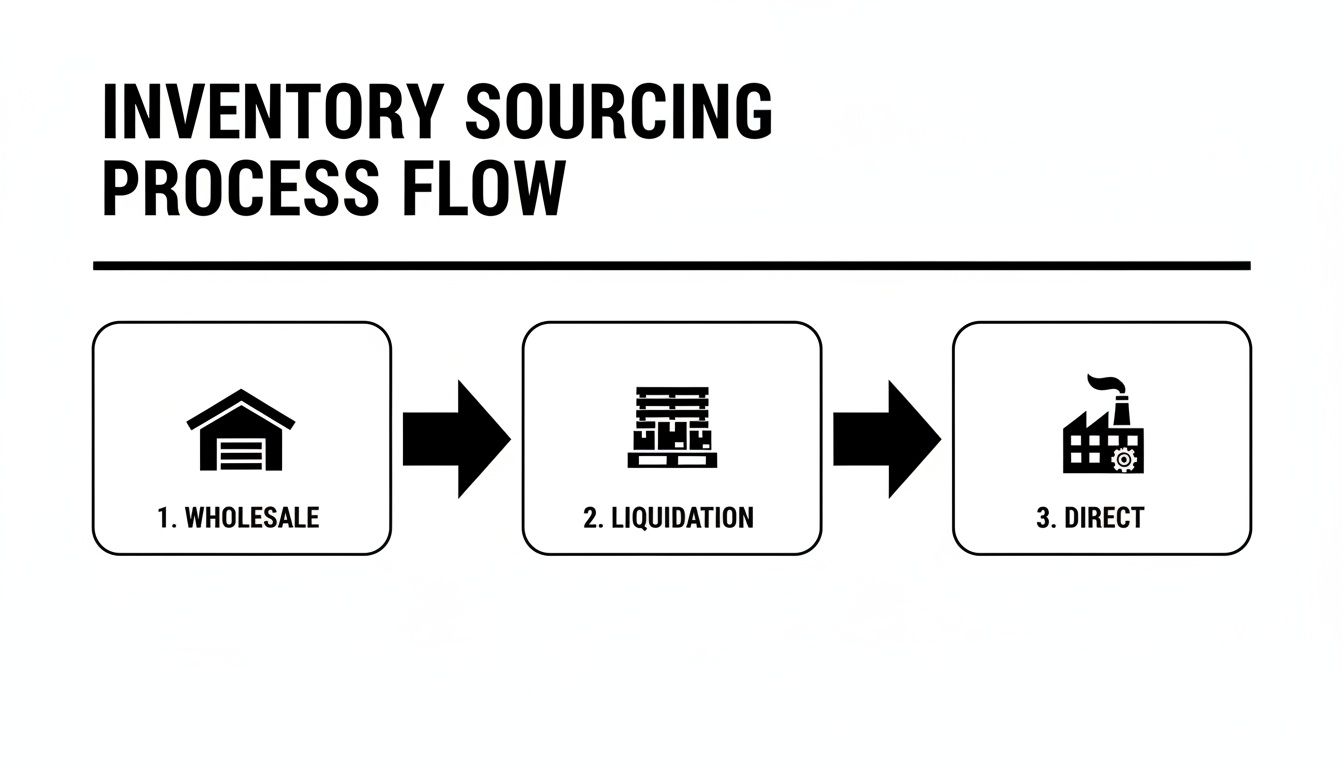
As you can see, the path you choose—whether it's the predictable pricing of wholesale or the wild west of liquidation—demands a different financial model and risk profile. You have to adapt.
The most successful sellers I know are ruthless with their numbers. They build a spreadsheet for every potential deal and kill more deals than they approve. They never let emotion or the fear of missing out override a negative ROI projection.
Beyond the hard numbers, you also have to do a little qualitative risk assessment. What are the market trends looking like on Google Trends or Helium 10? Scope out your top three competitors. What's their pricing and sales velocity? If they're constantly running deep promotions, that's a huge red flag for a potential price war that will squeeze your margins dry.
By combining disciplined financial modeling with smart market analysis, you create a powerful defense against bad inventory buys. This is the cornerstone of scaling a resale business.

So you’ve landed a pallet of high-potential products. Great start. But that inventory is just a liability—a pile of stuff taking up space—until it’s properly prepped, listed, and live for sale. The apathetic seller just throws their products online and hopes for the best. A professional operator, on the other hand, builds a system to turn bulk inventory into cash as quickly as humanly possible.
This stage is all about presentation and process. How you prepare your goods directly impacts how fast they sell and for how much.
The second that bulk shipment hits your floor, the clock starts ticking. Every single day an item sits in your warehouse, it's costing you money. For anyone serious about making real profit from buying in bulk, a disciplined receiving and inspection process isn't just a good idea—it's non-negotiable.
Your first job is to turn a chaotic, shrink-wrapped pallet into perfectly sellable individual units. This is a hands-on process that protects your investment and sets you up for a smooth customer experience. Skipping this step is a classic rookie mistake, and it’s a fast track to bad reviews and expensive returns.
A thorough quality control check is an absolute must. Even brand-new wholesale items can arrive with damaged packaging. For liquidation stock, this step is ten times more critical. You need to be ready to sort, test, clean, and accurately grade every single item.
Here’s what your prep workflow should look like:
Don't treat prep as a low-skill task. It's your first line of defense against negative feedback and your first opportunity to add value. A well-prepped item feels premium, justifying a higher price and earning customer trust.
For sellers who are scaling quickly, handling all this prep work in-house can become a massive bottleneck. This is exactly where specialized partners can save you. If you're selling on Amazon, it's absolutely worth exploring how Amazon prep centers can take over the tedious work of labeling, bagging, and boxing. This frees you up to focus on what really moves the needle: sourcing and selling.
With your inventory prepped and ready, the battle moves to the digital shelf. A product listing that converts like crazy is a blend of art and science—it has to appeal to search algorithms and human psychology. Your goal is simple: get seen, then convince the shopper to click "buy."
Always start with deep keyword research. You can't skip this. Tools like Helium 10 or Jungle Scout are indispensable for finding the exact phrases real customers are typing into the search bar. Weave these keywords naturally into your title, bullet points, and backend search terms. Your title is the most valuable piece of SEO real estate you have. Make it count.
But keywords alone aren't enough. Effective product copy does more than just describe features; it sells a solution.
Finally, and this might be the most important part, invest in professional-grade product photography. In e-commerce, your images are the product. Blurry, poorly lit photos from your phone scream "amateur" and destroy trust in an instant. You need a full set of high-resolution images showing the product from every angle, in use, and highlighting its key features. This is often the single biggest factor in lifting your conversion rates. Your images have to do the heavy lifting of building desire and proving quality before the customer ever holds the product in their hands.
Going from a garage hustle to a full-blown enterprise is the moment of truth for most resellers. It’s where the informal systems you cobbled together start to buckle. Suddenly, you're not just dealing with a few dozen orders a day; you're coordinating pallets and freight, and the cracks in your operation begin to show.
This is the stage where you stop just doing the business and start building the business. It’s all about creating the operational backbone that can actually support serious growth.
Success at this level boils down to two things: a bulletproof logistics strategy and a fanatical commitment to compliance. Nail one without the other, and you're building on shaky ground. The slickest fulfillment process in the world won't save you from a surprise sales tax audit or a brand complaint that gets your Amazon account suspended.
The wholesale distribution market—the very heart of this business model—is a $48,883.25 billion beast today, on track to hit $61,529.93 billion by 2027. With the global e-commerce pie now worth $6.3 trillion, the opportunity is staggering. But seizing it means you have to operate like a professional. You can discover more insights about these wholesale distribution industry trends to see just how big the playing field is.
As your order volume ticks up, you’ll quickly find that fulfilling every order yourself becomes a huge bottleneck. Every hour you spend taping up boxes is an hour you're not spending sourcing profitable inventory or negotiating better terms with suppliers. It's the classic "working in your business vs. on your business" problem, and it’s a critical hurdle to clear.
You've got three main paths you can take, and each has its own set of trade-offs for a growing reseller:
Truthfully, many of the most successful sellers I know use a hybrid approach. They might use a 3PL provider to receive and prep their bulk shipments from manufacturers. From there, they'll drip-feed inventory into Amazon FBA to take advantage of Prime, while keeping the rest of their stock in more affordable long-term storage at the 3PL. It's the best of both worlds.
To help you decide what's right for you, let's break down the options.
Choosing how to get products to your customers is one of the most important operational decisions you'll make. It directly impacts your costs, customer satisfaction, and your ability to scale. This table lays out the core differences between the primary fulfillment models.
.tbl-scroll{contain:inline-size;overflow-x:auto;-webkit-overflow-scrolling:touch}.tbl-scroll table{min-width:600px;width:100%;border-collapse:collapse;margin-bottom:20px}.tbl-scroll th{border:1px solid #ddd;padding:8px;text-align:left;background-color:#f2f2f2;white-space:nowrap}.tbl-scroll td{border:1px solid #ddd;padding:8px;text-align:left}Fulfillment ModelBest ForKey AdvantagesPrimary DrawbacksIn-House WarehousingSellers needing high control, custom prep, or handling specialized products.• Total control over inventory & quality• Fast handling for new arrivals• Lower per-unit cost at very high volume• High fixed costs (rent, labor, insurance)• Requires significant management time• Difficult to scale up or down quicklyThird-Party Logistics (3PL)Scalable businesses wanting to outsource logistics and focus on growth.• Converts fixed costs to variable costs• Expertise in logistics & shipping• Frees up your time to focus on sourcing• Less direct control over your inventory• Can be hard to find a 3PL that understands your specific needs (e.g., Amazon prep)Fulfilled by Amazon (FBA)Amazon-centric sellers prioritizing Prime eligibility and conversion rates.• Access to Amazon Prime shipping• Amazon handles customer service & returns• High consumer trust• High storage and fulfillment fees• Strict inventory and prep requirements• Less control over how items are handled
Ultimately, the right choice depends on your business model, profit margins, and where you want to spend your time. Don't be afraid to start with one model and evolve into a hybrid system as you grow.
As your business gets bigger, so does your exposure to risk. Ignoring compliance isn't a strategy—it's a gamble, and the house always wins eventually. Getting this stuff right is what separates a professional, long-term operation from a flash in the pan.
One of the biggest minefields is sales tax nexus. In simple terms, this means your business has a strong enough connection to a state that you're required to collect and pay sales tax there. That connection can be a physical presence (like your warehouse), but for most e-commerce sellers, it’s triggered by crossing sales or transaction thresholds in a particular state. Suddenly, you're on the hook for collecting tax in a state you've never even set foot in.
Building a resilient business means you don't just focus on the exciting parts like sourcing and selling. You have to sweat the small stuff—the legal fine print, the tax obligations, and the platform policies. That boring work is the foundation that allows you to build something that lasts.
Then there's the issue of brand gating on platforms like Amazon. As you start dealing with major, in-demand brands, you'll find that many of them restrict who is allowed to sell their products. It's their way of fighting counterfeits and protecting their brand's value. To get "ungated," you have to prove you have a legitimate supply chain by providing wholesale invoices from authorized distributors. This is precisely why building real relationships with your suppliers is so important. Without them, you'll be locked out of selling some of the most profitable products on the market.
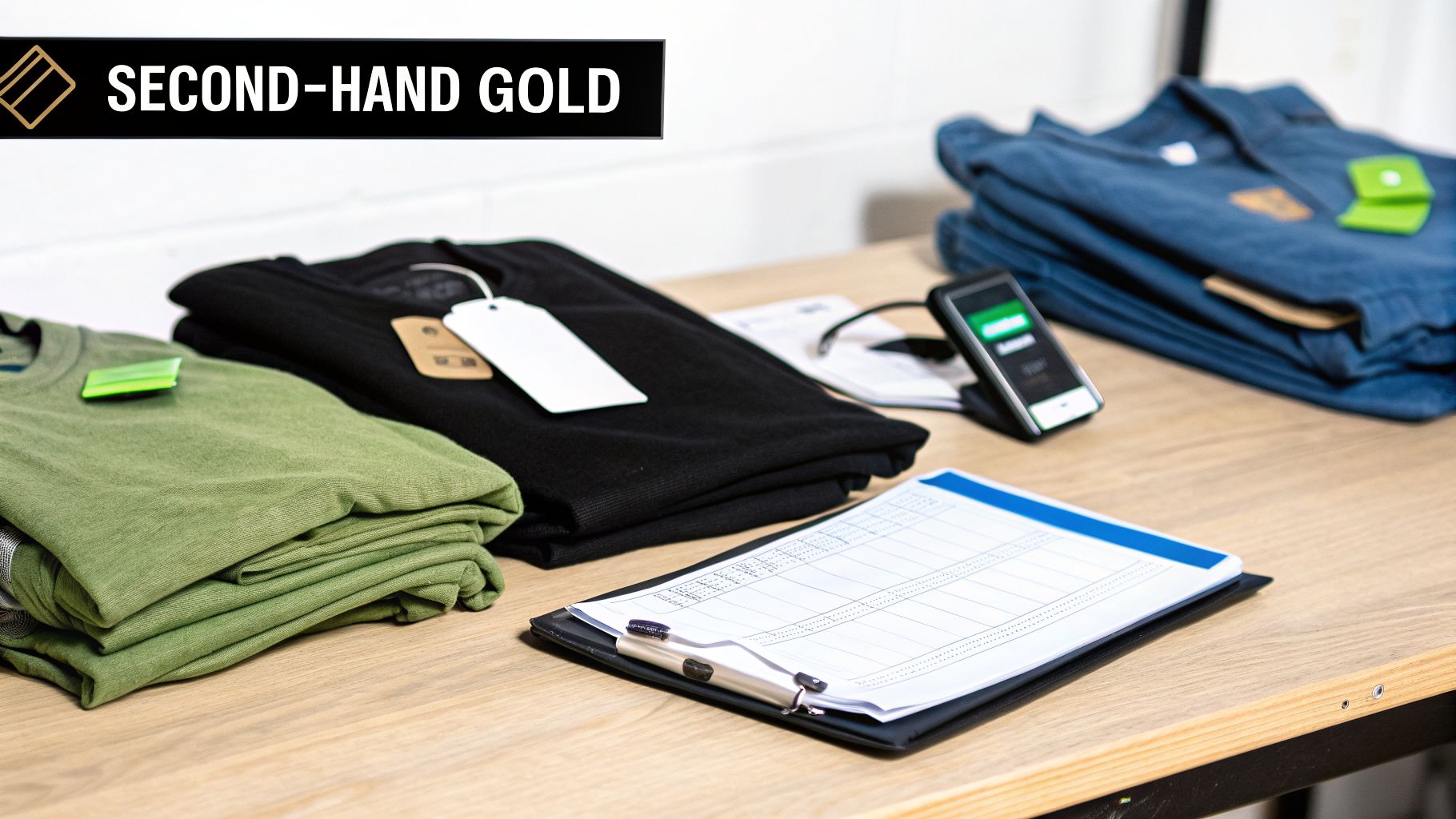
While everyone else is chasing shiny, new wholesale products, some of the most profitable and fastest-growing opportunities are in used goods. Buying and reselling second-hand items in bulk has exploded beyond a small-time niche. It's now a massive industry, powered by a huge consumer shift toward sustainability and getting more for their money.
This isn't just about digging through bins at your local thrift store. I'm talking about strategically sourcing large volumes of pre-owned inventory—from high-end clothing to refurbished electronics—at a tiny fraction of their original cost. If you dial in your process, the margins here can blow away what you'd make on brand-new products.
Your success in the second-hand game comes down to two things: how you get your inventory and how well you assess its condition. You’re not just a seller anymore; you're a curator.
Your best bets for sourcing are usually:
The real skill isn't just in the buying; it's in the grading. You absolutely must create a simple, consistent grading system for your business (e.g., New With Tags, Excellent, Very Good, Good). This is how you build trust with customers and justify your pricing.
Just look at the numbers. The global second-hand apparel market is on track to hit a mind-boggling $350 billion by the end of 2025. That’s a giant leap from where it was in 2020. This trend shows just how much runway there is for resellers who are willing to learn the ropes. You can see more of these powerful wholesale statistics to get a sense of the momentum.
The biggest upside is the incredibly low cost to acquire inventory. The catch? It's a hands-on, labor-intensive business of sorting, cleaning, and sometimes repairing. But if you can build an efficient workflow for all that prep work, you’ll unlock a market with way less competition and a base of very loyal, repeat customers.
Once you start moving from single-unit flips to buying by the pallet or truckload, a whole new set of questions pops up. These aren't rookie queries; they're the strategic hurdles every seller faces on their way to scaling. Let's tackle a few of the most common ones I hear.
There's no magic number here. Your starting capital is completely tied to your product category and how you're sourcing.
If you're dipping your toes in with liquidation, you might be able to snag a pallet for $1,000 - $2,500. But if you're aiming to open a direct wholesale account with a major brand? They'll likely want to see a minimum first order of $5,000 or even more.
Here’s my advice: calculate what you need for that first big purchase order, then add enough to cover freight, prep center fees, and any initial ad spend. Don't sink every last dollar into inventory. You always, always want to keep a cash buffer.
Forget chasing the hot new thing. The real money in bulk reselling is made on products that share a few key traits: consistent, proven demand, a solid sales velocity, and a listing that isn't completely dominated by the brand itself.
You'll want to hunt for products that are:
The most profitable products are often the most "boring." They solve a specific problem and have predictable, year-round demand. Build your business on a foundation of stability, not fleeting trends.
Absolutely not. This is a fast track to getting your account suspended. Buying products from Amazon's retail site to resell them on Amazon is called retail arbitrage, and it's a major violation of their terms of service for anything listed in "New" condition.
To build a sustainable, scalable business, you have to operate with legitimate, authorized sourcing channels. That means working with official distributors, reputable liquidation companies, or going straight to the manufacturers. This isn't just about following the rules—it's about building a real, defensible business.
At Million Dollar Sellers, we connect top-tier e-commerce entrepreneurs who are past the basics and focused on serious growth. Our private community is where 7-, 8-, and 9-figure sellers share the advanced strategies needed to scale smarter. If you're ready to learn from the best in the business, find out if you qualify for MDS at https://milliondollarsellers.com.
Join the Ecom Entrepreneur Community for Vetted 7-9 Figure Ecommerce Founders
Learn MoreYou may also like:
Learn more about our special events!
Check Events