Chilat Doina
February 19, 2026
If you've ever found yourself drowning in a sea of packing tape and shipping labels instead of, you know, actually growing your business, then you've hit the wall of self-fulfillment. This is where Third-Party Logistics (3PL) comes in.
In simple terms, 3PL fulfillment means you're outsourcing all the physical stuff—storing your inventory, picking and packing orders, and shipping them out—to a specialized partner. It’s the move you make when you're ready to stop playing warehouse manager and start being a CEO again.
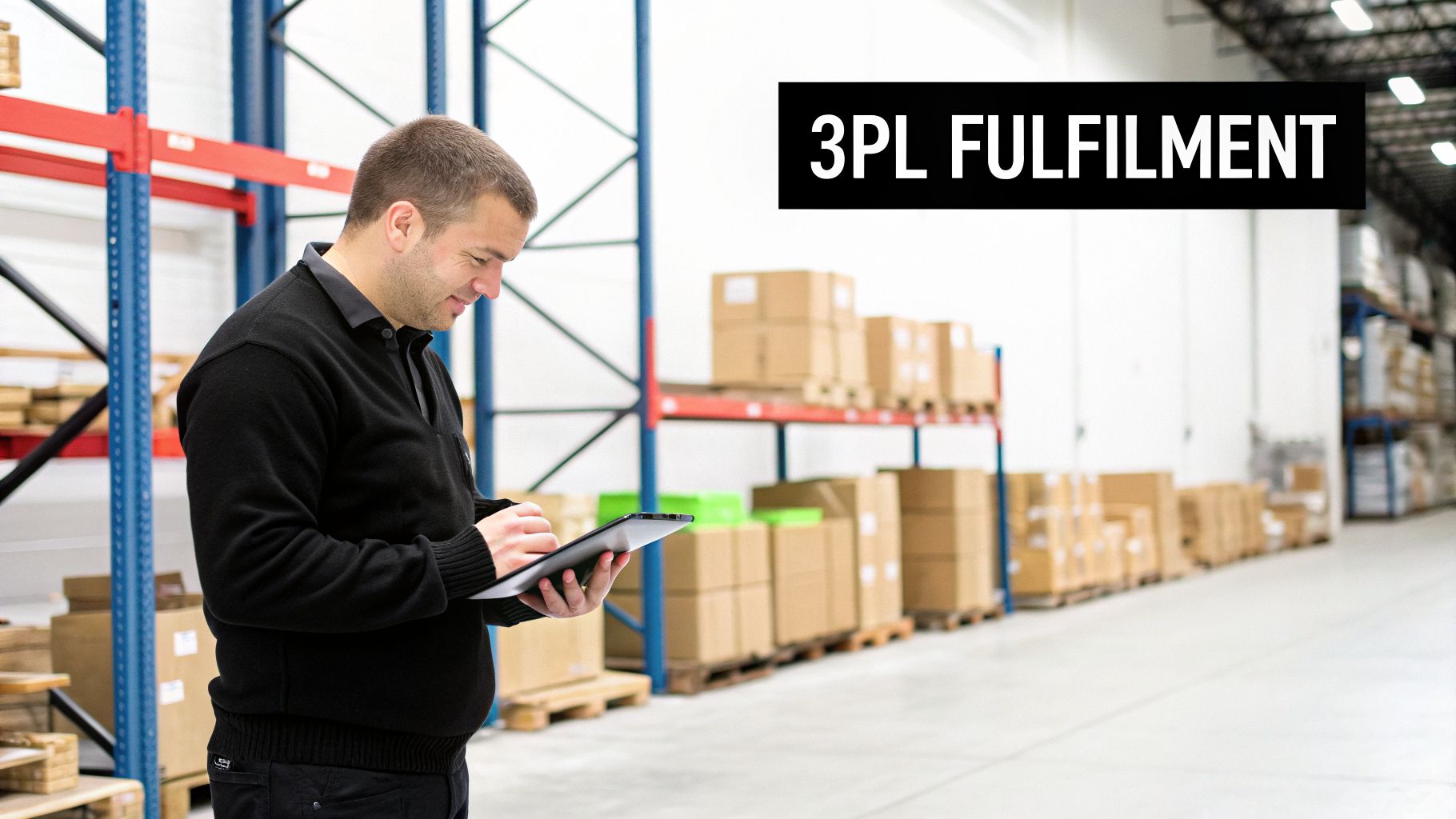
Think of a good 3PL partner as a dedicated, expert-run 'Logistics Operating System' for your business. Instead of burning cash and time on leasing warehouses, hiring staff, and wrestling with shipping carriers, you just plug into an existing infrastructure that’s already built for speed and efficiency.
This isn't just about renting some shelf space. It's a strategic decision that directly fuels your ability to scale. For any brand pushing to grow from seven to eight figures, managing inventory in-house eventually becomes a massive bottleneck. Every hour you spend packing boxes is an hour you’re not spending on customer acquisition or product innovation.
For fast-growing ecommerce brands, making the leap to a 3PL is a rite of passage. To really get it, you need to understand what a 3PL warehouse is and how it's designed to support dozens, or even hundreds, of brands all at once. This shared infrastructure is the secret sauce that creates incredible economies of scale.
A 3PL basically handles the entire physical journey of your products from the moment they leave your manufacturer to the second they land on your customer's doorstep.
The demand for these services is absolutely booming. The global third-party logistics market is on track to jump from $1.32 trillion in 2025 to a staggering $2.14 trillion by 2030. What's driving this? Sky-high e-commerce growth and even higher customer expectations.
A huge piece of the puzzle is the relentless demand for faster shipping. A recent survey showed that 53% of 3PLs now say their clients expect delivery in two days or less—a massive leap from just a few years ago.
By outsourcing your logistics, you're essentially turning a huge fixed cost (like warehouse rent and employee salaries) into a variable one that scales perfectly with your sales. You only pay for what you use, which makes it a much smarter, more capital-efficient way to grow.
To help you visualize what's actually being handed off, here’s a quick rundown of the core functions your 3PL partner takes over.
This table gives you a quick summary of the key operations your 3PL partner manages, freeing you up to focus on growing your brand.
.tbl-scroll{contain:inline-size;overflow-x:auto;-webkit-overflow-scrolling:touch}.tbl-scroll table{min-width:600px;width:100%;border-collapse:collapse;margin-bottom:20px}.tbl-scroll th{border:1px solid #ddd;padding:8px;text-align:left;background-color:#f2f2f2;white-space:nowrap}.tbl-scroll td{border:1px solid #ddd;padding:8px;text-align:left}Core FunctionHow It Benefits Your BusinessReceiving & StoringYour products are professionally received, inspected, and stored securely without you ever touching a box.Picking & PackingWhen an order comes in, their team finds the items, packs them to your specs, and gets them ready to ship.Shipping & Carrier Mgmt.They leverage their massive shipping volume to get you better carrier rates and handle all the shipping logistics.Returns ProcessingThey manage the entire "reverse logistics" process, from receiving returns to inspecting items and restocking them.
Ultimately, partnering with a 3PL isn't just about offloading a few tasks. It’s about building a resilient, scalable supply chain that can actually keep up with your brand’s ambition. It’s about getting your time back so you can focus on what you do best: building a business people love.
To really get what a 3PL does, you need to see it in motion. It's not just one thing; it's a whole sequence of events designed to get your products from the factory floor to your customer's front door without you lifting a finger.
Let's walk through it. Imagine you’re running a booming direct-to-consumer supplement brand. A shipment of 5,000 units of your best-selling protein powder just left the manufacturer. This is where your 3PL partner jumps in.
The whole process kicks off the second your inventory hits the 3PL's fulfillment center dock. This isn't just a simple drop-off. It’s a carefully managed receiving process, what we in the biz call inbound logistics.
The 3PL's team unloads the truck, inspects every box for damage, and meticulously checks the contents against the shipping manifest you provided. Every single case and pallet is counted. This initial check is your first line of defense, catching any screw-ups from your supplier before they become your problem.
Once everything is confirmed, each item gets scanned and logged into the 3PL’s Warehouse Management System (WMS). Think of the WMS as the brain of the entire operation. It instantly updates your inventory, and just like that, those 5,000 units are "live" and ready to sell on your ecommerce store.
With your products officially in the building, they need a home. A good 3PL doesn’t just shove your stuff onto any old shelf. They use a strategic approach to warehousing that’s all about keeping your products safe and making fulfillment fast.
Your protein powder tubs will be stored in specific zones, optimized for their size, weight, and how fast they sell. Hot-ticket items? They'll likely be placed right near the packing stations to shave precious seconds off the retrieval time for workers. This kind of smart placement is absolutely essential for hitting those tight delivery windows customers expect.
The WMS is your eye in the sky. It gives you a real-time, 24/7 view of your stock levels for every single SKU. You can log into a portal from your laptop and see exactly what you have on hand, which is a lifesaver for avoiding stockouts and figuring out when to reorder. It’s like having a window into the warehouse, no matter where you are.
A customer in Austin, Texas, just bought two tubs of your protein powder. The instant they hit "Complete Purchase" on your Shopify site, that order is automatically and securely zapped over to your 3PL’s WMS.
This immediately generates a picking list. A warehouse associate—a "picker"—gets the order details on a handheld scanner. The device doesn't just tell them what to grab; it maps out the most efficient route through the warehouse aisles to find the exact items for that order.
Once picked, the items arrive at a packing station. This is where your brand's unboxing experience truly begins. The 3PL's packing team follows your exact instructions, which are formalized in a document called Standard Operating Procedures (SOPs).
These SOPs cover every little detail:
Before the box is sealed, one last quality check ensures the items and quantities are perfect. This step is critical for keeping your order accuracy rate high and your customers happy. Juggling this level of detail is a huge perk of using a 3PL, especially as you scale and start thinking about things like what is omnichannel fulfillment and the need for a consistent experience everywhere you sell.
The final piece of the puzzle is getting the package out the door. 3PLs are shipping thousands of packages every single day, which gives them massive leverage with carriers like UPS, FedEx, and USPS.
Their software automatically "rate shops" to find the cheapest and fastest shipping option for every single order. Because of their sheer volume, they get deeply discounted shipping rates that a standalone business could only dream of. That means you save a ton on shipping, and your customer gets their order quicker.
As soon as the package is on the truck, the tracking information is pushed back to your ecommerce platform, which triggers a shipping notification to your customer. The order lifecycle is complete—and you never had to touch a single roll of packing tape.
Figuring out how to get products into your customers' hands is one of the biggest decisions you'll make as a brand founder. This choice hits everything—your costs, your ability to scale, and the kind of experience you deliver. There are really three main paths: doing it yourself, using Fulfillment by Amazon (FBA), and partnering with a 3PL.
Each one has its own set of trade-offs. The right call isn't just about what's easiest today; it's about what aligns with your long-term vision. You're making a strategic choice between hands-on control, marketplace convenience, and brand-focused flexibility.
Most ecommerce brands kick things off with self-fulfillment, sometimes called in-house fulfillment. It’s the ultimate DIY approach. You, your family, or your first few hires are the ones picking, packing, and shipping every single order out of a garage, a spare room, or a small rented space.
In the early days, this model gives you total control. You obsess over every detail, from the quality of the box to the handwritten thank-you note you slip inside. It’s also the cheapest way to start when your order volume is low since you’re just paying for materials and shipping, no management fees.
But self-fulfillment has a very real ceiling. As your brand grows, what once felt like control quickly turns into a massive operational bottleneck. Founders get buried in packing tape and carrier pickups instead of focusing on marketing, product development, and big-picture strategy. The time and money it takes to lease a bigger warehouse, hire a team, and manage logistics will eventually choke the very growth you’re working so hard for.
For many brands hitting that ceiling, the next logical step seems to be Fulfillment by Amazon (FBA). This model lets you plug into one of the world's most powerful logistics networks. You just send your inventory to Amazon's fulfillment centers, and they take over everything from storage and Prime delivery to customer service.
The biggest pull here is getting immediate access to the massive Prime customer base and the trust that comes with Amazon's fast, reliable shipping. If a huge chunk of your sales comes from the Amazon marketplace, FBA can be an incredible engine for growth. You can dive deeper into this world by checking out our guide on what is Amazon FBA.
But this convenience comes with some serious trade-offs:
FBA is a powerful sales channel, but it forces your brand to play by Amazon’s rules in Amazon's world, making it tough to build a direct relationship with your own customers.
This brings us to 3PL fulfillment, which really hits the sweet spot. It gives you the scale and operational expertise of a logistics giant like FBA but with the brand control and flexibility you had when you were shipping from your garage. A 3PL partner acts as a true extension of your team, running your fulfillment just the way you want it, according to your brand standards.
The core value of a great 3PL is its ability to adapt to your brand's unique needs. Whether you need custom branded packaging, specialized kitting for subscription boxes, or a multi-warehouse setup to reduce shipping times, a 3PL provides the tailored infrastructure to make it happen.
This diagram breaks down the simple, five-step process your 3PL partner manages for every order that comes in.
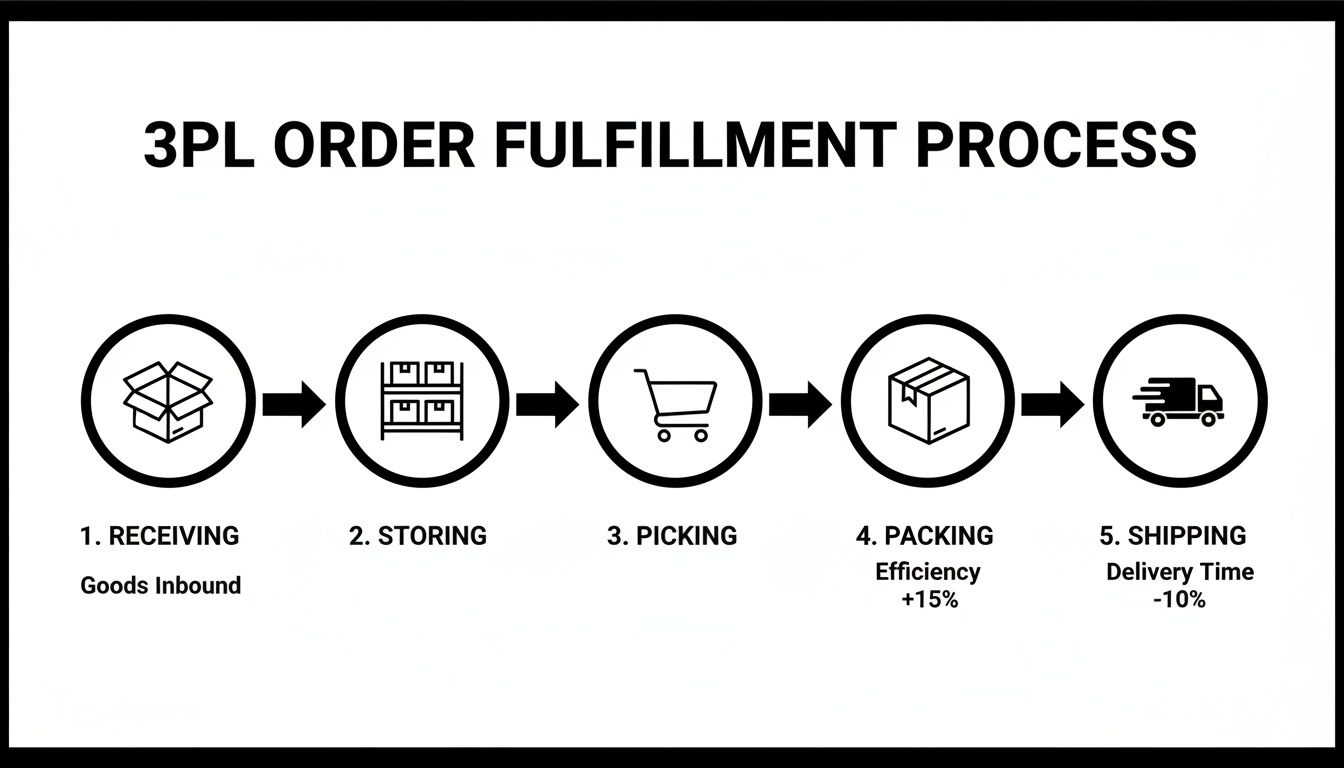
This kind of seamless integration frees you up to focus on growth while your partner nails the complex physical operations. Ultimately, a 3PL is built to support your entire business—handling orders from your website, retail partners, and other marketplaces with a consistent, branded experience every time.
To really see how these models stack up, it helps to compare them side-by-side based on what matters most to a growing brand. Think of this as a strategic cheatsheet for your next big operational decision.
.tbl-scroll{contain:inline-size;overflow-x:auto;-webkit-overflow-scrolling:touch}.tbl-scroll table{min-width:600px;width:100%;border-collapse:collapse;margin-bottom:20px}.tbl-scroll th{border:1px solid #ddd;padding:8px;text-align:left;background-color:#f2f2f2;white-space:nowrap}.tbl-scroll td{border:1px solid #ddd;padding:8px;text-align:left}CriteriaSelf-FulfillmentAmazon FBA3PL FulfillmentBrand ControlMaximum. Total control over packaging and the unboxing experience.Minimal. Orders arrive in standard Amazon-branded boxes.High. Full control over custom packaging, inserts, and branding.ScalabilityLow. Quickly becomes a bottleneck as order volume increases.High. Leverages Amazon's massive network, but with limits.High. Designed to scale with your brand's growth seamlessly.Cost StructureLow initial cost. Only pay for shipping and materials. High hidden costs (your time).Complex & High. Multiple fees (storage, fulfillment, penalties) can erode margins.Predictable & Scalable. Clear pricing for receiving, storage, pick/pack, and shipping.Multi-Channel SupportManual. Possible but operationally intensive to manage different channels.Difficult. Primarily built for the Amazon marketplace; multi-channel is complex/costly.Excellent. Natively supports DTC, B2B, and marketplace orders under one roof.Customer RelationshipDirect. You own all customer data and communication.Indirect. Amazon owns the customer relationship and data.Direct. You own the customer relationship and all associated data.FlexibilityHigh. You can change anything on a whim.Low. You must adhere to Amazon's strict, non-negotiable rules.High. Partners work with you on special projects, kitting, and custom needs.
Each model has its place. Self-fulfillment is perfect for getting started, FBA is a powerful tool for marketplace dominance, and a 3PL is the engine for building a scalable, independent brand. The best choice depends entirely on your business goals, sales channels, and the kind of customer experience you want to create.
Trying to make sense of a 3PL quote can feel like you’re decoding a secret language. The pricing isn’t always intuitive, and what seems like a great deal at first glance can nickel-and-dime you into the red if you don't know what you're looking at. To truly partner with a 3PL and protect your margins, you have to get fluent in their pricing models.
Your bill will usually be broken down into four main categories that cover the distinct stages of the fulfillment process. Think of these as the fundamental building blocks of any 3PL relationship.
Every 3PL has its own spin on a quote, but you’ll almost always run into these four charges. Nailing these down is the first step to making a smart decision.
Beyond the big four, a 3PL quote is often loaded with other potential charges that can catch you by surprise. They aren't always "hidden" on purpose, but they're easy to overlook when you're just focused on the main costs. Knowing what to look for lets you negotiate from a position of power.
Common variable costs include:
When you’re vetting partners, ask for a complete fee schedule right out of the gate. A transparent 3PL will have no problem giving you a detailed list of every single potential charge, from B2B compliance labeling to special project fees. This is the best way to prevent unexpected bills from wrecking your profitability later on.
The financial health of your 3PL partner is also a critical, yet often forgotten, piece of the puzzle. The logistics industry is facing some pretty tight operating conditions right now. Recent data shows only 69% of 3PLs reported growth in profitability, a steep drop from 81% in 2022.
This really drives home the need to pick partners with solid financial footing so they can weather economic storms and keep providing reliable service. You can learn more about these industry trends and what they mean for your brand from various industry reports.
Picking a 3PL partner is one of the most critical decisions you'll make for your brand. This isn't just about finding cheap shipping. A bad choice can poison customer relationships, torpedo your profit margins, and grind your growth to a halt.
But the right partner? They become a growth multiplier. This decision goes way beyond a simple per-order quote.
To truly vet a potential partner, you need to look past the price sheet and dig into four key areas: their tech, their operational muscle, their specific industry experience, and their ability to grow with you. This is your game plan for finding a provider who acts like a true extension of your team.
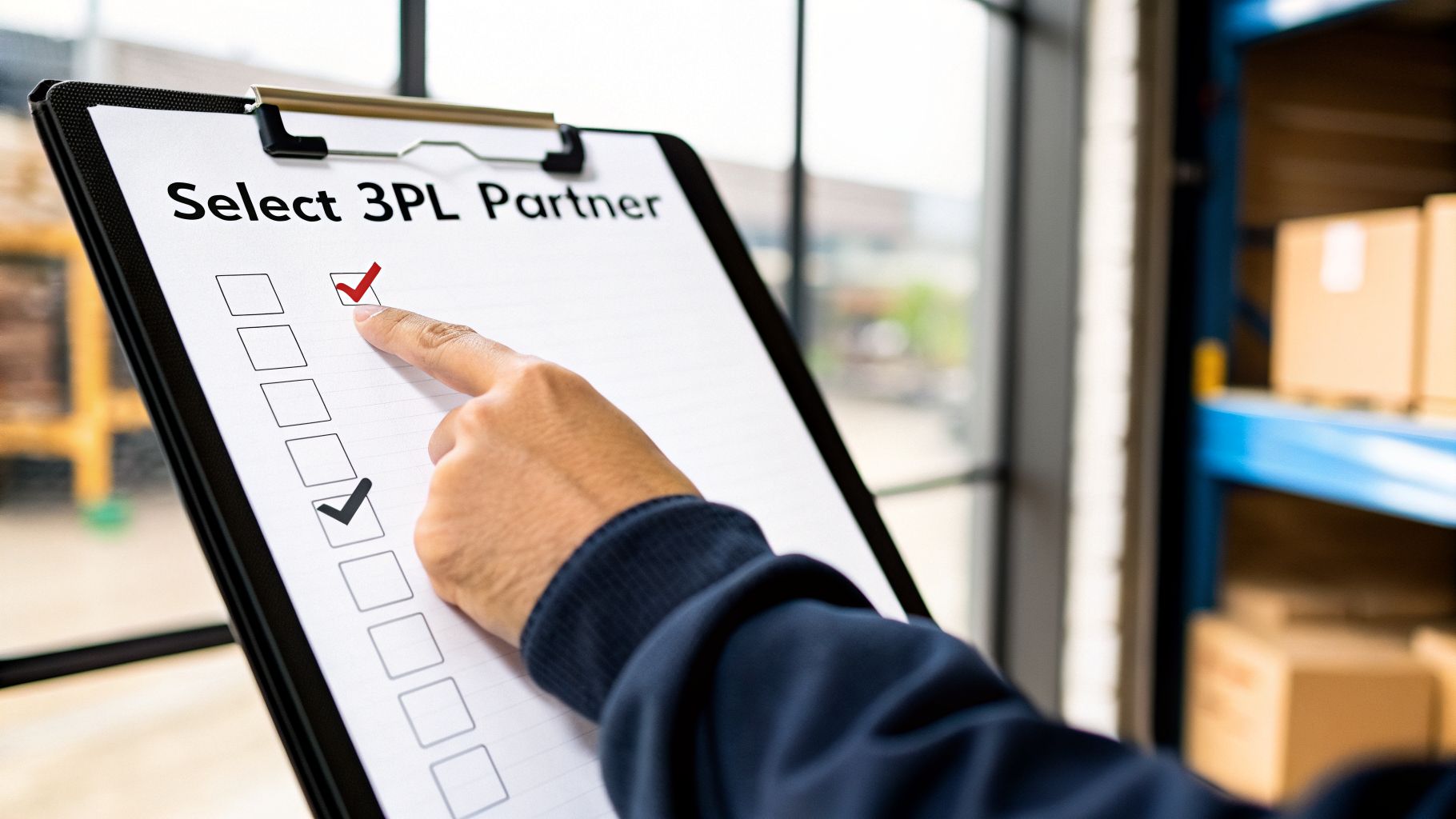
Modern fulfillment runs on technology. If a 3PL's systems can't talk to your ecommerce platform seamlessly, you’re signing up for a world of pain—manual data entry, inventory nightmares, and shipping delays. Your very first filter should be whether they have a rock-solid, pre-built integration with your tech stack.
Get straight to the point and ask about their Warehouse Management System (WMS):
A 3PL that has invested heavily in its technology is one that's serious about providing reliable, accurate, and transparent 3PL fulfillment services.
A slick dashboard is useless if the warehouse floor is a mess. This is where you have to look for hard proof of operational excellence, and that proof comes in the form of Service-Level Agreements (SLAs). SLAs are the contractual promises they make about their performance.
Don't just accept vague assurances. Ask for specific metrics and guarantees.
Key SLAs to Scrutinize:
These aren't just minor details; they are the vital signs of a well-oiled fulfillment machine. A partner confident in their operations will have no problem putting these commitments in writing. For a sense of what the top players offer, check out our analysis of the best ecommerce fulfillment companies and the standards they uphold.
Not all 3PLs are the same. A provider who’s a pro at shipping t-shirts might be completely clueless when it comes to handling frozen foods or delicate electronics. You absolutely must find a partner with deep, proven experience in your specific product category.
This kind of specialization is non-negotiable. A 3PL that gets your industry will already know the unique requirements for storing, packing, and shipping your goods. A food-grade facility, for instance, will have the right certifications (like AIB), while a 3PL handling high-value items will have serious security protocols in place.
The industry is also evolving. It's not just about warehousing anymore. Recent market research shows a massive shift, with logistics and transportation consulting now offered by 83% of 3PLs. This means the best partners are now expected to provide strategic advice, not just shelf space. You can dig into this trend and what it means for your brand over at InboundLogistics.com.
Finally, think about your future. You need a partner who can support you today and three years from now. A 3PL that crumbles under the pressure of your Black Friday rush or can't handle an expansion into a new market is a liability waiting to happen.
Look at their physical footprint. Do they have multiple fulfillment centers across the country? A distributed inventory network lets you store products closer to your customers, which is the key to slashing shipping times and costs. This multi-warehouse strategy is the mark of a sophisticated 3PL built for high-growth, national brands.
Signing on the dotted line with a 3PL isn't the finish line—it's the start of the race. A successful partnership is never a "set it and forget it" deal. It takes active management and brutally honest communication to sidestep the common mistakes that can sink even the most promising relationships.
Too many brands stumble right out of the gate with a chaotic onboarding. They just start shipping inventory to the new warehouse without a concrete plan, leading to receiving delays, lost units, and inaccurate stock counts from day one. That initial mess can take weeks, sometimes months, to clean up, all while your customers are left wondering where their orders are.
Another classic landmine is mismatched expectations. You might assume your 3PL can knock out a special kitting project on short notice, but they see it as an out-of-scope request that needs a separate work order and a week of lead time. These little disconnects have a way of snowballing into major frustration and expensive operational blunders.
The secret to avoiding all this drama? Building a partnership based on mutual accountability and planning for problems before they happen.
Start with a detailed implementation plan for the entire onboarding process. This isn't just a suggestion; it's a non-negotiable document outlining every single step, from the first tech integration test to the schedule for your first inbound shipment. Get granular. Specify exactly how your inventory needs to be prepped and labeled before it even leaves your supplier. A smooth start prevents massive headaches later.
Next, you need a crystal-clear communication and escalation path.
This structure means you know exactly who to talk to when something goes wrong, saving you from bouncing between departments in a panic.
At the end of the day, the best partnerships are built on a foundation of continuous improvement and open dialogue. Put simply, you have to talk to each other regularly and formally.
Don’t try to manage a multi-million dollar logistics operation over email. The single most effective tool for long-term alignment is the Quarterly Business Review (QBR). This is a dedicated meeting where leadership from both sides gets in a room to review performance against SLAs, discuss upcoming promotions or product launches, and solve challenges together.
A QBR forces everyone to look at the hard data—order accuracy, shipping times, receiving speed—and have an honest conversation about what’s working and what isn’t. It turns the relationship from a simple vendor transaction into a true strategic partnership, ensuring your 3PL fulfillment provider grows and adapts right alongside your brand. By actively managing the relationship this way, you build the trust and transparency needed to weather any storm.
Jumping into the world of third-party logistics always brings up a bunch of questions. To give you the full picture of what you’re getting into with a 3PL, here are some straight answers to the most common things we hear from fellow e-commerce founders.
Getting set up with a new fulfillment partner is a pretty involved process, and you don’t want to rush it. Realistically, you should budget anywhere from 30 to 90 days for a smooth onboarding.
This isn't just about sending them your inventory. The setup phase involves a few critical steps:
Cutting corners here is one of the biggest mistakes you can make. A rushed onboarding almost always leads to headaches and costly errors later on, so give this stage the time and focus it needs.
Absolutely. In fact, this is one of the biggest reasons to choose a good 3PL over a more rigid, one-size-fits-all solution like Amazon FBA. Most quality 3PLs offer a whole menu of value-added services to handle just about any custom request you can think of.
Be sure to ask potential partners if they specialize in things like:
These services let you keep total control over your brand's look and feel, even when someone else is doing all the physical work.
The core function of a Warehouse Management System (WMS) is to act as the central nervous system for all fulfillment operations. It's the software that tracks every piece of inventory, manages every order, and provides real-time data to both you and the warehouse team. A powerful WMS is the backbone of an efficient 3PL.
Managing returns, or reverse logistics as it's called in the industry, is a huge part of the puzzle. When you work with a 3PL, a customer's return goes directly to their warehouse, not to your office or garage. This is a game-changer.
Once the return arrives, the 3PL’s team gets to work:
Having a 3PL handle this keeps the process moving quickly, ensuring good products get back into your sellable inventory as fast as possible.
At Million Dollar Sellers, our members share battle-tested strategies for vetting and managing 3PL partners to ensure seamless scalability. Learn more about how the top 1% of ecommerce founders build resilient operations.
Join the Ecom Entrepreneur Community for Vetted 7-9 Figure Ecommerce Founders
Learn MoreYou may also like:
Learn more about our special events!
Check Events