Chilat Doina
January 12, 2026
Think of multi-channel selling software as the central command center for your entire e-commerce operation. It pulls your inventory, orders, and product listings from all the places you sell—like Amazon, your Shopify store, and even social media—into a single, unified dashboard.
No more frantically logging into a dozen different platforms. This centralized control is what stops you from accidentally selling the same item twice and makes getting orders out the door a whole lot smoother.

Imagine trying to conduct an orchestra where every musician has a different sheet of music. That’s pretty much what it’s like for a growing brand trying to manually manage an Amazon store, a DTC website, and a few other marketplaces.
It’s pure operational chaos. You end up overselling your most popular products, telling frustrated customers that what they just bought is actually out of stock, and making pricing mistakes that kill your margins. This manual juggling act quickly becomes the biggest roadblock to your growth, sucking up time that should be spent on marketing, product development, or big-picture strategy.
For every brand, there's a clear tipping point where spreadsheets and manual updates just don't cut it anymore. It’s that moment when the complexity of your business starts to outrun your team’s ability to keep up.
This usually happens right after you add your second or third sales channel. All of a sudden, the risk of a critical error skyrockets, and the workload becomes completely unsustainable.
This is exactly where multi-channel selling software stops being a "nice-to-have" and becomes a strategic necessity. It’s the conductor that finally gets your whole orchestra playing in harmony. It acts as a single "brain" for your business, making sure every moving part is perfectly in sync.
The market is exploding for a reason—the global multichannel order management space is on track to hit over $6.8 billion by 2030. That’s a lot of brands realizing they can’t scale without the right tech.
A unified platform directly tackles the core issues that hold you back. Instead of constantly reacting to problems like inventory mismatches, you can proactively run your business from one screen. Your team can finally stop putting out fires and start executing a real growth strategy.
The benefits are immediate and tangible:
"Scaling an e-commerce brand is impossible when your team is trapped in manual, repetitive tasks. Multi channel software isn't just about efficiency; it's about reclaiming the strategic bandwidth needed to actually grow the business."
Of course, selling globally means you also need a smart way to handle payments. A solid guide to multi currency payment processing is the perfect complement to a multi-channel setup, ensuring every transaction is seamless.
As you explore https://milliondollarsellers.com/blog/diversifying-revenue-streams, this guide will give you a clear roadmap—from understanding the basics of multi channel selling software to choosing the right growth partner for your brand.
To really get why multi-channel selling software is such a game-changer, you have to look under the hood. This isn't just another dashboard. It’s a powerful, integrated engine with several core parts, each built to solve a specific, high-stakes problem that every scaling e-commerce brand inevitably faces.
Let's break down the five core capabilities that make this whole system hum.
Think of your inventory like cash in a bank. You'd never keep your money in a dozen different banks without a master ledger telling you the total amount, right? Yet, that's precisely how many brands operate with their products—a recipe for disaster.
Unified inventory management is that master ledger.
It creates a single, authoritative pool of inventory that’s updated in real-time across every single place you sell. The moment a product sells on Amazon, the available quantity is instantly adjusted on your Shopify store, on eBay, and anywhere else you have a presence.
This real-time sync is the ultimate cure for overselling. It puts an end to those painful "sorry, we're out of stock" emails that kill customer trust and demolish your marketplace health scores. For a business on the rise, this isn't just a nice-to-have; it's the bedrock of operational sanity.
An order just came in. Now what? Without a system, figuring out where to ship it from is a slow, manual process filled with guesswork and expensive mistakes. Intelligent order routing acts like a GPS for your logistics, automatically sending every order to the absolute best fulfillment location.
This "GPS" runs on simple rules you define. For instance, you can tell it to always route orders to the warehouse closest to the customer, slashing shipping costs and delivery times. Or maybe you want it to prioritize FBA for all Prime orders while sending website sales to your 3PL partner.
This automated decision-making saves a staggering amount of time and money. By finding the most efficient fulfillment path for every single order, you're not just cutting shipping expenses—you're getting products into customers' hands faster and making them happier.
On fiercely competitive marketplaces like Amazon, pricing isn't a "set it and forget it" activity. Prices swing wildly, and trying to keep up manually is a losing battle. Automated repricing is like having a tireless algorithmic trader working for you around the clock.
You set the strategy by defining your floor (the absolute lowest you'll go) and your ceiling (the highest price you think the market will bear). The software then takes over, constantly monitoring competitors and adjusting your prices within those guardrails to win the Buy Box and squeeze every last drop of margin from each sale.
This is how you stay competitive without ever giving away profit. It’s a powerful way to capture revenue that would otherwise be left on the table.
Manually creating and updating product listings across ten different channels is a soul-crushing, repetitive task. A tiny change to a product description can balloon into hours of mind-numbing copy-and-paste. Centralized listing management eradicates this problem by creating one single source of truth for all your product data.
It's a "publish once, distribute everywhere" model. You build one master product listing inside the software, and it pushes that information out to all your connected channels, automatically formatting everything for each marketplace’s unique quirks and requirements.
You can't grow what you can't measure. But trying to get a clear picture of your business by stitching together reports from Shopify, Amazon Seller Central, and a half-dozen other platforms is a nightmare. Unified analytics gives you the mission control dashboard you've always wanted.
It pulls all your sales and performance data from every channel into one clean, consolidated view. Suddenly, you can see your best-selling products, most profitable channels, and overall business health without getting lost in a sea of spreadsheets. This single source of truth is absolutely essential for making the smart, data-driven calls that actually fuel growth.
To put it all together, here's a quick look at how these core capabilities connect to the real-world problems you're facing every day.
Each of these functions is powerful on its own. But when they work together, they create an operational flywheel that lets you scale faster and more profitably than you ever could by managing channels separately.
Thinking about multi channel selling software as just another expense is missing the point entirely. It's not a cost center; it's an engine for growth and a direct driver of your company's value. While making operations smoother is a nice perk, the real return on investment (ROI) shows up in cold, hard revenue growth and fatter profit margins. Let's look past the feature list and focus on the financial outcomes that actually matter.
The first place you'll feel the impact is your top line. Unified inventory management is the ultimate defense against the dreaded "out of stock" notice. When a customer is ready to buy but can't, that sale vanishes into thin air, probably to a competitor. This software ensures every single unit you own is visible and available to every potential buyer, on every channel, all at once.
This single, centralized view of your inventory, orders, and listings is the core of it all—the engine that powers both efficiency and growth.
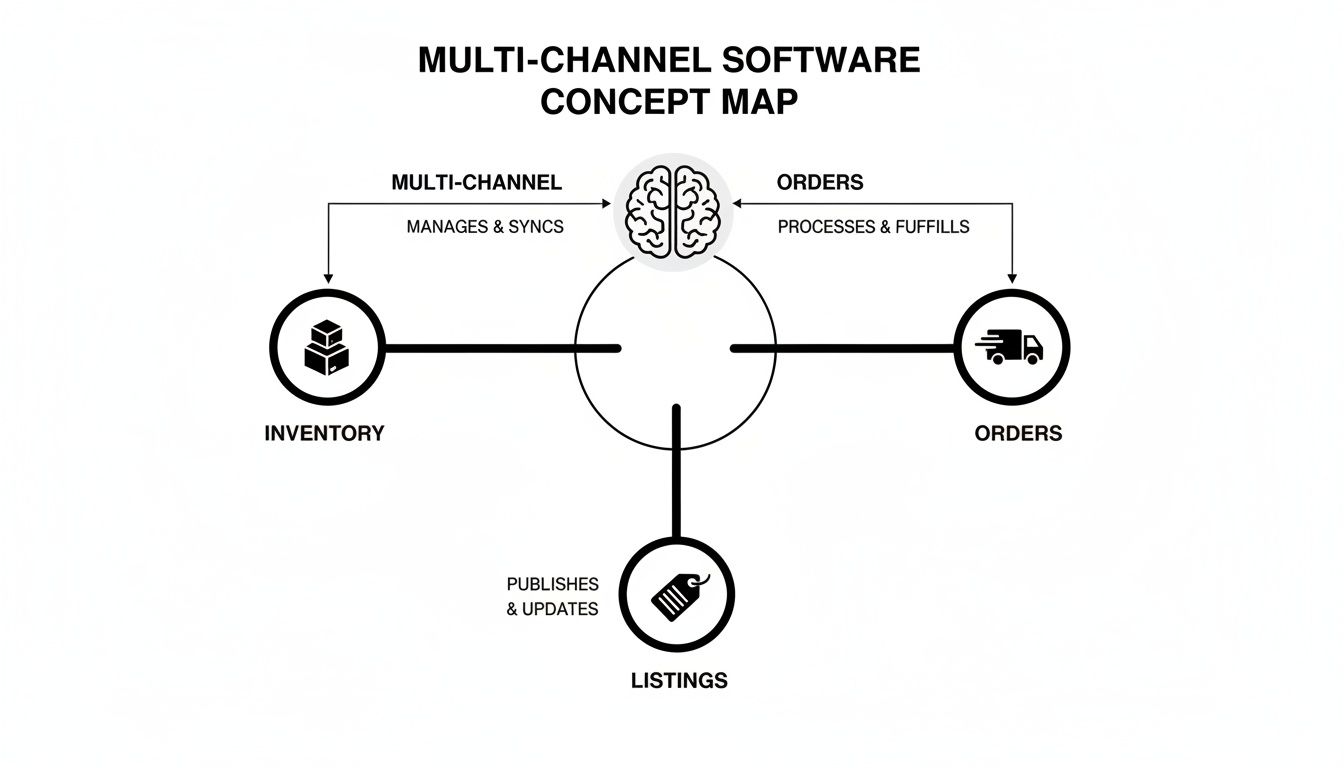
This map shows how the software acts as the central brain for your entire ecommerce operation, keeping all the critical pieces in sync.
Beyond just preventing lost sales, this software actively works to make every sale you do make more profitable. Think about automated repricing tools. They're on the job 24/7, hunting for the maximum possible margin on every transaction. They analyze competitor pricing in real-time and adjust your prices—within your set limits, of course—to win the sale at the highest price the market will bear. No human could ever keep up.
The financial wins start to stack up fast:
The real value isn’t just about saving time. It’s about reallocating that time to high-impact work like marketing, customer service, and product development. You’re not just cutting costs; you're funding your own growth.
Having a coordinated selling strategy isn't just a nice-to-have; it's a massive competitive edge. The data backs this up. Studies have found that omnichannel buyers can have a 30% higher lifetime value and can fuel revenue growth 3.5 times faster than people who only buy on one channel. It gets better: sales teams that get their act together across channels see 208% higher marketing revenue and close deals 67% faster. The impact of omnichannel strategies is undeniable.
The numbers don't lie. This kind of software pays for itself, and then some.
Every time a human has to manually touch a part of your process, you introduce a risk. A simple typo during data entry can lead to a wrong address, an angry customer, a one-star review, and a permanently lost customer. These aren't just minor slip-ups; they're expensive mistakes that chip away at your profits and tarnish your brand's reputation.
By automating these workflows, multi channel selling software acts as your quality control. It enforces consistency and accuracy across the board, making sure orders are routed to the right place and inventory counts are always spot on. This isn't just about being efficient—it's about protecting your profitability and the trust you've built with your customers.
Ultimately, this investment shifts your business from constantly putting out fires to proactively building for the future.
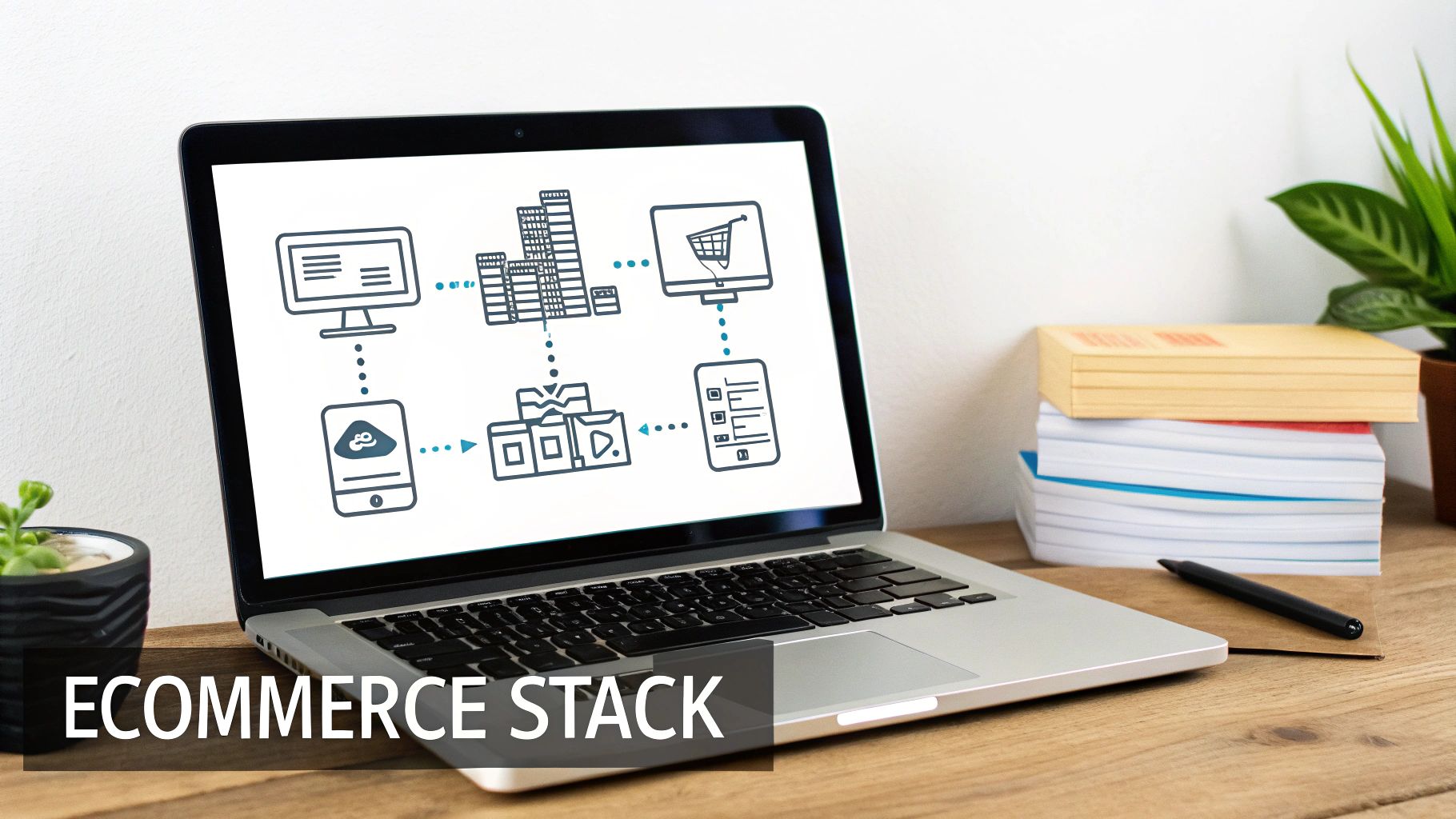
Your multi channel selling software doesn't live on an island; it's the central hub of your entire ecommerce universe. Think of your tech stack like a city's transportation network. For it to work, every road, bridge, and tunnel has to connect seamlessly back to Grand Central Station.
That station is your multi-channel platform, and all those connections are its integrations. If you don't have solid, real-time communication between your software and all your other systems, you're going to create data traffic jams, operational bottlenecks, and costly delays that tick off customers and frustrate your team.
The absolute first priority is forging flawless connections to every single place you sell. This means your software needs to have native, pre-built connectors for the major players, which act like plug-and-play adapters for your most vital channels.
You'll want to look for key integrations like:
This is where the true value of the multichannel listing software market—currently valued at $1.2 billion and projected to hit $3.8 billion by 2033—really shines. That growth is a direct response to sellers needing to be everywhere as global e-commerce sales rocket towards $6.39 trillion.
When you start looking at how platforms connect, you'll run into two main schools of thought. A massive part of designing a solid ecommerce setup is understanding how to choose your technology stack from the ground up, and this choice is a big piece of that puzzle.
Pre-built connectors are the simplest route. They're ready-made integrations that don't require much setup, getting you up and running fast on standard platforms. The downside? They can be rigid and might not support your unique or custom workflows.
API-first solutions offer the ultimate flexibility. An API (Application Programming Interface) is basically a set of rules that lets different software applications talk to each other. An API-first approach means you can build custom connections to any system, no matter how obscure. It's perfect for brands with very specific needs, but it usually requires some development resources.
The right choice really depends on your business. If you're using standard systems, pre-built connectors will save you a ton of time and money. But if you have a custom-built ERP or a really unique workflow, an API-first platform is the only way to future-proof your operations.
Just as critical as connecting your sales channels is integrating your fulfillment operations. Your software needs to communicate flawlessly with every single point where your inventory is stored and shipped from. This means your Third-Party Logistics (3PL) partners, Fulfillment by Amazon (FBA), and any in-house warehouse management systems (WMS).
This kind of end-to-end integration gives you a single, unified view of your inventory and orders across the entire supply chain. That unified view is the bedrock of intelligent order routing. For a deeper dive, check out our guide on ecommerce platform integration. A well-designed stack doesn't just prevent development headaches—it's what empowers you to scale profitably.
Choosing the right multi-channel selling software isn't like buying just another tool. It’s more like bringing on a critical business partner. This is a decision that will ripple through your operations for years, so you have to look past the flashy sales pitches and compare vendors on what actually matters for long-term, profitable growth.
This isn’t about checking boxes on a feature list. It's about finding a partner whose tech, support, and vision actually line up with where you want to be in five years. Make the wrong call, and you're looking at a nightmare of expensive replatforming projects, operational chaos, and squandered opportunities. Get it right, and the software becomes a genuine force multiplier for your entire business.
First things first: can the platform handle the heat? Your business doesn't move in a straight, predictable line. You have massive sales peaks during holidays and flash sales. The absolute last thing you need is for your central nervous system to crash and burn on Black Friday.
You need to ask potential vendors the tough questions about performance:
A real growth partner has sunk serious cash into building a resilient infrastructure designed for high-volume ecommerce. They should be completely transparent about their performance metrics and have the case studies to prove it.
Choosing a vendor is a long-term strategic decision, not a short-term feature comparison. The goal is to find a partner who can support your five-year vision, not just your current operational needs.
When something eventually goes sideways—and it will—the quality of your vendor's support team suddenly becomes the most important feature they offer. A cheap platform with a support team that’s slow, unskilled, or just plain absent is a terrible bargain. Remember, you're not just buying software; you're buying access to expertise.
Drill down into what their support really looks like day-to-day:
A true partner is invested in your success. They give you proactive advice, help you dial in your workflows, and act as a strategic resource. A mere vendor just sells you a login and hopes you don't call. For a brand that’s trying to scale, that distinction is everything.
Finally, you need a crystal-clear picture of the total financial commitment and where the vendor is headed. The sticker price is almost never the final price, and a platform that isn't actively innovating is already on its way to becoming obsolete.
Look beyond the monthly subscription to understand the true Total Cost of Ownership (TCO). This includes one-time setup fees, charges for premium support, and any per-transaction or per-order fees that can sneak up on you. A low monthly fee can be a smokescreen for hidden costs that punish you for growing.
Just as important is the vendor's product roadmap. Ask to see what new features and integrations they plan on releasing over the next 12-18 months. A forward-thinking partner will be investing in new marketplace connections, smarter analytics, and AI-driven automation. This ensures the platform you pick today will still be a powerful asset for your business years down the road.
To help you cut through the noise, we've put together a simple framework. Use this checklist when you're talking to potential vendors to make sure you're asking the right questions and comparing them on the criteria that will actually drive your growth.
Treat this process like you're hiring a key executive. Do your due diligence, ask the hard questions, and check references. The partner you choose will have a massive impact on your ability to scale efficiently and profitably in the years to come. Choose wisely.

Even the most powerful multi channel selling software can fall flat if the rollout is a mess. A thoughtful implementation isn't just about flipping a switch; it's a strategic plan to de-risk the transition and start seeing value fast.
Success hinges on a clear, phased playbook that spots challenges before they blow up into costly emergencies.
The first step is always the least glamorous but the most important: a full-on data audit. Before you even think about connecting a sales channel, you have to get your product information house in order. This means standardizing your SKUs, cleaning up inconsistent product titles, and making sure every single item has high-quality images and accurate details.
It’s the classic "garbage in, garbage out" problem. A messy catalog will only create bigger headaches when you try to sync it across multiple marketplaces. Getting this right from day one saves you from countless problems later.
Your first mission is to build a single source of truth for all your product data. This foundational work is the bedrock of a successful implementation.
Here's what that audit looks like in practice:
This is also the perfect time to take a hard look at your overall inventory strategy. For a deeper dive on managing stock across platforms, our guide on multi-channel inventory management is packed with valuable insights.
Once your data is clean, you can start the connection process. But resist the temptation to plug everything in at once.
Instead, start small. Pick a single, high-volume channel—like your Shopify store or your main Amazon account—and treat it like a pilot program. This lets your team validate crucial workflows, like order processing and inventory syncing, in a controlled environment.
After you’ve confirmed everything is running like a well-oiled machine and you've ironed out any kinks, you can confidently start connecting your other sales channels one by one.
A phased rollout is your best defense against overwhelming your team and causing system-wide chaos. Validate with one channel, master the process, then replicate that success across your network.
A lot of brands stumble during this critical phase because they underestimate the complexity. One of the most common mistakes? Failing to assign a dedicated project lead internally. Without one person owning the project, accountability disappears and deadlines start slipping.
Other frequent missteps include:
By following a structured playbook and sidestepping these common errors, you can ensure your investment in multi channel selling software turns into a smooth, successful launch that delivers immediate wins for your business.
Stepping into the world of multi-channel software can feel like learning a new language. You’re not alone. Here are some of the most common questions brand owners ask when they're looking to make a change.
That's the million-dollar question, isn't it? The truth is, pricing is all over the map. Most vendors use a subscription model that slides up or down based on your order volume, how many channels you've connected, or your total Gross Merchandise Value (GMV).
For smaller brands just getting started, you might find entry-level plans for a few hundred bucks a month. But if you're an 8-figure seller with a complex operation, don't be surprised to see costs climb into the thousands.
Here's the key: never just look at the monthly fee. You have to dig deeper. Ask about one-time setup costs, hidden transaction fees, and what they charge for premium support. The only way to get a real apples-to-apples comparison is by calculating the Total Cost of Ownership (TCO). That's how you avoid nasty surprises down the road.
Absolutely. In fact, this is where these platforms really shine. A solid system will give you a single, unified dashboard to see your stock levels across Amazon's FBA warehouses, your own FBM setup, and any 3PLs you work with. It's a game-changer.
This central command center lets you get clever with your fulfillment. You can build rules that, for example, automatically prioritize FBA stock for Prime orders but route orders from your website to your FBM inventory to duck Amazon's fees. It becomes your one source of truth for every unit you own, no matter where it's sitting.
This unified view is what finally kills the overselling beast for good. When every channel has real-time, accurate stock data, you protect your marketplace health scores and keep customers happy.
Not at all—a good system actually gives you more control, not less. These platforms are built for centralized management, not for making everything look the same. They use powerful templates that let you create a "master" product listing and then easily tweak it for each channel's audience and quirky rules.
This means you can have one title for Amazon, a different one for eBay, and unique descriptions for your Shopify store, all managed from a single screen. It’s the best of both worlds: brand consistency where it counts and targeted optimization where it matters most.
The timeline really hinges on how complex your business is. If you've got a couple of channels and your product data is already clean and organized, you could be up and running in as little as 2-4 weeks.
For larger sellers with huge catalogs, multiple warehouses, and custom workflows, you should probably budget for 2-3 months. The biggest hurdles are almost always messy data (especially messy SKUs) and not having your team ready to dedicate time to the project. Brands that come prepared always get through implementation faster and with fewer headaches.
At Million Dollar Sellers, we know that scaling past 7-figures isn't just about marketing—it's about building an operational machine that can handle the growth. Our private community is where top entrepreneurs share the playbooks and insights needed to build a resilient e-commerce business. Learn more about how MDS helps top entrepreneurs win.
Join the Ecom Entrepreneur Community for Vetted 7-9 Figure Ecommerce Founders
Learn MoreYou may also like:
Learn more about our special events!
Check Events