Chilat Doina
December 10, 2025
Launching a new product with just a to-do list is like trying to navigate a new city without a map. Sure, you're moving, but you're probably not going to end up where you want to be. A solid product launch strategy template is that map. It takes a jumble of tasks and turns it into a clear, unified plan that gets your whole company pulling in the same direction.
Let's be real: making a checklist feels good. You jot down tasks, assign them out, and start ticking off boxes. It’s a clean, satisfying process.
But product launches are anything but clean and simple. They’re messy, they’re unpredictable, and they're full of curveballs. A basic checklist can't handle sudden market shifts, a competitor's surprise move, or an internal snag. It tells you what to do, but it completely misses the why and the how.
A formal strategy, laid out in a proper template, elevates your game from just managing tasks to executing a strategic vision. It makes you ask—and answer—the hard questions before you're in the thick of it.
The single biggest risk of a checklist-only approach is that your teams end up working in silos. When everyone has their own separate to-do list, wires get crossed.
Marketing might be running a campaign that highlights a feature engineering hasn't quite locked down. Sales could be chasing a customer profile the product wasn't really designed for. The result? A disjointed, confusing experience for the customer that kills trust before you've even had a chance to earn it.
A product launch strategy template acts as the single source of truth, preventing this chaos. It ensures every team—from product and marketing to sales and customer support—is reading from the same playbook.
When teams don’t have a shared understanding of who the product is for or why it matters, they default to their own priorities. A strategy brings everyone onto the same page, aligning on audience, message, and value, so every function reinforces the same story and builds in the same direction.
Getting this alignment isn't just a nice-to-have; it's critical. The data is clear: 56% of product launch failures come from a lack of internal alignment among teams. A well-thought-out strategy forces that cross-functional collaboration from day one. You can find more data on what makes launches successful in these product launch statistics on Brainkraft.com.
Here’s the bottom line: a strategy transforms your launch from a one-off event into a repeatable, scalable engine for growth.
A checklist gets tossed out after launch day. A strategy template becomes a living document. It's where you capture what worked, what bombed, and how you'll do it better next time. It’s the difference between crossing your fingers for a win and actually engineering one.
This is the document that gives you the structure to handle market surprises and act decisively on customer feedback. It lays the foundation for driving the kind of revenue that puts your brand on the map. While a simple to-do list is a good starting point, our comprehensive product launch checklist template shows you how to integrate those tasks into a bigger strategic framework for real impact.
Alright, let's get into the good stuff. Here's the fill-in-the-blanks playbook I use to take a product from a strategic idea to a real-world, revenue-generating launch. This isn't just a random to-do list; it’s a battle-tested framework that will guide you through every critical stage. A solid product launch strategy template is the difference between a chaotic launch and a coordinated, successful one. It keeps everyone on the same page and makes sure no crucial details fall through the cracks.
I break every launch down into three core phases: Pre-Launch, Launch, and Post-Launch. Each section has specific, actionable steps tailored for e-commerce brands, whether you're on Shopify, Amazon, or both. Think of this as your master plan—the single source of truth for your entire team.
This visual timeline gives you a quick snapshot of the journey.
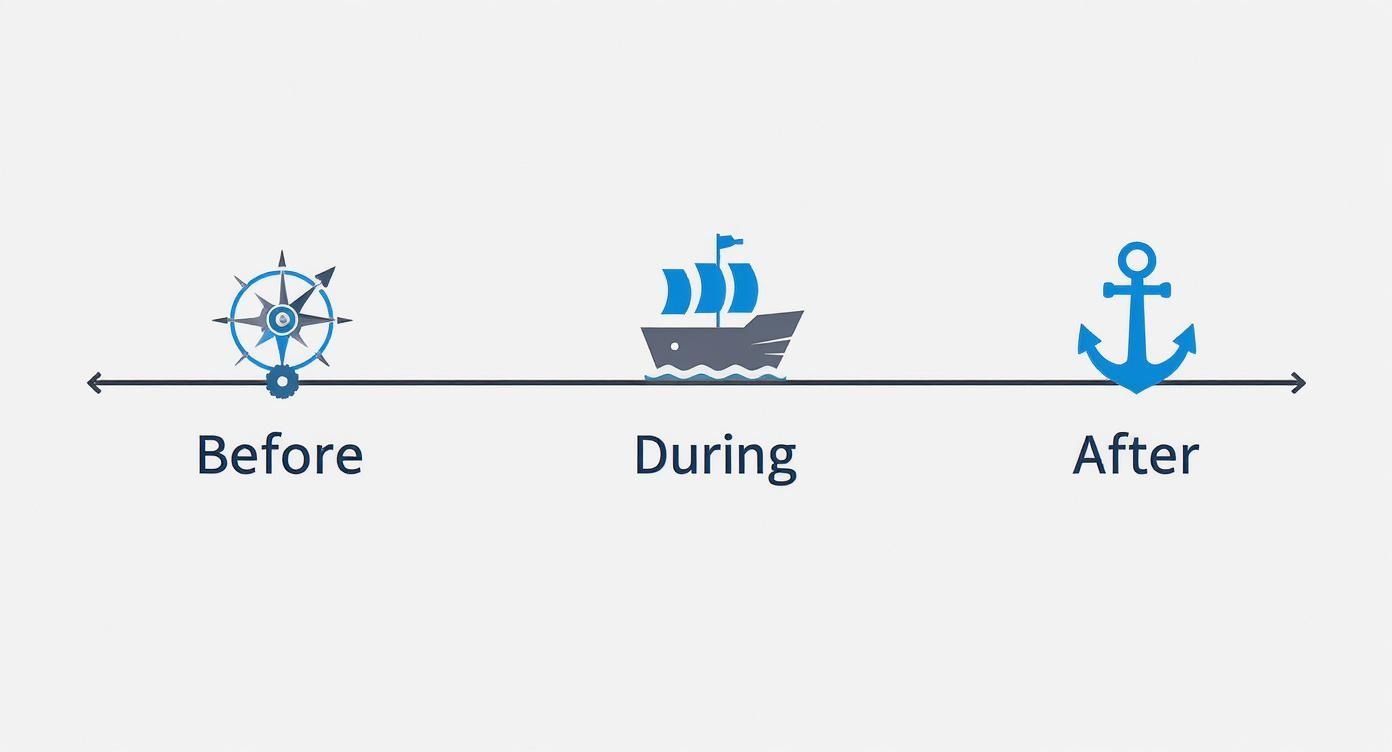
As you can see, the real work starts long before you hit "publish." You plan your route (the compass), you execute the journey (the ship), and then you secure your spot in the market (the anchor).
To give you a high-level view of how these pieces fit together, here’s a breakdown of the three phases.
Launch PhasePrimary ObjectiveKey ActivitiesCritical DeliverablesPre-LaunchBuild a rock-solid strategic foundation and generate initial buzz.Market research, customer profiling, competitive analysis, messaging development, content creation, influencer outreach.Ideal Customer Profile (ICP), competitive SWOT analysis, positioning statement, marketing calendar, all creative assets.LaunchExecute a coordinated, multi-channel push to drive traffic and secure initial sales.Go-live on all platforms, run paid ad campaigns, send email blasts, publish content, activate influencer partnerships.Live product pages, active ad campaigns, launch day sales, initial customer reviews, social media engagement.Post-LaunchAnalyze performance, gather feedback, and build momentum for long-term growth.Monitor KPIs, collect customer reviews, run optimization tests, plan follow-up marketing, iterate on product/messaging.Launch performance report, customer feedback summary, optimized marketing plan, content roadmap for the next 30-60 days.
This table serves as your North Star, keeping you focused on what truly matters at each stage. Now, let's dive into the nitty-gritty of each phase.
This is where you do all the heavy lifting. Seriously. Skipping these steps is like building a house on sand—it’s doomed to fail. I've seen it happen time and time again. A well-executed pre-launch can easily account for over 50% of your launch's overall success.
The main goal here is to get crystal clear on your strategy and get your team aligned. You need to know exactly who you're selling to, what problem your product solves for them, and why your solution is the only choice they should consider.
You have to get granular here. Vague descriptions like "millennial women" are useless. You need to dig deep to create a vivid picture of your ideal buyer.
You don't exist in a vacuum. Knowing your competition inside and out is non-negotiable.
This is where you turn all that research into a story that sells. Your positioning statement is an internal document that carves out your unique spot in the market.
A strong positioning statement answers four key questions: Who is the target customer? What is their core problem? How does our product uniquely solve it? And what's the primary benefit they'll get?
Once you have that statement locked in, you can build out your key messaging pillars. These are the core themes you'll hammer home across every single channel. Keep them consistent, clear, and always focus on the customer's benefit, not just your product's features.
With a solid strategy in place, it's go-time. The launch phase is all about making noise, driving a flood of traffic, and turning that initial interest into actual sales. This requires tight, military-grade coordination across every channel, whether you're launching on your own DTC site, a marketplace like Amazon, or both.
Here’s how to tackle it, channel by channel.
Your website is your home turf. It’s where you control the entire experience, from the first click to the final thank you page.
Launching on Amazon is a completely different beast. It's all about playing by the algorithm's rules and tapping into its massive built-in customer base.
Let me be clear: launch day is the starting line, not the finish line. The post-launch phase is where the real work begins, and it's what separates the one-hit wonders from the long-term bestsellers. This is when you obsess over data, gather feedback, and build on your initial momentum.
What you do in the first 30-60 days after launch will determine whether your product skyrockets or fizzles out.
Your first customers are an absolute goldmine of insights. You need to proactively seek out their opinions to find out what’s working and what’s not.
You can't improve what you don't measure. You need to be tracking the right metrics to understand the health of your launch and spot opportunities for improvement.
MetricWhat It Tells YouGood Target (Ecommerce)Conversion RateThe percentage of visitors who make a purchase.2-3%Customer Acquisition Cost (CAC)How much it costs, on average, to get a new customer.Lower than AOVAverage Order Value (AOV)The average amount a customer spends in a single order.Varies by industryProduct Return RateThe percentage of units sold that are returned by customers.Below 5-10%Customer Lifetime Value (CLV)The total revenue you expect from a single customer over time.At least 3x CAC
Use the feedback and data you've collected to create a clear optimization plan.
Alright, with your strategy locked in, it's time to decide where you're actually going to launch this thing. This is a huge decision. The channels you pick will shape your tactics, your budget, and the very first impression customers have of your product. It’s not about being everywhere; it’s about being exactly where your ideal customers are ready to listen.

For most e-commerce brands, this choice usually comes down to two main paths: launching Direct-to-Consumer (DTC) on a platform like Shopify, or going marketplace-first on a behemoth like Amazon. Each has its own killer advantages, and honestly, the right choice completely depends on your product, your brand, and where you want to be in five years.
Launching on your own DTC site is about one thing: control. You own the customer relationship, the branding, all the data, and the entire experience from start to finish. This is your turf.
A DTC-first launch is the go-to for brands that want to build a real, lasting connection with their audience. You're not just moving units; you're building a community.
Proven DTC Launch Tactics:
Launching on Amazon is like opening a store in the world's busiest mall. Customers are already there, credit cards in hand, actively searching for what you sell. The trade-off? You give up a lot of control over your branding and that direct line to your customers.
An Amazon-first launch is a powerful move if search volume and convenience are what drive people to buy your type of product.
Proven Amazon Launch Tactics:
Of course, you don't always have to choose. An omnichannel strategy uses both your DTC site and marketplaces, playing to the strengths of each.
You could launch on your DTC site to get those high-margin sales from your die-hard fans, while simultaneously launching on Amazon to scoop up new customers who live and die by Prime shipping. The trick is to keep your brand messaging and customer experience consistent, no matter where people find you.
The modern customer journey is anything but linear. A buyer might see your product in an Instagram ad, head to your DTC site to read your story, but then pop over to Amazon to buy it because they want that fast, free shipping. An omnichannel presence meets customers wherever they are.
No matter which channels you focus on, the tactics you use on launch day are what create that initial burst of energy. Research across thousands of launches reveals a clear pattern: 94% use social media blitzes, 89% lean on email announcements, and 71% send out press releases. This big, coordinated push leads to huge results, with website traffic spiking an average of 847% and email open rates jumping 67% higher than usual on launch day. You can dig into more of the data behind these tactics in this research on Openhunts.com.
Choosing your channels isn't a set-it-and-forget-it decision. It's a strategic choice you should revisit as your brand grows and the market changes. Start where you have the best shot at connecting with your core audience, execute like a pro, and then expand from that strong foundation.
A brilliant product and a perfect strategy mean nothing without the right people and resources to make it happen. I’ve seen it time and time again: a launch is a team sport, not a solo mission. Defining who does what and how much you can actually spend are two of the most critical steps in turning that strategic document on your hard drive into real-world action.

This is where your product launch strategy template moves from theory to practice. It’s time to assign ownership and allocate capital to bring your vision to life.
Forgetting to assign clear roles is a fast track to confusion and dropped balls. Every successful launch I've been a part of has a core team where each person owns a specific piece of the puzzle. While the job titles might change from company to company, the core functions are always there.
"Literally nothing matters if the team isn't aligned. When teams don’t have a shared understanding of who the product is for or why it matters, they default to their own priorities. Strategy brings everyone onto the same page."
Getting these key stakeholders on the same page is everything. For a deeper dive into organizing your crew for growth, our guide on building an effective ecommerce team structure lays out an excellent framework.
To keep everyone crystal clear on their duties, a simple matrix can work wonders.
This table breaks down who's responsible for what during each phase of the launch, preventing tasks from falling through the cracks.
RolePre-Launch ResponsibilitiesLaunch Day ResponsibilitiesPost-Launch ResponsibilitiesLaunch OwnerFinalize GTM plan, manage timeline, coordinate cross-functional meetings, set KPIs.Oversee launch execution, monitor real-time performance, lead the war room.Compile launch report, analyze performance against KPIs, plan optimization.Product LeadEnsure final product is bug-free, provide technical specs, approve marketing copy.Monitor product performance & stability, be on-call for technical issues.Gather user feedback, prioritize v1.1 features, update product roadmap.Marketing LeadBuild ad campaigns, create content, schedule emails & social posts, outreach.Go live with all campaigns, monitor engagement, manage social media.Optimize ad campaigns, analyze channel performance, create follow-up content.Sales LeadTrain sales team, finalize sales enablement materials, set launch day targets.Motivate the sales team, track initial sales, share early customer feedback.Analyze sales performance, gather feedback from sales team, refine sales pitch.Support LeadDevelop FAQs & help docs, train support agents, prepare canned responses.Manage influx of support tickets, monitor for common issues or questions.Update knowledge base, analyze ticket trends, provide feedback to product team.
A simple chart like this ensures everyone knows their role before, during, and after the big day, which is absolutely essential for a smooth execution.
Think of your budget as the fuel for your launch engine. Without a clear financial plan, you’ll either underspend and fail to make an impact or, worse, overspend on all the wrong things. A well-planned budget inside your product launch strategy template makes sure every dollar is working toward your main goal.
First, just start by listing every single potential expense. Don't leave anything out.
Once you have your full list, start allocating funds based on your strategic priorities. For example, a common DTC launch budget might look something like this: 40% to paid ads, 25% to creative, 20% to influencers, 10% to PR, and 5% to software.
Launch day isn’t the finish line. Far from it. Think of it more as the starting block for real, sustainable growth. What you do in the first 30 to 60 days after your product goes live is what separates the one-hit wonders from the long-term bestsellers.
This is when you shift gears from broadcasting your message to listening intently and tweaking relentlessly. The goal here is to get a tight feedback loop going, where raw data and real customer insights fuel constant improvement. This is what keeps you from fading into obscurity.
You can't fix what you don't measure. Vague feelings about how the launch "went" are totally useless. You need hard data to see what’s actually happening and make smart decisions. Start by zeroing in on a few essential Key Performance Indicators (KPIs) that tell the true story of your launch's health.
These metrics go way beyond simple sales numbers.
Your launch isn't a success just because you hit a revenue target. True success is achieving that revenue with healthy, sustainable metrics. A high CAC and a high return rate can quickly turn a profitable-looking launch into a long-term financial drain.
Keeping these numbers in one spot is a must. To get a better handle on organizing this, check out our guide on creating a comprehensive performance metrics dashboard. It’ll help you build a single source of truth for your entire team.
Data tells you what happened, but customer feedback tells you why. You absolutely have to be proactive about gathering this qualitative info. Your first wave of customers is a goldmine of honest, unfiltered opinions—use it.
Don't just wait for feedback to trickle in. Go get it.
This cycle—measure, listen, optimize—is the engine that will drive your post-launch momentum. It ensures your product evolves right alongside your customers, cementing its place in the market long after the initial launch buzz has died down.
Even the most buttoned-up launch plan runs into questions once you're in the thick of it. It happens. This is where we tackle those common "what ifs" and "how tos" that pop up for founders and brand managers, giving you straight answers to sidestep the usual hurdles.
For a typical e-commerce product, you really want to give yourself at least 3-6 months for detailed planning. That might sound like a lot, but it's a realistic runway to do proper market research, get the product just right, create killer content, and start warming up an audience before you ask them to buy.
A 90-day countdown is a great, manageable way to think about it.
Trying to cram this into a few weeks is one of the biggest reasons launches just fizzle out. Give your plan the time it needs to actually work.
Think of it like a dress rehearsal versus opening night.
A soft launch is a quiet, controlled release to a small, select group. This could be your most loyal email subscribers or customers in a specific city. The whole point is to test everything—the product, the checkout process, the shipping—and get real feedback to fix any snags before you go big. It's a massive risk-reducer.
A hard launch is the main event. It's the full-scale, public release to your entire audience, backed by your whole marketing campaign and ad budget. Whether you do one or both really comes down to your confidence in the product, your budget, and how much risk you're willing to take. Honestly, most of the smartest brands I know use a soft launch to de-risk their big public debut.
Building that pre-launch buzz is everything if you want a strong start. The goal isn't just to announce a product; it's to have a waitlist of people practically begging to buy it the second it drops.
Start teasing some behind-the-scenes content on your social channels to make your audience feel like they're in on a secret. You absolutely need a dedicated landing page to collect email addresses, usually in exchange for an exclusive launch-day deal or early access. Another great play is to partner with a few key influencers in your niche to get the product in their hands for a review or unboxing before anyone else. And don't underestimate a good old-fashioned giveaway—it can drive a ton of engagement and shares, getting your name out there fast.
The mistakes that sink most product launches are almost always the same—and thankfully, they're completely avoidable if you have a solid plan.
I see the same things trip people up time and time again: 1) Skimping on market research and not truly understanding the customer's problem. 2) Having vague positioning that just blends in. 3) Messy internal communication that leads to a confusing message. 4) Forgetting to build an audience before launch day. 5) Having zero plan for what to do after the launch to collect feedback.
Using a thorough template forces you to think through each of these potential landmines ahead of time. It’s no surprise the market for strategic tools like this is growing; valued at USD 6.9 billion in 2025, it's projected to hit USD 12.5 billion by 2033 as more brands get serious about structured launches. You can discover more insights about this market expansion on htfmarketinsights.com.
Ready to scale your e-commerce brand alongside the world's top founders? At Million Dollar Sellers, we provide the exclusive network, proven strategies, and peer support you need to navigate growth and dominate your market. Apply for membership at Million Dollar Sellers today.
Join the Ecom Entrepreneur Community for Vetted 7-9 Figure Ecommerce Founders
Learn MoreYou may also like:
Learn more about our special events!
Check Events