Chilat Doina
November 8, 2026
Small standard-size products priced between $10 and $50 face an average fulfillment fee increase of $0.25 per unit, compared with the $0.08 overall average, according to Amazon's U.S. fee update. That's the distinction sellers should focus on: a modest portfolio average doesn't describe the exposure of an individual SKU.
The new FBA fees require more than a blanket adjustment to your profit calculator. You need to separate product-band changes, shipment-date surcharges, seasonal fulfillment rates, and inventory holding costs. You also need to distinguish sales-channel diversification from fulfillment-provider diversification. Moving an order off Amazon's marketplace doesn't necessarily move its fulfillment costs outside Amazon's network.
2026 U.S. FBA fee changes by date
| Change | Effective | Programs or markets affected |
|---|---|---|
| Average FBA fee increase of $0.08 per unit | January 15, 2026 | U.S. FBA |
| Fuel and logistics surcharge of 3.5% | April 17, 2026 | U.S. and Canadian FBA; Remote Fulfillment from the U.S. into Canada, Mexico, and Brazil |
| Fuel and logistics surcharge of 3.5% | May 2, 2026 | U.S. and Canadian Multi-Channel Fulfillment; U.S. Buy with Prime |
| Peak fulfillment fees | October 15, 2026 to January 14, 2027 | FBA, Remote Fulfillment into Canada and Mexico, MCF, Buy with Prime |
| Aged-inventory surcharge removed and merged into an age-based storage rate | Effective date not stated in the fee summary | U.S. storage |
Treat this as a checklist for reconciling Seller Central notices, not a complete rate card. The changes affect different parts of your cost model, and a program's inclusion doesn't tell you the final charge for a particular shipment.
The baseline adjustment changes the starting fulfillment expense. The surcharge adds a percentage-based component, while peak pricing introduces a separate seasonal assumption. Storage requires its own model because inventory age and occupied space aren't captured by a per-order fulfillment calculation.
Amazon's statement that it introduced no new FBA fee types shouldn't be interpreted as a promise that every seller's total fulfillment expense stays close to the headline average. Fee categories and fee amounts are different questions. The pause in the preceding annual increase also doesn't establish a useful baseline for your next purchase order.
Assign each notice to an operational owner:
Mark the listed effective dates in your operating calendar and tag each SKU by the programs through which it ships. A SKU sold through several channels requires several fulfillment scenarios, not one universal fee estimate.
The overall average is a planning reference, not a SKU-level forecast. Within the same selling-price band, Amazon's announced adjustments differ materially between small and large standard-size products.
2026 FBA fulfillment fee change by product band
| Product band | Average change per unit | Note |
|---|---|---|
| All FBA products, average | +$0.08 | Less than 0.5% of the average item's selling price |
| Standard size, $10 to $50, small | +$0.25 | Larger of the stated increases in this price band |
| Standard size, $10 to $50, large | +$0.05 | Smaller increase in the same price band |
| Standard size, under $10 | Not stated | No band-specific figure stated in the announcement summary |
| Standard size, over $50 | Not stated | No band-specific figure stated in the announcement summary |
| Oversize | Not stated | No band-specific figure stated in the announcement summary |
Not stated doesn't mean unchanged. It means you shouldn't assign an increase without checking the applicable rate card or SKU-level fee estimate.
Export your active inventory and fee estimates from Seller Central. Join them by SKU or ASIN with selling price, product dimensions, shipping weight, size tier, and forecast monthly units.
Use the tier Amazon currently assigns, then compare it with your measured packaged product. Don't substitute a supplier's product dimensions for the dimensions of the sellable packaged unit.
Your incremental baseline expense is:
Applicable per-unit fee change × units expected to fulfill under the revised rate
For a hypothetical small standard-size product in the affected price band, multiply its applicable increase by its forecast shipments. Run the equivalent calculation for a large standard-size product rather than applying the small-item adjustment to both.
Portfolio pitfall: A blended percentage can make the catalogue look stable while concealing a concentrated increase on a high-volume product.
Keep the forecast and the actual fee reconciliation separate. The forecast helps you make purchasing and pricing decisions; the reconciliation tells you whether Amazon charged the tier and rate you expected.
Sort the catalogue by incremental fulfillment expense, then inspect the highest-volume products in the affected bands. A product with a modest unit increase can still deserve attention if it accounts for substantial shipment volume. Conversely, a larger increase on a slow seller may be less urgent than its percentage initially suggests.
Model the surcharge as a distinct charge, not as an adjustment to sales revenue. Amazon's fee notice specifies a 3.5% fuel and logistics surcharge beginning April 17, 2026 for U.S. and Canadian FBA and the specified Remote Fulfillment routes, followed by May 2, 2026 for U.S. and Canadian MCF and U.S. Buy with Prime.
For illustration, suppose the applicable fulfillment fee is $5.00. Applying the announced percentage produces $0.175 of additional cost; on a hypothetical $12 selling price, that equals approximately 1.46% of revenue. Those are scenario assumptions, not a published Amazon average.
The denominator matters. A surcharge expressed as a percentage of fulfillment expense isn't the same as that percentage of the item's selling price.
Use this checklist to organize the modelling work.
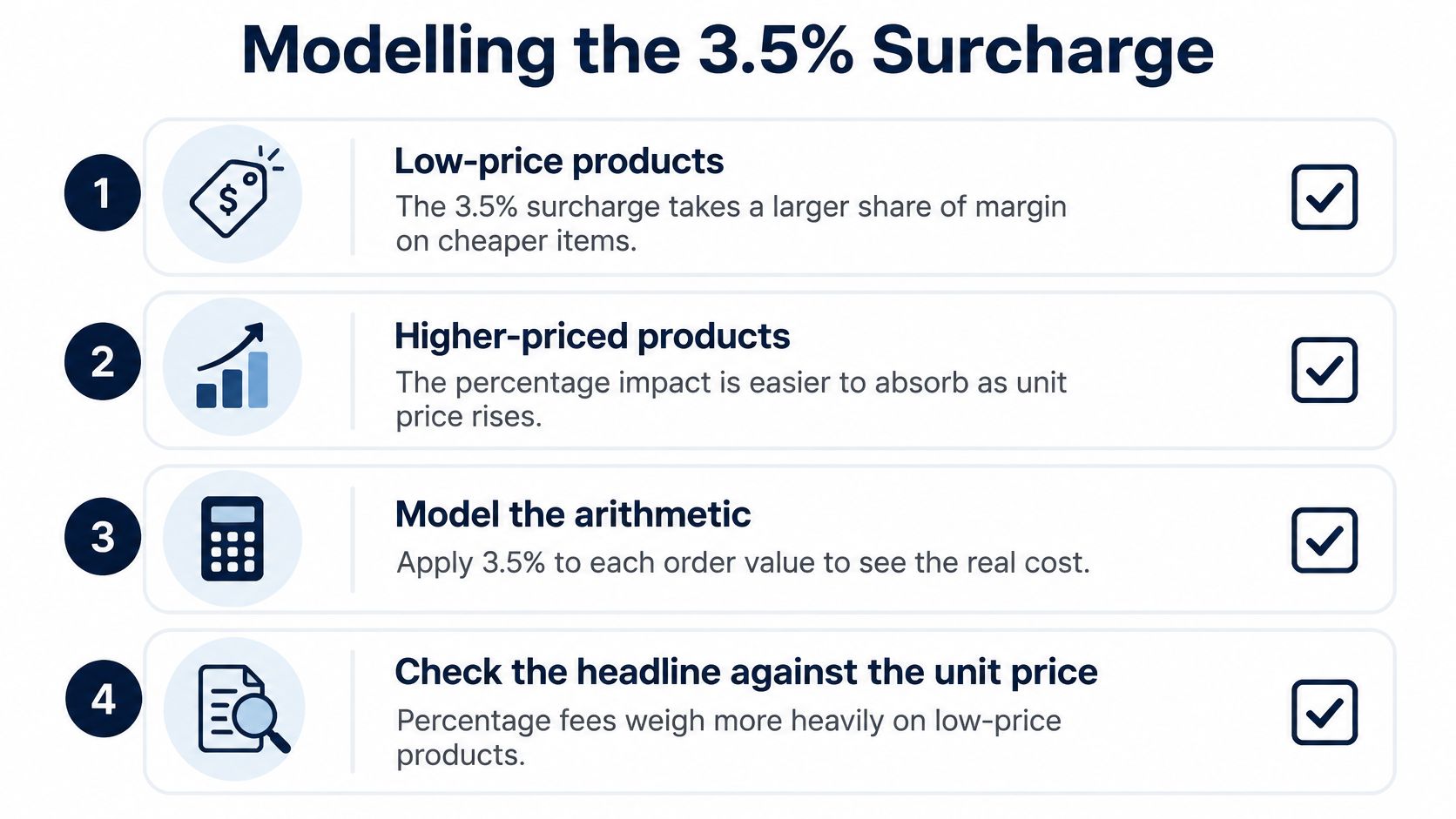
For the calculation itself, use the eligible fulfillment-fee base, not the full selling price. Also, cheaper products don't automatically have lower contribution margins; the surcharge's share of revenue increases when price falls while the eligible fulfillment fee stays constant.
Calculate liability by shipment date and program. Domestic FBA and Remote Fulfillment need separate rows because their rates and destinations differ, even where their surcharge start dates match.
If you also ship campaign rewards, PledgeBox's guidance on how to manage rising reward shipping costs offers a useful parallel budgeting resource. Keep those shipping assumptions separate from Amazon's fee calculation.
Before approving another reorder, complete the model for your highest-exposure SKUs and assign someone to resolve every unknown input.
Peak planning starts with the orders you expect Amazon to fulfill during the published window, not just with inventory arriving before it. Sending stock into a warehouse earlier doesn't, by itself, establish that a later customer shipment avoids seasonal fulfillment pricing.
The available announcement summary identifies the window and programs, but doesn't state the peak-rate amounts. That's a missing input, not permission to carry the base rate into your holiday margin forecast.
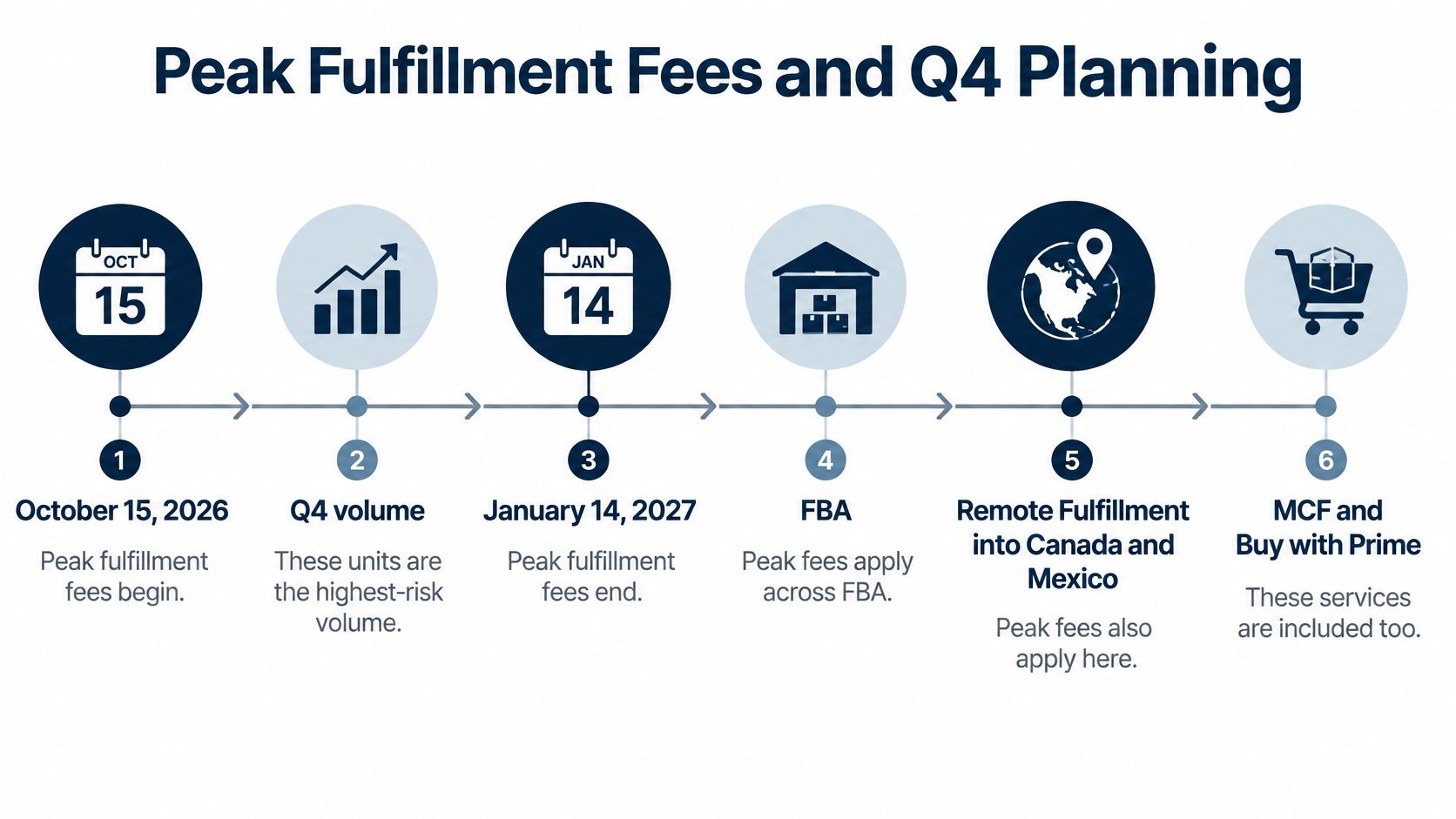
Use the published schedule as an operational planning boundary.
The inventory decision requires a separate comparison. Earlier inbound shipments may help availability, but they can also add storage time; later shipments may reduce holding time while introducing replenishment risk. Evaluate those trade-offs without claiming an early warehouse arrival eliminates a fee tied to customer fulfillment.
A dated inbound plan and a dated customer-fulfillment forecast solve different problems. Keep both.
Give each exposed SKU a contribution-margin trigger and a named decision-maker. If the confirmed seasonal cost pushes the forecast below your approved margin floor, that owner should review pricing, promotion depth, or fulfillment routing before the relevant orders arrive.
Begin this week by exporting the prior season's fulfilled units. That file gives operations and finance a common starting point, even before every rate is confirmed.
Amazon's storage change requires a different unit of analysis: space occupied over time. Its fee summary and associated AWD rate information describe merging the aged-inventory surcharge into an age-based monthly storage rate, while listing AWD storage at $0.57 per cubic foot per month in the West and $0.48 in the East and South, with the program discounts below.
The summary doesn't state the consolidation's effective date or supply the complete FBA age-band rate schedule. AWD is a separate program from FBA storage, so its regional rates aren't substitutes for missing FBA rates.
AWD storage rates and discounts by region
| Region | Storage rate per cubic foot per month | Discounts available |
|---|---|---|
| West | $0.57 | 10% AWD Smart Storage; 20% off AWD storage and 10% off AWD transportation with Amazon Managed Service |
| East | $0.48 | 10% AWD Smart Storage; 20% off AWD storage and 10% off AWD transportation with Amazon Managed Service |
| South | $0.48 | 10% AWD Smart Storage; 20% off AWD storage and 10% off AWD transportation with Amazon Managed Service |
Don't assume those discounts stack. Apply only the eligibility and combination rules confirmed for your account.
Cubic-foot-days help compare inventory scenarios with different dwell times. For a hypothetical item occupying two cubic feet for thirty days, exposure is sixty cubic-foot-days. That measures space and time, but it doesn't establish Amazon's daily billing convention.
Calculate the invoice estimate using the published monthly rate and applicable proration rules. If your spreadsheet converts a monthly rate to a daily equivalent, label the month-length assumption explicitly.
Export inventory age, packaged dimensions, quantity, region, and replenishment history. Then:
Use inventory forecasting to connect expected sales with replenishment timing rather than treating every unit in stock as equally necessary. Start with bulky, slow-moving products because they combine occupied space with extended dwell time.
Annual fee increase by volume and product band
The following calculations apply the announced band changes to hypothetical annual shipment volumes. They isolate the baseline increase and exclude storage, returns, referral fees, surcharges, and seasonal adjustments.
| Annual units | Overall-average increase | Small standard-size affected band | Large standard-size affected band |
|---|---|---|---|
| 10,000 | $800 | $2,500 | $500 |
| 50,000 | $4,000 | $12,500 | $2,500 |
| 100,000 | $8,000 | $25,000 | $5,000 |
These are full-volume scenarios, not automatically a seller's calendar-year liability. Apply the change only to units subject to the revised rate, and don't use the overall average where a confirmed SKU-specific adjustment is available.
The important comparison isn't merely annual dollars. It's what remains after the additional expense on each sale.
Divide incremental per-unit expense by selling price to measure the share of revenue consumed. Then divide it by the product's previous contribution margin per unit to understand the share of contribution lost.
Those calculations answer different questions. A product can show a modest change relative to revenue yet lose a meaningful portion of the money previously available to cover overhead and profit.
Use contribution margin per unit consistently across channels. Subtract product cost and the variable costs attributable to the sale, including applicable fulfillment, referral, advertising, return allowances, and inventory costs where relevant to the decision.
Decision rule: Investigate a SKU when the incremental cost breaches your approved margin floor, not simply when its fee increase exceeds the portfolio average.
A universal percentage trigger would be convenient, but the fee announcements don't establish one. Set your own commercial threshold using product economics, competitive pricing, and the return you require on the next inventory commitment.
Build the revised contribution calculation from a confirmed base rate. If that rate already includes the annual adjustment, don't add the baseline increase again.
Likewise, determine whether a published seasonal figure is a replacement fulfillment rate or an incremental charge before combining it with other fees. Where the surcharge also applies, calculate it on the eligible base specified by the program.
Run before-and-after contribution statements for your leading revenue products. Rank the results by total contribution dollars at risk, then review the products whose next reorder would commit the most capital to a weakened margin.
Selling through your own storefront doesn't automatically remove Amazon fulfillment exposure. If Amazon still picks, packs, and ships the order, you've changed the sales channel without necessarily changing the cost provider.
That distinction matters when deciding whether an alternative channel diversifies fulfillment risk.

Amazon's cross-program fee notice identifies 3.5% surcharge exposure across Amazon-operated fulfillment programs and lists October 15, 2026 through January 14, 2027 peak coverage across FBA, MCF, Buy with Prime, and Remote Fulfillment into Canada and Mexico. Brazil appears in the surcharge scope but not in that stated Remote Fulfillment peak scope; confirm the applicable country schedule rather than inferring an exemption from every seasonal charge.
Build a destination-level comparison of FBA, MCF, a third-party logistics provider, and seller fulfillment. Hold the product, destination, expected service level, and order configuration constant.
Mark unquoted provider fees as unknown, not zero. A comparison with missing fulfillment inputs isn't evidence that the alternative is cheaper.
Use the accompanying video as additional context, while keeping the financial decision tied to your own rate cards and order records.
Inventory position also belongs in the comparison. Regional stock may change transportation expense and service performance, but it introduces holding and replenishment costs of its own.
Start with one SKU and compare alternative fulfillment routes to the same destination. Choose on contribution after the full delivery obligation, not on the visible outbound shipping line alone.
Turn the fee model into an operating decision before peak orders begin. A spreadsheet with unresolved assumptions can identify exposure, but it can't establish that a product meets your margin target.
Load the effective-date calendar. Enter the announced implementation boundaries for each program into your model. Store the notice version and the date you last checked it so finance can distinguish a confirmed rate from an older assumption.
Run the margin test. Compare expected contribution before and after the applicable changes. Flag products below your approved floor and products whose outcome still depends on an unknown rate. Treat those as different problems: one requires a commercial response, the other requires missing information.
Choose a response for each exposed SKU. Reprice where the market allows, correct an inaccurate size classification, redesign packaging where operationally justified, or evaluate another fulfillment route. Use an Amazon pricing strategy that considers demand and competitive position rather than assuming every additional cost can be passed through unchanged.
Resolve inventory exposure. Export age and dimension records, inspect discrepancies, and evaluate slow stock before another replenishment commitment. Compare continued holding with removal, liquidation, or promotion using the applicable charges. Don't move inventory merely because it is old if the alternative destroys more value.
Approve the seasonal inventory plan. Match inbound availability to expected customer fulfillment, promotional demand, and supplier lead times. Record which decisions protect availability and which reduce cost, since those objectives can conflict.
Review the fulfillment network. For destinations served through Amazon-operated cross-channel programs, compare equivalent orders with genuinely independent alternatives. Include transition work, inventory fragmentation, returns handling, and the delivery promise you're prepared to offer.
Every active SKU should have a confirmed base fee, a correctly scoped surcharge calculation, and an applicable seasonal assumption. Where Amazon's published information hasn't resolved an input, record unknown, name the person responsible for checking it, and specify what decision remains conditional.
The final output should be operational: an approved price, a fulfillment route, an inventory commitment, and an owner. Don't approve a reorder solely because the catalogue-level average still looks manageable.
Before your first peak-period order, ask finance and operations to sign off on the same SKU-level contribution model. That shared approval is more useful than separate pricing and warehouse plans built on incompatible assumptions.
Million Dollar Sellers offers a private peer community for founders to compare operating decisions, share strategies, and access vetted service recommendations as they evaluate pricing and fulfillment changes. Our members also get access to 190+ vetted partner offers worth over $20k in value, with a 60-day risk-free guarantee and a full refund if they don't find value. Visit Million Dollar Sellers to explore membership and bring your SKU-level margin and fulfillment questions to a community of ecommerce operators.
Join the Ecommerce Community for Founders Scaling from 7 to 9 Figures
Learn MoreYou may also like:
Learn more about our events!
Check Events