Chilat Doina
November 12, 2026
The most expensive advice in ecommerce is to sell everywhere your customer shops. Another storefront can add revenue while shrinking profit, especially when it brings another fee stack, another inventory buffer, and another place to process returns. Channel count isn't the strategy. Incremental contribution is.
A useful omni channel selling strategy gives each channel a job, measures what remains after serving the order, and limits availability when the economics don't work. For a founder owning the P&L, that means being willing to cap a growing channel rather than fund its losses with a healthier one.
Opening another storefront because its revenue looks additive is a weak investment thesis. Before approving the launch, ask where those orders will come from, which existing orders might move there, and what operational promises the business must support.
Omnichannel selling means coordinating the customer journey across channels, not maintaining a stack of separate stores. Think of your website, Amazon listings, retail partners, mobile app, and social storefronts as doors into the same store. Customers can enter through different doors, but they shouldn't encounter contradictory product facts or discover that nobody can explain where their order is.
The commercial reason to connect those doors is substantial. An empirical benchmark discussed in Economic Research–Ekonomska Istraživanja involved approximately 46,000 shoppers, of whom 73% used multiple channels, compared with 7% online-only and 20% store-only; omnichannel shoppers spent 4% more in stores and 10% more online than single-channel shoppers.
Those are observed differences, not a guarantee that adding a marketplace will improve your economics. The useful conclusion is narrower: customers already combine channels, so isolated channel teams can miss how a purchase happens.
Say a shopper discovers a kitchen gadget on Instagram, compares specifications on a phone, and visits a retailer to check its size. They might buy in that store, order through Amazon for delivery, or choose a bundle on the brand website.
Searching online before purchasing offline is commonly called webrooming. But the operating lesson extends beyond that particular sequence: discovery, evaluation, and payment don't have to happen in the same place.
A systematic literature review in Management Review Quarterly, published in 2023, examined 128 academic papers and identified 66 factors influencing channel selection. That breadth matters because shoppers switch according to the task, product, context, and perceived convenience, not a fixed preference for one storefront.
Use this model to map the handoffs your customer makes.

Multichannel operations can function with separate catalogs, promotions, and reporting. Omnichannel operations require shared rules wherever those independent decisions affect the same customer.
Audit these items before expanding:
Consider a bundle priced lower on the brand site than in a wholesale flyer while Amazon is out of stock. Each channel manager might have a reasonable explanation. The customer sees an unreliable brand, and the wholesale buyer sees a supplier competing against a promotion they already funded.
Practical rule: Consistency doesn't require identical offers. It requires differences that your team can explain before a customer complains.
Assign every channel a primary role: discovery, evaluation, purchase, fulfillment, or retention. A channel can support several roles, but its owner should know which outcome justifies its existence. The milestone isn't another launch. It's a journey in which no channel contradicts the others.
Channel contribution scorecard
| Channel | Demand role | Cost drag to model | Keep when | Cut or cap when |
|---|---|---|---|---|
| Amazon marketplace | Captures high-intent search | Referral fees, FBA fees, advertising, and adjustments from settlement reports | It reaches new buyers and produces profitable demand you wouldn't otherwise capture | Fees erase contribution or orders displace healthier DTC purchases |
| DTC website | Creates demand through ads, content, and email | CAC, shipping, payment costs, and expected returns | Repeat contribution pays back acquisition cost | Blended ROAS conceals negative order contribution |
| Wholesale | Captures retailer demand | Wholesale discount, commissions, freight allowances, and chargebacks | Placement and collected volume justify the margin surrendered | Deductions and returns consume the account's contribution |
| Retail and click-and-collect | Creates trial and captures local demand | Rent, labor, shrink, and split shipments | Local sales and attached purchases cover the operating burden | Store costs exceed demonstrable incremental contribution |
| Social commerce | Creates impulse demand | Acquisition, creator commissions, fulfillment, and returns | Content brings incremental buyers with profitable subsequent behavior | Buyers don't repeat and return costs exceed the product's allowance |
Amazon can capture shoppers already searching for your product, but branded orders aren't automatically incremental. Reconcile the settlement report to actual order economics, including advertising and inventory adjustments. Search rank is useful only when the resulting demand produces contribution.
DTC gives you control over merchandising and customer relationships, not immunity from acquisition losses. Separate new-customer economics from repeat orders. Use a consistent contribution margin calculation so paid media doesn't claim credit for profit generated by established customers buying through email.
Wholesale replaces some consumer acquisition work with retailer acquisition and account service. Model the account through collections, not merely the purchase order. Promotional allowances, deductions, and returned inventory belong in the account's economics.
Retail and click-and-collect need their own labor allocation. A pickup order isn't free to fulfill because an employee was already on shift, and an attached purchase shouldn't count as incremental unless you can reasonably attribute it to the visit.
Social commerce needs a cohort test rather than a launch-week revenue celebration. Track whether acquired customers keep their purchases, buy again, and remain profitable after commissions and service costs.
Deloitte's retail industry outlook identifies customer acquisition costs as an obstacle to omnichannel profitability and reports that roughly one-third of retail executives planned significant investment in real-time inventory visibility, unified customer data, and multiple fulfillment options in 2025. Those investments don't rescue a channel whose underlying orders lose money.
Before adding a channel, calculate:
Set a written review window and loss allowance before launch. If a channel remains marginal after that window, reduce its assortment, geography, promotion exposure, or availability before buying another integration.
A channel is only operationally real when your team can see sellable stock and meet the delivery promise without turning the order into an unprofitable split shipment. Start with the fulfillment job, then choose where inventory belongs.
Fulfillment models by channel job
| Model | Best channel job | Inventory risk | Speed trade-off | Avoid when |
|---|---|---|---|---|
| Central distribution center | DTC orders and wholesale replenishment | Stock concentrated in one node | Longer last mile to distant customers | Local same-day delivery is central to the offer |
| FBA or marketplace fulfillment | Amazon purchase and eligible Prime delivery | Units can become stranded or costly to rebalance | Speed comes with fees and reduced operational control | Required packaging can't be supported |
| Multi-node 3PL | Geographically dispersed DTC demand | More stock and safety buffers across nodes | Shorter shipping zones when local stock is available | Volume can't support healthy stock at each node |
| Ship-from-store or BOPIS | Retail discovery and local fulfillment | Inaccurate store counts and misplaced units | Short distance, but picking competes with store work | Labor, fraud, or on-hand accuracy is already a problem |
| Wholesale partner dropship | Retail assortment tests using partner-held stock | Partner stockouts and feed delays | Partner controls dispatch execution | Packaging and delivery standards can't be enforced |
A central distribution center simplifies counting, replenishment, and bundle assembly. Its weakness is distance. Don't advertise a delivery speed your carrier service can't consistently support from that location.
FBA can support marketplace delivery expectations, but Amazon doesn't take ownership of your inventory risk. Your business still bears the economic consequences of excess, aging, or stranded units. Marketplace fulfillment also isn't a substitute for an enforceable pricing policy.
A multi-node 3PL makes sense when demand density supports distributing stock. Splitting shallow inventory across warehouses can create local stockouts even when total stock looks healthy, and poorly placed bundles can still require split shipments.
Use the inventory map to make those ownership boundaries explicit.
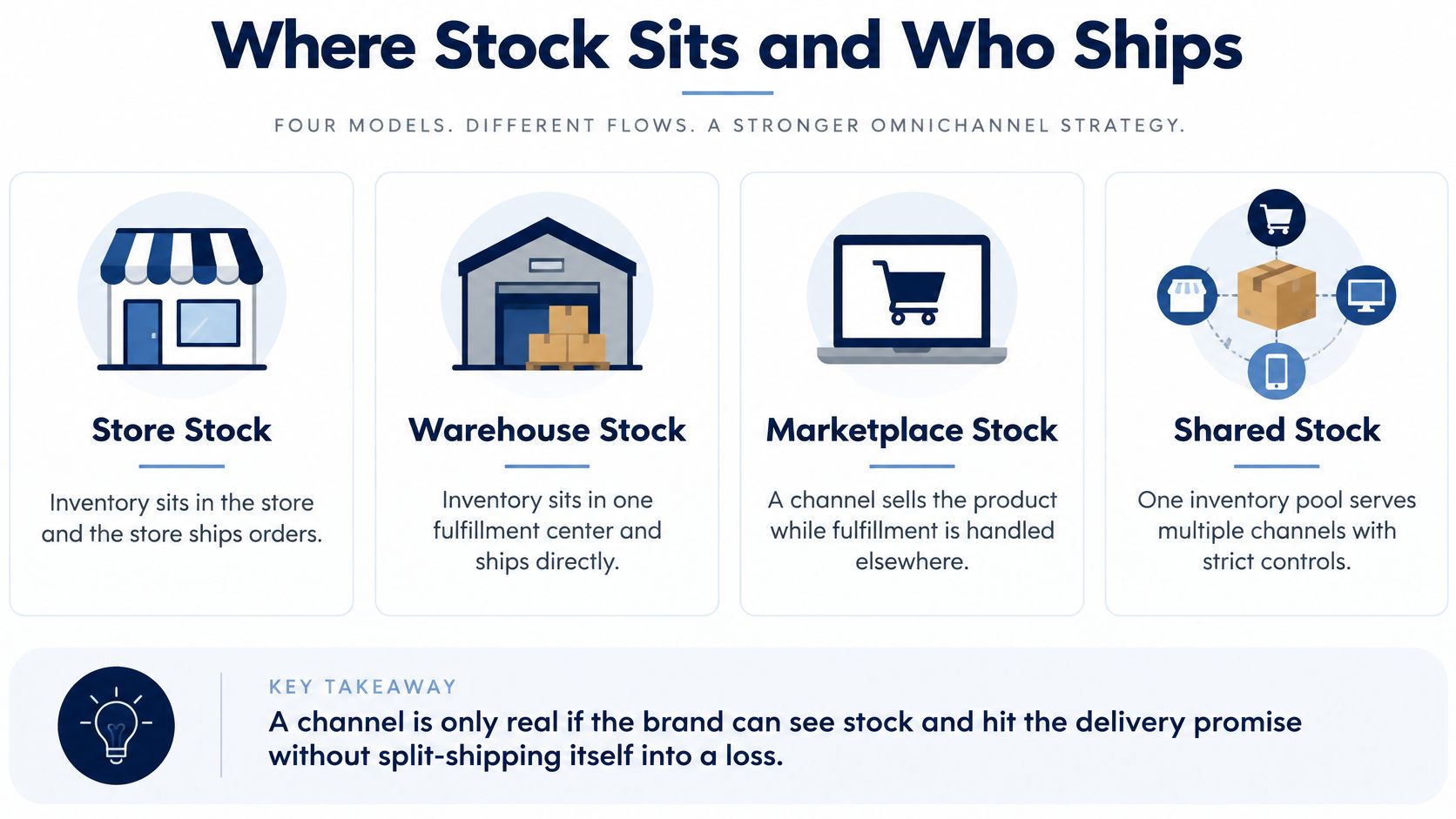
Ship-from-store and BOPIS require disciplined picking and immediate reservations. An item on a shelf, in a fitting room, or awaiting damage inspection isn't equally available. Partner dropship reduces the stock you hold for a retail test, but transfers execution to a partner whose dispatch and packaging standards you must verify.
Build omnichannel inventory management around shared stock definitions, not identical public quantities.
A hero SKU can work on the website, barely clear marketplace fees, and lose money when a store ships its components separately. Choose a primary fulfillment node for each channel and document the exception path, including who can approve a more expensive shipment.
Last-click reports and marketplace dashboards can each claim credit for a purchase influenced by the same campaign. Adding those reports together doesn't establish incremental demand.
Start with order-level net revenue and a shared order ledger. Keep platform-reported attribution in separate fields rather than treating it as another sale.
Give discovery credit to the touchpoint that introduced or reactivated the customer, where evidence supports that assignment. Give capture credit to the channel that accepted payment. Neither credit proves that the purchase wouldn't have happened otherwise.
Before increasing spend, run a holdout or geographic test with a defined contribution outcome. Keep promotions and stock availability comparable enough that you're testing the channel rather than a simultaneous merchandising change. A practical retail media attribution framework should help distinguish influence from sales that the retailer would have captured anyway.
Join customer records using permitted identifiers:
Don't force uncertain matches. An unknown customer is better than a falsely merged profile that triggers inappropriate messaging.
Product names and claims, core price architecture, promotion conflicts, delivery language, and the returns promise shown before checkout need explicit owners. Channel-specific offers are reasonable when their economics support them, but wholesale buyers shouldn't discover those exceptions through a customer complaint.
A rising blended ROAS beside falling contribution is a reason to audit credit assignment, not automatically increase spend.
Review a compact monthly operating dashboard:
Put the decisions in a page your advertising, operations, service, and wholesale teams can use: approved offers, attribution definitions, identity restrictions, exception owners, and escalation paths.
Returns are inventory and customer-experience decisions before they're warehouse tasks. A refund policy determines cash timing, recovery value, service workload, and whether the customer will consider buying again.
The National Retail Federation's 2025 returns outlook projected that U.S. consumers would return $849.9 billion, equal to 15.8% of annual retail sales, with an expected 19.3% online return rate; it also reported that free returns influence purchase decisions for 82% of shoppers, 76% prefer an instant refund or exchange, and 71% say a poor returns experience makes them less likely to shop with the retailer again.
That doesn't justify offering every customer the most expensive return path. It means restrictions carry a customer cost, just as convenience carries an operating cost.
Return policies by economics
| Policy | Use when | Margin effect | Experience effect |
|---|---|---|---|
| Instant exchange for repeat buyers | High-margin DTC customers with established purchase history | Can preserve future contribution when replacement stock is available | Resolves the product need without waiting for a refund |
| Prepaid mail return | Fit-sensitive products with sufficient margin allowance | Adds postage, inspection, and possible markdown cost | Offers a familiar, clearly explained process |
| Buy online, return in store | Stores can authenticate, process, and disposition units | Can save return postage but adds labor and inventory work | Convenient when staff can complete the return |
| No free return | Low-price accessories or products with uneconomic reverse logistics | Protects small-order contribution | Creates friction, so disclose charges before purchase |
| Local drop-off | Bulky or low-value products with a viable local recovery route | Can avoid expensive individual return shipments | Preserves convenience without automatically burdening stores |
An instant exchange can suit a repeat buyer with a clear replacement need. It still needs eligibility checks, stock availability, and a process for an original item that never arrives.
Prepaid mail can suit fit-driven categories, but don't use a broad online benchmark as your category forecast. Budget from your own size-level return reasons and actual recovery value.
Store returns need receiving capacity, authentication rules, and a destination for products the store doesn't sell. Don't justify the service with an assumed second purchase. Measure whether that purchase occurs and whether its contribution covers the extra work.
Give warehouse and store teams concrete recovery rules:
Local drop-off only helps when consolidation or local disposition costs less. Set the policy by size, damage risk, recoverability, and customer economics, not the marketing calendar, while honoring applicable consumer rights and channel requirements.
Say a home brand sells through Amazon, its website, wholesale accounts, and social commerce. It looks diversified, but its contribution review shows that only Amazon and selected wholesale accounts currently earn their operating burden. The founder needs a clearer architecture, not another door.
Treat the analytics review as an allocation decision.
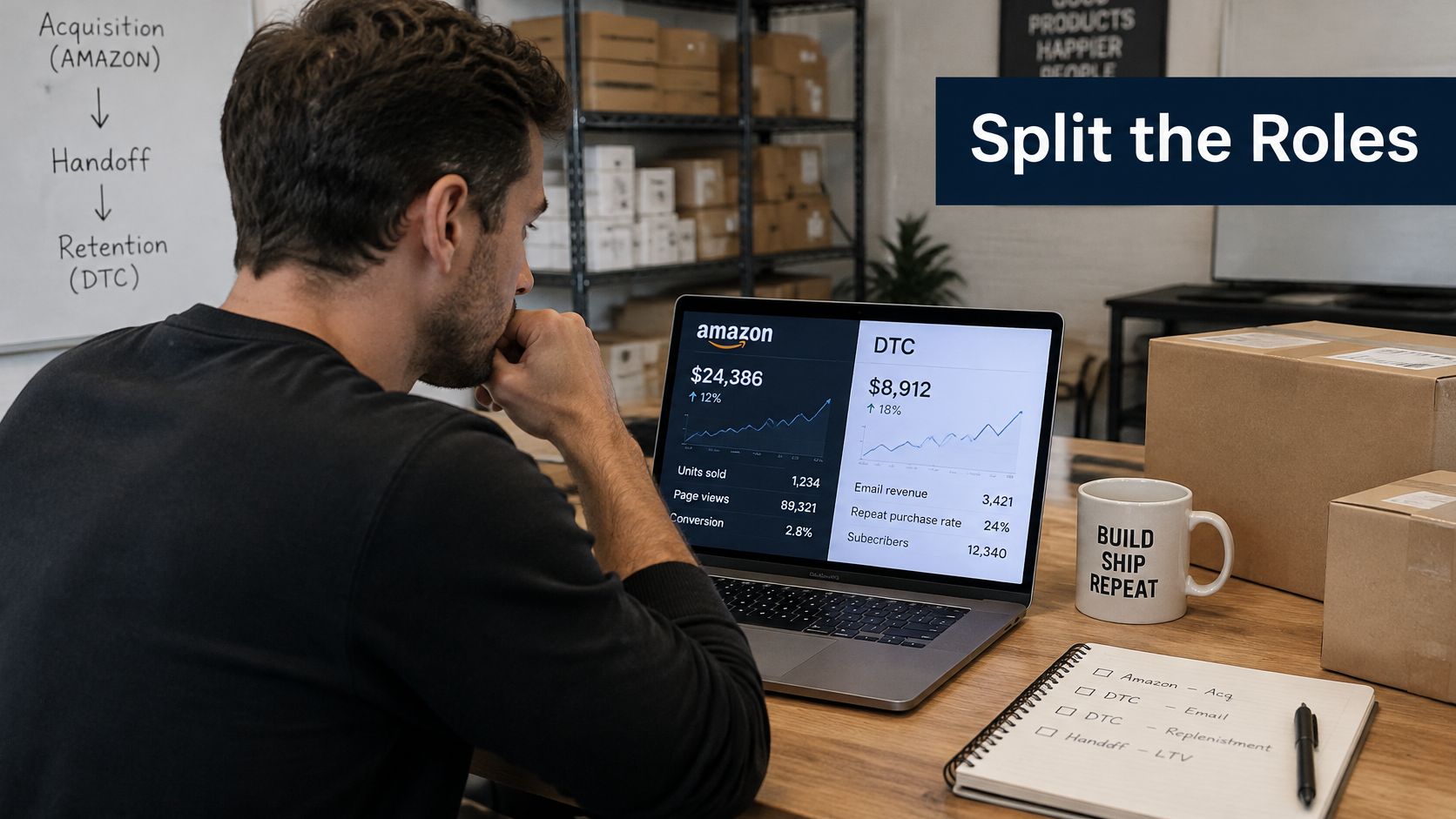
Amazon-led: Hero ASINs handle purchase. DTC supports permitted email acquisition and differentiated replenishment bundles, while wholesale expansion waits for stable economics. Allocate inventory weekly. The warning sign is coupon dependence alongside increasingly expensive DTC acquisition.
DTC-led with Amazon capture: Content and the site create demand; Amazon serves shoppers who prefer marketplace checkout. A selective wholesale list supports physical evaluation and credibility. Maintain a shared promotion calendar. This model breaks when advertised-price leakage and retailer bidding create expensive internal competition.
Wholesale-led: Retail partners create trial. A lean DTC operation supports warranty service, accessories, and refills, while an authorized Amazon offer provides a consistent listing and offer reference. It won't automatically remove unauthorized sellers or control their prices. Use a quarterly kill review focused on collected account contribution, including deductions and returns.
Use the video as another prompt for examining channel roles.
Decision boundary: A supporting channel doesn't need to become the next growth engine. It needs a defined job and an affordable operating budget.
For the hypothetical home brand, the answer might be a narrower DTC assortment and capped social acquisition, not immediate closure. Keep support functions that help profitable sales, but stop subsidizing an undefined growth experiment.
Start this month and sequence the work across your planning year. Don't let a roadmap become permission to leave an obvious loss untouched until its scheduled review.
Use the quarterly plan to assign owners and decision dates.
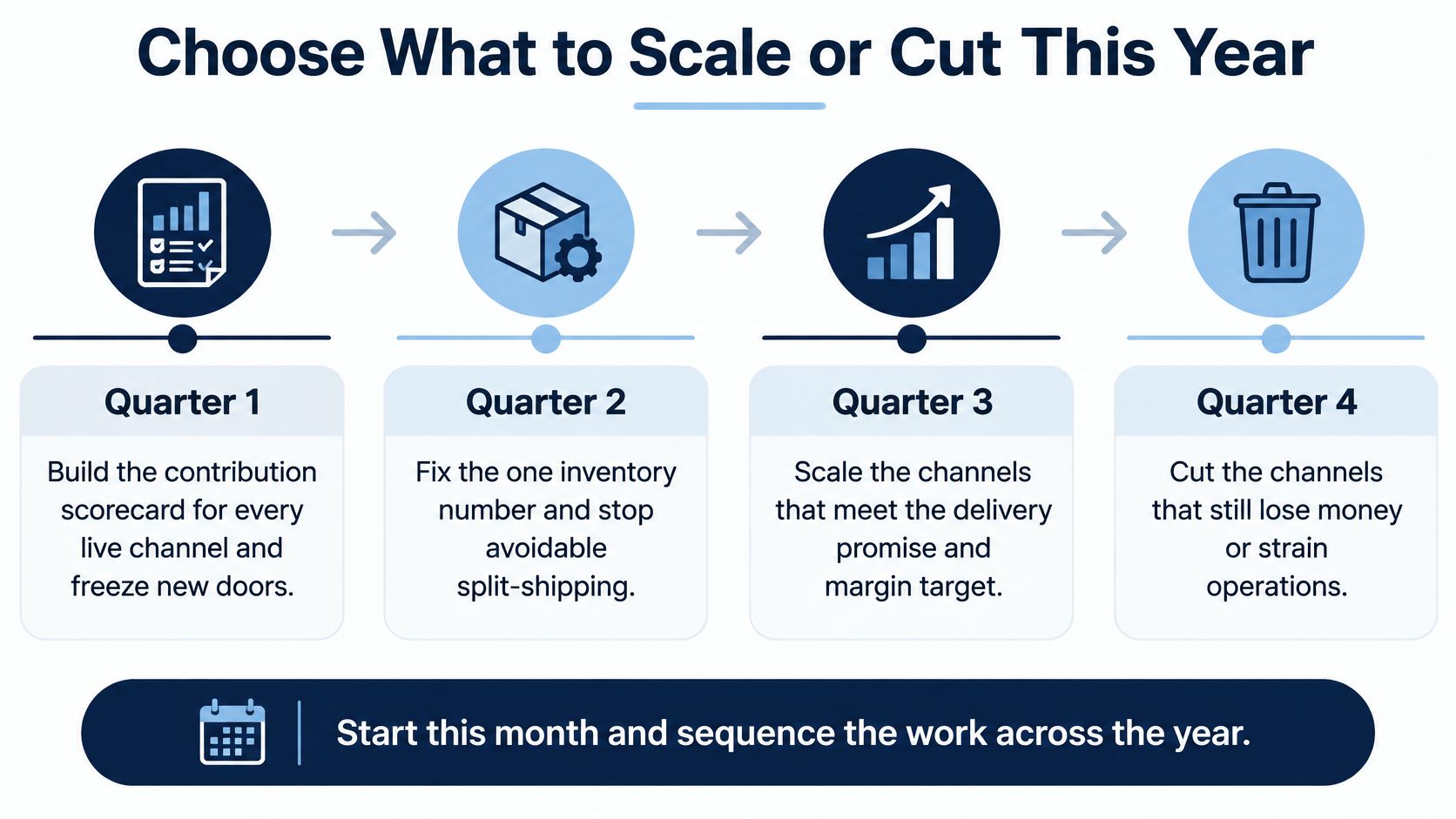
Scale incremental contribution. Cut availability where fees, returns, or labor consume it. A cap can mean fewer SKUs, restricted delivery regions, lower acquisition spend, or removal of an uneconomic service promise.
Founders can pressure-test that decision with operators who own comparable trade-offs. At Million Dollar Sellers, our membership focuses entirely on ecommerce operators, and all members must be founders or CEOs of businesses doing at least $1M TTM, with P&L ownership required.
Bring a proposed cut, the economics behind it, and the evidence that would change your mind. Before your next promotion, pick the channel you'll cap, name the owner, and set the release condition.
Million Dollar Sellers offers an ecommerce-only peer community with private discussions and topic-focused calls where founders can pressure-test channel economics and operating decisions. Visit Million Dollar Sellers to explore membership, and bring a specific scale-or-cut decision rather than a list of channels you might launch.
Join the Ecommerce Community for Founders Scaling from 7 to 9 Figures
Learn MoreYou may also like:
Learn more about our events!
Check Events