
Chilat Doina
July 5, 2026
You're probably dealing with some version of this right now.
Sales are up. Amazon is moving. Shopify is healthy. A retail partner wants deeper stock access. Maybe you added BOPIS, or you're testing ship-from-store. On paper, the business looks more diversified and more resilient.
Then the cracks show. A marketplace says you have stock that the warehouse can't find. A store associate accepts a return that never makes it back into available inventory. Finance sees one number, operations sees another, and customer support is left apologizing for orders your system should never have accepted.
That's the core work of omnichannel inventory management. It's not adding more channels. It's building a business that can survive them.
Most founders make the same mistake. They think this is a software selection problem. It usually isn't. It's a data governance problem first, a workflow problem second, and a software problem third. If your item master is sloppy, your naming conventions are inconsistent, and your returns process depends on tribal knowledge, no OMS is going to save you.
The ugly version of omnichannel usually starts during a peak event. One channel runs hot, another lags, and your systems don't update quickly enough. You sell inventory twice, promise delivery you can't fulfill, and burn margin fixing mistakes after the fact.
Founders often assume that more channels automatically provide greater advantage. Sometimes they do. Sometimes they just multiply confusion. A PwC survey found that only 19% of businesses successfully manage omnichannel inventory while remaining profitable, while 81% struggle with fragmented data, inaccurate stock levels, and inefficient order routing. That's the actual warning label on expansion.
Profitable growth in omnichannel doesn't fail because demand is bad. It fails because inventory decisions get made on bad information.
A lot of teams misread the early signals. They see top-line growth and assume the model is working. Meanwhile, carrying costs creep up, stock gets stranded in the wrong location, and customer support tickets rise because promised inventory doesn't exist where the order was routed.
That's when you need to look harder at the economics behind the sales. If you want a clean breakdown of the hidden costs that pile up when inventory sits too long or sits in the wrong place, this guide on inventory carrying cost is worth reviewing.
Practical rule: Omnichannel only works when inventory visibility is good enough to protect margin, not just drive orders.
The first bad move is buying a new tool before defining how inventory should behave across channels.
If your Shopify catalog calls a product one thing, Amazon calls it another, your 3PL abbreviates the variant, and your retail POS uses a legacy SKU, you don't have one inventory system. You have several disconnected opinions about inventory. The software layer only exposes the disagreement faster.
That's why the playbook starts upstream. Before you compare OMS platforms, before you connect APIs, before you automate reorder alerts, fix the data model and the workflows that determine whether inventory is trustworthy at all.
Most advice starts with, “Get an OMS.” I think that's backward.
You don't need a new order management layer until you know what your systems are agreeing on. If your item master is inconsistent, every integration spreads bad data with more speed. According to Panorama Consulting's analysis of omnichannel inventory management challenges, 60% of omnichannel inventory breakdowns stem from inconsistent item masters. That's a fundamental issue frequently overlooked.
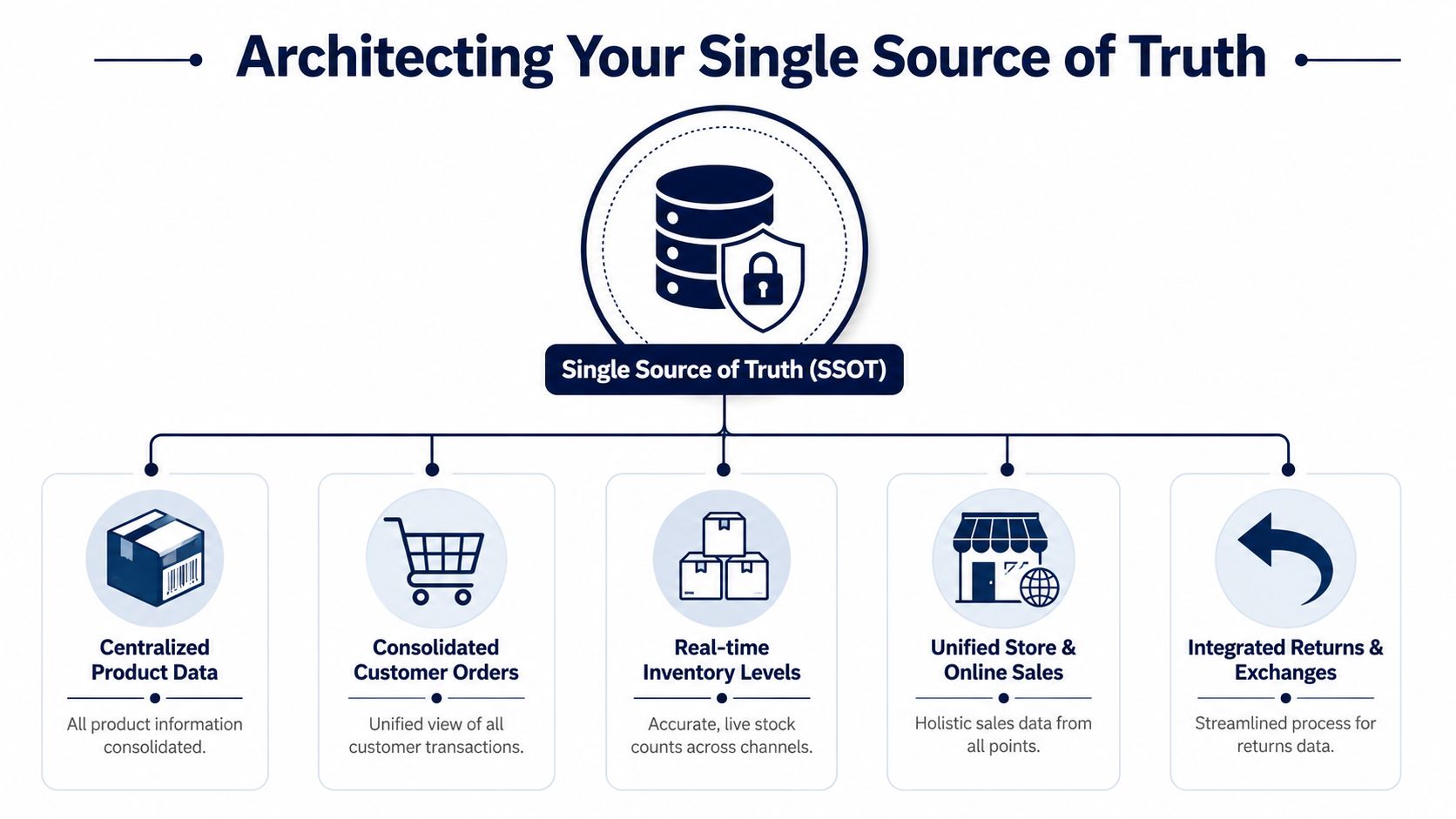
The item master is the controlled record for every SKU, variant, bundle, component, and status across the business. If that sounds administrative, good. It should be. Administrative discipline is what prevents ghost inventory.
A healthy item master answers questions that software can't improvise:
If you skip this work, your dashboard may look unified while the operations team is still chasing discrepancies manually.
A single source of truth is not one shiny dashboard. It's a decision about which system owns which data.
Use a simple ownership model:
| Data domain | Primary owner | What that system should control |
|---|---|---|
| Product and SKU structure | Item master or ERP | Naming, hierarchy, attributes, lifecycle |
| Warehouse stock movement | WMS | Receipts, picks, putaway, cycle counts |
| Order routing and orchestration | OMS | Allocation logic, split rules, fulfillment routing |
| Store transactions | POS | In-store sales, returns intake, local stock events |
| Financial records | ERP | Costing, valuation, accounting treatment |
Teams get in trouble when two systems are allowed to “own” the same field. That creates reconciliation work forever.
Bad architecture usually isn't one catastrophic bug. It's multiple systems editing the same truth in different ways.
ERP, WMS, and OMS are not interchangeable.
Founders often buy an OMS hoping it will clean up product data chaos. It won't. It will route orders based on the rules and data you gave it, whether those rules are smart or reckless.
If you're comparing options, use a buyer's lens that starts with data ownership and operational fit, not feature checklists. This breakdown of inventory management software for small business is useful if you're evaluating where your current setup stops being enough.
Before you sign a software contract, lock down these decisions:
If those aren't documented, your “single source of truth” is still a rumor.
Clean data gives you a foundation. Workflow discipline is what keeps the business from leaking margin every day.
Most brands talk about fulfillment flexibility as if every option is automatically good. It isn't. BOPIS, curbside pickup, ship-from-store, endless aisle, and store-based returns all have operational consequences. They only work if the location doing the work is staffed, trained, and equipped to do it well.
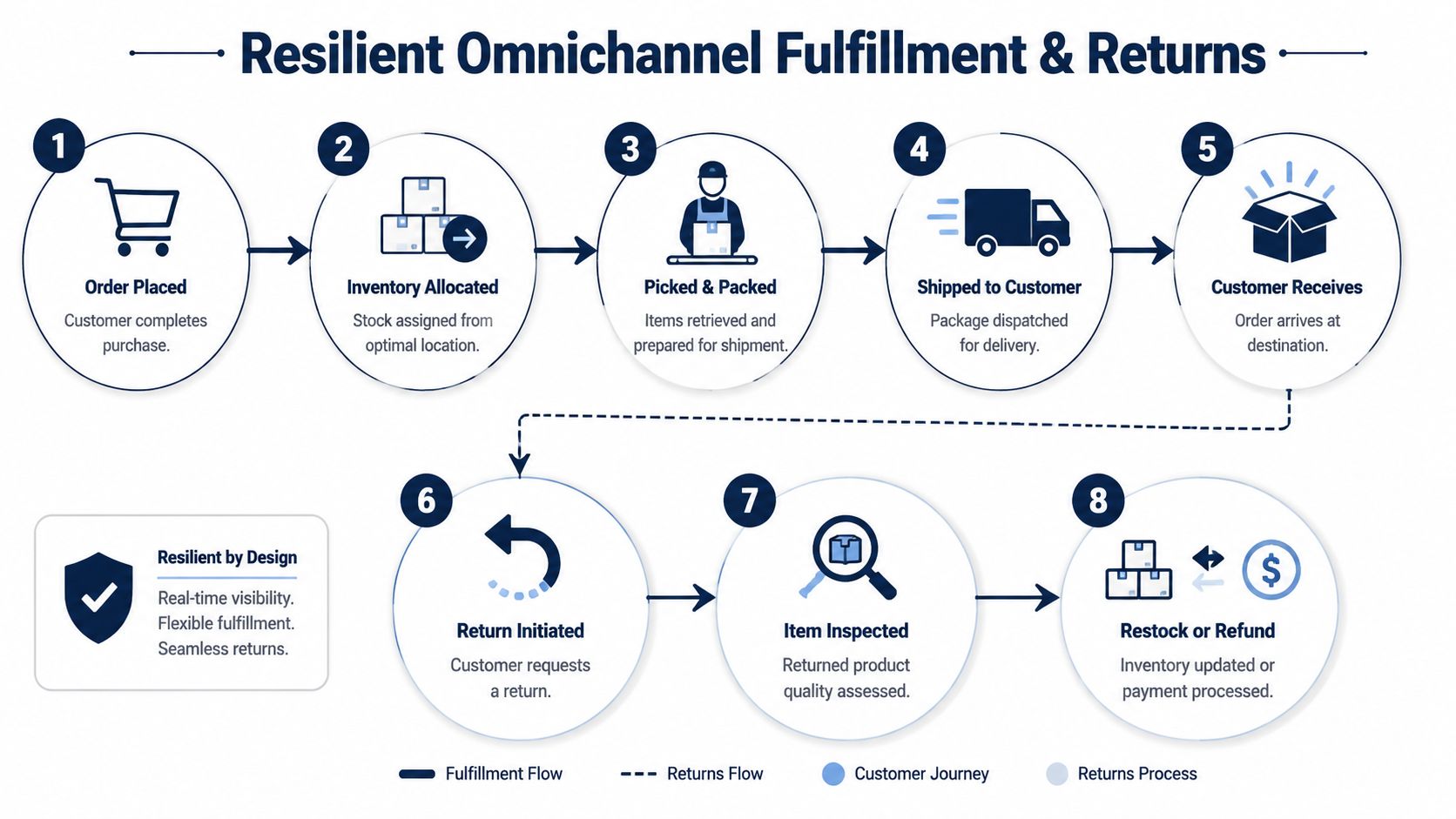
Ship-from-store sounds efficient because it can place inventory closer to the customer. Sometimes that's exactly the right move. But the store has to function like a mini fulfillment node, not just a sales floor with shelves.
According to ControlHub's overview of omnichannel inventory management, ship-from-store can cut last-mile costs by 20%, but it can also increase reverse logistics complexity by 30%. The same source notes that 40% of omnichannel retailers struggle with returns profitability because they lack standardized processes for handling cross-channel returns.
That trade-off is real. Founders love the delivery upside and underestimate the returns burden.
A store should not ship orders just because it has inventory. It should ship orders only if it can execute consistently.
At minimum, define:
If those rules live only in a manager's head, your process is fragile.
For a broader view of fulfillment models and where they tend to break in practice, this primer on omnichannel fulfillment gives useful context.
Most brands treat returns as a customer service event. That's incomplete. Returns are an inventory event, a finance event, and a workflow event all at once.
A solid reverse logistics process usually follows this sequence:
Miss one step and stock vanishes into limbo.
If a returned unit can't be inspected, statused, and routed on the same day it's received, expect inventory distortion to pile up.
Cross-channel returns get messy when the store takes the item, the refund is processed, but the product never re-enters available stock because nobody owns the final status update.
Use a simple handoff table:
| Workflow moment | Owner | Required system action |
|---|---|---|
| Return accepted | Store associate or support team | Link item to original order |
| Item inspected | Store lead or returns team | Assign condition status |
| Inventory disposition decided | Ops or inventory control | Restock, transfer, quarantine, or write off |
| Financial completion | Finance or ERP workflow | Refund or credit finalized |
| Availability updated | WMS, POS, or OMS based on architecture | Sellable inventory adjusted |
That clarity matters more than fancy automation. If ownership is vague, returned goods drift, and margins follow.
Most inventory allocation mistakes come from treating all demand as interchangeable. It isn't.
Your DTC site, Amazon, retail stores, and wholesale partners don't behave the same way. They have different lead times, different cancellation patterns, different promotion calendars, and different consequences when you stock them too aggressively or too conservatively.

A lot of teams split inventory by feel. They spread units across channels and locations to “stay covered,” then wonder why one node is overstocked while another is canceling orders.
A better approach starts with channel behavior.
Ask these questions channel by channel:
According to PYMNTS' 2024 Global Digital Shopping Index, 73% of consumers expect real-time inventory availability before making a purchase. If your allocation model can't support that expectation, the customer experience breaks before fulfillment even starts.
Safety stock is where founders often overcorrect. Some hold too much inventory everywhere. Others run too lean because they want cleaner cash flow. Both mistakes create avoidable pain.
Set buffer logic around operational risk, not instinct:
| Channel or location type | What should drive the buffer |
|---|---|
| DTC store | Promotion calendar, lead time, reorder confidence |
| Marketplace | Demand spikes, ranking sensitivity, inbound variability |
| Retail stores | Foot traffic patterns, local seasonality, transfer speed |
| Wholesale or B2B | Contract commitments, service expectations, replenishment schedule |
This is one reason I like borrowing methods from adjacent operational disciplines. If you want a useful framework for cataloging assets, statuses, and ownership logic that can sharpen how your team thinks about inventory records, this practical guide to asset inventory is a worthwhile read.
A common planning error is mixing gross sales, net sales, and return-adjusted demand in a way that muddies the true signal. If returns are noisy, late, or misclassified, your replenishment model starts solving for the wrong problem.
The cleanest demand planning usually separates:
That separation gives you better allocation decisions and more confidence when exposing stock levels publicly.
A useful walkthrough of fulfillment and allocation mechanics is below. It's worth watching with your ops lead and whoever owns system integrations.
Promotions, catalog changes, bundles, retail launches, and even barcode corrections affect inventory behavior. Your forecast should not live only in a spreadsheet owned by one planner. It should reflect what marketing, channel managers, warehouse leads, and finance already know is coming.
When inventory planning improves, stock visibility improves with it. That's what lets you show honest availability and keep your promise once the customer clicks buy.
This is the phase where teams usually create a lot of expensive technical debt very quickly.
They connect Shopify to Amazon, then add a 3PL portal, then bolt on a returns app, then ask an ERP consultant to “make it all sync.” It works for a while, until one field changes, one API call fails unnoticed, or one system updates on a different schedule than the rest.
The cleaner approach is the six-step methodology outlined by Cart.com: audit systems, centralize data, integrate platforms for continuous communication, map inventory, automate updates, and monitor performance through growth. Their breakdown of omnichannel inventory management best practices gets the sequence right, especially around continuous communication as the common failure point.
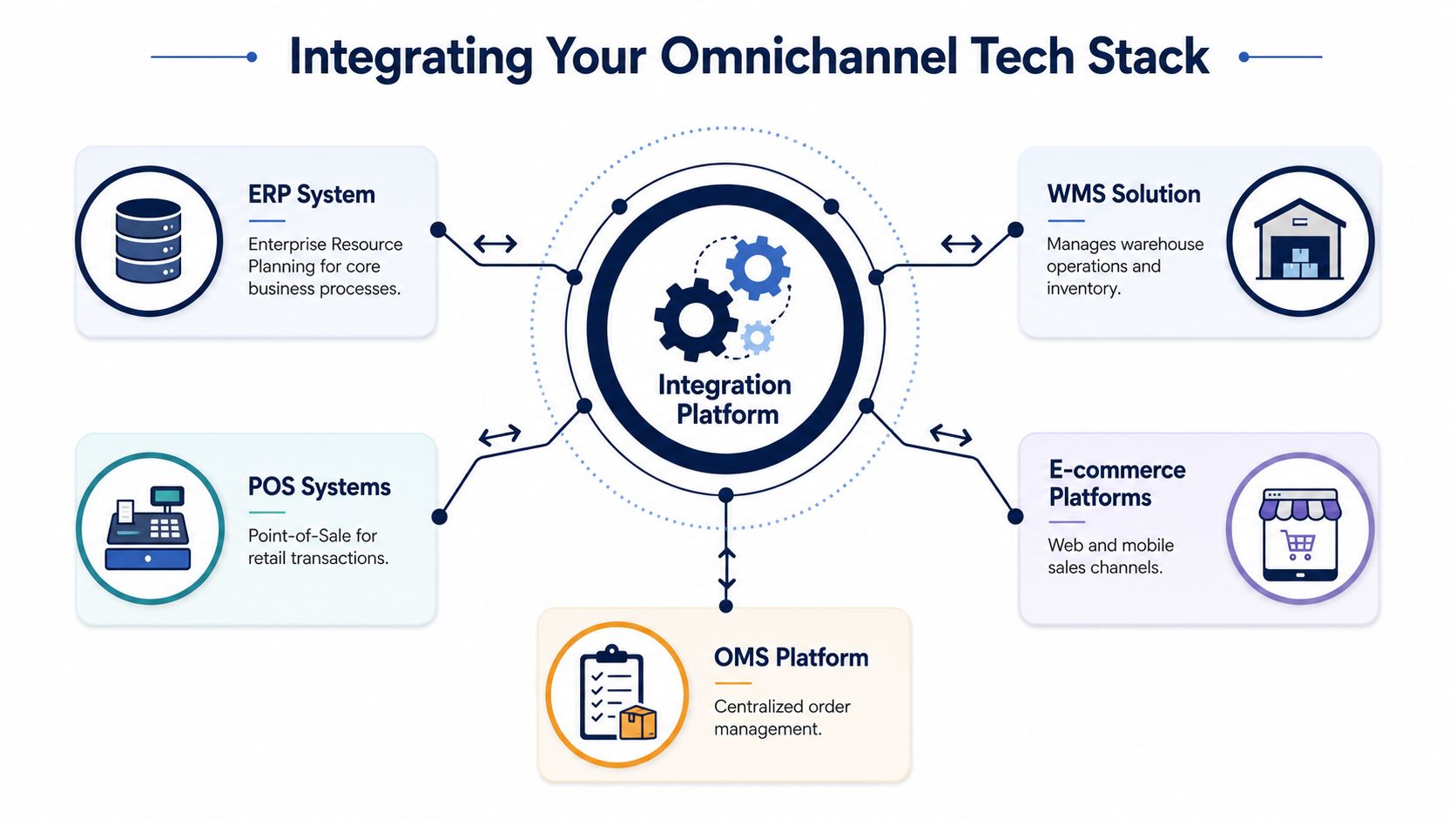
Point-to-point integrations are tempting because they're fast to launch. Shopify talks directly to your OMS. Your OMS talks to the 3PL. The POS has its own connector. It feels lightweight.
Then complexity arrives:
That's why many scaling brands move toward a central integration layer or middleware model. Not because it's fashionable, but because it creates a single place to validate, transform, log, and retry data flows.
Periodic syncs can be acceptable for some reporting. They're dangerous for inventory commitments.
If your stock updates are delayed, every channel is making promises from stale information. That's especially risky when stores, marketplaces, and warehouses can all create inventory events independently.
Use integration design rules like these:
A fragile integration can look healthy for months. Then peak season exposes every shortcut you took.
When you talk to developers, consultants, or software vendors, ask direct questions:
| Question | Why it matters |
|---|---|
| Which system owns SKU creation and edits | Prevents duplicate product records |
| How are inventory statuses mapped across systems | Avoids available stock being overstated |
| What happens when an update fails | Exposes whether exceptions are visible or silent |
| How are returns translated back into sellable inventory | Prevents stock from disappearing after intake |
| Can the architecture handle bundles and channel-specific rules | Protects against hidden edge cases |
Those questions do more than keep a project on track. They show whether your partner understands omnichannel operations or just knows how to connect software.
The best automation removes repetitive work without hiding critical exceptions. Good automation handles reorder triggers, stock updates, routing logic, and alerts. Bad automation buries edge cases until customers complain.
The right stack is not the one with the longest feature list. It's the one your team can govern, troubleshoot, and scale without rebuilding every quarter.
Omnichannel inventory management is not a launch project. It's an operating discipline.
A lot of teams build a decent stack, get through implementation, and then drift. New SKUs get added without review. A returns shortcut becomes standard behavior. A marketplace mapping issue lingers because no one owns it. The system doesn't collapse all at once. People slowly stop trusting it.
That's why metrics matter, but governance matters more.
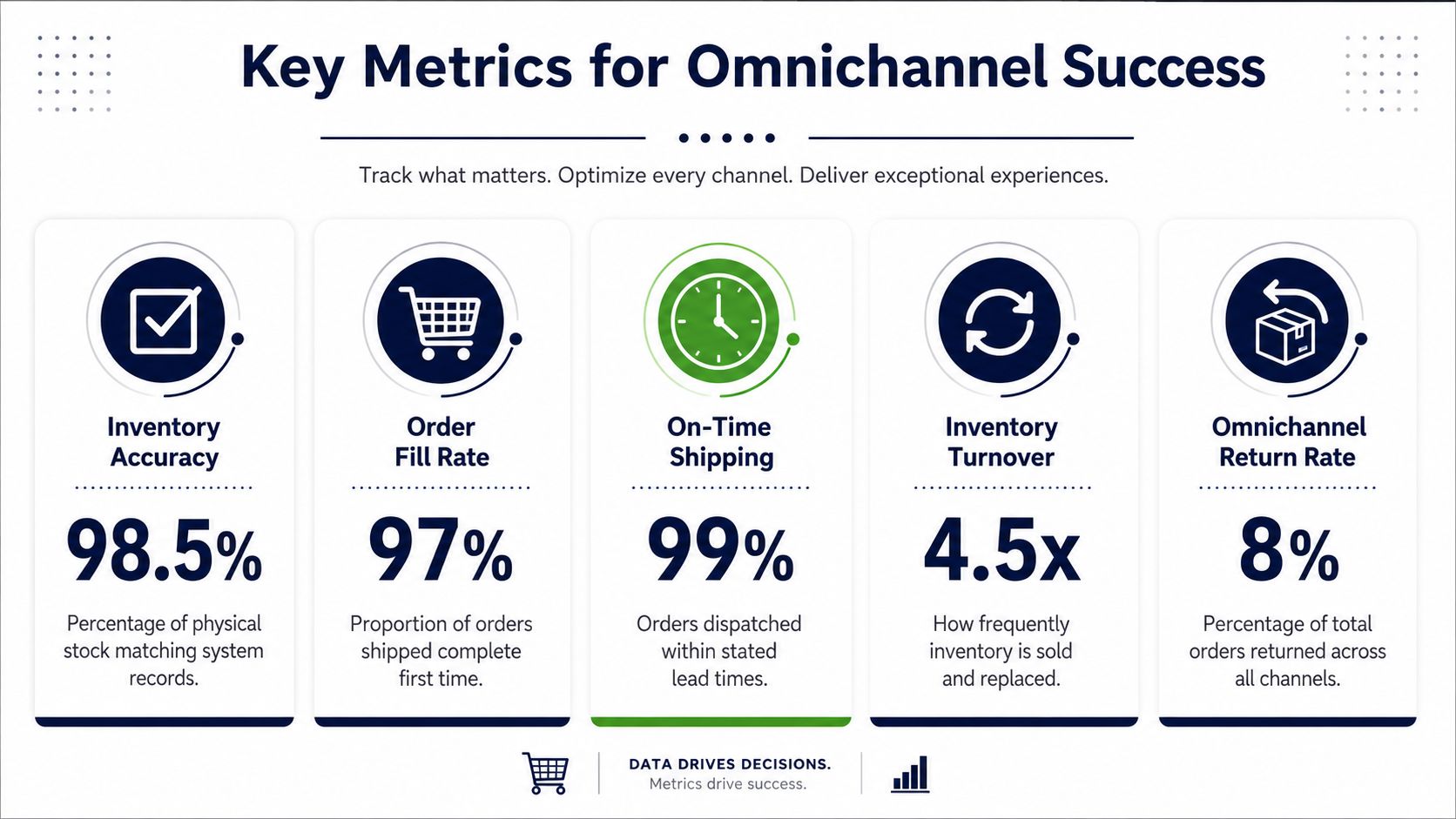
You should absolutely track inventory health, order quality, and exception patterns. But dashboards don't enforce standards. People do.
What I'd review routinely:
A metric without an owner is just a recurring observation.
Strong omnichannel performance is tied to customer retention. According to OneRail's summary of omnichannel retail requirements, companies with effective omnichannel strategies retain 89% of their customers, compared with 33% for those with weak strategies. The retention gap reflects operational trust. Customers come back when inventory visibility is reliable and fulfillment follows through.
That reliability doesn't come from software alone. It comes from rules.
Use a lightweight governance model:
| Governance area | Primary owner | Standard to enforce |
|---|---|---|
| New SKU setup | Merchandising or product ops | No SKU goes live without approved attributes and hierarchy |
| Item master changes | Data steward or ops lead | All edits logged and reviewed |
| Inventory status policy | Ops and finance | Shared definitions for sellable, reserved, damaged, and quarantined |
| Integration monitoring | Systems or IT lead | Exceptions reviewed and resolved on schedule |
| Returns disposition | Store ops, warehouse ops, and finance | One documented workflow across channels |
Many brands stay too informal for too long.
Nobody should be allowed to create or modify SKU records casually because “it's urgent.” Urgency is exactly how duplicate products, broken bundles, and invalid mappings enter the system. Assign one accountable owner for item master quality, even if several departments contribute data.
Clean inventory data survives growth only when someone has the authority to reject bad inputs.
That's the point. It should feel repetitive, administrative, and hard to bypass.
Good governance means:
Founders often want a smarter tool. What they usually need is a stricter operating cadence.
Most omnichannel migrations fail before go-live. The failure just isn't visible yet.
The team is rushing, assumptions are undocumented, and everyone believes the new stack will clean up old process debt. It won't. Migration is where bad habits get hard-coded.
Use this as a minimum standard before switching your inventory model over:
If you skip training, the process breaks at the human layer even if the software works.
I've seen the same mistakes repeat across high-growth brands.
Don't ask whether your systems can connect. Ask whether your data model, operating rules, and accountability structure are strong enough to make those connections useful.
That's the essential founder's filter. The brands that scale omnichannel profitably don't just buy better software. They build cleaner records, stricter workflows, and tighter ownership around the truth of their inventory.
If you're building through these kinds of scaling decisions and want honest, operator-level feedback from founders who've already lived them, Million Dollar Sellers is where serious e-commerce leaders compare playbooks, pressure-test systems, and avoid expensive mistakes before they hit the P&L.
Join the Ecom Entrepreneur Community for Vetted 7-9 Figure Ecommerce Founders
Learn MoreYou may also like:
Learn more about our special events!
Check Events