Chilat Doina
September 12, 2026
Monday morning starts with four different versions of the business. Amazon Seller Central says there are 480 units available. Shopify says 612. The 3PL dashboard says 905. Meanwhile, a wholesale buyer wants to know why a purchase order shipped short by 40 units.
The founder is reconciling spreadsheets before coffee. Marketing is exporting reports from Amazon Ads, Meta, Google, and Shopify. Finance is closing the month with channel P&Ls that don't agree on revenue, inventory costs, returns, or acquisition spend. Everyone is busy, yet nobody can answer the basic operating questions: which channel should get the next unit, which customer journey created the sale, and whether the order was profitable after fulfillment?
That isn't an omnichannel sales strategy. It's a collection of sales lines competing for the same inventory and customer. The fix isn't automatically another integration or another marketplace. The fix is designing how the channels work together, then giving the business the inventory, identity, attribution, and margin controls to enforce that design.
A brand can reach meaningful scale while operating like three separate companies. Amazon has its own catalog conventions, advertising reports, fulfillment rules, and customer restrictions. Shopify has richer first-party data and more control over merchandising, but it also carries the burden of traffic acquisition, conversion, support, and delivery economics. Wholesale adds purchase orders, negotiated pricing, retailer deductions, and demand that may arrive in batches rather than clean daily orders.
The problem usually starts innocently. A founder adds Amazon to capture marketplace demand, launches Shopify to own the customer relationship, then accepts a wholesale opportunity because the retailer can put the product in front of buyers the brand can't reach alone. Each decision makes sense in isolation. The operating model breaks when every channel creates its own SKU logic, inventory file, promotion calendar, and definition of profit.
Operator observation: A channel isn't an asset just because it produces revenue. It becomes an asset when the business knows what job it performs and what trade-offs it creates elsewhere.
The human cost appears before the financial cost. The founder spends time resolving inventory conflicts instead of reviewing demand and cash flow. The marketing team optimizes reported return inside each platform, even when two platforms claim credit for the same buyer. Operations protects marketplace service levels by withholding stock that could have supported a higher-margin DTC launch. Finance sees revenue by channel, but not the contribution margin after channel fees, pick-and-pack charges, discounts, returns, and allocated overhead.
This is multichannel presence without operating integration. The brand is everywhere, but the customer journey isn't connected and the internal decisions aren't coordinated. A shopper can discover a product through social media, compare it on Amazon, buy it from a retailer, and later visit the DTC site for replenishment. If those interactions sit in separate systems, the company sees transactions, not a relationship.
Consumer behavior makes that fragmentation harder to ignore. One industry study found that around 73% of shoppers use more than one channel during their buying journey, while omnichannel buyers average about six touchpoints before purchase. The same study associated omnichannel customers with about 16% higher order value, roughly 30% higher lifetime value, and retention of 89% compared with 33% for weaker single-channel approaches. The Brightpearl omnichannel study provides the source for those findings.
The practical conclusion is uncomfortable but useful. Stop asking which new channel to add until you can state what your existing channels are supposed to do for the customer, the inventory pool, and the income statement.
An omnichannel sales strategy is an operating model in which Amazon, DTC, wholesale, retail, social commerce, and offline activity work from shared rules. Each channel has an assigned role. Product and inventory data follow a common structure. Orders and returns update the same operational picture. Customer identity is connected where the data allows it. Finance measures each channel using one contribution-margin framework.
That definition separates omnichannel from two weaker approaches. Multichannel means the brand sells in multiple places, but the places may operate independently. Everywhere presence means the brand lists products wherever distribution is available, often without deciding whether a channel is meant to create demand, convert existing demand, retain customers, or clear inventory.
The customer journey is the starting point. A shopper may discover a product on TikTok, read reviews on Amazon, check availability on the brand site, purchase in a store, and contact support through email. The strategy should preserve relevant context across those transitions rather than forcing the shopper to restart at every touchpoint.
Unified data is the second essential pillar. That doesn't always mean every system must be replaced by one platform. It means the business needs agreed definitions for products, orders, customers, costs, inventory status, and channel attribution. If Amazon's SKU, Shopify's variant, the 3PL's item code, and the retailer's EDI identifier don't map cleanly, the business can't reliably allocate stock or reconcile revenue.
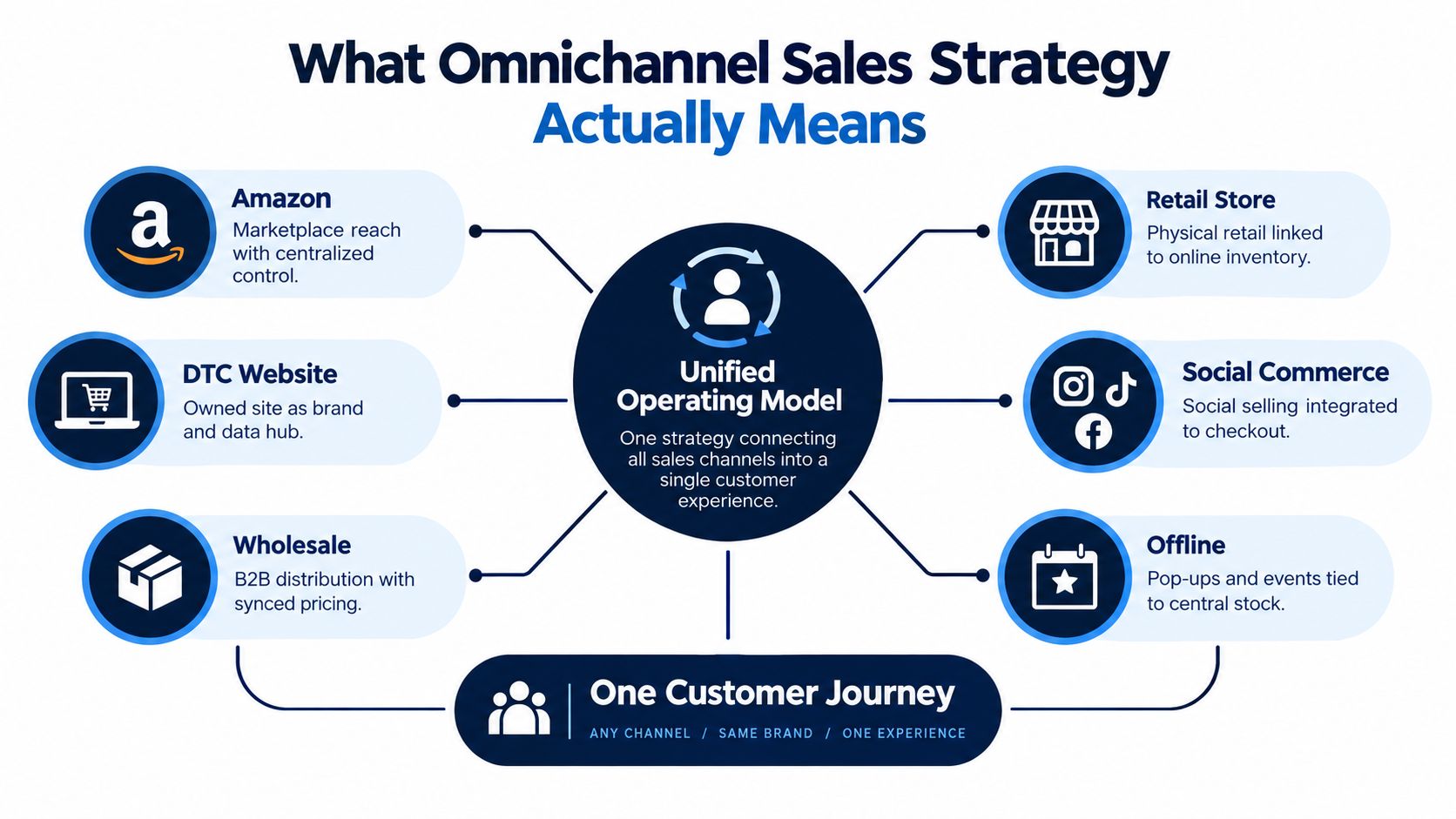
A connected model lets a shopper move between channels without losing the brand's context. It also lets the operator make decisions across channels instead of optimizing one dashboard at a time. A useful planning question is not, “Are we on this channel?” It is, “What should this channel do, what data must it share, and what economics must it meet?”
For founders mapping the customer journey across devices and touchpoints, the practical objective is to reach buyers on any screen without treating every screen as an independent business. A channel earns its place when it contributes a defined function and the company can measure the cost of delivering that function.
A functioning omnichannel model rests on four connected pillars. Each one maps to a decision a founder has to make, not a software category to purchase.
Write down the job of every channel. Amazon might handle category entry and high-intent conversion. The DTC site might own bundles, subscriptions, education, and first-party relationship building. Wholesale may provide physical discovery, predictable reorders, and distribution into audiences the brand can't acquire efficiently through paid media.
The role determines the operating rules. A discovery channel may tolerate a lower immediate contribution margin if the brand has a credible way to capture future value. A liquidation channel may prioritize cash recovery and inventory velocity. A retention channel should be evaluated through repeat behavior rather than first-order revenue.
The customer record should connect what can legitimately be connected. DTC email addresses, Shopify accounts, loyalty IDs, point-of-sale records, support tickets, and wholesale buyer contacts can often be matched through disciplined identity rules. Amazon buyer identities are more constrained, so the business must avoid pretending it has data it doesn't own.
The artifact here is an identity map with confidence levels, consent rules, and clear ownership. A CDP can help, but a manually governed matching process is preferable to an expensive platform that creates false certainty.
The business needs one inventory picture, even when stock sits across FBA, a 3PL, retail stores, and wholesale allocations. A shared pool doesn't mean every unit is available to every channel at all times. It means allocation rules, safety stock, launch reservations, and transfer decisions are explicit.
Revenue alone hides channel conflict. Finance needs contribution by channel after variable selling fees, payment costs, fulfillment, discounts, returns, advertising, retailer deductions, and relevant operating labor. The purpose isn't to make every channel show the same margin. It's to make the trade-off visible.
| Pillar | Operating Decision | Required Artifact |
|---|---|---|
| Channel role assignment | Which channel owns discovery, conversion, retention, or liquidation? | Channel role charter |
| Unified customer view | Which identities can be matched, and with what confidence? | Identity map and consent rules |
| Inventory orchestration | Which channel receives the next available unit? | Allocation policy and safety-stock rules |
| Measurement | What contribution must each channel produce? | Channel P&L and shared KPI definitions |
The pillars interlock. Assigning Amazon the role of category-entry channel changes the acceptable acquisition cost. Giving DTC responsibility for retention changes the data and post-purchase requirements. Promising a retailer reliable availability changes the safety stock and cash commitment. The operating model works only when those decisions are made together.
Amazon, DTC, and wholesale shouldn't carry identical assortments, promotions, and expectations. They reach buyers differently, convert through different forms of trust, and create different cost structures. Treating them as interchangeable is how an 8-figure brand ends up paying to move the same customer through multiple competing funnels.
Amazon is usually strongest where demand already exists. Search intent, reviews, delivery expectations, and marketplace convenience can make it effective for hero products and category entry. The trade-off is limited customer ownership and a cost structure that includes marketplace fees, advertising, fulfillment, storage, returns, and compliance requirements.
DTC gives the brand control over merchandising, bundles, subscriptions, education, retention, and first-party consent. It can become the margin engine, but only if the brand manages blended acquisition cost, conversion, customer support, delivery, and repeat purchase behavior. A DTC order isn't automatically more profitable because the marketplace fee is absent.
Wholesale and retail offer physical discovery, distribution, and access to retail audiences. They can produce meaningful volume and a reorder cadence, but wholesale pricing, deductions, terms, packaging requirements, and retailer-specific logistics can reduce contribution. The brand also gives up some control over merchandising and customer data.
For a deeper examination of the economic and strategic differences, the DTC versus wholesale comparison from MDS is a useful companion.
| Dimension | Amazon | DTC (Shopify) | Wholesale / Retail |
|---|---|---|---|
| Primary discovery | Marketplace search, reviews, and retail media | Brand search, paid media, content, referrals, and retention | Store traffic, buyer networks, and physical merchandising |
| Best operating role | Category entry and conversion for selected SKUs | Brand education, bundles, subscriptions, and relationship building | Distribution, physical discovery, and planned replenishment |
| Main margin pressure | Marketplace fees, ads, fulfillment, storage, and returns | Acquisition, payment, fulfillment, support, and discounting | Wholesale price, deductions, terms, compliance, and logistics |
| Data ownership | More limited customer visibility | Stronger first-party customer and behavior data | Retailer-controlled shopper data, often with reporting lag |
| Assortment logic | Hero and high-intent products | Full story, bundles, exclusives, and retention offers | Retail-ready packs, store-specific items, and volume lines |
Use four SKU roles: traffic drivers, margin engines, halo or loss leaders, and exclusivity plays. A traffic driver may be widely distributed to make the brand easy to find. A margin engine can be reserved for DTC bundles or subscription offers. A halo SKU can create trust even when its direct contribution is modest. An exclusivity play gives a retailer or channel a reason to promote the brand without forcing every channel into price competition.
Don't run the same assortment everywhere by default. Identical products, identical discounts, and identical timing invite cannibalization. They also make it difficult to determine whether a channel created incremental demand or merely captured an order that would have happened elsewhere.
Inventory orchestration begins with a shared stock pool and ends with a decision about where each order should ship from. The pool should include on-hand stock, inbound inventory, committed wholesale units, damaged or quarantined units, and channel-specific reservations. Each status needs a precise definition, or the system will promise units that aren't sellable.
Channel-specific safety stock protects against volatility. A fast marketplace may need a protected buffer to avoid overselling and service failures. A planned wholesale order may require a committed allocation long before the retailer sells through it. A DTC launch may reserve units for a campaign rather than expose every unit to the fastest-moving channel.
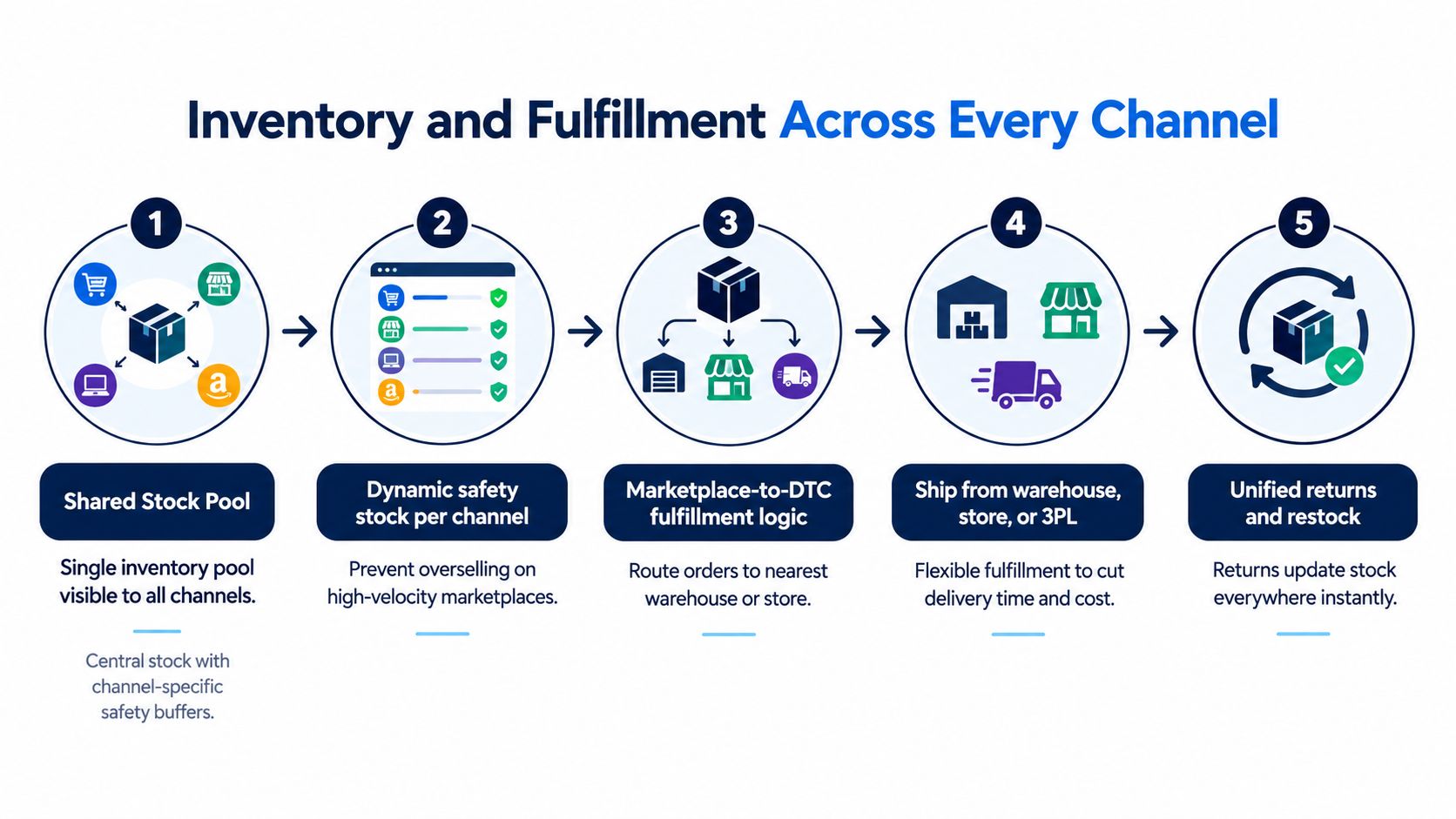
Amazon Multi-Channel Fulfillment can support DTC orders from marketplace inventory, while Seller Fulfilled Prime can keep selected inventory outside FBA when the brand can meet the required service obligations. A distributed 3PL model may shorten delivery distances in regions with enough demand, but it can also strand inventory when demand shifts. Ship-from-store and click-and-collect can improve access to local inventory, though store teams need reliable pick, hold, and handoff procedures.
The fastest option isn't always the best option. Faster delivery can carry higher pick fees, carrier costs, or marketplace charges. Centralizing fulfillment can simplify control but create longer zones and concentration risk. Pre-purchasing a wholesale PO can secure distribution while tying up cash if demand moves to another channel.
Run a weekly sync that checks available stock, reservations, inbound timing, oversell risk, transfer needs, and returns. During a launch, a bufferless allocation approach can be appropriate when the team deliberately sells through a constrained pool, but it shouldn't become the default for a mature replenishment program.
Margin rule: Compare the contribution margin of each fulfillment path after shipping, labor, storage, returns, and service cost. A cheaper warehouse isn't cheaper if it creates stockouts in the channel that funds the business.
The MDS guide to omnichannel inventory management offers additional context on coordinating stock visibility and fulfillment across channels.
A founder's margin-cost ledger should show the cost of centralizing versus splitting fulfillment by region or channel. Include inventory transfers, minimums, storage, delivery promises, return handling, customer service contacts, and the cash cost of holding safety stock. The correct answer can change as volume, geography, and channel mix change.
A visual walkthrough of the orchestration flow is available below.
Attribution breaks when the same product appears in paid social, Amazon, Shopify, and retail. A platform can report that its ad influenced a purchase without showing whether another channel created the original demand. Retail sell-through may arrive after the sale, while Amazon and DTC platforms can report quickly but use different definitions of conversion and customer value.
Start with identity, but respect the limits of each channel. Match email addresses to DTC orders where consent and data quality support it. Use CDP stitching for web behavior and known profiles. Bridge loyalty IDs across POS and ecommerce. Keep Amazon buyer identities separate when the marketplace doesn't provide a permissible way to connect them. A unified view is valuable only when its matches are trustworthy.
Last-click attribution is especially weak for brands with halo products. A shopper may encounter the brand through retail, research on Amazon, and later type the DTC URL directly. Assigning all credit to the final click will systematically understate discovery and overstate conversion channels.
Run the dashboard on three clocks:
Each view answers a different question. The weekly report protects cash and execution. The monthly view evaluates customer quality. The quarterly test challenges the assumptions behind reported attribution.
The MDS perspective on retail media attribution is relevant when retail media claims credit for demand that may have existed without the placement. That skepticism should apply across platforms, not only to retail advertising.
Measurement principle: Choose the KPI that remains useful even if the attribution model is wrong by 20%, then allocate spend toward that durable signal.
A practical dashboard may include contribution margin, blended acquisition cost, repeat purchase, net revenue retention by cohort, stockout exposure, and customer service burden. Don't let the channel with the cleanest data feed become the channel that receives the most budget. Clean reporting is not the same as incremental impact.
The stack should reflect the operating model, not substitute for one. Start with the product information management layer. A PIM should hold the canonical SKU structure, attributes, titles, descriptions, imagery, compliance information, and channel-specific content rules. If every channel edits product information independently, the customer sees inconsistent claims and operations loses confidence in the catalog.
An order management system then routes orders across FBA, Amazon fulfillment, 3PLs, stores, and wholesale workflows. The OMS needs clear rules for inventory availability, service level, split shipments, backorders, returns, and exceptions. An ERP or finance backbone should reconcile stock, landed cost, purchase orders, deductions, and accounting entries.
A CDP can unify customer profiles and behavioral signals across Shopify, loyalty, POS, support, and marketing systems. It won't solve poor source data or unclear consent rules. Channel managers and integration middleware earn their place when they eliminate manual exports, prevent duplicate catalog work, or keep inventory and order status synchronized.
They become theater when they add another dashboard without changing a decision. A connector that pushes orders between systems but doesn't reconcile cancellations, returns, bundles, or partial shipments may increase confidence while preserving the underlying error.
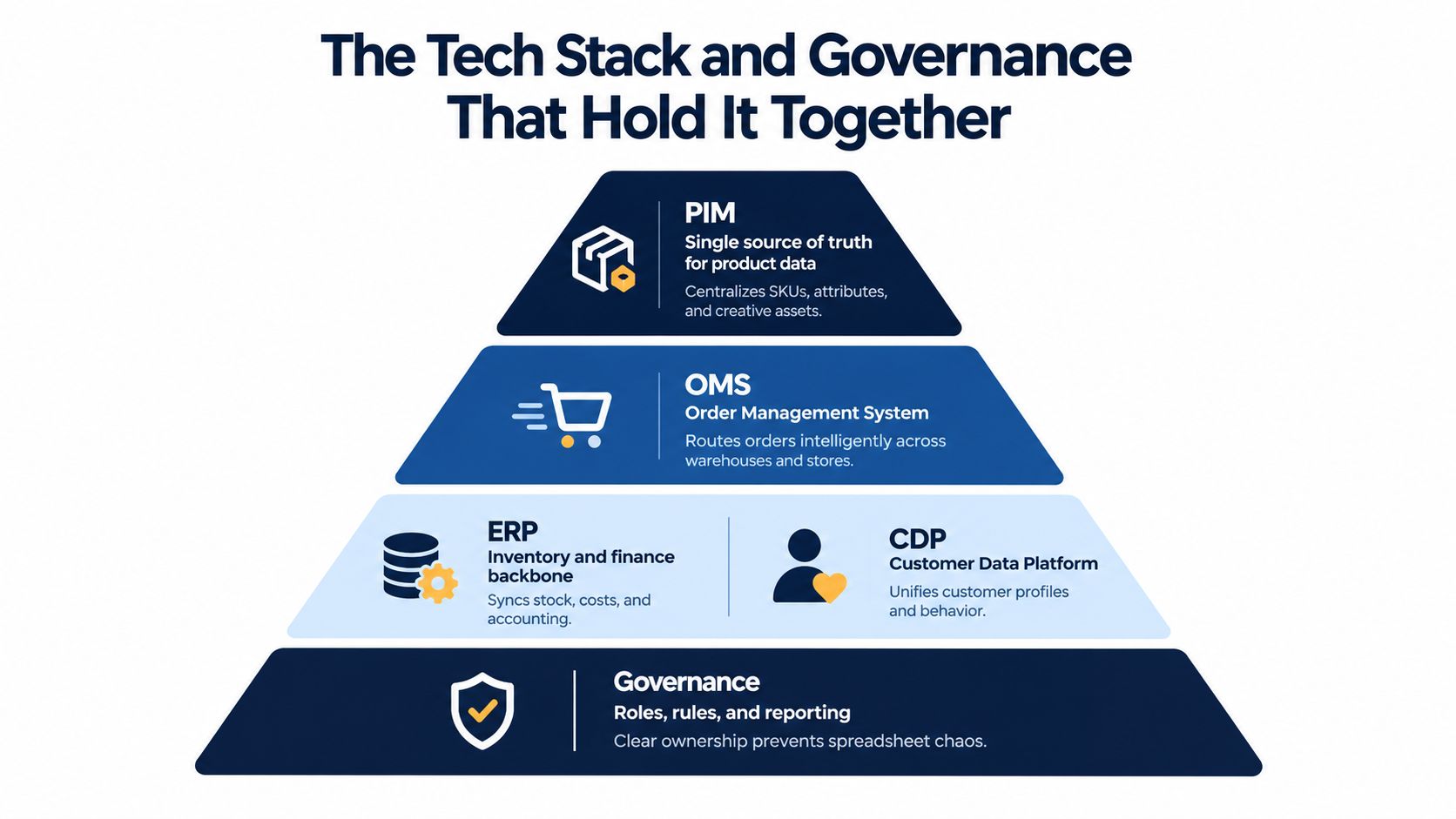
Governance turns software into an operating system. Hold a weekly cross-channel meeting covering sell-through, inventory risk, forecast changes, fulfillment exceptions, promotion conflicts, and contribution margin. Close the month with a channel P&L that allocates relevant costs consistently. Revisit channel roles quarterly as products mature, new retailers emerge, or a once-profitable acquisition source becomes expensive.
Give named owners to catalog data, inventory availability, fulfillment rules, attribution definitions, promotions, and financial reconciliation. Document escalation paths for stock conflicts and pricing exceptions. Store the decision rules where operators can find them, not inside one person's spreadsheet.
Million Dollar Sellers can be one peer resource for founders working through these cross-channel decisions, with a private community focused on strategy sharing among established ecommerce operators. Visit Million Dollar Sellers if you want to evaluate that type of operator network alongside your systems and advisors.
The first 30 days should expose the current truth. Audit channel revenue and contribution, assign a role to every channel, consolidate inventory definitions into an OMS, and publish one SKU taxonomy. Don't expand distribution while the business still argues about which inventory number is correct.
From days 31 through 60, standardize customer identity and attribution, then connect the systems that support the priority journey. Wholesale EDI or an Amazon expansion can follow once DTC contribution and stockout controls are stable. The sequence matters because a new channel multiplies existing errors when the foundation is unresolved.
Days 61 through 90 should test the operating model under real demand. Trial DTC fulfillment from Amazon inventory where the ledger supports it, evaluate wholesale drop-ship only when service and margin are clear, and tighten the weekly and monthly reporting rituals. Document what worked, what created hidden cost, and which channel role needs revision.
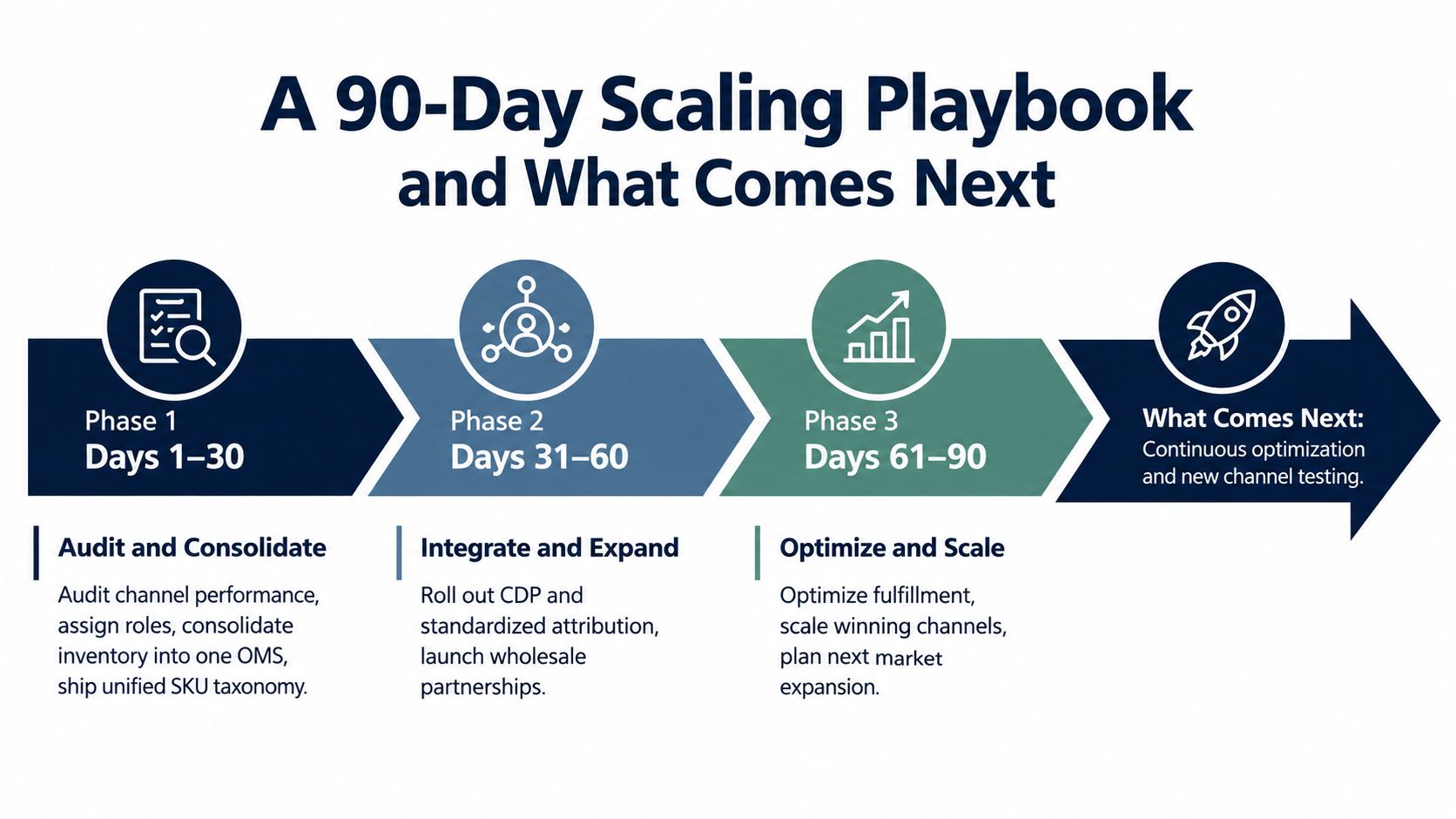
After the first 90 days, the work becomes continuous optimization. International marketplaces, broader retail distribution, and new social or messaging channels can expand reach, but each addition should pass the same gates: assigned role, reliable inventory treatment, measurable contribution, and a named owner. Klaviyo's consumer research found that 77% of global consumers shop across three to four channels, while more than 20% use five or more, and it describes social as increasingly important for discovery while email, SMS, and WhatsApp often support conversion and follow-up. Klaviyo's 2025 consumer study supports a role-based approach rather than a simple “be everywhere” mandate.
Million Dollar Sellers offers ecommerce founders a private peer network, strategy sharing, and practical access to operators building across Amazon, DTC, and omnichannel brands. Visit Million Dollar Sellers to connect with experienced sellers who can pressure-test your channel roles, inventory decisions, and margin plan.
Join the Ecom Entrepreneur Community for Vetted 7-9 Figure Ecommerce Founders
Learn MoreYou may also like:
Learn more about our special events!
Check Events


