Chilat Doina
March 26, 2026
For e-commerce founders, figuring out where to invest for the quickest return on investment can feel like a constant battle. Should you pour money into a long-term brand-building campaign or find something that brings in cash now?
The truth is, the fastest payback almost always comes from a tight focus on three specific areas: paid media, marketing automation, and conversion rate optimization (CRO). These aren't speculative, "hope-for-the-best" strategies. They are immediate levers you can pull to generate cash flow.
Forget chasing shiny objects. The mindset of top-tier entrepreneurs, like the ones you’ll find in the Million Dollar Sellers community, is a relentless focus on proven tactics that put money in the bank today, not next quarter. Fast ROI isn’t about cutting corners; it’s about making every dollar you spend work smarter and faster.
This playbook is built on a "fail fast" mentality—a practical approach that prioritizes quick tests to see what actually works, so you don't waste time or money on unproven ideas. You don’t need a massive budget, just a disciplined focus on a few key growth areas.
It all boils down to this:
Here’s a look at how these pieces fit together to create a powerful ROI engine.
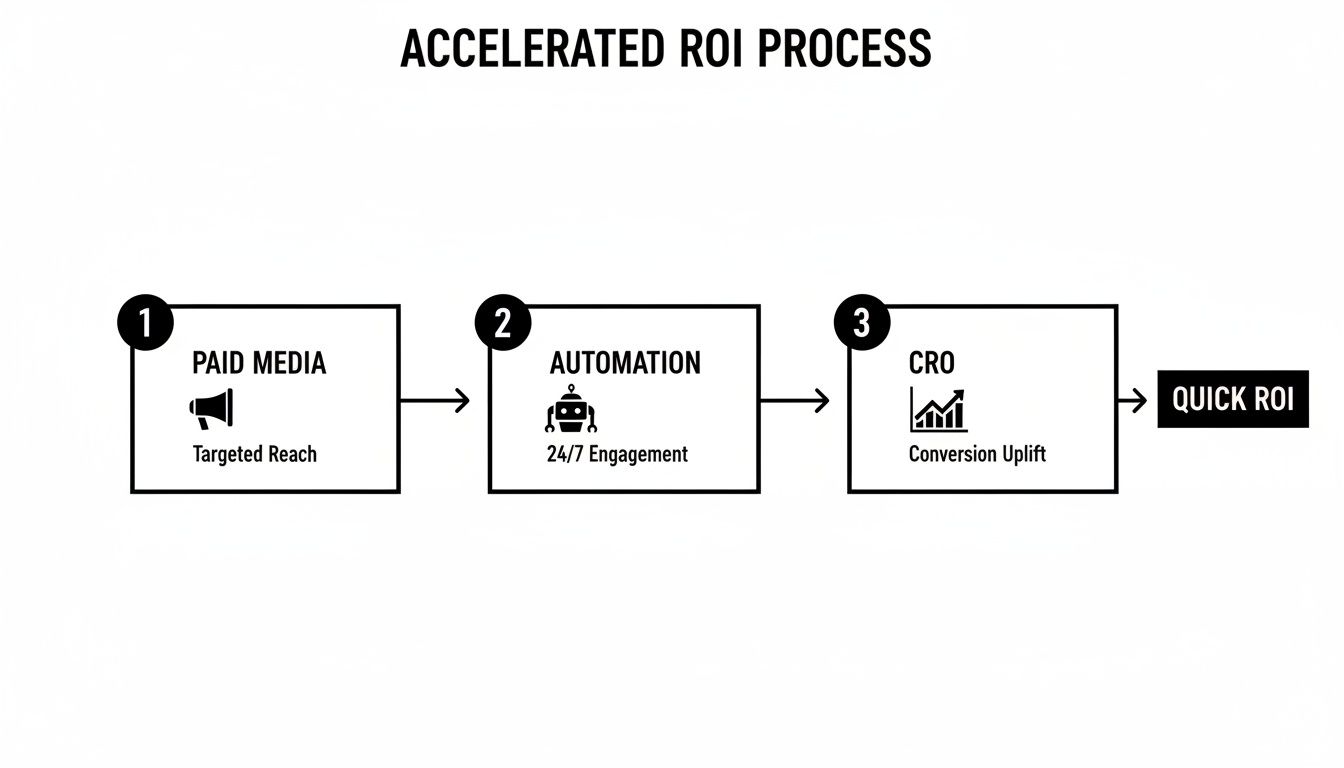
When you combine these three pillars, you create a flywheel that drives immediate results.
By focusing on the root of the problem—how to convert interested shoppers efficiently—you gain flexibility in your tactics. This enables the creativity and experimentation needed to find what truly moves the needle for your brand.
To help you decide where to start, this table breaks down the most common high-impact strategies. We've laid out the typical payback period and how complex each one is to implement, so you can prioritize based on your resources and goals.
| Strategy Area | Typical Payback Period | Implementation Complexity | Primary Channel |
|---|---|---|---|
| Paid Retargeting | 1-4 Weeks | Low | Google Ads, Meta Ads |
| Email & SMS Automation | 2-6 Weeks | Low to Medium | Klaviyo, Attentive |
| A/B Testing (CRO) | 4-8 Weeks | Medium | Google Optimize, VWO |
| Pricing & Promotions | 1-2 Weeks | Low | Your E-commerce Platform |
| Influencer Partnerships | 4-12 Weeks | Medium | Instagram, TikTok, YouTube |
| New Sales Channels | 8-16 Weeks | High | Amazon, Walmart, Retail |
| Quick Ops & Tech Fixes | 2-8 Weeks | Low to High | Varies (e.g., Shipping, Site Speed) |
Think of this as your roadmap. Each strategy we're about to dive into is designed to make your business more resilient and profitable. It’s time to move from guessing to executing with confidence. Let's get started.
If you need cash this month, paid acquisition is the most direct lever you can pull. And within paid ads, nothing delivers a quickest return on investment quite like retargeting.
Think about it: you're not trying to find brand-new customers. You're simply talking to "warm" leads—people who have already visited your site, checked out your products, or even added something to their cart. They already know who you are, which makes them far more likely to buy.
You’ve already paid to get this traffic to your site once. Retargeting is how you turn that sunk cost into real profit. The strategy is straightforward: use tracking pixels from platforms like Meta or Amazon to re-engage those visitors with ads that remind them of what they were just looking at.
The financial upside here is enormous. It’s not uncommon for e-commerce remarketing to hit a staggering 1,000% ROI. That’s a 10x return. For every $1 you spend reminding past visitors about your brand, you could get $10 back, often within a matter of days. You can explore more of these 2025 Gauss e-commerce ROI statistics to see the full potential.
The good news is you don't need some wildly complex setup to get going. The key is to focus your budget on the highest-intent audiences first. That’s where you’ll see the fastest payback.
Start by carving out your audience segments based on the actions they took on your site. I always start with these three:
With these segments defined, you can serve them incredibly relevant ads. For instance, that person who abandoned a cart with a pair of sneakers should see an ad for those exact sneakers. A simple headline like "Still thinking about it?" or a small nudge like a free shipping offer can be all it takes to close the deal.
This is exactly why platforms like Meta are so effective for retargeting, a point they highlight in their own business guidance. You can get incredibly specific.
As you can see, Meta's custom audiences are built to re-engage people who have already interacted with your business. This is the engine behind any solid retargeting strategy, letting you deliver personalized ads that actually get people to act.
To get the best results quickly, stick to these best practices. They're designed for speed and immediate impact.
ViewContent, AddToCart, and Purchase. If this is wrong, nothing else works.Pro Tip: Make sure you exclude recent purchasers from your general retargeting campaigns for at least 30 days. There's no point in showing ads for a product someone just bought. It’s a waste of money and a surefire way to annoy your new customer. Instead, add them to a separate audience you can target later with cross-sell or new product announcements.
While paid retargeting helps you chase down warm leads, marketing automation is what actually closes the deal for you—often while you sleep. For any founder looking for the quickest return on investment, this isn't optional. It’s how the smartest e-commerce brands let systems do the heavy lifting.
We’re not talking about your run-of-the-mill email blasts. This is about setting up powerful, behavior-triggered sequences for abandoned carts, new subscribers, and recent customers. These automations run 24/7, catching shoppers at the exact moment their interest is highest with messages that are actually relevant.
The difference in performance is almost hard to believe. The top 5% of e-commerce brands—the ones we see at MDS who really get it—drive their growth with ruthless automation. Their automated email campaigns see a click-to-conversion rate of 27.05%, absolutely demolishing the 7.69% from standard, scheduled sends. It's the same story with SMS and push notifications.
You don't need a dozen complicated sequences to get going. Just focus on the three automated flows that consistently bring in the fastest and most reliable returns. Think of them as the workhorses of your e-commerce engine.
Of course, you need the right tools to make this happen. Our guide on the best email marketing software for e-commerce breaks down the top platforms to fit your brand’s needs. If you're serious about getting this right from the start, it's worth learning how to maximize your marketing automation ROI.
The whole point of automation is to make a personalized journey feel effortless. A customer who gets a timely reminder about the exact pair of shoes they left in their cart feels understood, not spammed. That relevance is what drives them to complete the purchase.
Once these foundational flows are up and running, they start generating revenue right away. It's a small one-time setup for a machine that pays you back over and over, without you having to lift a finger.
While paid ads and automation are busy filling your funnel, your pricing is one of the most powerful levers you can pull for immediate profit. It's one of the fastest ways to impact your bottom line without spending a single extra dollar on traffic. Honestly, this is where you can see the quickest return on investment, often in a matter of days.
You have to move past a simple "cost-plus" model. The best brands know that pricing is a serious marketing tool. They don’t just cover costs and slap on a margin; they use dynamic strategies that grow revenue and actually make customers feel better about their purchase.
It all comes down to getting surgical with your numbers to find that sweet spot. You want customers to feel like they’re getting incredible value, while you’re maximizing profitability on every single transaction.
So, what are your customers really willing to pay for your products? You don't have to guess. A simple price elasticity test will give you the hard data you need.
For a short period, try bumping the price of a popular product by 5-10%. Then, watch your sales volume and conversion rate like a hawk. Did sales tank? Or did they hold steady, bringing in more pure profit per unit?
You could also go the other way. Test a small price decrease and see if the jump in sales volume more than makes up for the slightly thinner margin. This data is pure gold. It tells you exactly how sensitive your customers are to price changes and points you straight to your most profitable price point.
Promotions aren't just about handing out discounts; they're about creating a powerful sense of urgency. But the way you structure your offer has a massive impact on how customers behave.
The key is to shift the customer's focus from "how much am I saving?" to "what else can I get?" This psychological shift is crucial for increasing your AOV and improving your unit economics instantly.
Product bundling is another killer tactic for a quick ROI. When you package complementary items together, you increase the perceived value and get customers to spend more than they might have planned.
For a deeper look, check out our guide to powerful product bundling strategies.
A classic example is a skincare brand bundling a cleanser, serum, and moisturizer. The price is slightly lower than buying each item separately, so the customer gets a complete routine for a great value, and the brand sells three products instead of one. It’s a win-win that makes your existing traffic more valuable from day one.
You've already paid to get visitors to your site—now it's time to make sure they actually buy something. This is where Conversion Rate Optimization (CRO) comes in, and frankly, it's often where you'll find the quickest return on investment. Why? Because you’re making every dollar you’ve already spent on ads work that much harder.
Let’s forget about complex, months-long A/B tests for a moment. Right now, we’re focused on the "no-brainer" fixes that consistently convince more browsers to become buyers.
The goal is simple: remove friction. Every extra click, confusing button, or moment of doubt is a potential lost sale. We’re hunting for the most common conversion killers you can identify and fix this afternoon.
Think about what happens the instant someone lands on your product page. Is your value proposition crystal clear and visible "above the fold" without any scrolling? If people have to search for why they should buy from you, a lot of them just won't.
Adding social proof is another instant win. A page with customer reviews, star ratings, and real testimonials will almost always outperform one without. In fact, a study from the Spiegel Research Center found that just displaying reviews can boost conversion rates by as much as 270%.
A customer's journey from your landing page to checkout should feel effortless and trustworthy. Your job is to clear any obstacle—no matter how small—that stands in their way. That focus on a seamless experience is what high-impact CRO is all about.
Instead of guessing where to start, use this checklist to hit the lowest-hanging fruit. These are the quick fixes that require minimal effort but deliver an outsized impact on your bottom line.
These small tweaks can produce real gains almost immediately. If you want to dig deeper into improving your store's performance, check out these practical Conversion Rate Optimization For Shopify Tips That Actually Work. Making these changes is a one-time effort that pays dividends with every new visitor you get.
When you're trying to grow an ecommerce brand, a lot of questions come up. Especially when you need to see a return, fast. Knowing where to put your time and money is half the battle. Here are some no-fluff answers to the questions we hear most often from founders.
For a brand-new store, the quickest path to ROI is a one-two punch: paid retargeting plus an abandoned cart automation. Even if you only have a trickle of traffic, this combo targets the people who are closest to buying.
Think about it. Someone who adds a product to their cart is already on the finish line. All you need to do is give them a little nudge. A simple reminder ad on their social feed or an automated email offering free shipping can be enough to close the deal almost instantly. This focuses every dollar on your lowest-hanging fruit for a quick revenue hit.
Calculating your payback period sounds more complicated than it is, but it’s crucial for knowing what's working. You just divide what you spent by the net profit you made from that spend each month.
The formula is straightforward: Payback Period = Initial Investment / Monthly Net Profit.
Let's say you drop $2,000 on a retargeting campaign. It brings in $6,000 in sales, and your products have a 50% profit margin. That gives you a net profit of $3,000.
Your payback math looks like this: $2,000 / $3,000 = 0.67 months. You’ll make your ad money back in about 20 days. This simple number tells you exactly how hard your marketing dollars are working for you.
For the fastest ROI, always focus on improving your conversion rate first. Pouring money into ads to drive traffic to a website that doesn't convert—what we call a "leaky bucket"—is the quickest way to burn your budget.
Look at it this way: getting your conversion rate from 1% to 1.5% is a 50% jump in revenue from the traffic you already have. That costs you zero in new ad spend. Once you’ve fixed the biggest conversion killers (like a clunky checkout or slow site speed), every new visitor you pay for is far more likely to turn into a customer.
Fix the engine before you buy more fuel.
Promotions are a great tool for a short-term cash injection, but you have to be smart about it. If you’re constantly running deep discounts, you’ll just train your customers to wait for a sale and kill your margins.
The trick is to use them with a clear purpose.
A sustainable strategy is about using targeted offers to add value, not just slashing prices everywhere. It protects your brand while still giving you that quick ROI when needed.
At Million Dollar Sellers, we believe in working smarter, not just harder. Our exclusive community gives you direct access to the playbooks and strategies that 7, 8, and 9-figure founders use to scale their brands profitably. Stop guessing and start executing with the best in the business. Learn more about joining MDS.
Join the Ecom Entrepreneur Community for Vetted 7-9 Figure Ecommerce Founders
Learn MoreYou may also like:
Learn more about our special events!
Check Events