Chilat Doina
February 17, 2026
Product bundling isn't just about sticking a few items together with a discount. That’s the old way of thinking. For today’s top ecommerce brands, it's a core growth lever that turns a simple transaction into a curated customer experience.
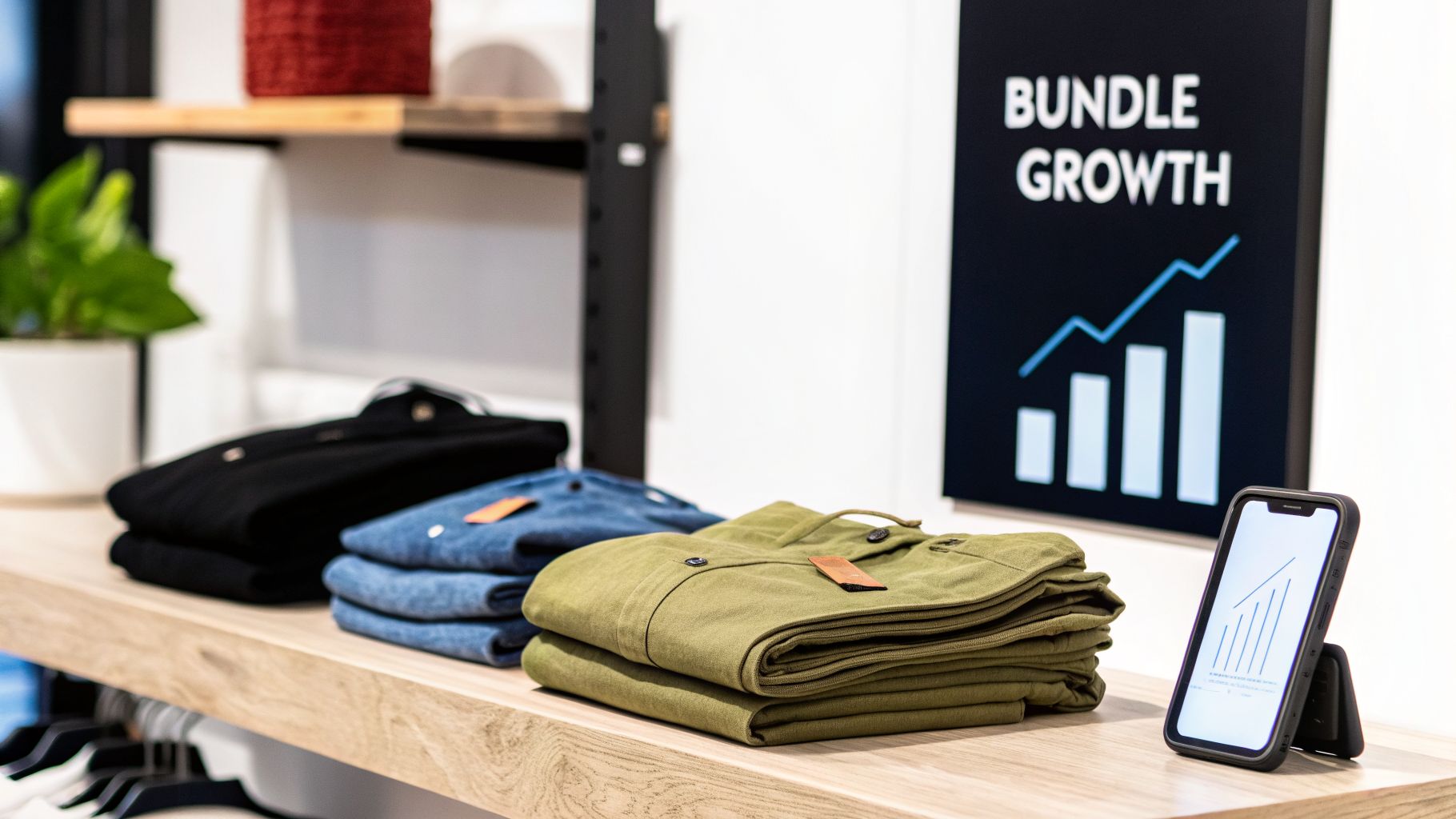
Think of a smart bundle less like a discount and more like a chef’s tasting menu. Your customer isn't just buying items off a grocery list; they're getting a complete solution designed to solve their entire problem in a single click.
This simple shift in perspective is what separates the high-growth brands from everyone else. Instead of just selling individual products, you start selling a complete experience, a convenient solution, or a perfectly matched set. It’s a powerful move.
This isn’t just theory. The data shows that up to 30% of total eCommerce revenue now comes directly from cleverly crafted bundles. For savvy operators like those in the Million Dollar Sellers community—where every edge counts for scaling on Amazon and DTC—this isn't just interesting, it's a game-changer.
A good bundle is tough for your competition to copy directly. It shifts the conversation away from a line-by-line price comparison on a single widget and reframes it around the unique value and convenience of your curated offer. Suddenly, you've built a competitive moat, protecting your brand from the race-to-the-bottom price wars.
The goals here are pretty straightforward but incredibly impactful:
The most effective bundles don't just push products; they solve problems. Whether it's a "New Parent Starter Kit" or a "Complete Skincare Routine," the real value is in the curation and convenience you provide.
At the end of the day, mastering product bundling is about getting inside your customer's head, understanding their journey, and anticipating what they'll need next. Before we jump into the different types of bundles and how to price them, it’s critical to align your strategy with your core business objectives.
For a deeper dive into one of the most important metrics here, check out our full guide on how to increase Average Order Value. In the sections that follow, we'll lay out the actionable playbooks you need to build and launch bundles that drive real, measurable growth.
Picking the right product bundling strategy is a lot like choosing the right tool for a specific job. You wouldn't use a hammer to turn a screw, right? In the same way, your bundle needs to align perfectly with your business goal—whether that's cranking up your Average Order Value (AOV), clearing out slow-moving inventory, or locking in that sweet recurring revenue.
Not all bundles are created equal. Getting beyond the textbook definitions is where the real money is made. For serious sellers, this means understanding the why behind each bundle type. Let's break down the core models so you can start making these decisions with confidence.
A pure bundle is an exclusive package where you can only buy the items together, not separately. Think about your cable TV package—you can't just subscribe to the one sports channel you want; you have to buy the whole entertainment tier. It forces a commitment but delivers a complete, turn-key solution.
This strategy crushes it when the products are so complementary that they create a system far more valuable together than apart. A high-end camera body, for instance, might only be sold with the specific lens it needs to perform at its peak.
This is where most brands live and breathe. Mixed bundles offer the best of both worlds: customers can buy each item individually, but the curated bundle comes with a tempting discount or some extra value. It’s easily the most common and flexible approach.
The classic example is a fast-food "combo meal." Sure, you can buy the burger, fries, and drink separately, but the bundled price just makes more sense. For an e-commerce brand, this might be a "Skincare Essentials Kit" that bundles a cleanser, serum, and moisturizer for less than their combined individual prices.
This approach taps into a powerful psychological trigger called the "compromise effect." When a shopper sees a cheap single item, a pricey single item, and a mid-priced bundle, they often gravitate toward the bundle. It feels like the safest, most balanced value proposition on the page.
This flexibility opens the door to a wider audience, grabbing the attention of both bargain hunters and shoppers who only need one specific thing. It's a fantastic way to lift AOV without strong-arming your customers.
Often framed as "add-ons" or "frequently bought together" prompts, complementary bundles are all about enhancing the primary purchase. The goal here isn't to sell a pre-made kit, but to nudge the customer's cart size up by suggesting the logical next step.
Imagine buying a new smartphone. Right at checkout, the site suggests adding a protective case and a screen protector at a small discount. You were already sold on the big-ticket item; the add-ons feel like a smart, low-friction upgrade. This is less of a formal "bundle" and more of a tactical, in-the-moment cross-sell.
Finally, we have the subscription kit—a powerhouse bundle designed from the ground up to create predictable, recurring revenue. These bundles deliver a curated selection of products, usually consumables or new discovery items, on a regular schedule.
Examples are everywhere, from a monthly coffee subscription box that introduces you to different roasts to a quarterly "shave club" box with razor refills, shaving cream, and aftershave. This strategy flips a one-time transaction into a long-term customer relationship.
It's a win-win. You dramatically increase customer lifetime value (CLV) and make inventory forecasting a whole lot easier. Better yet, by consistently delivering value and convenience right to their doorstep, you build the kind of brand loyalty that competitors can't touch.
The magic of a great bundle can vanish in a puff of smoke if your pricing isn’t on point. It's an art, really—crafting an offer that feels like a steal to the customer but still pads your bottom line. I’ve seen countless brands get this wrong. They get so caught up in the allure of a big discount that they completely forget to model the actual financial impact.
A profitable bundle isn't just about mashing two products together and slicing 15% off. You have to work backward from your target profit margin, accounting for every single cost that gets that bundle into your customer's hands. This is the kind of deep financial work that separates the amateurs from the 7- and 8-figure operators.
Before you even think about a price tag, you need to know your total costs, and I mean all of them. This goes way beyond the basic Cost of Goods Sold (COGS) for each item. Nailing this cost analysis is the foundation of any bundle that’s actually going to make you money.
Here’s what needs to be in your calculation:
One of the most common pitfalls is applying the same fee logic to a bundle as you would to a single product. Remember, platform fees are calculated on the final sale price. A higher AOV from a bundle means you're paying more in fees in raw dollars, even if the percentage stays the same.
This map breaks down the different types of bundling strategies you can use, each with its own unique pricing and margin considerations.
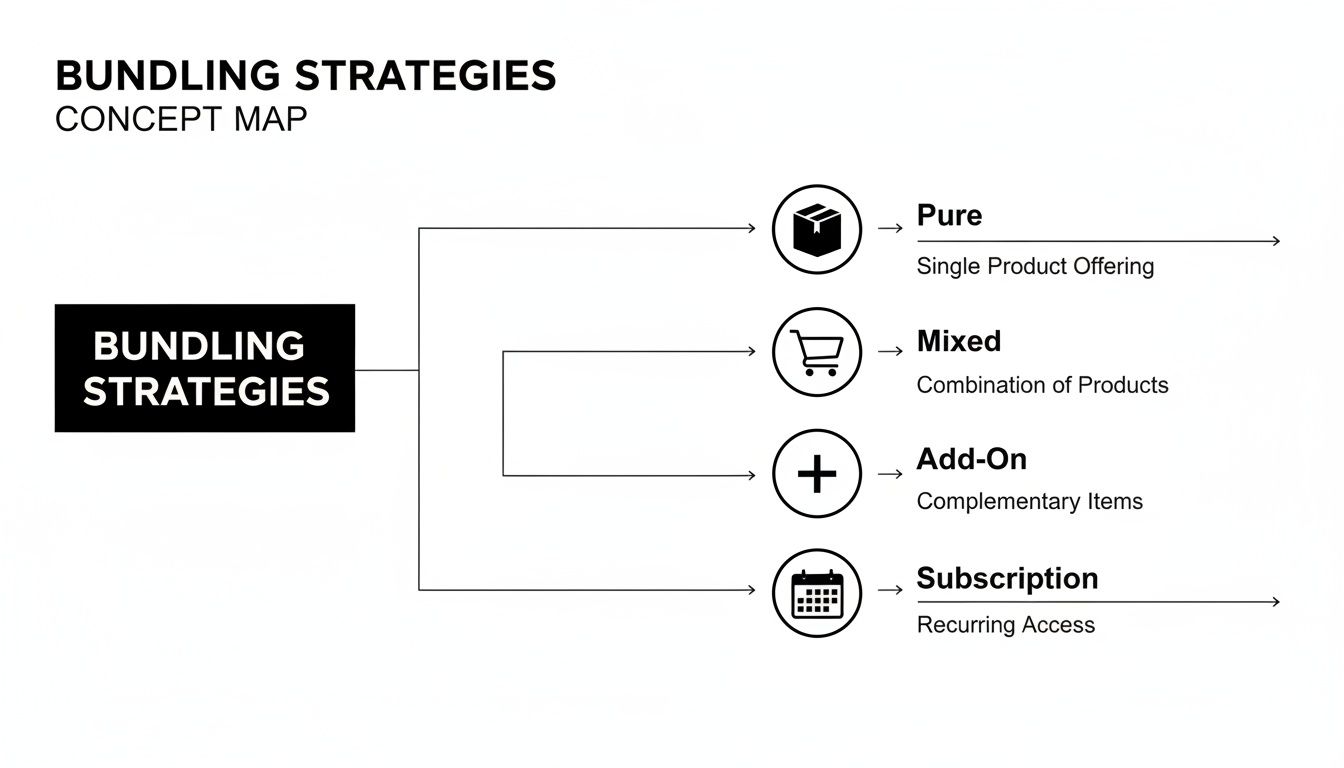
As you can see, every bundle type has a specific job to do, from the "all-or-nothing" pure bundle to the recurring revenue engine of a subscription kit.
Let's run the numbers on two common promotional setups to see how this plays out in the real world. Let’s say you sell a "hero" shampoo for $20 (COGS $5) and a matching conditioner for $20 (COGS $5).
Scenario 1: A "BOGO 50% Off" Deal
Scenario 2: A Curated "3-for-2" Bundle
Now, imagine you add a travel-size hair serum (COGS $2) to create a premium kit. The customer gets the serum "free" when they buy the shampoo and conditioner at full price.
Look at that. In the second scenario, the customer gets the perceived value of a "free" product, but your brand walks away with 40% higher gross profit ($28 vs. $20) and a much healthier AOV. This is a perfect example of how a smart, value-add bundle can crush a straightforward discount, both in your customer's mind and on your P&L.
To really get this down to a science, you need to understand your numbers inside and out. A great next step is to learn more about contribution margin ratio and how it reveals the true profitability of every sale. Once you master that concept, you can engineer bundles that aren't just attractive—they're built for maximum profit from day one.
A killer bundling strategy is just an idea on a whiteboard until you bring it to life on your sales channels. But launching a bundle isn’t a one-size-fits-all job. The playbook for Amazon is a whole different ballgame compared to your own DTC store.
Getting the tactical details right is where the magic happens—where a good idea turns into a cash-generating machine. This means you’ve got to navigate platform-specific rules, optimize for different algorithms, and use the right tools for the job.
Amazon is its own beast. Bundles can give you a massive competitive edge, but only if you play by their rules. You’ve got two main ways to go about it: physical or virtual.
A physical bundle, often called a case-packed bundle, is exactly what it sounds like. You physically package multiple products into a new kit, slap a unique UPC on it, and it becomes a brand-new ASIN. You then ship these ready-to-go units to FBA. The big win here is total control over branding and the customer's unboxing experience.
Then there’s the virtual bundle. This is a slick, digital-only creation you set up in Seller Central. It lets brand-registered sellers "digitally" group two to five complementary FBA products. When a customer clicks "buy," Amazon's warehouse team simply picks the individual items from your existing inventory and ships them together.
The beauty of virtual bundles is speed and flexibility. You can test different product combos with zero risk and no need to pre-pack anything. It’s the fastest way to find a winning offer using real sales data.
For a broader look at winning on the platform, check out these proven tactics for improving Amazon sales. A solid bundling strategy should always fit into a bigger, smarter marketplace plan.
You have to get the math right, and that means understanding the fees. With physical bundles, FBA fees are based on the final dimensions and weight of that single, pre-packaged kit. Smart, compact packaging can literally save you a fortune.
For virtual bundles, it's a bit different. The fees are just the sum of the FBA fees for each individual item sold separately. There’s no discount, so you have to be extra sharp with your profit calculations.
No matter which type you choose, a successful bundle needs a killer listing.
To really get into the weeds of this, our expert guide on how to optimize an Amazon listing has all the details you need.
On your own turf—like a Shopify store—you call the shots. The game shifts from navigating platform rules to creating a seamless, high-converting customer experience.
First things first, you need the right app to power your bundles. Tools like Bold Bundles or Bundle Bear are popular for a reason; they handle the tricky inventory logic, making sure stock is deducted from individual SKUs when a bundle is sold.
From there, it's all about marketing and presentation.
This operational focus is where the biggest brands win. Product bundling's rise to account for up to 30% of sales is being driven by smarter tech and a finely tuned global packaging infrastructure. For Amazon sellers, this means speed; a well-designed bundle can slash shipping costs by 20-30% by optimizing box space, directly padding your margins. Whether you're on Amazon or DTC, nailing the implementation makes all the difference.
The most successful product bundling strategies are never "set and forget." Think of it this way: launching a bundle is just the first draft. The real pros treat their bundles like living products, constantly testing, tweaking, and optimizing them for peak performance.
This isn't about one-time promotions; it's about building an ongoing optimization engine. And that entire process starts with knowing exactly what to measure. Without the right data, you're just guessing.
So, how do you know if your bundles are actually working? You need to track the right Key Performance Indicators (KPIs). These numbers tell the true story of your bundle's impact on customer behavior and, more importantly, your bottom line.
Focus on these core metrics:
By keeping a close eye on these KPIs, you get a clear, quantitative picture of a bundle’s health and can spot opportunities to make it even better.
Once you have your baseline metrics, it's time to start experimenting. For DTC brands, A/B testing is the gold standard for systematically improving your offers without any guesswork. To really nail this, understanding the fundamentals of A/B testing in marketing is a must for data-driven optimization.
The goal here is simple: isolate one variable at a time to see what gives you the biggest lift in your KPIs.
You can start with simple but high-impact tests:
The biggest wins often come from the smallest, most iterative changes. A simple tweak to a bundle's name or a minor adjustment to its discount can sometimes lead to a double-digit jump in conversions.
While you can't run a classic A/B test on an Amazon listing, you can use its incredibly powerful data tools to get to the same place. Dive into your Brand Analytics reports and look for the "Frequently Bought Together" patterns. This is basically Amazon telling you exactly what your customers already want to buy together.
Amazon’s whole approach is a masterclass in this. Features like 'Frequently Bought Together' crunch millions of purchase patterns to create suggestions that lead to a 40% higher lifetime customer value (LTV) for bundle buyers. Why? Because these smart bundles introduce customers to new products, which builds loyalty and encourages repeat buys.
Use this data to create virtual bundles that mirror what's already happening organically. Track their sales velocity, and if a combo proves to be a winner, you can even create a physical, pre-packaged version for an even smoother customer experience.
Even with a killer strategy mapped out, the day-to-day reality of product bundling can throw a lot of curveballs. Getting the little details right is what separates a smooth, profitable launch from a logistical nightmare. Here, we'll tackle the most common—and most important—questions that come up when leaders start rolling out their bundling strategies.
Think of this as your playbook for those "what if" moments that inevitably pop up after the whiteboard session is over. These are the answers you need to make smarter, faster decisions when it really counts.
The best bundles are born from data, not just a gut feeling. Your customers are probably already showing you what they want to buy together; you just have to know where to look. Start by digging into your sales reports to find those "frequently bought together" patterns.
For Amazon sellers, Brand Analytics is a goldmine for this stuff. If you're on your own DTC store, your platform's reporting or a good analytics app can uncover these natural pairings. This data isn't a guess—it's confirmation of an existing buying habit, making it a super low-risk place to start.
The second approach is just good old-fashioned logic. You're aiming to solve a customer's problem completely.
The most powerful bundles either prove an existing behavior with data or create an obvious, complete solution that saves the customer a ton of time and mental energy.
A few common, and totally avoidable, mistakes can sink an otherwise great bundling strategy. The absolute biggest one is bundling a bestseller with a slow-moving, unpopular product just to clear out dead stock. Customers are smart. They can spot a "dump bundle" from a mile away, and it can seriously cheapen the perception of your best products.
Another huge pitfall is confusing pricing. The value—the convenience and the savings—has to be crystal clear in about two seconds. If a customer has to pull out a calculator to figure out if they're actually getting a good deal, you've already lost.
The perceived value of a bundle must be immediate. A customer should glance at it and think, "That just makes sense." Any friction or confusion in the offer will kill its conversion potential.
Finally, so many sellers forget to account for the full operational cost. This goes way beyond just the products themselves. You have to factor in:
Always model the full landed cost of the bundle, not just the sum of its parts, or you'll be in for a nasty surprise when you look at your margins.
This is a critical question, and the answer is a firm no. While discounts are a great motivator, the real value of a top-tier bundle is often convenience and curation, not just a lower price. If you slap a discount on every single bundle, you're training your customers to always expect a deal, which can seriously erode your brand's premium feel over time.
A "complete system" or a "curated starter kit" can often sell at the full combined price of its individual components. Why? Because you did the thinking for the customer. You saved them the research time and eliminated decision fatigue. The value is the expertly curated solution you’re handing them.
Reserve your discounts for bundles with specific, strategic goals:
Bundling definitely adds a new layer to inventory tracking, but it's totally manageable with the right systems. The way you handle it depends on whether your bundle is physical or virtual.
For physical, pre-packaged bundles, you have to create a new, unique SKU for the kit itself. In your inventory system, this new SKU is treated just like any other single product. When one sells, the stock count for that bundle SKU goes down by one. Simple.
For virtual bundles—which are super common on DTC stores and on Amazon—the setup is different. Your inventory management software has to be smart enough to deduct stock from each individual component SKU whenever a bundle is sold. So, if your "Skincare Kit" (one cleanser, one moisturizer) sells, your system must reduce the inventory for the cleanser SKU by one and the moisturizer SKU by one.
Making sure your system can handle this "component tracking" flawlessly is non-negotiable. If it can't, you're on the fast track to overselling products, creating backorders, and seriously ticking off your customers.
Ready to connect with other high-level sellers who are mastering these strategies every day? At Million Dollar Sellers, our members share the exact playbooks they use to scale to 8 and 9 figures. Apply for membership today and join an elite community of ecommerce operators.
Join the Ecom Entrepreneur Community for Vetted 7-9 Figure Ecommerce Founders
Learn MoreYou may also like:
Learn more about our special events!
Check Events