Chilat Doina
September 7, 2026
You're looking at a catalog that performs well through FBA, but the economics no longer work for every SKU. Oversize items consume expensive storage capacity, specialized products need careful handling, and distributed inventory sits closer to your customers than Amazon's network can always make practical. At the same time, removing Prime eligibility can weaken conversion and reduce your control over the customer experience.
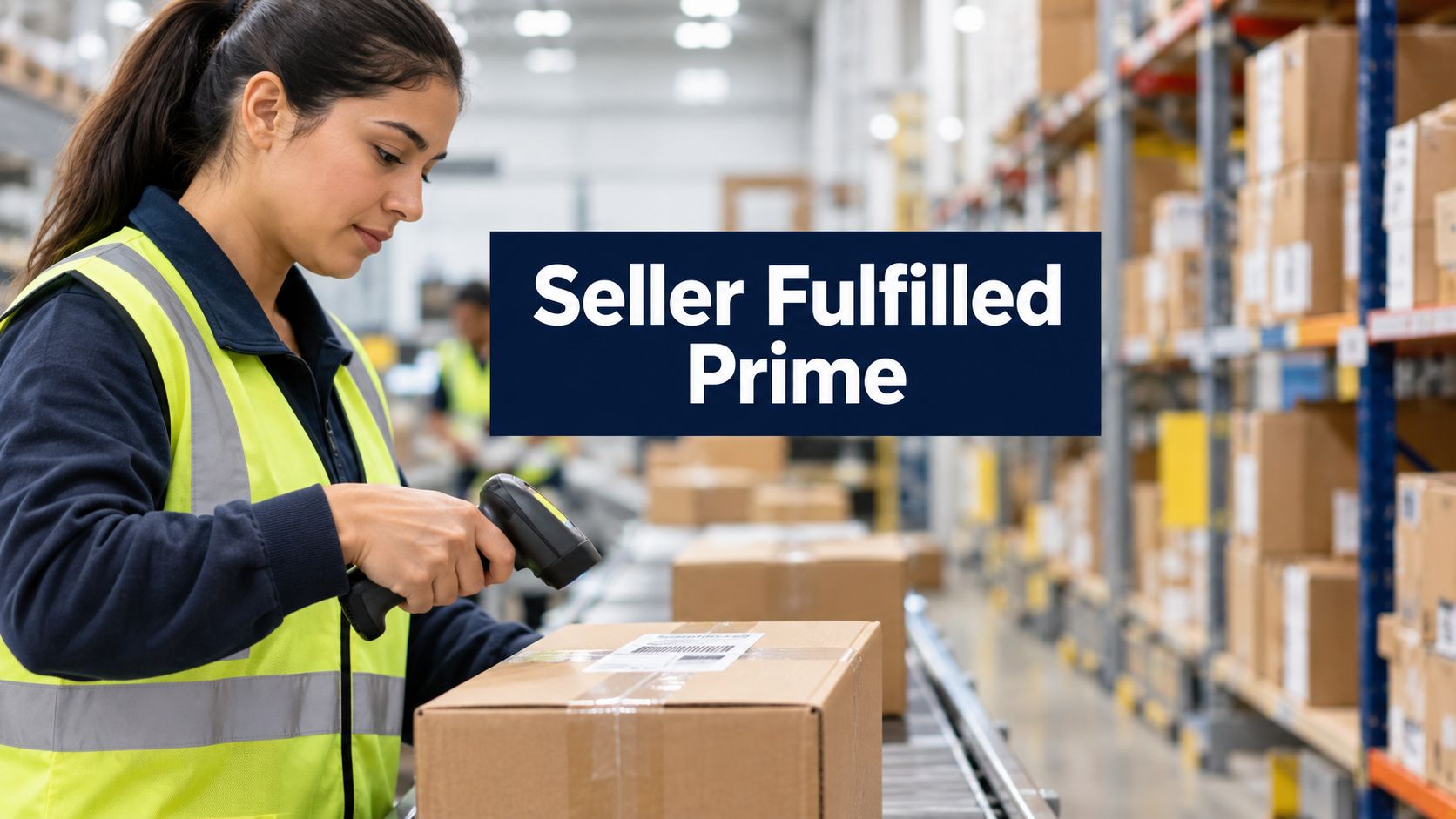
Seller Fulfilled Prime (SFP) can solve part of that problem, but it isn't merely FBA with your warehouse substituted in. Amazon expects sellers to prove that their own operation can deliver the Prime experience consistently. The difficult work starts after activation, when carrier delays, inventory gaps, cutoff times, and regional coverage determine whether the badge remains attached to your offers.
Seller Fulfilled Prime lets eligible third-party sellers ship Prime orders from their own warehouses or through a third-party logistics provider while displaying the Prime badge. Amazon launched the program in 2015, paused it in 2019 to rework its standards, and relaunched it in 2023 with a stronger focus on the two-day Prime promise, as documented in this history of merchant fulfillment and Seller Fulfilled Prime.
The pause tells you how Amazon views the program. SFP isn't a branding shortcut. Around 2018, fewer than 16% of SFP offers met the two-day-or-less Prime delivery promise, which helps explain why the relaunched program became more selective and performance-driven. The Prime badge represents a customer expectation, not merely a shipping template.
Standard Fulfilled by Merchant lets you control fulfillment while accepting the delivery promises available to your listings. SFP adds a much stricter operating obligation. Your warehouse, 3PL, order-management process, carrier mix, and inventory placement must work together well enough to support Prime-level delivery performance.
That distinction matters for an omnichannel brand. SFP can preserve control over packaging, lot handling, bundling, returns workflows, and inventory allocation. It may also make more sense for products that are costly, awkward, slow-moving, regulated, or operationally sensitive to place inside an FBA network.
Practical rule: Treat SFP as a dedicated service tier, not as your default shipping method for every Amazon SKU.
The strongest use case usually combines fulfillment channels. FBA can handle compact, predictable, fast-moving products where Amazon's network is efficient. SFP can handle selected products where direct inventory control or fulfillment economics justify the added operational discipline. That approach protects flexibility without forcing one network to serve every product equally.
Before assigning inventory or changing shipping templates, audit the operating baseline. Amazon requires sellers to ship at least 100 Prime packages per month, maintain at least 93.5% on-time delivery, provide valid tracking for 99% of shipments, and keep pre-fulfillment cancellations below 0.5%, according to Amazon's Seller Fulfilled Prime eligibility requirements.
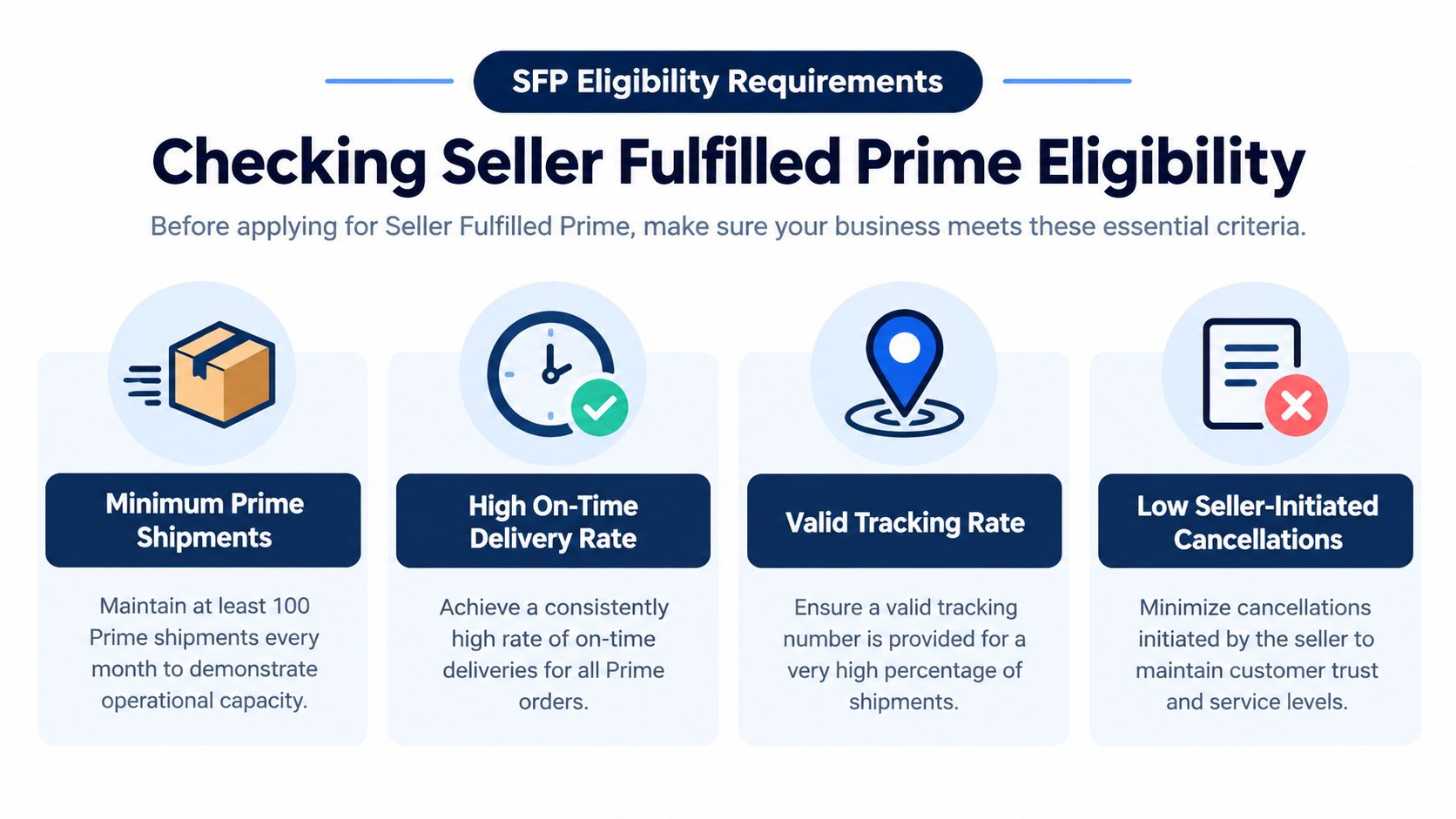
The shipment threshold tests whether your operation can produce a reliable Prime sample, not whether you can handle an occasional expedited order. Pull recent Amazon order data and separate likely Prime volume by SKU, region, warehouse, and carrier. If your forecast only reaches the threshold during promotions, you may have enough volume to qualify temporarily but not enough stability to protect capacity throughout the year.
Amazon can also limit daily Prime order volume if a seller falls below the monthly consistency threshold. That creates a capacity risk. A seller may have sufficient warehouse space but still lose the ability to accept the same Prime order flow after performance or volume consistency deteriorates.
Review every metric at the level where failure occurs:
A midsize beauty brand should map its forecast against the monthly Prime shipment requirement before enrolling. If tracking performance is below the required level, the team shouldn't start by adding more carriers. It should first trace the handoff from order import to label creation, shipment confirmation, and carrier acceptance, then test the complete event chain on representative orders.
Proceed only when your baseline remains comfortably above the minimum in the regions and product groups you intend to enroll. If performance is close to the threshold, pause enrollment, repair the weak process, and create a daily exception review. SFP leaves little room for an operation that depends on manual corrections after the parcel has already missed its planned handoff.
Enrollment begins with a trial, and the trial is where many sellers underestimate the risk. Amazon assesses the operation over 28 days and requires at least 100 Prime trial shipments, while delivery-speed targets vary by product size and delivery context, as shown in Amazon's SFP trial and delivery-speed guidance.
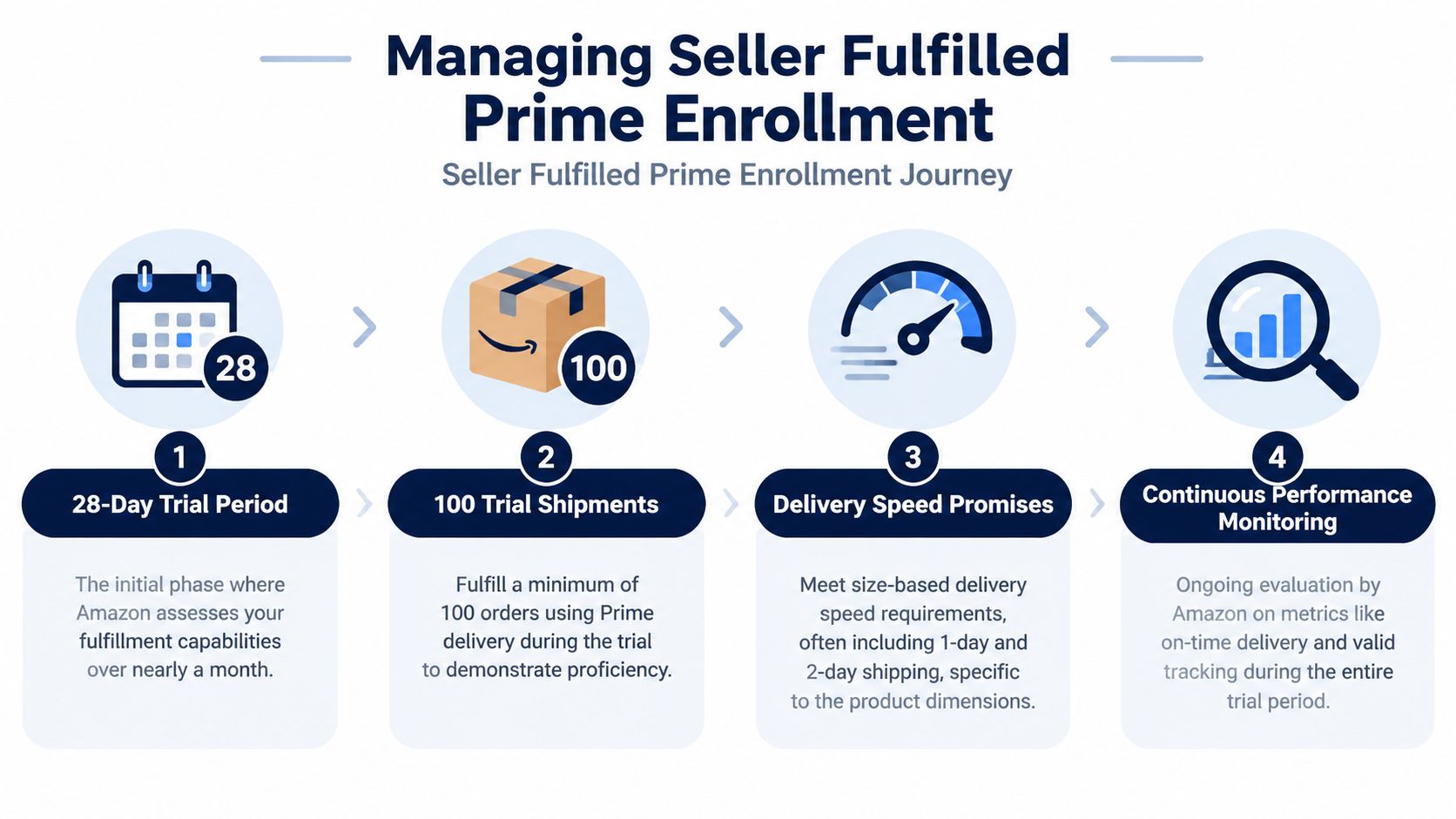
A midsize seller should plan the trial as a controlled launch rather than expose its entire catalog immediately. Select products with stable inventory, repeatable packaging, reliable carrier service, and enough expected Prime demand to produce the required shipment sample without forcing marginal SKUs into the program.
For standard-size offers, Amazon's example thresholds require at least 30% of Prime page views to show one-day delivery and 70% to show two-day delivery. Oversize offers use different thresholds, including 10% at one day and 45% at two days. These are not interchangeable benchmarks, so your trial plan should group products by size and evaluate the delivery promises Amazon displays to shoppers.
A practical trial calendar looks like this:
Amazon can suspend a product tier when the same metric is missed a third time within the 28-day period after the second miss. That rule changes the way you manage alerts. A single miss deserves investigation, the second requires corrective action, and the third can remove the affected tier before the team has time to debate the root cause.
A consumer-electronics seller can improve its odds by moving trial inventory into regional nodes before enrollment. That decision reduces the distance that selected orders travel and gives the warehouse more predictable carrier options. It also introduces an inventory-allocation cost, so the move should be limited to products whose demand and margin support regional placement.
Operational lesson: Don't use the trial to discover whether your network works. Use it to prove that a deliberately selected network works under Amazon's measurement rules.
The trial tests a complete chain, not just the pack station. It includes promise calculation, order routing, picking, packing, label purchase, carrier acceptance, tracking transmission, delivery, and exception handling. Any disconnected step can undermine the result.
The following video can help teams visualize the enrollment process before they configure their own workflows.
A seller can have excellent warehouse employees and still fail SFP because the systems create late or inaccurate events. The operation needs one dependable path from Amazon order intake to warehouse execution, compliant label purchase, shipment confirmation, carrier movement, and performance reporting.
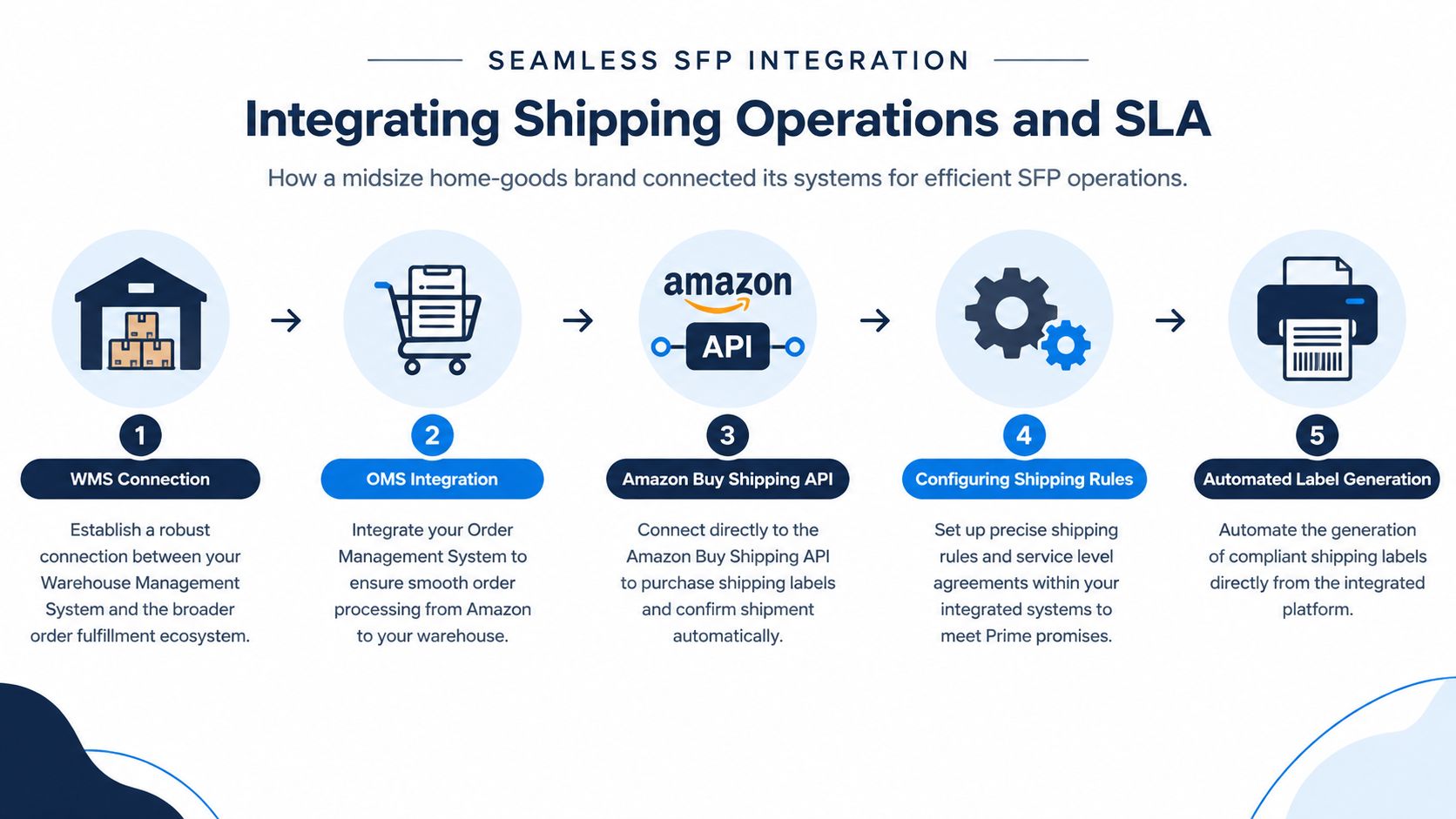
A midsize home-goods brand using both an in-house warehouse and a 3PL should establish ownership before connecting software. Decide which node can serve each destination, which products each node may ship, who approves carrier-service changes, and who handles an order that arrives after the cutoff.
The integration sequence should follow the physical movement of the order:
Amazon's current requirements include at least 93.5% on-time delivery, 99% valid tracking, and below 0.5% pre-fulfillment cancellations, as described in its Fulfilled by Merchant program guidance. Amazon also states that 62% of customers expect free-shipping orders to arrive in fewer than three business days, which explains why a late tracking event or inaccurate promise can quickly become a customer-experience issue.
The most valuable automation is often the rule that stops an unsafe order from entering the Prime queue. Examples include holding an order when inventory is uncertain, routing a destination away from a carrier lane with recent delays, and escalating an order when the warehouse hasn't completed the pick by its internal deadline.
A transportation management system can help teams coordinate carrier selection, shipment visibility, and delivery execution. For operators managing regional freight or larger networks, this practical TMS resource for UK hauliers offers useful context on how transportation systems organize planning and movement.
Keep the performance workflow separate from general ecommerce reporting. Your team can use last-mile delivery solutions to assess broader delivery capabilities, but the SFP dashboard must answer operational questions immediately: which orders are at risk, which node caused the delay, which carrier owns the next scan, and whether the promise should remain active for that lane.
Amazon measures the customer-facing outcome, but your operation needs earlier internal checkpoints. Set a warehouse release deadline before the carrier cutoff, a tracking-confirmation check after label creation, and an exception queue for orders without an acceptance scan. The exact buffer depends on your network, so test it against real processing behavior rather than choosing a convenient time.
A 3PL and in-house team should also reconcile data daily. If the 3PL marks an order shipped while Amazon lacks valid carrier data, the seller carries the metric risk. One owner must be accountable for resolving that mismatch before it becomes a delivery miss.
SFP can outperform FBA for large and oversize catalogs, especially when the seller avoids FBA storage fees, but Amazon's policy guidance also highlights hidden costs around peak-period trial cutoffs and regional rules. The relevant question isn't whether one program has a lower visible fee. It's whether the entire fulfillment model produces acceptable contribution margin while preserving service reliability.
For a one-pound consumer product, build the comparison from actual costs rather than a generic FBA-versus-SFP assumption. Include inbound freight, storage, pick and pack labor, packaging, postage, software, 3PL charges, returns, damage handling, customer-service labor, and the working capital tied to inventory placement. The FBA operating model guide can help frame the Amazon-managed side of that analysis, while an Amazon e-commerce seller guide provides useful preparation and fulfillment context.
| Aspect | Seller Fulfilled Prime | FBA |
|---|---|---|
| Fulfillment control | Seller controls warehouse execution, packaging, routing, and inventory allocation. | Amazon controls fulfillment after inventory enters its network. |
| Visible fulfillment charges | Seller pays the warehouse, carrier, systems, packaging, and exception costs directly. | Amazon charges its applicable fulfillment and storage fees. |
| Large or oversize products | Can protect margin when direct fulfillment avoids unsuitable storage or handling economics. | May be less attractive when storage and specialized handling weigh heavily on the SKU. |
| Inventory control | Inventory remains in the seller's network or with its chosen 3PL. | Inventory is positioned inside Amazon's fulfillment network. |
| Delivery risk | Seller owns the Prime promise, carrier performance, and operational recovery. | Amazon manages the fulfillment process, while the seller still manages inventory health and related costs. |
| Brand and packaging control | Greater control over presentation and product handling. | Packaging and handling follow Amazon's fulfillment processes. |
| Peak-period exposure | Trial timing, regional rules, capacity, and badge continuity require active planning. | Amazon manages fulfillment capacity, but the seller remains exposed to Amazon inventory and program policies. |
| Best fit | Nonstandard, oversize, sensitive, or strategically controlled SKUs with dependable regional fulfillment. | Predictable products that fit Amazon's network and benefit from outsourced execution. |
A common mistake is to compare one average fulfillment cost across the full catalog. Instead, model separate groups such as compact fast movers, oversize items, hazmat or sensitive products, slow-moving inventory, and products with uneven regional demand.
SFP's apparent margin advantage can disappear when a seller must place stock in multiple nodes, pay for premium transportation, retain extra labor for exceptions, or carry safety inventory to avoid cancellations. FBA's apparent simplicity can also conceal costs tied to storage, replenishment, removals, and reduced control over handling.
The decision should therefore include a service-risk allowance. If a product has thin contribution margin and unpredictable demand, SFP may create more operational exposure than it solves. If a product is expensive to store, difficult to package, or strategically important to keep under direct control, SFP can deserve a deeper test even when the workflow demands more management.
Graduation doesn't make SFP passive. Amazon emphasizes that sellers must sustain 93.5% on-time delivery and meet size-based speed thresholds, while repeated misses can suspend offers, as explained in its Seller Fulfilled Prime performance guidance.
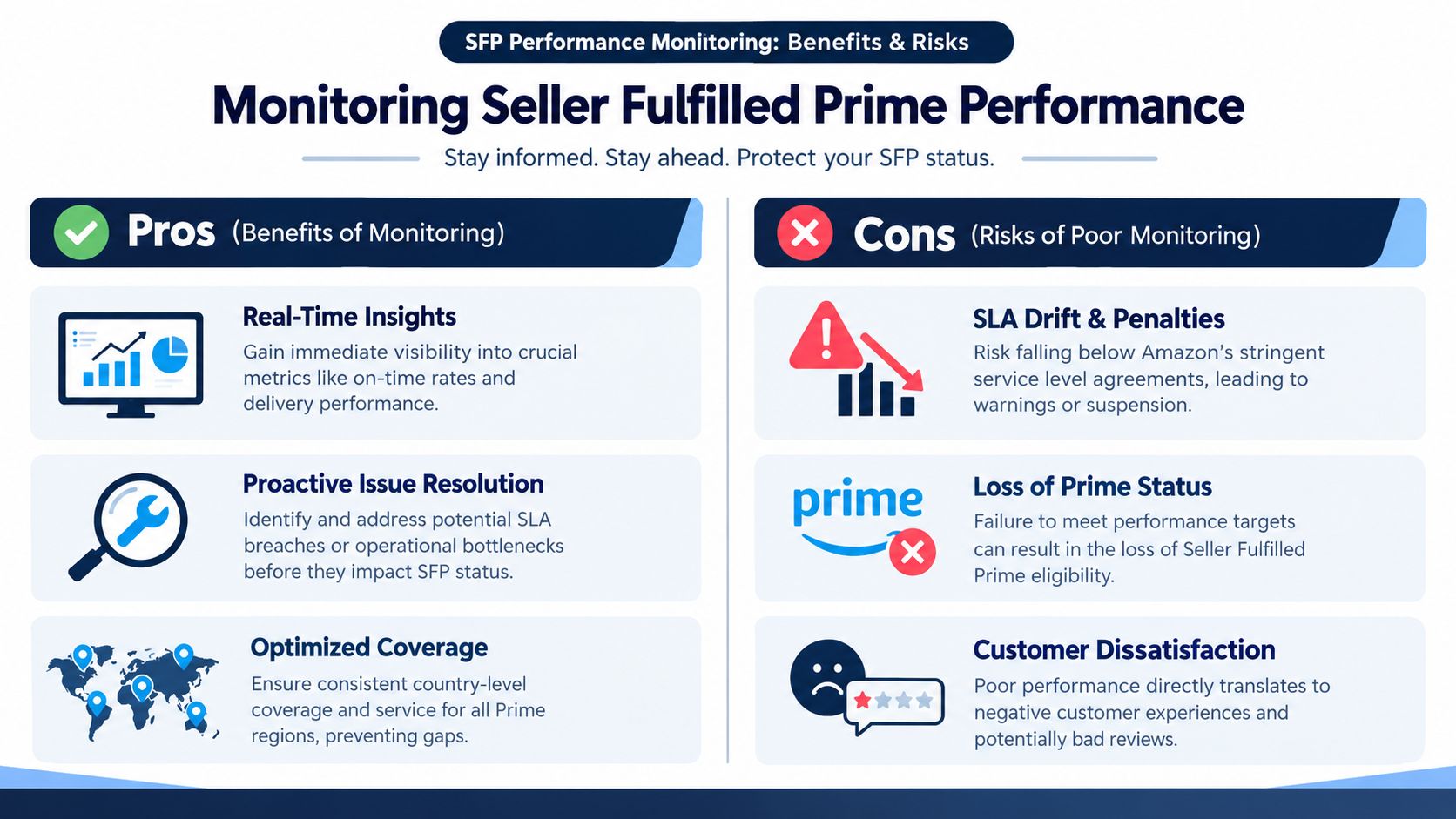
An account-level dashboard is useful, but it isn't enough. A sporting-goods seller can appear healthy overall while one regional carrier backlog threatens a specific delivery tier. The dashboard must allow the operations team to filter by product size, destination, warehouse, carrier, service, order age, and promise date.
Track the customer outcome and the leading indicators:
Teams should also use the right alert channel for the response time. Email works for routine reporting, SMS suits urgent operational failures, and webhooks can push exceptions directly into an order-management or incident system. The important distinction is ownership. Every alert needs a person, a response deadline, and a documented fallback.
For broader ecommerce measurement, these ecommerce key performance indicators provide a useful reporting foundation, but SFP requires more granular operational views than a conventional revenue dashboard.
Monitoring principle: A metric that only appears after Amazon calculates the failure is a lagging control. Watch the warehouse and carrier events that predict the failure.
If a tier is suspended, don't react by reopening every region at once. Isolate the failed lane, verify inventory and carrier performance, correct the process, and reintroduce coverage only when the team can support the promised service. Reintegration should be treated as a controlled operational change, with one owner reviewing the first orders and escalating anomalies immediately.
Enterprise sellers should evaluate SFP by SKU segment, node, and season rather than approve or reject it for the entire catalog. Score each segment from one to ten across four dimensions:
A high score across all four supports a controlled SFP rollout. A weak margin score suggests FBA or another fulfillment path may be better. A weak SLA score means the seller should first redesign inventory placement, carrier selection, or regional coverage. A weak volume score makes the trial difficult to support consistently, even if the product is operationally easy to ship.
For seasonal products, evaluate the trial calendar and peak restrictions before committing inventory. For permanent catalog items, prioritize stable demand and repeatable fulfillment lanes. The right answer may be a hybrid portfolio, with FBA for standardized fast movers and SFP for products where control and direct-fulfillment economics justify the operational burden.
Million Dollar Sellers gives serious ecommerce operators access to an invite-only peer network, practical strategy sharing, and vetted recommendations from founders operating at scale. Visit Million Dollar Sellers to connect with experienced sellers who can help pressure-test your SFP economics, fulfillment design, and expansion decisions.
Join the Ecom Entrepreneur Community for Vetted 7-9 Figure Ecommerce Founders
Learn MoreYou may also like:
Learn more about our special events!
Check Events